

Avis sur Workday Adaptive Planning : avantages, inconvénients, fonctionnalités et tarification


Workday Adaptive Planning est un logiciel de budgétisation et de planification qui aide les entreprises à gérer la planification financière, la prévision et l'analyse. Il s'adresse en priorité aux équipes financières des secteurs comme la technologie et la santé, où la prévision dynamique et la prise de décision basée sur les données sont essentielles. Sa proposition de valeur réside dans la fourniture de rapports en temps réel, de tableaux de bord personnalisables et d'outils de collaboration pour optimiser l'efficacité de la planification.
Workday Adaptive Planning répond à des problématiques courantes telles que des processus manuels fastidieux et un manque de données en temps réel, au bénéfice des équipes financières et comptables. Dans cet article, je présenterai les fonctionnalités, avantages et inconvénients, cas d'utilisation et tarifs de Workday Adaptive Planning, afin que vous puissiez décider s'il répond à vos besoins en FP&A.
Workday Adaptive Planning Evaluation Summary

- Pricing upon request
- 30-day free trial + free demo available
Why Trust Our Software Reviews
We’ve been testing and reviewing financial software since 2023. As finance specialists ourselves, we know how critical and difficult it is to make the right decision when selecting software.
We invest in deep research to help our audience make better software purchasing decisions. We’ve tested more than 2,000 tools for different finance use cases and written over 1,000 comprehensive software reviews. Learn how we stay transparent & our software review methodology.
Workday Adaptive Planning Overview
In my opinion, Workday Adaptive Planning is a strong choice for businesses seeking scalable budgeting and planning tools. It offers impressive forecasting and collaborative features that surpass many competitors. However, its onboarding could be simpler, and some users find the interface takes time to master. It's best for medium to large organizations that value real-time data access and detailed financial analysis. If your team prioritizes integration capabilities and data-driven insights, this software could fit well into your financial planning strategy.
pros
-
Users appreciate the detailed financial analysis capabilities.
-
The collaborative tools enhance teamwork across departments and tie operational data to financial models.
-
It offers real-time forecasting, helping your team make quick decisions with connected data sets.
cons
-
A few users feel the reporting features could be more intuitive.
-
Onboarding can be more complex than expected.
-
Some users find the user interface takes time to learn.
-

LiveFlow
Visit WebsiteThis is an aggregated rating for this tool including ratings from Crozdesk users and ratings from other sites.4.9 -
Float Financial
Visit WebsiteThis is an aggregated rating for this tool including ratings from Crozdesk users and ratings from other sites.4.1 -
Creatio CRM
Visit WebsiteThis is an aggregated rating for this tool including ratings from Crozdesk users and ratings from other sites.4.7


How We Test & Score Tools
We’ve spent years building, refining, and improving our software testing and scoring system. The rubric is designed to capture the nuances of software selection and what makes a tool effective, focusing on critical aspects of the decision-making process.
Below, you can see exactly how our testing and scoring works across seven criteria. It allows us to provide an unbiased evaluation of the software based on core functionality, standout features, ease of use, onboarding, customer support, integrations, customer reviews, and value for money.
Core Functionality (25% of final scoring)
The starting point of our evaluation is always the core functionality of the tool. Does it have the basic features and functions that a user would expect to see? Are any of those core features locked to higher-tiered pricing plans? At its core, we expect a tool to stand up against the baseline capabilities of its competitors.
Standout Features (25% of final scoring)
Next, we evaluate uncommon standout features that go above and beyond the core functionality typically found in tools of its kind. A high score reflects specialized or unique features that make the product faster, more efficient, or offer additional value to the user.
We also evaluate how easy it is to integrate with other tools typically found in the tech stack to expand the functionality and utility of the software. Tools offering plentiful native integrations, 3rd party connections, and API access to build custom integrations score best.
Ease of Use (10% of final scoring)
We consider how quick and easy it is to execute the tasks defined in the core functionality using the tool. High scoring software is well designed, intuitive to use, offers mobile apps, provides templates, and makes relatively complex tasks seem simple.
Onboarding (10% of final scoring)
We know how important rapid team adoption is for a new platform, so we evaluate how easy it is to learn and use a tool with minimal training. We evaluate how quickly a team member can get set up and start using the tool with no experience. High scoring solutions indicate little or no support is required.
Customer Support (10% of final scoring)
We review how quick and easy it is to get unstuck and find help by phone, live chat, or knowledge base. Tools and companies that provide real-time support score best, while chatbots score worst.
Customer Reviews (10% of final scoring)
Beyond our own testing and evaluation, we consider the net promoter score from current and past customers. We review their likelihood, given the option, to choose the tool again for the core functionality. A high scoring software reflects a high net promoter score from current or past customers.
Value for Money (10% of final scoring)
Lastly, in consideration of all the other criteria, we review the average price of entry level plans against the core features and consider the value of the other evaluation criteria. Software that delivers more, for less, will score higher.
Core Features
Budgeting and Forecasting: This feature lets your team create detailed budgets and forecasts with real-time data. It helps you adjust quickly to market changes.
Financial Reporting: Generate comprehensive reports that give you a clear view of your financial performance. It's designed to simplify complex data into easy-to-read formats.
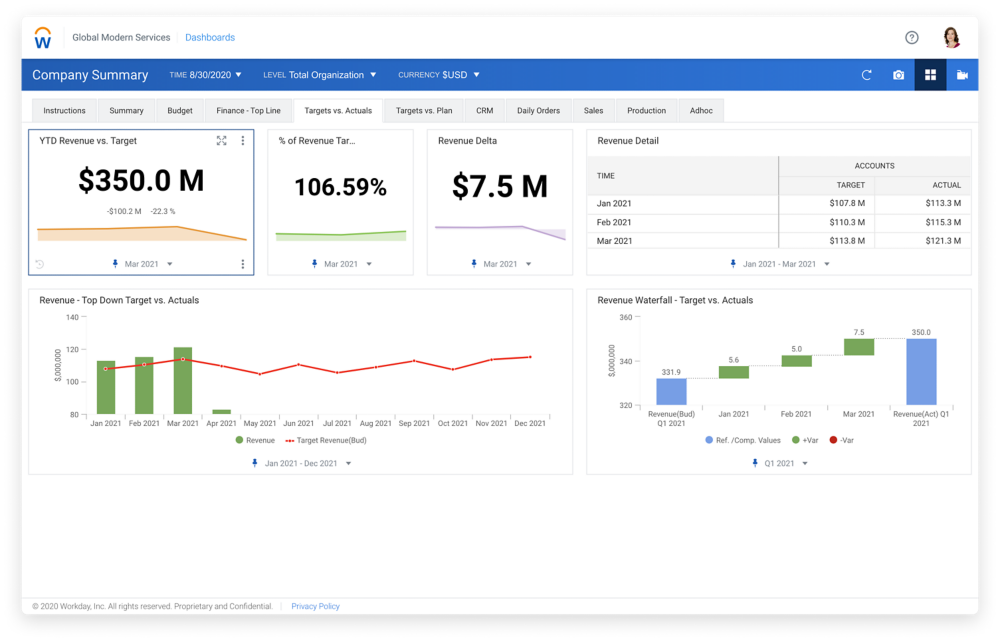
Data Visualization: Use visual dashboards to track your financial metrics and KPIs. This helps your team grasp insights at a glance.
Scenario Planning: You can test different financial scenarios to see potential impacts on your business. This feature aids in strategic decision-making.
Collaboration Tools: Workday Adaptive Planning offers tools that enhance team collaboration across departments. It ensures everyone is aligned and informed.
Automated Workflows: Streamline your processes with automated workflows that save time and reduce errors. This lets your team focus on strategic tasks.
Ease of Use
Workday Adaptive Planning is relatively user-friendly, but some users find its interface takes time to master. While it offers powerful features like real-time data access and advanced analytics, your team might need some time to adapt. Once familiar, you'll find its functionalities greatly enhance your financial planning and analysis processes. Training and initial setup can be a bit complex, but the long-term benefits in efficiency and collaboration are worth the initial effort.

Integrations
Workday Adaptive Planning integrates with NetSuite, Salesforce, Workday HCM, Microsoft Dynamics, QuickBooks, Xero, Oracle, SAP, and Sage Intacct.
Workday Adaptive Planning also offers an API and connects with third-party integration tools.
Workday Adaptive Planning Specs
- 2-Factor Authentication
- Accounts Payable
- Accounts Receivable
- API
- Approval Workflows
- Balance Sheet
- Billing/Invoicing
- Budgeting
- Calendar Management
- Comparative Reporting
- CRM Integration
- Custom Reports
- Customer Management
- Dashboard
- Data Export
- Data Import
- Data Visualization
- Expense Tracking
- External Integrations
- Forecasting
- General Account Ledger
- Historical Data Analysis
- Inventory Tracking
- Multi-Currency
- Multi-User
- Notifications
- P&L
- Payroll
- Scenario Planning
- Scheduling
- Supplier Management
- Tax Management
- Time Management


