

Programvare for kontraktsadministrasjon i virksomheter er utviklet for å hjelpe bedrifter med å opprette, forhandle, gjennomføre og overvåke komplekse kontrakter i stor skala. Hvis du vurderer slike verktøy, sliter du sannsynligvis med fragmenterte prosesser, risiko for manglende etterlevelse og utfordringen med å koordinere mellom team. Det er viktig å velge riktig løsning – organisasjonens eksponering, revisjonsberedskap og gjennomløpstider står på spill. Denne veiledningen fokuserer på hva de ledende alternativene tilbyr og hva du bør se etter, slik at du trygt kan finne en løsning som passer behovene dine og minimere risikoen.
Hvorfor du kan stole på våre programvareanbefalinger
6,700+
Reviews
20
Industry experts
16+
Evaluation factors
14
Years
Teamet vårt har testet og anmeldt programvare siden 2012. Vi er selv økonomiledere, så vi vet hvor vanskelig og hvor viktig det er å velge riktig programvare.
I denne guiden har vi vurdert verktøyene gjennom praktisk testing og uavhengig research og gitt dem poeng ut fra våre utvelgelseskriterier.
Anmeldelsene våre bygger på vår egen redaksjonelle vurdering. De er ikke et salgsargument.
Sammenligningstabell for programvare for kontraktsadministrasjon i virksomheter
Denne sammenligningstabellen oppsummerer prisdetaljene for mine beste utvalgte programmer for kontraktsadministrasjon i virksomheter.
| Tool | Best For | Trial Info | Price | ||
|---|---|---|---|---|---|
| 1 | Best for portfolio-wide contract reporting | Free demo available | Pricing upon request | Website | |
| 2 | Best for AI discovery across contract repositories | Free demo available | Pricing upon request | Website | |
| 3 | Best for AI contract performance management | Free demo available | Pricing upon request | Website | |
| 4 | Best for cross-functional contract collaboration | Free demo available | Pricing upon request | Website | |
| 5 | Best for playbook-driven contract redlining | Free demo available | Pricing upon request | Website | |
| 6 | Best for CLM with integrated e-signatures | Free demo available | Pricing upon request | Website | |
| 7 | Best for highly configurable contract processes | Free plan available | Pricing upon request | Website | |
| 8 | Best for workflow automation with self-serve tools | Free demo available | Pricing upon request | Website | |
| 9 | Best for enterprise-wide obligation intelligence | Free demo available | Pricing upon request | Website | |
| 10 | Best for revenue-focused contract management | Free demo available | Pricing upon request | Website |


Anmeldelser av den beste programvaren for kontraktsadministrasjon i virksomheter
Nedenfor finner du mine detaljerte sammendrag av den beste programvaren for kontraktsadministrasjon i virksomheter som kom med på kortlisten min. Anmeldelsene mine gir et detaljert innblikk i funksjonene, integrasjonene og de beste bruksområdene for hver plattform, slik at du kan finne den som passer best for deg.
 Best for portfolio-wide contract reporting
- Free demo available
- Pricing upon request
Visit WebsiteCustomer Rating:4.7/5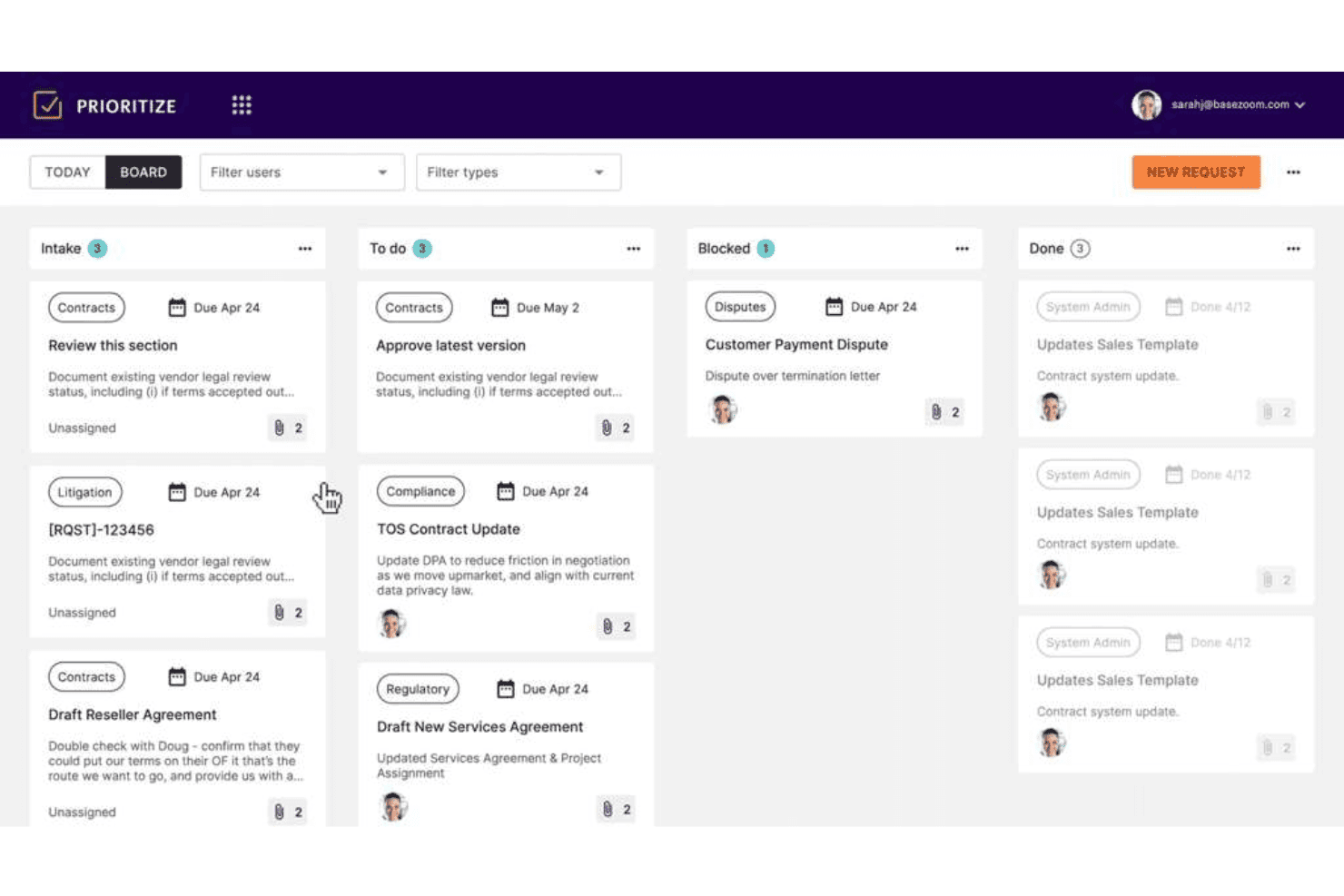
LinkSquares uses a kanban-style Prioritize board to manage legal requests across Intake, To Do, Blocked, and Done stages. LinkSquares is an AI-powered contract lifecycle management platform that covers pre- and post-signature workflows, including drafting, clause management, approval routing, obligation tracking, and portfolio-wide contract analytics.
Who Is LinkSquares Best For?
LinkSquares is a strong fit for mid-market to enterprise organizations with high contract volumes that need legal and finance teams working from a single source of contract data.
Why I Picked LinkSquares
LinkSquares earns its spot on my shortlist because of how it turns contracts into structured, reportable data. Its LinkAI engine auto-extracts 75+ data points from every agreement, including financial obligations, key dates, and renewal terms. I like that you can query and report across an entire contract portfolio at once, and the data export feature makes it straightforward to pipe that output directly into finance reporting workflows.
LinkSquares Key Features
- Contract playbooks and clause library: Store and manage pre-approved language, fallback clauses, and negotiation guidance in one workspace.
- Centralized legal project management: Track, assign, and prioritize internal contract-related requests across legal and finance teams.
- Microsoft Word add-in for AI redlining: Edit, redline, and apply company playbook rules directly within Word using AI suggestions.
- Automated renewal notification system: Schedule and customize alerts for upcoming contract expirations, auto-renewals, and key milestone dates.
LinkSquares Integrations
Native integrations include Salesforce, DocuSign, Adobe Sign, Microsoft Word, SharePoint, Slack, and Ramp Procurement. An open API is available for custom integrations.
Pros and Cons
Pros:
- Covers both pre- and post-signature workflows
- Portfolio-wide contract analytics with exportable dashboards
- AI extracts 75+ data points automatically
Cons:
- Customizing reports requires help from support teams
- Long enterprise implementation and onboarding timeline
Learn more about LinkSquares: Best for AI discovery across contract repositories
- Free demo available
- Pricing upon request
Visit WebsiteCustomer Rating:4.5/5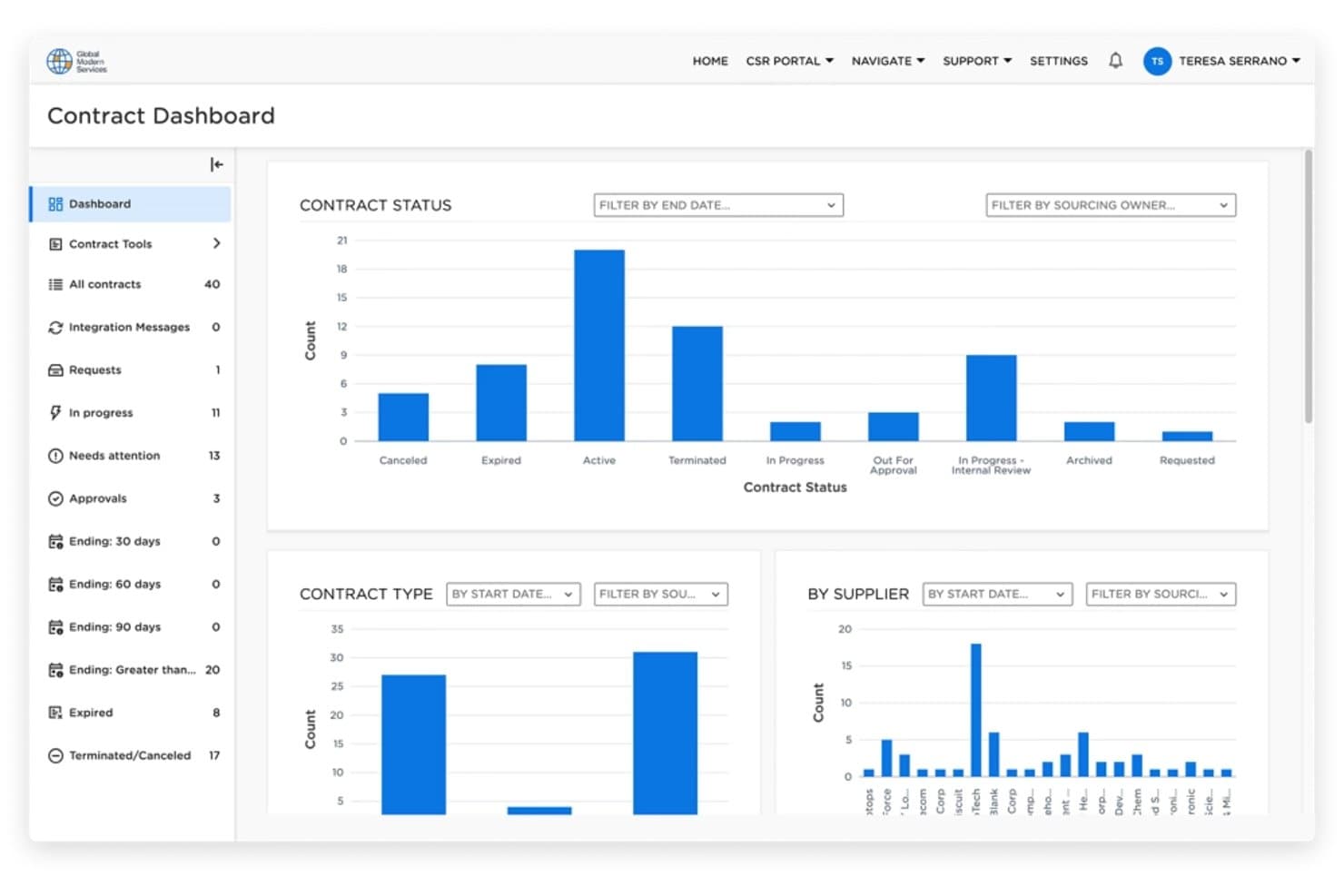
Workday Contract Management includes contract status tracking, contract type breakdowns, and supplier views for enterprise-level contract oversight. Workday Contract Management is an AI-native CLM platform that combines a unified contract repository, end-to-end lifecycle automation, financial obligation tracking, and AI-powered clause extraction across enterprise contract portfolios.
Who Is Workday Contract Management Best For?
It's a strong fit for large enterprises that already run Workday Financials and need CLM capabilities managed within the same finance ecosystem.
Why I Picked Workday Contract Management
Workday Contract Management earns its spot on my shortlist because of how it handles AI discovery across existing contract repositories. I love that it syncs with SharePoint, Box, Salesforce, and even other CLM platforms, then applies OCR+AI to ingest and analyze up to 450,000 documents in 24 hours. The natural-language "Ask AI" search lets my team query the entire contract portfolio in plain English and get sourced, cited answers instantly, without rebuilding the repository from scratch.
Workday Contract Management Key Features
- Custom AI model library: Build and reuse department-specific AI models for tracking complex data points across contracts.
- No-code workflow automation: Configure approval processes, routing, and dashboards without technical skills required.
- Financial obligation extraction: Automatically capture payment schedules, pricing, and milestones from new and legacy contracts.
- Role-based permissions: Manage granular access controls across business units, subsidiaries, and user roles for enterprise governance.
Workday Contract Management Integrations
Workday Contract Management offers native integrations with Workday Financial Management, DocuSign, Adobe Sign, Salesforce, Box, SharePoint, and Google Drive. An API is available for custom integrations.
Pros and Cons
Pros:
- Built-in SOX and ASC 606 compliance controls
- Natural language contract search across entire portfolio
- OCR-powered mass ingestion of legacy contract portfolios
Cons:
- Implementation can take months for large enterprises
- Requires Workday ecosystem for full functionality
Learn more about Workday Contract Management: Best for AI contract performance management
- Free demo available
- Pricing upon request
Visit WebsiteCustomer Rating:4.5/5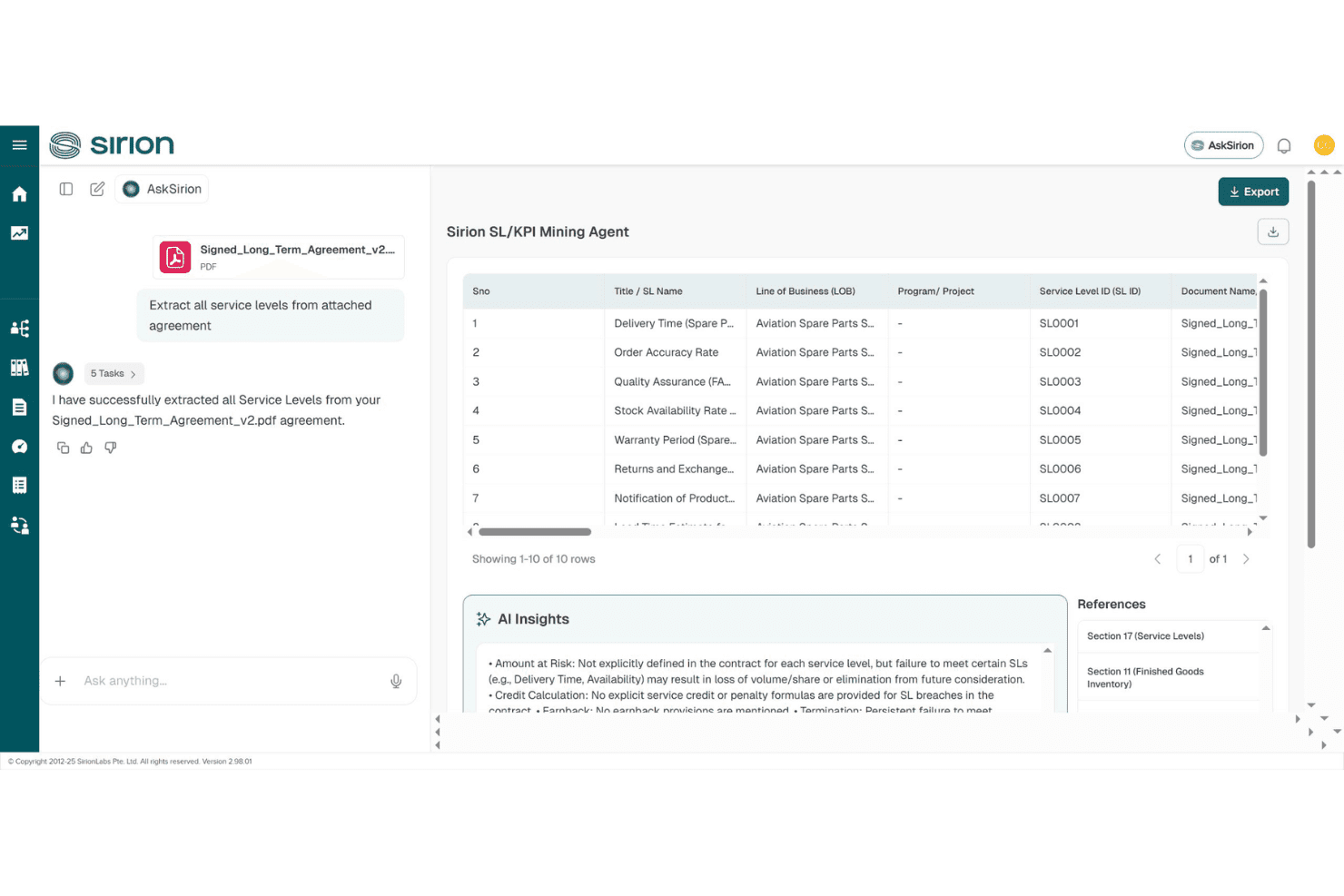
Sirion's AskSirion AI assistant automatically extracts and organizes service levels from contracts using its SL/KPI Mining Agent. Sirion is an AI-native contract lifecycle management platform that uses purpose-built AI agents to handle contract storage, drafting, negotiation, obligation tracking, and invoice reconciliation across enterprise-scale portfolios.
Who Is Sirion Best For?
Sirion is built for large enterprises managing high-volume, complex contract portfolios across legal, procurement, finance, and supplier management functions.
Why I Picked Sirion
Sirion earns its spot on my shortlist because of how its AI agents handle post-signature contract performance. The Obligations Agent automatically tracks contractual commitments, flags at-risk obligations in real time, and triggers escalations before performance gaps become costly. Paired with the Invoice Agent, which reconciles invoices directly against contract terms, I can identify value leakage at the line level rather than discovering it in a quarterly review.
Sirion Key Features
- Centralized contract repository: Collects and organizes executed contracts with metadata, versioning, and granular access controls.
- Configurable workflow automation: Lets you set up customizable drafting, approval, and routing workflows for different contract types.
- Integration studio: Offers no-code connectors for syncing contract data with ERP, CRM, and procurement systems.
- Clause library and playbook agent: Stores pre-approved clauses and transforms internal policies into smart templates for contract drafting.
Sirion Integrations
Sirion offers native integrations with Salesforce, SAP, Oracle, Workday, Microsoft 365, and Slack. An open API and the Sirion Integration Studio let you build custom connections to over 1,000 applications.
Pros and Cons
Pros:
- Scales to millions of contracts natively
- Contract analytics give portfolio-wide performance visibility
- AI agents automate post-execution obligation tracking
Cons:
- Workflow configuration requires substantial upfront effort
- Implementation typically takes several months
Learn more about Sirion: Best for cross-functional contract collaboration
- Free demo available
- Pricing upon request
Visit WebsiteCustomer Rating:4.5/5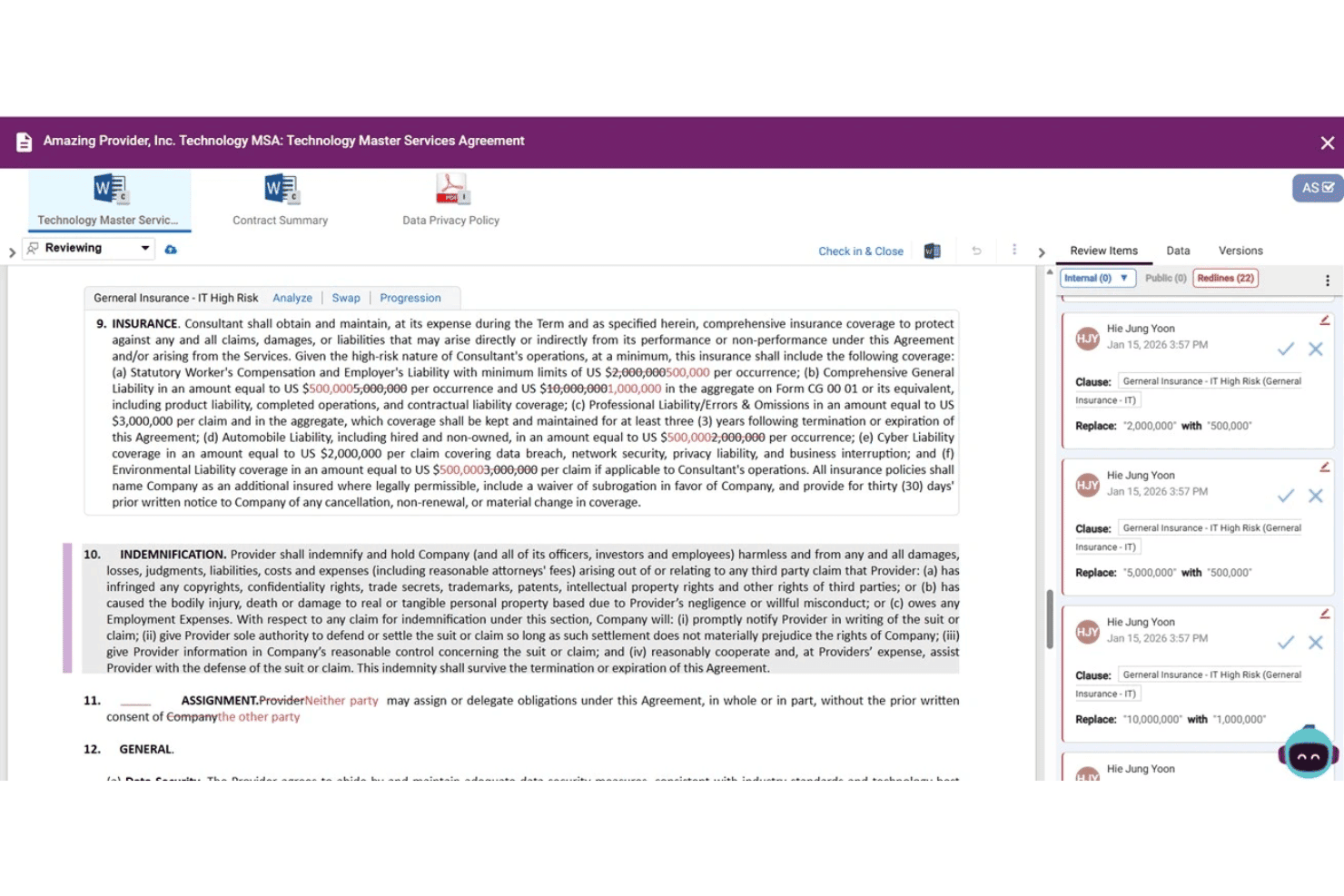
Malbek enables legal teams to review and redline contract insurance clauses with tracked changes and inline comments directly in the contract editor. Malbek is an AI-native contract lifecycle management platform that combines contract authoring, workflow automation, clause analysis, obligation tracking, and cross-functional commercial intelligence for legal, finance, sales, and procurement teams.
Who Is Malbek Best For?
Malbek is a strong fit for enterprise organizations where legal, finance, and procurement teams need a shared contracting process with centralized visibility.
Why I Picked Malbek
I picked Malbek as one of the best because its no-code workflow engine lets legal, finance, sales, and procurement teams move through creation, approval, and negotiation in one shared environment. I also rely on BusinessIQ to pull revenue, risk, and renewal exposure from the contract repository into dashboards the CFO and CPO can act on. On top of that, Bek, the conversational AI assistant, lets any stakeholder query contract data mid-cycle without pulling in a legal analyst.
Malbek Key Features
- Centralized contract repository: Store, search, and control access to all executed contracts with full metadata and version history.
- Advanced workflow automation: Build conditional, multi-step contract approval processes without IT involvement.
- ERP and CRM integrations: Connect natively with Salesforce, SAP, NetSuite, Coupa, and other core enterprise systems.
- Configurable clause library: Maintain a library of pre-approved clauses with version control for consistent legal language.
Malbek Integrations
Malbek offers native integrations with Salesforce, SAP, NetSuite, Oracle, Microsoft Dynamics 365, Coupa, DocuSign, Adobe Sign, OneTrust, and Slack. An API is available for custom integrations.
Pros and Cons
Pros:
- Fast implementation timeline, often live within weeks
- MS Word add-in is cumbersome and disrupts document authoring
- Negotiation cycle time tracking across all contract stages
Cons:
- Amendment workflow supports only one draft at a time
- Native reporting requires external BI tools for deeper analysis
Learn more about Malbek: 5Best for playbook-driven contract redlining
Leah
- Free demo available
- Pricing upon request
Visit WebsiteCustomer Rating:4.5/5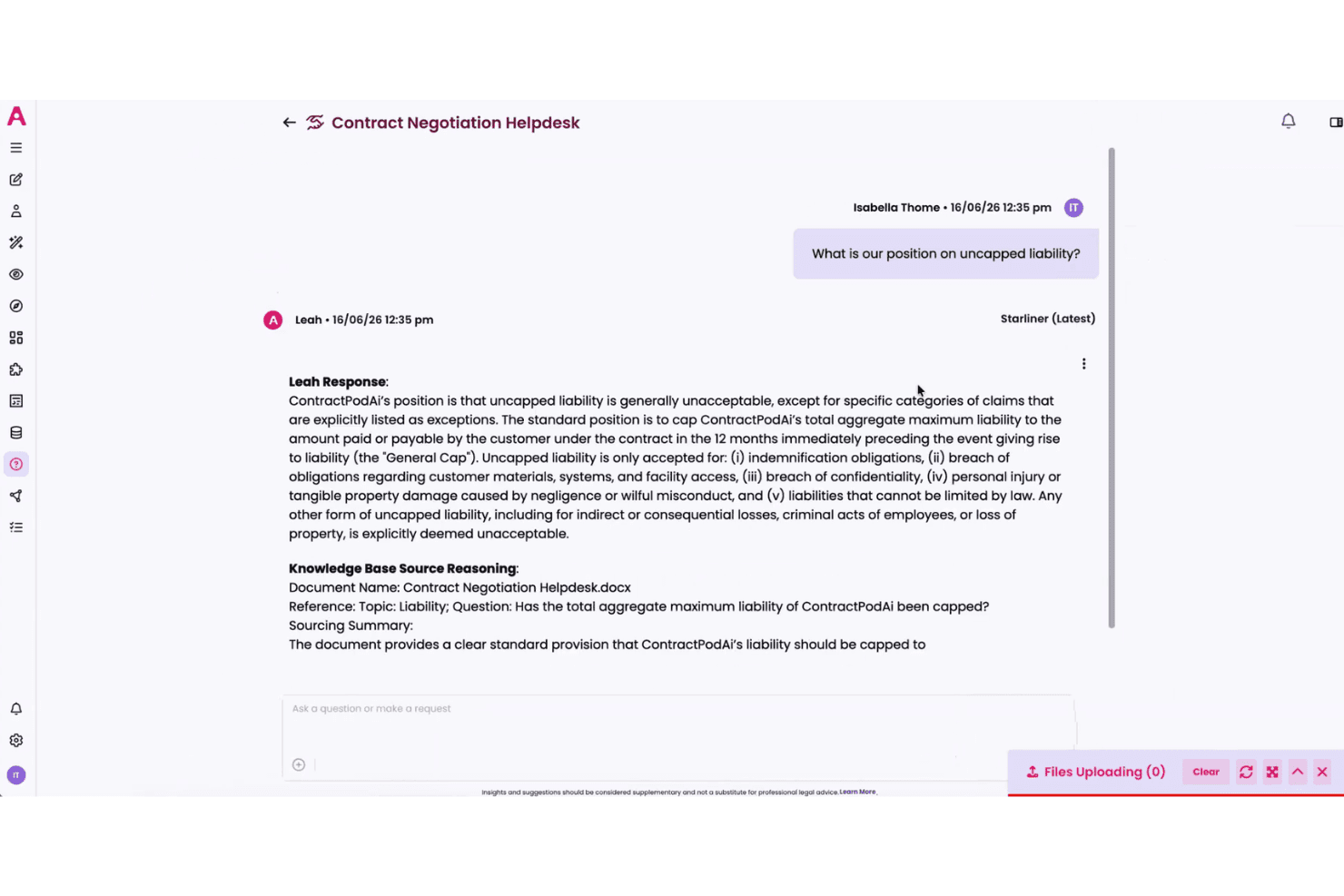
Leah, ContractPodAi's AI assistant, provides a detailed position on uncapped liability exceptions within the Contract Negotiation Helpdesk. Leah is an agentic enterprise CLM platform that combines contract creation, playbook-driven review and negotiation, conditional approval routing, obligation tracking, and CFO-specific financial dashboards in a single system.
Who Is Leah Best For?
Leah is a strong fit for Fortune 500 legal, finance, and procurement teams that manage high volumes of complex contracts across regulated industries.
Why I Picked Leah
Leah earns its spot on my shortlist because of how it handles contract redlining at enterprise scale. I particularly like how the Word Add-in applies your negotiating playbooks directly inside Microsoft Word, keeping reviewers anchored to preferred positions on every deal. The "Ask Leah" feature layers in-document AI guidance on top of that, and prior deal intelligence lets my team reference how similar clauses were resolved in past contracts.
Leah Key Features
- Smart repository: Stores all contracts with advanced search, metadata tagging, and granular role-based access controls.
- Obligation tracking dashboards: Surfaces milestones, renewal dates, and payment schedules in customizable executive dashboards.
- ERP and financial integrations: Connects directly with SAP, NetSuite, Oracle, Coupa, and other core enterprise systems.
- Configurable clause library: Centralizes pre-approved legal language for consistent use across all agreements.
Leah Integrations
Leah offers native integrations with SAP, NetSuite, Oracle, Workday, Coupa, iValua, Salesforce, Microsoft 365, DocuSign, Adobe Sign, and ServiceNow. An open API is also available for custom integrations.
Pros and Cons
Pros:
- AI obligation extraction across large contract volumes
- Highly configurable workflows and admin controls
- Playbook enforcement anchors reviewers on every deal
Cons:
- Misconfigured workflows can't be overridden without backend access
- Implementation process requires heavy customer involvement
Learn more about Leah: Best for CLM with integrated e-signatures
- Free demo available
- Pricing upon request
Visit WebsiteCustomer Rating:4.7/5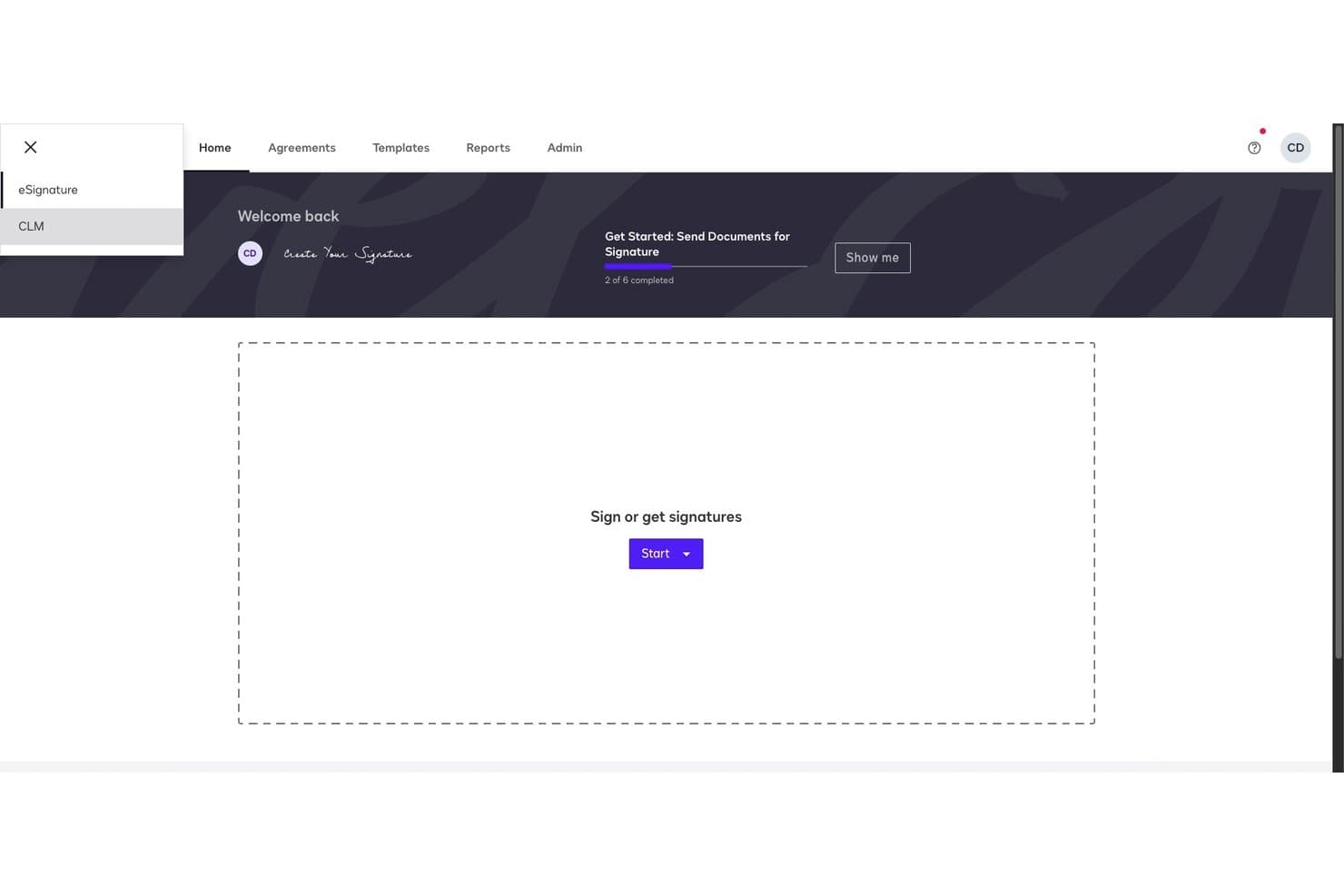
Docusign CLM includes a home dashboard with eSignature and CLM product switching, a getting-started progress tracker, and a 'Sign or get signatures' action area. Docusign CLM is an enterprise contract lifecycle management platform that combines AI-powered contract creation, automated approval workflows, clause library management, obligation tracking, and a centralized repository with native e-signature execution.
Who Is Docusign CLM Best For?
It's a strong fit for large enterprises that already operate within the Docusign ecosystem and need full contract lifecycle control beyond e-signature.
Why I Picked Docusign CLM
Docusign CLM earns its spot on my shortlist because the e-signature step isn't an integration — it's native to the platform. I like that approval workflows can be configured to route contracts directly into signature execution based on deal value thresholds, so there's no handoff between systems at the most critical stage. The Iris AI engine also adds real value here, extracting clause-level data and risk scores before a contract ever reaches the signing stage.
Docusign CLM Key Features
- Centralized contract repository: Store, organize, and search executed contracts with metadata, version history, and granular role-based access.
- Obligation management: Track contract commitments, milestones, renewal dates, and SLA deadlines with built-in alerts for stakeholders.
- Advanced workflow automation: Build automated, no-code workflows with conditional logic for contract creation, negotiation, and renewals.
- ERP and procurement integrations: Connect natively with SAP Ariba, Coupa, and Salesforce to sync contract data with critical financial systems.
Docusign CLM Integrations
Docusign CLM offers native integrations with Salesforce, SAP Ariba, Coupa, Microsoft 365, and Oracle. An API is available for custom integrations.
Pros and Cons
Pros:
- Audit trails support SOX compliance requirements
- AI clause extraction across large contract portfolios
- Native e-signature execution within the same platform
Cons:
- Workflow configuration requires significant admin time
- Implementation complexity for non-Docusign environments
Learn more about Docusign CLM: Best for highly configurable contract processes
- Free plan available
- Pricing upon request
Visit WebsiteCustomer Rating:4.7/5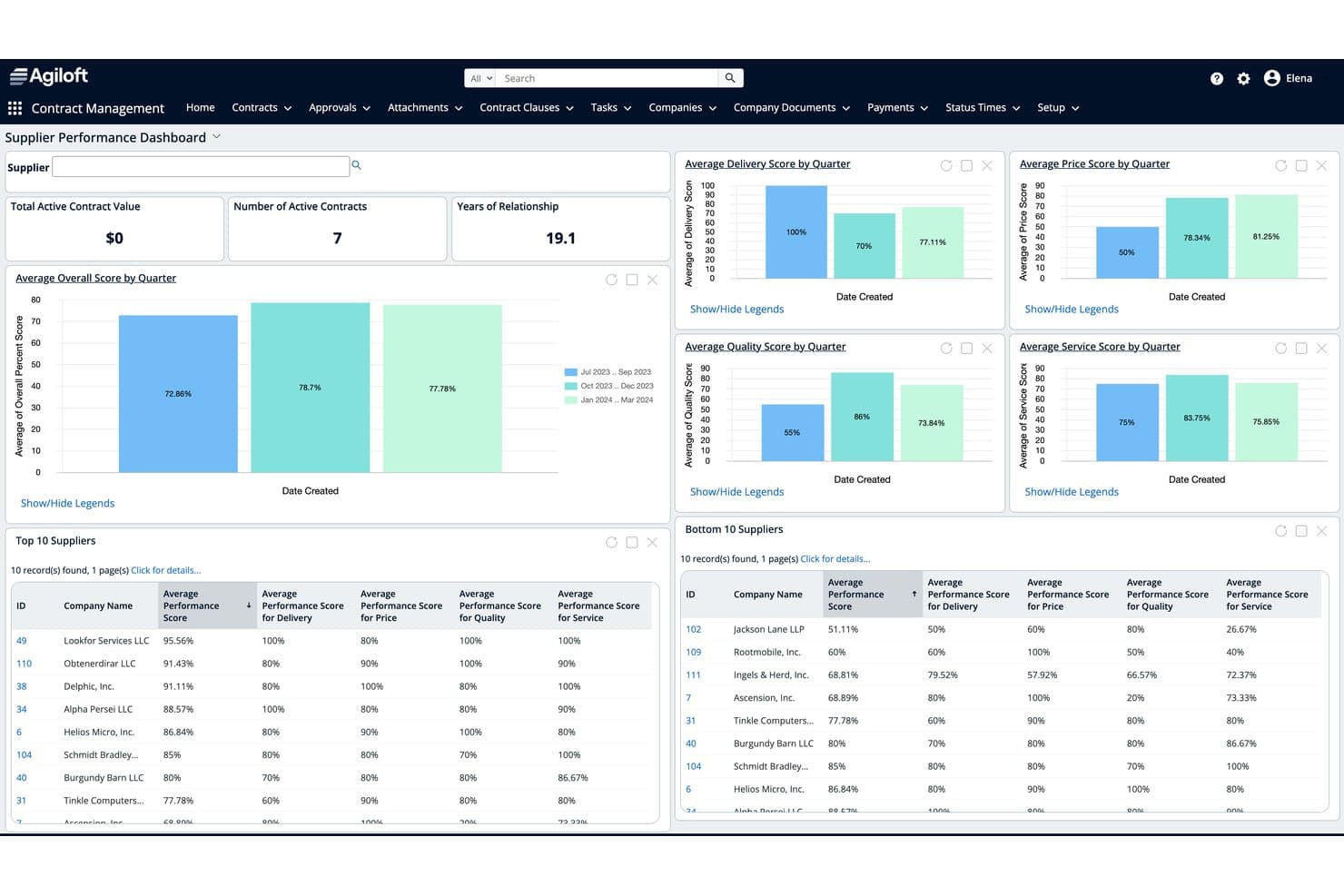
Agiloft’s Supplier Performance Dashboard tracks active contract values, delivery scores, quality metrics, and top and bottom supplier rankings across quarterly periods. Agiloft is a no-code contract lifecycle management platform built for enterprise teams, offering a centralized contract repository, AI-powered clause extraction, configurable approval workflows, and integrations with ERP, procurement, and e-signature systems.
Who Is Agiloft Best For?
Agiloft is a strong fit for large enterprises with complex, cross-functional contract processes spanning legal, finance, and procurement teams.
Why I Picked Agiloft
I picked Agiloft as one of the best because its no-code workflow builder lets me configure contract routing logic that mirrors exactly how my organization operates. I can set a rule that automatically escalates any contract above $50,000 to the CFO for approval, without writing a single line of code. Agiloft's ConvoAI also lets me query the entire contract repository using plain-language questions, so surfacing specific obligation terms or clause language takes seconds, not hours.
Agiloft Key Features
- Centralized contract repository: Store and organize all executed contracts with metadata, version control, and secure, role-based access.
- Financial obligation tracking: Extract and monitor payment schedules, milestones, and renewal dates directly from contract data.
- Enterprise-grade audit controls: Maintain detailed audit trails, e-signature records, and compliance-ready logging for regulated environments.
- ERP and procurement integrations: Connect natively to SAP, Oracle, NetSuite, Coupa, and other major enterprise systems for synchronized contract data.
Agiloft Integrations
Agiloft offers native integrations with SAP, Oracle, NetSuite, Coupa, Tradeshift, Salesforce, DocuSign, and Adobe Sign, and provides an API for custom integrations.
Pros and Cons
Pros:
- Granular role-based permissions suit enterprise governance
- AI extracts clauses across large contract portfolios
- No-code workflow builder is highly configurable
Cons:
- Reporting dashboards feel dated compared to competitors
- Initial deployment requires significant IT involvement
Learn more about Agiloft: Best for workflow automation with self-serve tools
- Free demo available
- Pricing upon request
Visit WebsiteCustomer Rating:4.4/5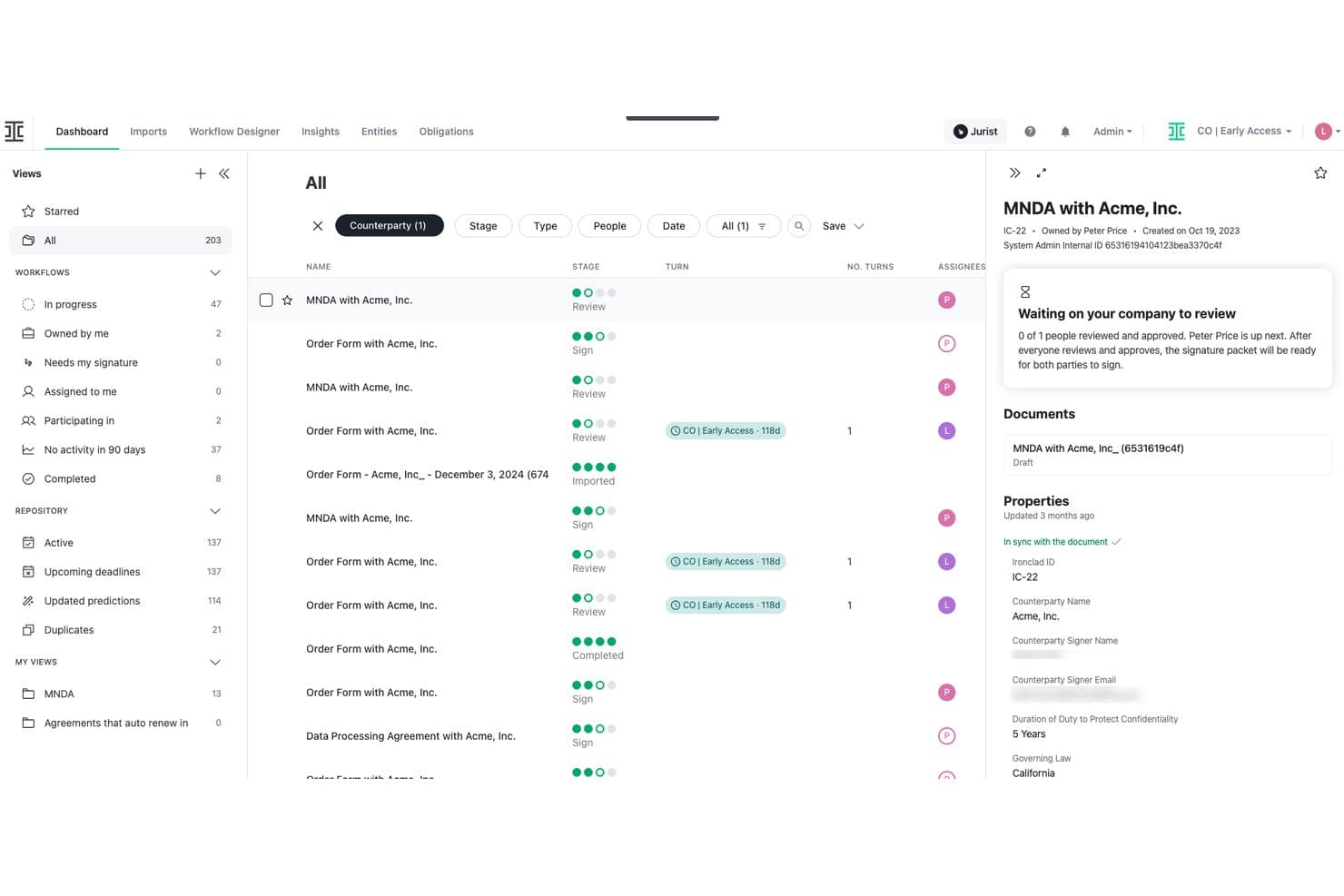
Ironclad lets teams manage contracts with filtering, workflow stages, counterparty details, and document properties. Ironclad is an AI-powered contract lifecycle management platform that handles contract creation, negotiation, approval routing, execution, and renewal management across legal, finance, procurement, and sales teams.
Who Is Ironclad Best For?
Ironclad suits mid-market to enterprise legal and finance teams that manage high contract volumes across multiple departments and need cross-functional approval workflows.
Why I Picked Ironclad
I've included Ironclad in my top picks because its no-code Workflow Designer genuinely sets it apart. I can build conditional approval paths, automated routing, and renewal alerts without touching code, which means finance and procurement teams can trigger and manage their own contracts without routing every request through legal. The Renewals Dashboard is another feature I rely on, tracking opt-out windows and surfacing upcoming renewal dates before they become costly auto-renewals.
Ironclad Key Features
- Centralized contract repository: Store executed contracts with metadata, version control, and role-based access for large volumes.
- AI-powered clause extraction: Identify and extract critical clauses, obligations, and risks across all contract documents.
- ERP and procurement system integrations: Sync contract data with leading ERPs, accounting tools, and procurement platforms through native connectors and APIs.
- Audit trails and compliance controls: Maintain detailed audit logs, electronic signature integrity, and governance for SOX and global regulatory standards.
Ironclad Integrations
Ironclad offers native integrations with Salesforce, SAP, Coupa, Ramp, HubSpot, Box, Slack, and Microsoft Teams, and provides an API for custom integrations.
Pros and Cons
Pros:
- Self-serve contracting for non-legal stakeholders
- AI clause extraction across large contract portfolios
- No-code workflow builder with conditional logic
Cons:
- Reporting customization limited without additional configuration
- Admin configuration requires significant upfront setup time
Learn more about Ironclad: Best for enterprise-wide obligation intelligence
- Free demo available
- Pricing upon request
Visit WebsiteCustomer Rating:4.3/5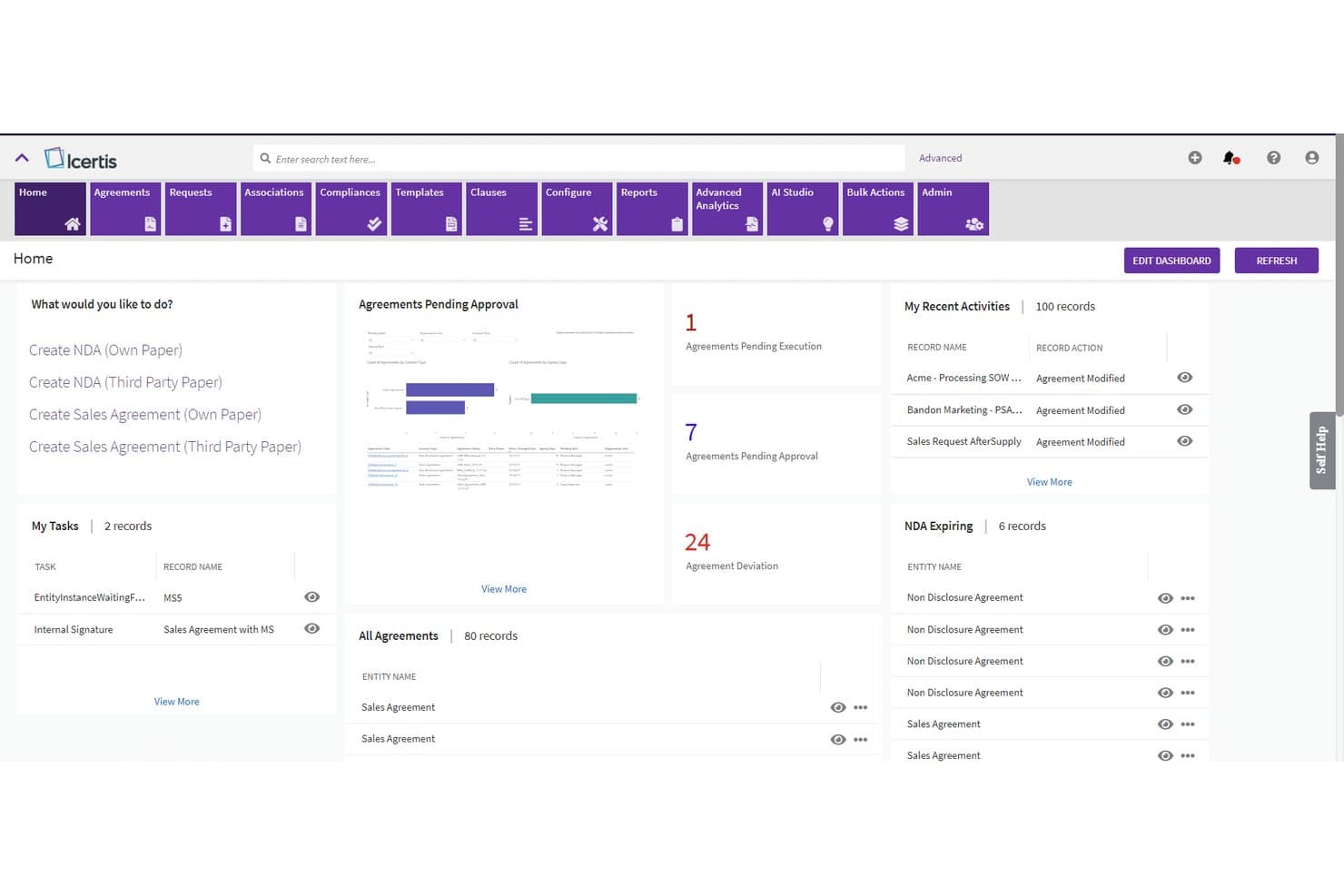
Icertis offers a centralized contract management dashboard with agreement tracking, pending approvals, task management, and NDA expiration alerts for enterprise users. Icertis is an AI-powered contract lifecycle management platform that centralizes contract repositories, automates end-to-end contract workflows, and extracts structured obligation and financial data from enterprise-scale contract portfolios.
Who Is Icertis Best For?
Icertis is a strong fit for large enterprises in regulated industries — financial services, healthcare, and manufacturing — managing high volumes of complex contracts across global operations.
Why I Picked Icertis
Icertis earns its spot on my shortlist because of how it handles obligation tracking at scale. The dedicated Vera Obligations and Vera Fulfillment Agent modules extract financial terms directly from contracts and monitor fulfillment status across the entire portfolio. I particularly like Vera Copilot, which lets me query contracts in plain language to surface payment schedules, pricing milestones, and risk triggers without digging through individual documents.
Icertis Key Features
- Centralized contract repository: Maintain all executed contracts in a searchable, versioned, and access-controlled enterprise repository.
- Configurable clause library: Store, manage, and update pre-approved clauses for use in new contracts across business units.
- Advanced workflow automation: Design no-code workflows for dynamic contract approval routing, negotiation, and renewal management.
- Contract analytics dashboards: Visualize contract risk, cycle times, contract value, and performance with customizable reporting tools.
Icertis Integrations
Icertis offers native integrations with SAP, Microsoft Dynamics, Salesforce, Workday, and DocuSign. An API is available for custom integrations.
Pros and Cons
Pros:
- Built-in SOX and ASC 606 compliance controls
- AI clause extraction from legacy contract portfolios
- Deep obligation tracking across complex contract portfolios
Cons:
- Requires significant IT resources for initial configuration
- Long implementation timelines for enterprise deployments
Learn more about Icertis: Best for revenue-focused contract management
- Free demo available
- Pricing upon request
Visit WebsiteCustomer Rating:4.3/5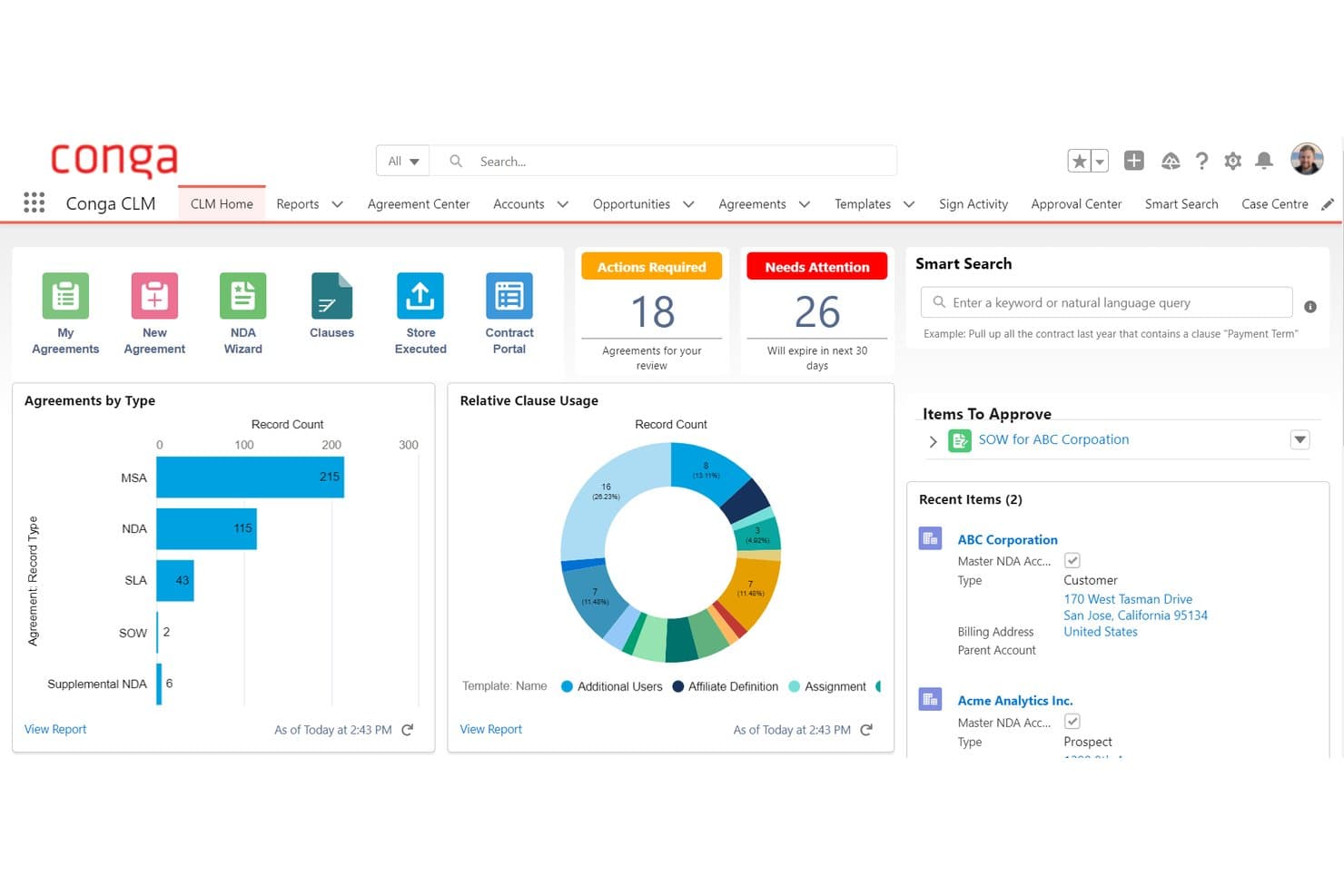
Conga CLM brings together agreement tracking, clause usage analytics, approval workflows, and smart search for enterprise teams. Conga CLM is an AI-powered contract lifecycle management platform built for enterprise teams, covering contract creation, negotiation, approval workflows, obligation tracking, and renewal management across sales, legal, and procurement functions.
Who Is Conga CLM Best For?
Conga CLM is a strong fit for large enterprises running Salesforce-based revenue operations that need contract management connected to their CPQ, billing, and procurement workflows.
Why I Picked Conga CLM
I've included Conga CLM in my top picks because its revenue lifecycle positioning sets it apart from purely legal-focused CLM tools. What I find most compelling is the AI's ability to flag upsell and cross-sell opportunities directly from contract data, something most CLM platforms simply don't do. I also like how obligation extraction connects directly to billing schedules when paired with Conga Billing, so my team isn't manually chasing payment triggers after contracts close.
Conga CLM Key Features
- Centralized contract repository: Stores all contracts with metadata, version control, and enterprise-grade access permissions.
- Configurable clause library: Provides legal-approved standard and fallback language with usage tracking across the portfolio.
- Advanced workflow automation: Enables no-code workflows with conditional routing, parallel approvals, and flexible stakeholder assignments.
- Contract analytics dashboards: Offers customizable reporting on contract value, risk metrics, cycle times, and portfolio performance.
Conga CLM Integrations
Conga CLM offers native integrations with Salesforce, SAP, Oracle, Microsoft 365, Coupa, Ariba, DocuSign, and Adobe Sign. An API is available for custom integrations.
Pros and Cons
Pros:
- Strong audit trail supporting SOX and revenue recognition compliance
- Deep Salesforce-native workflow and approval automation
- AI-powered clause extraction across large contract portfolios
Cons:
- Advanced modules and configurations carry significant added costs
- Heavy Salesforce dependency limits value outside that ecosystem
Learn more about Conga CLM:
Annen programvare for kontraktsadministrasjon i virksomheter
Her er noen andre alternativer for programvare for kontraktsadministrasjon i virksomheter som ikke kom med på kortlisten min, men som likevel er verdt å undersøke:
- 11Coupa Contract Lifecycle ManagementBest for connecting contracts with spend data
- 12SAP Ariba ContractsBest for source-to-pay contract compliance
- 13GEP SMARTBest for AI-led procurement contract management
- 14JuroBest for browser-based contract collaboration
- 15SpotDraftBest for fast deployment with native e-signing
- 16GatekeeperBest for unified vendor and contract oversight
- 17JaggaerBest for CLM within source-to-pay operations
- 18OnitBest for contract governance at enterprise scale
How I Evaluate Enterprise Contract Management Software
I split my evaluation into two layers: the core functionality every enterprise CLM must deliver—like obligation extraction and SOX-ready audit trails—and what separates the best options from the rest.
Core Functionality (Table Stakes For This List)
When I'm selecting tools for my list, I rank each one on a scale from 0 (does not offer the functionality) to 5 (excels in this area) for each core functionality listed below. Then, I calculate the tool's total score into a percentage. Each tool needs to achieve a minimum total score of 65% to be considered for inclusion.
- Centralized Contract Repository: I look for full-text search, metadata tagging, version history, and role-based permissions that scale cleanly across multiple business entities.
- Contract Lifecycle Automation: Each platform's workflow engine should handle drafting from templates, conditional approval routing, e-signatures, and automated renewal alerts.
- Financial Obligation Tracking: I evaluate whether the tool surfaces payment milestones, pricing terms, and revenue recognition triggers tied to specific contract clauses.
- Compliance & Audit Controls: SOX-ready audit trails, e-signature integrity, and built-in support for standards like ASC 606 and IFRS 15 are what I check for here.
- ERP & Financial Integrations: Bi-directional sync with platforms like SAP, Oracle, or NetSuite matters—contract data needs to flow into your financial workflows.
- AI Clause & Risk Analysis: Strong tools here can extract obligations, flag risk clauses, and compare language across a portfolio of thousands of contracts.
Once I have a list of tools that meet the criteria, I consider what sets each platform apart.
Differentiating Factors (What Sets Vendors Apart)
Here's how I compare and contrast different vendors:
Standout Features
AI-powered clause extraction is where I see the biggest gap between vendors. The best implementations scan a legacy portfolio and surface hidden commitments—like auto-renewal terms or embedded price escalation clauses—without manual review. Contract analytics dashboards matter just as much, since CFOs need real-time visibility into cycle times, contract value, and risk exposure across business units. Obligation management rounds this out by tracking post-execution milestones and SLA deadlines with automated alerts.
Beyond Features
Integration depth is a major differentiator. I check whether a platform offers bi-directional sync with ERPs and procurement systems—not just one-way data pushes. Cross-departmental usability also matters; if procurement or sales teams can't self-serve within legal-approved guardrails, adoption stalls fast. I also evaluate total cost of ownership, including how pricing scales with user counts and whether AI features or premium connectors carry hidden fees.
Slik velger du programvare for kontraktsadministrasjon i virksomheter
Det er lett å gå seg vill i lange funksjonslister og kompliserte prisstrukturer. For å hjelpe deg med å holde fokus mens du går gjennom den unike prosessen din for valg av programvare, har vi laget en sjekkliste over faktorer du bør ha i tankene:
| Faktor | Dette bør du vurdere |
|---|---|
| FaktorSkalerbarhet | Dette bør du vurdereVil løsningen støtte mengden kontrakter, enheter og brukere etter hvert som virksomheten vokser? Se etter begrensninger eller ekstra kostnader. |
| FaktorIntegrasjoner | Dette bør du vurdereKan den kobles direkte til ERP-systemene, CRM-systemene og verktøyene for elektronisk signering? Spør om synkronisering i sanntid kontra satsvis synkronisering, samt vedlikehold. |
| FaktorTilpasningsmuligheter | Dette bør du vurdereKan du tilpasse arbeidsflyter, datafelt og rapportering slik at de passer virksomhetens godkjenningskjeder og økonomiprosesser? |
| FaktorBrukervennlighet | Dette bør du vurdereVil økonomi-, juridisk- og innkjøpsteamene faktisk bruke løsningen uten ekstra opplæring? Se etter ryddige grensesnitt og enkel navigering. |
| FaktorImplementering og innføring | Dette bør du vurdereHvilke ressurser kreves fra din side? Undersøk om det finnes støtte for migrering, realistiske tidsplaner for lansering og ressurser for endringsledelse. |
| FaktorKostnad | Dette bør du vurdereI tillegg til lisenser bør du ta høyde for kostnader til integrasjoner, brukertrinn, prioritert kundestøtte og fremtidig vekst i kontraktsmengden. |
| FaktorSikkerhetstiltak | Dette bør du vurdereSamsvarer kontrollene med virksomhetens krav til sensitive data, regelverksetterlevelse og tilgangspolicyer? |
| FaktorKrav til etterlevelse | Dette bør du vurdereKan løsningen hjelpe deg med å oppfylle standarder som SOX, ASC 606, IFRS 15 eller regionale krav direkte fra start? |
Hva er programvare for kontraktsadministrasjon i virksomheter?
Programvare for kontraktsadministrasjon i virksomheter er et spesialisert system som hjelper organisasjoner med å opprette, lagre, spore og analysere store mengder kontrakter. Disse plattformene sentraliserer alle kontraktsdata, automatiserer godkjenningsflyter og sørger for at de økonomiske forpliktelsene dine oppfyller kravene til regelverk, revisjon og inntektsføring. Team bruker dem til å redusere risiko, forbedre etterlevelsen og få oversikt over kontraktsforpliktelser på tvers av avdelinger.
Funksjoner i programvare for administrasjon av virksomhetskontrakter
Vær oppmerksom på følgende nøkkelfunksjoner når du velger programvare for administrasjon av virksomhetskontrakter:
- Sentralisert kontraktsregister: En enkelt, søkbar database som inneholder alle kontraktsdokumenter, støtter metadataetiketter og håndhever detaljerte tilgangskontroller for ulike forretningsenheter.
- Automatisert arbeidsflytstyring: Verktøy for å rute kontrakter gjennom utarbeidelse, godkjenning, forhandling, signering og fornyelse ved hjelp av konfigurerbare, regelbaserte arbeidsflyter.
- Sporing av økonomiske forpliktelser: Automatisert uttrekking og overvåking av betalingsbetingelser, milepæler, prisordninger og fornyelsesdatoer for å hjelpe team med å administrere forpliktelser.
- Kontroller for revisjon og etterlevelse: Detaljerte revisjonsspor, integritet for elektroniske signaturer og støtte for regelverk som SOX, ASC 606 og IFRS 15.
- Bibliotek for klausuler og maler: Sentral lagring av forhåndsgodkjente klausuler og maler, slik at brukere kan standardisere språk og fremskynde kontraktsopprettingen med versjonskontroll.
- ERP- og systemintegrasjoner: API-er og ferdigbygde koblinger for synkronisering av kontraktsdata med ERP-systemer, CRM-systemer, innkjøpsverktøy og regnskapsplattformer.
- KI-drevet analyse og uttrekking: Maskinlæringsverktøy som identifiserer viktige klausuler, synliggjør forpliktelser, vurderer risiko og analyserer trender på tvers av kontraktsporteføljer.
- Tilpassede rapporteringsdashbord: Visuelle dashbord som gir innsikt i kontraktssyklustider, risikoeksponering, flaskehalser og kontraktsverdier for ledelsens gjennomgang.
- Rollebaserte tillatelser: Kontroller som begrenser kontraktstilgang og handlinger basert på bruker, avdeling eller enhet for å bidra til å opprettholde sikkerhet og etterlevelse.
- Støtte for masseimport og migrering: Verktøy for å registrere eldre kontrakter i stor skala, inkludert OCR, masseopplastinger og datatilordning.
Fordeler med programvare for administrasjon av virksomhetskontrakter
Implementering av programvare for administrasjon av virksomhetskontrakter gir flere fordeler for teamet og virksomheten din. Her er noen av fordelene du kan se frem til:
- Bedre risikostyring: Automatisert uttrekking av klausuler og risikoanalyse avdekker eksponeringer i kontraktsspråket, fornyelsesbetingelsene og de økonomiske forpliktelsene før de eskalerer.
- Forbedret etterlevelse: Innebygde revisjonsspor, verifisering av elektroniske signaturer og kontroller utformet for standarder som SOX og ASC 606 reduserer belastningen ved regulatorisk rapportering.
- Bedre økonomisk oversikt: Dashbord i sanntid og sporing av forpliktelser synliggjør kontraktsdrevet omsetning, kostnader og viktige fornyelsesdatoer for økonomiledere.
- Raskere kontraktssykluser: Automatiserte arbeidsflyter, malbiblioteker og selvbetjeningsverktøy lar team rute, forhandle og signere kontrakter uten forsinkelser eller flaskehalser.
- Samarbeid på tvers av team: Rollebaserte tillatelser og intuitive grensesnitt gjør det enkelt for juridisk avdeling, innkjøp, økonomi og salg å arbeide i samme plattform.
- Skalerbarhet for vekst: Sentraliserte registre og infrastruktur i bedriftsklasse håndterer økende kontraktsmengder og komplekse organisasjonsstrukturer.
- Revisjonsklart arkiv: Versjonskontroll og omfattende metadata sikrer at alle kontraktsendringer og godkjenninger spores for både interne og eksterne revisjoner.
Kostnader og priser for programvare for administrasjon av virksomhetskontrakter
Valg av programvare for administrasjon av virksomhetskontrakter krever en forståelse av de ulike prismodellene og abonnementene som er tilgjengelige. Kostnadene varierer basert på funksjoner, teamstørrelse, tillegg og mer. Tabellen nedenfor oppsummerer vanlige abonnementer, gjennomsnittsprisene deres og typiske funksjoner som er inkludert i programvareløsninger for administrasjon av virksomhetskontrakter:
Sammenligningstabell for abonnementer for programvare for administrasjon av virksomhetskontrakter
| Abonnementstype | Gjennomsnittspris | Vanlige funksjoner |
|---|---|---|
| AbonnementstypeGratisabonnement | Gjennomsnittspris$0 | Vanlige funksjonerGrunnleggende kontraktslagring, begrenset antall brukere, minimale arbeidsflytfunksjoner og grunnleggende søkeverktøy. |
| AbonnementstypePersonlig abonnement | Gjennomsnittspris$30–$50/bruker/måned | Vanlige funksjonerUtvidet lagring, elektroniske signaturer, enkel arbeidsflytautomatisering, grunnleggende sporing av forpliktelser og e-postvarsler. |
| AbonnementstypeForretningsabonnement | Gjennomsnittspris$60–$120/bruker/måned | Vanlige funksjonerAvansert arbeidsflytautomatisering, rollebaserte tillatelser, ERP-/CRM-integrasjoner, analysedashbord og forpliktelsesstyring. |
| AbonnementstypeVirksomhetsabonnement | Gjennomsnittspris$150+/bruker/måned | Vanlige funksjonerTilpassede integrasjoner, KI-drevet uttrekking av klausuler, avansert sikkerhet, ubegrenset antall kontrakter og virksomhetsstøtte. |
Vanlige spørsmål om programvare for kontraktsstyring i virksomheter
Her er noen svar på vanlige spørsmål om programvare for kontraktsstyring i virksomheter:
Hvordan støtter programvare for kontraktsstyring i virksomheter etterlevelse?
Programvare for kontraktsstyring i virksomheter gir revisjonsspor, kontroller for brukertilgang og automatiske påminnelser om viktige frister, slik at du kan oppfylle kravene i standarder som SOX, ASC 606 og GDPR.
Kan ulike avdelinger samarbeide på samme plattform for kontraktsstyring?
Ja, disse plattformene er utformet for samarbeid på tvers av avdelinger og tilbyr konfigurerbare tillatelser, tilpassbare arbeidsområder og arbeidsflyter som gjenspeiler ulike teamprosesser.
Hvor lang tid tar implementeringen vanligvis?
Implementeringen kan ta alt fra noen uker til flere måneder, avhengig av datamigrering, integrasjonskompleksitet og hvor mye du tilpasser arbeidsflytene til virksomhetsstrukturen din.
Hvilke integrasjoner bør jeg forvente?
De fleste løsninger tilbyr innebygde integrasjoner eller API-integrasjoner med ERP- og CRM-systemer, verktøy for elektronisk signering og innkjøpssystemer, slik at kontraktsdata kan flyte inn i organisasjonens økonomiske prosesser.
Er KI-drevet uttrekking av klausuler verdt å vurdere?
Ja, KI-drevet uttrekking av klausuler hjelper juridiske team og økonomiteam med å finne forpliktelser, risikoer og kritiske vilkår i store porteføljer, noe som reduserer tiden som brukes på manuell gjennomgang og avdekker skjulte eksponeringer.
Hva bør jeg vite om lagringsbegrensninger?
Noen abonnementer har begrensninger på kontraktsvolum eller lagring, så sjekk alltid om abonnementet du velger, kan håndtere den forventede veksten i antall kontrakter og behovene dine for arkivering.