


Monk is usually connected and running in less than a week, giving finance teams a fast path to getting started. Alaskan Salmon reports that its Monk integration was completed within that same timeframe. The rest of the first month goes into configuring follow-up and collecting a baseline you can measure against.
This walkthrough is for the controller or finance lead running the project, and it follows the work in the order it happens.
What should you gather before kickoff?
Week one goes faster when four pieces of data are ready before the first call:
- Open receivables: Leave closed invoices out, since they slow validation down.
- The AP contact for each account: The name on an account record is often the salesperson’s original champion, and reminders sent to that person can look like a customer ignoring you.
- A few examples of customer remittance advice: Check whether your invoice numbers appear on them in the format your ERP uses. If they don’t, cash application will struggle later.
- Customers who require portal submission: For example, through Coupa or Ariba. Ask whoever uploads those invoices today, because the list is rarely written down.
Write down your current DSO and roughly how many hours a week go into chasing before anything changes. You’ll be asked for both at day 30.
What does the month look like at a glance?
Finance signs off on each week before the next one starts.
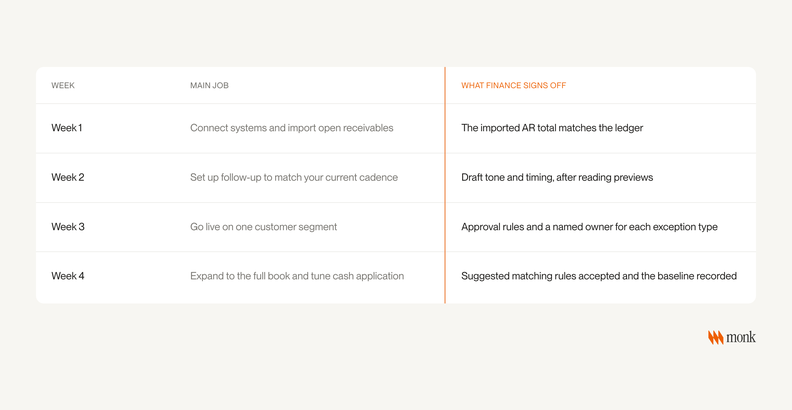
What happens in week one?
Monk connects to the systems you already use, such as QuickBooks, NetSuite, Salesforce, HubSpot, or Stripe, and imports your open receivables.
Reconcile the imported AR total against your ledger before you configure anything. A mismatch is quick to fix this early.
During onboarding, your team agrees on escalation rules with Monk. Come with a short list of accounts that should always go to a person. Most teams start with large balances and customers who are in the middle of a renewal.
This is also when you write down your house rules. In Monk, they live in Knowledge, and each one can apply to every customer or to a single account. A typical first rule reads: “Never mention suspending service in a first reminder.”
What if some customers require portal submission?
Plan for it early, because many enterprise buyers won’t pay an invoice that only arrived by email. Across the receivables Monk manages, 92% of enterprise invoices have to be submitted through a vendor portal or network.
Monk submits invoices into more than 600 corporate AP portals. Your part is the list you pulled before kickoff and the logins that go with it.
Sort that list by invoice volume and get credentials for the busiest portals first, so the accounts that matter most are covered on the day you go live.
It’s also worth checking who receives the verification codes some portals send at login, since a code landing with someone on holiday can hold up a submission for days.
What happens in week two?
In week two, you set up follow-up to match how your team already collects.
Before changing anything, sit with the person who does the chasing for an hour and write down what they actually send and when. Teams that skip this usually accept a default cadence and then spend the month overriding it.
Playbook Previews in Monk show the next draft before it sends. Ask whoever owns your customer relationships to read a dozen this week and flag anything that sounds off.
Leave rare cases for later. You’ll have replies to work from by week four.
What happens in week three?
Go live on one segment. Mid-market accounts usually work well first, with enough volume to learn from and lower stakes than your biggest customers.
Before the first message goes out, decide what needs approval. Monk’s smart queue lets your team approve or edit tasks before they send, so new or sensitive accounts can stay on approval while routine reminders go out on their own.
Each kind of exception needs a named owner. Short pays, disputes, unapplied cash, and missing documents all come back to a person, and they stall when nobody’s name is on them.
On Friday, read through what went out that week.
What happens in week four?
Once week three is clean, expand to the rest of the book.
This is also the week to look at cash application. Monk matches about 80% of payments automatically from day one. Once teams accept its suggested matching rules, that rises to about 95%.
Any payment that still doesn’t reconcile becomes a cash exception with an owner and an audit trail.
What should you expect to see by day 30?
DSO probably won’t have moved much. On net 30 terms, invoices issued after go-live haven’t come due yet, so the day-30 figure mostly reflects the old process.
Check DSO again at the end of the second and third months. Cash on hand can move sooner. Profound, a Monk customer, grew it by 122% in its first month.
What should you report to the CFO at day 30?
Keep the day-30 update short and compare everything with the baseline you took before kickoff.
Four numbers cover it:
- Response rate on follow-up, compared with the weeks before go-live
- Hours spent chasing, from the same weekly tally
- The share of payments matched automatically
- Open cash exceptions, each with a named owner
What did this look like at Alaskan Salmon?
Alaskan Salmon supplies wild-caught fish to restaurants such as Nobu, TAO, and Sagaya, and it handed Monk its invoicing and collections together.
That gave the rollout more to encode than most. Every order is priced by the actual weight of the catch, so no two invoices look alike.
Orders also pass through warehouses on the way to the restaurants, and that relationship decides who gets invoiced and on what terms.
Before Monk, those account rules lived in people’s heads. During setup, they were turned into per-account terms, so each invoice now goes out with the right ones and nobody calculates them by hand.
High-value restaurant accounts got priority logic, which means their orders are invoiced first. Invoices go out every day, so Monk also put a consistent numbering system in place, and each invoice stays traceable when the payment for it arrives.
Monk’s agent now creates and sends every invoice and follows up without anyone prompting it.
Since go-live, Alaskan Salmon’s 1-to-30-day aging bucket is down 85%, and the 90-to-120-day bucket is down 43%.
Who needs to be involved?
The controller, or whoever owns the receivables number, makes the calls on tone and escalation.
You also need someone who knows the accounting system well enough to confirm the data mapping.
Keep the person who does the chasing today close to the project. They know which customers need invoices sent to a different inbox, and very little of that is written down.
Sales needs one conversation about when finance can contact a customer directly. Agree it once for all accounts.
If you want to see this run against your own receivables, you can book a demo with our team.
Frequently asked questions
How long does it take to implement AR automation?
Monk is usually connected and live in less than a week. Plan on about 30 days before the whole book is running with a baseline to measure against.
What slows an implementation down the most?
Wrong contact data causes more delay than anything else. If an account’s AP contact is out of date, reminders go to someone who can’t pay them.
How much IT time will we need?
Most of the work falls on finance, mainly checking the imported data and reading drafts. Ask for the list of what IT will need before you sign, since it depends on your systems.
Should we start with our largest customers?
Start with a segment that has enough volume to learn from, where a mistake would be minor. Your largest accounts can follow in week four.
When should DSO start to improve?
On net 30 terms, expect it from the second month, once invoices issued after go-live start coming due.
Can we keep some accounts out of automation?
Accounts can stay on approval for as long as you want, and invoices can be paused for customers you’re in the middle of negotiating with.
What does the team need to keep doing after the first month?
Review exceptions each week and keep the rules in Knowledge current as terms and contacts change.
Check the AP contact on every new customer when it’s added, because a wrong contact is the easiest problem to prevent.