


A business case for AR automation gets approved when the numbers in it come from your own team. CFOs tend to ask the same questions in these reviews, so this walkthrough goes through them in order.
The worked example is a hypothetical distributor with $25 million in revenue, 600 customers, and a DSO of 62 days. Every figure attached to it is illustrative.
What does the current process cost?
Expect the CFO to ask for this in hours at a loaded cost. Most teams have never measured it because the work is split between an AR specialist and a controller, while portal uploads go to whoever has the logins.
For one week, ask everyone who handles receivables to log their time against four activities:
- Follow-up
- Cash application
- Chasing documents such as W-9s and PO numbers
- Portal submission
Loaded cost is salary plus payroll taxes and benefits, divided by about 2,080 hours a year.
In the example, the AR specialist logs 15 hours a week at an illustrative $42 an hour, or $32,760 a year. The controller spends four hours a week on cash application exceptions at $80 an hour, which adds $16,640.
That is about $49,400 a year.
Do not count that $49,400 as savings unless the project lets you cut a role or contractor.
How much cash will it release?
This line usually decides the approval because the money comes back as working capital.
Divide 12 months of cash collected by 365 to get average daily receipts, then multiply by the number of DSO days you expect to remove.
The distributor collects about $68,500 a day. Monk reports a 40% average reduction in DSO, and a sensible base case uses half of that.
At 20%, about 12 of the 62 days come off and roughly $820,000 is released once.
Run the case again at 10%. That releases about $410,000. If the project still clears your hurdle rate there, the CFO has less to push back on.
If the business draws on a credit line, the released cash is also worth something every year. At an illustrative 9% cost of capital, $820,000 saves about $74,000 a year in interest.
How much bad debt can it prevent?
Start with your own ledger.
Pull three years of write-offs as a share of revenue and look at what happened to invoices once they passed 90 days. Most teams see collection rates fall sharply somewhere past that point.
Portal submission is a cause of aging that is easy to miss. Across the receivables Monk manages, 92% of enterprise invoices have to go through a vendor portal or network.
An invoice that was emailed but never submitted does not exist in the customer’s system, so it keeps aging while each side assumes the other has it.
The distributor writes off 0.5% of revenue, or $125,000 a year. If earlier follow-up recovers a quarter of that, the model gains $31,250 a year.
Does the case depend on cutting headcount?
In most cases, it does not, and it helps to say so upfront.
In our conversations with finance leaders, two lines come up again and again: “we’re not backfilling for the controller” and a plan to replace two overseas contractors with software.
Both describe teams keeping headcount flat while the customer base grows.
Put the hire you avoid on its own line and label it as avoided. Contractor spend is easier to count because you simply stop paying the invoice.
Monk reports 90% of collections resolved without human intervention, which is the capacity that makes an avoided hire believable.
How fast does it pay back?
Calculate payback from the profit and loss lines alone.
In the example, that means the $74,000 of interest avoided plus the $31,250 of bad debt avoided, or about $105,000 a year.
Divide the annual software cost by that figure and multiply by 12 to get payback in months.
Show the $820,000 of released cash and the labor capacity beside the payback figure.
If a model claims payback within weeks, it has usually counted working capital as profit, and a CFO will catch it.
You will need a quote to finish the calculation. Most vendors in this category, Monk included, quote prices instead of publishing them because cost depends on invoice volume, customer count, the entities you connect, and the modules you use.
Ask what is metered and what the price becomes at twice your current volume. Ask about implementation fees and how renewal increases are capped.
Give every vendor the same volumes so the quotes can be compared.
What does the finished model look like?
For the hypothetical distributor, the lines look like this. Labeling the type of each number lets the CFO decide how much weight to give it.
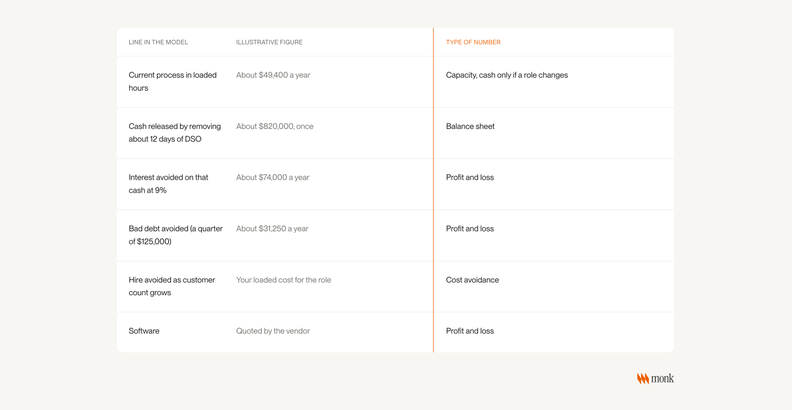
How do you prove it worked after 90 days?
Agree on the measurement plan with your CFO before you sign.
Take readings at 30, 60, and 90 days, and calculate DSO with exactly the same formula every time, or the comparison will not hold up.
Four measures carry most of the proof:
- DSO, calculated the same way as in the baseline
- The share of cash applied without anyone touching it
- Hours logged against the same four activities as the original tally
- The 90-plus bucket as a share of total AR
Monk reports DSO, aging, and cash flow in real time, so the controller can pull these readings from the platform each month.
On net 30 terms, DSO will lag at first because invoices issued after go-live need time to come due.
Elate, a Monk customer, cut DSO nearly in half and more than doubled monthly collections in its first month.
Frequently Asked Questions
What is usually the largest number in an AR automation business case?
The cash released by a lower DSO. It grows with revenue and with each day removed, and for a business with $25 million in revenue, one day of DSO is worth about $68,500.
Is the released cash a one-time benefit?
It is released once and stays available as long as DSO stays lower. To show it as an annual figure in the P&L, price it at your cost of capital.
What DSO improvement should we assume?
Use half of the vendor’s reported average for the base case, then check the case at half of that again. Your own result depends on where the delays sit today.
How many hours will it save?
Monk reports about 26 hours a month per team, mostly from manual chasing and reconciliation. Measure your own baseline first so the saving you report is yours.
Why don’t AR automation vendors publish their pricing?
Cost depends on invoice volume, customer count, the entities you connect, and the modules you switch on. Ask for a quote against your own volumes, and ask what it becomes at twice those volumes.
If you’d like these numbers pressure-tested against receivables like yours before the finance review, you can book a demo and bring your aging report.