

Yes, you can let an AI agent email customers about invoices safely. The practical safeguard is not leaving the agent to decide everything on its own. You define the messages it can send, check the facts before each send, keep a record of the decision, and send anything unclear to a person.
In AR, most of the work happens before the email is sent. The decision is whether an invoice is still open, whether the customer has replied, whether the balance changed, and whether your team has a reason to pause outreach.
Monk lets finance teams set the tone, timing, and escalation rules by customer segment. The team can start with human review, then raise autonomy as the workflow proves reliable. Monk also keeps messages and actions auditable, while a deterministic check runs before customer-facing activity.
This guide covers how to define the agent’s remit, set up checks before sending, run a controlled pilot, and decide when automation should stop.
What should an AI collections agent be allowed to do at first?
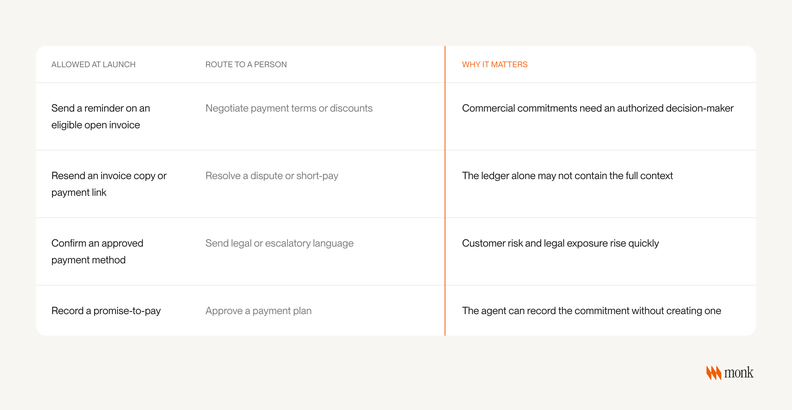
Start with routine communication: send a reminder for an eligible invoice, resend an invoice copy, and share an approved payment link. Keep anything that changes the commercial relationship with a person.
That means the agent should not negotiate a discount, accept a short payment, agree to a payment plan, or use legal language. It can record a customer’s promise to pay and route it according to your team’s policy.
What checks should run before every invoice email?
Every outbound message needs a current read of the account. The system should verify that the invoice is open, the amount is current, the recipient is appropriate, and the account is not subject to a hold.
The checklist also needs to look at recent activity. If the customer has replied, promised payment, disputed the invoice, or been contacted by another workflow, a reminder may no longer be the right next action.
At a minimum, log whether each of these checks passed:
- Ledger status: The invoice remains open and the balance has not changed.
- Recipient: The billing contact is valid for the invoice and account.
- Suppression rules: No active dispute, relationship hold, or internal instruction blocks outreach.
- Recent communication: No reply or recent message changes the action.
- Message data: Invoice number, amount, attachment, and payment link match approved records.
Monk’s cash-application workflow can match 80% to 95% of payments automatically, depending on the rules in place. That reduces the manual reconciliation work that often leaves teams following up on payments that have already arrived, but it does not remove the need to check current invoice status before an email sends.
How should approval and escalation work?
A workable policy has three paths: messages that can send automatically, messages that need review, and messages that cannot go out until someone resolves the account.
Use automatic sending only where the invoice is eligible, the recipient is verified, and the message follows an approved template. Route ambiguous cases to a reviewer. Block outreach when the account has a dispute, a payment-status conflict, or an instruction from the relationship owner.
Some organizations use confidence scores as part of this routing. Monk scores email responses on a 0–1 scale: high-confidence responses above 0.85 can be eligible for auto-send, medium-confidence responses from 0.4 to 0.85 go to review, and low-confidence responses below 0.4 escalate to a person.
Those thresholds are not a substitute for policy. A high-confidence message should still stop if an account is on hold, a customer has raised a dispute, or the proposed action falls outside the scope you approved.
Set any value threshold around your own book. The right limit depends on invoice size, customer concentration, and the cost of getting a message wrong.
What record should you keep for each message?
When a customer asks why they received an email, your team should be able to see exactly what was sent and why.
Keep a record of:
- The sent email, including attachments.
- The send time, recipients, and invoice reference.
- The balance and account status at the time of the decision.
- The checks that passed or failed.
- The template or playbook that triggered the message.
- The reviewer and approval, where one was required.
- Delivery outcome and any linked customer reply.
Monk’s activity log records the action source, event type, user or system attribution, timestamp, and structured context such as recipients, draft ID, and thread ID. The history is searchable by conversation, invoice, activity type, or source.
Ask how long those records are retained, who can access them, and whether your team can export them. If you need immutable or tamper-evident storage for a regulatory reason, verify that requirement directly rather than assuming an activity log has those properties.
How do you keep templates factual?
A safe collections email should be built from the current invoice record, not from an agent’s memory of the account.
Use templates that state only what the system can confirm:
Our records show an outstanding balance of {{invoice_amount}} for invoice {{invoice_number}}, dated {{invoice_date}}. You can review the invoice and approved payment options here: {{payment_link}}.
Attached is a copy of invoice {{invoice_number}}. If payment has already been sent and is not yet reflected, please reply with the payment date and reference so we can check the record.
Do not let a template promise a discount, change a payment term, acknowledge a short-pay as accepted, or introduce legal language. Payment destinations should come from an approved source, with a separate process for authorizing changes.
The important test is simple: can your team point to the source for every factual statement in the email?
How do you turn collection policies into agent instructions?
Most finance teams already have rules that experienced collectors follow without writing them down. A customer may need a different contact, a gentler tone, a specific reference number, or a complete pause while a commercial conversation is underway.
Those rules must become instructions the system can apply. For each instruction, record the account or segment it applies to, the approved action, and the owner who can update it.
For example:
Send invoice copies to the billing contact. Do not add the commercial sponsor to collection threads without approval.
Monk’s playbooks allow teams to configure tone, escalation rules, timing, and send conditions by customer segment or queue. Test those instructions against an account before relying on them at scale. Include one outdated rule in the test, then update it and confirm the change takes effect.
What should a two-week pilot look like?
A pilot should show whether the agent makes the right decision on an account, not merely whether it can draft a readable email.
Before the pilot: Choose a limited cohort, define the accounts to exclude, establish approval ownership, and test the ability to pause scheduled communication.
Week one: Run messages in review mode. Reviewers approve, edit, or reject each draft and label the reason for meaningful changes. An incorrect amount is a different problem from a preferred greeting.
Week two: Permit automatic sending only for low-risk messages that have repeatedly passed review. Keep disputed, high-sensitivity, or unclear accounts in the approval queue.
Track the number of messages approved without edits, factual corrections, duplicate reminders, failed suppression rules, delivery failures, and time spent reviewing exceptions. If reviewers spend nearly as much time checking messages as they used to spend writing them, include that in the pilot result.
Monk supports full review, auto-send until a customer replies, and fully automated send modes. A reply can route the thread to human review, while configured escalation triggers preserve the context for the person taking over.
Which signs mean you should pause automation?
Stop the affected workflow when the error has consequences beyond ordinary editorial feedback.
A wrong recipient, an incorrect balance, a payment link that was not approved, or outreach sent despite an account hold deserves immediate investigation. Repeated reminders after a customer has paid or disputed an invoice also require a pause until your team understands the failure.
Decide in advance who can stop messages, who investigates, and who approves restarting the workflow. You do not need a universal percentage threshold for every business. The appropriate response depends on the customer impact and the nature of the error.
How should the agent handle customer replies?
Customer replies should change the workflow, not disappear into an inbox.
A response that includes remittance information, a request for documents, a dispute, a promise to pay, or a new contact should each have a defined route. A promise to pay may pause the cadence until the stated date. A dispute should stop routine collections and bring the relevant invoice context to the designated owner.
Monk can use escalation rules based on confidence, keywords, sentiment, or ticket age. Its documented hard-escalation examples include payment disputes, claims that an invoice has already been paid, legal or formal complaints, payment-plan requests, hard bounces, and requests for documents that are unavailable in the system.
Do not rely on classification alone. Review the downstream action attached to each category, especially for disputes and requests that could affect payment terms.
What should procurement check before authorizing customer emails?
Procurement and security should review the vendor separately from the workflow design. Confirm data access, retention, deletion, subprocessors, incident-notification commitments, and restrictions on model training.
Monk reports SOC 2 Type II attestation and ISO/IEC 27001:2022 certification. Its published materials also state that customer data is not used to train Monk’s AI models or its AI providers’ public models.
Those facts support vendor diligence. They do not prove that your own collection policy has been configured correctly. Run the workflow against representative invoices before changing the send mode.
If you are evaluating Monk, review its security information and bring three examples to the demonstration: a standard reminder, a disputed invoice, and an account that must remain paused.
Frequently Asked Questions
Can an AI agent send reminders without a human approving every message?
Yes, once your team has defined the eligible invoice population, required checks, approved language, and escalation rules. Start in review mode, then permit automatic sending only for the cases that have performed reliably.
Do confidence scores make an AI email safe?
No. Confidence can help determine when to send, review, or escalate, but it cannot override a customer hold, dispute, or approval boundary. Use confidence as one input inside a policy your finance team controls.
How do we prevent duplicate reminders?
Give one system ownership of reminder scheduling and test what happens when your ERP, billing tool, and collections workflow could all trigger a message. The workflow should check recent activity before sending and log the outcome.
What should happen when a customer says they have already paid?
Pause the collection sequence and verify the payment. The agent should not decide whether the payment cleared if the ledger does not yet show it; it should route the account to the designated owner with the invoice and reply context.
When should a team move from review mode to automatic sending?
Move one set of messages at a time after your pilot shows that invoice facts are correct, suppressed accounts are excluded, replies reach the right owner, and the remaining review workload is acceptable.