

As soluções de pagamento com criptomoedas permitem que a sua empresa aceite, envie e gira pagamentos em moedas digitais como Bitcoin ou Ethereum. Ao lidar com ativos digitais, precisa de ferramentas flexíveis que se adaptem a regras de conformidade complexas, mercados dinâmicos e modelos de negócio em constante evolução.
Escolher a plataforma certa significa ter menos problemas de contabilidade, reconciliar transações com maior facilidade e conseguir apoiar o crescimento estratégico. Neste guia, poderá comparar rapidamente as principais soluções de pagamento com criptomoedas, para encontrar com confiança aquela que corresponde aos seus fluxos de trabalho de pagamentos, controlos e necessidades de elaboração de relatórios.
Why Trust Our Software Recommendations
6,700+
Reviews
20
Industry experts
16+
Evaluation factors
14
Years
Our team has been testing and reviewing software since 2012. As finance leaders ourselves, we know how difficult—and important—it is to choose the right software.
For this guide, we evaluated tools using hands-on testing and independent research, scoring tools using our selection criteria.
Our reviews reflect our human editorial judgment, not a sales pitch.
Tabela de comparação de soluções de pagamento com criptomoedas
A tabela abaixo compara os detalhes de preços das minhas principais seleções de soluções de pagamento com criptomoedas.
Sorted by: Default
| Tool | Starting Price | Website | |
|---|---|---|---|
Best for crypto-funded global vendor payouts | 4.5 out of 5 | Pricing upon request Free plan + free demo available | Website |
Best for zero withdrawal fee management | 4.6 out of 5 | From 0.23% processing fee + transaction fee Free plan available | Website |
Best for open-source, self-hosted payment control | Not rated | Free forever Free demo available | Website |
Best for accounting reconciliation | Not rated | Pricing upon request Free demo available | Website |
Best for enterprise-grade regulatory compliance | Not rated | Pricing upon request Free demo available | Website |
Best for ecommerce store plugin compatibility | 4.9 out of 5 | From 0.5% transaction fee Free demo available | Website |
Best for global business-to-business transactions | Not rated | Pricing upon request Free demo available | Website |
Best for crypto treasury management | Not rated | Pricing upon request Not available | Website |
Best for automated fiat payouts to bank accounts | Not rated | From 1% transaction fee Free demo available | Website |
Best for instant onramp integration at checkout | Not rated | Pricing upon request Not available | Website |


Avaliações das melhores soluções de pagamento com criptomoedas
Abaixo encontram-se os meus resumos detalhados das melhores soluções de pagamento com criptomoedas que chegaram à minha lista restrita. As minhas avaliações apresentam uma análise detalhada das funcionalidades, integrações e preços de cada plataforma, para o ajudar a encontrar a melhor opção para si.
 Best for crypto-funded global vendor payouts
- Free plan + free demo available
- Pricing upon request
Visit WebsiteCustomer Rating:4.5/5
Payouts provides instant payout capabilities for quick transactions. Payouts.com is a B2B financial operations platform that consolidates crypto pay-ins, global vendor payouts, AP/AR automation, multi-currency wallets, and on-chain reconciliation into a single system.
Who Is Payouts.com Best For?
Payouts.com is a strong fit for finance and treasury teams that fund global vendor or contractor payouts from a crypto treasury and need reconciliation built in.
Why I Picked Payouts.com
Payouts.com earns its spot on my shortlist because of how it handles crypto-funded vendor payouts specifically. I love that you can fund bulk payouts to up to 50,000 recipients using BTC, ETH, USDC, or USDT from your crypto treasury, with locked FX quotes converting to local fiat before funds hit recipient bank accounts in 190+ countries. Every transaction is tied to an on-chain hash and synced to NetSuite, so reconciliation doesn't require manual intervention.
Payouts.com Key Features
- Bulk payouts: Send payments to up to 50,000 recipients simultaneously via CSV batch or API across any rail, currency, or country.
- AP invoice OCR: Automatically extracts vendor name, amount, tax ID, dates, and payment terms from uploaded invoices to reduce manual data entry.
- AI agent wallets: Issues each AI agent its own wallet with a real balance, spend limits, scoped API keys, and a full audit trail.
- 1099 and W-form e-filing: Collects W-9 and W-8 forms, runs real-time IRS TIN verification, and e-files 1099-NEC, 1099-MISC, W-2G, and 1042-S directly with the IRS.
Payouts.com Integrations
Documented integrations include NetSuite, Priority ERP, Avalara, ComplyAdvantage, Persona, Plaid, and Bridge. Payouts.com also offers REST APIs, TypeScript and Python SDKs, OpenAPI 3.1, and webhooks for custom connectivity.
Pros and Cons
Pros:
- AI agents receive unique wallets and permissions
- Crypto pay-ins settle into 135+ fiat currencies
- On-chain hash tags every crypto transaction
Cons:
- No consumer checkout plugins for e-commerce platforms
- Only supports four crypto assets for payments
Learn more about Payouts: Best for zero withdrawal fee management
- Free plan available
- From 0.23% processing fee + transaction fee
Visit WebsiteCustomer Rating:4.6/5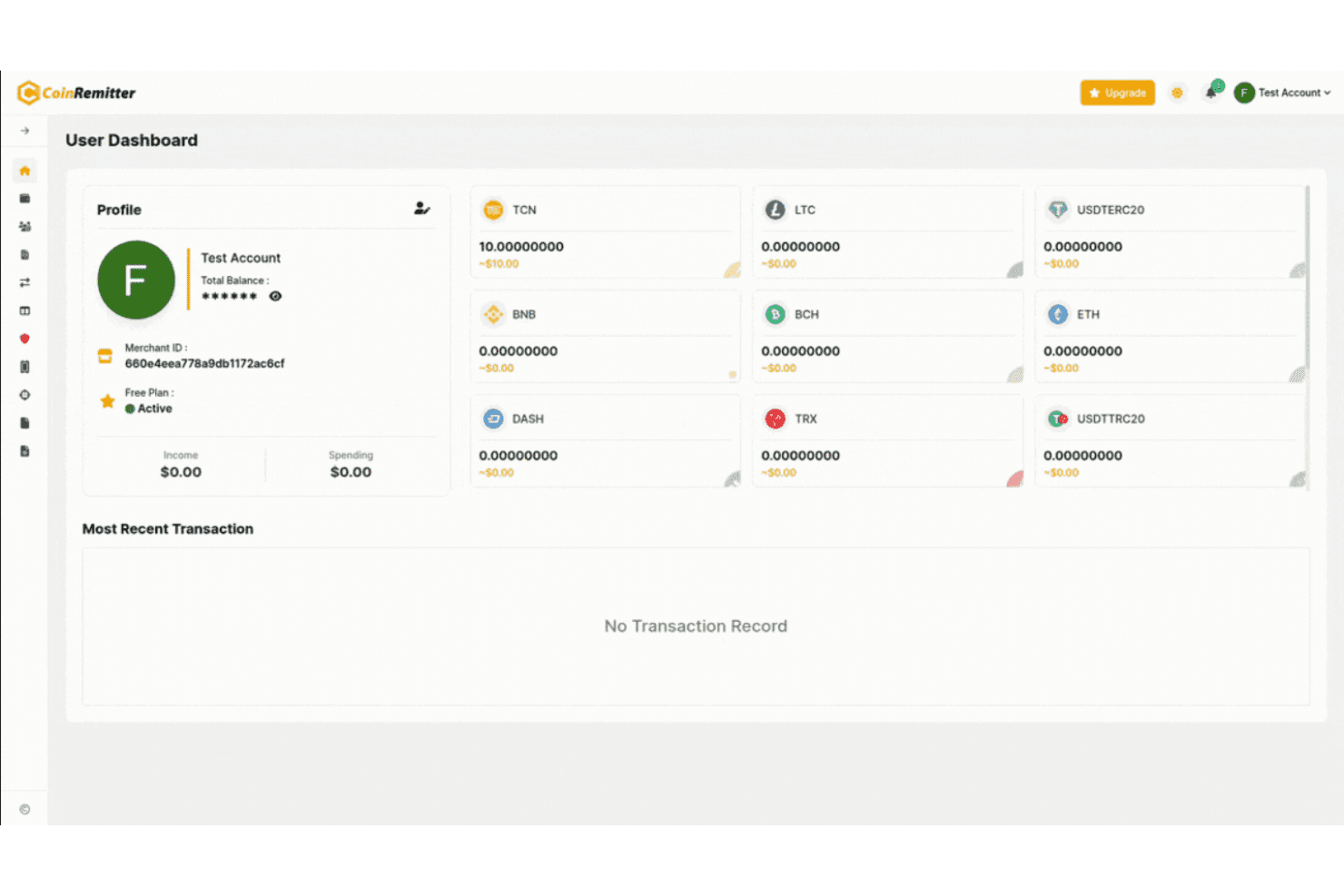
CoinRemitter features a user dashboard with multi-cryptocurrency wallet balances, merchant ID, and transaction history. Coinremitter is a crypto payment gateway that lets merchants accept payments in multiple cryptocurrencies via APIs, plugins, invoicing tools, and embeddable widgets across ecommerce and web platforms.
Who Is Coinremitter Best For?
Coinremitter is a good fit for small to mid-size ecommerce merchants and developers who need a lightweight, low-fee crypto payment gateway with minimal onboarding friction.
Why I Picked Coinremitter
I've included Coinremitter in my top picks because of how its Gas Station feature handles withdrawal fees. Rather than passing network gas costs directly to merchants, it absorbs and reduces them on supported cryptocurrencies like ETH and USDT. Combined with a flat 0.23% processing fee and free deposits, withdrawal cost management here is more predictable than most competing gateways I've tested.
Coinremitter Key Features
- REST API integration: Generate wallets, validate addresses, handle invoices, and automate payment flows using Coinremitter’s documented API.
- No-code payment widgets: Add embeddable pricing tables, payment buttons, and presale widgets to websites without custom coding.
- Multi-platform plugins: Use open-source plugins for Adobe Commerce, WooCommerce, Prestashop, Laravel, and more to start accepting crypto easily.
- Hosted custodial wallets: Store, send, and receive multiple cryptocurrencies within user-managed Coinremitter wallets secured by 2FA.
Coinremitter Integrations
Coinremitter offers native integrations with Adobe Commerce, WooCommerce, PrestaShop, OpenCart, Laravel, PHP, and Node.js. An API is available for custom integrations.
Pros and Cons
Pros:
- Simple payment button and invoice creation
- Merchants control crypto wallet balances
- Zero gas fees on select blockchains
Cons:
- Lacks tax and regulatory compliance features
- No fiat withdrawal or off-ramp support
Learn more about Coinremitter: Best for open-source, self-hosted payment control
- Free demo available
- Free forever
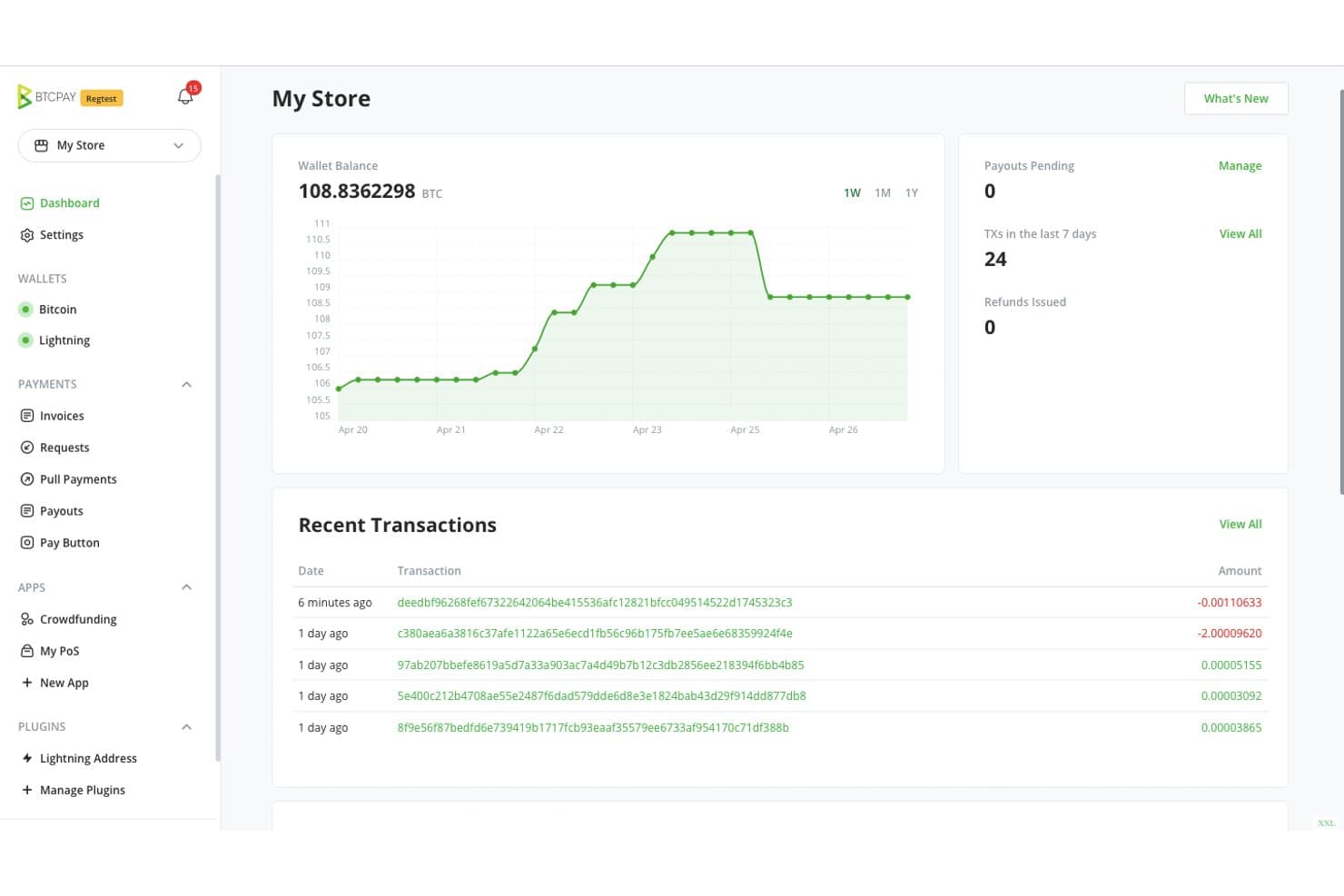
BTCPay Server offers a store dashboard displaying wallet balance, recent transactions, and payment analytics in one view. BTCPay Server is an open-source, self-hosted cryptocurrency payment processor that supports Bitcoin and altcoin acceptance, invoicing, a point-of-sale app, payment links, and a built-in non-custodial wallet with Lightning Network support.
Who Is BTCPay Server Best For?
BTCPay Server suits technically capable merchants, crypto-native businesses, and developers who need full sovereignty over their Bitcoin payment infrastructure.
Why I Picked BTCPay Server
BTCPay Server earns its spot on my shortlist because no other crypto payment solution gives merchants this level of direct control over their payment infrastructure. I like that it's genuinely self-hosted: your keys, your node, your coins, with no platform sitting between you and your customers. The built-in Lightning Network support means you can process fast, low-fee Bitcoin microtransactions directly to your own wallet, with no custodian involved.
BTCPay Server Key Features
- Multi-store management: Run and organize multiple distinct stores from the same BTCPay Server instance.
- Crowdfunding tools: Launch customizable crowdfunding campaigns with built-in crypto payment acceptance.
- Ecommerce platform plugins: Integrate with platforms like WooCommerce, Shopify, Adobe Commerce, and PrestaShop for easier crypto checkouts.
- Invoice export options: Export transaction data and invoices in multiple formats for reconciliation and bookkeeping needs.
BTCPay Server Integrations
BTCPay Server offers native integrations with WooCommerce, Shopify, PrestaShop, OpenCart, Odoo, Wix, Pretix, BigCommerce, Xenforo, Drupal, Joomla, Ghost, WHMCS, and Easy Digital Downloads. An API is available for custom integrations.
Pros and Cons
Pros:
- Open-source with active community development
- Supports Lightning Network Bitcoin payments
- Fully non-custodial self-hosted payment processing
Cons:
- Lacks native compliance and KYC features
- No built-in fiat settlement or conversion
Learn more about BTCPay Server:
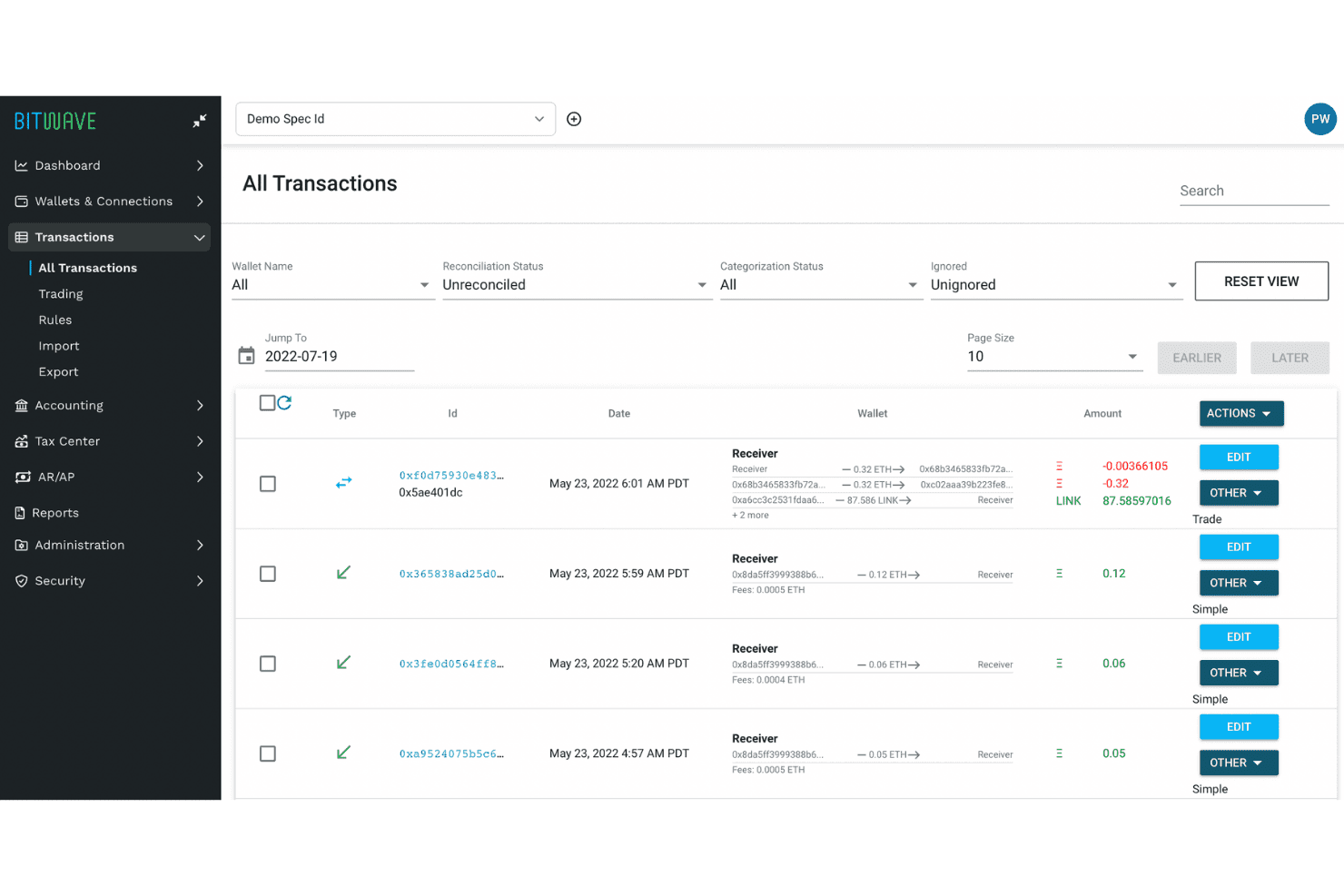
Bitwave offers an All Transactions view with reconciliation filters, wallet details, and categorized crypto transaction entries. Bitwave is an enterprise digital asset accounting and stablecoin payments platform that handles on-chain AP workflows, batch vendor payouts, and automated reconciliation with ERP systems like NetSuite, QuickBooks, Xero, and Sage.
Who Is Bitwave Best For?
Bitwave is a strong fit for controllers and accounting managers at mid-to-large enterprises running active digital asset or stablecoin payment programs.
Why I Picked Bitwave
I picked Bitwave as one of the best because its accounting reconciliation capabilities go well beyond basic CSV exports. It maintains an enterprise-grade subledger with an immutable audit trail for every on-chain transaction, keeping records audit-ready without extra prep at close. I also rely on its support for FIFO, LIFO, and Specific Identification lot tracking, which keeps cost basis calculations accurate across high-volume stablecoin payment runs.
Bitwave Key Features
- Native ERP integration: Connect directly with NetSuite, QuickBooks, Xero, or Sage for real-time data sync across systems.
- Batch stablecoin payments: Send hundreds of USDC or USDT payouts to multiple vendors in one workflow.
- Vendor payment network: Access a directory of pre-verified, allow-listed wallet addresses to reduce payment risk.
- Multi-chain support: Track and manage digital asset transactions across 50+ supported blockchains.
Bitwave Integrations
Bitwave offers native integrations with NetSuite, QuickBooks, Xero, Sage, Anchorage, BitGo, Coinbase, Fireblocks, Gemini, Kraken, and Paxos. An API is available for custom integrations.
Pros and Cons
Pros:
- Strong audit trail for on-chain transactions
- Supports 50+ blockchains and stablecoins
- Enterprise-grade crypto accounting automation
Cons:
- No transparent or self-serve pricing
- Lacks native merchant checkout features
Learn more about Bitwave: Best for enterprise-grade regulatory compliance
- Free demo available
- Pricing upon request
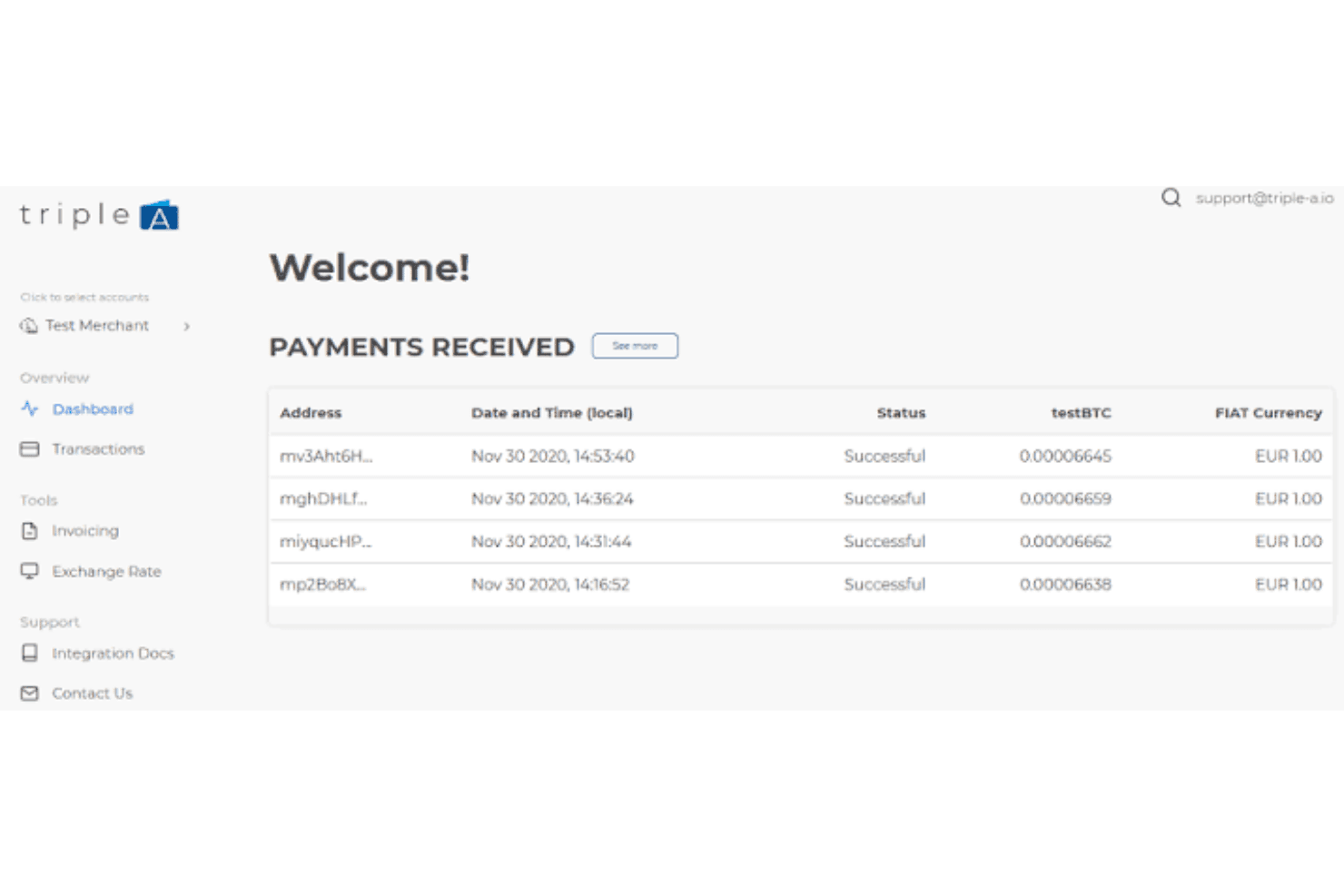
Triple-A offers a merchant dashboard with a payments received table showing successful Bitcoin transactions converted to EUR fiat currency. Triple-A is a licensed crypto payment gateway that lets businesses accept stablecoin and cryptocurrency payments, issue payouts in 30+ local currencies, and settle funds directly to a bank account via API, checkout, or invoicing tools.
Who Is Triple-A Best For?
Triple-A suits mid-market and enterprise businesses in regulated industries that need multi-jurisdiction crypto payment compliance across Asia-Pacific, Europe, and the US.
Why I Picked Triple-A
Triple-A earns its spot on my shortlist because it holds more regulatory licenses than any other crypto payment gateway I've reviewed: MAS (Singapore), ACPR and AMF DASP (France/EU), and FinCEN MSB (US). In practice, that means my team can operate across Asia-Pacific, Europe, and North America without separate compliance infrastructure. I also like that exchange rates lock at the moment of payment, so there's zero crypto on the balance sheet while settlement processes.
Triple-A Key Features
- Checkout plugins and API integration: Supports ecommerce sites and custom platforms via plugins and developer APIs.
- Multicurrency IBAN accounts: Lets businesses receive payments to unique IBANs with conversion to preferred currencies.
- Stablecoin and local currency payouts: Enables sending business payments in USDT, USDC, and 30+ local currencies worldwide.
- Exportable transaction and settlement reports: Provides downloadable reports for auditing and financial reconciliation needs.
Triple-A Integrations
Triple-A offers integrations via its API. Native integrations are not clearly documented beyond the API access.
Pros and Cons
Pros:
- Multi-currency IBAN accounts for businesses
- Zero-volatility instant settlement to fiat
- Singapore MAS licensed payment provider
Cons:
- Custom pricing for smaller merchants
- Limited selection of supported cryptocurrencies
Learn more about Triple-A: Best for ecommerce store plugin compatibility
- Free demo available
- From 0.5% transaction fee
Visit WebsiteCustomer Rating:4.9/5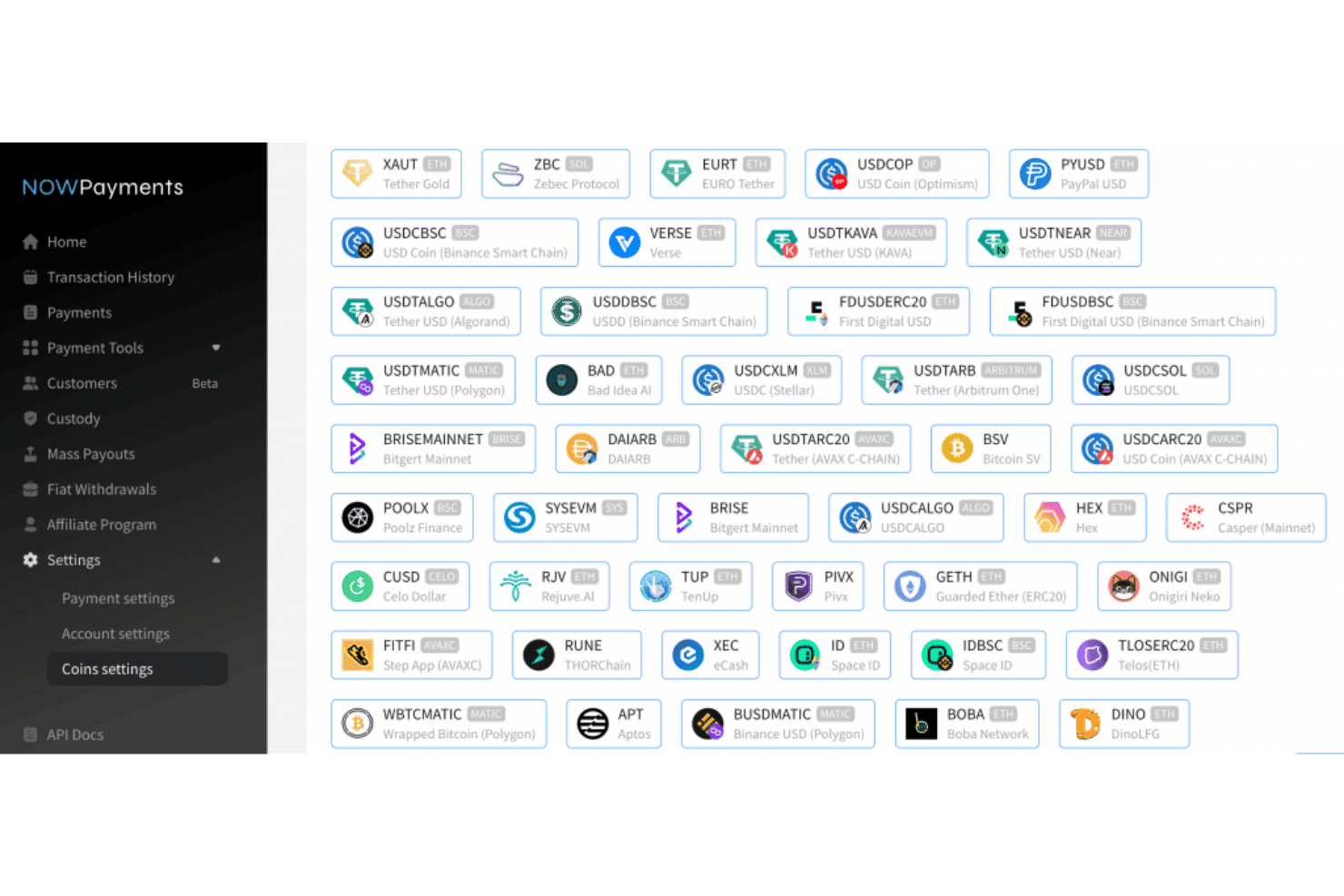
NOWPayments offers a wide range of supported cryptocurrencies accessible through its Coins Settings dashboard. NOWPayments is a non-custodial crypto payment gateway that lets merchants accept 350+ cryptocurrencies, issue invoices, run subscriptions, and process mass payouts via API, plugins, or a hosted checkout widget.
Who Is NOWPayments Best For?
NOWPayments is a strong fit for ecommerce merchants and SMB operators who need plug-and-play crypto payment acceptance across platforms like WooCommerce, Shopify, or Adobe Commerce.
Why I Picked NOWPayments
NOWPayments earns its spot on my shortlist because of how many ecommerce platforms it supports natively, without needing custom development. I've installed the WooCommerce plugin and it's fully compatible with WooCommerce Blocks and the modern block-based checkout, which matters when you're running a headless or block-theme storefront. Beyond WooCommerce, ready-built plugins for Adobe Commerce, PrestaShop, OpenCart, and WHMCS mean I can add crypto acceptance to almost any stack without touching the API.
NOWPayments Key Features
- Multi-currency crypto acceptance: Accept payments in 350+ cryptocurrencies including BTC, ETH, and stablecoins from anywhere in the world.
- Fiat on- and off-ramp support: Enable customers to buy crypto with fiat and merchants to convert crypto payments to over 75 fiat currencies.
- Non-custodial and custody wallet options: Choose between non-custodial direct settlement or platform-based custody for holding and disbursing funds.
- Subscription and recurring billing: Set up automated recurring crypto payments for SaaS, memberships, or ongoing services.
NOWPayments Integrations
NOWPayments offers native integrations with WooCommerce and WHMCS, and provides an API for custom integrations.
Pros and Cons
Pros:
- Option for non-custodial or custodial wallets
- Full plugin support for major ecommerce platforms
- Supports email-based zero-fee payouts
Cons:
- Lacks published regulatory compliance certifications
- Requires intermediate wallet routing step
Learn more about NOWPayments:
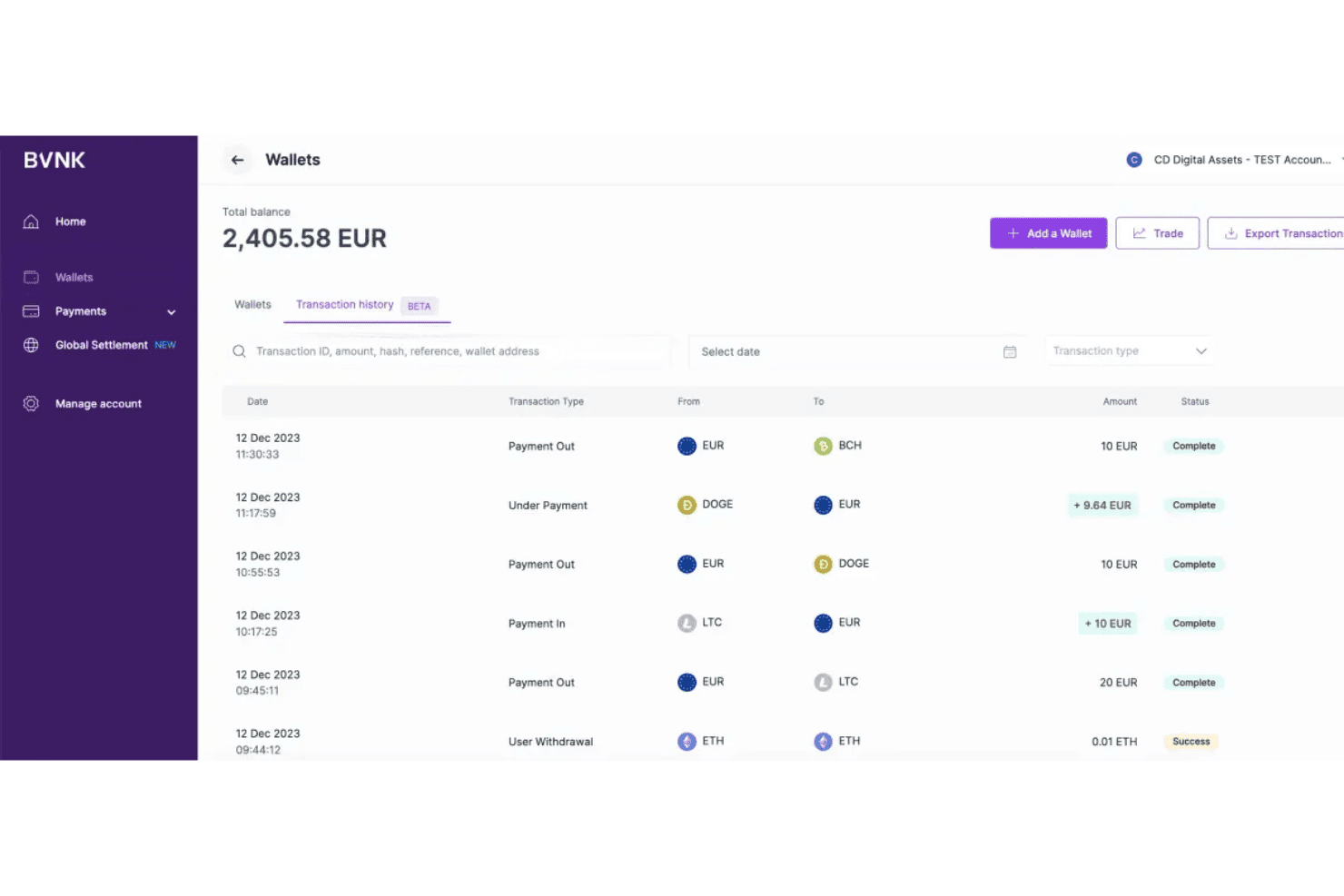
BVNK offers a multi-currency wallet dashboard with transaction history, showing EUR, crypto payments, and real-time statuses. BVNK is a stablecoin payments infrastructure platform that lets businesses send, receive, convert, and store crypto and fiat currencies through APIs, hosted checkout pages, invoicing, and multi-currency wallets across 130+ countries.
Who Is BVNK Best For?
BVNK is a strong fit for enterprise fintech companies, marketplaces, and global payroll platforms that need stablecoin payment infrastructure at scale.
Why I Picked BVNK
I've included BVNK in my top picks because its cross-border B2B payout infrastructure is genuinely built for volume. My team can fund payouts in fiat and deliver stablecoins to partners across 130+ countries, or do the reverse, all settled 24/7 through SWIFT, SEPA, and ACH. The mass payout tooling via CSV or API is where it gets practical: I can push high-volume payments to suppliers or contractors without manual processing per transaction.
BVNK Key Features
- Multi-chain asset support: Accept and send payments in USDC, USDT, DAI, BTC, ETH, and other leading cryptocurrencies across major blockchains.
- Regulatory compliance infrastructure: Leverage MiCA passporting, full KYC/AML onboarding, and SOC 2 Type II certification for global transaction oversight.
- API-first integration: Access REST APIs and SDKs in multiple languages for automating payment, reconciliation, and treasury workflows.
- Customizable hosted checkout: Deploy branded payment pages supporting crypto and fiat, with auto-convert and multi-language options for customer payments.
BVNK Integrations
BVNK offers native integrations with Payment IQ, Praxis Checkout, Bridgerpay, PremierCashier, and Stratified. An API is available for custom integrations.
Pros and Cons
Pros:
- Regulated in US, UK, and EU
- Multi-currency wallets for crypto and fiat
- Global B2B stablecoin settlement capabilities
Cons:
- Requires minimum monthly transaction commitment
- No direct integration with accounting software
Learn more about BVNK:
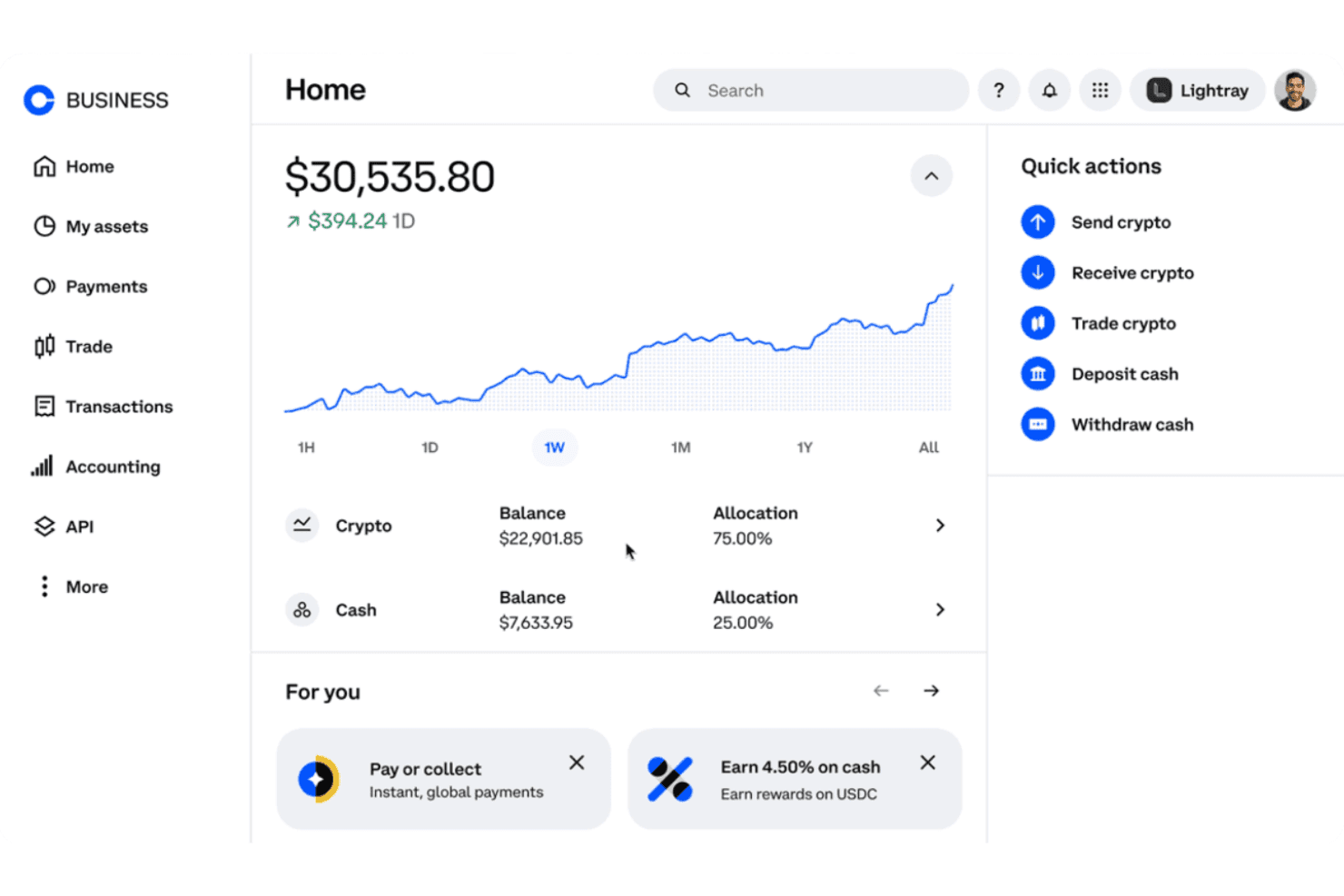
Coinbase Business offers a home dashboard with total portfolio balance, crypto and cash allocations, a performance chart, and quick action shortcuts. Coinbase Business is a regulated crypto financial platform that combines merchant payment acceptance, invoicing, payouts, custody, USDC treasury yield, and trading in a single business account.
Who Is Coinbase Business Best For?
It's a strong fit for CFOs and corporate treasurers at startups and growth-stage companies that want institutional-grade crypto custody, payments, and yield management under one regulated account.
Why I Picked Coinbase Business
Coinbase Business earns its spot on my shortlist because no other crypto payment platform bundles institutional custody with a live 3.35% APY on idle USDC balances. I like that the custody side is NYDFS-regulated and SOC 2 audited, so I'm not trading compliance for yield. Payments settle in seconds across Ethereum, Base, Polygon, Optimism, and Arbitrum with no chargebacks.
Coinbase Business Key Features
- Global payouts infrastructure: Send USDC payments instantly to vendors or contractors in supported regions with low fees.
- Native QuickBooks and Xero integrations: Sync crypto transactions directly with leading accounting software for reconciliation and reporting.
- Checkouts API and ecommerce plugins: Add crypto payment options to online checkout flows using developer APIs or ready-made storefront integrations.
- Automated compliance monitoring: Every transaction is screened for sanctions, KYC, and AML within a regulated custodial framework.
Coinbase Business Integrations
Native integrations are not publicly documented. Coinbase Business offers an API for custom integrations.
Pros and Cons
Pros:
- Built-in treasury yield on USDC balances
- Multi-chain USDC payments and settlements
- Regulated NYDFS-qualified custody for businesses
Cons:
- Fiat settlement limited to select countries
- Only supports USDC for merchant payments
Learn more about Coinbase Business: Best for automated fiat payouts to bank accounts
- Free demo available
- From 1% transaction fee
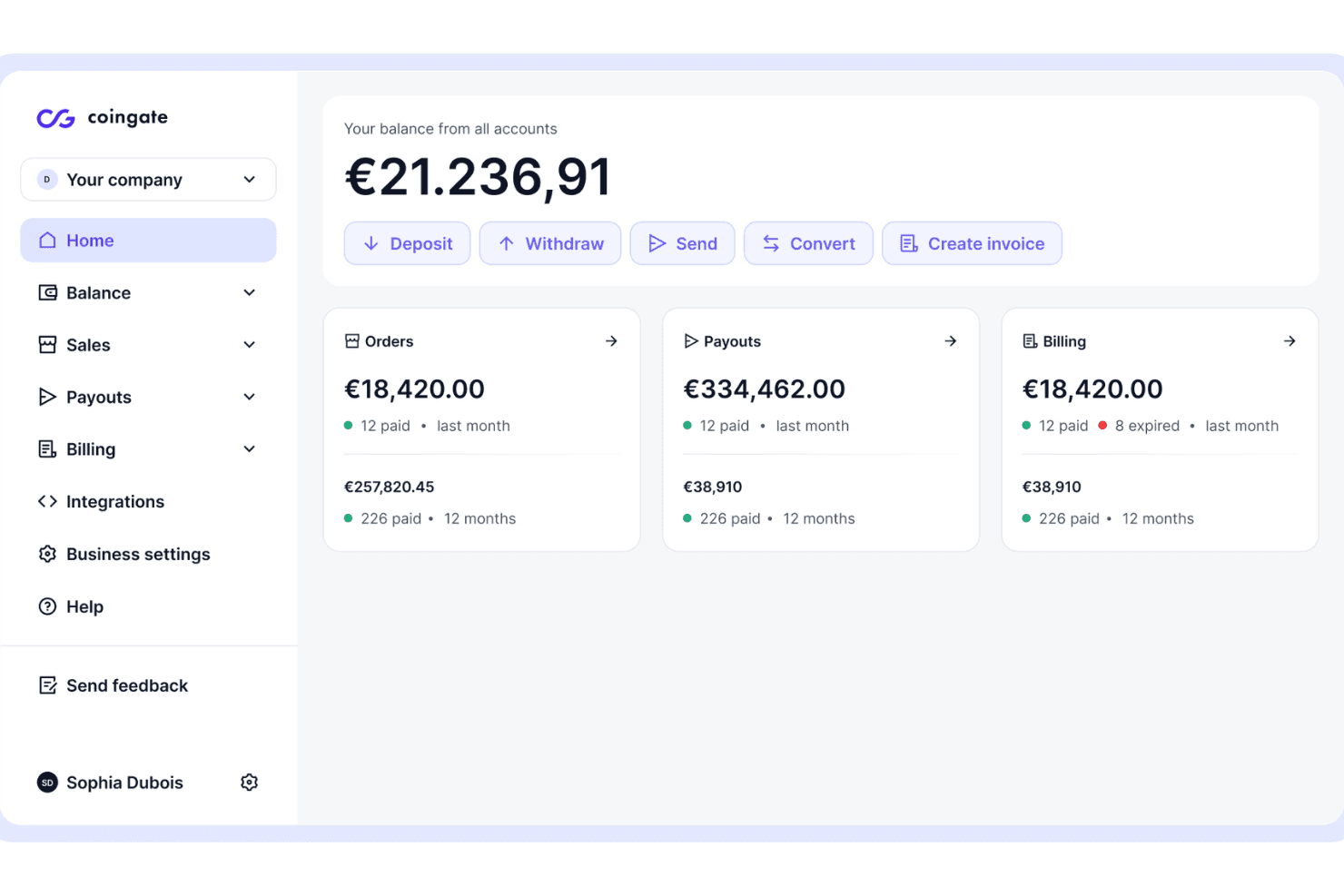
CoinGate offers a centralized dashboard showing account balance, orders, payouts, and billing summaries with quick-action buttons. CoinGate is a crypto payment gateway that lets merchants accept 10+ cryptocurrencies, auto-convert to fiat or stablecoins, issue invoices, and send mass payouts via API, no-code dashboard, or ecommerce plugins.
Who Is CoinGate Best For?
CoinGate suits ecommerce operators and digital platforms that need to accept crypto globally and receive automatic fiat settlements directly into a business bank account.
Why I Picked CoinGate
I picked CoinGate as one of the best because of how its fiat settlement pipeline actually works. The platform locks the exchange rate at the exact moment a customer pays, so volatility between payment and payout doesn't eat into your margins. SEPA bank settlements run automatically on a weekly schedule at no extra cost, and Enterprise clients can switch to on-demand payouts when cash flow timing matters.
CoinGate Key Features
- Multi-chain crypto acceptance: Accept payments in BTC, ETH, USDT, USDC, and several other leading cryptocurrencies across popular blockchains.
- Ecommerce plugin integrations: Connect with WooCommerce, Adobe Commerce (Magento), PrestaShop, and OpenCart for easy merchant onboarding.
- Role-based account permissions: Assign team members different access levels for managing crypto payments, payouts, and reconciling transactions.
- Customizable reporting tools: Generate account statements and filter, export, or download structured CSVs for compliance and bookkeeping.
CoinGate Integrations
CoinGate offers native integrations with WooCommerce, PrestaShop, OpenCart, and WHMCS for ecommerce platforms. An API is available for building custom integrations.
Pros and Cons
Pros:
- Customizable reporting for transaction reconciliation
- Supports multi-asset settlements including stablecoins
- Automated SEPA payouts for EU businesses
Cons:
- Custodial-only wallet without MPC or insurance
- High minimum bank withdrawal amounts
Learn more about CoinGate: Best for instant onramp integration at checkout
- Not available
- Pricing upon request
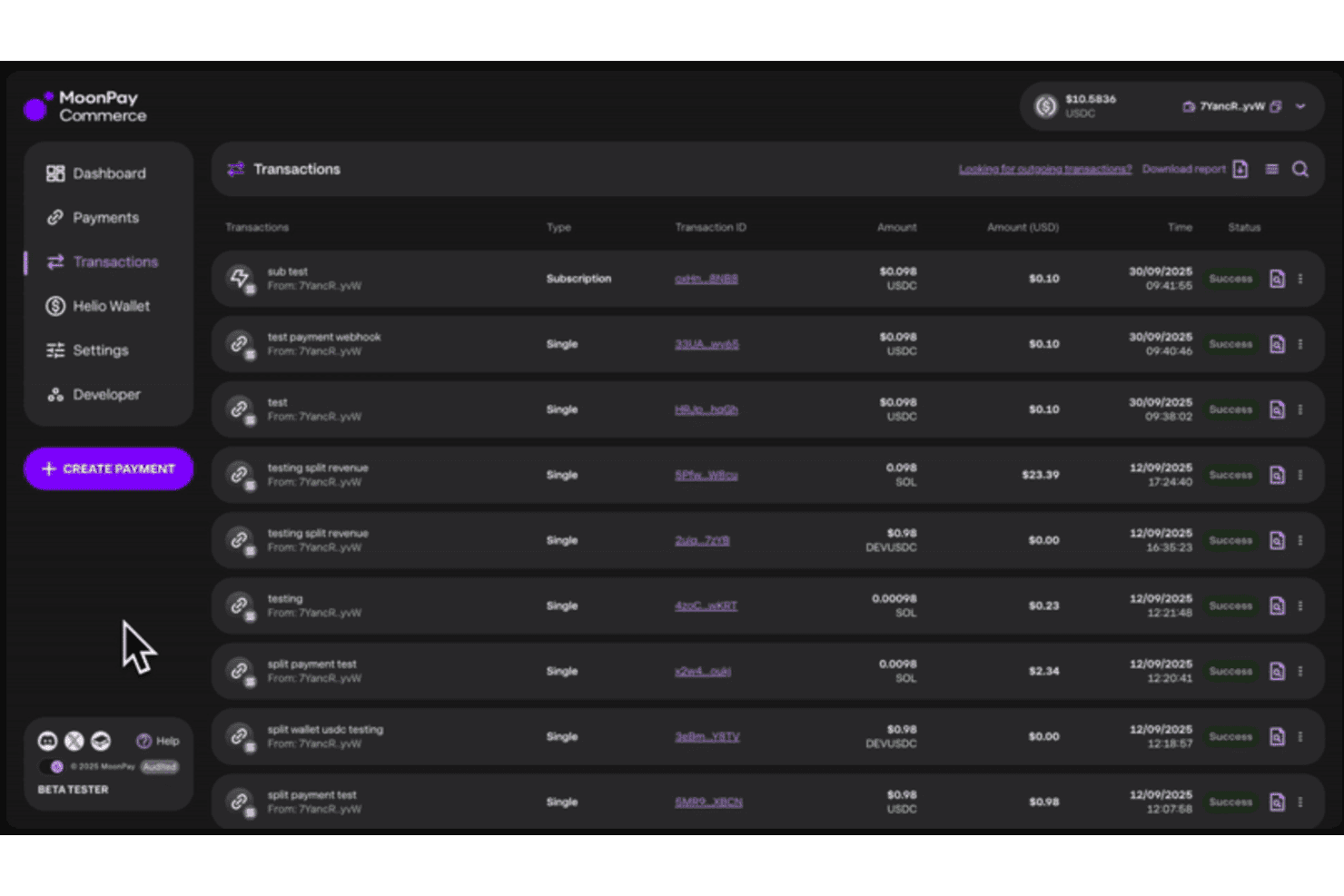
MoonPay Commerce displays a transactions dashboard listing payment history with statuses, amounts, and transaction IDs. MoonPay Commerce is a crypto payment platform that lets merchants accept multi-chain cryptocurrency payments via checkout widgets, pay links, APIs, and plugins, with built-in fiat settlement and KYC/AML compliance.
Who Is MoonPay Commerce Best For?
MoonPay Commerce is a strong fit for ecommerce merchants and digital platforms that need to accept crypto payments without building payment infrastructure from scratch.
Why I Picked MoonPay Commerce
I picked MoonPay Commerce as one of the best because the card-to-crypto onramp lives inside the checkout widget itself. Shopify merchants, for instance, can activate the Solana Pay plugin and let customers pay by card while receiving crypto in real time. The "Pay with Card" feature handles non-crypto buyers without redirecting anyone off-site, keeping the transaction fully within the checkout experience.
MoonPay Commerce Key Features
- Multi-chain token support: Accept payments in hundreds of cryptocurrencies across major blockchains like Solana, Ethereum, Bitcoin, and Polygon.
- Auto-offramp to fiat: Enable automated conversion of crypto payments to USD or EUR, with settlement to your linked bank account.
- APIs and webhooks: Access developer endpoints for custom payment flows, real-time notifications, and back-office automation.
- Regulatory compliance stack: Includes SOC 2, PCI DSS, and ISO 27001 certifications, plus multi-jurisdiction KYC/AML coverage.
MoonPay Commerce Integrations
MoonPay Commerce offers native integrations with Shopify (including Solana Pay) and Discord, and provides an API and webhooks for custom integrations.
Pros and Cons
Pros:
- Granular payment control via APIs and plugins
- Instant fiat settlement for select currencies
- Built-in onramp for non-crypto-native buyers
Cons:
- Fiat settlement limited to USD and EUR
- No native accounting software integrations
Learn more about MoonPay Commerce:
Outras soluções de pagamento com criptomoedas
Eis algumas opções adicionais de soluções de pagamento com criptomoedas que não chegaram à minha lista restrita, mas que continuam a merecer consideração:
- 11BlockBeeBest for simple payment link creation
- 12CryptoProcessingBest for high-volume merchant settlements
- 13B2BINPAYBest for multi-chain and token acceptance
- 14StripeBest for unified crypto and fiat checkout flows
- 150xProcessingBest for flexible wallet custody options
- 16MESHBest for API-driven digital asset integration
- 17PassimPayBest for fast merchant onboarding worldwide
- 18BitPayBest for payment card rewards with digital assets
How I Evaluate Crypto Payment Solutions
I split my evaluation into what a platform must handle—like fiat settlement and KYC—and what separates the best from the rest, like multi-chain reach and reconciliation depth.
Core Functionality (Table Stakes for This List)
When I'm selecting tools for my list, I rank each one on a scale from 0 (does not offer the functionality) to 5 (excels in this area) for each core functionality listed below. Then, I calculate the tool's total score into a percentage. Each tool needs to achieve a minimum total score of 65% to be considered for inclusion.
- Multi-Currency Crypto Acceptance: I check how many cryptocurrencies and stablecoins a platform supports, since your customers may want to pay in BTC, ETH, USDC, or tokens on chains like Solana or Tron.
- Fiat Settlement & Conversion: A platform should auto-convert crypto payments into fiat currencies and settle to your bank account, so your treasury team isn't manually managing exchange risk.
- Payment Processing Infrastructure: I evaluate the checkout tools, invoicing options, payment links, and API access each platform provides for merchant or B2B transaction workflows.
- Accounting & Reconciliation Tools: Finance teams need exportable reports or native integrations with platforms like QuickBooks, Xero, or NetSuite to close the books without manual data entry.
- Regulatory Compliance & KYC/AML: I look at each platform's licensing, KYC/AML enforcement, and sanctions screening to confirm it can support your obligations across the jurisdictions you operate in.
- Wallet & Custody Management: Whether custodial or self-hosted, I evaluate how each platform handles fund storage, including security measures like MPC wallets or multi-signature controls.
Once I have a list of tools that meet the criteria, I consider what sets each platform apart.
Differentiating Factors (What Sets Vendors Apart)
Here's how I compare and contrast different vendors:
Standout Features
Multi-chain support matters because your customers may hold tokens on Ethereum, Solana, Tron, or Polygon—and a platform that covers more chains means fewer lost sales at checkout. I also look at auto-conversion to fiat, which shields your treasury from price swings by settling payments in local currency before volatility hits. For crypto-native businesses, non-custodial wallet options let you keep full control of funds without relying on a third party's security. On/off-ramp integration is another differentiator I evaluate, since it lets buyers who don't yet hold crypto purchase it directly during checkout.
Beyond Features
Fee structure is a big differentiator—I look at how gas fees are handled and whether settlement happens in real time or on a T+1 cycle. Regulatory posture also shapes my view, since I check for multi-jurisdictional licensing and chain analytics partnerships with providers like Chainalysis or Elliptic for sanctions screening. Integration quality rounds out my evaluation, from ecommerce plugins for Shopify or WooCommerce to REST APIs and sandbox environments for pre-launch testing.
Como escolher soluções de pagamento com criptomoedas
É fácil ficar preso a listas extensas de funcionalidades e estruturas de preços complexas. Para o ajudar a manter-se focado enquanto percorre o seu processo exclusivo de seleção de software, eis uma lista de verificação dos fatores a ter em conta:
| Fator | O que considerar |
|---|---|
| FatorEscalabilidade | O que considerarA plataforma acompanhará o crescimento das transações e a expansão para novos mercados ou moedas? Avalie a sua capacidade para suportar picos ou aumentos súbitos de volume. |
| FatorIntegrações | O que considerarA solução liga-se ao seu ERP, à sua plataforma de comércio eletrónico ou ao seu sistema de contabilidade? Procure plug-ins pré-configurados ou APIs compatíveis com o seu fluxo de trabalho e a sua infraestrutura tecnológica. |
| FatorPersonalização | O que considerarPode adaptar os fluxos de pagamentos, os formatos de faturação ou os calendários de liquidação? Avalie o nível de configuração possível para os seus processos. |
| FatorFacilidade de utilização | O que considerarQuão intuitivo é o painel de controlo para as equipas financeiras e de apoio? Considere as necessidades de formação, a navegação diária e a clareza dos relatórios de transações. |
| FatorImplementação e integração inicial | O que considerarQue prazo, recursos internos e apoio são necessários para entrar em funcionamento? Informe-se sobre os processos de migração, os ambientes de teste e o apoio à formação dos funcionários. |
| FatorCusto | O que considerarAnalise não só as taxas de transação e conversão, mas também quaisquer custos de configuração, subscrição ou pagamento. Esteja atento a taxas de rede ou de levantamento ocultas. |
| FatorMedidas de segurança | O que considerarQue proteções das carteiras, controlos de acesso e históricos de incidentes mantém o fornecedor? Procure provas de certificações, seguros ou auditorias. |
| FatorRequisitos de conformidade | O que considerarO fornecedor cumpre os requisitos de KYC/AML ou de licenciamento aplicáveis às suas jurisdições? As ferramentas de elaboração de relatórios são adequadas às suas necessidades fiscais, de auditoria ou regulamentares? |
O que são soluções de pagamento com criptomoedas?
As soluções de pagamento em criptomoedas são plataformas que permitem à sua empresa aceitar, liquidar e gerir pagamentos em moedas digitais como Bitcoin, Ethereum e moedas estáveis. Estas ferramentas suportam a aceitação de várias moedas, a conversão para moeda fiduciária, o processo de pagamento para comerciantes e os fluxos de trabalho de conformidade, ajudando as equipas financeiras a gerir transações de ativos digitais juntamente com pagamentos tradicionais em várias regiões e para diferentes tipos de clientes.
Funcionalidades das soluções de pagamento em criptomoedas
Ao selecionar soluções de pagamento em criptomoedas, tenha em atenção as seguintes funcionalidades principais:
- Aceitação de várias moedas: Aceite pagamentos numa vasta gama de criptomoedas e moedas estáveis para servir clientes a nível global e expandir o seu alcance.
- Conversão e liquidação em moeda fiduciária: Converta automaticamente os pagamentos em criptomoedas para moedas fiduciárias e transfira os fundos para a sua conta bancária, gerindo a volatilidade e simplificando as operações financeiras.
- Ligações de pagamento e ferramentas de finalização de pagamentos: Gere ligações ou incorpore componentes de finalização de pagamentos para pagamentos de clientes no seu sítio Web, faturas ou canais digitais.
- Integração de faturação: Crie, envie e gira faturas compatíveis com criptomoedas diretamente a partir da plataforma, suportando transações recorrentes e pontuais.
- Integrações contabilísticas: Ligue-se a plataformas como QuickBooks ou Xero para sincronizar automaticamente os dados das transações, simplificando a reconciliação e os relatórios.
- Ferramentas de KYC/AML e conformidade: Imponha os requisitos de conhecimento do cliente (KYC) e de combate ao branqueamento de capitais (AML), garantindo que as suas transações cumprem as normas regulamentares.
- Gestão de carteiras: Armazene, receba e distribua fundos em criptomoedas de forma segura, utilizando carteiras com ou sem custódia e controlos de acesso adequados.
- Suporte para API e programadores: Tire partido de APIs e SDKs para incorporar funcionalidades de pagamento em criptomoedas nas suas aplicações personalizadas ou sistemas administrativos.
- Relatórios e análises: Aceda ao histórico de transações, aos calendários de pagamentos e a painéis em tempo real que fornecem informações úteis para auditorias e tomadas de decisão.
- Opções de conversão entre criptomoedas e moeda fiduciária: Permita que os clientes convertam criptomoedas em moeda fiduciária e vice-versa durante o processo de pagamento, ajudando a integrar novos utilizadores e a liquidar fundos de forma eficiente.
Benefícios das soluções de pagamento em criptomoedas
A implementação de soluções de pagamento em criptomoedas oferece várias vantagens à sua equipa e à sua empresa. Eis algumas das que pode esperar:
- Maior alcance de clientes: Aceitar criptomoedas e moedas estáveis atrai uma base de clientes mais ampla e global, que prefere pagamentos com ativos digitais.
- Liquidação mais rápida: Os pagamentos em criptomoedas podem ser liquidados em minutos ou horas, em vez de dias, melhorando a gestão do fluxo de caixa.
- Custos de transação mais baixos: As transações em criptomoedas implicam frequentemente comissões mais baixas do que os pagamentos com cartão de crédito, sobretudo nas vendas transfronteiriças e nas transações B2B.
- Segurança reforçada: Os controlos avançados das carteiras, as verificações de conformidade e as funcionalidades de encriptação protegem os fundos e os dados das transações contra fraude ou roubo.
- Redução do risco cambial: A conversão automática para moeda fiduciária ajuda a proteger as receitas da volatilidade dos preços das criptomoedas, contribuindo para uma contabilidade mais estável.
- Melhoria da conformidade: O KYC/AML, os relatórios fiscais e os controlos regulamentares integrados nestas soluções simplificam os requisitos para as equipas financeiras e de auditoria.
- Reconciliação melhorada: As integrações diretas com sistemas contabilísticos e as ferramentas de relatórios integradas reduzem o trabalho manual no final do mês e no fecho contabilístico.
Custos e preços das soluções de pagamento em criptomoedas
A seleção de soluções de pagamento em criptomoedas exige uma compreensão dos vários modelos de preços e planos disponíveis. Os custos variam consoante as funcionalidades, a dimensão da equipa, os complementos e outros fatores. A tabela abaixo resume os planos mais comuns, os seus preços médios e as funcionalidades normalmente incluídas nas soluções de pagamento em criptomoedas:
Tabela de comparação de planos para soluções de pagamento em criptomoedas
| Tipo de plano | Preço médio | Funcionalidades comuns |
|---|---|---|
| Tipo de planoPlano gratuito | Preço médio$0 | Funcionalidades comunsAceitação básica de criptomoedas, volume de transações limitado, relatórios padrão e ferramentas essenciais de gestão de carteiras. |
| Tipo de planoPlano pessoal | Preço médio$10–$40/mês | Funcionalidades comunsSuporte para várias moedas, ligações de pagamento, faturação básica, reconciliação manual e suporte por e-mail. |
| Tipo de planoPlano empresarial | Preço médio$49–$199/mês | Funcionalidades comunsFerramentas de finalização de pagamentos personalizáveis, conversão automática para moeda fiduciária, integrações com plataformas contabilísticas, limites de transação superiores e ferramentas de KYC/AML. |
| Tipo de planoPlano empresarial avançado | Preço médio$200+/mês ou personalizado | Funcionalidades comunsIntegrações avançadas de API, suporte para várias redes e moedas fiduciárias, integração dedicada, relatórios regulamentares e suporte prioritário. |
Perguntas frequentes sobre soluções de pagamentos em criptomoedas
Eis algumas respostas a perguntas comuns sobre soluções de pagamentos em criptomoedas:
Como é que as soluções de pagamentos em criptomoedas asseguram a conformidade regulamentar?
A maioria dos serviços de pagamento que disponibilizam um gateway de pagamentos em criptomoedas inclui verificações KYC/AML integradas, autenticação de identidade e cumpre os requisitos de licenciamento definidos pelas instituições financeiras e pelos reguladores nas regiões onde opera.
Deve verificar se o prestador de serviços realiza as análises necessárias da blockchain e fornece relatórios que cumprem as obrigações de auditoria, fiscais e legais da sua empresa no âmbito dos pagamentos globais.
Posso aceitar várias criptomoedas com uma única solução de pagamentos?
Sim, os melhores gateways de pagamentos em criptomoedas permitem aceitar dezenas ou até centenas de moedas digitais, incluindo as principais moedas e stablecoins, diretamente através de uma interface de carteira digital unificada. Disponibilizar métodos de pagamento diversificados melhora a experiência geral do utilizador, otimiza as taxas de conversão e reduz os obstáculos no checkout, permitindo que os clientes de todo o mundo paguem com o token da sua preferência.
Receberei os pagamentos em moeda fiduciária ou em criptomoedas?
Normalmente, pode optar por liquidar diretamente na sua carteira digital de criptomoedas, executar transferências automatizadas através de um contrato inteligente ou converter os fundos em moedas fiduciárias suportadas, como USD, EUR ou GBP. As opções flexíveis de liquidação disponibilizadas por um processador moderno de pagamentos em criptomoedas ajudam a satisfazer as suas necessidades de tesouraria, contabilidade e fluxo de caixa.
As soluções de pagamentos em criptomoedas integram-se com software de contabilidade?
Sim, as principais plataformas integram-se com sistemas de pagamento tradicionais, plataformas de comércio eletrónico e conjuntos de aplicações de contabilidade, como o QuickBooks, o Xero ou o NetSuite. Quer as utilize para comércio eletrónico, remessas B2B ou serviços financeiros mais abrangentes, estas ferramentas simplificam os casos de utilização em todo o seu ecossistema tecnológico e facilitam o fecho da contabilidade.
Com que aspetos de segurança devo ter cuidado?
Verifique se o prestador utiliza carteiras offline, controlos de múltiplas assinaturas ou MPC, certificações SOC 2, monitorização de transações em tempo real e autenticação multifator. Estas funcionalidades protegem os fundos dos comerciantes e os dados dos clientes contra roubo, fraude e acesso não autorizado em todas as transações.