

Software-ul pentru gestionarea contractelor la nivel de întreprindere este conceput pentru a ajuta companiile să creeze, să negocieze, să execute și să monitorizeze contracte complexe la scară largă. Dacă evaluați aceste instrumente, probabil vă confruntați cu procese fragmentate, riscuri de neconformitate și dificultatea coordonării între echipe. Alegerea soluției potrivite este importantă — expunerea organizației, pregătirea pentru audit și durata ciclurilor depind toate de aceasta. Acest ghid se concentrează pe ceea ce oferă cele mai bune opțiuni și pe aspectele pe care trebuie să le urmăriți, astfel încât să puteți alege cu încredere soluția potrivită nevoilor dumneavoastră și să minimizați riscurile.
Why Trust Our Software Recommendations
6,700+
Reviews
20
Industry experts
16+
Evaluation factors
14
Years
Our team has been testing and reviewing software since 2012. As finance leaders ourselves, we know how difficult—and important—it is to choose the right software.
For this guide, we evaluated tools using hands-on testing and independent research, scoring tools using our selection criteria.
Our reviews reflect our human editorial judgment, not a sales pitch.
Tabel comparativ al soluțiilor software pentru gestionarea contractelor la nivel de întreprindere
Acest tabel comparativ rezumă detaliile privind prețurile pentru selecția mea de top de soluții software pentru gestionarea contractelor la nivel de întreprindere.
Sorted by: Default
| Tool | Starting Price | Website | |
|---|---|---|---|
Best for portfolio-wide contract reporting | 4.7 out of 5 | Pricing upon request Free demo available | Website |
Best for AI discovery across contract repositories | 4.5 out of 5 | Pricing upon request Free demo available | Website |
Best for AI contract performance management | 4.5 out of 5 | Pricing upon request Free demo available | Website |
Best for cross-functional contract collaboration | 4.5 out of 5 | Pricing upon request Free demo available | Website |
Best for playbook-driven contract redlining | 4.5 out of 5 | Pricing upon request Free demo available | Website |
Best for CLM with integrated e-signatures | 4.7 out of 5 | Pricing upon request Free demo available | Website |
Best for highly configurable contract processes | 4.7 out of 5 | Pricing upon request Free demo available | Website |
Best for workflow automation with self-serve tools | 4.4 out of 5 | Pricing upon request Free demo available | Website |
Best for enterprise-wide obligation intelligence | 4.3 out of 5 | Pricing upon request Free demo available | Website |
Best for revenue-focused contract management | 4.3 out of 5 | Pricing upon request Free demo available | Website |


Recenzii ale celor mai bune soluții software pentru gestionarea contractelor la nivel de întreprindere
Mai jos sunt prezentate rezumatele mele detaliate ale celor mai bune soluții software pentru gestionarea contractelor la nivel de întreprindere care au ajuns pe lista mea scurtă. Recenziile mele oferă o analiză detaliată a funcțiilor, integrărilor și celor mai potrivite cazuri de utilizare pentru fiecare platformă, pentru a vă ajuta să o găsiți pe cea mai potrivită pentru dumneavoastră.
 Best for portfolio-wide contract reporting
- Free demo available
- Pricing upon request
Visit WebsiteCustomer Rating:4.7/5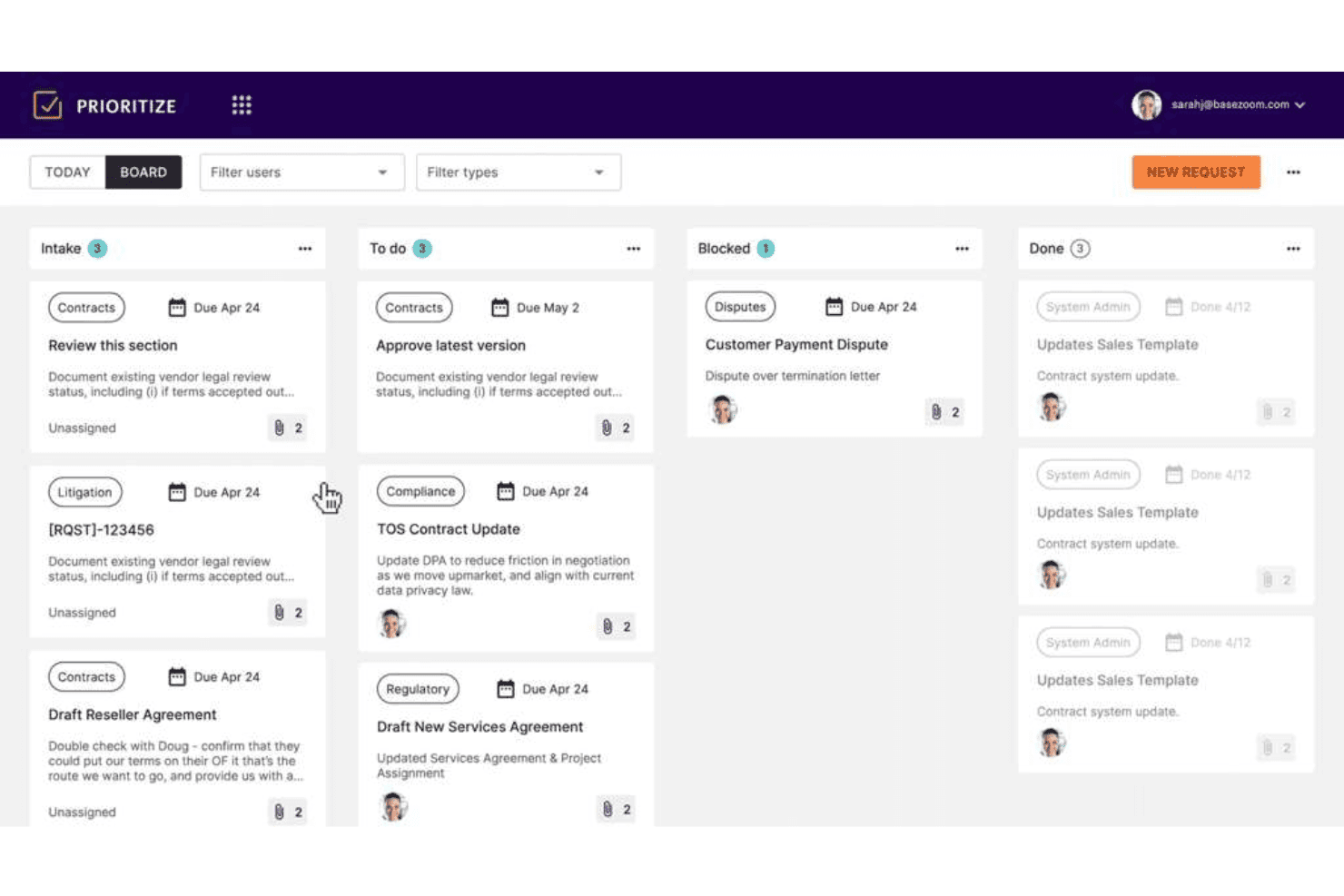
LinkSquares uses a kanban-style Prioritize board to manage legal requests across Intake, To Do, Blocked, and Done stages. LinkSquares is an AI-powered contract lifecycle management platform that covers pre- and post-signature workflows, including drafting, clause management, approval routing, obligation tracking, and portfolio-wide contract analytics.
Who Is LinkSquares Best For?
LinkSquares is a strong fit for mid-market to enterprise organizations with high contract volumes that need legal and finance teams working from a single source of contract data.
Why I Picked LinkSquares
LinkSquares earns its spot on my shortlist because of how it turns contracts into structured, reportable data. Its LinkAI engine auto-extracts 75+ data points from every agreement, including financial obligations, key dates, and renewal terms. I like that you can query and report across an entire contract portfolio at once, and the data export feature makes it straightforward to pipe that output directly into finance reporting workflows.
LinkSquares Key Features
- Contract playbooks and clause library: Store and manage pre-approved language, fallback clauses, and negotiation guidance in one workspace.
- Centralized legal project management: Track, assign, and prioritize internal contract-related requests across legal and finance teams.
- Microsoft Word add-in for AI redlining: Edit, redline, and apply company playbook rules directly within Word using AI suggestions.
- Automated renewal notification system: Schedule and customize alerts for upcoming contract expirations, auto-renewals, and key milestone dates.
LinkSquares Integrations
Native integrations include Salesforce, DocuSign, Adobe Sign, Microsoft Word, SharePoint, Slack, and Ramp Procurement. An open API is available for custom integrations.
Pros and Cons
Pros:
- Covers both pre- and post-signature workflows
- Portfolio-wide contract analytics with exportable dashboards
- AI extracts 75+ data points automatically
Cons:
- Customizing reports requires help from support teams
- Long enterprise implementation and onboarding timeline
Learn more about LinkSquares: Best for AI discovery across contract repositories
- Free demo available
- Pricing upon request
Visit WebsiteCustomer Rating:4.5/5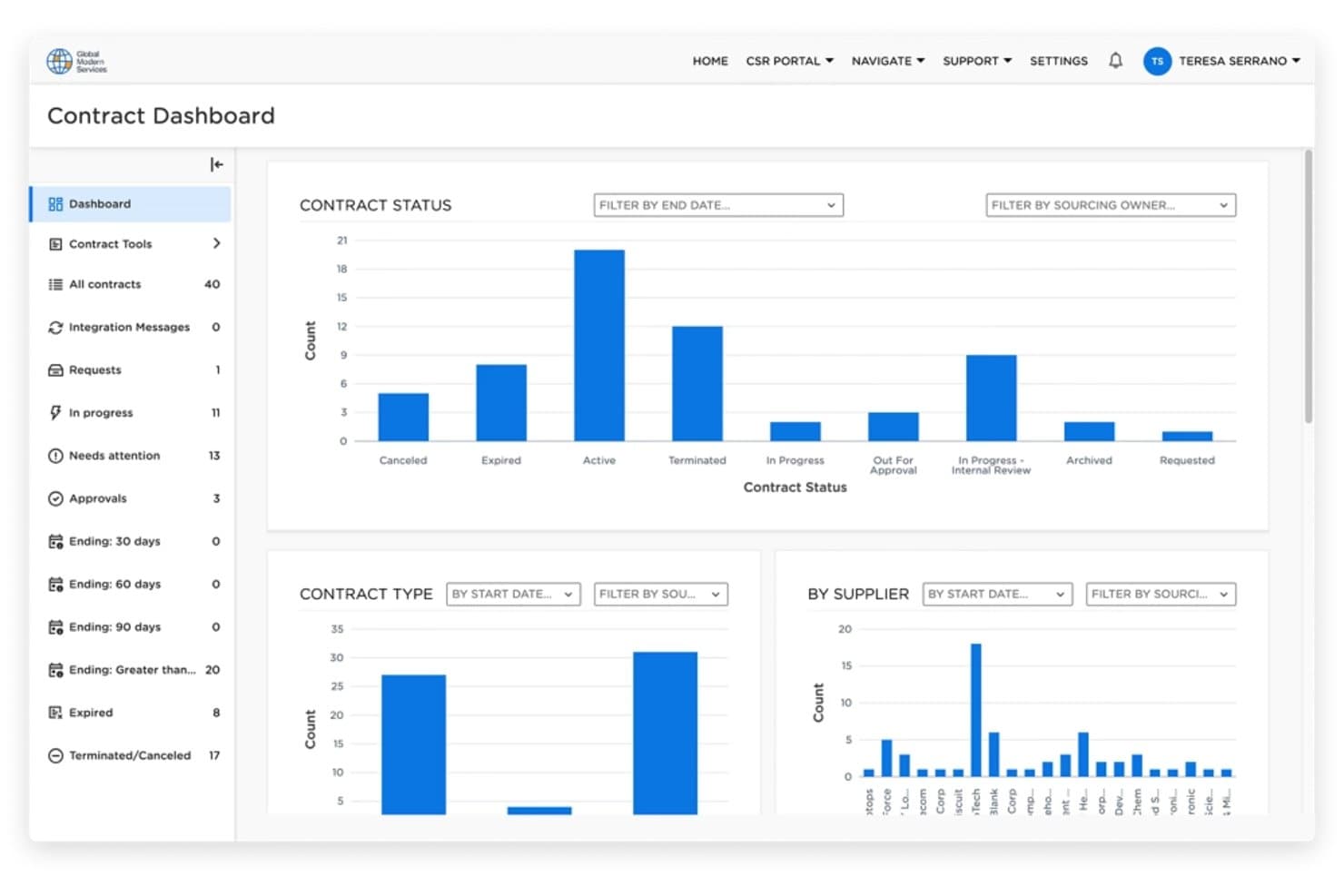
Workday Contract Management includes contract status tracking, contract type breakdowns, and supplier views for enterprise-level contract oversight. Workday Contract Management is an AI-native CLM platform that combines a unified contract repository, end-to-end lifecycle automation, financial obligation tracking, and AI-powered clause extraction across enterprise contract portfolios.
Who Is Workday Contract Management Best For?
It's a strong fit for large enterprises that already run Workday Financials and need CLM capabilities managed within the same finance ecosystem.
Why I Picked Workday Contract Management
Workday Contract Management earns its spot on my shortlist because of how it handles AI discovery across existing contract repositories. I love that it syncs with SharePoint, Box, Salesforce, and even other CLM platforms, then applies OCR+AI to ingest and analyze up to 450,000 documents in 24 hours. The natural-language "Ask AI" search lets my team query the entire contract portfolio in plain English and get sourced, cited answers instantly, without rebuilding the repository from scratch.
Workday Contract Management Key Features
- Custom AI model library: Build and reuse department-specific AI models for tracking complex data points across contracts.
- No-code workflow automation: Configure approval processes, routing, and dashboards without technical skills required.
- Financial obligation extraction: Automatically capture payment schedules, pricing, and milestones from new and legacy contracts.
- Role-based permissions: Manage granular access controls across business units, subsidiaries, and user roles for enterprise governance.
Workday Contract Management Integrations
Workday Contract Management offers native integrations with Workday Financial Management, DocuSign, Adobe Sign, Salesforce, Box, SharePoint, and Google Drive. An API is available for custom integrations.
Pros and Cons
Pros:
- Built-in SOX and ASC 606 compliance controls
- Natural language contract search across entire portfolio
- OCR-powered mass ingestion of legacy contract portfolios
Cons:
- Implementation can take months for large enterprises
- Requires Workday ecosystem for full functionality
Learn more about Workday Contract Management: Best for AI contract performance management
- Free demo available
- Pricing upon request
Visit WebsiteCustomer Rating:4.5/5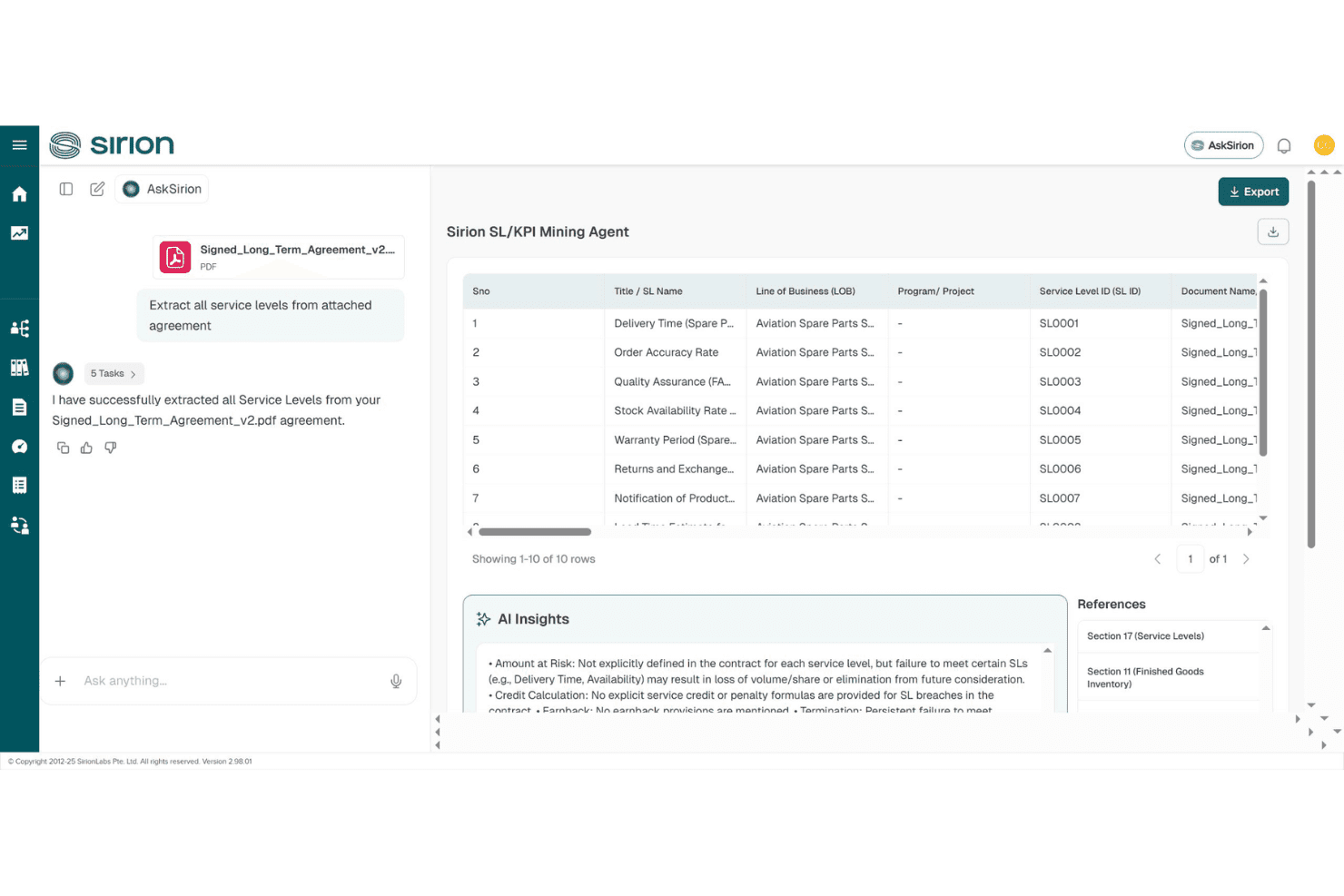
Sirion's AskSirion AI assistant automatically extracts and organizes service levels from contracts using its SL/KPI Mining Agent. Sirion is an AI-native contract lifecycle management platform that uses purpose-built AI agents to handle contract storage, drafting, negotiation, obligation tracking, and invoice reconciliation across enterprise-scale portfolios.
Who Is Sirion Best For?
Sirion is built for large enterprises managing high-volume, complex contract portfolios across legal, procurement, finance, and supplier management functions.
Why I Picked Sirion
Sirion earns its spot on my shortlist because of how its AI agents handle post-signature contract performance. The Obligations Agent automatically tracks contractual commitments, flags at-risk obligations in real time, and triggers escalations before performance gaps become costly. Paired with the Invoice Agent, which reconciles invoices directly against contract terms, I can identify value leakage at the line level rather than discovering it in a quarterly review.
Sirion Key Features
- Centralized contract repository: Collects and organizes executed contracts with metadata, versioning, and granular access controls.
- Configurable workflow automation: Lets you set up customizable drafting, approval, and routing workflows for different contract types.
- Integration studio: Offers no-code connectors for syncing contract data with ERP, CRM, and procurement systems.
- Clause library and playbook agent: Stores pre-approved clauses and transforms internal policies into smart templates for contract drafting.
Sirion Integrations
Sirion offers native integrations with Salesforce, SAP, Oracle, Workday, Microsoft 365, and Slack. An open API and the Sirion Integration Studio let you build custom connections to over 1,000 applications.
Pros and Cons
Pros:
- Scales to millions of contracts natively
- Contract analytics give portfolio-wide performance visibility
- AI agents automate post-execution obligation tracking
Cons:
- Workflow configuration requires substantial upfront effort
- Implementation typically takes several months
Learn more about Sirion: Best for cross-functional contract collaboration
- Free demo available
- Pricing upon request
Visit WebsiteCustomer Rating:4.5/5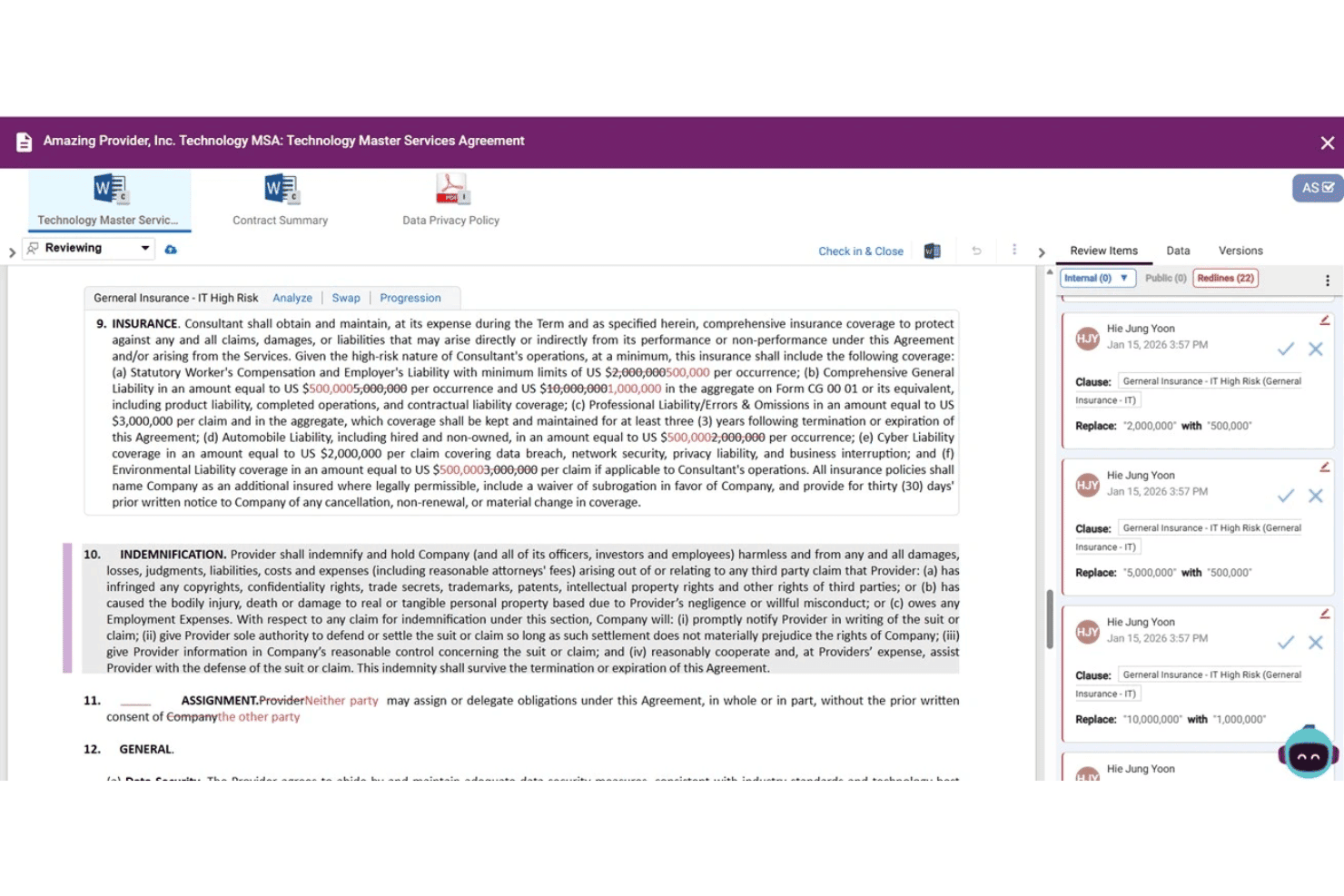
Malbek enables legal teams to review and redline contract insurance clauses with tracked changes and inline comments directly in the contract editor. Malbek is an AI-native contract lifecycle management platform that combines contract authoring, workflow automation, clause analysis, obligation tracking, and cross-functional commercial intelligence for legal, finance, sales, and procurement teams.
Who Is Malbek Best For?
Malbek is a strong fit for enterprise organizations where legal, finance, and procurement teams need a shared contracting process with centralized visibility.
Why I Picked Malbek
I picked Malbek as one of the best because its no-code workflow engine lets legal, finance, sales, and procurement teams move through creation, approval, and negotiation in one shared environment. I also rely on BusinessIQ to pull revenue, risk, and renewal exposure from the contract repository into dashboards the CFO and CPO can act on. On top of that, Bek, the conversational AI assistant, lets any stakeholder query contract data mid-cycle without pulling in a legal analyst.
Malbek Key Features
- Centralized contract repository: Store, search, and control access to all executed contracts with full metadata and version history.
- Advanced workflow automation: Build conditional, multi-step contract approval processes without IT involvement.
- ERP and CRM integrations: Connect natively with Salesforce, SAP, NetSuite, Coupa, and other core enterprise systems.
- Configurable clause library: Maintain a library of pre-approved clauses with version control for consistent legal language.
Malbek Integrations
Malbek offers native integrations with Salesforce, SAP, NetSuite, Oracle, Microsoft Dynamics 365, Coupa, DocuSign, Adobe Sign, OneTrust, and Slack. An API is available for custom integrations.
Pros and Cons
Pros:
- Fast implementation timeline, often live within weeks
- MS Word add-in is cumbersome and disrupts document authoring
- Negotiation cycle time tracking across all contract stages
Cons:
- Amendment workflow supports only one draft at a time
- Native reporting requires external BI tools for deeper analysis
Learn more about Malbek: 5Best for playbook-driven contract redlining
Leah
- Free demo available
- Pricing upon request
Visit WebsiteCustomer Rating:4.5/5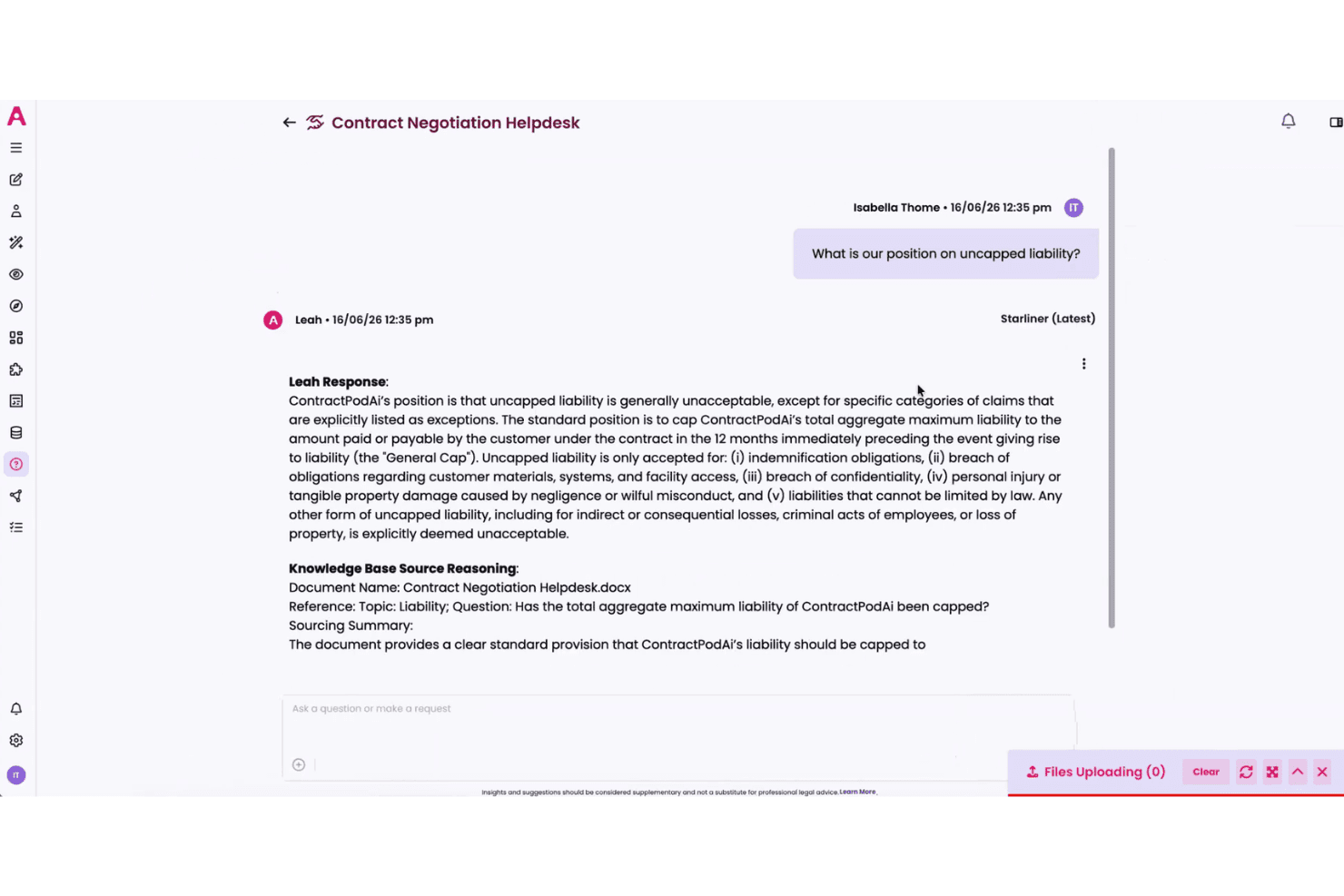
Leah, ContractPodAi's AI assistant, provides a detailed position on uncapped liability exceptions within the Contract Negotiation Helpdesk. Leah is an agentic enterprise CLM platform that combines contract creation, playbook-driven review and negotiation, conditional approval routing, obligation tracking, and CFO-specific financial dashboards in a single system.
Who Is Leah Best For?
Leah is a strong fit for Fortune 500 legal, finance, and procurement teams that manage high volumes of complex contracts across regulated industries.
Why I Picked Leah
Leah earns its spot on my shortlist because of how it handles contract redlining at enterprise scale. I particularly like how the Word Add-in applies your negotiating playbooks directly inside Microsoft Word, keeping reviewers anchored to preferred positions on every deal. The "Ask Leah" feature layers in-document AI guidance on top of that, and prior deal intelligence lets my team reference how similar clauses were resolved in past contracts.
Leah Key Features
- Smart repository: Stores all contracts with advanced search, metadata tagging, and granular role-based access controls.
- Obligation tracking dashboards: Surfaces milestones, renewal dates, and payment schedules in customizable executive dashboards.
- ERP and financial integrations: Connects directly with SAP, NetSuite, Oracle, Coupa, and other core enterprise systems.
- Configurable clause library: Centralizes pre-approved legal language for consistent use across all agreements.
Leah Integrations
Leah offers native integrations with SAP, NetSuite, Oracle, Workday, Coupa, iValua, Salesforce, Microsoft 365, DocuSign, Adobe Sign, and ServiceNow. An open API is also available for custom integrations.
Pros and Cons
Pros:
- AI obligation extraction across large contract volumes
- Highly configurable workflows and admin controls
- Playbook enforcement anchors reviewers on every deal
Cons:
- Misconfigured workflows can't be overridden without backend access
- Implementation process requires heavy customer involvement
Learn more about Leah: Best for CLM with integrated e-signatures
- Free demo available
- Pricing upon request
Visit WebsiteCustomer Rating:4.7/5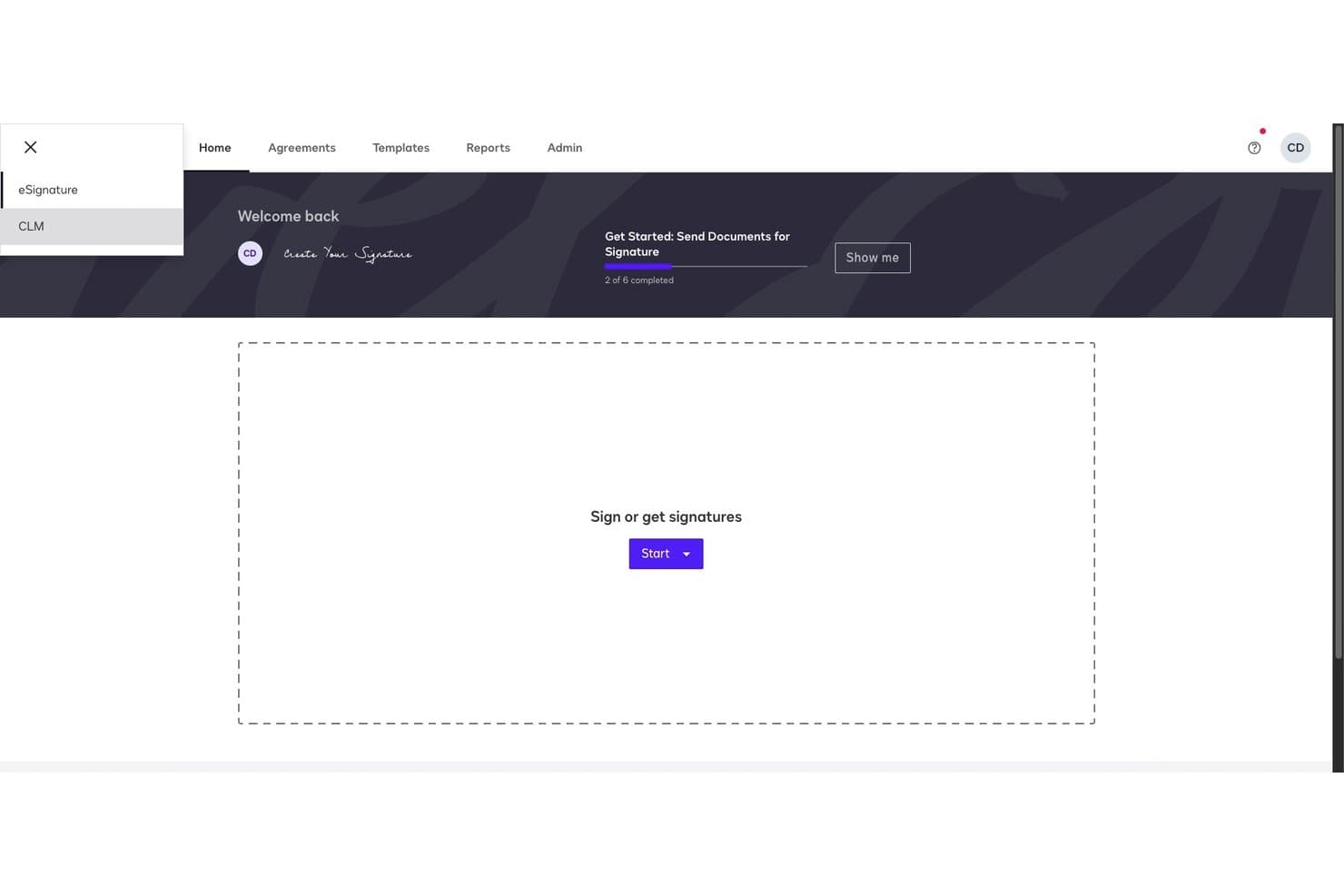
Docusign CLM includes a home dashboard with eSignature and CLM product switching, a getting-started progress tracker, and a 'Sign or get signatures' action area. Docusign CLM is an enterprise contract lifecycle management platform that combines AI-powered contract creation, automated approval workflows, clause library management, obligation tracking, and a centralized repository with native e-signature execution.
Who Is Docusign CLM Best For?
It's a strong fit for large enterprises that already operate within the Docusign ecosystem and need full contract lifecycle control beyond e-signature.
Why I Picked Docusign CLM
Docusign CLM earns its spot on my shortlist because the e-signature step isn't an integration — it's native to the platform. I like that approval workflows can be configured to route contracts directly into signature execution based on deal value thresholds, so there's no handoff between systems at the most critical stage. The Iris AI engine also adds real value here, extracting clause-level data and risk scores before a contract ever reaches the signing stage.
Docusign CLM Key Features
- Centralized contract repository: Store, organize, and search executed contracts with metadata, version history, and granular role-based access.
- Obligation management: Track contract commitments, milestones, renewal dates, and SLA deadlines with built-in alerts for stakeholders.
- Advanced workflow automation: Build automated, no-code workflows with conditional logic for contract creation, negotiation, and renewals.
- ERP and procurement integrations: Connect natively with SAP Ariba, Coupa, and Salesforce to sync contract data with critical financial systems.
Docusign CLM Integrations
Docusign CLM offers native integrations with Salesforce, SAP Ariba, Coupa, Microsoft 365, and Oracle. An API is available for custom integrations.
Pros and Cons
Pros:
- Audit trails support SOX compliance requirements
- AI clause extraction across large contract portfolios
- Native e-signature execution within the same platform
Cons:
- Workflow configuration requires significant admin time
- Implementation complexity for non-Docusign environments
Learn more about Docusign CLM: Best for highly configurable contract processes
- Free demo available
- Pricing upon request
Visit WebsiteCustomer Rating:4.7/5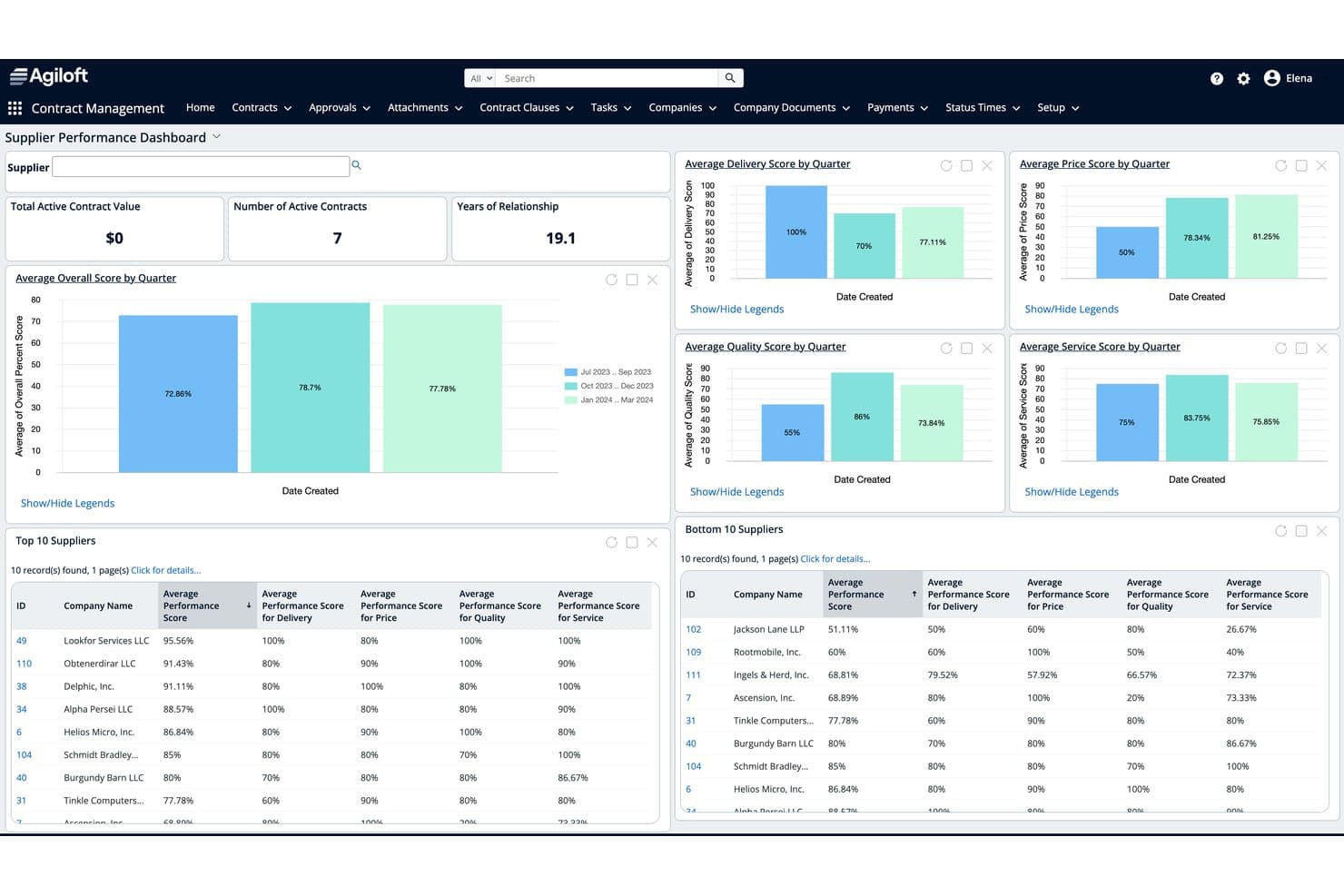
Agiloft’s Supplier Performance Dashboard tracks active contract values, delivery scores, quality metrics, and top and bottom supplier rankings across quarterly periods. Agiloft is a no-code contract lifecycle management platform built for enterprise teams, offering a centralized contract repository, AI-powered clause extraction, configurable approval workflows, and integrations with ERP, procurement, and e-signature systems.
Who Is Agiloft Best For?
Agiloft is a strong fit for large enterprises with complex, cross-functional contract processes spanning legal, finance, and procurement teams.
Why I Picked Agiloft
I picked Agiloft as one of the best because its no-code workflow builder lets me configure contract routing logic that mirrors exactly how my organization operates. I can set a rule that automatically escalates any contract above $50,000 to the CFO for approval, without writing a single line of code. Agiloft's ConvoAI also lets me query the entire contract repository using plain-language questions, so surfacing specific obligation terms or clause language takes seconds, not hours.
Agiloft Key Features
- Centralized contract repository: Store and organize all executed contracts with metadata, version control, and secure, role-based access.
- Financial obligation tracking: Extract and monitor payment schedules, milestones, and renewal dates directly from contract data.
- Enterprise-grade audit controls: Maintain detailed audit trails, e-signature records, and compliance-ready logging for regulated environments.
- ERP and procurement integrations: Connect natively to SAP, Oracle, NetSuite, Coupa, and other major enterprise systems for synchronized contract data.
Agiloft Integrations
Agiloft offers native integrations with SAP, Oracle, NetSuite, Coupa, Tradeshift, Salesforce, DocuSign, and Adobe Sign, and provides an API for custom integrations.
Pros and Cons
Pros:
- Granular role-based permissions suit enterprise governance
- AI extracts clauses across large contract portfolios
- No-code workflow builder is highly configurable
Cons:
- Reporting dashboards feel dated compared to competitors
- Initial deployment requires significant IT involvement
Learn more about Agiloft: Best for workflow automation with self-serve tools
- Free demo available
- Pricing upon request
Visit WebsiteCustomer Rating:4.4/5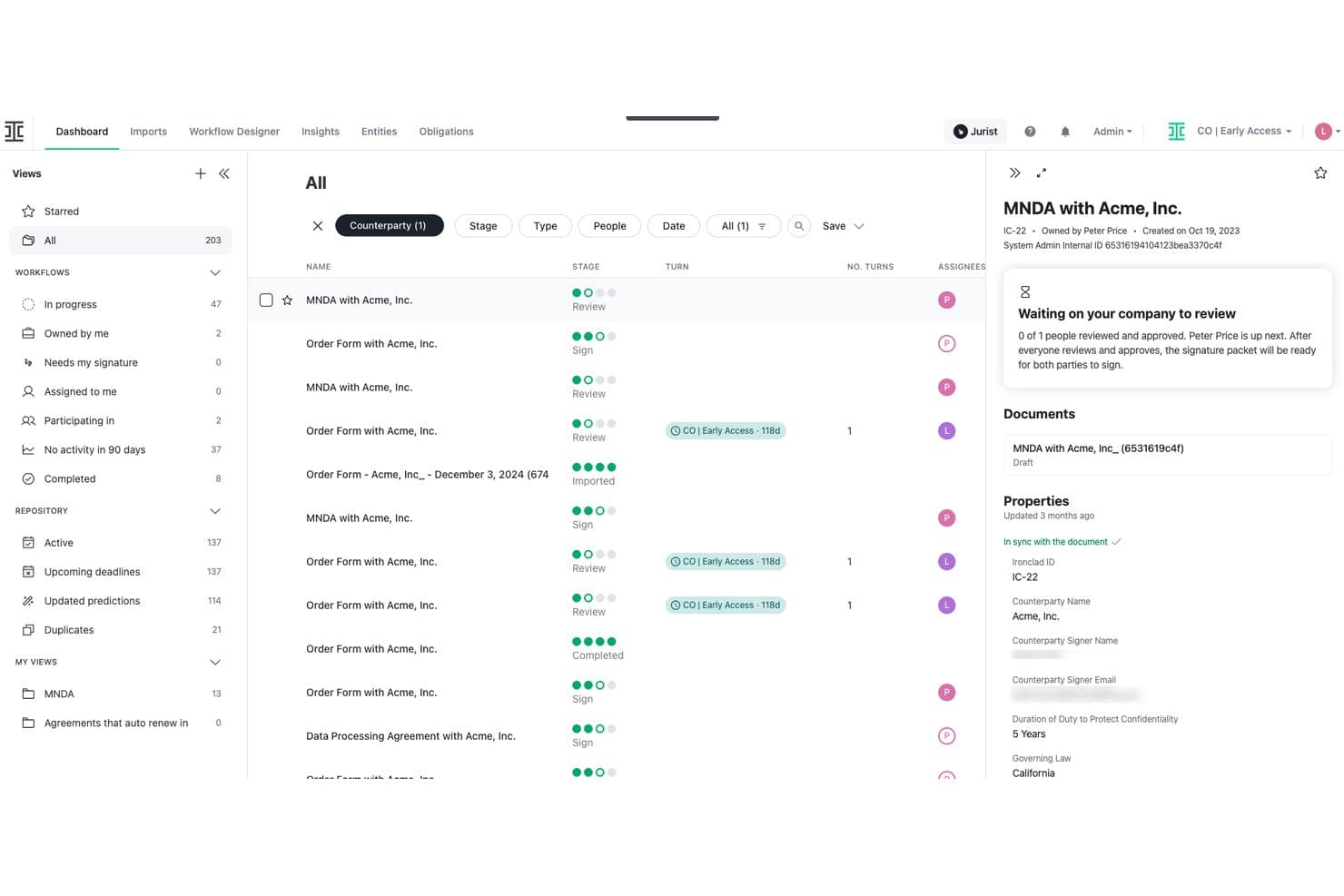
Ironclad lets teams manage contracts with filtering, workflow stages, counterparty details, and document properties. Ironclad is an AI-powered contract lifecycle management platform that handles contract creation, negotiation, approval routing, execution, and renewal management across legal, finance, procurement, and sales teams.
Who Is Ironclad Best For?
Ironclad suits mid-market to enterprise legal and finance teams that manage high contract volumes across multiple departments and need cross-functional approval workflows.
Why I Picked Ironclad
I've included Ironclad in my top picks because its no-code Workflow Designer genuinely sets it apart. I can build conditional approval paths, automated routing, and renewal alerts without touching code, which means finance and procurement teams can trigger and manage their own contracts without routing every request through legal. The Renewals Dashboard is another feature I rely on, tracking opt-out windows and surfacing upcoming renewal dates before they become costly auto-renewals.
Ironclad Key Features
- Centralized contract repository: Store executed contracts with metadata, version control, and role-based access for large volumes.
- AI-powered clause extraction: Identify and extract critical clauses, obligations, and risks across all contract documents.
- ERP and procurement system integrations: Sync contract data with leading ERPs, accounting tools, and procurement platforms through native connectors and APIs.
- Audit trails and compliance controls: Maintain detailed audit logs, electronic signature integrity, and governance for SOX and global regulatory standards.
Ironclad Integrations
Ironclad offers native integrations with Salesforce, SAP, Coupa, Ramp, HubSpot, Box, Slack, and Microsoft Teams, and provides an API for custom integrations.
Pros and Cons
Pros:
- Self-serve contracting for non-legal stakeholders
- AI clause extraction across large contract portfolios
- No-code workflow builder with conditional logic
Cons:
- Reporting customization limited without additional configuration
- Admin configuration requires significant upfront setup time
Learn more about Ironclad: Best for enterprise-wide obligation intelligence
- Free demo available
- Pricing upon request
Visit WebsiteCustomer Rating:4.3/5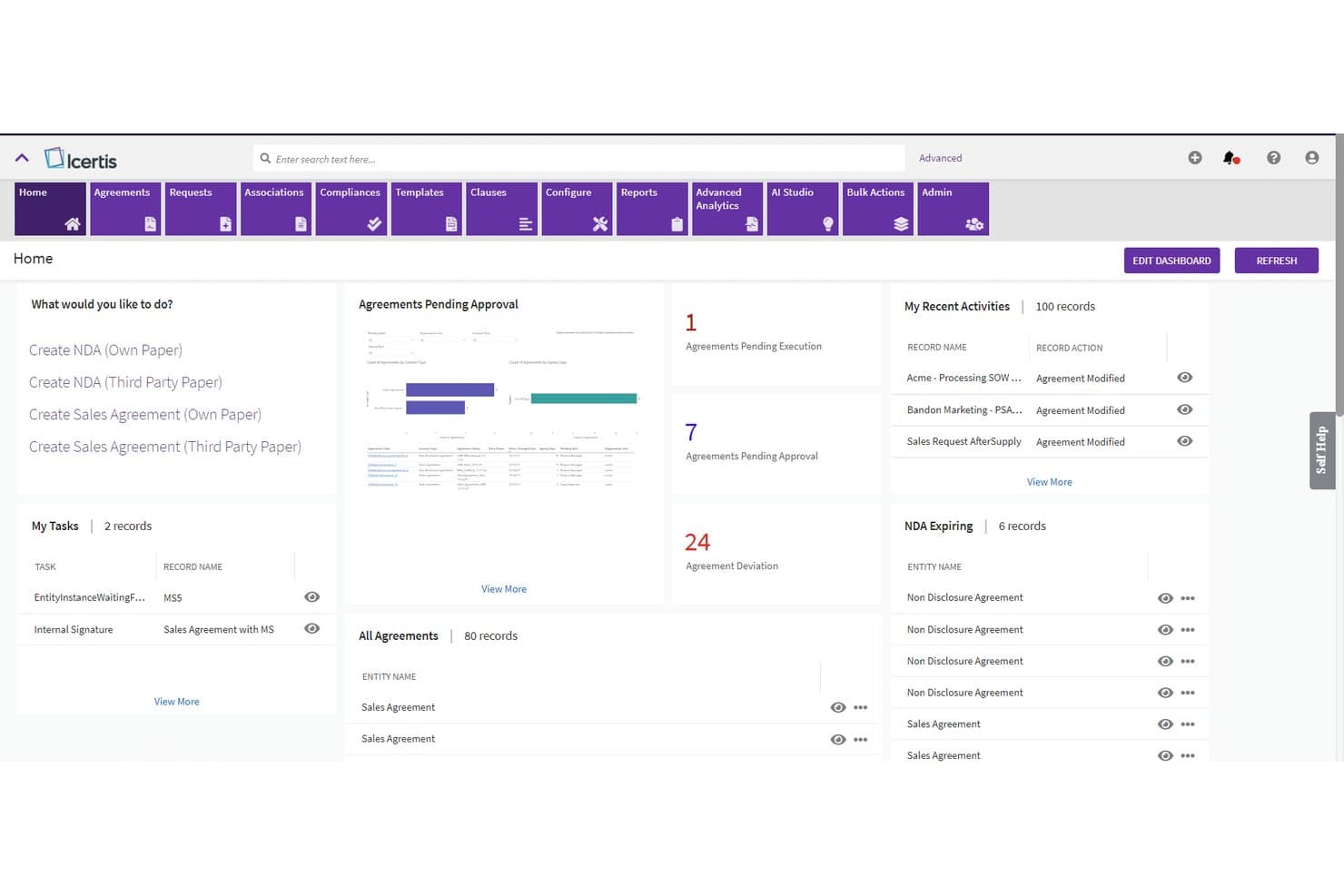
Icertis offers a centralized contract management dashboard with agreement tracking, pending approvals, task management, and NDA expiration alerts for enterprise users. Icertis is an AI-powered contract lifecycle management platform that centralizes contract repositories, automates end-to-end contract workflows, and extracts structured obligation and financial data from enterprise-scale contract portfolios.
Who Is Icertis Best For?
Icertis is a strong fit for large enterprises in regulated industries — financial services, healthcare, and manufacturing — managing high volumes of complex contracts across global operations.
Why I Picked Icertis
Icertis earns its spot on my shortlist because of how it handles obligation tracking at scale. The dedicated Vera Obligations and Vera Fulfillment Agent modules extract financial terms directly from contracts and monitor fulfillment status across the entire portfolio. I particularly like Vera Copilot, which lets me query contracts in plain language to surface payment schedules, pricing milestones, and risk triggers without digging through individual documents.
Icertis Key Features
- Centralized contract repository: Maintain all executed contracts in a searchable, versioned, and access-controlled enterprise repository.
- Configurable clause library: Store, manage, and update pre-approved clauses for use in new contracts across business units.
- Advanced workflow automation: Design no-code workflows for dynamic contract approval routing, negotiation, and renewal management.
- Contract analytics dashboards: Visualize contract risk, cycle times, contract value, and performance with customizable reporting tools.
Icertis Integrations
Icertis offers native integrations with SAP, Microsoft Dynamics, Salesforce, Workday, and DocuSign. An API is available for custom integrations.
Pros and Cons
Pros:
- Built-in SOX and ASC 606 compliance controls
- AI clause extraction from legacy contract portfolios
- Deep obligation tracking across complex contract portfolios
Cons:
- Requires significant IT resources for initial configuration
- Long implementation timelines for enterprise deployments
Learn more about Icertis: Best for revenue-focused contract management
- Free demo available
- Pricing upon request
Visit WebsiteCustomer Rating:4.3/5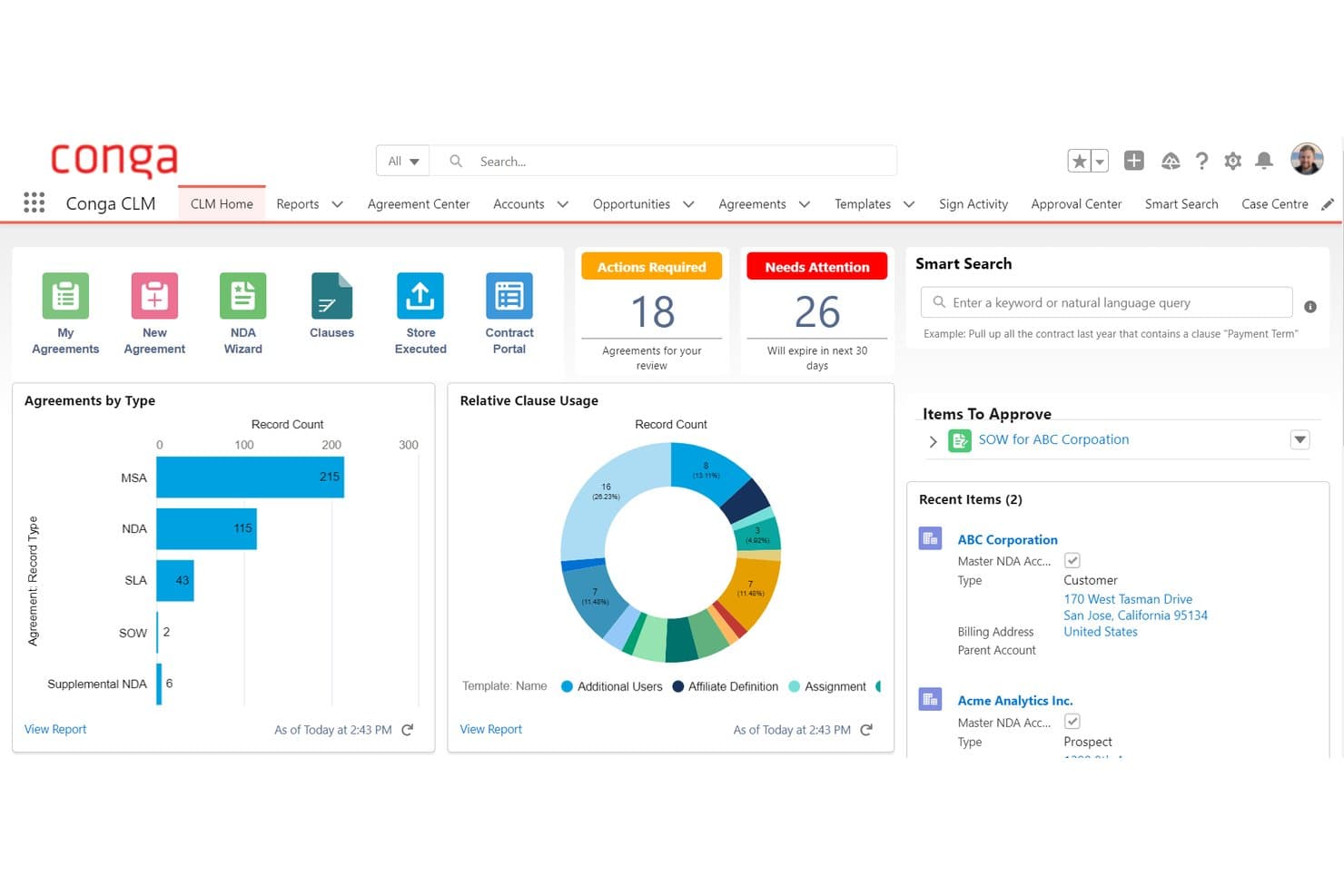
Conga CLM brings together agreement tracking, clause usage analytics, approval workflows, and smart search for enterprise teams. Conga CLM is an AI-powered contract lifecycle management platform built for enterprise teams, covering contract creation, negotiation, approval workflows, obligation tracking, and renewal management across sales, legal, and procurement functions.
Who Is Conga CLM Best For?
Conga CLM is a strong fit for large enterprises running Salesforce-based revenue operations that need contract management connected to their CPQ, billing, and procurement workflows.
Why I Picked Conga CLM
I've included Conga CLM in my top picks because its revenue lifecycle positioning sets it apart from purely legal-focused CLM tools. What I find most compelling is the AI's ability to flag upsell and cross-sell opportunities directly from contract data, something most CLM platforms simply don't do. I also like how obligation extraction connects directly to billing schedules when paired with Conga Billing, so my team isn't manually chasing payment triggers after contracts close.
Conga CLM Key Features
- Centralized contract repository: Stores all contracts with metadata, version control, and enterprise-grade access permissions.
- Configurable clause library: Provides legal-approved standard and fallback language with usage tracking across the portfolio.
- Advanced workflow automation: Enables no-code workflows with conditional routing, parallel approvals, and flexible stakeholder assignments.
- Contract analytics dashboards: Offers customizable reporting on contract value, risk metrics, cycle times, and portfolio performance.
Conga CLM Integrations
Conga CLM offers native integrations with Salesforce, SAP, Oracle, Microsoft 365, Coupa, Ariba, DocuSign, and Adobe Sign. An API is available for custom integrations.
Pros and Cons
Pros:
- Strong audit trail supporting SOX and revenue recognition compliance
- Deep Salesforce-native workflow and approval automation
- AI-powered clause extraction across large contract portfolios
Cons:
- Advanced modules and configurations carry significant added costs
- Heavy Salesforce dependency limits value outside that ecosystem
Learn more about Conga CLM:
Alte soluții software pentru gestionarea contractelor la nivel de întreprindere
Iată câteva opțiuni suplimentare de software pentru gestionarea contractelor la nivel de întreprindere care nu au ajuns pe lista mea scurtă, dar care merită totuși analizate:
- 11Coupa Contract Lifecycle ManagementBest for connecting contracts with spend data
- 12SAP Ariba ContractsBest for source-to-pay contract compliance
- 13GEP SMARTBest for AI-led procurement contract management
- 14JuroBest for browser-based contract collaboration
- 15SpotDraftBest for fast deployment with native e-signing
- 16GatekeeperBest for unified vendor and contract oversight
- 17JaggaerBest for CLM within source-to-pay operations
- 18OnitBest for contract governance at enterprise scale
How I Evaluate Enterprise Contract Management Software
I split my evaluation into two layers: the core functionality every enterprise CLM must deliver—like obligation extraction and SOX-ready audit trails—and what separates the best options from the rest.
Core Functionality (Table Stakes For This List)
When I'm selecting tools for my list, I rank each one on a scale from 0 (does not offer the functionality) to 5 (excels in this area) for each core functionality listed below. Then, I calculate the tool's total score into a percentage. Each tool needs to achieve a minimum total score of 65% to be considered for inclusion.
- Centralized Contract Repository: I look for full-text search, metadata tagging, version history, and role-based permissions that scale cleanly across multiple business entities.
- Contract Lifecycle Automation: Each platform's workflow engine should handle drafting from templates, conditional approval routing, e-signatures, and automated renewal alerts.
- Financial Obligation Tracking: I evaluate whether the tool surfaces payment milestones, pricing terms, and revenue recognition triggers tied to specific contract clauses.
- Compliance & Audit Controls: SOX-ready audit trails, e-signature integrity, and built-in support for standards like ASC 606 and IFRS 15 are what I check for here.
- ERP & Financial Integrations: Bi-directional sync with platforms like SAP, Oracle, or NetSuite matters—contract data needs to flow into your financial workflows.
- AI Clause & Risk Analysis: Strong tools here can extract obligations, flag risk clauses, and compare language across a portfolio of thousands of contracts.
Once I have a list of tools that meet the criteria, I consider what sets each platform apart.
Differentiating Factors (What Sets Vendors Apart)
Here's how I compare and contrast different vendors:
Standout Features
AI-powered clause extraction is where I see the biggest gap between vendors. The best implementations scan a legacy portfolio and surface hidden commitments—like auto-renewal terms or embedded price escalation clauses—without manual review. Contract analytics dashboards matter just as much, since CFOs need real-time visibility into cycle times, contract value, and risk exposure across business units. Obligation management rounds this out by tracking post-execution milestones and SLA deadlines with automated alerts.
Beyond Features
Integration depth is a major differentiator. I check whether a platform offers bi-directional sync with ERPs and procurement systems—not just one-way data pushes. Cross-departmental usability also matters; if procurement or sales teams can't self-serve within legal-approved guardrails, adoption stalls fast. I also evaluate total cost of ownership, including how pricing scales with user counts and whether AI features or premium connectors carry hidden fees.
Cum să alegeți software-ul pentru gestionarea contractelor la nivel de întreprindere
Este ușor să vă pierdeți în liste lungi de funcții și structuri complexe de prețuri. Pentru a rămâne concentrați pe parcursul procesului dumneavoastră unic de selecție a software-ului, iată o listă de verificare a factorilor de care trebuie să țineți cont:
| Factor | Aspecte de luat în considerare |
|---|---|
| FactorScalabilitate | Aspecte de luat în considerareVa susține volumul de contracte, entități și utilizatori pe măsură ce compania dumneavoastră se dezvoltă? Fiți atenți la limite sau costuri suplimentare. |
| FactorIntegrări | Aspecte de luat în considerareSe conectează nativ la sistemele ERP, CRM și instrumentele dumneavoastră de semnătură electronică? Întrebați despre sincronizarea în timp real față de cea pe loturi și despre mentenanță. |
| FactorPosibilități de personalizare | Aspecte de luat în considerarePuteți adapta fluxurile de lucru, câmpurile de date și rapoartele pentru a corespunde lanțurilor de aprobare și proceselor financiare ale companiei? |
| FactorUșurință în utilizare | Aspecte de luat în considerareÎl vor utiliza efectiv echipele financiare, juridice și de achiziții fără instruire suplimentară? Căutați interfețe clare și navigare fără obstacole. |
| FactorImplementare și integrare inițială | Aspecte de luat în considerareCe resurse sunt necesare din partea dumneavoastră? Verificați existența asistenței pentru migrare, a unor termene realiste pentru lansare și a resurselor pentru gestionarea schimbării. |
| FactorCost | Aspecte de luat în considerarePe lângă licențe, luați în calcul taxele pentru integrări, nivelurile de utilizatori, asistența premium și creșterea viitoare a volumului de contracte. |
| FactorMăsuri de securitate | Aspecte de luat în considerareControalele corespund cerințelor întreprinderii dumneavoastră privind datele sensibile, conformitatea cu reglementările și politicile de acces? |
| FactorCerințe de conformitate | Aspecte de luat în considerareVă poate ajuta să respectați standarde precum SOX, ASC 606, IFRS 15 sau cerințe specifice anumitor regiuni, fără configurări suplimentare? |
Ce este software-ul pentru gestionarea contractelor la nivel de întreprindere?
Software-ul pentru gestionarea contractelor la nivel de întreprindere este un sistem specializat care ajută organizațiile să creeze, să stocheze, să urmărească și să analizeze volume mari de contracte. Aceste platforme centralizează toate datele contractuale, automatizează fluxurile de aprobare și se asigură că angajamentele dumneavoastră financiare respectă cerințele de reglementare, audit și recunoaștere a veniturilor. Echipele le folosesc pentru a reduce riscurile, a îmbunătăți conformitatea și a obține vizibilitate asupra obligațiilor contractuale între departamente.
Funcțiile software-ului pentru gestionarea contractelor la nivel de întreprindere
Atunci când selectați software pentru gestionarea contractelor la nivel de întreprindere, urmăriți următoarele funcții esențiale:
- Depozit centralizat de contracte: O bază de date unică și ușor de căutat, care găzduiește toate documentele contractuale, permite etichetarea metadatelor și aplică controale de acces granulare pentru diferite unități de afaceri.
- Gestionarea automatizată a fluxurilor de lucru: Instrumente pentru direcționarea contractelor prin etapele de redactare, aprobare, negociere, semnare și reînnoire, utilizând fluxuri de lucru configurabile, bazate pe reguli.
- Urmărirea obligațiilor financiare: Extragerea și monitorizarea automatizată a termenilor de plată, etapelor, acordurilor de preț și datelor de reînnoire, pentru a ajuta echipele să își gestioneze angajamentele.
- Controale de audit și conformitate: Jurnale de audit detaliate, integritatea semnăturilor electronice și compatibilitate cu cadre de reglementare precum SOX, ASC 606 și IFRS 15.
- Bibliotecă de clauze și șabloane: Stocare centralizată a clauzelor și șabloanelor aprobate în prealabil, permițând utilizatorilor să standardizeze formulările și să accelereze crearea contractelor prin controlul versiunilor.
- Integrări cu ERP și alte sisteme: API-uri și conectori preconfigurați pentru sincronizarea datelor contractuale cu sistemele ERP, CRM, instrumentele de achiziții și platformele de contabilitate.
- Analiză și extragere bazate pe inteligență artificială: Instrumente de învățare automată care identifică clauzele-cheie, evidențiază obligațiile, evaluează riscurile și analizează tendințele de-a lungul portofoliilor de contracte.
- Tablouri de bord pentru raportare personalizată: Tablouri de bord vizuale care oferă informații despre durata ciclurilor contractuale, expunerea la riscuri, blocajele și valorile contractelor, pentru analiza conducerii.
- Permisiuni bazate pe roluri: Controale care restricționează accesul la contracte și acțiunile în funcție de utilizator, departament sau entitate, pentru a contribui la menținerea securității și conformității.
- Asistență pentru importul și migrarea în bloc: Instrumente pentru integrarea contractelor existente la scară largă, inclusiv OCR, încărcări în masă și maparea datelor.
Beneficiile software-ului de gestionare a contractelor pentru întreprinderi
Implementarea unui software de gestionare a contractelor pentru întreprinderi oferă mai multe beneficii pentru echipa și compania dumneavoastră. Iată câteva dintre acestea:
- Gestionarea mai eficientă a riscurilor: Extragerea automatizată a clauzelor și analiza riscurilor evidențiază expunerile din formulările contractuale, termenii de reînnoire și angajamentele financiare înainte ca acestea să se agraveze.
- Conformitate îmbunătățită: Jurnalele de audit integrate, verificarea semnăturilor electronice și controalele concepute pentru standarde precum SOX și ASC 606 reduc efortul necesar pentru raportarea de reglementare.
- Vizibilitate financiară sporită: Tablourile de bord în timp real și urmărirea obligațiilor dezvăluie veniturile, cheltuielile și datele importante de reînnoire generate de contracte pentru responsabilii financiari.
- Cicluri contractuale mai rapide: Fluxurile de lucru automatizate, bibliotecile de șabloane și instrumentele cu autoservire permit echipelor să direcționeze, să negocieze și să semneze contracte fără întârzieri sau blocaje.
- Colaborare între echipe: Permisiunile bazate pe roluri și interfețele intuitive facilitează colaborarea dintre departamentele juridic, de achiziții, financiar și de vânzări în cadrul aceleiași platforme.
- Scalabilitate pentru creștere: Depozitele centralizate și infrastructura de nivel pentru întreprinderi pot gestiona volume în creștere de contracte și structuri organizaționale complexe.
- Păstrarea evidențelor pregătită pentru audit: Controlul versiunilor și metadatele complete asigură urmărirea fiecărei modificări și aprobări a contractelor, atât pentru auditurile interne, cât și pentru cele externe.
Costurile și prețurile software-ului de gestionare a contractelor pentru întreprinderi
Alegerea unui software de gestionare a contractelor pentru întreprinderi necesită înțelegerea diferitelor modele și planuri de preț disponibile. Costurile variază în funcție de funcționalități, dimensiunea echipei, suplimente și alți factori. Tabelul de mai jos sintetizează planurile comune, prețurile medii ale acestora și funcționalitățile incluse de obicei în soluțiile software de gestionare a contractelor pentru întreprinderi:
Tabel comparativ al planurilor pentru software-ul de gestionare a contractelor pentru întreprinderi
| Tipul planului | Preț mediu | Funcționalități comune |
|---|---|---|
| Tipul planuluiPlan gratuit | Preț mediu$0 | Funcționalități comuneStocare de bază a contractelor, număr limitat de utilizatori, funcționalități minime pentru fluxurile de lucru și instrumente de căutare de bază. |
| Tipul planuluiPlan personal | Preț mediu$30–$50/user/month | Funcționalități comuneStocare extinsă, semnături electronice, automatizarea simplă a fluxurilor de lucru, urmărirea de bază a obligațiilor și alerte prin e-mail. |
| Tipul planuluiPlan de afaceri | Preț mediu$60–$120/user/month | Funcționalități comuneAutomatizarea avansată a fluxurilor de lucru, permisiuni bazate pe roluri, integrări ERP/CRM, tablouri de bord pentru analiză și gestionarea obligațiilor. |
| Tipul planuluiPlan pentru întreprinderi | Preț mediu$150+/user/month | Funcționalități comuneIntegrări personalizate, extragerea clauzelor bazată pe inteligență artificială, securitate avansată, contracte nelimitate și asistență pentru întreprinderi. |
Întrebări frecvente despre software-ul de gestionare a contractelor pentru întreprinderi
Iată câteva răspunsuri la întrebările frecvente despre software-ul de gestionare a contractelor pentru întreprinderi:
Cum sprijină software-ul de gestionare a contractelor pentru întreprinderi respectarea cerințelor de conformitate?
Software-ul de gestionare a contractelor pentru întreprinderi oferă piste de audit, controale privind accesul utilizatorilor și mementouri automate pentru termenele-limită importante, ajutându-vă să îndepliniți cerințele unor standarde precum SOX, ASC 606 și GDPR.
Pot colabora diferite departamente în aceeași platformă de gestionare a contractelor?
Da, aceste platforme sunt concepute pentru colaborarea între departamente, oferind permisiuni configurabile, spații de lucru personalizabile și fluxuri de lucru care reflectă procesele diferitelor echipe.
Cât durează de obicei implementarea?
Implementarea poate dura de la câteva săptămâni până la câteva luni, în funcție de migrarea datelor, complexitatea integrărilor și gradul în care personalizați fluxurile de lucru pentru structura organizației dumneavoastră.
La ce integrări ar trebui să mă aștept?
Majoritatea soluțiilor oferă integrări native sau prin API cu sisteme ERP, CRM, instrumente de semnătură electronică și sisteme de achiziții, permițând datelor contractuale să ajungă în operațiunile financiare ale organizației dumneavoastră.
Merită luată în considerare extragerea clauzelor bazată pe inteligență artificială?
Da, extragerea clauzelor bazată pe inteligență artificială ajută echipele juridice și financiare să identifice obligații, riscuri și termeni critici în portofolii extinse, reducând timpul alocat verificării manuale și evidențiind riscurile ascunse.
Ce ar trebui să știu despre limitele de stocare?
Unele planuri limitează numărul de contracte sau spațiul de stocare, așa că verificați întotdeauna dacă planul ales poate face față creșterii preconizate a numărului de contracte și necesităților de arhivare.