

Intuit Enterprise Suite Test: Hauptfunktionen, Vorteile, Nachteile und Preisinformationen
In einem Tab ist eine Tabellenkalkulation geöffnet, in einem anderen ein Finanzbericht, und Zahlen aus verschiedenen Unternehmen müssen noch vor Tagesende zusammengeführt werden. Mit dem Wachstum Ihres Unternehmens kann das Finanzmanagement über Tochtergesellschaften hinweg, die Prognose der Leistung und die Organisation von Arbeitsabläufen schnell kompliziert werden – sofern keine geeignete ERP-Software implementiert ist. Genau hier kommen Plattformen wie die Intuit Unternehmenssuite ins Spiel […]

Wir bewerten Tools unabhängig; Provisionen helfen, unsere Tests zu finanzieren. Siehe unsere Transparenzrichtlinie und unsere Methodik.
In einem Tab ist eine Tabellenkalkulation geöffnet, in einem anderen ein Finanzbericht, und Zahlen aus verschiedenen Unternehmen müssen noch kombiniert werden, bevor der Tag zu Ende geht.
Mit dem Wachstum Ihres Unternehmens wird es immer schwieriger, Finanzen über Tochtergesellschaften hinweg zu steuern, die Leistung zu prognostizieren und Arbeitsabläufe zu organisieren – es sei denn, Sie haben die richtige ERP-Software im Einsatz.
Hier kommen Plattformen wie Intuit Enterprise Suite ins Spiel.
In diesem Leitfaden erläutere ich Ihnen die Funktionen, Preise, Stärken und besten Anwendungsfälle, damit Sie verstehen, wie das System funktioniert und entscheiden können, ob es den finanziellen Anforderungen Ihres Unternehmens entspricht.
Intuit Enterprise Suite Evaluation Summary

4.6/5
- Pricing upon request
- Free demo available
Warum Sie unseren Software-Empfehlungen vertrauen können
6,700+
Reviews
20
Industry experts
16+
Evaluation factors
14
Years
Unsere Bewertungen spiegeln unser unabhängiges Urteilsvermögen wider – keine Verkaufsstrategie. Erfahren Sie, wie wir transparent bleiben.
Für diesen Leitfaden haben wir Tools mithilfe von praktischen Tests und unabhängiger Recherche bewertet und dabei unsere Bewertungskriterien angewendet.
Unsere Bewertungen spiegeln unser menschliches redaktionelles Urteilsvermögen wider, keine Verkaufsstrategie.
Intuit Enterprise Suite Overview
Pros
- Multi-entity management supports complex organizational structures.
- AI-powered forecasting and insights help businesses analyze financial data.
- Built-in migration tools support transitions from QuickBooks Desktop and Advanced.
Cons
- The platform lacks sufficient training for new releases.
- Features can feel overwhelming.
- Reports take longer than expected to load.
Is Intuit Enterprise Suite Right For Your Needs?
Who Would be a Good Fit for Intuit Enterprise Suite?
Intuit Enterprise Suite is best suited for growing or mid-sized organizations that need advanced financial management capabilities. Businesses managing multiple entities, relying on forecasting, or handling structured financial workflows can benefit from its automation, reporting, and consolidated visibility tools.
It’s particularly valuable for data-driven teams, product-based companies managing inventory, and organizations that need detailed financial tracking across departments, locations, or projects.
- Multi-Entity BusinessesCompanies managing multiple subsidiaries, brands, or locations that need consolidated financial visibility while maintaining separate books.
- Finance Teams Focused on ForecastingOrganizations that rely on financial planning and projections to guide budgeting, expansion, and strategic decisions.
- Businesses With Structured Financial WorkflowsCompanies with complex approval processes that want to automate financial workflows and improve internal controls.
- Growing Service BusinessesService businesses needing project profitability tracking, workforce management, and consolidated financial planning across departments benefit significantly.
- Product-Based BusinessesCompanies that manage inventory and sales orders and need accounting, inventory, and order workflows connected in one system.
- Construction FirmsConstruction companies tracking job costing, project budgets, and multi-entity structures gain stronger operational visibility.
Who Would be a Bad Fit for Intuit Enterprise Suite?
Intuit Enterprise Suite may not be the best choice for businesses with simple financial needs or limited operational complexity. Freelancers, very small businesses, or organizations without a dedicated accounting staff may find the platform more advanced than necessary.
Companies looking for lightweight bookkeeping tools or those that rarely rely on forecasting, reporting, or multi-entity management may be better served by simpler accounting solutions.
- Freelancers and Independent ContractorsIndividuals managing basic income and expenses typically don’t need the platform’s multi-entity management, forecasting tools, or workflow automation.
- Very Small BusinessesBusinesses that only need basic accounting features, such as invoicing and expense tracking, may find the platform unnecessarily complex.
- Businesses Without Dedicated Accounting StaffOrganizations without internal finance teams may struggle to manage a platform designed for structured financial processes and reporting.
- Inventory-Heavy ManufacturersManufacturers needing advanced inventory controls like serial numbers, bins, builds, or barcode workflows may struggle.
- Businesses Looking for Lightweight Accounting ToolsCompanies seeking a simple bookkeeping solution may be better served by smaller accounting platforms rather than a full financial management suite.
- Early-Stage StartupsStartups without operational complexity or financial teams gain minimal benefit from enterprise-level accounting features.
Wie wir Tools testen und bewerten
Wir haben jahrelang daran gearbeitet, unser System zur Softwarebewertung zu entwickeln, zu verfeinern und stetig zu verbessern. Der Bewertungsleitfaden wurde entworfen, um die Feinheiten der Softwareauswahl und die Qualitätskriterien eines effektiven Tools präzise zu erfassen, mit Fokus auf entscheidende Aspekte im Auswahlprozess. Im Folgenden sehen Sie genau, wie unsere Prüfungen und Bewertungen nach sieben Kriterien funktioniert. So können wir eine objektive Bewertung der Software auf Grundlage der Kernfunktionalitäten, herausragenden Eigenschaften, Benutzerfreundlichkeit, Einführung, Kundensupport, Integrationen, Kundenbewertungen sowie Preis-Leistungs-Verhältnis bieten.
Kernfunktionalität (25 % der Gesamtbewertung)
Der Ausgangspunkt unserer Bewertung ist immer die Kernfunktionalität des Tools. Verfügt es über die grundlegenden Features und Funktionen, die ein Nutzer erwarten würde? Sind einige dieser Kernfunktionen auf höherpreisige Tarife beschränkt? Im Kern erwarten wir, dass ein Tool mit den Basisfunktionen seiner Wettbewerber mithalten kann.
Herausragende Funktionen (25 % der Gesamtbewertung)
Im nächsten Schritt bewerten wir ungewöhnliche, herausragende Funktionen, die über die üblichen Kernfunktionen vergleichbarer Tools hinausgehen. Eine hohe Punktzahl erhält, wer spezialisierte oder einzigartige Funktionen bietet, die das Produkt schneller, effizienter oder besonders wertvoll für den Nutzer machen. Wir prüfen auch, wie einfach sich das Tool mit anderen Programmen des typischen Tech-Stacks integrieren lässt, um den Funktionsumfang und die Nützlichkeit der Software zu erweitern. Vielseitige native Integrationen, Drittanbieter-Anbindungen sowie API-Zugänge für individuelle Integrationen schneiden am besten ab.
Benutzerfreundlichkeit (10 % der Gesamtbewertung)
Wir bewerten, wie schnell und einfach sich die wichtigsten Aufgaben im Tool erledigen lassen. Hoch bewertete Software ist gut gestaltet, intuitiv bedienbar, bietet mobile Apps, Vorlagen und macht selbst komplexere Aufgaben handhabbar.
Einführung (10 % der Gesamtbewertung)
Wir wissen, wie wichtig eine rasche Teamakzeptanz bei neuen Plattformen ist. Deshalb prüfen wir, wie einfach sich ein Tool mit minimalem Trainingsaufwand erlernen und bedienen lässt. Wir bewerten auch, wie schnell ein Teammitglied ohne vorherige Erfahrung startklar ist. Hoch bewertete Lösungen benötigen wenig oder gar keinen Support.
Kundensupport (10 % der Gesamtbewertung)
Wir prüfen, wie leicht und schnell Sie mit Telefon, Live-Chat oder Wissensdatenbank Hilfe erhalten können. Tools und Unternehmen, die Echtzeit-Support bieten, erzielen die besten Ergebnisse, während Chatbots am schlechtesten abschneiden.
Kundenbewertungen (10 % der Gesamtbewertung)
Neben unseren eigenen Tests berücksichtigen wir den Net-Promoter-Score aktueller und ehemaliger Kunden. Wir prüfen, wie wahrscheinlich sie sich erneut für das Tool entscheiden würden, basierend auf der Kernfunktionalität. Hoch bewertete Software spiegelt einen hohen Net-Promoter-Score wider.
Preis-Leistungs-Verhältnis (10 % der Gesamtbewertung)
Abschließend vergleichen wir alle Kriterien und bewerten den Durchschnittspreis der Einstiegstarife im Verhältnis zu den Kernfunktionen und dem Nutzen der weiteren Bewertungskriterien. Software, die mehr für weniger bietet, erhält die besten Bewertungen.
Core Features
Multi-Entity Financial Management
Manage multiple subsidiaries or business units in one platform with consolidated financial reporting and cross-entity visibility.
Workflow Automation
Automate financial approvals and operational workflows to reduce manual tasks and improve internal controls across your organization.
Business Intelligence and Reporting
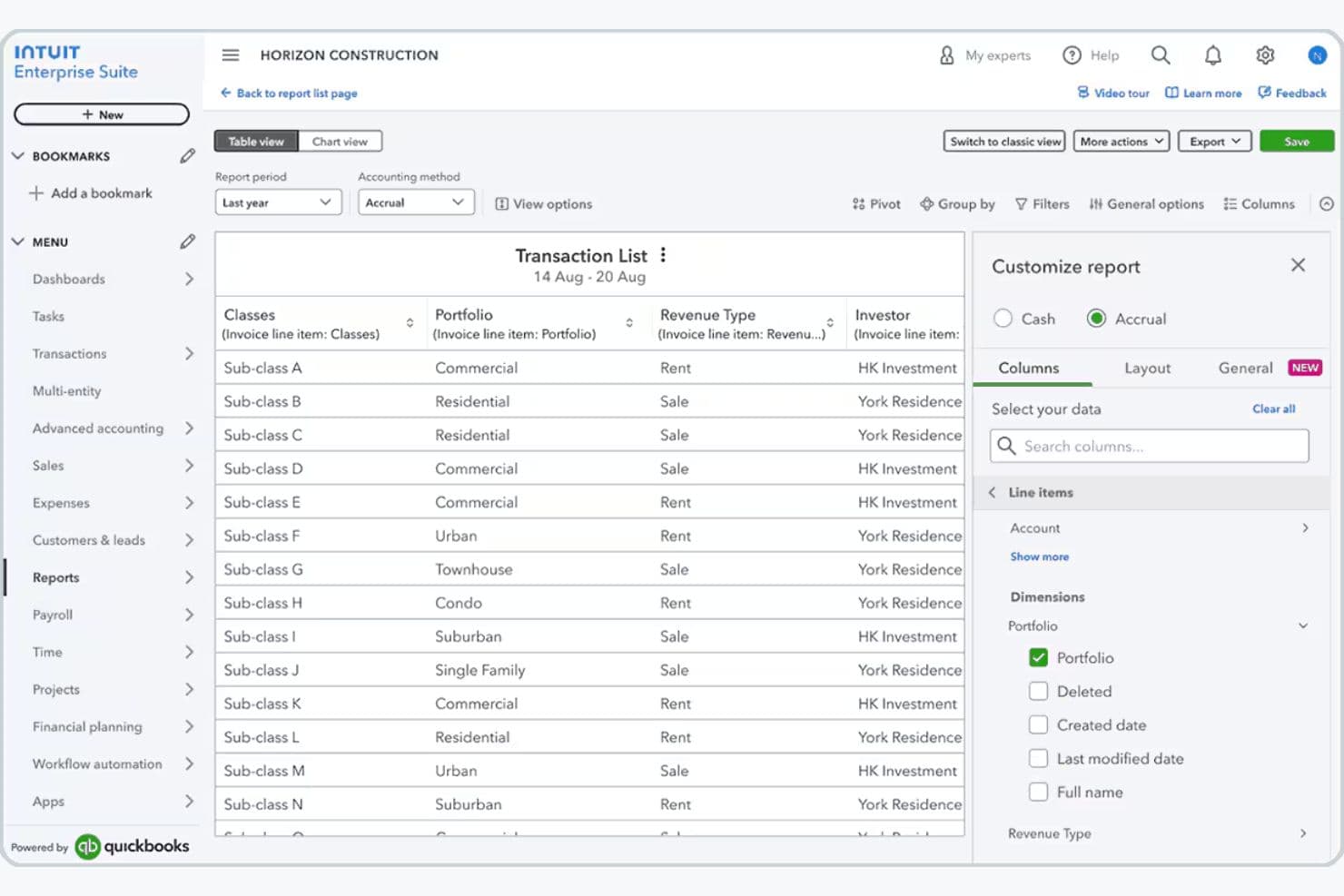
Generate customizable financial reports, dashboards, and KPIs to monitor company performance and analyze financial data in real time.
Inventory and Order Management
Track inventory, manage sales orders, and connect operational workflows with accounting data to streamline order-to-cash processes.
Dimension Enhancements
Assign dimensions to transactions to track financial performance across departments, projects, or locations, with options for faster and bulk assignment.
Industry-Specific Business Modules
Intuit Enterprise Suite includes capabilities designed for industries like construction and professional services, helping businesses manage project budgets, proposals, and operational workflows.

Standout Features
AI-Powered Financial Forecasting
Intuit Enterprise Suite uses AI-powered forecasting to analyze historical data and generate financial projections up to three years ahead.
Real-Time Consolidated Financial Reporting
Intuit Enterprise Suite allows finance teams to generate consolidated financial reports across multiple entities, giving organizations a unified view of financial performance without manually combining data from separate systems.

Ease of Use
Intuit Enterprise Suite is generally easy to use, especially if you already use QuickBooks, since the interface follows familiar design patterns that shorten your learning curve.
You can manage accounting, payroll, reporting, and multiple entities in one cloud platform, making it easier to collaborate, access data anywhere, and reduce manual work. Most users find the interface intuitive and time-saving, though the advanced features—like multi-entity management and dimensional reporting—can feel overwhelming if you’re new to ERP accounting systems.
Onboarding
Intuit Enterprise Suite offers guided onboarding through a dedicated Customer Success Manager who helps businesses configure the platform, migrate data, and train their teams.
Companies transitioning from QuickBooks or other systems receive migration support from Intuit’s implementation team, while professional services and training resources help organizations adopt the platform more quickly.
This structured onboarding approach allows you to move to the platform with minimal disruption while ensuring your workflows, financial structures, and integrations are properly configured.
Customer Support
Intuit Enterprise Suite provides several customer support options to help businesses adopt and maintain the platform. Customers typically work with a dedicated Customer Success Manager who serves as a primary contact for onboarding, platform configuration, and ongoing guidance.
Additional support is available through phone assistance with Intuit product experts, a searchable knowledge base of help articles, and community forums where users can share solutions and best practices.
Together, these support channels provide both direct assistance and self-service resources for troubleshooting and platform optimization.

Integrations
With Intuit Enterprise Suite, you can connect the platform to hundreds of third-party apps through the broader QuickBooks ecosystem. For example, you can connect Mailchimp for marketing, QuickBooks Payroll and QuickBooks Time for workforce management, and various CRM, project management, and ecommerce apps available through the QuickBooks App Store, helping you keep financial and operational data synced across systems.
If you need deeper customization, you can also use the QuickBooks Online API, which works with Intuit Enterprise Suite out of the box and lets developers build custom integrations or connect internal tools—though if you manage multiple entities, you currently need to connect integrations to each entity individually.

Value for Money
Because pricing is tailored to each business, you’ll need to schedule a consultation with Intuit to receive a quote and determine the appropriate configuration for their needs. This approach allows companies to scale the platform as they grow while paying only for the capabilities and operational scope relevant to their organization.
The final cost depends on factors such as the number of entities, users, modules required, and the complexity of the organization’s financial structure.

Intuit Enterprise Suite Specs
- Accounts Payable: Yes
- Accounts Receivable: Yes
- API: Yes
- Batch Permissions & Access: No
- Budgeting: Yes
- Calendar Management: No
- Customer Management: No
- Dashboard: Yes
- Data Export: Yes
- Data Import: Yes
- Data Visualization: Yes
- Expense Tracking: Yes
- External Integrations: Yes
- Forecasting: Yes
- General Account Ledger: Yes
- Inventory Tracking: Yes
- Lead Management: No
- Lead Scoring: No
- Marketing Automation: No
- Multi-User: Yes
- Notifications: Yes
- Password & Access Management: No
- Payroll: Yes
- Project Management: Yes
- Scheduling: No
- Supplier Management: Yes
- Tax Management: Yes
- Third-Party Plugins/Add-Ons: Yes
- Travel Management: No
Intuit Enterprise Suite FAQs
Intuit Enterprise Suite Company Overview & History
Intuit Enterprise Suite is part of Intuit, a global financial technology company headquartered in Mountain View, California. Intuit is known for building widely used financial software, including QuickBooks, TurboTax, Mailchimp, and Credit Karma.
The platform combines financial management, payroll, payments, automation, and business intelligence tools in a single system to help companies streamline operations and scale efficiently.
Intuit Enterprise Suite Major Milestones
- 1983: Intuit Inc. was founded in Palo Alto, California.
- 2024: Intuit launches Intuit Enterprise Suite, an AI-powered financial management platform designed for growing mid-market businesses.
- 2025: Intuit continues expanding the platform with updates focused on automation, reporting, and operational efficiency.