

QAD Adaptive ERP im Test: Vorteile, Nachteile, Funktionen und Preise
QAD Adaptive ERP isn’t just another upgrade—it’s a rethink on ERP flexibility. Here’s how it can actually scale with your manufacturing needs, minus the usual headaches.

Wir bewerten Tools unabhängig; Provisionen helfen, unsere Tests zu finanzieren. Siehe unsere Transparenzrichtlinie und unsere Methodik.
QAD Adaptive ERP is a cloud-based ERP software built specifically for manufacturing companies in industries like automotive, life sciences, consumer products, food and beverage, high-tech, and industrial. I'd consider it if you run a mid-market or global manufacturing operation that needs deep production, supply chain, and financial capabilities without the heavy customization overhead of SAP S/4HANA. Compared with general-purpose cloud suites, QAD gives you stronger out-of-the-box manufacturing depth and industry-specific process models, so your finance team spends less time bending a generic ERP to fit shop-floor and compliance realities. QAD Cloud ERP is the deployment most mid-market buyers land on.
QAD Adaptive ERP Evaluation Summary
3.4/5
- Pricing upon request
- Free demo available
Warum Sie unseren Software-Empfehlungen vertrauen können
6,700+
Reviews
20
Industry experts
16+
Evaluation factors
14
Years
Unsere Bewertungen spiegeln unser unabhängiges Urteilsvermögen wider – keine Verkaufsstrategie. Erfahren Sie, wie wir transparent bleiben.
Für diesen Leitfaden haben wir Tools mithilfe von praktischen Tests und unabhängiger Recherche bewertet und dabei unsere Bewertungskriterien angewendet.
Unsere Bewertungen spiegeln unser menschliches redaktionelles Urteilsvermögen wider, keine Verkaufsstrategie.
QAD Adaptive ERP Overview
If you’re judging ERP systems for manufacturing, I think QAD Adaptive ERP is an option that earns serious consideration. Its built-in industry models, manufacturing-centric features, and strong compliance tools are far ahead when you need out-of-the-box depth—instead of endless tailoring. QAD frames its buyers as adaptive manufacturing enterprises, and the ERP solution genuinely is built around change rather than a fixed template. The interface is modern, though you’ll notice a learning curve during onboarding. Integrations target real factory requirements, and the modular design keeps support and upgrades simple. Pricing is best suited to companies ready for enterprise capabilities. I’d suggest it especially for mid-sized and global manufacturers who want rapid deployment without sacrificing industry fit.
Pros
- Built-in industry-specific manufacturing and compliance process models
- Advanced supply chain planning and analytics for manufacturers
- Modular deployment speeds up rollout and future upgrades
Cons
- Limited vendor support for niche non-manufacturing workflows
- Complex configuration for international tax and localization needs
- User interface feels dated compared to top-tier ERP competitors
Is QAD Adaptive ERP Right For Your Needs?
Who Would be a Good Fit for QAD Adaptive ERP?
QAD Adaptive ERP is a strong fit for manufacturing-driven businesses or finance teams handling complex global operations. You’ll get the most out of it if you need industry-specific modules, advanced multinational compliance tools, and deep customization. Customer relationship management sits alongside the production and finance modules rather than in a separate system, which matters for order-to-cash visibility. I think midsize to large enterprises with multiple entities, controlled environments, or highly regulated workflows are going to benefit most from the adaptive features and integration options QAD provides.
- Global ManufacturingQAD Adaptive ERP’s manufacturing-specific modules, localization features, and support for multinational tax compliance are designed for complex production and global distribution environments.
- Automotive SuppliersQAD’s support for electronic data interchange (EDI), compliance, and supply chain traceability aligns well with the demands of automotive supplier networks.
- Life SciencesBuilt-in validation, QMS audit trails, and regulatory reporting features help life sciences companies meet FDA, EMA, and other compliance requirements.
- Multinational FinanceQAD handles international financial operations, sophisticated tax calculations, and multi-entity consolidations for companies operating across borders.
- Enterprise OperationsLarge organizations with intricate processes can leverage QAD’s modular workflows, role-based dashboards, and API-based integrations to coordinate finance, supply chain, and manufacturing.
- Project-Based ManufacturingCompanies with engineer-to-order or configure-to-order needs will find QAD’s adaptive project management and production planning tools useful for non-standard workflows.
Who Would be a Bad Fit for QAD Adaptive ERP?
QAD Adaptive ERP is not a good match for small organizations with straightforward needs or businesses outside manufacturing-focused industries. If your team relies on out-of-the-box simplicity, avoids heavy customization, or works in sectors with few regulatory obligations, you’re likely to find QAD too complex and costly for your operations.
- Small RetailersThe setup complexity, higher costs, and manufacturing-centered features do not align with the needs of a small retail business.
- Creative AgenciesQAD lacks specialized tools for client billing, campaign management, and project workflows common to design and marketing agencies.
- Local NonprofitsNonprofits with basic accounting requirements and minimal compliance obligations will not benefit from QAD’s advanced finance features or pricing.
- Early-Stage StartupsStartups needing quick setup, low overhead, and simple accounting would find QAD’s onboarding and customization unnecessary and cumbersome.
- Food Service ChainsFood service and hospitality businesses require point-of-sale, inventory turnover, and scheduling features not prioritized in QAD’s manufacturing focus.
- Construction ManagementConstruction firms typically need industry-specific field operations, subcontractor management, and project costing tools not provided by QAD Adaptive ERP.
Wie wir Tools testen und bewerten
Wir haben jahrelang daran gearbeitet, unser System zur Softwarebewertung zu entwickeln, zu verfeinern und stetig zu verbessern. Der Bewertungsleitfaden wurde entworfen, um die Feinheiten der Softwareauswahl und die Qualitätskriterien eines effektiven Tools präzise zu erfassen, mit Fokus auf entscheidende Aspekte im Auswahlprozess. Im Folgenden sehen Sie genau, wie unsere Prüfungen und Bewertungen nach sieben Kriterien funktioniert. So können wir eine objektive Bewertung der Software auf Grundlage der Kernfunktionalitäten, herausragenden Eigenschaften, Benutzerfreundlichkeit, Einführung, Kundensupport, Integrationen, Kundenbewertungen sowie Preis-Leistungs-Verhältnis bieten.
Kernfunktionalität (25 % der Gesamtbewertung)
Der Ausgangspunkt unserer Bewertung ist immer die Kernfunktionalität des Tools. Verfügt es über die grundlegenden Features und Funktionen, die ein Nutzer erwarten würde? Sind einige dieser Kernfunktionen auf höherpreisige Tarife beschränkt? Im Kern erwarten wir, dass ein Tool mit den Basisfunktionen seiner Wettbewerber mithalten kann.
Herausragende Funktionen (25 % der Gesamtbewertung)
Im nächsten Schritt bewerten wir ungewöhnliche, herausragende Funktionen, die über die üblichen Kernfunktionen vergleichbarer Tools hinausgehen. Eine hohe Punktzahl erhält, wer spezialisierte oder einzigartige Funktionen bietet, die das Produkt schneller, effizienter oder besonders wertvoll für den Nutzer machen. Wir prüfen auch, wie einfach sich das Tool mit anderen Programmen des typischen Tech-Stacks integrieren lässt, um den Funktionsumfang und die Nützlichkeit der Software zu erweitern. Vielseitige native Integrationen, Drittanbieter-Anbindungen sowie API-Zugänge für individuelle Integrationen schneiden am besten ab.
Benutzerfreundlichkeit (10 % der Gesamtbewertung)
Wir bewerten, wie schnell und einfach sich die wichtigsten Aufgaben im Tool erledigen lassen. Hoch bewertete Software ist gut gestaltet, intuitiv bedienbar, bietet mobile Apps, Vorlagen und macht selbst komplexere Aufgaben handhabbar.
Einführung (10 % der Gesamtbewertung)
Wir wissen, wie wichtig eine rasche Teamakzeptanz bei neuen Plattformen ist. Deshalb prüfen wir, wie einfach sich ein Tool mit minimalem Trainingsaufwand erlernen und bedienen lässt. Wir bewerten auch, wie schnell ein Teammitglied ohne vorherige Erfahrung startklar ist. Hoch bewertete Lösungen benötigen wenig oder gar keinen Support.
Kundensupport (10 % der Gesamtbewertung)
Wir prüfen, wie leicht und schnell Sie mit Telefon, Live-Chat oder Wissensdatenbank Hilfe erhalten können. Tools und Unternehmen, die Echtzeit-Support bieten, erzielen die besten Ergebnisse, während Chatbots am schlechtesten abschneiden.
Kundenbewertungen (10 % der Gesamtbewertung)
Neben unseren eigenen Tests berücksichtigen wir den Net-Promoter-Score aktueller und ehemaliger Kunden. Wir prüfen, wie wahrscheinlich sie sich erneut für das Tool entscheiden würden, basierend auf der Kernfunktionalität. Hoch bewertete Software spiegelt einen hohen Net-Promoter-Score wider.
Preis-Leistungs-Verhältnis (10 % der Gesamtbewertung)
Abschließend vergleichen wir alle Kriterien und bewerten den Durchschnittspreis der Einstiegstarife im Verhältnis zu den Kernfunktionen und dem Nutzen der weiteren Bewertungskriterien. Software, die mehr für weniger bietet, erhält die besten Bewertungen.
Core Features
Manufacturing Process Modeling
Prebuilt process models cover automotive, life sciences, high-tech, and industrial manufacturing. Manufacturing ERP setup shortens because the rules already fit.
Advanced Supply Chain Planning
Forecast demand and plan inventory with multi-site MRP, supplier management, and scenario modeling. QAD DSCP handles supply chain management when orders shift.
Global Financial Management
Multi-entity, multi-currency accounting with automated tax, consolidation, and asset management. Financial close stays accurate and group reporting meets standards.
Compliance and Quality Management
Track regulations, automate documentation, and manage audit trails for certifications. QAD EQMS runs the quality management system, so traceability is provable.
Analytics and Reporting
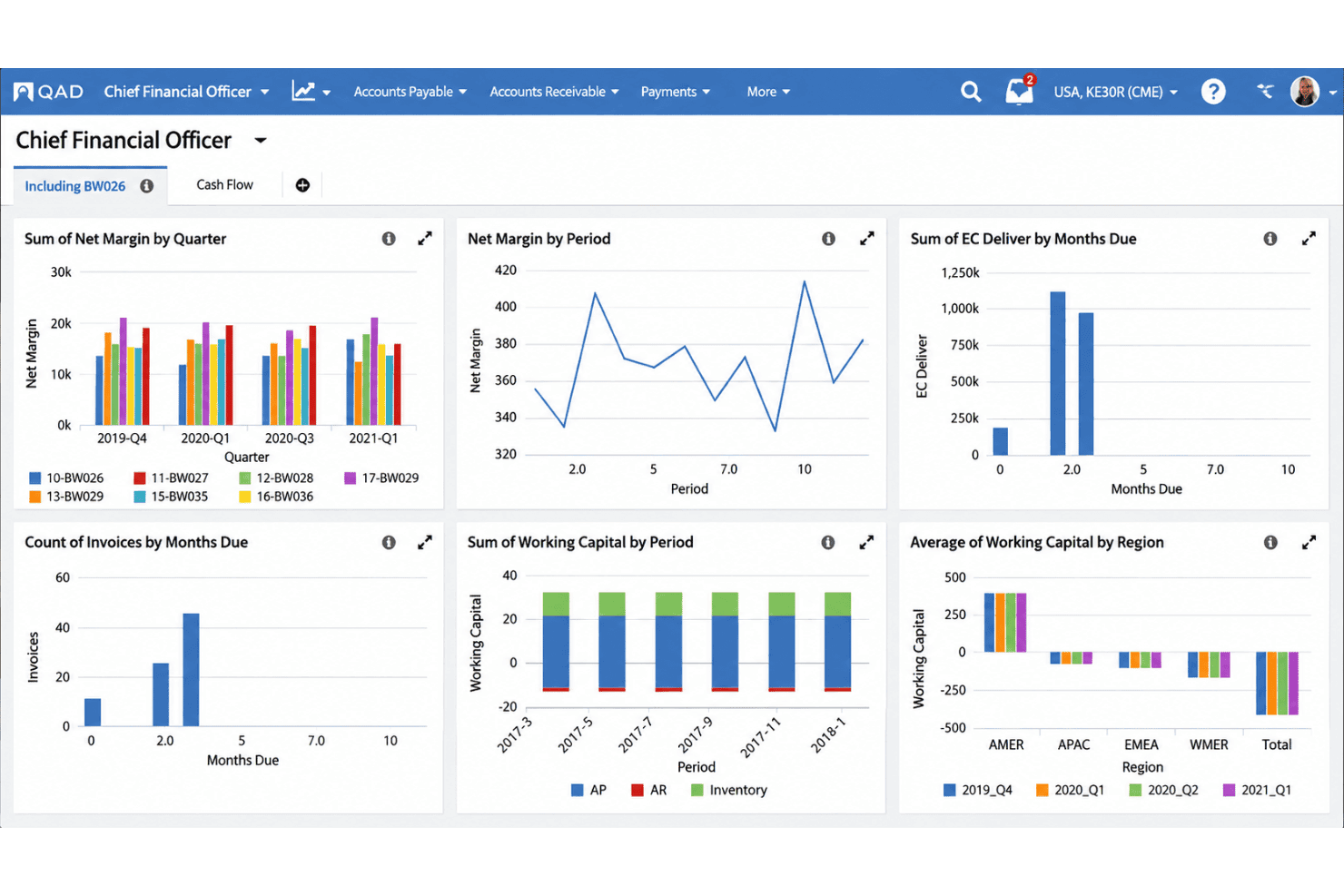
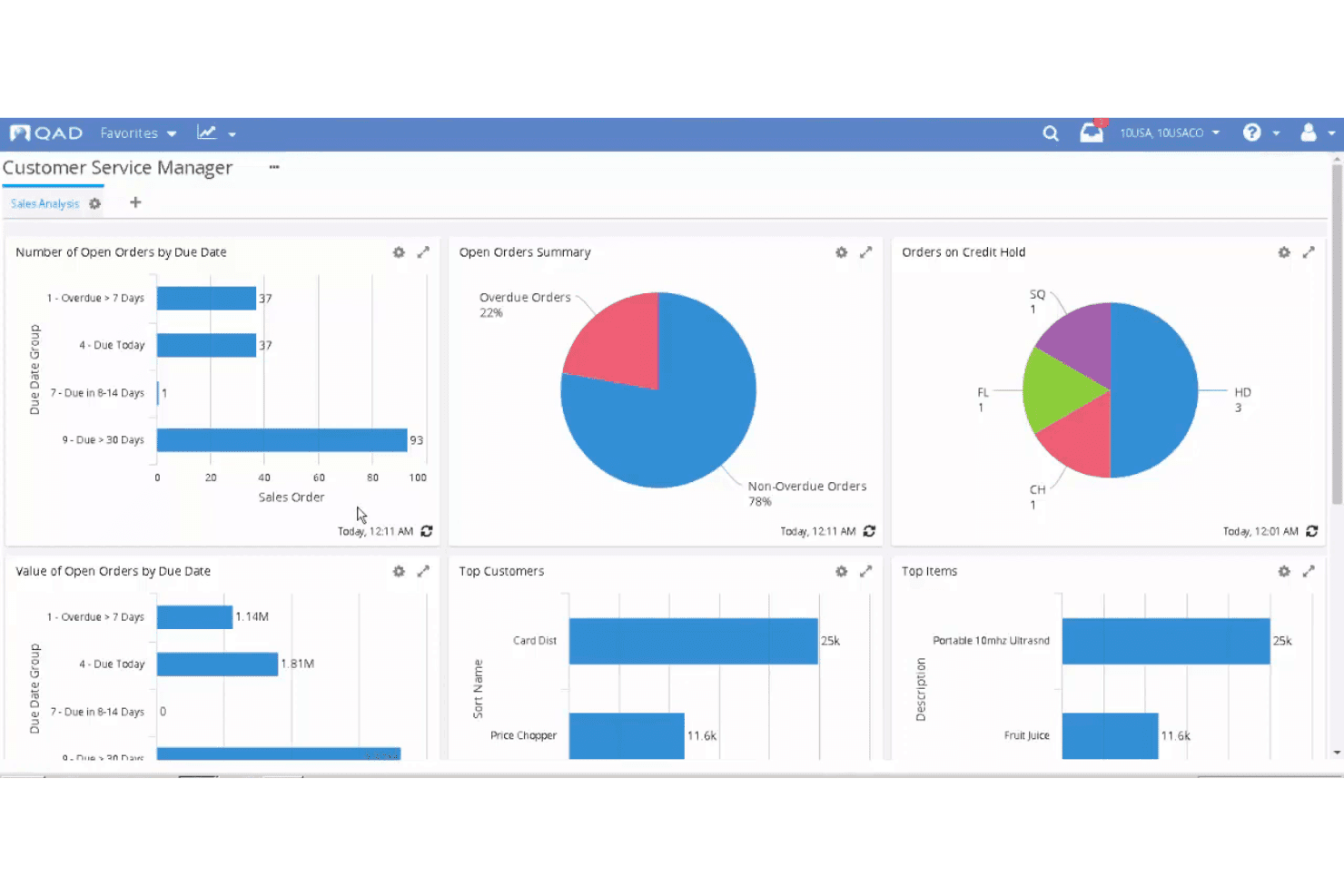
Real-time dashboards and role-based analytics for finance, operations, and supply chain. Mobile access lets you drill into transactions or trends wherever you are.
Modular Platform Upgrades
Add or update modules—production, inventory management, procurement—without breaking existing workflows. Upgrades stay manageable as ERP functions scale.
Ease of Use
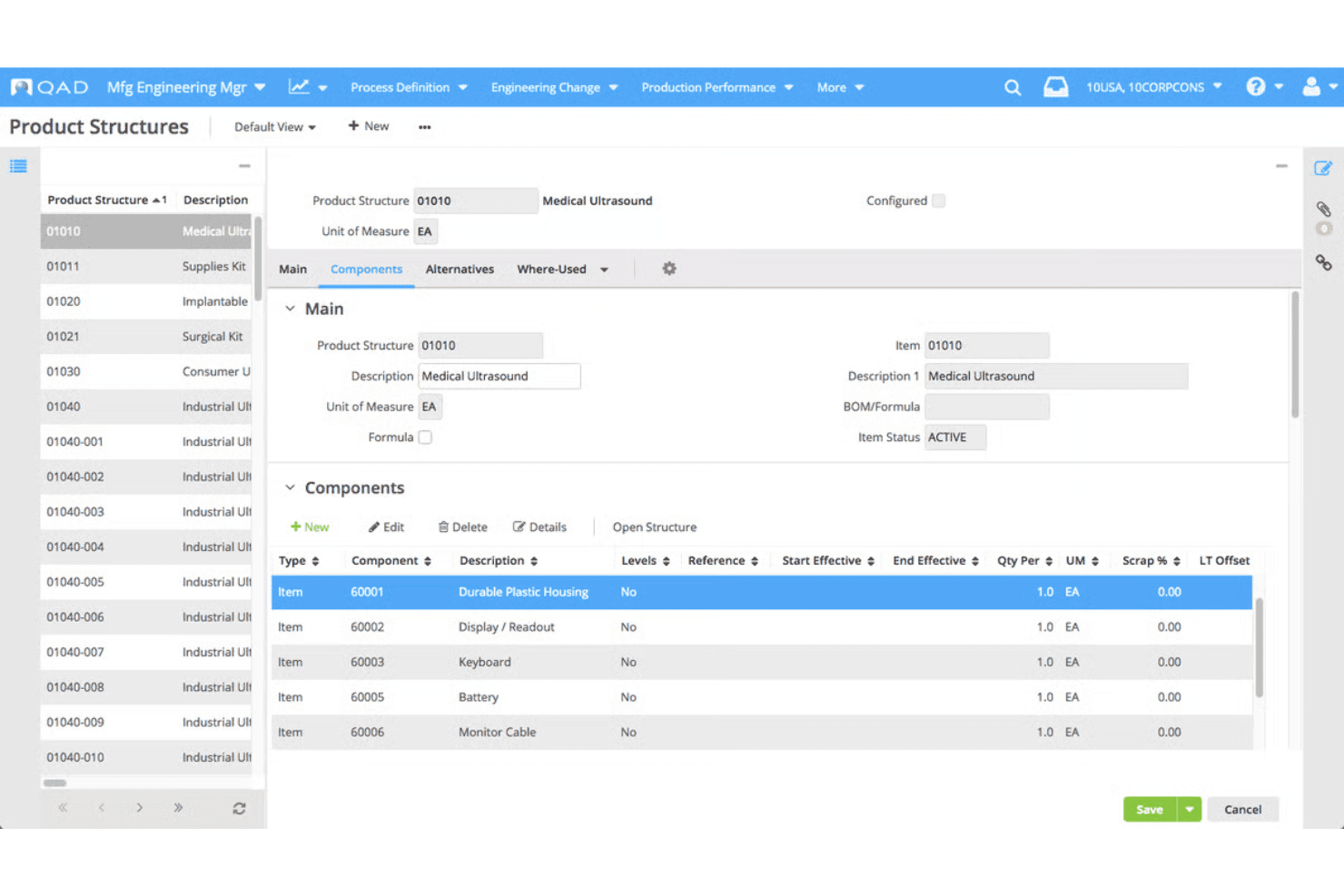
QAD Adaptive ERP’s interface feels modern but has a learning curve, especially for teams used to less specialized ERP platforms. Once configured, I think the modular workflows, customizable dashboards, and adaptive user features make it much easier to use for ongoing operations. Routine tasks become faster as users tailor screens by role, but initial setup and complex configurations like multinational tax rules can slow down adoption.
Integrations
QAD Adaptive ERP integrates with Salesforce, Oracle NetSuite, Microsoft Dynamics 365, SAP, ADP, Avalara, Vertex, Shopify, Dell Boomi, and Tableau, among others.
QAD Adaptive ERP also offers a robust API and supports integration with third-party tools such as Dell Boomi and MuleSoft.
QAD Adaptive ERP Specs
- API: Yes
- Calendar Management: Yes
- Customer Management: Yes
- Dashboard: Yes
- Data Export: Yes
- Data Import: Yes
- Data Visualization: Yes
- External Integrations: Yes
- Inventory Tracking: Yes
- Multi-User: Yes
- Natural Resources: Yes
- Notifications: Yes
- Order Management: Yes
- Project Management: Yes
- Scheduling: Yes
- Shipping Management: Yes
- Supplier Management: Yes


