

Reseña de OneUp: Ventajas, Desventajas, Características y Precios
OneUp destaca en la automatización de la contabilidad y la integración con CRM, lo que lo convierte en una de las mejores opciones para pequeñas empresas que buscan eficiencia y precios asequibles.

Revisamos las herramientas de forma independiente, y las comisiones ayudan a financiar nuestras pruebas. Consulta nuestra política de transparencia, nuestra metodología o sugiere una herramienta.
OneUp is an accounting software built for small businesses that need invoicing, inventory tracking, and CRM tools without juggling multiple platforms. I'd mainly consider it if you sell physical products and want tighter inventory-accounting integration than QuickBooks offers, at a price point that makes more sense for leaner operations.
OneUp Evaluation Summary
4.8/5
- Pricing upon request
- Not available
Por qué confiar en nuestras recomendaciones de software
6,700+
Reviews
20
Industry experts
16+
Evaluation factors
14
Years
Nuestras reseñas reflejan nuestro criterio independiente, no un discurso de ventas. Descubra cómo mantenemos la transparencia.
Para esta guía, evaluamos las herramientas mediante pruebas prácticas e investigación independiente, puntuando las herramientas según nuestros criterios de selección.
Nuestras reseñas reflejan nuestro criterio editorial humano, no un discurso de ventas.
OneUp Overview
In my opinion, OneUp is a solid choice for small businesses looking for affordable accounting solutions. Its standout feature is its CRM integration, which is a plus for teams that need both financial and customer management in one place. The pricing is competitive, but onboarding can be a bit challenging if you're new to accounting software. Compared to similar products, OneUp excels in ease of use and customer support, though it might not have all the advanced features larger enterprises need. It's best for businesses that prioritize user-friendly interfaces and require basic to intermediate accounting tools.
Pros
- It provides automated bookkeeping, saving time on manual entries.
- It's easy to use, even if you're not tech-savvy.
- Customer support is responsive and helpful when you need it.
Cons
- Onboarding can be tricky if you're new to accounting software.
- It might not have the advanced features large enterprises need.
- Some users find the report customization options limited.
Is OneUp Right For Your Needs?
Who Would be a Good Fit for OneUp?
OneUp is a great fit for small businesses, startups, and freelancers seeking efficient accounting without a steep learning curve. If your team values automated bookkeeping and integrated CRM functions, OneUp can save you time and effort. Its user-friendly interface makes it ideal for those who aren't tech-savvy but still need reliable financial management. If you run a business that doesn't require complex, enterprise-level features, OneUp offers the essential tools you need to manage your finances effectively.
- Small BusinessesOneUp provides automated bookkeeping and CRM integration, perfect for small businesses needing simple, efficient accounting tools.
- FreelancersWith its ease of use, OneUp suits freelancers who need to manage finances without complex software.
- StartupsStartups benefit from OneUp's cost-effective solution that offers essential accounting features, including tracking cash flow and bank transactions, without overwhelming new users.
- Retail ShopsRetailers can use OneUp's inventory management features to efficiently track inventory and sales orders.
- ConsultantsConsultants can leverage OneUp's invoicing, expense tracking, and notifications for straightforward and organized client billing.
- NonprofitsNonprofits value the ability to handle basic accounting tasks with OneUp, keeping their focus on their mission.
Who Would be a Bad Fit for OneUp?
OneUp might not suit the business needs of large enterprises or complex organizations that require advanced accounting features and customization. If your team relies on in-depth reporting and extensive feature sets, OneUp's basic offerings might fall short. Industries with intricate financial regulations or those that seek specialized accounting functions could find OneUp lacking. It's not ideal for businesses that need a high level of customization or integration with a wide array of third-party tools.
- Large CorporationsLarge corporations need advanced features and customization that OneUp doesn’t offer.
- Manufacturing CompaniesManufacturers often require complex inventory and production tracking, which OneUp might not be able to address.
- Financial ServicesFinancial services demand advanced reporting and compliance tools that OneUp lacks.
- Healthcare ProvidersHealthcare providers need specialized billing and regulatory features that aren't available in OneUp.
- Government AgenciesGovernment agencies often require extensive customization and compliance features not found in OneUp.
- Educational InstitutionsEducational institutions need specific accounting features for handling grants and funds, which OneUp doesn’t provide.
Cómo probamos y puntuamos las herramientas
Hemos dedicado años a construir, perfeccionar y mejorar nuestro sistema de evaluación y puntuación de software. La rúbrica está diseñada para capturar los matices de la selección de software y lo que hace que una herramienta sea efectiva, enfocándose en los aspectos críticos del proceso de toma de decisiones. A continuación, puedes ver exactamente cómo funcionan nuestras pruebas y puntuación en siete criterios. Esto nos permite proporcionar una evaluación imparcial del software basada en la funcionalidad principal, características destacadas, facilidad de uso, onboarding, atención al cliente, integraciones, opiniones de clientes y relación calidad-precio.
Funcionalidad principal (25% de la puntuación final)
Nuestro punto de partida siempre es la funcionalidad principal de la herramienta. ¿Tiene las funciones básicas que un usuario esperaría ver? ¿Alguna de estas características principales está limitada a planes de precios superiores? En esencia, esperamos que una herramienta esté a la altura de las capacidades básicas de sus competidores.
Características destacadas (25% de la puntuación final)
A continuación, evaluamos las características únicas y sobresalientes que van más allá de la funcionalidad principal normalmente encontrada en herramientas de este tipo. Una puntuación alta refleja funciones especializadas o únicas que hacen el producto más rápido, eficiente o que aportan valor adicional al usuario. También evaluamos lo fácil que es integrarse con otras herramientas que normalmente forman parte del stack tecnológico para ampliar la funcionalidad y utilidad del software. Las herramientas que ofrecen numerosas integraciones nativas, conexiones con terceros y acceso API para crear integraciones personalizadas obtienen la mejor puntuación.
Facilidad de uso (10% de la puntuación final)
Consideramos cuán rápido y fácil es ejecutar las tareas definidas en la funcionalidad principal usando la herramienta. El software que obtiene la puntuación más alta está bien diseñado, es intuitivo, ofrece aplicaciones móviles, proporciona plantillas y hace que tareas relativamente complejas parezcan simples.
Onboarding (10% de la puntuación final)
Sabemos lo importante que es una adopción rápida del equipo para una nueva plataforma, por lo que evaluamos cuán sencillo es aprender y utilizar una herramienta con una formación mínima. Analizamos lo rápido que un miembro del equipo puede configurarse y empezar a usar la herramienta sin experiencia previa. Las soluciones con alta puntuación indican que se requiere poco o ningún soporte.
Atención al cliente (10% de la puntuación final)
Revisamos cuán rápido y sencillo es salir de un atasco y encontrar ayuda por teléfono, chat en vivo o base de conocimiento. Las herramientas y empresas que proporcionan soporte en tiempo real obtienen la mejor puntuación, mientras que los chatbots obtienen la peor.
Opiniones de clientes (10% de la puntuación final)
Además de nuestras propias pruebas y evaluaciones, consideramos el net promoter score de clientes actuales y anteriores. Revisamos la probabilidad de que, de tener la opción, elijan nuevamente la herramienta por su funcionalidad principal. Un software con alta puntuación refleja un alto net promoter score de clientes presentes o pasados.
Relación calidad-precio (10% de la puntuación final)
Por último, considerando todos los demás criterios, revisamos el precio medio de los planes de entrada frente a las funciones principales y analizamos el valor de los demás criterios de evaluación. El software que ofrece más por menos obtiene una puntuación superior.
Core Features
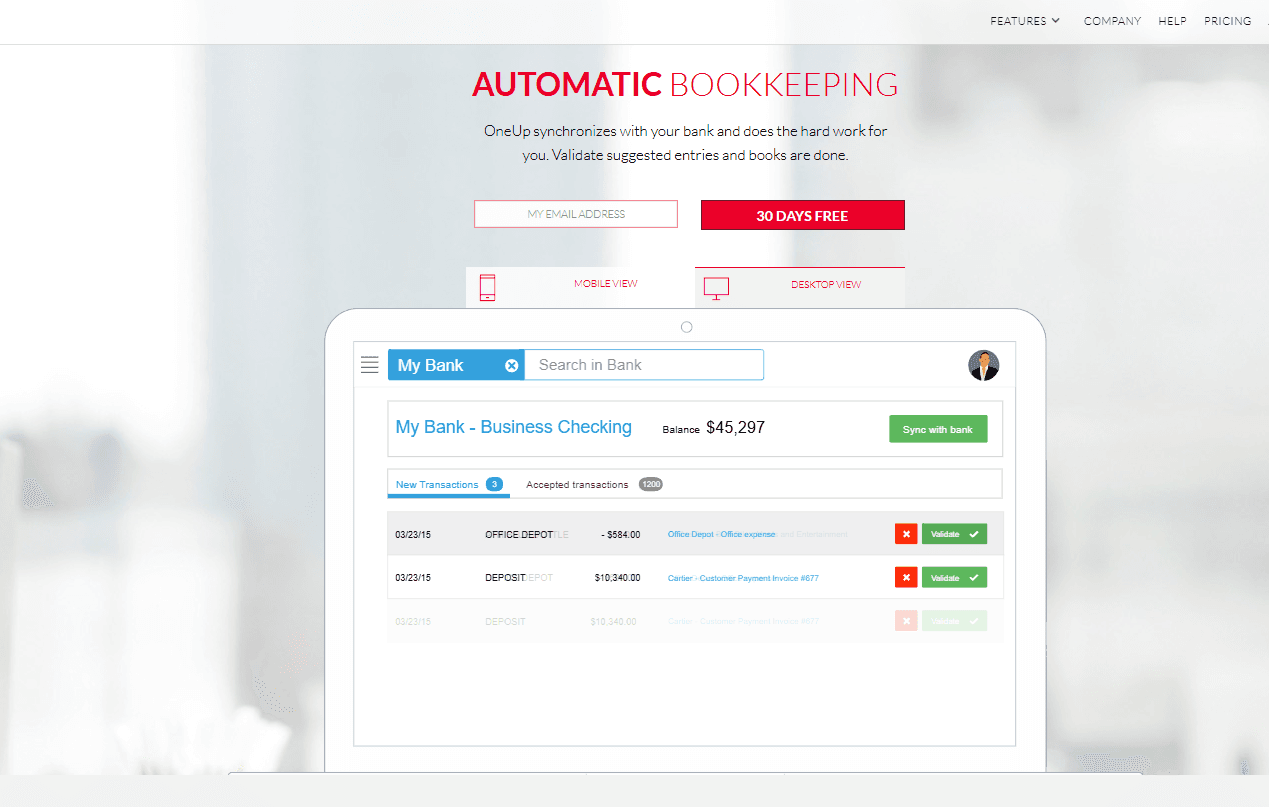
Automated Bookkeeping: OneUp automates your bookkeeping tasks, reducing the need for manual data entry. This saves you time and minimizes errors in your records.
Invoicing: You can create and send professional invoices with ease. OneUp allows customization, so your invoices always reflect your brand.
Expense Tracking: Track your expenses efficiently with OneUp's intuitive interface. It helps you keep an eye on your spending and manage your budget effectively.
Inventory Management: OneUp offers simple tools to manage your inventory, keeping you informed of stock levels. This feature helps avoid overstocking or running out of products.
Financial Reporting: You can generate financial reports with just a few clicks. OneUp provides clear insights into your business's financial health, helping you make informed decisions.
CRM Integration: With CRM integration, you can manage customer relationships alongside your finances. This feature ensures your customer data is always up to date.

Ease of Use
OneUp stands out for its user-friendly interface, making it accessible even if you’re not tech-savvy. The intuitive design lets you and your team quickly navigate tasks such as invoicing, bank reconciliation, and expense tracking without the need for extensive training. Users appreciate how straightforward it is to generate reports and manage inventory.

OneUp Specs
- 2-Factor Authentication: No
- Accounts Payable: Yes
- Accounts Receivable: Yes
- API: Yes
- Balance Sheet: Yes
- Billing/Invoicing: Yes
- BitCoin: No
- Budgeting: No
- Calendar Management: No
- Contact Management: Yes
- CRM Integration: No
- Customer Management: Yes
- Dashboard: Yes
- Data Export: Yes
- Data Import: Yes
- Data Visualization: Yes
- Expense Tracking: Yes
- External Integrations: Yes
- Forecasting: Yes
- General Account Ledger: Yes
- Inventory Tracking: Yes
- Multi-Currency: Yes
- Multi-User: Yes
- Notifications: Yes
- P&L: Yes
- PayPal: No
- Payroll: No
- SAP Integration: No
- Stripe: No
- Supplier Management: Yes
- Tax Management: Yes


