

Avis sur Dext 2026 : Avantages, Inconvénients, Fonctionnalités et Guide Actuel des Tarifs
Dext associe une extraction IA mature à des contrôles de comptabilité à l’échelle du cabinet, en faisant une option convaincante pour les entreprises submergées par la paperasse client. Découvrez si son automatisation, ses modules complémentaires et ses tarifs conviennent à votre équipe.

Nous évaluons les outils indépendamment ; les commissions aident à financer nos tests. Consultez notre politique de transparence et notre méthodologie.
Finance teams lose a surprising amount of time chasing receipts, cleaning up transaction data, and fixing avoidable bookkeeping errors. When close deadlines are already tight, that kind of manual work quickly becomes a drain on both capacity and visibility.
Dext is an AI bookkeeping software designed to take that work off your team’s plate. It captures and extracts financial data, categorizes transactions, and supports broader bookkeeping workflows across accounting firms and finance teams.
In this review, I’ll break down Dext’s key features, pricing, strengths, limitations, and best-fit use cases so you can decide whether it deserves a place in your stack.
Dext Evaluation Summary
4.5/5
- Pricing upon request
- 14-day free trial
Pourquoi faire confiance à nos recommandations de logiciels
6,700+
Reviews
20
Industry experts
16+
Evaluation factors
14
Years
Nos avis reflètent notre jugement indépendant — et non un argumentaire de vente. Découvrez comment nous restons transparents.
Pour ce guide, nous avons évalué les outils grâce à des tests pratiques et une recherche indépendante, en notant les outils selon nos critères de sélection.
Nos avis reflètent notre jugement éditorial humain, et non un argumentaire de vente.
Dext Overview
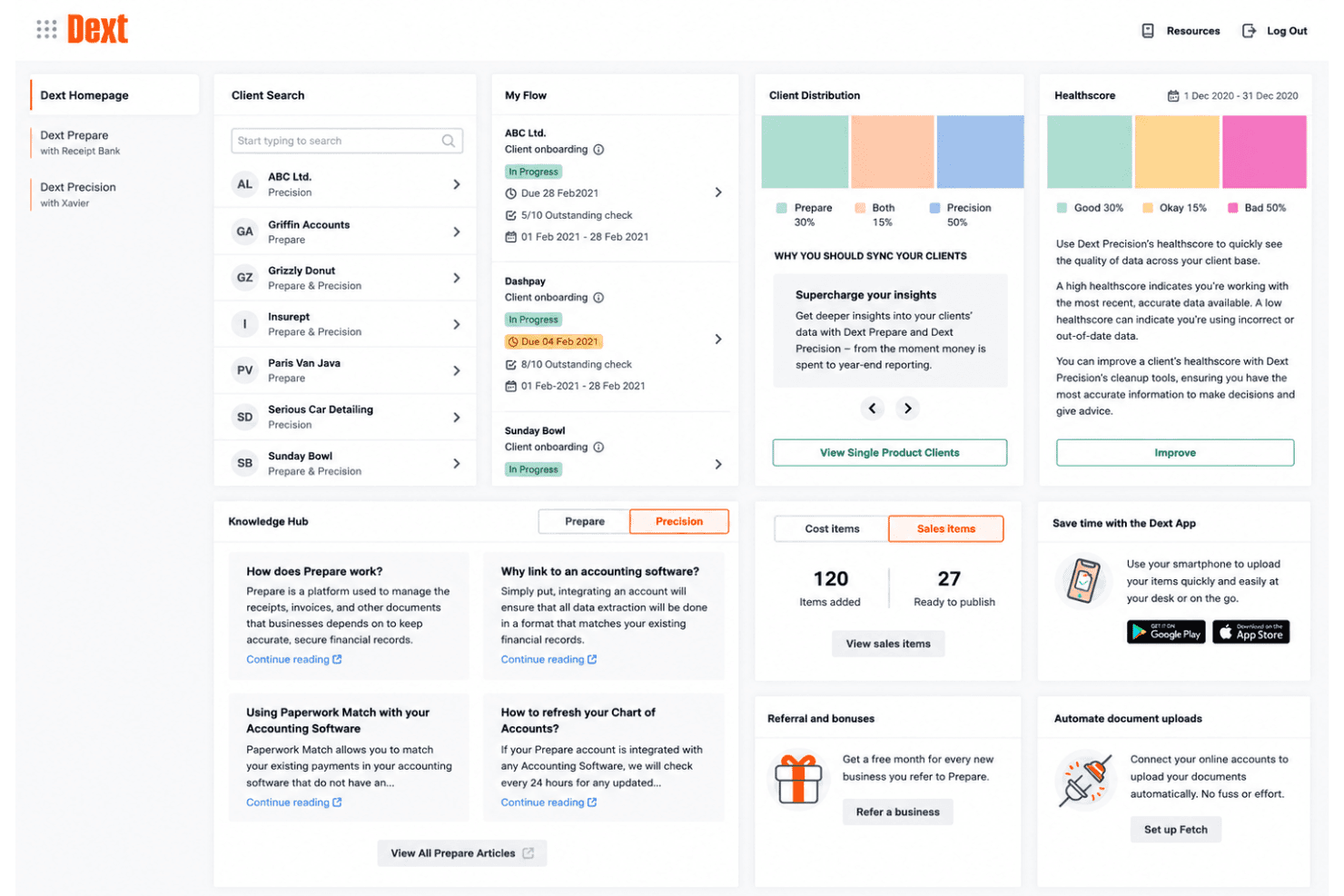
In my opinion, Dext stands out for combining accurate document extraction with practical bookkeeping automation. AI Assist, approval workflows, practice controls, and Data Health & Insights help reduce manual work, although pricing can be confusing and some integrations offer less automation. It is a strong fit for accounting firms and finance teams handling steady document volumes.
Pros
- Proprietary AI and automation rules reduce manual bookkeeping across high document volumes.
- Practice Advanced adds smart workflows, team controls, and firm-wide performance visibility.
- Data Health & Insights helps Xero and QuickBooks Online users catch and fix errors faster.
Cons
- Plans, allowances, and overage charges can make pricing difficult to predict.
- Firms may still spend time chasing clients for missing receipts and invoices.
- Fetch, Sage Line 50, and complex ecommerce setups offer more limited automation.
Is Dext Right For Your Needs?
Who Would be a Good Fit for Dext?
Dext is best suited to accounting firms and established businesses that already use bookkeeping software and process a steady volume of financial documents. Its document capture, automation, expense management, and practice-wide controls are particularly useful when manual bookkeeping begins limiting team capacity.
- Accounting FirmsMulti-client dashboards, automation rules, workflows, and data-quality tools help firms manage more client work without adding the same amount of manual processing.
- Small and Mid-Sized BusinessesReceipt capture, automated extraction, and expense workflows reduce the time internal teams spend entering and organizing bookkeeping data.
- Multi-Entity Businesses and FranchisesConsistent rules, centralized document collection, and accounting integrations support businesses managing several entities, branches, or locations.
- Retail and Ecommerce BusinessesDext helps process supplier invoices, employee expenses, and ecommerce sales data for businesses with relatively straightforward online selling setups.
- Real Estate and Construction BusinessesMobile capture and expense approvals make it easier to collect receipts and invoices from properties, job sites, employees, and contractors.
- Hospitality and Wellness BusinessesBusinesses handling frequent supplier bills and staff expenses can use Dext to keep documents organized and move data into their bookkeeping software faster.
Who Would be a Bad Fit for Dext?
Dext may offer less value to businesses that have not yet established their accounting processes or do not handle enough documents to benefit from automation. It can also be limiting for organizations with highly specialized integrations, complex ecommerce workflows, or requirements that go beyond bookkeeping automation.
- Brand-New StartupsBusinesses without an established bookkeeping process may not yet have enough activity to benefit from Dext.
- Direct MTD IT FilersSole traders and landlords needing direct Making Tax Digital for Income Tax support must access Dext Solo through an accounting partner.
- Very Low-Volume BusinessesCompanies processing only a few receipts or invoices each month may struggle to justify Dext’s subscription and add-on costs.
- Complex Ecommerce OperationsAdvanced Shopify, multichannel, marketplace VAT, and remitted-tax workflows may exceed what Dext Commerce can automate reliably.
- Sage Line 50-Dependent FirmsThe Sage Line 50 integration cannot support document attachments or read existing purchase items as deeply as Dext’s Xero and QuickBooks Online integrations.
Comment nous testons et évaluons les outils
Nous avons passé des années à construire, affiner et améliorer notre système de test et d’évaluation des logiciels. Notre grille vise à saisir toute la subtilité de la sélection logicielle et les facteurs déterminant l’efficacité d’un outil, en mettant l’accent sur les aspects essentiels du processus de décision. Ci-dessous, vous pouvez voir exactement comment notre test et notre notation fonctionnent selon sept critères. Cela nous permet de fournir une évaluation impartiale des logiciels sur la base des fonctionnalités principales, des fonctionnalités distinctives, de la facilité d’utilisation, de la prise en main, du service client, des intégrations, des avis clients et du rapport qualité/prix.
Fonctionnalité principale (25 % de la note finale)
Le point de départ de notre évaluation est toujours la fonctionnalité principale de l’outil. Dispose-t-il des caractéristiques de base attendues ? Certaines de ces fonctions de base sont-elles réservées aux plans tarifaires supérieurs ? Fondamentalement, nous attendons d’un outil qu’il soit au moins l’égal de ses concurrents en capacités essentielles.
Fonctionnalités Distinctives (25 % de la note finale)
Ensuite, nous évaluons les fonctionnalités rares ou uniques, allant au-delà de la fonctionnalité principale habituellement trouvée dans ce type d’outil. Un score élevé traduit des fonctionnalités spécialisées ou innovantes qui rendent le produit plus rapide, plus efficace, ou apportent une valeur supplémentaire à l’utilisateur. Nous évaluons aussi la facilité d’intégration avec d’autres outils courants de l’écosystème technologique pour étendre les capacités du logiciel. Les outils offrant de nombreuses intégrations natives, des connexions tierces et un accès API pour des intégrations personnalisées obtiennent le meilleur score.
Facilité d’utilisation (10 % de la note finale)
Nous considérons la rapidité et la facilité d’exécution des tâches essentielles avec l’outil. Un logiciel bien conçu, intuitif, proposant des applications mobiles, des modèles et permettant de simplifier des tâches complexes obtient la meilleure note.
Prise en Main (10 % de la note finale)
Nous savons combien il est important d’adopter rapidement une nouvelle plateforme, c’est pourquoi nous évaluons la facilité d’apprentissage et d’utilisation du logiciel avec un minimum de formation. Nous évaluons la rapidité de mise en place d’un nouveau membre d’équipe sans expérience. Un outil ayant un bon score requiert peu voire aucun support pour la prise en main.
Service Client (10 % de la note finale)
Nous évaluons s’il est rapide et facile d’obtenir de l’aide ou de dépanner par téléphone, chat en direct ou base de connaissances. Les outils et entreprises offrant une assistance en temps réel obtiennent le meilleur score, tandis que les chatbots sont moins bien notés.
Avis Clients (10 % de la note finale)
Au-delà de nos propres tests et évaluations, nous prenons en compte le net promoter score fourni par les clients actuels et passés. Nous vérifions leur probabilité de recommander l’outil et d’en refaire le choix pour ses fonctionnalités principales. Un logiciel bien noté se traduit par un net promoter score élevé.
Rapport Qualité/Prix (10 % de la note finale)
Enfin, en tenant compte de tous les autres critères, nous comparons le prix moyen des plans d’entrée de gamme avec les fonctionnalités principales, et le rapport de valeur avec les autres critères d’évaluation. Les logiciels offrant plus pour moins obtiennent la meilleure note.
Core Features
Receipt and Invoice Capture
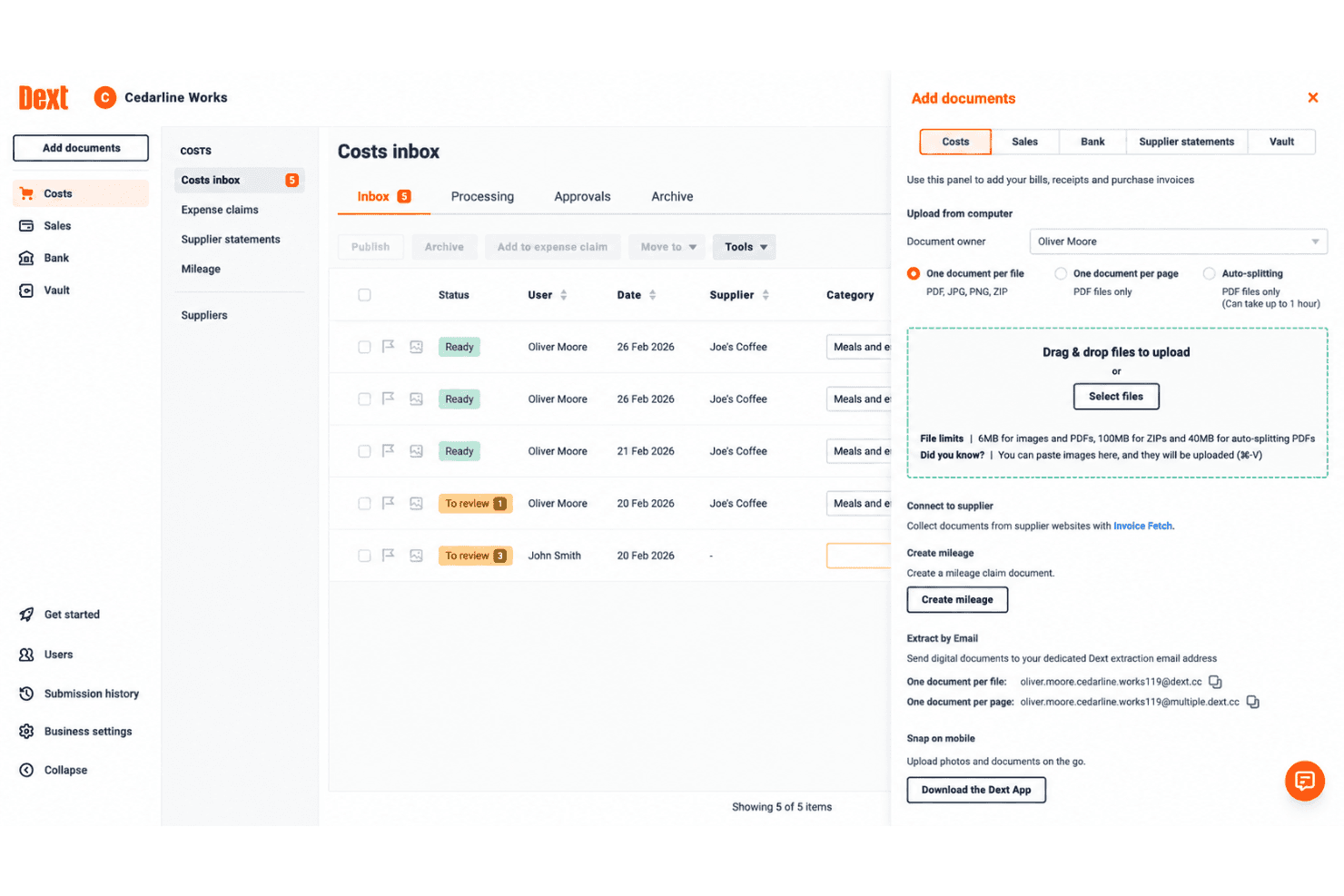
Dext lets users scan receipts and invoices through its mobile app or submit documents by email and web upload. It extracts key details, including line items, supplier statement data, and transactions from PDF bank statements.
Business Expense Management
Employees can submit and track expenses and mileage claims in Dext. Finance teams can then review costs through customized approval workflows before sending them to the accounting ledger.
AI Bookkeeping Automation
Supplier Rules, User Rules, Smart Split, and Auto-Publish automate repetitive coding, allocation, and publishing tasks. This helps teams process recurring transactions more consistently with less manual review.
Accounting Software Integrations
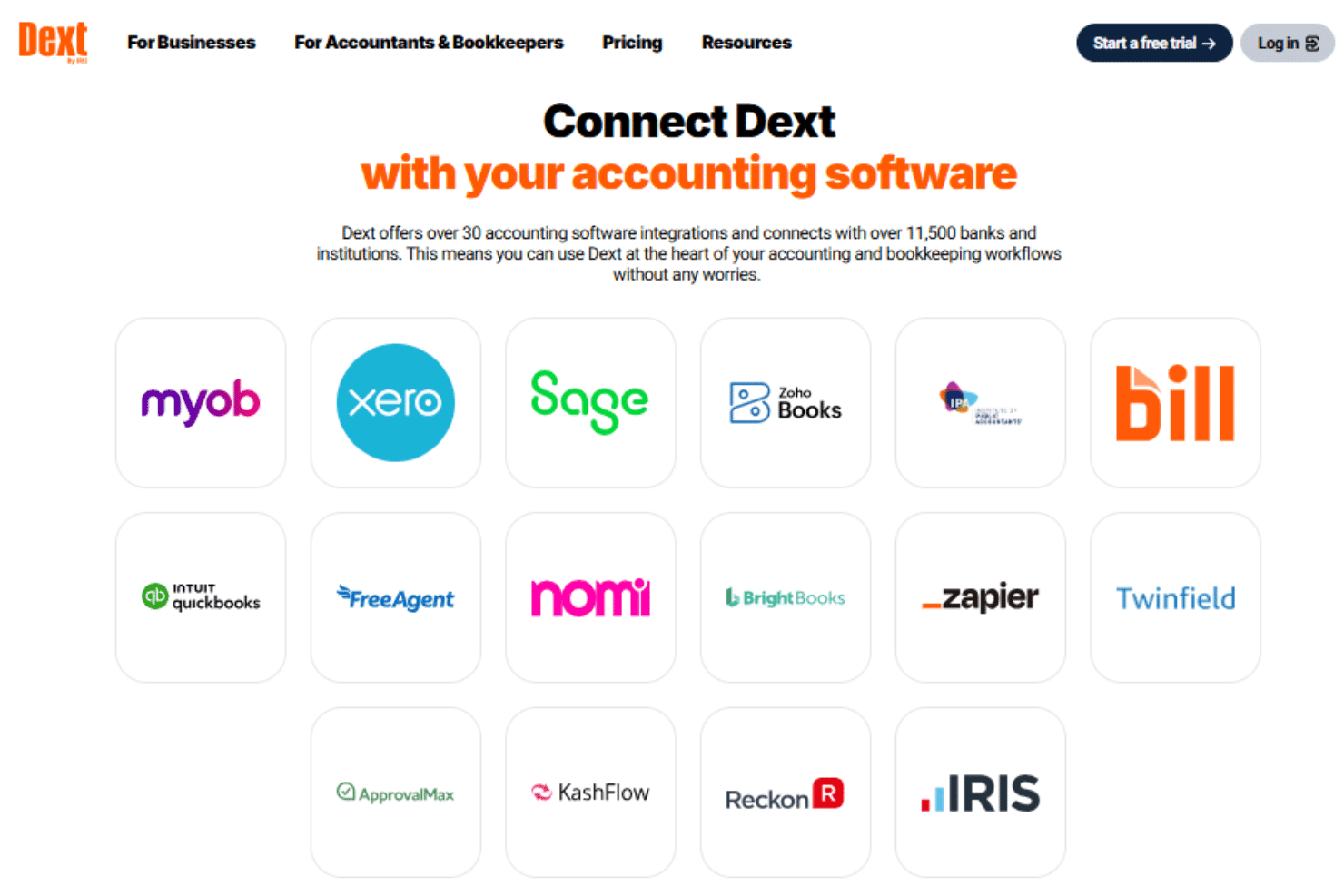
Dext connects with more than 36 accounting platforms, including Xero, QuickBooks, Sage, and FreeAgent. Dextension brings Dext tools into supported browser-based accounting workflows, while Commerce Lite can import sales data from ecommerce channels.
Vault Document Storage
Dext Vault securely stores contracts, statements, and other business documents alongside bookkeeping records. Its AI automatically organizes uploaded files so teams can find supporting documents more easily.
Supplier Payments
Dext Payments lets eligible businesses approve and pay supplier invoices directly from Dext. It is currently available only to UK customers using Xero.
Standout Features
Dext AI Assist
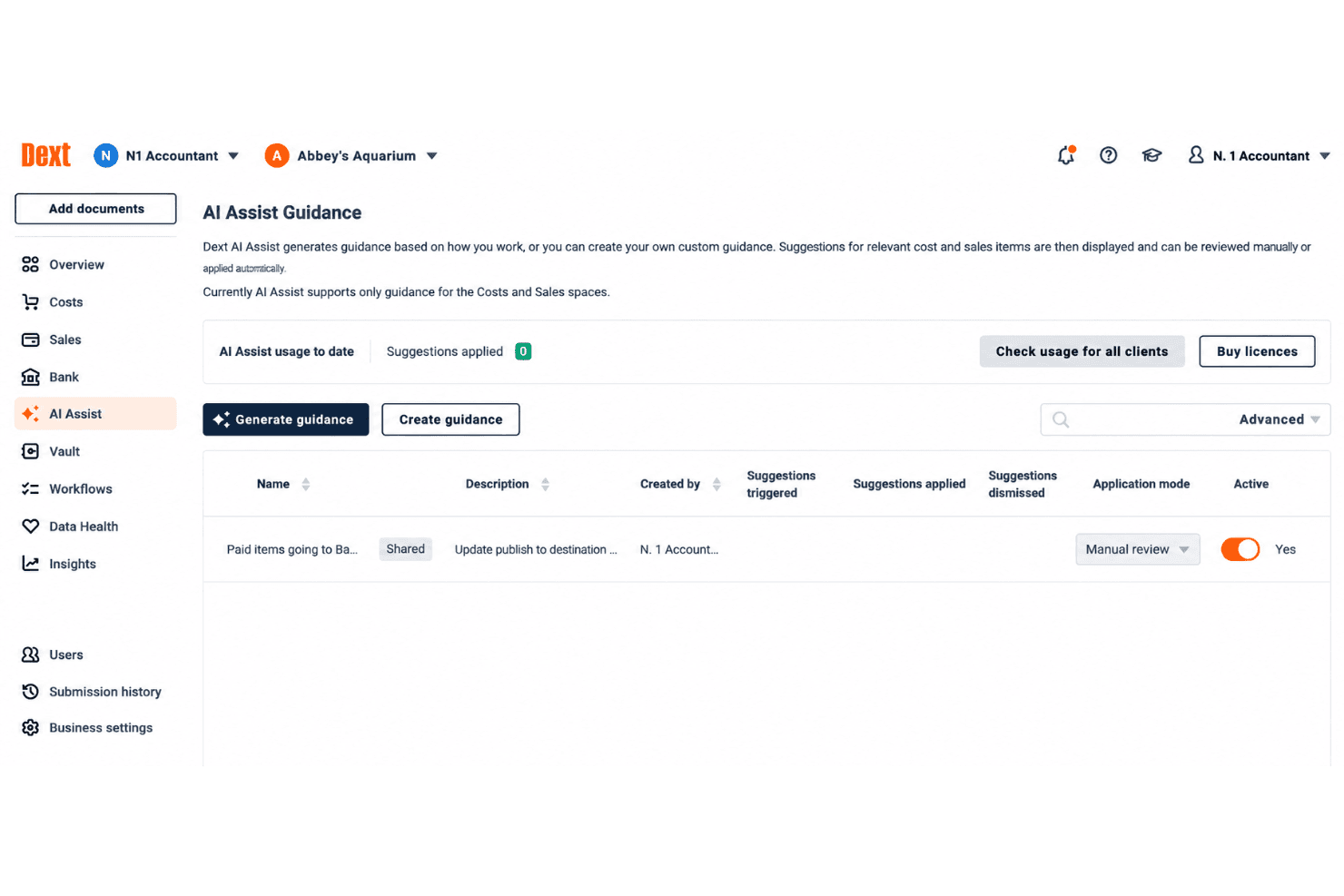
Dext AI Assist learns from user corrections and previous bookkeeping decisions to recommend coding for future transactions. It considers client-specific context beyond fixed rules while keeping accountants in control.
Client Data Health and Practice Insights
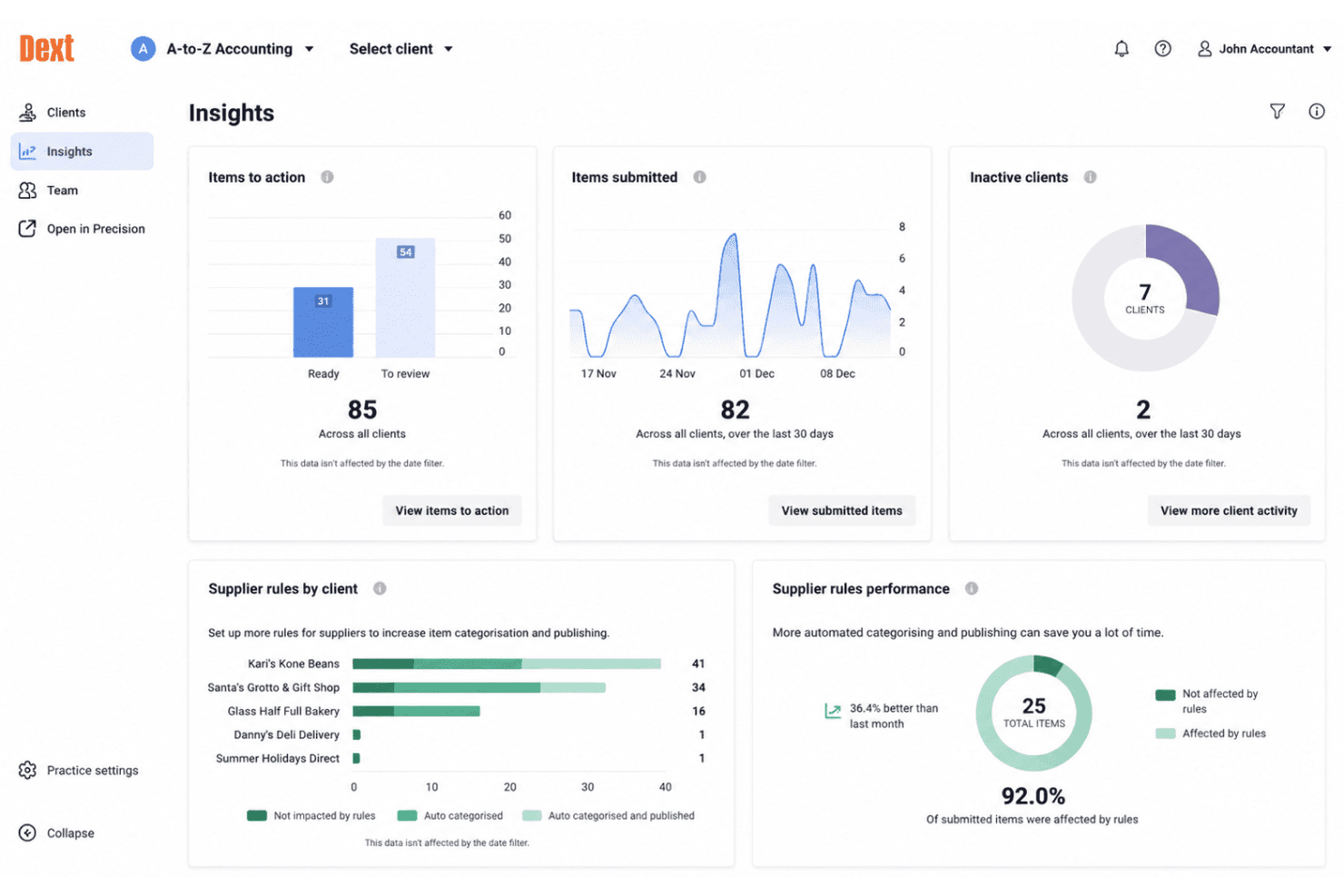
Dext checks Xero and QuickBooks Online data for errors, incomplete records, and other data-quality issues. Health Scores, Insights dashboards, and structured workflows help firms monitor client work, team productivity, deadlines, and automation performance across the practice.
Ease of Use
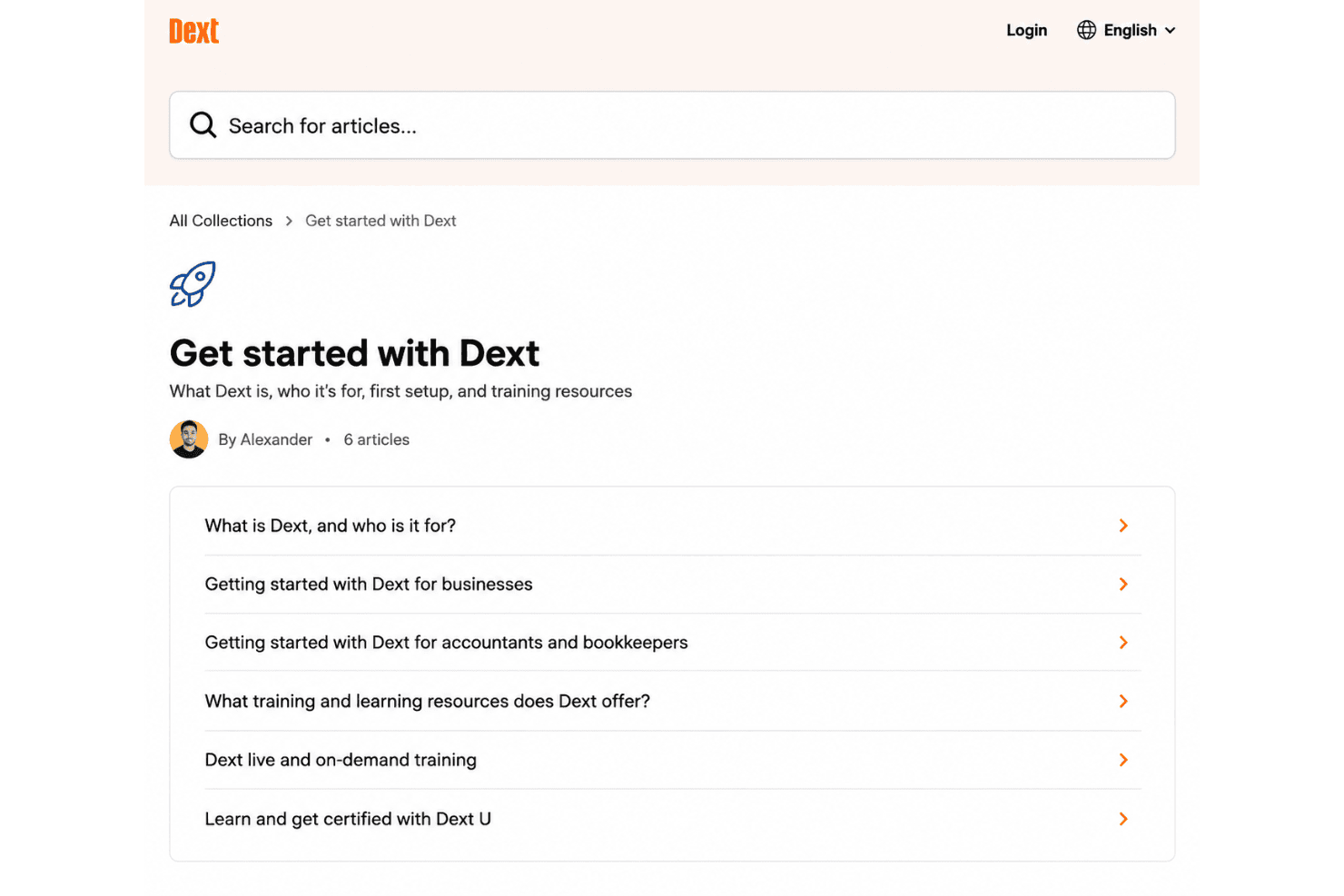
Dext is generally straightforward to use, with guided checklists, product tours, banners, and in-app prompts that help users complete common tasks. Most setups do not require a technical project team, although configuring permissions, approval workflows, and some advanced features may take more attention.
Onboarding
Dext uses a highly automated, self-service onboarding process with in-app checklists, product tours, banners, and Intercom guidance. Role-based onboarding communications span 15 to 90 days, while Dext Payments adds guided setup for KYC, Xero connections, permissions, supplier verification, and wallet funding.
Customer Support
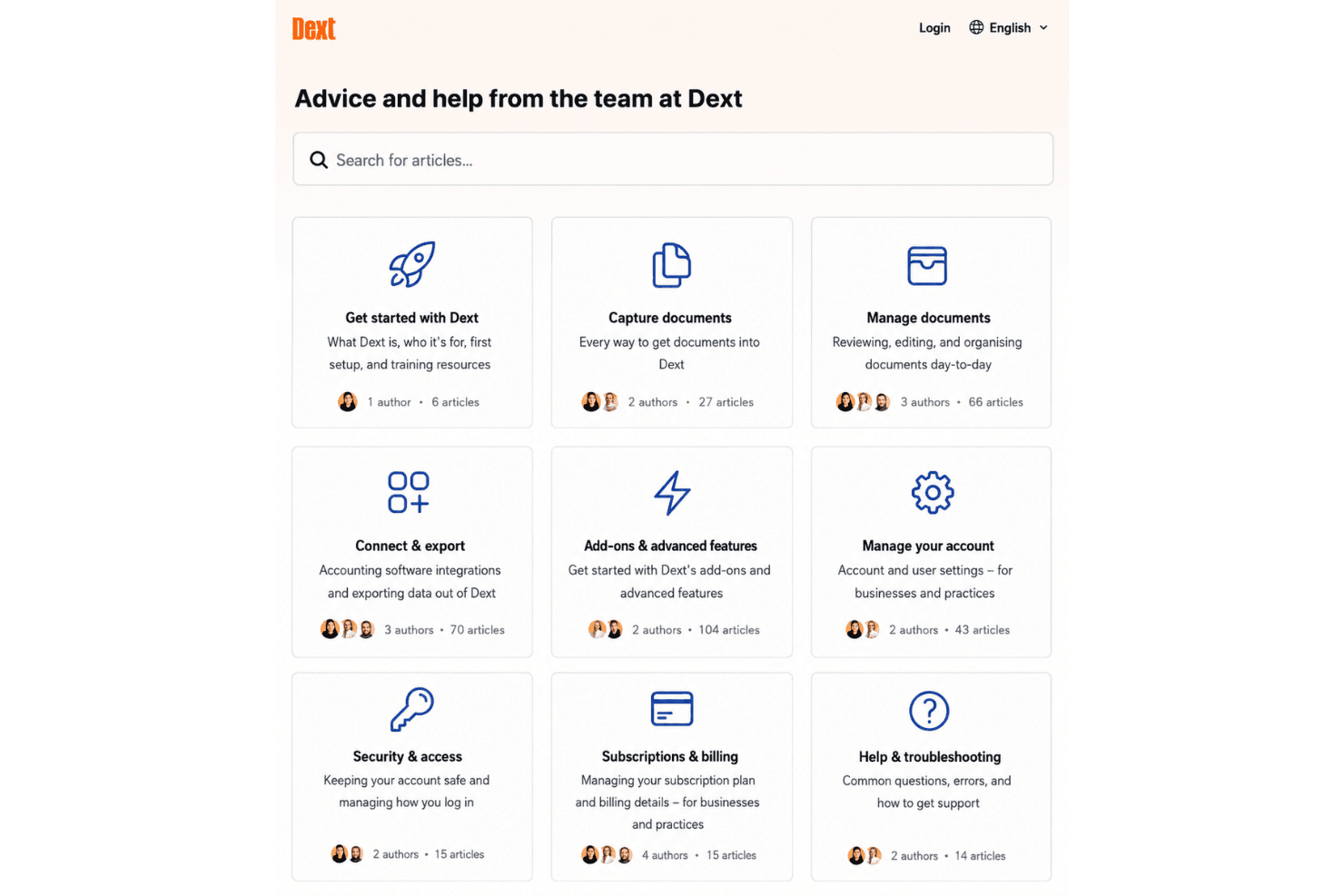
Dext provides 24/5 customer support, an extensive Help Centre, and Intercom-based assistance that includes the Fin AI chatbot. Depending on the plan, practices may also receive account manager check-ins, customer success guidance, dedicated training, and onboarding support.
Integrations
Dext integrates with more than 36 accounting platforms, including Xero, QuickBooks Online and Desktop, Sage Accounting, FreeAgent, MYOB, KashFlow, and Twinfield. It also integrates with tools such as Gusto, ApprovalMax, Bill.com, and Zapier, and offers APIs for select Dext products and workflows.
Value for Money
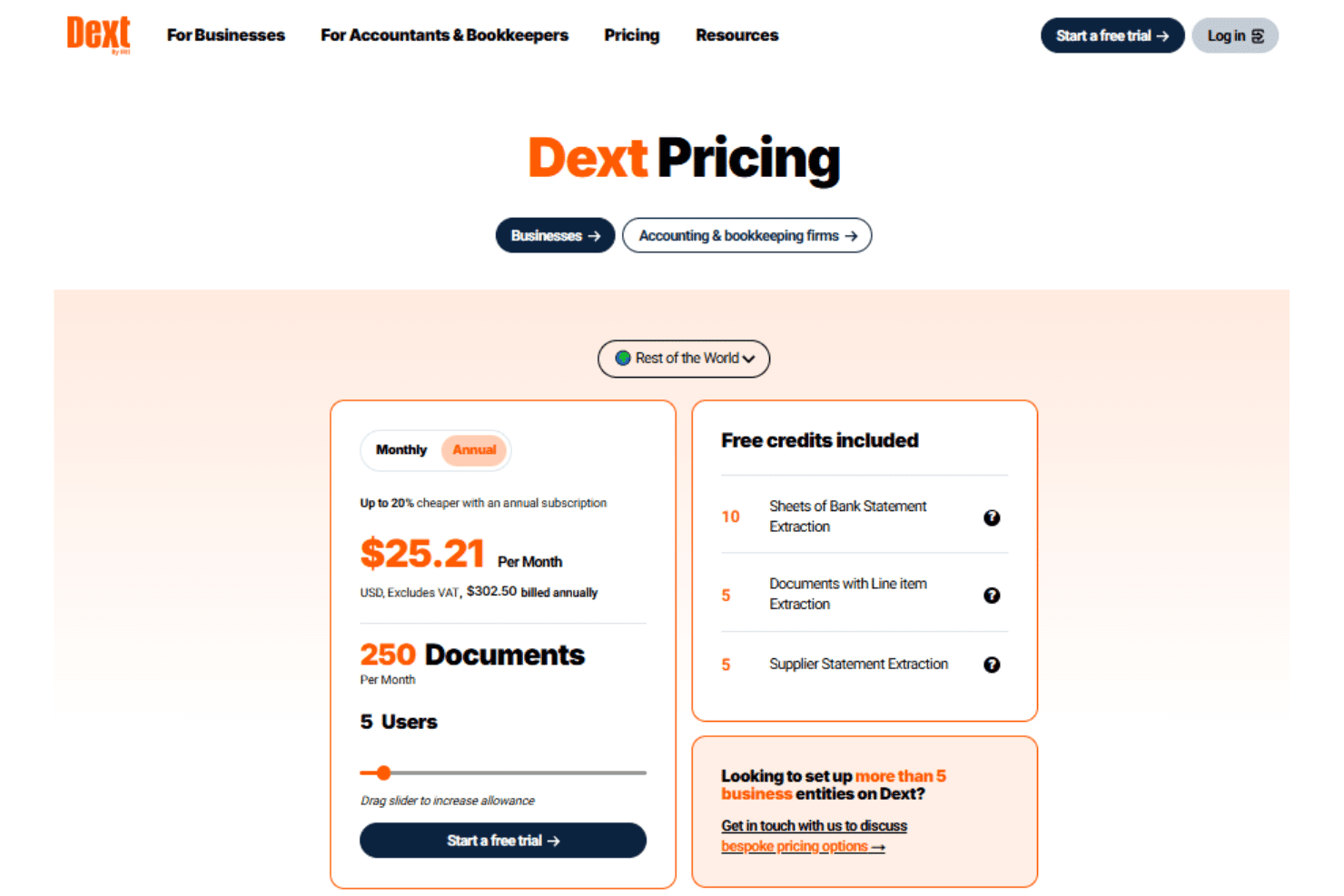
Dext prices its business and practice products differently, which makes sense given how each group uses the platform. Businesses pay based on document volume, user limits, and optional add-ons, while accounting practices pay per client and choose between Essentials and Advanced. Although the core plans already cover document capture and bookkeeping automation, the total cost can increase once you add paid AI Assist options, advanced extraction, Commerce Lite, Data Health & Insights, or extra Vault storage.
Dext for Business
- Business Plan: Includes receipt and invoice capture, mobile and web access, automated extraction, expense management, five users, and a monthly document allowance. Limited credits for bank statement, line-item, and supplier statement extraction are included, while AI Assist, Commerce Lite, additional Vault storage, and higher extraction volumes cost extra.
Dext Practice Plans
- Essentials: Includes multi-client document capture, supplier rules, approvals, reconciliation, duplicate detection, Auto-Publish, Dextension, accounting integrations, expense management, and client deadline tracking.
- Advanced: Includes everything in Essentials, plus smart practice workflows, team and location management, advanced client controls, time-spent insights, and practice-wide reporting.
Dext Specs
- 2-Factor Authentication: Yes
- API: Yes
- Approval Workflows: Yes
- Audit Trail: Yes
- Balance Sheet: Yes
- Billing/Invoicing: Yes
- Budgeting: No
- Calendar Management: No
- Compliance Tracking: No
- Contact Management: Yes
- CRM Integration: No
- Custom Reports: No
- Customer Management: Yes
- Dashboard: Yes
- Data Export: Yes
- Data Import: Yes
- Data Visualization: Yes
- Document Management: Yes
- Expense Tracking: Yes
- External Integrations: Yes
- Forecasting: No
- Inventory Tracking: Yes
- Multi-Currency: Yes
- Multi-User: Yes
- Notifications: Yes
- P&L: Yes
- Risk Assessment: No
- SAP Integration: Yes
- Scheduling: No
- Supplier Management: Yes
- Workflow Management: Yes
Dext FAQs
Dext Company Overview & History
Dext, formerly known as Receipt Bank, is an AI-powered bookkeeping automation software company founded in London in 2010 by Michael Wood and Alexis Prenn. It helps businesses, accountants, and bookkeepers capture financial documents, extract and categorize transaction data, manage expenses, improve client data quality, and automate recurring bookkeeping workflows.
The platform now covers receipt and invoice capture, AI-assisted bookkeeping, practice workflows, data health, ecommerce bookkeeping, accounting integrations, and payments in supported regions. Dext positions its technology as a way to reduce administrative work and help finance professionals make faster, more reliable financial decisions.
Dext Major Milestones
- 2010: Michael Wood and Alexis Prenn founded Receipt Bank in London.
- 2020: Receipt Bank acquired Xavier Analytics, adding financial data-quality checks, Health Scores, and practice insights to its product portfolio.
- 2021: Receipt Bank rebranded as Dext, while Xavier Analytics became Dext Precision.
- 2024: IRIS Software Group completed its acquisition of Dext, with Dext continuing to operate as a dedicated bookkeeping automation business.
- 2025: Dext continued rolling out its unified platform, bringing Prepare and Precision together while integrating key Commerce capabilities.