

Avis sur Intuit Enterprise Suite : principales fonctionnalités, avantages, inconvénients et détails des tarifs
Un tableur est ouvert dans un onglet, un rapport financier dans un autre, et il reste à combiner les chiffres de différentes entités avant la fin de la journée. À mesure que votre entreprise se développe, gérer les finances entre filiales, prévoir les performances et garder les processus organisés peut vite devenir complexe sans le bon logiciel ERP en place. C’est là que des plateformes comme Intuit Enterprise Suite entrent en jeu […]

Nous évaluons les outils indépendamment ; les commissions aident à financer nos tests. Consultez notre politique de transparence et notre méthodologie.
Une feuille de calcul est ouverte dans un onglet, un rapport financier dans un autre, et les chiffres provenant de différentes entités doivent encore être consolidés avant la fin de la journée.
À mesure que votre entreprise se développe, gérer les finances à travers plusieurs filiales, prévoir les performances et garder des workflows organisés peut rapidement devenir complexe sans le bon logiciel ERP en place.
C’est là qu’entrent en jeu des plateformes comme Intuit Enterprise Suite.
Dans ce guide, je détaille ses fonctionnalités, ses tarifs, ses points forts et ses principaux cas d’utilisation afin que vous puissiez comprendre son fonctionnement et décider si elle répond aux besoins de gestion financière de votre organisation.
Intuit Enterprise Suite Evaluation Summary

4.6/5
- Pricing upon request
- Free demo available
Pourquoi faire confiance à nos recommandations de logiciels
6,700+
Reviews
20
Industry experts
16+
Evaluation factors
14
Years
Nos avis reflètent notre jugement indépendant — et non un argumentaire de vente. Découvrez comment nous restons transparents.
Pour ce guide, nous avons évalué les outils grâce à des tests pratiques et une recherche indépendante, en notant les outils selon nos critères de sélection.
Nos avis reflètent notre jugement éditorial humain, et non un argumentaire de vente.
Intuit Enterprise Suite Overview
Pros
- Multi-entity management supports complex organizational structures.
- AI-powered forecasting and insights help businesses analyze financial data.
- Built-in migration tools support transitions from QuickBooks Desktop and Advanced.
Cons
- The platform lacks sufficient training for new releases.
- Features can feel overwhelming.
- Reports take longer than expected to load.
Is Intuit Enterprise Suite Right For Your Needs?
Who Would be a Good Fit for Intuit Enterprise Suite?
Intuit Enterprise Suite is best suited for growing or mid-sized organizations that need advanced financial management capabilities. Businesses managing multiple entities, relying on forecasting, or handling structured financial workflows can benefit from its automation, reporting, and consolidated visibility tools.
It’s particularly valuable for data-driven teams, product-based companies managing inventory, and organizations that need detailed financial tracking across departments, locations, or projects.
- Multi-Entity BusinessesCompanies managing multiple subsidiaries, brands, or locations that need consolidated financial visibility while maintaining separate books.
- Finance Teams Focused on ForecastingOrganizations that rely on financial planning and projections to guide budgeting, expansion, and strategic decisions.
- Businesses With Structured Financial WorkflowsCompanies with complex approval processes that want to automate financial workflows and improve internal controls.
- Growing Service BusinessesService businesses needing project profitability tracking, workforce management, and consolidated financial planning across departments benefit significantly.
- Product-Based BusinessesCompanies that manage inventory and sales orders and need accounting, inventory, and order workflows connected in one system.
- Construction FirmsConstruction companies tracking job costing, project budgets, and multi-entity structures gain stronger operational visibility.
Who Would be a Bad Fit for Intuit Enterprise Suite?
Intuit Enterprise Suite may not be the best choice for businesses with simple financial needs or limited operational complexity. Freelancers, very small businesses, or organizations without a dedicated accounting staff may find the platform more advanced than necessary.
Companies looking for lightweight bookkeeping tools or those that rarely rely on forecasting, reporting, or multi-entity management may be better served by simpler accounting solutions.
- Freelancers and Independent ContractorsIndividuals managing basic income and expenses typically don’t need the platform’s multi-entity management, forecasting tools, or workflow automation.
- Very Small BusinessesBusinesses that only need basic accounting features, such as invoicing and expense tracking, may find the platform unnecessarily complex.
- Businesses Without Dedicated Accounting StaffOrganizations without internal finance teams may struggle to manage a platform designed for structured financial processes and reporting.
- Inventory-Heavy ManufacturersManufacturers needing advanced inventory controls like serial numbers, bins, builds, or barcode workflows may struggle.
- Businesses Looking for Lightweight Accounting ToolsCompanies seeking a simple bookkeeping solution may be better served by smaller accounting platforms rather than a full financial management suite.
- Early-Stage StartupsStartups without operational complexity or financial teams gain minimal benefit from enterprise-level accounting features.
Comment nous testons et évaluons les outils
Nous avons passé des années à construire, affiner et améliorer notre système de test et d’évaluation des logiciels. Notre grille vise à saisir toute la subtilité de la sélection logicielle et les facteurs déterminant l’efficacité d’un outil, en mettant l’accent sur les aspects essentiels du processus de décision. Ci-dessous, vous pouvez voir exactement comment notre test et notre notation fonctionnent selon sept critères. Cela nous permet de fournir une évaluation impartiale des logiciels sur la base des fonctionnalités principales, des fonctionnalités distinctives, de la facilité d’utilisation, de la prise en main, du service client, des intégrations, des avis clients et du rapport qualité/prix.
Fonctionnalité principale (25 % de la note finale)
Le point de départ de notre évaluation est toujours la fonctionnalité principale de l’outil. Dispose-t-il des caractéristiques de base attendues ? Certaines de ces fonctions de base sont-elles réservées aux plans tarifaires supérieurs ? Fondamentalement, nous attendons d’un outil qu’il soit au moins l’égal de ses concurrents en capacités essentielles.
Fonctionnalités Distinctives (25 % de la note finale)
Ensuite, nous évaluons les fonctionnalités rares ou uniques, allant au-delà de la fonctionnalité principale habituellement trouvée dans ce type d’outil. Un score élevé traduit des fonctionnalités spécialisées ou innovantes qui rendent le produit plus rapide, plus efficace, ou apportent une valeur supplémentaire à l’utilisateur. Nous évaluons aussi la facilité d’intégration avec d’autres outils courants de l’écosystème technologique pour étendre les capacités du logiciel. Les outils offrant de nombreuses intégrations natives, des connexions tierces et un accès API pour des intégrations personnalisées obtiennent le meilleur score.
Facilité d’utilisation (10 % de la note finale)
Nous considérons la rapidité et la facilité d’exécution des tâches essentielles avec l’outil. Un logiciel bien conçu, intuitif, proposant des applications mobiles, des modèles et permettant de simplifier des tâches complexes obtient la meilleure note.
Prise en Main (10 % de la note finale)
Nous savons combien il est important d’adopter rapidement une nouvelle plateforme, c’est pourquoi nous évaluons la facilité d’apprentissage et d’utilisation du logiciel avec un minimum de formation. Nous évaluons la rapidité de mise en place d’un nouveau membre d’équipe sans expérience. Un outil ayant un bon score requiert peu voire aucun support pour la prise en main.
Service Client (10 % de la note finale)
Nous évaluons s’il est rapide et facile d’obtenir de l’aide ou de dépanner par téléphone, chat en direct ou base de connaissances. Les outils et entreprises offrant une assistance en temps réel obtiennent le meilleur score, tandis que les chatbots sont moins bien notés.
Avis Clients (10 % de la note finale)
Au-delà de nos propres tests et évaluations, nous prenons en compte le net promoter score fourni par les clients actuels et passés. Nous vérifions leur probabilité de recommander l’outil et d’en refaire le choix pour ses fonctionnalités principales. Un logiciel bien noté se traduit par un net promoter score élevé.
Rapport Qualité/Prix (10 % de la note finale)
Enfin, en tenant compte de tous les autres critères, nous comparons le prix moyen des plans d’entrée de gamme avec les fonctionnalités principales, et le rapport de valeur avec les autres critères d’évaluation. Les logiciels offrant plus pour moins obtiennent la meilleure note.
Core Features
Multi-Entity Financial Management
Manage multiple subsidiaries or business units in one platform with consolidated financial reporting and cross-entity visibility.
Workflow Automation
Automate financial approvals and operational workflows to reduce manual tasks and improve internal controls across your organization.
Business Intelligence and Reporting
Generate customizable financial reports, dashboards, and KPIs to monitor company performance and analyze financial data in real time.
Inventory and Order Management
Track inventory, manage sales orders, and connect operational workflows with accounting data to streamline order-to-cash processes.
Dimension Enhancements
Assign dimensions to transactions to track financial performance across departments, projects, or locations, with options for faster and bulk assignment.
Industry-Specific Business Modules
Intuit Enterprise Suite includes capabilities designed for industries like construction and professional services, helping businesses manage project budgets, proposals, and operational workflows.

Standout Features
AI-Powered Financial Forecasting
Intuit Enterprise Suite uses AI-powered forecasting to analyze historical data and generate financial projections up to three years ahead.
Real-Time Consolidated Financial Reporting
Intuit Enterprise Suite allows finance teams to generate consolidated financial reports across multiple entities, giving organizations a unified view of financial performance without manually combining data from separate systems.

Ease of Use
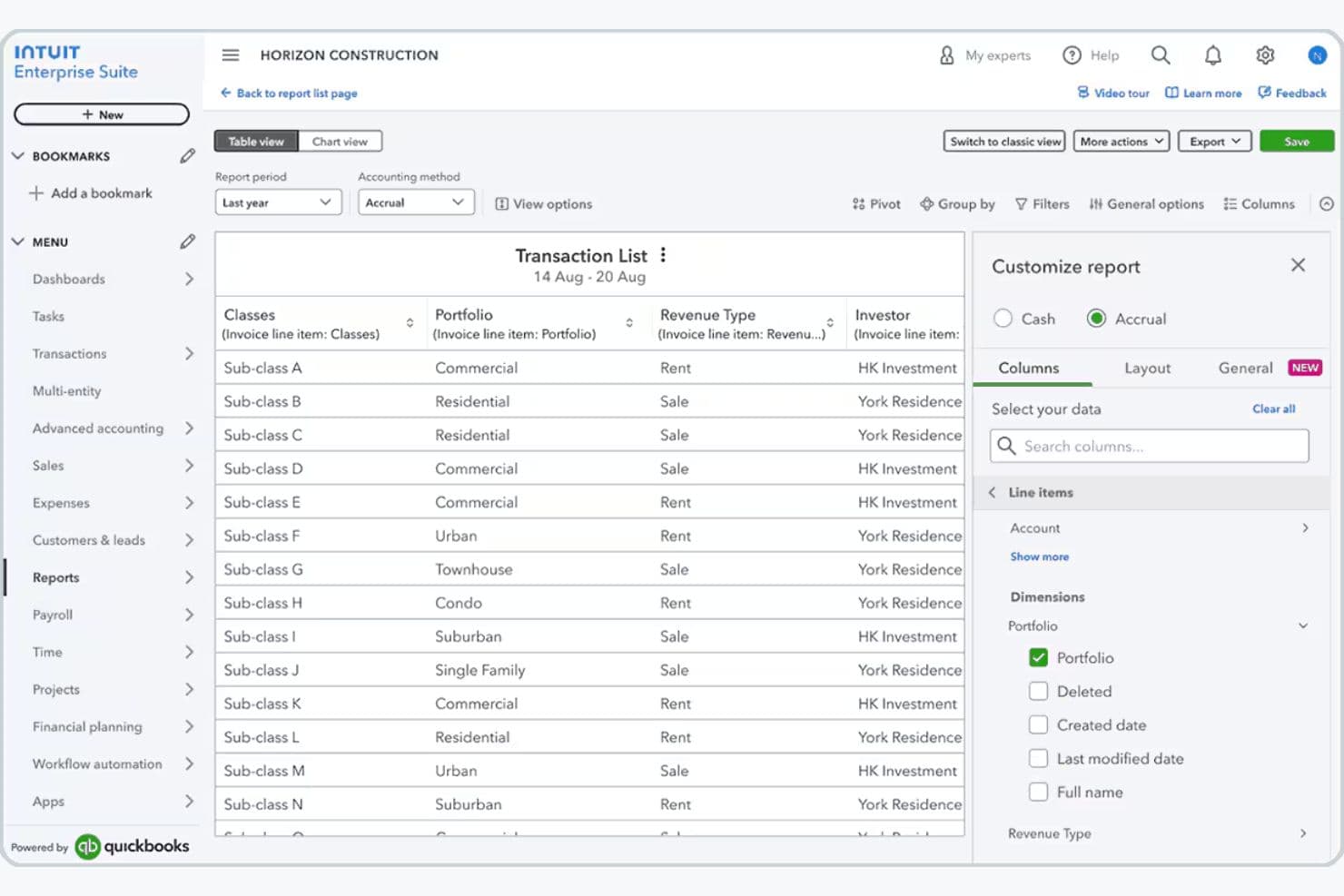
Intuit Enterprise Suite is generally easy to use, especially if you already use QuickBooks, since the interface follows familiar design patterns that shorten your learning curve.
You can manage accounting, payroll, reporting, and multiple entities in one cloud platform, making it easier to collaborate, access data anywhere, and reduce manual work. Most users find the interface intuitive and time-saving, though the advanced features—like multi-entity management and dimensional reporting—can feel overwhelming if you’re new to ERP accounting systems.
Onboarding
Intuit Enterprise Suite offers guided onboarding through a dedicated Customer Success Manager who helps businesses configure the platform, migrate data, and train their teams.
Companies transitioning from QuickBooks or other systems receive migration support from Intuit’s implementation team, while professional services and training resources help organizations adopt the platform more quickly.
This structured onboarding approach allows you to move to the platform with minimal disruption while ensuring your workflows, financial structures, and integrations are properly configured.
Customer Support
Intuit Enterprise Suite provides several customer support options to help businesses adopt and maintain the platform. Customers typically work with a dedicated Customer Success Manager who serves as a primary contact for onboarding, platform configuration, and ongoing guidance.
Additional support is available through phone assistance with Intuit product experts, a searchable knowledge base of help articles, and community forums where users can share solutions and best practices.
Together, these support channels provide both direct assistance and self-service resources for troubleshooting and platform optimization.

Integrations
With Intuit Enterprise Suite, you can connect the platform to hundreds of third-party apps through the broader QuickBooks ecosystem. For example, you can connect Mailchimp for marketing, QuickBooks Payroll and QuickBooks Time for workforce management, and various CRM, project management, and ecommerce apps available through the QuickBooks App Store, helping you keep financial and operational data synced across systems.
If you need deeper customization, you can also use the QuickBooks Online API, which works with Intuit Enterprise Suite out of the box and lets developers build custom integrations or connect internal tools—though if you manage multiple entities, you currently need to connect integrations to each entity individually.

Value for Money
Because pricing is tailored to each business, you’ll need to schedule a consultation with Intuit to receive a quote and determine the appropriate configuration for their needs. This approach allows companies to scale the platform as they grow while paying only for the capabilities and operational scope relevant to their organization.
The final cost depends on factors such as the number of entities, users, modules required, and the complexity of the organization’s financial structure.

Intuit Enterprise Suite Specs
- Accounts Payable: Yes
- Accounts Receivable: Yes
- API: Yes
- Batch Permissions & Access: No
- Budgeting: Yes
- Calendar Management: No
- Customer Management: No
- Dashboard: Yes
- Data Export: Yes
- Data Import: Yes
- Data Visualization: Yes
- Expense Tracking: Yes
- External Integrations: Yes
- Forecasting: Yes
- General Account Ledger: Yes
- Inventory Tracking: Yes
- Lead Management: No
- Lead Scoring: No
- Marketing Automation: No
- Multi-User: Yes
- Notifications: Yes
- Password & Access Management: No
- Payroll: Yes
- Project Management: Yes
- Scheduling: No
- Supplier Management: Yes
- Tax Management: Yes
- Third-Party Plugins/Add-Ons: Yes
- Travel Management: No
Intuit Enterprise Suite FAQs
Intuit Enterprise Suite Company Overview & History
Intuit Enterprise Suite is part of Intuit, a global financial technology company headquartered in Mountain View, California. Intuit is known for building widely used financial software, including QuickBooks, TurboTax, Mailchimp, and Credit Karma.
The platform combines financial management, payroll, payments, automation, and business intelligence tools in a single system to help companies streamline operations and scale efficiently.
Intuit Enterprise Suite Major Milestones
- 1983: Intuit Inc. was founded in Palo Alto, California.
- 2024: Intuit launches Intuit Enterprise Suite, an AI-powered financial management platform designed for growing mid-market businesses.
- 2025: Intuit continues expanding the platform with updates focused on automation, reporting, and operational efficiency.