

Avis sur Salesforce CRM : avantages, inconvénients, fonctionnalités et tarification
Salesforce CRM se distingue par ses options de personnalisation et d’intégration robustes, ce qui le rend idéal pour des besoins comptables complexes, mais il peut s’avérer déroutant pour les entreprises de plus petite taille.

Nous évaluons les outils indépendamment ; les commissions aident à financer nos tests. Consultez notre politique de transparence et notre méthodologie.
Salesforce CRM is an accounting CRM built for finance and accounting teams that need to connect client relationship data with pipeline tracking, revenue reporting, and financial workflows. I'd consider it if your team has moved past what HubSpot CRM can offer, specifically, if you need deeper customization, more granular reporting, and the ability to integrate with a broader financial tech stack without hitting a ceiling.
Salesforce CRM Evaluation Summary
4.2/5
- From $25/user/month
- 30-day free trial
Pourquoi faire confiance à nos recommandations de logiciels
6,700+
Reviews
20
Industry experts
16+
Evaluation factors
14
Years
Nos avis reflètent notre jugement indépendant — et non un argumentaire de vente. Découvrez comment nous restons transparents.
Pour ce guide, nous avons évalué les outils grâce à des tests pratiques et une recherche indépendante, en notant les outils selon nos critères de sélection.
Nos avis reflètent notre jugement éditorial humain, et non un argumentaire de vente.
Salesforce CRM Overview
If you're judging accounting CRM software on customization, integration, and reporting, Salesforce CRM consistently comes out ahead. Its flexible workflows and deep analytics let you tailor processes to your firm's needs, while the AppExchange ecosystem covers nearly any integration you'll want. Pricing can be steep, and onboarding takes time, but the interface is intuitive once set up. I think it's best for teams who want to build a CRM around their accounting processes, not the other way around—especially those with complex requirements or rapid growth plans.
Pros
- Advanced reporting and analytics for financial tracking.
- Highly customizable workflows for accounting processes.
- Strong audit trail and compliance features.
Cons
- Pricing increases quickly with advanced features.
- Initial setup and configuration can be complex.
- Native accounting functions require third-party add-ons.
Is Salesforce CRM Right For Your Needs?
Who Would be a Good Fit for Salesforce CRM?
Salesforce CRM is a strong choice for organizations that need advanced customization, detailed reporting, and scalable workflows to manage complex accounting and client relationships. It's one of the more powerful crm solutions available for teams with dedicated IT support, high compliance needs, or multi-entity operations—delivering real value through its automation, audit trails, and analytics. This makes the salesforce platform especially useful for industries with strict regulatory requirements or fast growth.
- Large Accounting FirmsHandles multi-entity management and complex client structures with ease.
- Financial ServicesSupports compliance, audit trails, and detailed client segmentation.
- Enterprise-Level CorporationsScales with high transaction volumes and custom workflow needs.
- Consulting AgenciesCustomizes project billing, invoicing, lead management, and client communications.
- CFOs in Regulated IndustriesOffers strong controls and documentation for audit-readiness.
- Multi-Department OrganizationsCentralizes customer data and automates cross-team collaboration.
Who Would be a Bad Fit for Salesforce CRM?
Salesforce CRM is less suitable for smaller businesses, teams with limited budgets, or those seeking out-of-the-box accounting features without heavy customization. If your team needs a simple, plug-and-play CRM system or lacks IT resources for setup and maintenance, you may find Salesforce CRM overwhelming or cost-prohibitive.
- Small BusinessesSetup complexity and cost outweigh basic accounting needs.
- Solo AccountantsToo feature-heavy for single-user workflows and simple tracking.
- Startups with Tight BudgetsPricing and required add-ons can strain limited resources.
- Nonprofits with Simple NeedsOverkill for basic donor or member management tasks.
- Teams Without IT SupportCustomization and maintenance require technical expertise.
- Firms Wanting Built-In AccountingNative accounting features are limited and need third-party apps.
Comment nous testons et évaluons les outils
Nous avons passé des années à construire, affiner et améliorer notre système de test et d’évaluation des logiciels. Notre grille vise à saisir toute la subtilité de la sélection logicielle et les facteurs déterminant l’efficacité d’un outil, en mettant l’accent sur les aspects essentiels du processus de décision. Ci-dessous, vous pouvez voir exactement comment notre test et notre notation fonctionnent selon sept critères. Cela nous permet de fournir une évaluation impartiale des logiciels sur la base des fonctionnalités principales, des fonctionnalités distinctives, de la facilité d’utilisation, de la prise en main, du service client, des intégrations, des avis clients et du rapport qualité/prix.
Fonctionnalité principale (25 % de la note finale)
Le point de départ de notre évaluation est toujours la fonctionnalité principale de l’outil. Dispose-t-il des caractéristiques de base attendues ? Certaines de ces fonctions de base sont-elles réservées aux plans tarifaires supérieurs ? Fondamentalement, nous attendons d’un outil qu’il soit au moins l’égal de ses concurrents en capacités essentielles.
Fonctionnalités Distinctives (25 % de la note finale)
Ensuite, nous évaluons les fonctionnalités rares ou uniques, allant au-delà de la fonctionnalité principale habituellement trouvée dans ce type d’outil. Un score élevé traduit des fonctionnalités spécialisées ou innovantes qui rendent le produit plus rapide, plus efficace, ou apportent une valeur supplémentaire à l’utilisateur. Nous évaluons aussi la facilité d’intégration avec d’autres outils courants de l’écosystème technologique pour étendre les capacités du logiciel. Les outils offrant de nombreuses intégrations natives, des connexions tierces et un accès API pour des intégrations personnalisées obtiennent le meilleur score.
Facilité d’utilisation (10 % de la note finale)
Nous considérons la rapidité et la facilité d’exécution des tâches essentielles avec l’outil. Un logiciel bien conçu, intuitif, proposant des applications mobiles, des modèles et permettant de simplifier des tâches complexes obtient la meilleure note.
Prise en Main (10 % de la note finale)
Nous savons combien il est important d’adopter rapidement une nouvelle plateforme, c’est pourquoi nous évaluons la facilité d’apprentissage et d’utilisation du logiciel avec un minimum de formation. Nous évaluons la rapidité de mise en place d’un nouveau membre d’équipe sans expérience. Un outil ayant un bon score requiert peu voire aucun support pour la prise en main.
Service Client (10 % de la note finale)
Nous évaluons s’il est rapide et facile d’obtenir de l’aide ou de dépanner par téléphone, chat en direct ou base de connaissances. Les outils et entreprises offrant une assistance en temps réel obtiennent le meilleur score, tandis que les chatbots sont moins bien notés.
Avis Clients (10 % de la note finale)
Au-delà de nos propres tests et évaluations, nous prenons en compte le net promoter score fourni par les clients actuels et passés. Nous vérifions leur probabilité de recommander l’outil et d’en refaire le choix pour ses fonctionnalités principales. Un logiciel bien noté se traduit par un net promoter score élevé.
Rapport Qualité/Prix (10 % de la note finale)
Enfin, en tenant compte de tous les autres critères, nous comparons le prix moyen des plans d’entrée de gamme avec les fonctionnalités principales, et le rapport de valeur avec les autres critères d’évaluation. Les logiciels offrant plus pour moins obtiennent la meilleure note.
Core Features
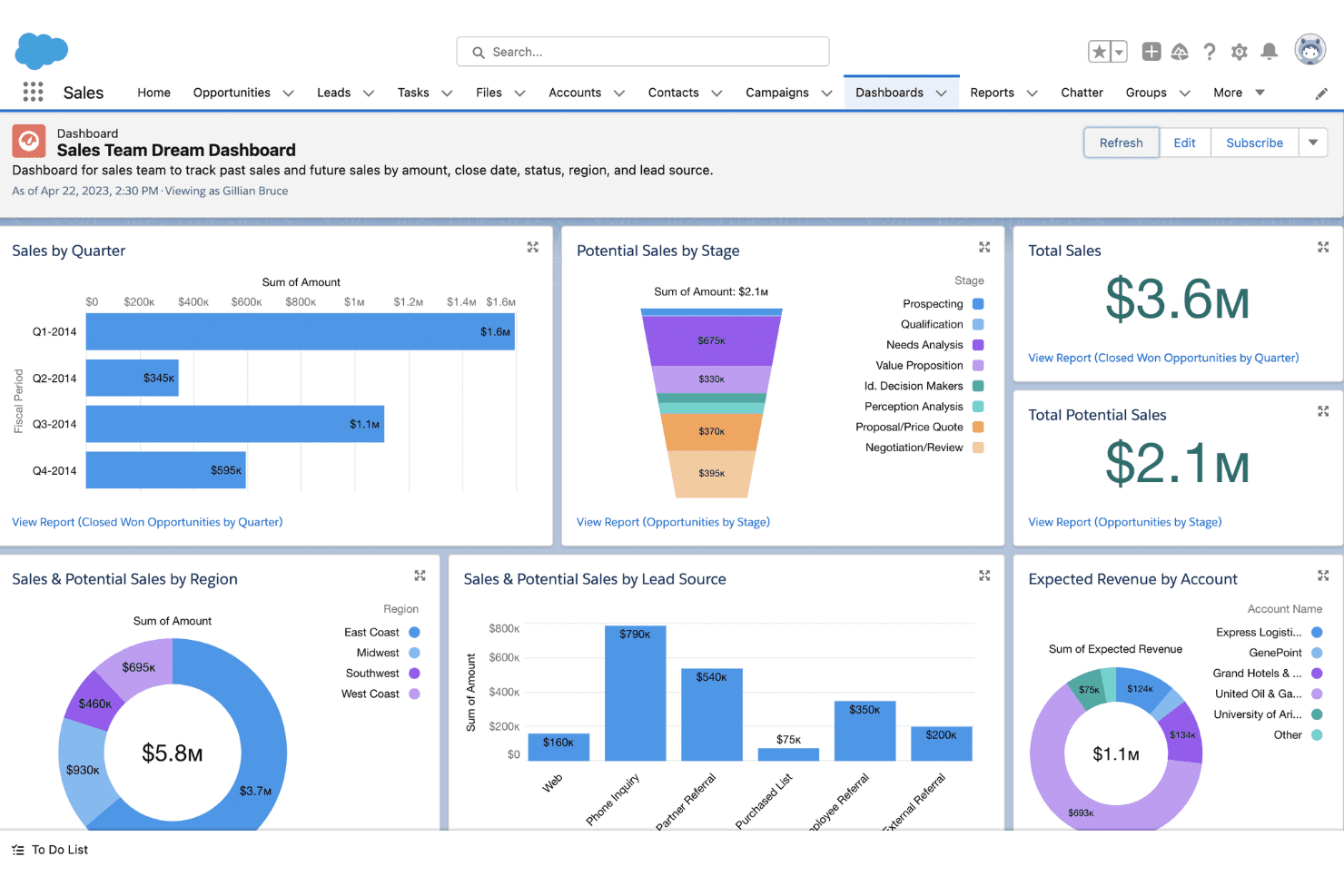
Customizable Dashboards
Build real-time financial dashboards tailored to your KPIs. Use drag-and-drop tools to visualize revenue, receivables, and pipeline data.
Automated Workflow Rules
Configure triggers for invoice approvals, payment reminders, and notifications. Reduce manual tasks and streamline accounting processes.
Opportunity and Pipeline Management
Track deals, proposals, and renewals with detailed financial forecasting. Monitor your sales pipeline and prioritize high-value clients.
Audit Trail and Compliance Tracking
Log every change to client records and transactions for audit-readiness. Meet regulatory requirements with detailed activity histories.
Document Management
Store contracts, invoices, and financial statements securely in client records. Access and share documents directly from the CRM system.
Advanced Reporting and Analytics
Generate custom reports and analyze trends across clients or periods. Drill down into revenue, expenses, and outstanding balances.

Ease of Use
Salesforce CRM offers a clean, modern interface, but its depth and customization options can feel overwhelming at first—especially for accounting teams without dedicated admins. Many users say the platform becomes intuitive after initial setup, thanks to customizable dashboards and guided workflows. However, configuring features like workflow automation and reporting often requires training or IT support, so it's best suited for teams ready to invest time in onboarding.
Integrations
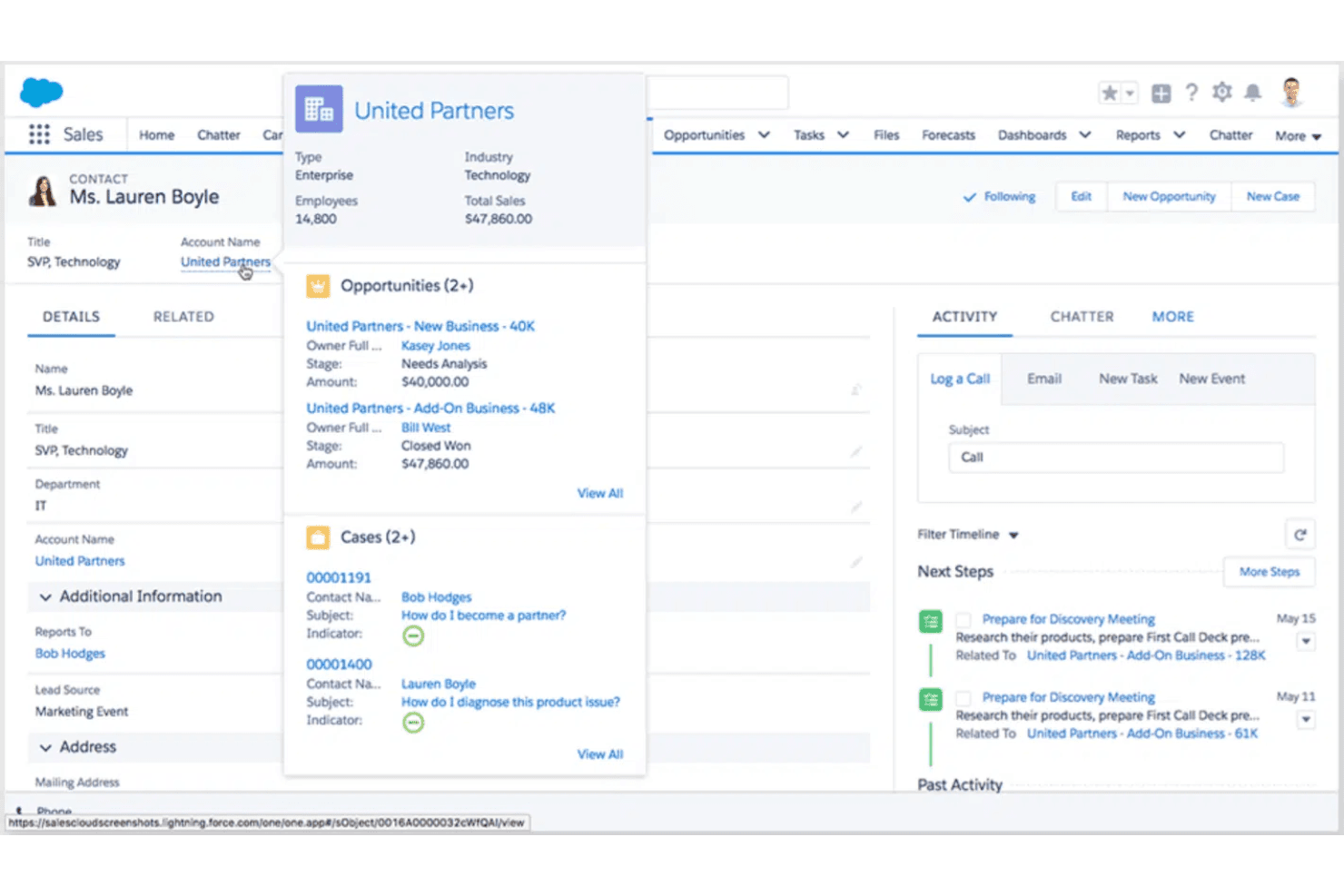
Salesforce CRM integrates with QuickBooks, Jira, Slack, Microsoft Outlook, Google Workspace, and Dropbox, among others.
Salesforce CRM also offers a robust API and connects with third-party integration tools for custom workflows.

Salesforce CRM Specs
- 2-Factor Authentication: Yes
- API: Yes
- Calendar Management: Yes
- Call Tracking: Yes
- Campaign Management: Yes
- Click-to-Dial: Yes
- Contact Management: Yes
- Contact Sharing: Yes
- Custom Data Forms: Yes
- Customer Management: Yes
- Dashboard: Yes
- Data Export: Yes
- Data Import: Yes
- Data Visualization: Yes
- Email Integration: Yes
- External Integrations: Yes
- File Sharing: Yes
- File Transfer: Yes
- Google Apps Integration: Yes
- Lead Management: Yes
- Lead Scoring: Yes
- Marketing Automation: No
- Mobile App: Yes
- Multi-User: Yes
- Notifications: Yes
- Pipeline Management: Yes
- Sales Automation: Yes
- Scheduling: Yes
- Social-Media Integration: No
- Task Scheduling/Tracking: Yes
- Third-Party Plugins/Add-Ons: Yes


