

Avis sur Briefcase 2026 : fonctionnalités, tarifs, avantages et inconvénients expliqués
J’ai mis Briefcase à l’épreuve—voici ce qui ressort : une véritable comptabilité pilotée par l’IA qui vous libère réellement l’esprit. Plongez ici pour voir si l’engouement pour l’automatisation en 2026 est justifié.

Nous évaluons les outils indépendamment ; les commissions aident à financer nos tests. Consultez notre politique de transparence et notre méthodologie.
Briefcase is an AI accounting software built for finance teams that need to automate transaction categorization, reconciliation, and financial close processes. I'd lean toward it over Botkeeper if you want more direct control of your AI-driven workflows. Botkeeper takes more of a managed service approach, where a third party handles your books rather than your own team doing it in-house.
Briefcase Evaluation Summary
5/5
- From $12/client/month
- 14-day free trial
Pourquoi faire confiance à nos recommandations de logiciels
6,700+
Reviews
20
Industry experts
16+
Evaluation factors
14
Years
Nos avis reflètent notre jugement indépendant — et non un argumentaire de vente. Découvrez comment nous restons transparents.
Pour ce guide, nous avons évalué les outils grâce à des tests pratiques et une recherche indépendante, en notant les outils selon nos critères de sélection.
Nos avis reflètent notre jugement éditorial humain, et non un argumentaire de vente.
Briefcase Overview
I think Briefcase stands out for its smooth interface and rapid onboarding, especially when compared to other AI accounting software. Its automation cuts down on data entry, and support is quick to respond. Pricing is reasonable for small to mid-size teams, though deep integrations with legacy ERP systems are limited. If you’re weighing options for a tech-forward finance function or a lean startup, I’d judge Briefcase as a smart pick—particularly for teams open to embracing workflow automation without heavy customization.
Pros
- Automates invoice data extraction and categorization with high accuracy
- Offers real-time financial dashboards and reporting tools
- Slack integration streamlines approvals and communication in-app
Cons
- No built-in payroll or HR modules available yet
- Limited support for complex global tax compliance needs
- Custom reporting options are not fully flexible
Is Briefcase Right For Your Needs?
Who Would be a Good Fit for Briefcase?
Briefcase is a smart pick for growing businesses, digital-first teams, or finance departments who want fast automation and user-friendly workflows without heavy IT overhead. Teams dealing with frequent approvals, remote work, and dynamic expense flows will see the most value. The intuitive interface, Slack integration, and AI-driven features cut down manual work and improve transparency, especially for organizations with moderate complexity and rapid scaling needs.
- SaaS StartupsBriefcase fits SaaS startups that need to digitize all finance ops quickly—its Slack integration and AI routing boost speed and accuracy.
- Marketing AgenciesAgencies handling multiple clients benefit from fast expense approvals and clear audit trails to keep client billing transparent.
- Hybrid WorkplacesCompanies with distributed finance teams can approve, track, and reconcile on the go with Briefcase’s real-time, cloud-based dashboards.
- Series A Finance TeamsEarly-stage but growing companies can automate payables and reporting, freeing up lean teams to focus on analysis.
- Professional Services FirmsFirms with frequent billable hours and client reimbursements get value from categorized expenses and built-in documentation matching.
- Nonprofit Finance DepartmentsNonprofits managing grants and donor funds gain from real-time spend tracking and audit-ready activity logs built into Briefcase.
Who Would be a Bad Fit for Briefcase?
Briefcase isn’t built for global enterprises, heavy manufacturing, or businesses with specialized regulatory needs—it lacks deep customization, multi-entity support, and industry-focused compliance features. If you require granular, country-specific tax handling, complex inventory management, or full-service HR modules, you'll likely outgrow the platform fast. Briefcase is best for nimble, finance-led teams, not complex multinational operations.
- Multinational CorporationsLarge global firms will find Briefcase’s tax compliance and entity management too limited for their complex structures.
- Manufacturing EnterprisesManufacturers who need advanced inventory tracking or supply chain integrations don’t get those features built in.
- Government AgenciesAgencies with stringent regulatory or auditing requirements miss out on deep compliance controls and workflows.
- Retail ChainsRetailers with large, physical inventory and omnichannel platforms need more extensive POS and logistics integrations.
- Healthcare ProvidersOrganizations requiring industry-specific controls and HIPAA compliance will find Briefcase unsuitable for their unique needs.
- In-House Payroll TeamsCompanies seeking a unified payroll and HR solution need more than Briefcase’s core accounting and bill pay functions.
Comment nous testons et évaluons les outils
Nous avons passé des années à construire, affiner et améliorer notre système de test et d’évaluation des logiciels. Notre grille vise à saisir toute la subtilité de la sélection logicielle et les facteurs déterminant l’efficacité d’un outil, en mettant l’accent sur les aspects essentiels du processus de décision. Ci-dessous, vous pouvez voir exactement comment notre test et notre notation fonctionnent selon sept critères. Cela nous permet de fournir une évaluation impartiale des logiciels sur la base des fonctionnalités principales, des fonctionnalités distinctives, de la facilité d’utilisation, de la prise en main, du service client, des intégrations, des avis clients et du rapport qualité/prix.
Fonctionnalité principale (25 % de la note finale)
Le point de départ de notre évaluation est toujours la fonctionnalité principale de l’outil. Dispose-t-il des caractéristiques de base attendues ? Certaines de ces fonctions de base sont-elles réservées aux plans tarifaires supérieurs ? Fondamentalement, nous attendons d’un outil qu’il soit au moins l’égal de ses concurrents en capacités essentielles.
Fonctionnalités Distinctives (25 % de la note finale)
Ensuite, nous évaluons les fonctionnalités rares ou uniques, allant au-delà de la fonctionnalité principale habituellement trouvée dans ce type d’outil. Un score élevé traduit des fonctionnalités spécialisées ou innovantes qui rendent le produit plus rapide, plus efficace, ou apportent une valeur supplémentaire à l’utilisateur. Nous évaluons aussi la facilité d’intégration avec d’autres outils courants de l’écosystème technologique pour étendre les capacités du logiciel. Les outils offrant de nombreuses intégrations natives, des connexions tierces et un accès API pour des intégrations personnalisées obtiennent le meilleur score.
Facilité d’utilisation (10 % de la note finale)
Nous considérons la rapidité et la facilité d’exécution des tâches essentielles avec l’outil. Un logiciel bien conçu, intuitif, proposant des applications mobiles, des modèles et permettant de simplifier des tâches complexes obtient la meilleure note.
Prise en Main (10 % de la note finale)
Nous savons combien il est important d’adopter rapidement une nouvelle plateforme, c’est pourquoi nous évaluons la facilité d’apprentissage et d’utilisation du logiciel avec un minimum de formation. Nous évaluons la rapidité de mise en place d’un nouveau membre d’équipe sans expérience. Un outil ayant un bon score requiert peu voire aucun support pour la prise en main.
Service Client (10 % de la note finale)
Nous évaluons s’il est rapide et facile d’obtenir de l’aide ou de dépanner par téléphone, chat en direct ou base de connaissances. Les outils et entreprises offrant une assistance en temps réel obtiennent le meilleur score, tandis que les chatbots sont moins bien notés.
Avis Clients (10 % de la note finale)
Au-delà de nos propres tests et évaluations, nous prenons en compte le net promoter score fourni par les clients actuels et passés. Nous vérifions leur probabilité de recommander l’outil et d’en refaire le choix pour ses fonctionnalités principales. Un logiciel bien noté se traduit par un net promoter score élevé.
Rapport Qualité/Prix (10 % de la note finale)
Enfin, en tenant compte de tous les autres critères, nous comparons le prix moyen des plans d’entrée de gamme avec les fonctionnalités principales, et le rapport de valeur avec les autres critères d’évaluation. Les logiciels offrant plus pour moins obtiennent la meilleure note.
Core Features
Automated Invoice Processing
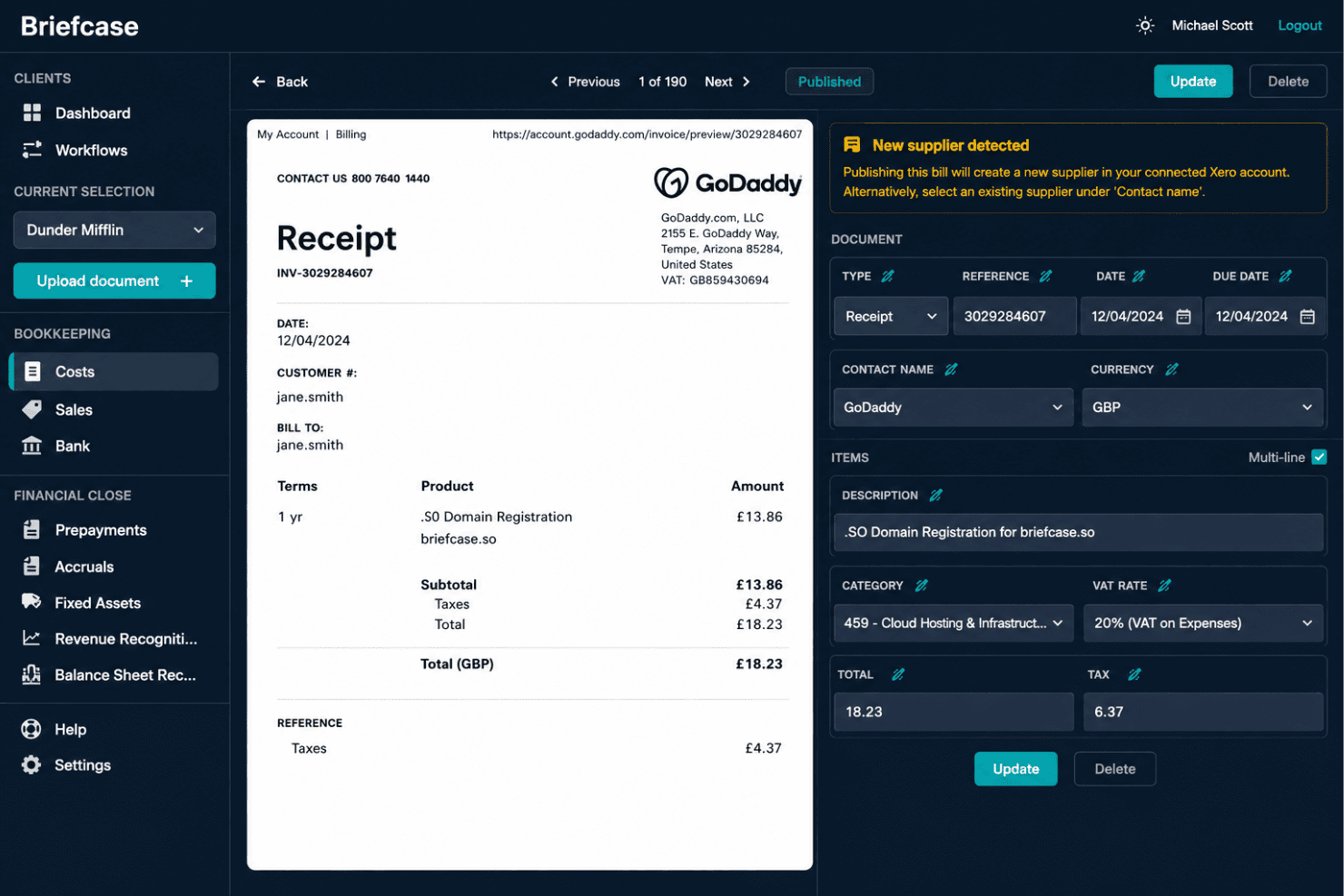
Briefcase uses AI to capture, extract, and categorize invoice data automatically. This eliminates manual data entry and speeds up invoice approvals.
Real-Time Financial Dashboards
View live snapshots of cash flow, expenses, and revenue trends in customizable dashboards. Finance teams can track KPIs and spot anomalies instantly.
AI-Powered Categorization
Transactions are sorted and labeled by AI to match your chart of accounts. This keeps financial data clean and ready for reporting with little effort.
Smart Approval Workflows
Route bills and expenses to the right approvers with automated logic. Approvals happen in one place, making audits and reviews easier.
PDF and Email Receipt Matching
Upload or email receipts and let Briefcase match them to transactions automatically. This reduces missing documentation and speeds up month-end close.
Audit Trail and Activity Log
Each transaction includes a timestamped, tamper-proof audit history. You can review who made edits or approved invoices for total transparency.
Ease of Use
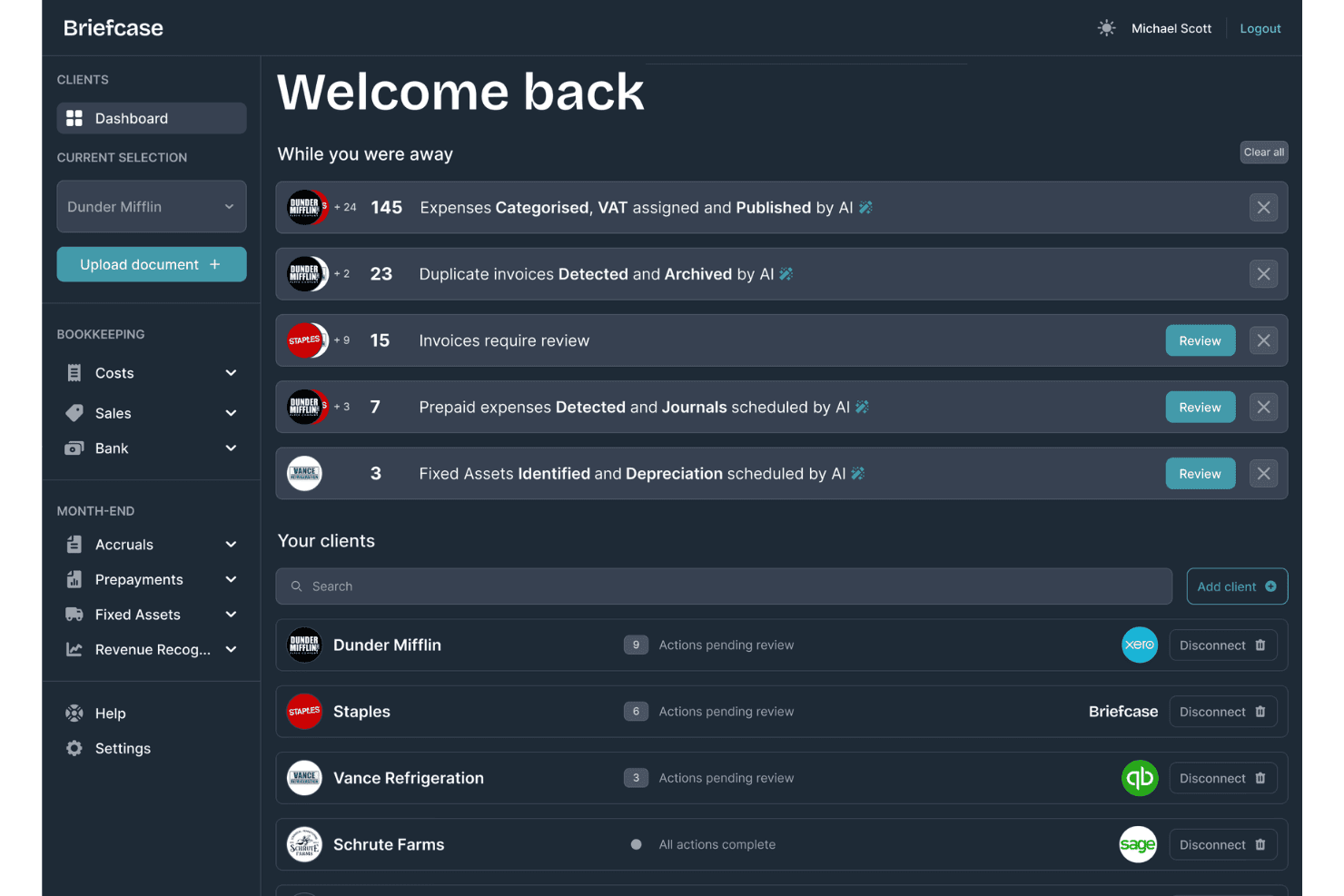
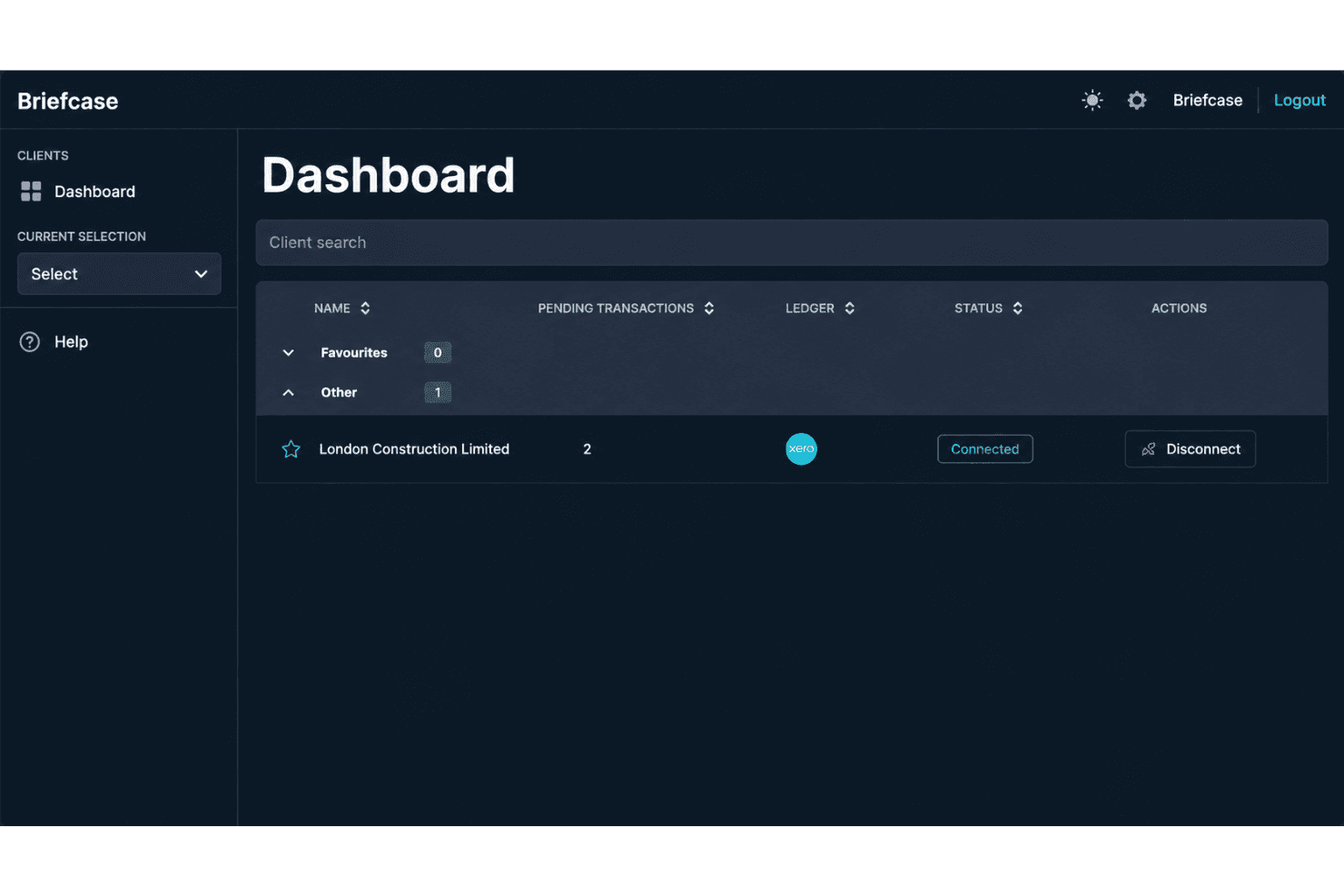
Briefcase has a straightforward interface and requires minimal setup or manual configuration. Its AI-driven categorization learns from accounting history and user corrections, reducing repetitive work, while dashboards keep completed tasks, pending reviews, and client activity accessible.
Integrations
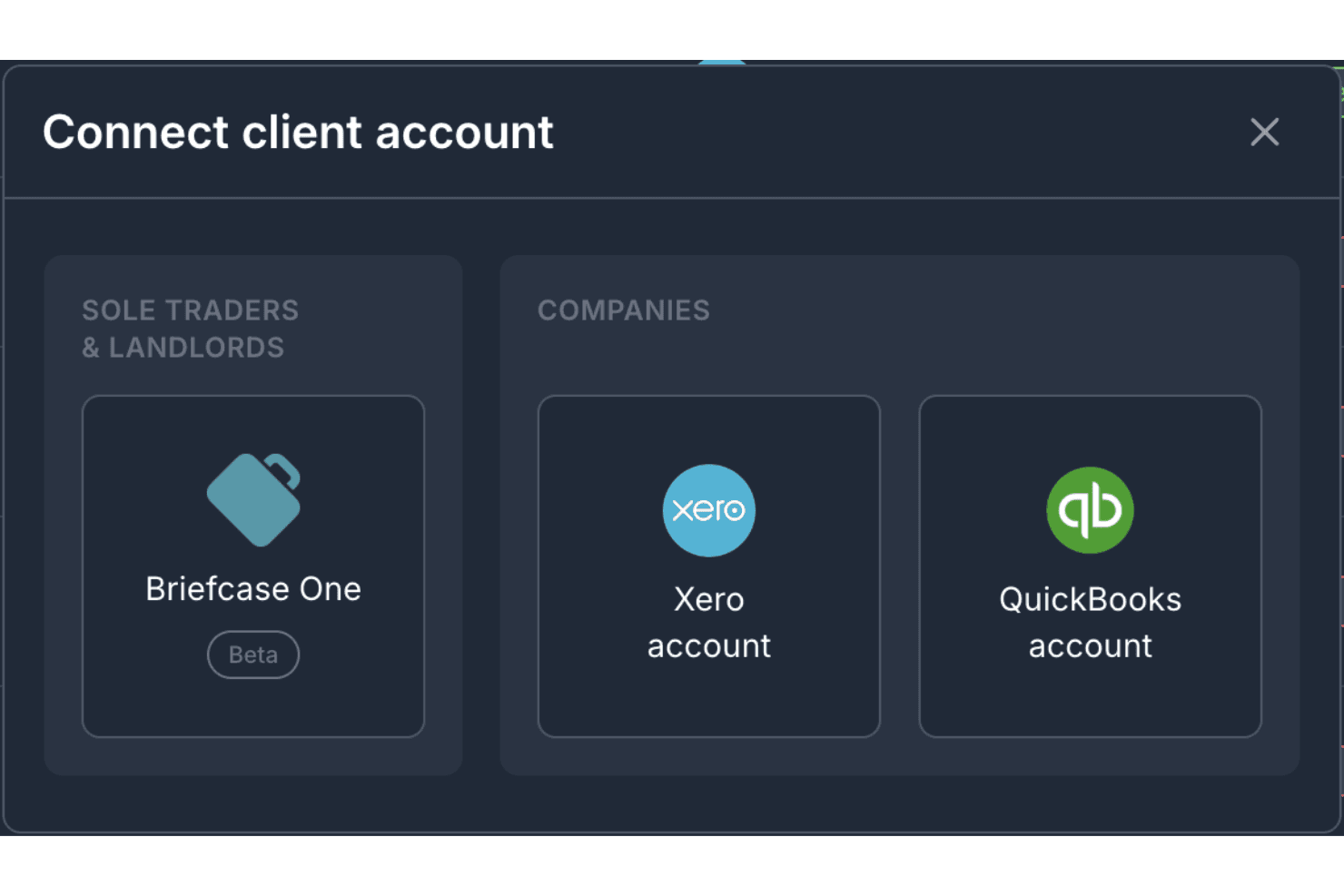
Briefcase integrates with Xero and QuickBooks to synchronize accounting data and publish processed transactions. However, it does not currently advertise a public API, which may limit teams that need custom integrations beyond its supported accounting platforms.
Briefcase Specs
- 2-Factor Authentication: Yes
- Accounts Payable: Yes
- Accounts Receivable: No
- API: Yes
- Balance Sheet: Yes
- Billing/Invoicing: No
- BitCoin: No
- Budgeting: No
- Calendar Management: No
- Contact Management: No
- CRM Integration: No
- Customer Management: No
- Dashboard: Yes
- Data Export: Yes
- Data Import: Yes
- Data Visualization: Yes
- Expense Tracking: Yes
- External Integrations: Yes
- Forecasting: Yes
- General Account Ledger: No
- Inventory Tracking: No
- Multi-Currency: Yes
- Multi-User: Yes
- Notifications: No
- P&L: No
- PayPal: No
- Payroll: No
- SAP Integration: No
- Stripe: No
- Supplier Management: Yes
- Tax Management: Yes


