
Recensione di Unit4: vantaggi, svantaggi, funzionalità e prezzi spiegati
Here’s my candid take: If you’re evaluating ERP systems, Unit4 stands out for flexibility and people focus—but is it right for your organization's evolving needs? Let’s find out.

Recensiamo gli strumenti in modo indipendente e le commissioni aiutano a finanziare i nostri test. Consulta la nostra politica sulla trasparenza, la nostra metodologia, oppure suggerisci uno strumento.
Unit4 is an ERP software built for people-centric, services-led organizations like professional services firms, higher education institutions, non-profit groups, and public sector agencies. I'd reach for it when your team needs financials, procurement, project accounting, and HR on one platform, but doesn't want the implementation weight of a tier-one suite. Compared with tier-one enterprise resource planning suites, Unit4 is a friendlier fit for mid-market finance teams that value faster configuration and a project-driven data model over deep manufacturing and supply chain coverage.
Unit4 Evaluation Summary
4/5
- Pricing upon request
Perché fidarsi dei nostri consigli sui software
6,700+
Reviews
20
Industry experts
16+
Evaluation factors
14
Years
Le nostre recensioni riflettono il nostro giudizio indipendente, non un discorso di vendita. Scopri come manteniamo la trasparenza.
Per questa guida, abbiamo valutato gli strumenti attraverso test pratici e ricerche indipendenti, assegnando un punteggio agli strumenti in base ai nostri criteri di selezione.
Le nostre recensioni riflettono il nostro giudizio editoriale umano, non un discorso di vendita.
Unit4 Overview
If you’re judging Unit4 against other options, I think you'll find the flexibility and people-first data model a strong advantage, especially for professional services, nonprofits, and higher education. Its interface is approachable and configuration is far less of a project than most enterprise ERPs. Pricing can be a hurdle for smaller organizations and reporting features sometimes feel basic for complex FP&A needs. Across Unit4 reviews the same two themes recur: fast configuration, thin advanced reporting. Still, the onboarding is smoother than most, support is responsive, and integrations cover the main platforms your team will need. I’d suggest Unit4 for teams prioritizing agility and user experience over manufacturing or deep supply chain capabilities.
Pros
- Project-centric data model fits services and nonprofit organizations
- Flexible reporting tools and dimensional accounting options are included
- Modern interface simplifies configuration and daily finance workflows
Cons
- Reporting features are basic for complex FP&A scenarios
- Pricing is expensive for smaller organizations with tight budgets
- Limited manufacturing and supply chain management depth compared to peers
Is Unit4 Right For Your Needs?
Who Would be a Good Fit for Unit4?
Unit4 is a good fit for organizations with people-focused operations that need to customize workflows and quickly onboard new team members. If you deal with complex finance, HR, or multi-entity requirements, the platform’s modular design, guided onboarding, strong support, and broad integration library help your teams adapt fast. I think Unit4’s drag-and-drop reporting, rapid personalizations, and prebuilt integrations with mainstream productivity, BI, and CRM platforms make it ideal for growing businesses or those with evolving processes.
- Nonprofit OrganizationsUnit4 supports multi-entity finance, budget control, and grant tracking that non-profit teams need for accountability and compliance.
- Mid-Sized EnterprisesYou’ll get value from customizable modules and fast onboarding that scale easily for teams outgrowing entry-level ERPs.
- Higher EducationColleges and universities appreciate Unit4’s robust HR, finance, and people management features that work across faculties and schools.
- Professional ServicesConsultancies benefit from workflow automation, fast user training, and real-time project financial tracking.
- Global Finance TeamsUnit4’s advanced reporting, API access, and integration options fit complex, multi-location finance environments.
- HR DepartmentsHR staff can tailor dashboards, automate workflows, and connect Unit4 directly to other HCM and productivity tools.
Who Would be a Bad Fit for Unit4?
Unit4 is often not a great match if you want an ERP that works straight away for narrow industries or if your needs center around high-volume manufacturing or deeply industry-specific logistics. You may find Unit4’s pricing high for very small teams or that its deep configuration options are more than what’s needed for basic accounting or inventory management. Teams with highly technical, product-centric requirements or ultra-lean budgets may get more value elsewhere.
- Small Retail StoresThese businesses usually need simpler inventory and sales modules than what Unit4 provides.
- High-Volume ManufacturingUnit4 doesn’t focus on the granular production controls or engineering integrations manufacturers often require.
- Early-Stage StartupsStartups with basic finance or HR needs may find Unit4’s cost and capabilities excessive.
- E-commerce Pure PlayersPure-play ecommerce teams often prefer ERPs with turnkey marketplace and inventory integrations.
- Construction FirmsConstruction usually needs specialized project costing and field management tools not included in Unit4’s core modules.
- Basic Accounting TeamsSmall organizations seeking only core bookkeeping features will likely find Unit4 more complex than necessary.
Come testiamo e valutiamo gli strumenti
Abbiamo impiegato anni a costruire, perfezionare e migliorare il nostro sistema di test e valutazione dei software. Il nostro schema è progettato per cogliere le sfumature della scelta del software e ciò che rende uno strumento efficace, concentrandosi sugli aspetti critici del processo decisionale. Di seguito puoi vedere esattamente come funzionano i nostri test e le nostre valutazioni in base a sette criteri. Questo ci permette di offrire una valutazione imparziale del software basata su funzionalità di base, caratteristiche distintive, facilità d’uso, onboarding, assistenza clienti, integrazioni, recensioni dei clienti e rapporto qualità-prezzo.
Funzionalità principali (25% del punteggio finale)
Il punto di partenza della nostra valutazione è sempre la funzionalità principale dello strumento. Dispone delle funzionalità base che un utente si aspetterebbe di trovare? Alcune di queste funzionalità sono riservate ai piani a pagamento più elevati? In sostanza, ci aspettiamo che uno strumento sia all’altezza delle capacità minime dei concorrenti.
Caratteristiche distintive (25% del punteggio finale)
Successivamente, valutiamo le caratteristiche distintive che vanno oltre la funzionalità principale normalmente presente negli strumenti di questo tipo. Un punteggio elevato riflette funzionalità specializzate o uniche che rendono il prodotto più rapido, efficiente o offrono valore aggiunto all’utente. Valutiamo inoltre quanto sia semplice integrare il software con altri strumenti tipicamente presenti nello stack tecnologico, per estenderne la funzionalità e l’utilità. Gli strumenti che offrono numerose integrazioni native, connessioni di terze parti e accesso API per creare integrazioni personalizzate ottengono il punteggio migliore.
Facilità d’uso (10% del punteggio finale)
Consideriamo quanto sia rapido e semplice eseguire le attività fondamentali previste dallo strumento. Un software con punteggio elevato è ben progettato, intuitivo da usare, offre app mobile, modelli predefiniti e semplifica operazioni complesse.
Onboarding (10% del punteggio finale)
Sappiamo quanto sia importante l’adozione rapida da parte del team quando si introduce una nuova piattaforma: per questo valutiamo quanto sia facile imparare e utilizzare lo strumento con una formazione minima. Valutiamo la rapidità con cui un membro del team può impostare e iniziare a utilizzare lo strumento senza esperienza pregressa. Le soluzioni con punteggio alto richiedono poco o nessun supporto.
Assistenza clienti (10% del punteggio finale)
Analizziamo quanto sia semplice e veloce ottenere aiuto tramite telefono, live chat o knowledge base. Gli strumenti e le aziende che offrono supporto in tempo reale ottengono i punteggi migliori, mentre i chatbot ricevono i punteggi più bassi.
Recensioni dei clienti (10% del punteggio finale)
Oltre ai nostri test e valutazioni, consideriamo il net promoter score dei clienti attuali e passati. Verifichiamo la probabilità che i clienti scelgano nuovamente lo strumento per le funzionalità di base. Un software con punteggio elevato riflette un net promoter score alto da parte dei clienti vecchi e attuali.
Rapporto qualità-prezzo (10% del punteggio finale)
Infine, considerando tutti gli altri criteri, valutiamo il prezzo medio dei piani base rispetto alle funzionalità principali e agli altri criteri di valutazione. I software che offrono di più, a un costo inferiore, ottengono punteggi migliori.
Core Features
Financial Management
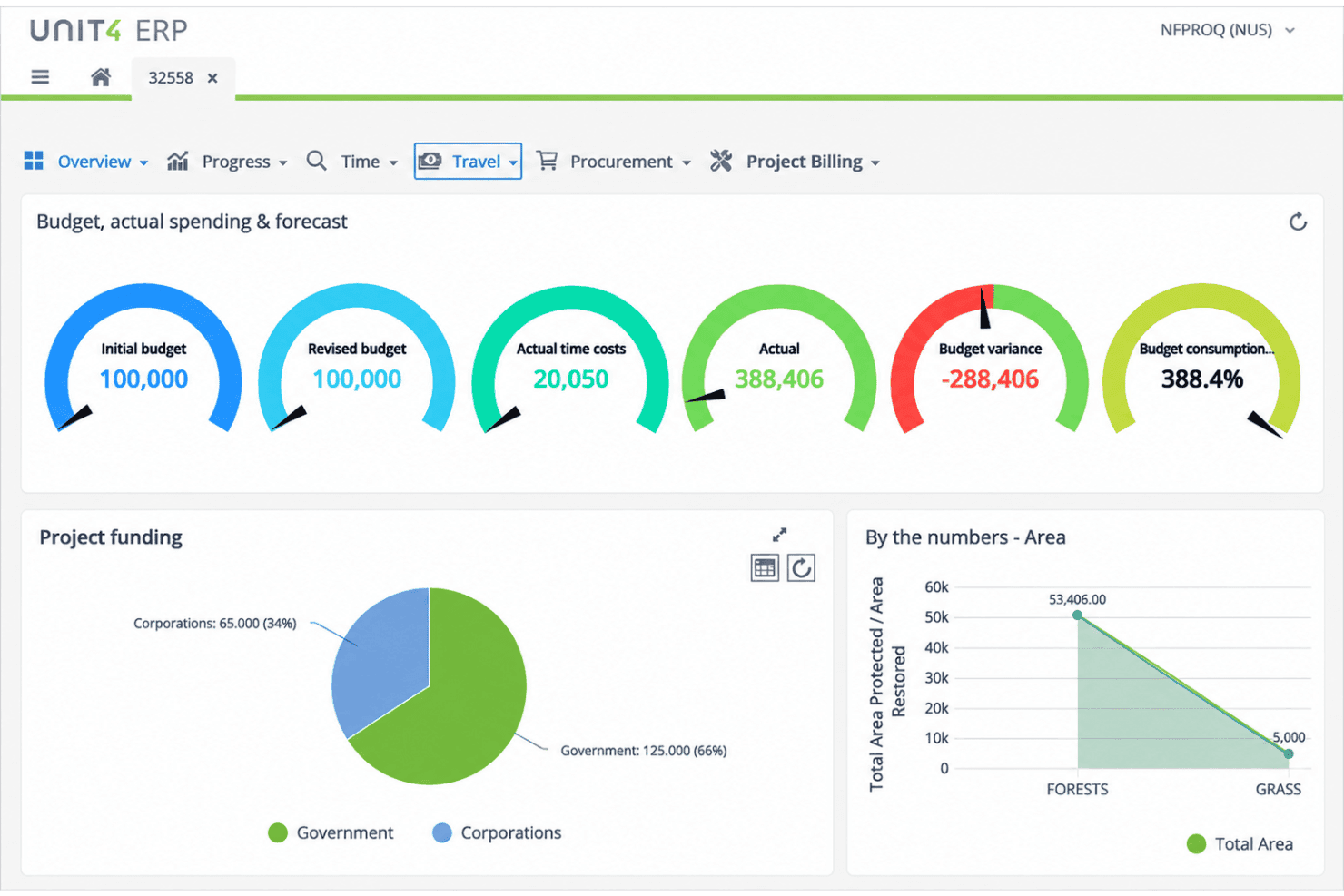
General ledger, accounts payable, accounts receivable, and fixed assets in one place. Multi-dimensional reports give real-time visibility into your financial position.
Project Management and Accounting
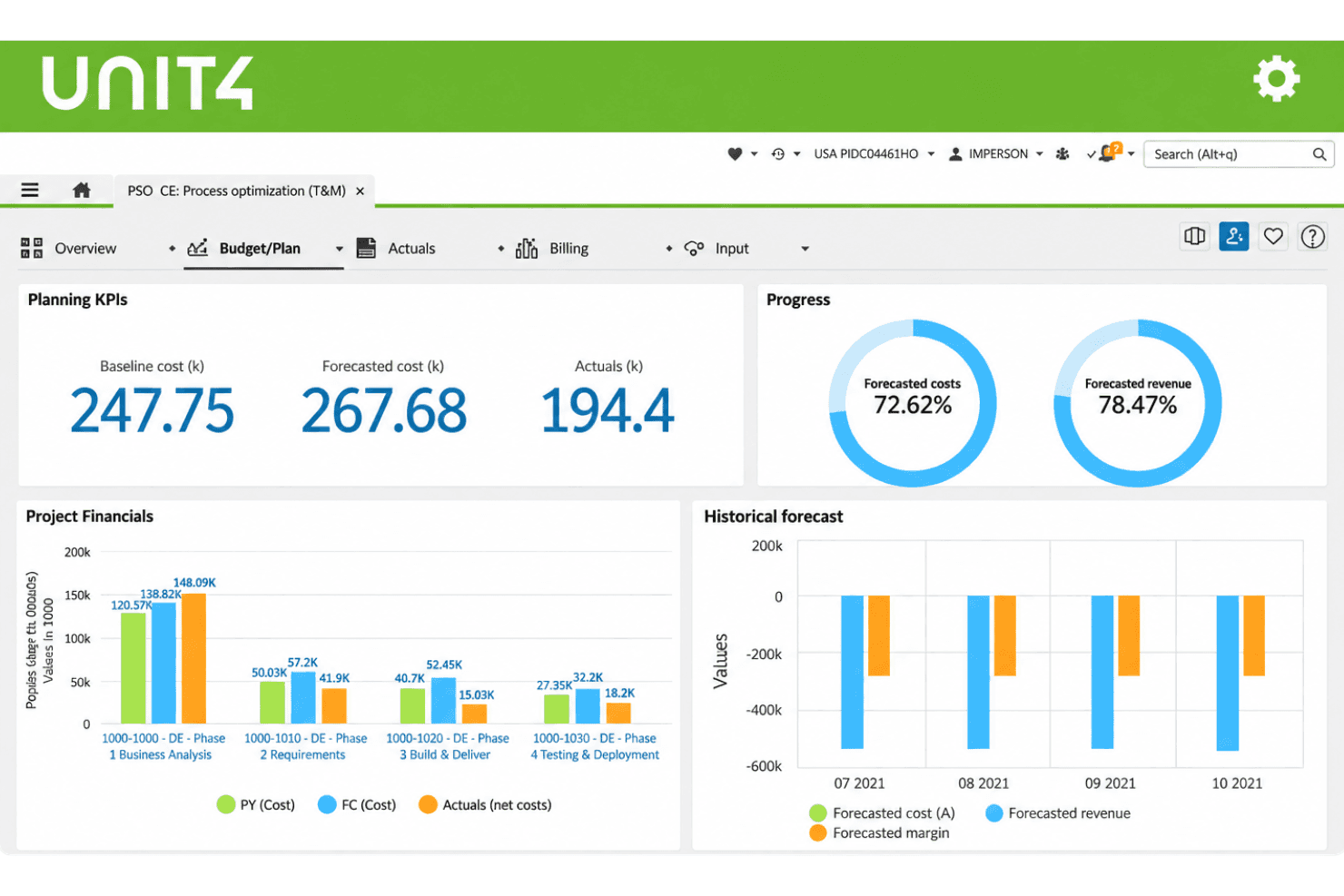
Track project budgets, time, billing, and resources in one system. Live data on project profitability and resource utilization, without the side spreadsheets.
Procurement Management
Manage requisition, purchase orders, supplier catalogs, and approvals end-to-end. Automated workflows tie procurement to budget controls and contract management.
Human Resources and Payroll
Employee records, HR tasks, and payroll in one HCM suite. Self-service covers time off, benefits, and personal data, with talent management alongside it.
Planning, Budgeting, and Forecasting
Rolling budgets, forecasts, and scenario plans update as your data changes. Integrated financial planning lets finance and operations build and approve together.
Reporting and Analytics
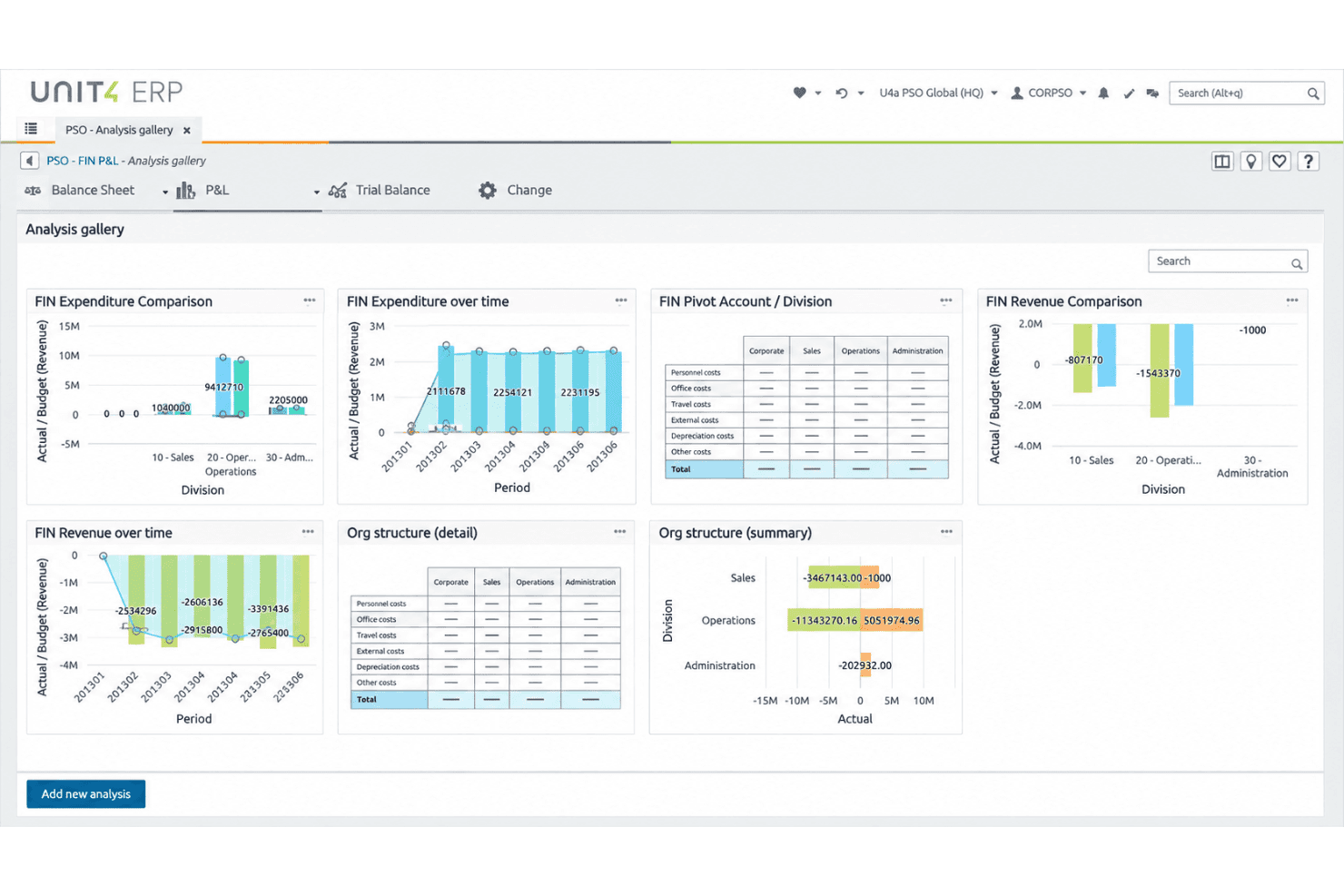
Pre-built and custom financial, operational, and project reports via drag-and-drop. Slice by cost center, project, or region to match how your team reports.
Ease of Use
Unit4 feels approachable from the first login, thanks to a clean, modern interface that doesn’t overwhelm new users. Configuring workflows and personalizing dashboards takes less time than many ERP options, so most teams find onboarding easier. Drag-and-drop reporting tools and guided process prompts keep day-to-day tasks simple, though some finance pros mention complex reporting can take extra steps. Overall, Unit4’s usability makes routine work faster for people-focused teams.
Integrations
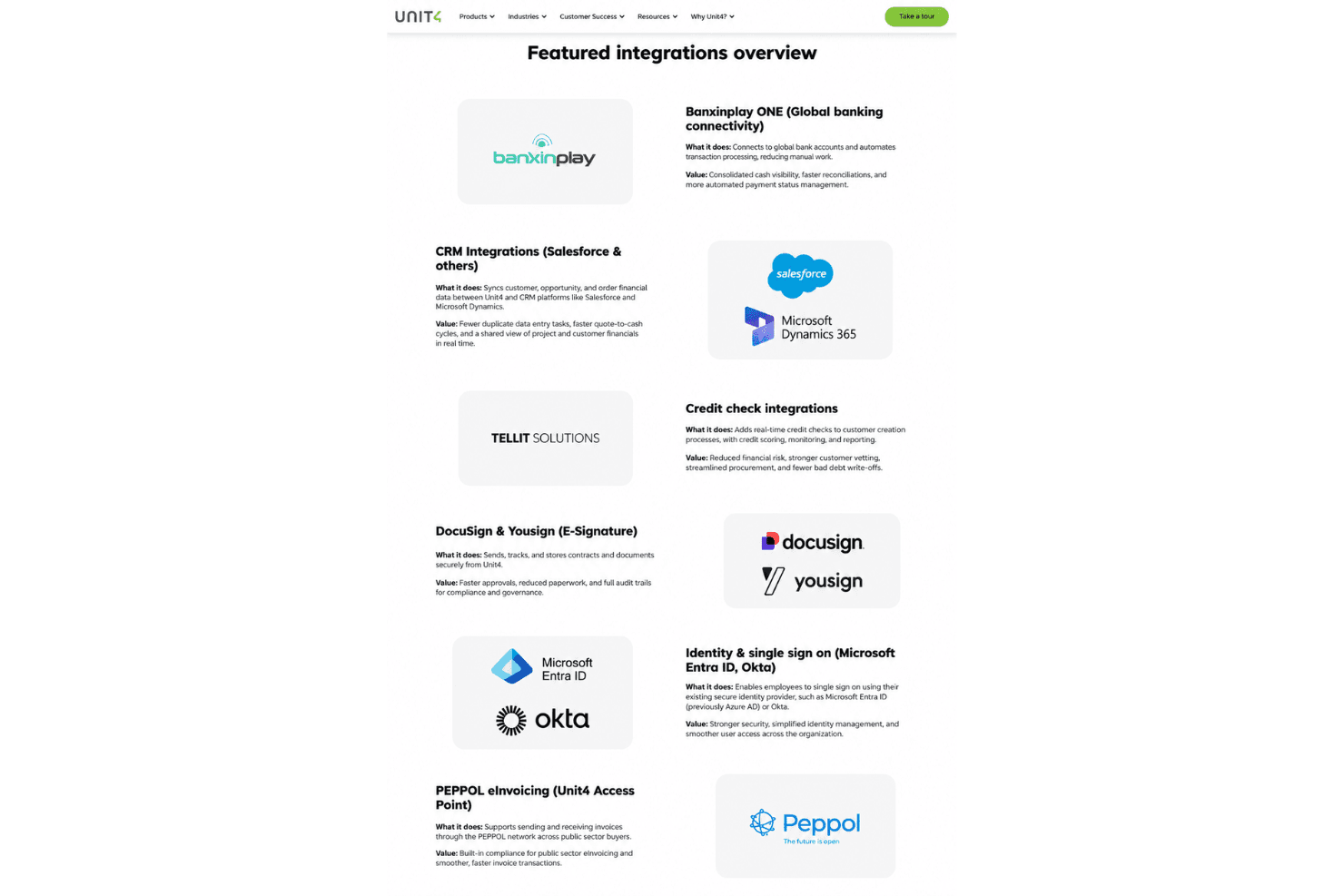
Unit4 integrates with Microsoft Office 365, Microsoft Teams, Salesforce, SAP, Workday, Oracle, Power BI, Google Workspace, Adobe Sign, and DocuSign, among others.
Unit4 also offers an API and connects with third-party integration tools.
Unit4 Specs
- Accounts Payable: Yes
- Accounts Receivable: Yes
- API: Yes
- Budgeting: Yes
- Calendar Management: Yes
- Compliance Tracking: Yes
- Customer Management: Yes
- Dashboard: Yes
- Data Export: Yes
- Data Import: Yes
- Data Visualization: Yes
- Expense Tracking: Yes
- External Integrations: Yes
- Financial Analysis: Yes
- Forecasting: Yes
- Inventory Tracking: Yes
- Multi-Currency: Yes
- Multi-User: Yes
- Notifications: Yes
- Order Management: Yes
- Payroll: Yes
- Project Management: Yes
- Purchase Orders: Yes
- Resource Management: Yes
- Scheduling: Yes
- Supplier Management: Yes
- Task Scheduling/Tracking: Yes
- Third-Party Plugins/Add-Ons: Yes
- Warehouse Management: Yes
- Workflow Management: Yes


