

Akaunting-beoordeling: voordelen, nadelen, functies en prijzen
Akaunting blinkt uit met zijn gebruiksvriendelijke interface en gratis abonnement, waardoor het een uitstekende keuze is voor kleine bedrijven en freelancers.

We review tools independently, and commissions help fund our testing. See our transparency policy, our methodology, or suggest a tool.
Akaunting is an open-source accounting software built for small businesses and freelancers who need invoicing, expense tracking, and basic financial reporting without a subscription fee. I'd consider it over Wave if self-hosting matters to your team or you want to extend functionality through its app marketplace—Wave gives you less control over where your data lives and how the platform behaves.
Akaunting Evaluation Summary
3.2/5
- From $8/month (billed annually)
- Free trial available
Waarom u onze softwareaanbevelingen kunt vertrouwen
6,700+
Reviews
20
Industry experts
16+
Evaluation factors
14
Years
Onze reviews weerspiegelen ons onafhankelijke oordeel — geen verkooppraatje. Ontdek hoe we transparant blijven.
Voor deze gids hebben we tools geëvalueerd met behulp van praktijktests en onafhankelijk onderzoek, waarbij we tools beoordeelden aan de hand van onze selectiecriteria.
Onze reviews weerspiegelen ons menselijke redactionele oordeel, geen verkooppraatje.
Akaunting Overview
In my opinion, Akaunting is a solid choice for small businesses and freelancers looking for a cost-effective accounting solution. It offers essential features without overwhelming you with complexity. While its ease of use and onboarding could use refinement, its price and core functionality are appealing. Compared to QuickBooks and other ERP-style providers, it lacks extensive integrations, but it outperforms in affordability and user-friendly design. I think it's best suited for those who need basic accounting without the bells and whistles. If you're choosing an accounting tool, consider your need for advanced features versus budget constraints.
Pros
- You get a user-friendly interface that makes managing your accounts easy.
- It's great for invoicing and expense tracking, perfect for small teams.
- You can access it anywhere, keeping your work flexible and mobile.
Cons
- You might find that the reporting features are limited compared to other tools.
- Your team may encounter a steep learning curve with some advanced functions.
- Customer support isn't as responsive as you'd hope.
Is Akaunting Right For Your Needs?
Who Would be a Good Fit for Akaunting?
Akaunting is ideal for small businesses and freelancers who need basic accounting without extra complexity. It's great for startups and sole proprietors because of its user-friendly interface and essential features like invoicing, purchase orders, and expense tracking. If your team values mobility, Akaunting’s cloud and on-premise flexibility let you manage finances from anywhere. It’s perfect for those who want a simple, affordable solution with basic automation tools and essential financial reporting.
- FreelancersAkaunting simplifies invoicing and expense tracking, making it perfect for managing your freelance finances.
- Small BusinessesYour small business can benefit from Akaunting’s easy-to-use tools, helping you manage cash flow and stay on top of your balance sheet.
- StartupsIf you’re starting out, Akaunting offers a cost-effective way to handle bookkeeping and monitor your general ledger.
- ConsultantsConsultants can easily manage client billing and expenses with Akaunting’s straightforward invoicing and templates.
- NonprofitsAkaunting helps your nonprofit manage financial reporting, track donations, and control budgets seamlessly.
- Remote TeamsFor remote teams, Akaunting’s cloud-based and self-hosted options provide real-time access, ensuring flexibility.
Who Would be a Bad Fit for Akaunting?
Akaunting isn’t ideal for large enterprises or businesses needing advanced ERP functionality. If your team relies on deep integrations, detailed financial reporting, or automated tax reconciliation, Akaunting might fall short. Its limited analytics and module depth can be a hurdle for those managing complex business processes. Companies requiring extensive customer support might also find Akaunting lacking compared to major providers like QuickBooks.
- Large CorporationsYour corporation might find Akaunting lacking in advanced ERP modules and scalability for complex operations.
- Financial AnalystsAkaunting doesn’t support the in-depth financial modeling and forecasting analysts typically need.
- Retail ChainsRetail chains with intricate sales and supply-chain needs might find Akaunting insufficient for inventory management.
- ManufacturingManufacturing companies often require advanced purchase order workflows and supply-chain tracking that Akaunting doesn’t provide.
- EnterprisesEnterprises requiring integrations with large-scale ERP systems will find Akaunting’s functionality limited.
- Accounting FirmsAkaunting’s lack of advanced audit trails and client permissions controls makes it less suitable for multi-client management.
How We Test & Score Tools
We’ve spent years building, refining, and improving our software testing and scoring system. The rubric is designed to capture the nuances of software selection and what makes a tool effective, focusing on critical aspects of the decision-making process.
Below, you can see exactly how our testing and scoring works across seven criteria. It allows us to provide an unbiased evaluation of the software based on core functionality, standout features, ease of use, onboarding, customer support, integrations, customer reviews, and value for money.
Core Functionality (25% of final scoring)
The starting point of our evaluation is always the core functionality of the tool. Does it have the basic features and functions that a user would expect to see? Are any of those core features locked to higher-tiered pricing plans? At its core, we expect a tool to stand up against the baseline capabilities of its competitors.
Standout Features (25% of final scoring)
Next, we evaluate uncommon standout features that go above and beyond the core functionality typically found in tools of its kind. A high score reflects specialized or unique features that make the product faster, more efficient, or offer additional value to the user.
We also evaluate how easy it is to integrate with other tools typically found in the tech stack to expand the functionality and utility of the software. Tools offering plentiful native integrations, 3rd party connections, and API access to build custom integrations score best.
Ease of Use (10% of final scoring)
We consider how quick and easy it is to execute the tasks defined in the core functionality using the tool. High scoring software is well designed, intuitive to use, offers mobile apps, provides templates, and makes relatively complex tasks seem simple.
Onboarding (10% of final scoring)
We know how important rapid team adoption is for a new platform, so we evaluate how easy it is to learn and use a tool with minimal training. We evaluate how quickly a team member can get set up and start using the tool with no experience. High scoring solutions indicate little or no support is required.
Customer Support (10% of final scoring)
We review how quick and easy it is to get unstuck and find help by phone, live chat, or knowledge base. Tools and companies that provide real-time support score best, while chatbots score worst.
Customer Reviews (10% of final scoring)
Beyond our own testing and evaluation, we consider the net promoter score from current and past customers. We review their likelihood, given the option, to choose the tool again for the core functionality. A high scoring software reflects a high net promoter score from current or past customers.
Value for Money (10% of final scoring)
Lastly, in consideration of all the other criteria, we review the average price of entry level plans against the core features and consider the value of the other evaluation criteria. Software that delivers more, for less, will score higher.
Core Features
Invoicing: Akaunting lets you create and send invoices easily, with customizable templates to reflect your brand.
Expense Tracking: Track and categorize expenses to manage budgets and control cash flow effectively.
Financial Reports: Generate core financial reports like balance sheet, profit and loss, and general ledger summaries.
Client Management: Manage client details and invoices using simple CRM-like features.
Multi-Currency Support: Handle transactions in multiple currencies and apply tax rates accurately.
Recurring Billing: Automate recurring invoices and purchase orders to streamline billing cycles.

Ease of Use
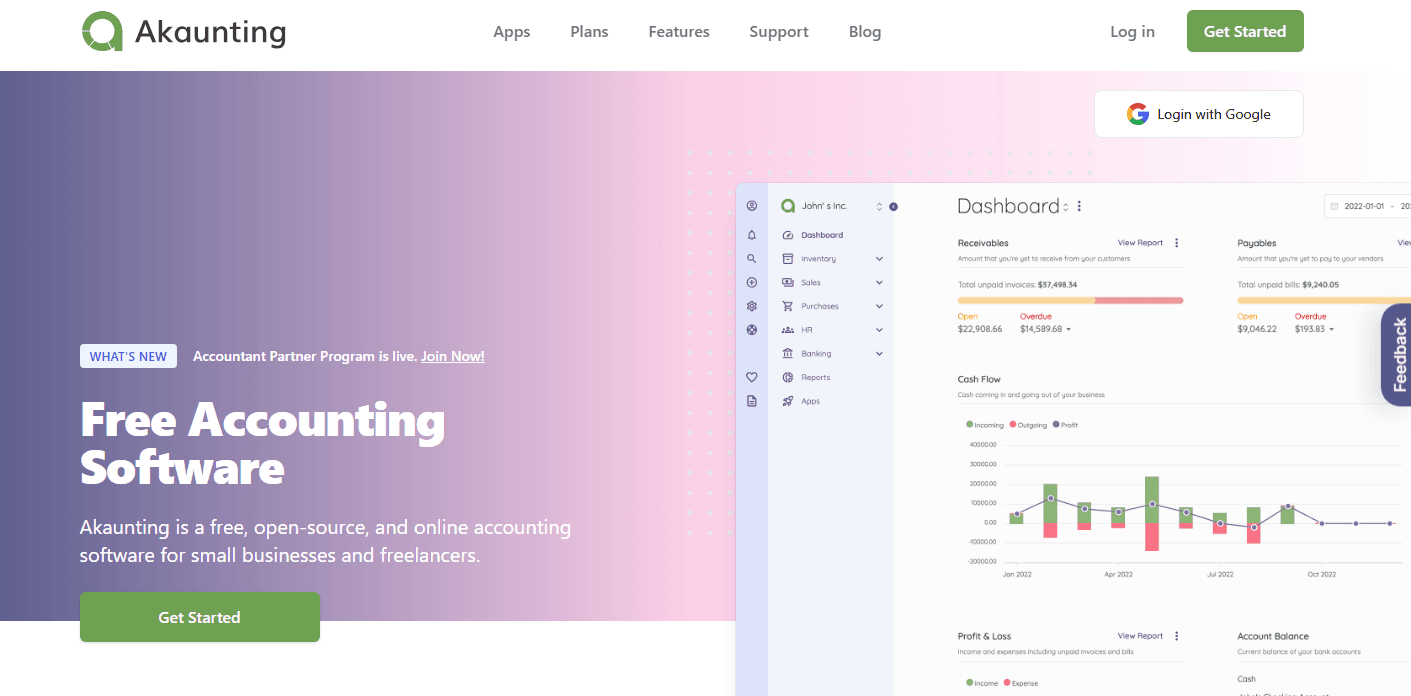
Akaunting’s clean dashboard and layout make navigation simple, even for beginners. While some advanced modules require time to master, most freelancers and small businesses find the learning curve manageable. Its automation tools streamline repetitive bookkeeping tasks, improving efficiency.

Integrations
Akaunting integrates with ZohoBooks, M-Pesa, Amazon Business, HubSpot, and more.
Akaunting also offers an API for custom integrations and connects with third-party integration tools for expanded functionality.

Akaunting Specs
- 2-Factor Authentication: Yes
- Accounts Payable: Yes
- Accounts Receivable: Yes
- API: Yes
- Balance Sheet: Yes
- Billing/Invoicing: Yes
- BitCoin: Yes
- Budgeting: Yes
- Calendar Management: Yes
- Contact Management: Yes
- CRM Integration: Yes
- Customer Management: Yes
- Dashboard: Yes
- Data Export: Yes
- Data Import: Yes
- Data Visualization: Yes
- Expense Tracking: Yes
- External Integrations: Yes
- Forecasting: Yes
- General Account Ledger: Yes
- Inventory Tracking: Yes
- Multi-Currency: Yes
- Multi-User: Yes
- Notifications: Yes
- P&L: Yes
- PayPal: No
- Payroll: Yes
- SAP Integration: Yes
- Stripe: Yes
- Supplier Management: Yes
- Tax Management: Yes


