


Intuit Enterprise Suite versus NetSuite ERP: Vergelijking voor 2026 en beoordelingen door experts

We review tools independently, and commissions help fund our testing. See our transparency policy, our methodology, or suggest a tool.
Een modern bedrijf runnen zou niet moeten betekenen dat je voortdurend tussen tools moet schakelen om de informatie te vinden die je nodig hebt. Toch hebben veel bedrijven nog steeds te maken met verspreide gegevens, dubbel werk en eindeloze handmatige updates om de bedrijfsvoering gaande te houden. Hoe meer je bedrijf groeit, hoe meer die losgekoppelde systemen je tijd, nauwkeurigheid en inzicht gaan kosten.
Daarom wenden steeds meer teams zich tot ERP-software om alles samen te brengen. Maar wanneer je grote platforms zoals Intuit Enterprise Suite en NetSuite vergelijkt, kan de beslissing overweldigend aanvoelen. In dit artikel krijg je een vergelijking naast elkaar van beide ERP-oplossingen, deskundige inzichten en praktisch advies om de juiste keuze te maken voor de toekomst van je financiële team.
Intuit Enterprise Suite
4.6/5
- Free demo available
- Pricing upon request
Oracle NetSuite ERP
4.2/5
- Free demo available
- Pricing upon request
Waarom u onze softwareaanbevelingen kunt vertrouwen
6,700+
Reviews
20
Industry experts
16+
Evaluation factors
14
Years
Onze reviews weerspiegelen ons onafhankelijke oordeel — geen verkooppraatje. Ontdek hoe we transparant blijven.
Voor deze gids hebben we tools geëvalueerd met behulp van praktijktests en onafhankelijk onderzoek, waarbij we tools beoordeelden aan de hand van onze selectiecriteria.
Onze reviews weerspiegelen ons menselijke redactionele oordeel, geen verkooppraatje.
| Intuit Enterprise Suite | Oracle NetSuite ERP | |
|---|---|---|
| Free Trial | Free demo available | Free demo available |
| Pricing | Pricing upon request | Pricing upon request |
Prijzen en verborgen kosten van Intuit Enterprise Suite versus NetSuite ERP
Intuit Enterprise Suite maakt gebruik van een contractgebaseerd abonnementsmodel met prijzen die voor elk bedrijf worden aangepast. De kosten variëren doorgaans op basis van factoren zoals het aantal entiteiten, gebruikers en benodigde mogelijkheden. Hoewel het basisplatform financieel beheer en andere kernfuncties omvat, kunnen aanvullende functionaliteiten—zoals salarisadministratie, geavanceerde automatisering of integraties met derden—de totale kosten verhogen.
NetSuite ERP hanteert een modulaire abonnementsprijsstructuur die is opgebouwd rond een basislicentie voor het platform, gebruikerslicenties en optionele aanvullende modules. Bedrijven betalen voor de specifieke functionaliteit die ze nodig hebben—zoals geavanceerde financiële functies, voorraadbeheer of CRM—maar de kosten kunnen oplopen naarmate er meer modules en gebruikers worden toegevoegd. Implementatie, maatwerk, integraties en doorlopende ondersteuning kunnen de totale eigendomskosten ook aanzienlijk verhogen, en de uiteindelijke prijs hangt doorgaans af van de bedrijfsvereisten en de onderhandelde contractvoorwaarden.
Een belangrijk verschil tussen Intuit Enterprise Suite en NetSuite ERP is de reikwijdte van de functionaliteit waarop elk platform zich richt. Intuit Enterprise Suite richt zich sterk op financiële activiteiten voor groeiende bedrijven, met ingebouwde tools voor boekhouding van meerdere entiteiten, salarisadministratie, HR en geconsolideerde rapportage binnen het bredere Intuit-ecosysteem. Dit maakt het platform bijzonder aantrekkelijk voor organisaties die QuickBooks al gebruiken en een schaalbaarder platform voor financieel beheer willen.
NetSuite ERP is daarentegen ontworpen als een veel breder operationeel platform. Het biedt uitgebreide modules voor supplychainbeheer, voorraadbeheer, inkoop, productie, CRM en e-commerce, naast financieel beheer. Toch overlappen de twee tools op veel belangrijke ERP-mogelijkheden, waaronder algemene boekhouding, rapportagedashboards, workflowautomatisering en tools voor het beheren van bestellingen, projecten en financiële gegevens in het hele bedrijf.
| Intuit Enterprise Suite | Oracle NetSuite ERP | |
|---|---|---|
| Accounts Payable | Yes | Yes |
| Accounts Receivable | Yes | Yes |
| API | Yes | Yes |
| Budgeting | Yes | Yes |
| Calendar Management | No | Yes |
| Customer Management | No | Yes |
| Dashboard | Yes | Yes |
| Data Export | Yes | Yes |
| Data Import | Yes | Yes |
| Data Visualization | Yes | Yes |
| Expense Tracking | Yes | Yes |
| External Integrations | Yes | Yes |
| Forecasting | Yes | Yes |
| General Account Ledger | Yes | Yes |
| Inventory Tracking | Yes | Yes |
| Multi-User | Yes | Yes |
| Notifications | Yes | Yes |
| Payroll | Yes | Yes |
| Supplier Management | Yes | Yes |
| Tax Management | Yes | Yes |
| Integratie | Intuit Enterprise Suite | NetSuite ERP |
| Salesforce | ❌ | ✅ |
| Shopify | ✅ | ✅ |
| Avalara | ✅ | ✅ |
| Bill.com | ✅ | ✅ |
| Expensify | ✅ | ✅ |
| HubSpot | ✅ | ✅ |
| ADP | ✅ | ✅ |
| PayPal | ✅ | ✅ |
| API | ✅ | ✅ |
| Zapier | ✅ | ✅ |
Beide platforms ondersteunen integraties met veelgebruikte financiële en zakelijke tools, waaronder betalingsverwerkers, systemen voor onkostenbeheer, belastingsoftware en CRM-platforms. Veel integraties voor beide systemen worden geleverd via API's, middlewareplatforms of connectoren uit marktplaatsen, in plaats van via uitsluitend native verbindingen. Dit betekent dat bedrijven vaak afhankelijk zijn van integratieplatforms of connectoren van derden om gegevens tussen systemen te synchroniseren.
| Factor | Intuit Enterprise Suite | NetSuite ERP |
| Gegevensversleuteling | Gebruikt 256-bitsversleuteling voor gegevens in rust en tijdens overdracht. | Biedt end-to-endversleuteling en geavanceerde toegangscontroles voor alle gegevens. |
| Naleving van regelgeving | Wordt ondersteund door het bredere nalevingskader van Intuit, waaronder standaarden zoals SOC 1, SOC 2, ISO 27001 en PCI DSS binnen de cloudinfrastructuur. | Biedt uitgebreide ondersteuning voor naleving, waaronder SOC 1 Type II, SOC 2 Type II, ISO 27001/27018 en PCI DSS, waarmee organisaties kunnen voldoen aan vereisten voor regelgeving en financiële rapportage. |
| Beschikbaarheid & betrouwbaarheid | De betrouwbaarheid is afhankelijk van de cloudinfrastructuur en hostingomgeving, met back-up- en herstelmaatregelen voor noodgevallen die kenmerkend zijn voor financiële cloudplatforms. | Ontworpen met wereldwijde cloudinfrastructuur, continue monitoring, processen voor herstel na noodgevallen en operationele beveiligingscontroles om een hoge beschikbaarheid te behouden. |
| Toegangscontroles voor gebruikers | Biedt aanpasbare gebruikersrollen en machtigingen voor gevoelige financiële gegevens. | Beschikt over gedetailleerde op rollen gebaseerde toegang en audittrails voor alle gebruikersactiviteiten. |
| Auditsporen | Houdt wijzigingen in transacties en gebruikersactiviteiten bij voor basisondersteuning bij audits. | Houdt uitgebreide auditlogboeken en geautomatiseerde nalevingsrapportage bij. |
NetSuite ERP biedt over het algemeen een uitgebreider kader voor naleving en governance, met meerdere internationale certificeringen en geavanceerde hulpmiddelen voor auditgereedheid, interne controles en rapportage over regelgeving. Intuit Enterprise Suite biedt daarentegen sterke beveiligingsfuncties die zijn gebaseerd op de cloudinfrastructuur van Intuit, waaronder versleuteling, op rollen gebaseerde machtigingen en het bijhouden van audits, ontworpen voor groeiende bedrijven.
Hoewel beide systemen prioriteit geven aan gegevensbescherming en toegangscontrole, maken het bredere nalevingsecosysteem en de governance-mogelijkheden op ondernemingsniveau van NetSuite het doorgaans geschikter voor organisaties die actief zijn in complexe regelgevingsomgevingen.
| Factor | Intuit Enterprise Suite | NetSuite ERP |
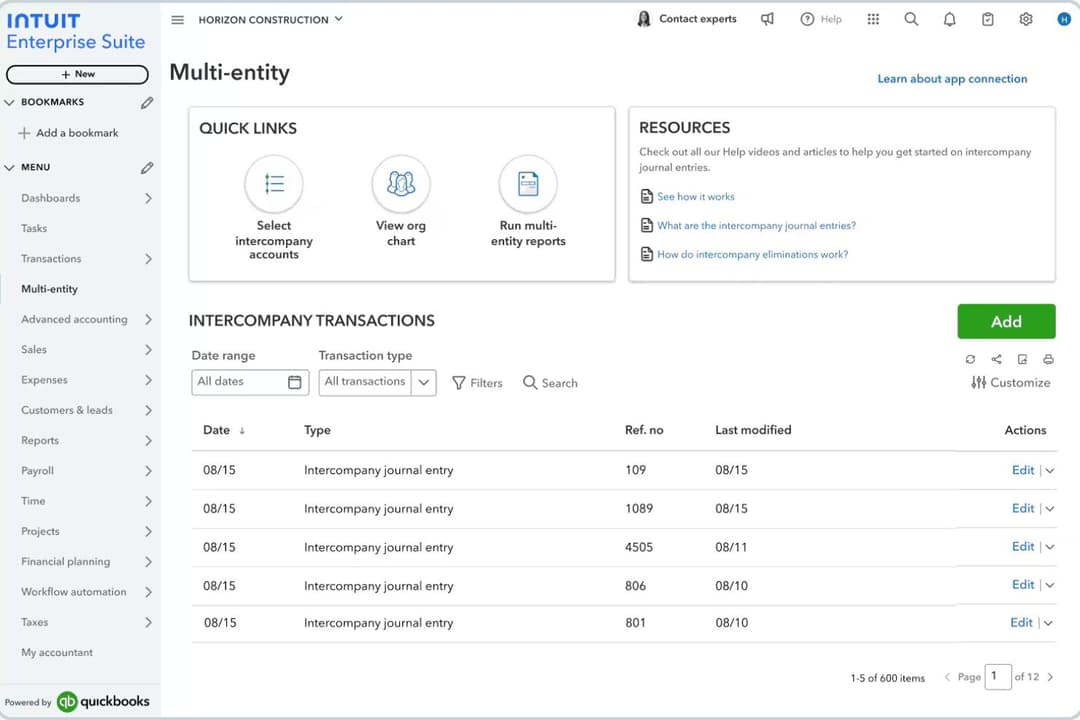
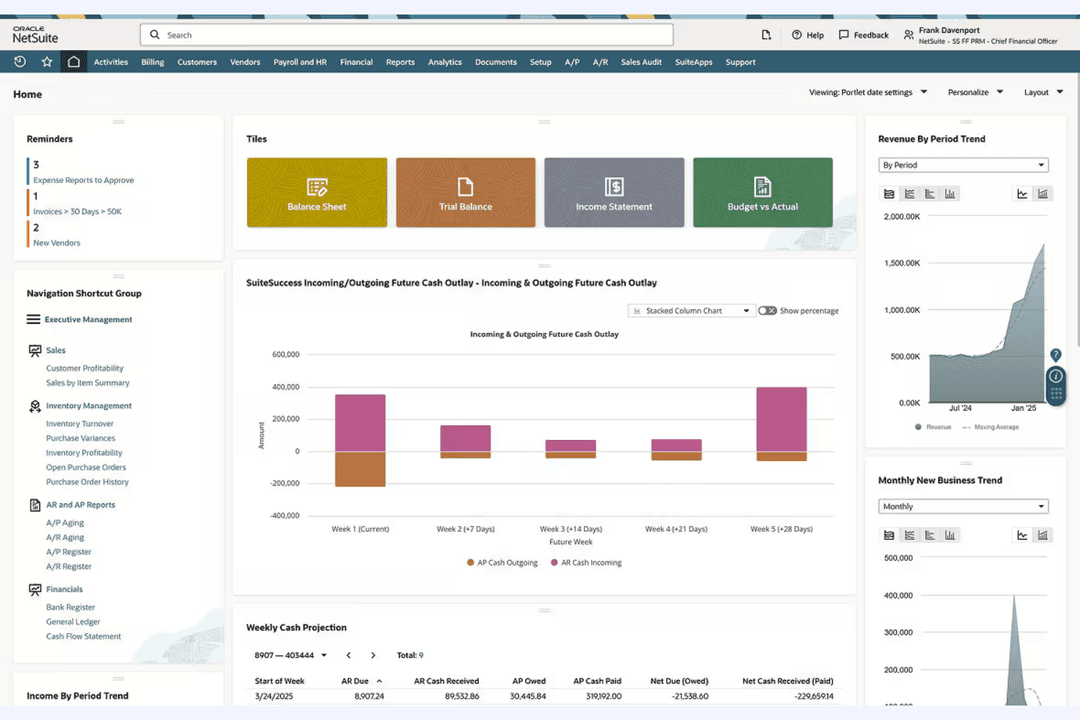
| Gebruikersinterface | Gebruikt een interface die is beïnvloed door het QuickBooks-ecosysteem, met een vertrouwde indeling en dashboards die zijn ontworpen voor financiële teams die overstappen van kleinere boekhoudtools. | Biedt aanpasbare dashboards en op rollen gebaseerde weergaven, maar de interface kan complex aanvoelen door de uitgebreide functionaliteit van het platform. |
| Ingebruikname | Biedt begeleide configuratie en tips in de app voor een snelle start. | Vereist formele training en een langere leercurve voor volledige ingebruikname. |
| Aanpassing | Ondersteunt configureerbare workflows, dashboards en financiële rapportage, maar richt zich meer op gebruiksgemak dan op diepgaande aanpassingen op systeemniveau. | Biedt uitgebreide aanpassingsmogelijkheden via SuiteScript, aangepaste velden, workflows en dashboards. |
| Ondersteuningsbronnen | Omvat livechat, telefonische ondersteuning en een uitgebreide kennisbank. | Biedt ondersteuningsplannen, uitgebreide documentatie, trainingsprogramma's en een partnernetwerk voor implementatie en doorlopende ondersteuning. |
| Mobiele toegang | De mobiele app biedt de belangrijkste functies voor taken onderweg. | De mobiele app biedt volledige toegang tot het platform, maar vereist mogelijk extra configuratie. |
Intuit Enterprise Suite is over het algemeen eenvoudiger voor financiële teams om snel in gebruik te nemen, vooral voor organisaties die al vertrouwd zijn met workflows in QuickBooks-stijl. De interface en het configuratieproces zijn ontworpen om complexiteit te verminderen en bedrijven te helpen overstappen van kleinere boekhoudsystemen met minimale verstoring.
NetSuite ERP vereist doorgaans meer tijd voor implementatie en leren vanwege de bredere functieset en aanpassingsmogelijkheden. Die complexiteit stelt organisaties echter ook in staat om workflows, dashboards en datastructuren af te stemmen op geavanceerdere operationele vereisten.
Intuit Enterprise Suite
- Multi-entity management supports complex organizational structures.
- AI-powered forecasting and insights help businesses analyze financial data.
- Built-in migration tools support transitions from QuickBooks Desktop and Advanced.
- The platform lacks sufficient training for new releases.
- Features can feel overwhelming.
- Reports take longer than expected to load.
Oracle NetSuite ERP
- Handles multi-entity and global financial consolidation well
- Offers strong automation for recurring accounting processes
- Provides real-time dashboards and customizable reporting
- Pricing is higher than many other ERP options
- Implementation and onboarding can be lengthy and complex
- Some users report slow customer support response times
Intuit Enterprise Suite
- Multi-Entity BusinessesCompanies managing multiple subsidiaries, brands, or locations that need consolidated financial visibility while maintaining separate books.
- Finance Teams Focused on ForecastingOrganizations that rely on financial planning and projections to guide budgeting, expansion, and strategic decisions.
- Businesses With Structured Financial WorkflowsCompanies with complex approval processes that want to automate financial workflows and improve internal controls.
- Growing Service BusinessesService businesses needing project profitability tracking, workforce management, and consolidated financial planning across departments benefit significantly.
- Product-Based BusinessesCompanies that manage inventory and sales orders and need accounting, inventory, and order workflows connected in one system.
- Construction FirmsConstruction companies tracking job costing, project budgets, and multi-entity structures gain stronger operational visibility.
Oracle NetSuite ERP
- Global EnterprisesSupports multi-currency, multi-subsidiary, and international compliance requirements.
- Manufacturing CompaniesTracks inventory, production, and supply chain in real time.
- SaaS BusinessesManages recurring revenue, subscription billing, and deferred revenue.
- Retail ChainsHandles multi-location inventory, POS integration, and omnichannel sales.
- Finance DepartmentsAutomates consolidations, intercompany eliminations, and advanced reporting.
- Healthcare OrganizationsSupports HIPAA compliance and complex billing structures.
Wie zou Intuit Enterprise Suite moeten gebruiken en wie NetSuite ERP?
Intuit Enterprise Suite is een slimme keuze voor middelgrote en groeiende organisaties, boekhoudteams en organisaties die een vertrouwd, eenvoudig ERP-systeem willen zonder een steile leercurve of een grote IT-inspanning. Het is bijzonder geschikt voor bedrijven die al QuickBooks gebruiken en voor bedrijven met eenvoudigere workflows of beperkte budgetten.
NetSuite ERP is daarentegen ontwikkeld voor grotere, snelgroeiende of wereldwijde organisaties die geavanceerde aanpassingsmogelijkheden, ondersteuning voor meerdere entiteiten en robuuste nalevingsfuncties nodig hebben. Als uw team complexe activiteiten, meerdere dochterondernemingen of snelle groei beheert, is NetSuite ERP mogelijk beter geschikt voor u—houd er wel rekening mee dat u vooraf meer tijd moet investeren in implementatie en leren.
| Intuit Enterprise Suite | Oracle NetSuite ERP | |
|---|---|---|
| Automation | Intuit Enterprise Suite Automates financial workflows such as budgeting, payroll, approvals, and reporting. | Oracle NetSuite ERP Automation extends across finance, inventory, procurement, supply chain, and operations. |
| Core Strength | Intuit Enterprise Suite Multi-entity financial management and consolidated reporting. | Oracle NetSuite ERP End-to-end ERP capabilities across finance, supply chain, CRM, and commerce. |
| Customization | Intuit Enterprise Suite Supports configurable dashboards, workflows, and reporting dimensions. | Oracle NetSuite ERP Extensive customization with SuiteScript, custom fields, and workflow automation. |
| Pricing Model | Intuit Enterprise Suite Custom subscription pricing based on configuration, number of entities, and features. | Oracle NetSuite ERP Modular pricing based on activated features and negotiated contracts. |
| User Interface | Intuit Enterprise Suite Familiar QuickBooks-style interface designed for ease-of-use. | Oracle NetSuite ERP Highly customizable dashboards with a steeper learning curve. |
| Audit Trails | Each system maintains audit logs that track changes to transactions and user activity for financial transparency. |
|---|---|
| Cloud-Based Access | Both are cloud-based platforms that allow teams to access financial and operational data from anywhere through a web browser. |
| Core Accounting | Each platform includes essential accounting capabilities such as general ledger, accounts payable, accounts receivable, and financial reporting. |
| Financial Reporting | Both offer customizable financial reports and dashboards that help businesses track performance and key financial metrics. |
| Role-Based Permissions | Both provide role-based user permissions so administrators can control access to financial data and system functions. |