


Finance teams are expected to do more than report on past performance. They're expected to forecast cash flow, identify risks early, accelerate the financial close, and provide strategic insight.
AI is making that possible, but the greatest value doesn't come from standalone tools. It comes from AI embedded directly into your ERP, where financial transactions and operational data already live. By analyzing live business data, embedded AI can automate routine tasks, identify patterns, surface risks, and recommend actions before small issues become bigger problems.
For today's CFOs and finance leaders, the question is no longer whether to adopt AI, it's whether their ERP can put AI to work where it matters most.
AI has moved beyond automation
For years, finance technology has focused on automating repetitive tasks like data entry, approvals, and month-end close. While these rule-based processes improved efficiency, they could only perform predefined actions.
AI changes that by analyzing historical and live data to identify patterns, detect anomalies, and predict outcomes. Rather than simply automating processes, it helps finance teams make faster, more informed decisions as business conditions evolve.
This shift allows finance professionals to spend less time on manual reconciliation, and reporting, and more time on forecasting, risk management exception handling, and strategic planning. AI doesn't replace financial expertise; it amplifies it by removing much of the routine work that gets in the way.
How AI works in finance
AI learns from the financial and operational data already within the business, analyzing invoices, payments, journal entries, purchase orders, and other transactions to identify patterns, detect anomalies, and predict future outcomes.
Embedded within Priority ERP, AI will continually analyze live business activity to improve cash-flow forecasting, identify duplicate payments, flag unusual journal entries, and surface emerging risks before they affect financial performance.
Unlike traditional reporting tools that explain what has already happened, AI provides recommendations while there's still time to act, helping finance teams make faster, more informed decisions.
Want to learn more about Priority Software?
What does AI-powered ERP integration mean for finance?
The value of AI depends on how integrated it is to the data it analyzes. Standalone financial tools with AI can summarize reports or answer questions relying on the data they process, but they operate outside the systems where financial activity takes place.
When AI is embedded within an ERP, it works with live data across finance and operations, understanding the full business context behind every transaction. Rather than relying on exported spreadsheets, it delivers recommendations and insights directly within everyday workflows.
Instead of spending time searching for information or investigating exceptions, finance teams can focus on higher-value work while AI surfaces risks, predicts outcomes, and recommends the next best actions.
How Priority aiERP brings AI into everyday finance
Many ERP vendors now offer AI, but not all approaches are the same. Priority aiERP embeds AI directly into the ERP, where financial and operational data already lives, eliminating the need to export information into separate tools.
With access to live data across accounts receivable, accounts payable, the general ledger, banking, purchasing, sales, and inventory, Priority aiERP combines AI Companion, intelligent agents, predictive analytics, and machine learning to support the entire finance lifecycle. It can propose reconciliation matches, predict customer payment behavior, and eventually detect anomalies such as duplicate payments or missing journal entries, and surface risks as they emerge.
By embedding AI into everyday finance workflows, Priority aiERP helps teams automate routine tasks, make faster decisions, and spend more time on analysis and strategic planning, all while keeping finance professionals firmly in control.
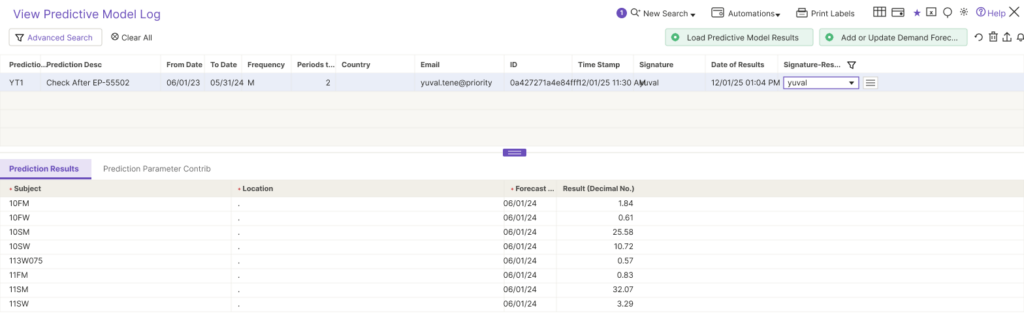
Core applications of aiERP in finance
Automated invoice processing
Priority aiERP streamlines invoice processing by classifying invoices, recommending general ledger accounts, validating supplier information, and identifying exceptions before they reach the approval stage. By learning from previous approvals, it reduces manual data entry, speeds processing, and allows finance teams to focus on exceptions instead of routine invoices.
Smart transaction matching
AI-assisted transaction matching simplifies bank reconciliation by automatically proposing matches based on payment amounts, references, dates, and historical patterns. Confidence scores help finance teams review and approve recommendations quickly.
Predictive cash-flow forecasting
Priority aiERP improves cash-flow forecasting by analyzing how customers actually pay, not just when invoices are due. The Payment Behavior Analysis Agent identifies changing payment patterns, while the Payment Collection Forecast Agent predicts when payments are likely to arrive, giving finance teams a more realistic view of future cash flow.
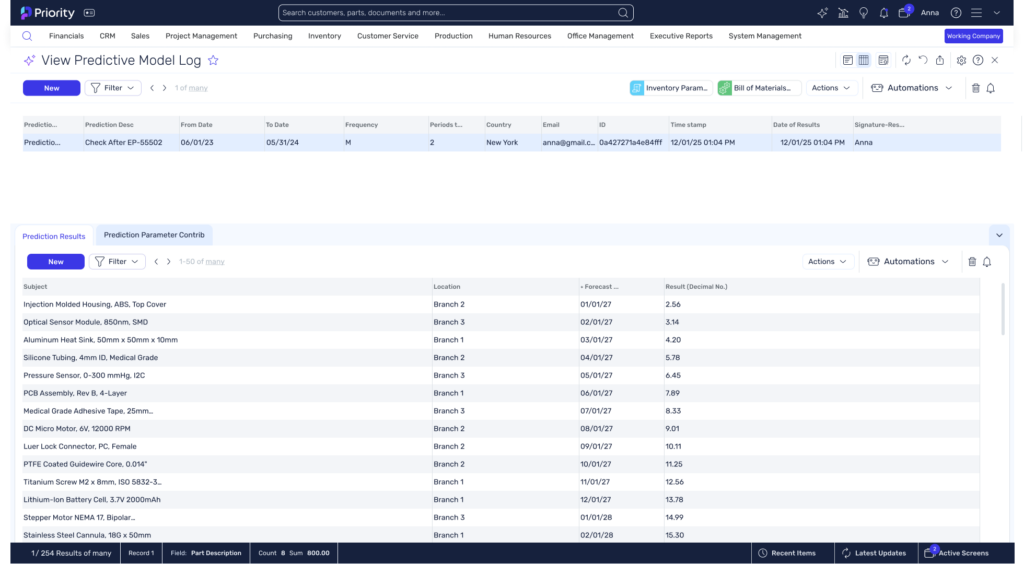
Anomaly and fraud detection
Embedded AI continuously monitors financial activity for duplicate payments, unusual transactions, missing journal entries, and other anomalies before they affect the financial close. Because monitoring extends beyond the general ledger into purchasing and sales, issues can be identified earlier in the transaction lifecycle.
Automated financial close
AI helps shorten the financial close by identifying missing journal entries, highlighting unreconciled accounts, and prioritizing outstanding close activities throughout the accounting period. Resolving issues continuously reduces month-end pressure and improves reporting accuracy.
Continuous reconciliation
With AI Companion, finance professionals can interact with ERP data using natural language instead of building reports manually. Users can ask questions about payment behavior, cash flow, expenses, or financial performance and receive immediate insights based on live ERP data.
Where Priority aiERP delivers the greatest value in finance
Priority aiERP delivers the greatest value in areas where finance teams spend the most time on manual work, exception handling, and forecasting. By combining embedded AI, intelligent agents, and live ERP data, it automates routine processes while providing earlier visibility into risks and opportunities.
Smarter bank reconciliation
Bank reconciliation is one of the most time-consuming parts of the financial close. AI-assisted transaction matching automatically proposes reconciliation matches based on historical patterns and confidence scores, allowing finance teams to review and approve recommendations instead of manually searching for matches. The result is faster reconciliation, fewer exceptions, and a more efficient month-end close.
More accurate cash collection forecasting
Traditional cash-flow forecasts rely on invoice due dates, but customer payment behavior often tells a different story. Priority aiERP's Payment Behavior Analysis Agent and Payment Collection Forecast Agent analyze historical payment patterns to predict when invoices are likely to be paid. This gives finance leaders more accurate cash-flow forecasts and helps collections teams focus on accounts that need attention.
Financial anomaly detection
Priority aiERP continuously monitors financial activity to detect duplicate payments, unusual journal entries, unexpected transaction values, and missing recurring postings before they impact financial reporting. Because anomaly detection extends across purchasing, sales, and finance, issues can be identified earlier, reducing investigation time and improving financial accuracy.
AI across the entire financial lifecycle
Finance doesn't operate in isolation. Every financial result is influenced by activity across sales, procurement, inventory, manufacturing, and customer service. Because Priority aiERP connects these functions in a single platform, AI can identify operational changes that may affect future financial performance. Combined with AI Companion and intelligent agents, finance teams gain real-time visibility into business performance, helping them move from reactive reporting to proactive decision-making.
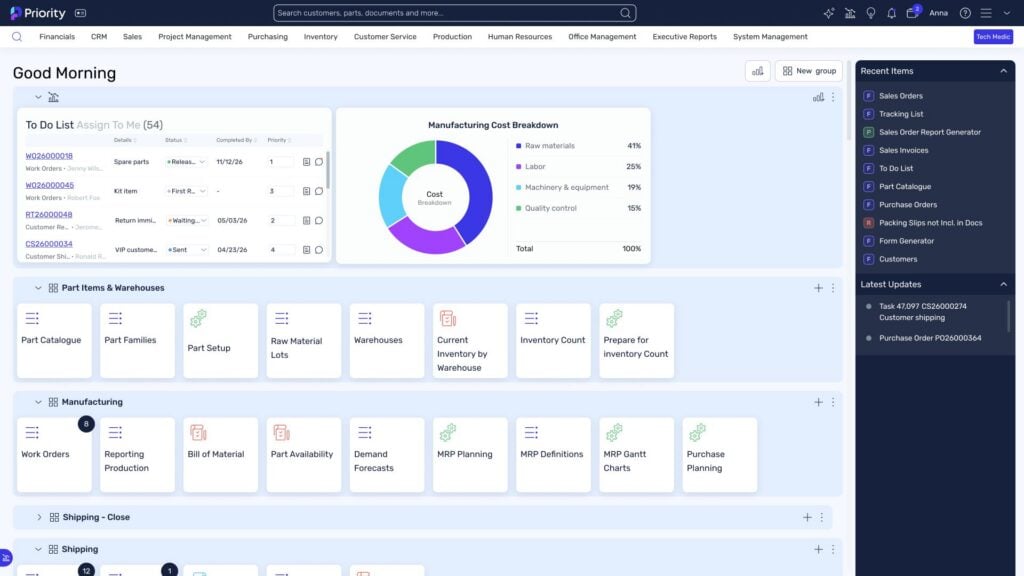
Why embedded AI matters more than standalone AI tools
Not all AI delivers the same value. Standalone AI tools can summarize reports or analyze spreadsheets, but they operate outside the systems where financial activity takes place. Embedded AI works directly within the ERP, using live financial and operational data to deliver insights, automate processes, and support decision-making in real time.
AI works with live financial data
Unlike standalone tools that rely on exported reports, Priority aiERP analyzes live ERP data across finance, sales, purchasing, inventory, and operations. This gives AI the context to understand not just what has changed, but why it has changed and how it may affect the business. As new transactions are recorded, forecasts, anomaly detection, and recommendations are updated automatically, helping finance teams make decisions based on current information.
Better context leads to better decisions
Financial data rarely tells the whole story on its own. A delayed customer payment may be linked to a disputed shipment, an inventory shortage could explain declining revenue, or an unexpected purchasing decision might affect cash flow weeks later.
Because Priority aiERP connects finance with procurement, sales, manufacturing, inventory, projects, and customer management, its AI understands the operational context behind financial transactions. Instead of analyzing isolated datasets, it identifies relationships across the business, helping finance teams understand not only what has changed, but why it has changed and what actions may be needed next.
Less manual work, fewer data silos
Embedded AI eliminates much of the manual work involved in exporting data, building reports, and reconciling information across multiple systems. AI Companion provides instant access to financial insights using natural language, while intelligent agents continuously monitor transactions and surface exceptions that require attention. With a single source of truth, finance teams spend less time gathering data and more time acting on it.
Stronger security, governance, and compliance
Because AI is built directly into the ERP, organizations can extend existing security controls, permissions, audit trails, and approval workflows to AI-powered processes. Finance teams work within familiar screens rather than adopting separate AI applications, making implementation faster while maintaining governance and keeping people firmly in control of financial decisions.
Faster adoption with everyday finance workflows
Unlike traditional automation, embedded AI improves over time. As users approve reconciliation matches, investigate anomalies, and review forecasts. The result is an intelligent system that becomes more accurate as it learns, helping finance teams make better decisions without sacrificing transparency or control.
Risks of AI ERP in financial operations
Like any technology that supports financial decision-making, AI introduces new considerations around data quality, governance, security, and compliance. The key is to treat AI as a decision-support tool—not a replacement for professional judgment.
Data-related risks
AI is only as reliable as the data it analyzes. Inaccurate master data, duplicate records, or incomplete transaction histories can reduce the quality of forecasts and recommendations. Maintaining strong data governance remains essential.
Algorithmic risks
AI learns from historical patterns, but business conditions can change. Finance teams should validate AI-generated recommendations before acting on them, particularly for high-impact decisions. Priority aiERP supports this human-in-the-loop approach by providing confidence scores and supporting context while leaving approvals to finance professionals.
Operational risks
Introducing AI changes the way finance teams work. Organizations need clear processes that define where AI can automate routine tasks and where human review is required. Embedding AI into familiar ERP workflows helps teams adopt AI without disrupting existing controls.
Cybersecurity risks
AI has access to sensitive financial information, making security and access controls critical. Because Priority aiERP embeds AI directly within the ERP, organizations can apply existing permissions, audit trails, and security policies without moving data into separate AI applications.
Compliance and regulatory risks
Financial decisions must remain transparent, explainable, and auditable. AI recommendations should always be traceable, allowing finance teams to understand why a recommendation was made and who approved the final action. Maintaining this level of transparency is essential for regulatory compliance, internal controls, and building trust in AI-driven finance.
Risk mitigation strategies for AI ERP in finance
The most effective AI implementations don't replace finance professionals—they help them make better decisions. While AI can automate routine tasks and surface insights, accountability for financial decisions should always remain with people.
Governance and oversight
Human oversight is the foundation of responsible AI. Organizations should establish clear policies defining where AI can automate tasks and where human approval is required. High-impact activities such as journal entries, financial reporting, and exception handling should always remain subject to established approval workflows. This human-in-the-loop approach allows finance teams to benefit from AI while maintaining accountability and strong internal controls.
Technical controls
AI is only as effective as the data and controls behind it. Organizations should prioritize data quality, role-based access, audit trails, and continuous monitoring, while ensuring AI recommendations are transparent and explainable.
Vendor and ecosystem risk management
When evaluating AI-enabled ERP solutions, finance leaders should look beyond features to assess security, governance, compliance, and transparency. AI should be embedded within the ERP, not bolted on through disconnected tools, so organizations can apply existing security policies and maintain full visibility over financial data. The best platforms strengthen governance by combining intelligent automation with human oversight, not replacing it.
What CFOs should look for in an AI-enabled ERP
As AI becomes a standard ERP capability, the focus should shift from whether a platform offers AI to how it improves finance operations.
CFOs should look for AI that is embedded within the ERP, works from live transactional data, and delivers practical capabilities such as AI-assisted reconciliation, predictive cash-flow forecasting, anomaly detection, conversational reporting, and intelligent agents. Just as important are explainability, strong governance, and the ability to keep finance professionals in control of high-impact decisions.
Finally, choose a vendor with a clear AI roadmap. Priority aiERP combines AI Companion, intelligent agents, predictive analytics, and natural language interaction in a single platform, allowing organizations to adopt new AI capabilities without disrupting existing workflows.
What this means for today’s CFOs
Today's CFOs are expected to do more than report financial performance—they're expected to anticipate risks, improve cash flow, and guide strategic decisions. Embedded AI helps by continuously analyzing business activity, surfacing insights, and automating routine work, giving finance teams more time to focus on higher-value analysis.
The future of finance isn't about replacing people with AI. It's about combining intelligent technology with financial expertise. By embedding AI directly into the ERP, Priority aiERP helps organizations make faster, better-informed decisions while maintaining the governance, transparency, and human oversight that finance demands.

