


What is Priority aiERP?
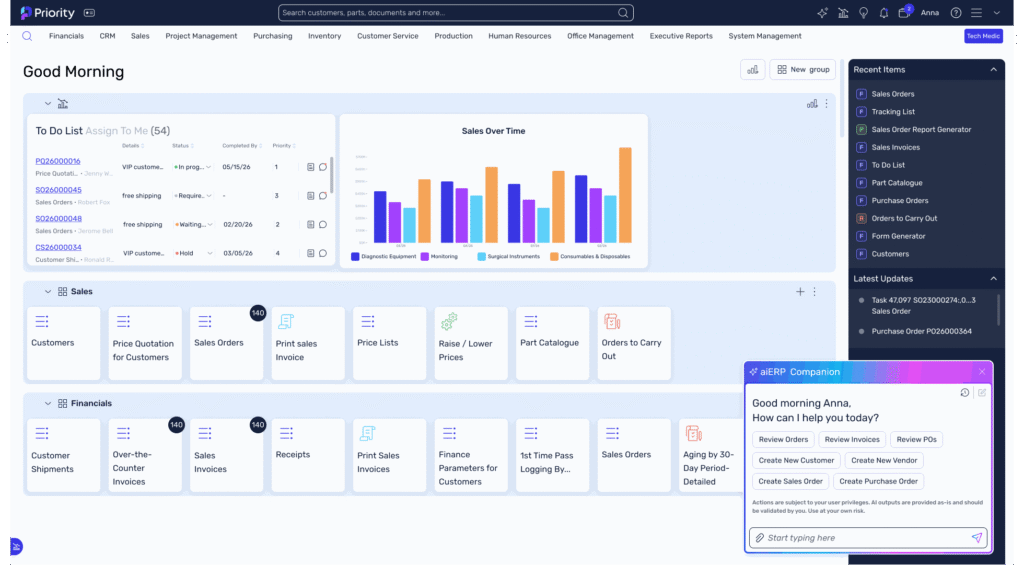
Priority aiERP is an ERP platform with built-in artificial intelligence that allows users to interact with business data using natural language instead of traditional reports or dashboards. It connects financial, operational, and supply chain data in a single system and enables users to ask questions about costs, inventory, production, or margins and receive immediate, context-aware answers based on real-time ERP data.
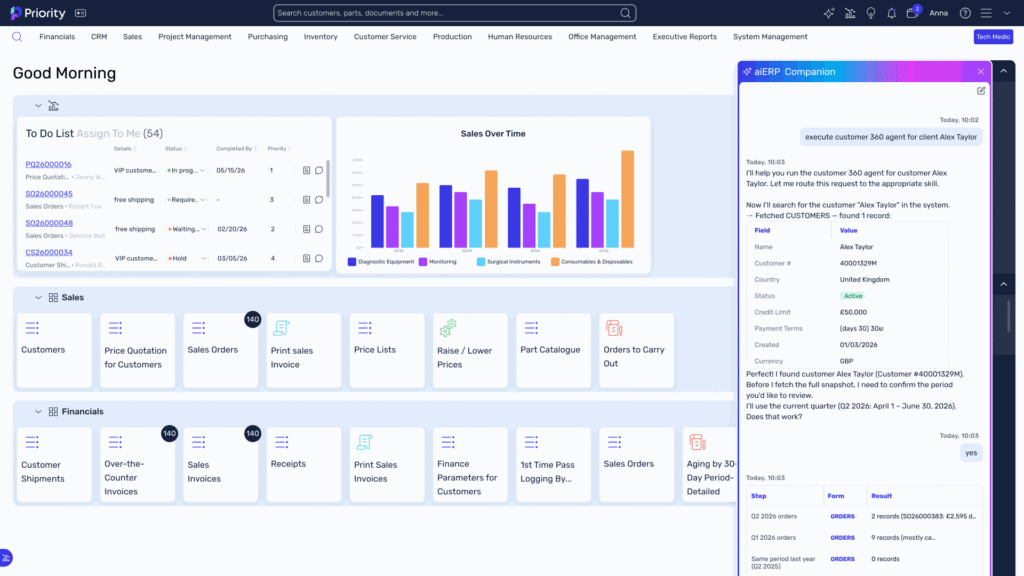
In its latest version, Priority aiERP expands this capability with an aiERP Companion and a set of embedded AI agents. These agents go beyond answering questions, they can execute tasks, automate routine processes, and support users across finance, sales, and supply chain workflows using natural language. Importantly, these capabilities are designed with a human-in-the-loop approach: users review and approve AI-generated insights and actions to ensure accuracy, control, and compliance.
What are natural language queries in ERP?
Natural language queries in an ERP system allow users to ask business questions in plain language, just as they would ask a colleague, instead of building reports or navigating complex menus.
Instead of filtering dashboards or exporting data to spreadsheets, a user can type:
- “What were my production costs this week?”
- “Which customers had the lowest margins?”
The system interprets the intent behind the question, retrieves the relevant data, and presents a clear answer. For finance teams, this removes the dependency on technical skills or predefined reports and significantly shortens the time between question and insight.
Want to learn more about Priority Software?
How Priority aiERP works
Connection to a unified ERP data model
Priority aiERP is built on a single data model that connects finance, production, inventory, procurement, and sales. This ensures that every query pulls from consistent, real-time data across the organization, eliminating reconciliation issues between systems.
AI interpreting user intent
The system doesn't rely on keywords alone. It understands context, meaning, and relationships between data points. For example, it can distinguish between “direct cost”, “selling cost ,” and “profitability” and apply the correct business logic behind the scenes.
Real-time data access
Answers are based on live ERP data, not static reports. This allows users to make decisions based on what is happening now, not what happened at month-end.
Personalization
Priority aiERP adapts to how you work, not the other way around. It tailors responses and recommendations based on your role, past queries, and business context-so a CFO, controller, or operations manager each sees insights that are relevant to their priorities and decisions.
Natural language queries Priority aiERP answers in manufacturing
Production and cost visibility
Manufacturing finance teams can ask:
- “What was the actual vs planned cost for production orders this week?”
- “Which production lines exceeded budget in the last 30 days?”
Priority aiERP pulls data from bills of materials (BOMs), labor records, and overhead allocations to provide a real-time view of production cost performance, helping finance teams identify margin erosion early and trace it back to specific processes or lines.
Inventory and working capital
Examples include:
- “Which items haven't moved in the last 60 days?”
- “What is the total value of excess inventory by warehouse?”
Priority aiERP analyzes inventory movements, valuation methods, and warehouse data to surface slow-moving and excess stock, giving finance teams a clear picture of where working capital is tied up and where corrective action is needed.
Sales and margin analysis
Users can ask:
- “Which customers had the lowest gross margin last quarter?”
- “Show top 10 products by revenue and margin this month”
Priority aiERP connects sales transactions with cost data to calculate real-time profitability by customer, product, or region, allowing finance teams to quickly identify underperforming segments and adjust pricing or strategy.
Procurement and spend management
Typical queries:
- “Which suppliers increased prices in the last 90 days?”
- “What are my top indirect spend categories?”
Priority aiERP aggregates purchasing data across suppliers, categories, and time periods to highlight pricing trends and spend concentration, supporting better negotiation strategies and stronger cost control.
Exception detection and anomalies
Examples:
- “Show unusual cost spikes in production this week”
- “Which invoices don't match purchase orders?”
Priority aiERP continuously monitors transactional and operational data to flag anomalies, such as unexpected cost spikes or mismatches in three-way matching, helping teams detect issues early and reduce financial and compliance risk.

Human-in-the-loop validation and control
AI in Priority aiERP is designed to support, not replace decision-making. Users review, validate, and approve outputs before actions are finalized, whether it's a financial entry, a purchase order, or an exception alert.
This ensures that automation improves speed while maintaining accuracy, auditability, and financial control, especially critical in manufacturing environments where decisions directly impact costs and margins.
Why natural language ERP matters for manufacturing CFOs
For CFOs, the value of natural language ERP is not convenience-it's speed and control.
It enables:
- Faster access to cost and margin insights
- Real-time validation of assumptions
- Shorter decision cycles
- Better alignment between finance and operations
Instead of relying on scheduled reports or analyst support, CFOs can directly explore the business in real time, asking follow-up questions as new insights emerge.
How Priority aiERP changes day-to-day finance work
Preparing for board and executive meetings
CFOs can validate numbers, test assumptions, and pull last-minute insights without waiting on reports, making preparation more dynamic and accurate.
Investigating variances and anomalies
Controllers can quickly drill into unexpected changes in costs, margins, or performance by asking follow-up questions, reducing investigation time significantly.
Faster FP&A analysis and scenario testing
FP&A teams can iterate on forecasts and compare scenarios using real-time data, instead of rebuilding reports for each analysis.
Reducing reliance on IT and manual reporting
Finance teams gain independence from technical report-building processes, freeing up both IT and finance resources.
Aligning finance with operations in real time
With access to the same live data across production, inventory, and procurement, finance teams can collaborate more effectively with operations and respond faster to changes.
Priority aiERP vs traditional ERP reporting
Traditional ERP reporting depends on predefined reports and manual processes. Answering new questions often requires building new reports or involving IT.
Priority aiERP shifts this by enabling:
- On-demand answers instead of static reports
- Continuous exploration instead of one-time analysis
- Real-time insights instead of delayed reporting
This changes ERP from a reporting tool into an interactive decision environment.
Common misconceptions about AI in ERP
It's just a chatbot
AI in ERP is directly connected to business data. It doesn't generate generic responses; it delivers answers based on actual financial and operational data.
It replaces finance teams
AI supports finance professionals by reducing manual work and speeding up analysis, allowing them to focus on higher-value decision-making.
It only works with perfect data
While clean data improves results, modern ERP systems are designed to operate in real-world environments and still provide meaningful insights.
It's only useful for IT or data teams
Natural language queries are designed for business users: CFOs, controllers, and operations leaders - not technical specialists.
It's a future capability, not something usable today
These capabilities are already in use. Manufacturing organizations are actively using natural language queries to access real-time insights and improve decision-making.
How Priority approaches AI differently in ERP
Priority embeds AI directly into the ERP experience rather than layering it on top. This means users interact with AI in the context of their daily workflows-whether in finance, production, or supply chain.
Instead of requiring separate tools or interfaces, AI becomes part of how the system is used:
- Asking questions directly within the ERP
- Generating insights from live business data
- Supporting decisions across functions
This approach connects insights directly to execution. Instead of switching between systems or manually translating insights into actions, users can move from question to outcome within the same environment.
The result is a more practical use of AI in ERP focused on helping teams work faster, reduce manual effort, and make better decisions in real time.

