

Um agente de IA para finanças é um software autónomo que executa tarefas financeiras e contabilísticas em dados, fluxos de trabalho e controlos, com orientação humana limitada. Os melhores agentes podem apoiar a gestão do fecho, a reconciliação, a contabilidade, a previsão, o planeamento, as contas a pagar e os relatórios financeiros.
Este guia compara as principais opções quanto à adequação aos fluxos de trabalho, aos requisitos de auditoria, às integrações, aos controlos de revisão e à escalabilidade, para que possa escolher o sistema certo para a sua equipa financeira.
Why Trust Our Software Recommendations
6,700+
Reviews
20
Industry experts
16+
Evaluation factors
14
Years
Our team has been testing and reviewing software since 2012. As finance leaders ourselves, we know how difficult—and important—it is to choose the right software.
For this guide, we evaluated tools using hands-on testing and independent research, scoring tools using our selection criteria.
Our reviews reflect our human editorial judgment, not a sales pitch.
Tabela comparativa: agentes de IA para finanças
Compare preços e especificações lado a lado dos melhores agentes de IA para finanças que entraram na minha lista restrita.
| Tool | Best For | Trial Info | Price | ||
|---|---|---|---|---|---|
| 1 | Best for mid-market planning and analysis | Free demo available | Pricing upon request | Website | |
| 2 | Best for hospitality accounting | Free demo available | From $299/property/month (billed annually) | Website | |
| 3 | Best for SAP-native finance ops | Free plan available | Pricing upon request | Website | |
| 4 | Best for AI bookkeeping with audit-proof reconciliation | Free demo + 30-day free trial available | From $65/month | Website | |
| 5 | Best for AI-native General Ledger | Free demo available | Pricing upon request | Website | |
| 6 | Best for confidence-scored audit trails | Free demo available | Pricing upon request | Website | |
| 7 | Best for AP and expense managament | Free demo available | Pricing upon request | Website | |
| 8 | Best for multi-agent ERP finance | Free demo available | From $625/user/month | Website | |
| 9 | Best for NetSuite agentic subledgers | Free demo available | Pricing upon request | Website | |
| 10 | Best for GL-native materiality approvals | Free demo available | Pricing upon request | Website |


Avaliações de agentes de IA para finanças
Apresentamos abaixo os meus resumos detalhados dos melhores agentes de IA para finanças da minha lista restrita. As minhas avaliações analisam detalhadamente as funcionalidades, os melhores casos de utilização e as capacidades de cada ferramenta de IA para finanças, para o ajudar a encontrar a melhor opção para si.
 Best for mid-market planning and analysis
- Free demo available
- Pricing upon request
Visit WebsiteCustomer Rating:4.5/5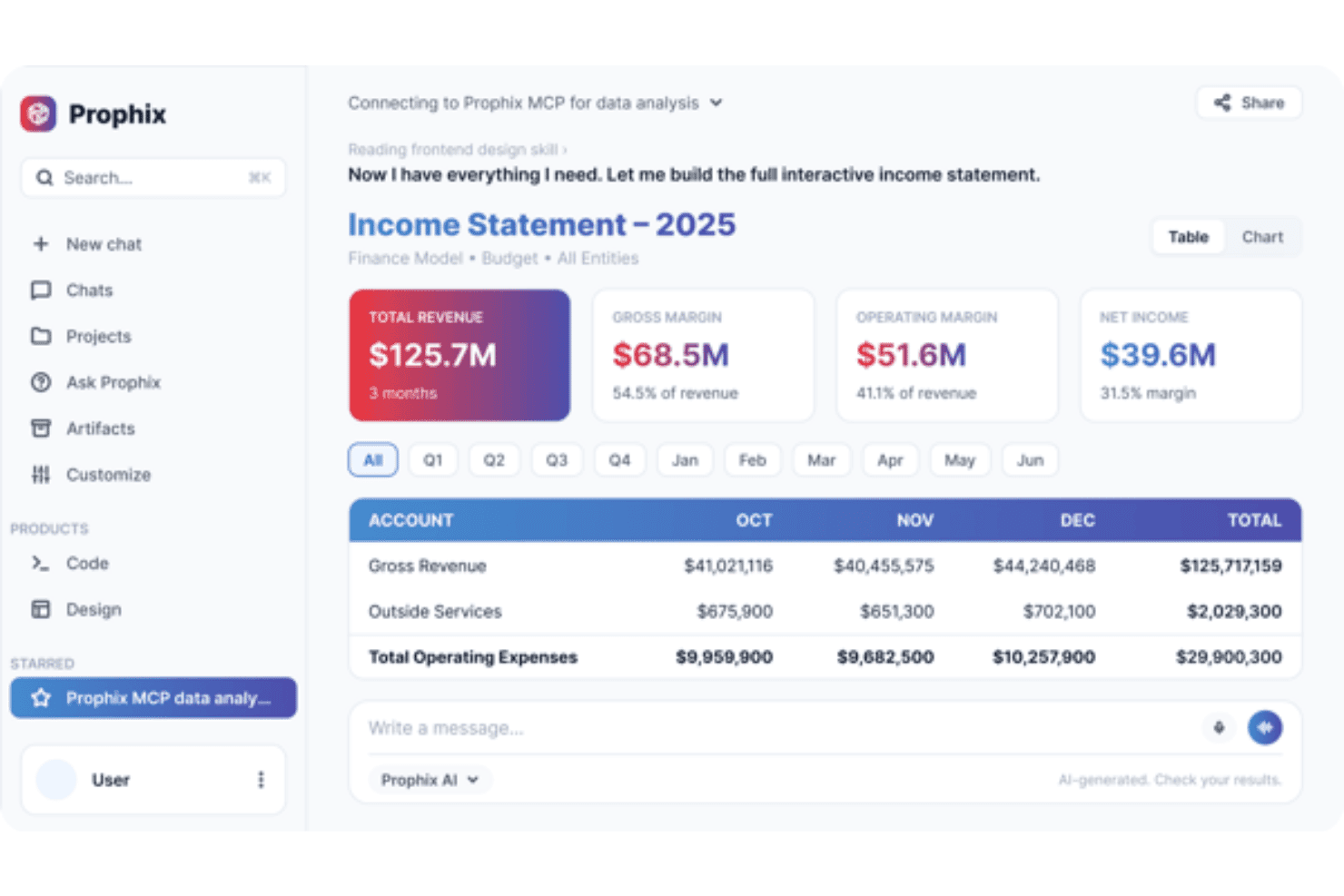
Prophix lets users query financial data to build interactive income statements. Prophix is an autonomous finance platform covering FP&A, financial consolidation and close, account reconciliation, and reporting through a suite of AI agents that execute multi-step workflows.
Who Is Prophix Best For?
Prophix fits mid-market finance teams managing multi-entity planning, consolidation, and close.
Why I Picked Prophix
I've included Prophix because it covers the full planning-to-close cycle with dedicated agents. The Budgeting Agent updates personnel and OPEX budgets when underlying data changes, validates submissions, and fills missing fields with an audit trail behind each change. I also like the Consolidation Agent, which delivers instant, audit-ready answers to consolidation questions without rerunning trial balance variants or exporting to Excel.
Prophix Key Features
- Prophix Copilot: A conversational AI interface built into the platform that lets you query financial data, generate variance analysis, and surface trends using natural language.
- AI-powered transaction matching: Automatically matches high-volume transactions for bank reconciliations and sub-ledger matching, flagging unmatched items for your review.
- Prophix One MCP Server: Exposes governed Prophix data and agents to any MCP-enabled AI platform, including Claude and Microsoft Copilot, so you can act on finance data outside the platform.
- Financial consolidation: Automate multi-entity eliminations and currency translations.
Prophix Integrations
Prophix offers integrations with SAP, Microsoft Dynamics 365, Oracle NetSuite, UKG Pro, Salesforce, Zoho CRM, and HubSpot. It also supports an API for custom connections.
Pros and Cons
Pros:
- Sized for mid-market team structures
- Finance owns the connectors, no IT tickets
- Planning through close in one platform
Cons:
- Advanced reports require admin expertise
- No dedicated AP or AR agent
Learn more about Prophix: Best for hospitality accounting
- Free demo available
- From $299/property/month (billed annually)
Visit WebsiteCustomer Rating:4.7/5
Docyt lets users connect PMS or POS revenue systems directly. Docyt is an AI-native ERP built on a 16-agent architecture covering AP, revenue reconciliation, multi-entity close, and financial reporting.
Who Is Docyt Best For?
Docyt is built for accounting managers and controllers at hospitality and multi-unit businesses—hotel portfolios, restaurant groups, franchises—where nightly revenue reconciliation is routine.
Why I Picked Docyt
I picked Docyt as one of the best because its agents are mapped to hospitality accounting. The Revenue Reconciliation Agent posts night-audit and Point of Sale (POS) revenue daily by 7 am with USALI mapping, while the Revenue Leakage Agent flags short payments and Online Travel Agency (OTA) discrepancies before they compound. The Quality of Books Agent scans for miscoding and variances across ledgers, which is the morning check a controller managing a property portfolio actually runs.
Docyt Key Features
- Multi-entity consolidation: Manage intercompany entries, management fees, and consolidated financials across portfolios of 5–500+ properties from a single ledger.
- GARY reporting agent: Query your financials in plain English and get report outputs with supporting evidence, without building manual exports.
- Forecast Agent: Generates multi-scenario budgets and rolling forecasts in the ledger.
- Immutable audit trail: Every ledger entry logs its source document, confidence score, and reviewer identity, with corrections posted as new entries rather than overwrites.
Docyt Integrations
Docyt integrates with Oracle OPERA Cloud, Toast, Square, Paychex Flex, Dayforce, NetSuite, Xero, and Plaid. An API for custom connections is also available.
Pros and Cons
Pros:
- USALI mapping handled without manual exports
- Scales well across multiple properties
- Daily revenue posted before the morning review
Cons:
- Vendor management and check payments draw complaints
- Built around hospitality workflows only
Learn more about Docyt: Best for SAP-native finance ops
- Free plan available
- Pricing upon request
Visit WebsiteCustomer Rating:4.8/5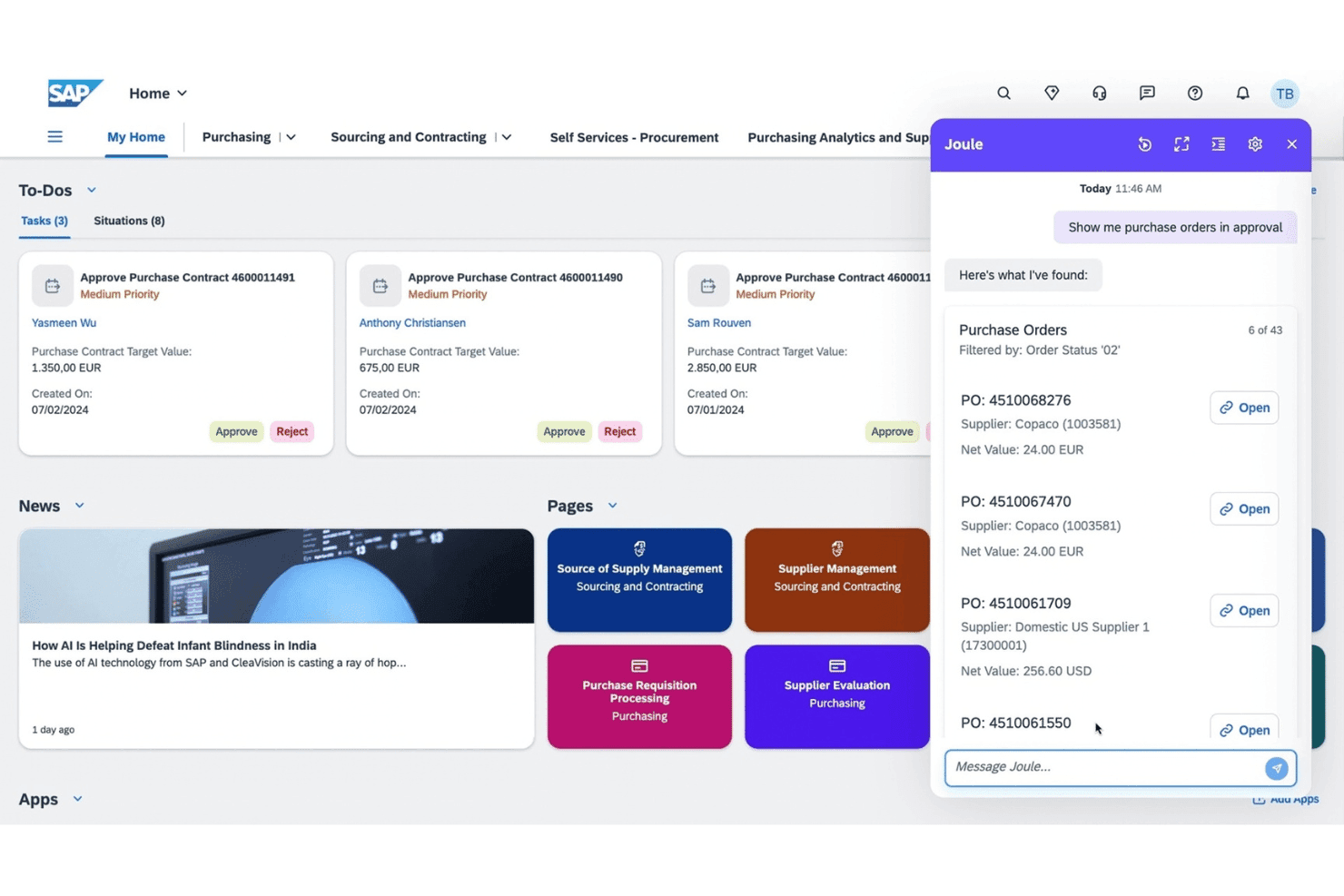
SAP Joule surfaces purchase orders in approval directly in chat. SAP Joule is an AI agent and assistant layer built into SAP's ERP ecosystem, covering accounts payable, accounts receivable, financial close, planning, and tax and compliance monitoring workflows.
Who Is SAP Joule Best For?
SAP Joule is for finance teams already on SAP Cloud ERP or S/4HANA who want AI automation across AP, AR, close, and planning inside their existing environment.
Why I Picked SAP Joule
I included SAP Joule because it operates on live transactional data inside S/4HANA. The Financial Closing Assistant orchestrates specialized agents across the close cycle, flagging bottlenecks and correcting errors in-system with no export step. The Accounts Payable and Accounts Receivable Assistants work the same way, running dispute resolution and payment scheduling with limited human direction.
SAP Joule Key Features
- Financial Planning Assistant: Detects changes in business conditions and models their downstream financial impact to support dynamic planning decisions.
- Joule Studio: A low-code and pro-code agent builder that lets you describe agent behavior in plain language, with support for LangChain and LlamaIndex extensions.
- SAP AI Agent Hub: Deploy, monitor, and govern all agents—including custom and third-party ones—with KPI and ROI tracking.
- Tax and compliance assistant: Cover tax and regulatory compliance workflows within the SAP environment.
SAP Joule Integrations
SAP Joule offers native integrations across SAP Ariba, SAP Concur, SAP SuccessFactors, SAP Datasphere, SAP Incentive Management, and Microsoft 365 Copilot. An API is also available for custom integrations.
Pros and Cons
Pros:
- Automates dispute resolution and cash application
- Flags close anomalies before resolution
- No export step during close
Cons:
- Output depends heavily on data quality
- Complex queries can produce generic answers
Learn more about SAP Joule: Best for AI bookkeeping with audit-proof reconciliation
- Free demo + 30-day free trial available
- From $65/month
Visit WebsiteCustomer Rating:4.9/5
Digits gives users a detailed ledger view of all transactions by account. Digits is an AI-native general ledger covering continuous bookkeeping, automated month-end close, accounts payable, invoicing, and real-time reporting in one platform.
Who Is Digits Best For?
Digits is a good fit for accounting firms and small-to-midsize businesses that want a full general ledger rather than a layer on top of QuickBooks or Xero.
Why I Picked Digits
I picked Digits because its Agentic Close runs continuously rather than as a scheduled batch. Every reconciliation match links to a bounding-box reference on the source statement PDF, so audit evidence is built as the work happens. Exceptions arrive with a plain-language note on what the agent attempted and why, which keeps the review queue readable.
Digits Key Features
- Ask Digits: A conversational AI assistant included on every plan that lets you query your financials and get answers in plain language.
- AI Bill Pay: Extracts bill details via OCR, detects vendor remittance information, and routes payments through customizable approval policies before auto-reconciling to the ledger.
- Category manager: Lets you define and enforce coding logic across transactions for a consistent chart of accounts.
- Live financial statements: Always-current P&L, balance sheet, and cash flow reports that pull from the ledger, with drill-down to individual transactions.
Digits Integrations
Digits connects to 12,000+ financial institutions through the Digits Connect API and offers native integrations with Mercury, Ramp, Gusto, Stripe, Arc, Ignition, Karbon, and Reach Reporting.
Pros and Cons
Pros:
- AI assistant included on every plan
- Replaces the ledger rather than layering on it
- Audit evidence builds as work happens
Cons:
- No scenario forecasting for FP&A
- Complex accruals need manual cleanup
Learn more about Digits: Best for AI-native General Ledger
- Free demo available
- Pricing upon request
Visit WebsiteCustomer Rating:3.8/5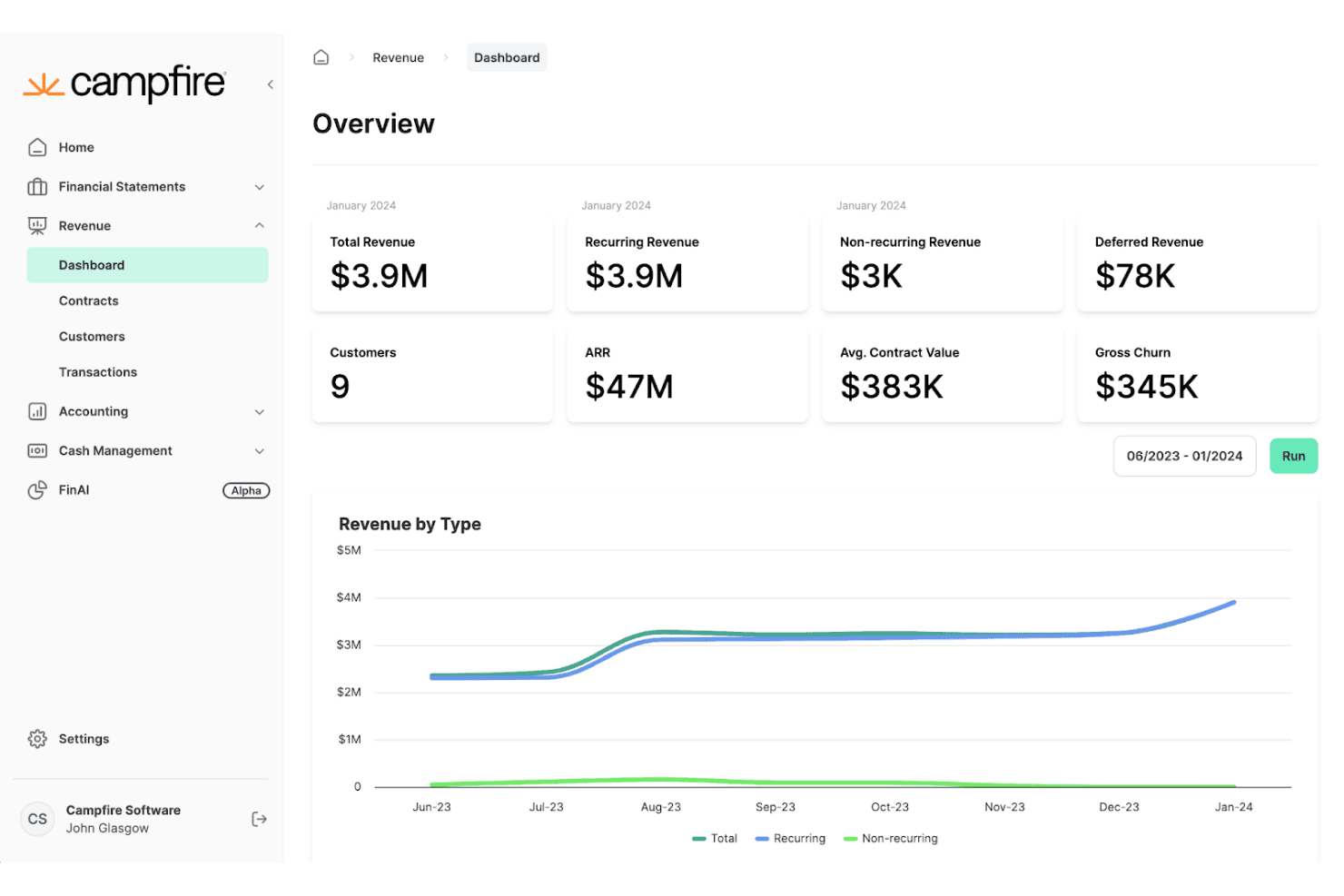
Campfire tracks recurring revenue, ARR, and churn on one dashboard. Campfire is an AI-native accounting platform with built-in agents for AP, AR, transaction matching, accrual management, flux analysis, and period-end close.
Who Is Campfire Best For?
Campfire fits controllers and accounting managers at mid-market companies that are ready to move off their current general ledger.
Why I Picked Campfire
I picked Campfire as one of the best because its agents run continuously inside the ledger without needing a trigger. The Ember Agents handle AP, AR, transaction matching, and accrual management as transactions arrive, rather than waiting for a close date. The Flux Analysis Agent then writes commentary on material variances by department or cost centre, which comes out close enough to finished to edit and drop into a board deck
Campfire Key Features
- Accruals agent: Calculates pro-rated accrual amounts, generates reversing entries for the next period, and routes items above your approval threshold for human review before posting.
- Multi-entity consolidation: Supports unlimited entities across more than 180 currencies with real-time global consolidation, including intercompany transaction matching.
- Ember Chat: Answers finance questions in about 30 seconds with source links to the underlying GL accounts, transactions, and documents, and can draft journal entries on request.
- ASC 606 revenue recognition: Handles subscription, usage, milestone, and transaction billing models with deferred revenue tracking, ARR waterfalls, and churn analysis built into the core product.
Campfire Integrations
Campfire integrates with ADP, Rippling, Deel, HubSpot, Gusto, JPMorgan, Salesforce, Avalara, and Plaid. It also offers a REST API, OAuth 2.0 apps, and an MCP server for custom connections.
Pros and Cons
Pros:
- Mid-market teams can run close in one system
- Variance commentary is ready to edit
- Agents run without a close-date trigger
Cons:
- Complex accounting judgments still need human review
- Requires moving off your existing GL
Learn more about Campfire: Best for confidence-scored audit trails
- Free demo available
- Pricing upon request
Visit WebsiteCustomer Rating:4.5/5
BlackLine centralizes outstanding payment tracking and aging data in one dashboard. BlackLine is an agentic financial operations platform combining a multi-agent AI suite (Verity) with workflow orchestration, ERP integration, and governance tools across record-to-report and invoice-to-cash.
Who Is BlackLine Best For?
BlackLine fits controllers and accounting managers at large, multi-entity organizations that need close and AR workflows backed by auditable, explainable controls.
Why I Picked BlackLine
BlackLine makes my list on audit transparency at the AI level rather than only the workflow level. Every action Verity takes during reconciliation prep carries a confidence score, its reasoning, and a complete audit trail, so a reviewer can see why the AI flagged or matched something. Verity Prepare splits the work across agents that analyze supporting documentation, draft reconciling items, and generate variance explanations, with human sign-off reserved for exceptions.
BlackLine Key Features
- Multi-agent orchestration: Vera acts as an AI team lead, assigning tasks to specialized sub-agents and tracking progress across close and AR workflows with full auditability.
- Natural-language financial querying: Verity Insights lets you explore financial data using plain-language questions, surfacing analysis without manual report building.
- Automated accruals drafting: Verity Accruals gathers source data and vendor confirmations, then drafts audit-ready journal entries for your team to review.
- Prebuilt process blueprints: Studio360 Blueprint includes 70+ ready-to-use workflow templates built on industry best practices for financial close and AR processes.
BlackLine Integrations
BlackLine integrates with SAP, Oracle NetSuite, Microsoft Dynamics, and Acumatica. An open API is also available for custom integrations.
Pros and Cons
Pros:
- Human approval remains central for exceptions
- Multi-agent workflows cover close and AR
- Confidence-scored actions support audit review
Cons:
- Implementation requires careful planning and training
- Agent features have limited independent validation
Learn more about BlackLine: Best for AP and expense managament
- Free demo available
- Pricing upon request
Visit WebsiteCustomer Rating:4.4/5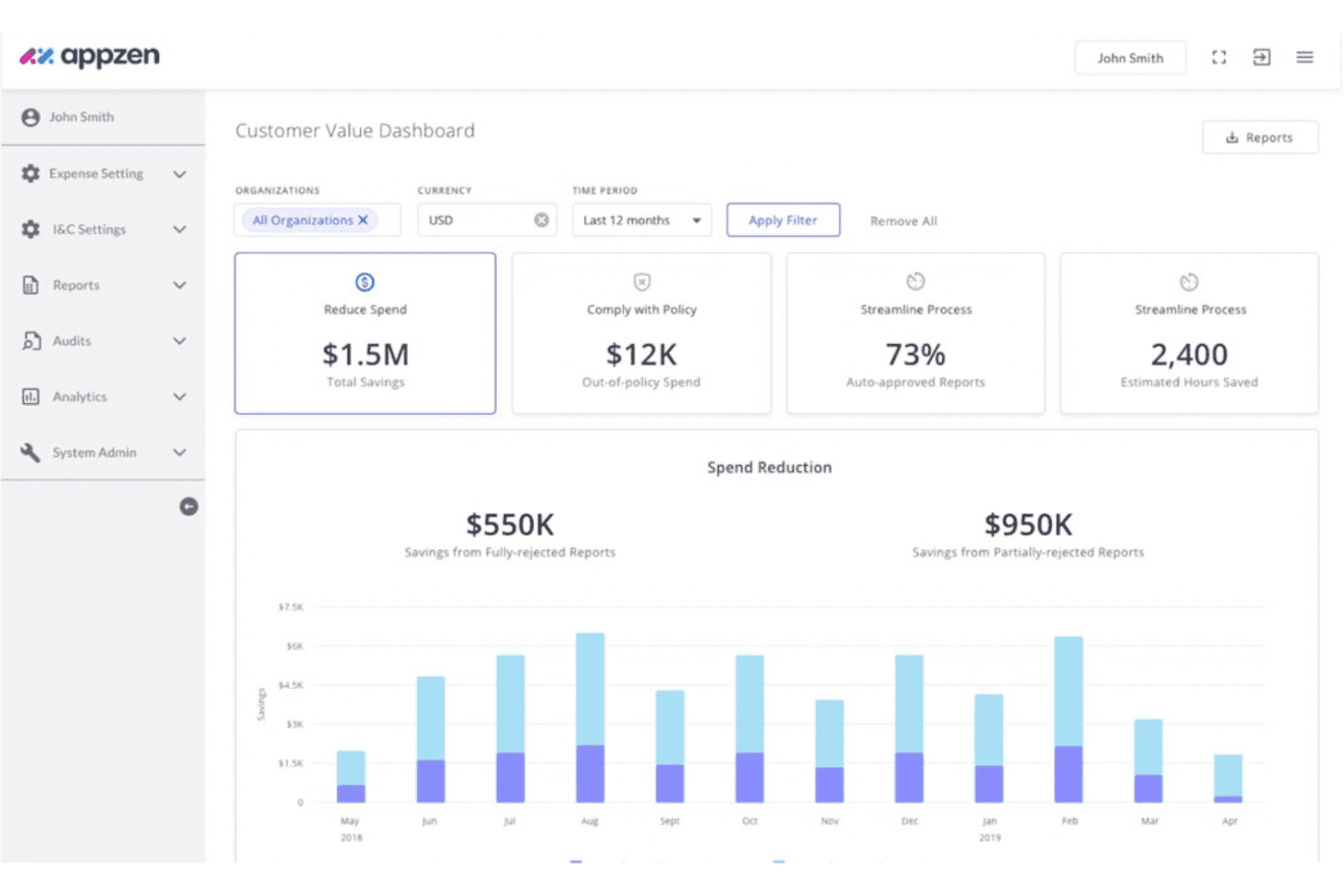
AppZen tracks expense savings, policy compliance, and hours saved. AppZen is an AP and expense management platform with autonomous invoice processing, pre-payment expense auditing, corporate card transaction review, and a no-code agent builder for custom AP and T&E workflows.
Who Is AppZen Best For?
AppZen fits enterprise finance and accounting teams that own AP and T&E and need audit-ready processing at volume.
Why I Picked AppZen
AppZen earns a spot on my shortlist because AP and expense are the full scope of what it does. The pre-payment expense audit screens every report before money moves, catching AI-generated fake receipts, blocklisted merchants, and cross-report duplicates. The no-code AI Agent Studio also lets finance ops staff turn an existing SOP document into a live AP workflow without involving IT.
AppZen Key Features
- GL code prediction: Automatically assigns general ledger codes to non-PO invoices by learning from your historical data and chart of accounts.
- E-invoicing compliance: Validates invoices against global mandates including VAT, OFAC, and Peppol requirements across 40+ languages.
- AI Analytics dashboard: Delivers real-time spend visibility with drill-down reporting and natural-language Q&A for on-demand answers.
- Sandbox testing environment: Lets you test new agents against historical or live data before activation, with pre- and post-launch performance dashboards.
AppZen Integrations
AppZen offers integrations with Oracle NetSuite, Workday, SAP Concur, Coupa, Rydoo, American Express, Mastercard, and Visa card networks. A REST API for custom integrations is also available.
Pros and Cons
Pros:
- Finance ops team can build workflows without IT
- Screens expenses before money moves
- Deepest coverage of AP and T&E on this list
Cons:
- Analytics cannot trigger finance actions
- Scoped to AP and expense only
Learn more about AppZen: Best for multi-agent ERP finance
- Free demo available
- From $625/user/month

Oracle Fusion Cloud ERP lets users monitor ledger prompts by priority. Oracle Fusion Cloud ERP is a cloud-based ERP platform with embedded, finance-specific AI agents spanning accounts payable, accounts receivable, general ledger, expenses, payments, cash processing, reconciliation, and financial planning.
Who Is Oracle Fusion Cloud ERP Best For?
Oracle Fusion Cloud ERP suits large, multi-entity organizations that already run Oracle as their system of record and need agents across the whole finance function.
Why I Picked Oracle Fusion Cloud ERP
Oracle Fusion Cloud ERP is on this list for the breadth of its agent coverage. The Payables Agent handles invoice ingestion through to payment, and the Ledger Agent surfaces GL exceptions and auto-creates adjustment journals, both working on live data in the same system of record. AI Agent Studio also lets finance ops teams build and extend custom agents without developer support, which really matters at enterprise scale.
Oracle Fusion Cloud ERP Key Features
- Planning Agent: Analyzes trends and variances and runs what-if simulations via natural language.
- Expenses Agent: Processes receipts forwarded by email, matches card charges, validates policy, and triggers reimbursement.
- Cash Processing Agent: Matches bank statement lines to AR receipts and auto-creates entries for straight-through cash application.
- Continuous transaction monitoring: Runs 300-plus algorithms across Fusion transactions to detect anomalies, duplicates, and fraud.
Oracle Fusion Cloud ERP Integrations
Oracle Fusion Cloud ERP has native integrations across Fusion Financials, EPM, Procurement, SCM, HCM, CX, J.P. Morgan, Box, and Stripe. An API for custom integrations is also available.
Pros and Cons
Pros:
- Runs on live ERP data in place
- Finance ops can build agents without developers
- Agent coverage spans the full finance function
Cons:
- Agent maturity varies across workflows
- Implementation requires lengthy enterprise projects
Learn more about Oracle Fusion Cloud ERP:

Numeric lets users embed SQL queries and rich text into close checklists. Numeric is an AI-native financial data platform combining agentic subledgers, close management, reconciliation, cash matching, and billing automation into end-to-end accounting workflows.
Who Is Numeric Best For?
Numeric fits accounting teams at growth-stage and mid-market companies on NetSuite that want subledger, close, and cash-matching automation.
Why I Picked Numeric
Numeric earns its spot on my shortlist because its Agentic Subledgers handle NetSuite accounting end-to-end. I've used it to ingest lease agreements and commission plans, and the agent derives the accounting treatment, builds the schedule, and updates balances automatically. When a document changes, it applies the previously approved treatment to correct the downstream accounting on its own, and Prism surfaces the overnight agent actions and exceptions that need sign-off.
Numeric Key Features
- Transaction monitors: Set plain-language rules that flag duplicate transactions, unusual balances, and policy violations against live transaction data before close.
- Cash matching rules engine: Configure rules on any field—memo, amount, date range—to match 90%+ of bank, AR, and AP transactions, including many-to-many scenarios.
- App Studio: Build custom dashboards and workbooks using plain-language prompts, with every app versioned and logged.
- Real-time cycle analytics: Tracks operational trends, cycle times, workflow bottlenecks, and workload distribution to optimize overall close efficiency period-over-period.
Numeric Integrations
Numeric offers integrations with Xero, Stripe, Anrik, Salesforce, HubSpot, Snowflake, Carta, HSBC, Chase Connect, and Databricks. It also offers an MCP server to connect with LLMs like Claude and ChatGPT.
Pros and Cons
Pros:
- Overnight agent work surfaced for sign-off
- MCP actions land in audit logs
- Keeps your existing NetSuite in place
Cons:
- Limited forecasting and scenario modeling
- Full agentic modules need ERP replacement
Learn more about Numeric:

Rillet centralizes financial metrics, close checklists, and AI workflows in one dashboard. Rillet is an AI-native ERP with a general ledger at its core, embedding agents in the ledger for natural-language GL queries, automated close workflows, continuous anomaly monitoring, and materiality-tiered approval routing.
Who Is Rillet Best For?
Rillet fits mid-market and scaling SaaS companies that want a GL-native system with structured approval governance around their existing close workflows.
Why I Picked Rillet
Rillet earns its place on materiality-tiered approval routing. When an agent proposes a journal entry above a set threshold, it routes to the controller, and above a higher one it escalates to the CFO, so the level of review scales with the size of the entry. Every agent action is logged in the Aura Audit Trail with timestamped data snapshots and step-by-step reasoning, which gives approvers a full evidence chain they can export.
Rillet Key Features
- Aura Flow workflow builder: Define multi-step finance workflows in plain English—Rillet breaks them into parallel sub-processes, handles scheduling, and remembers your accounts and dimensions across runs.
- Continuous AI monitoring: Always-on scanning of your books flags anomalies, surfaces exceptions, and proposes accruals as transactions occur, not just during close.
- Aura MCP connectivity: Connects Rillet's live GL data to external tools like Salesforce, Snowflake, and Claude for reads and writes without leaving those environments.
- Automated revenue recognition: Native ASC 606 support handles flat-rate, usage-based, milestone, and hybrid billing models, with auto-generated rev-rec analyses pulled directly from contracts.
Rillet Integrations
Rillet offers native integrations with Salesforce, Snowflake, Stripe, Tipalti, Procurify, Justworks, ADP, Zapier, and Anaplan. An API and MCP are also available for custom workflows.
Pros and Cons
Pros:
- Plain-English workflows support multi-step close tasks
- Audit trails include snapshots and reasoning
- Materiality-based approvals route agent proposals
Cons:
- No native scenario planning
- Human approval prevents fully unattended posting
Learn more about Rillet:
Outros agentes de IA para finanças
Eis algumas opções adicionais que não entraram na minha lista principal, mas que vale a pena conhecer:
- 11TrintechBest for multi-entity close
- 12ZeniBest for bookkeeping and insights
- 13Sage IntacctBest for close-to-consolidation workflows
- 14RampBest for agents built on real transaction data
- 15PayhawkBest for natural-language spend playbooks
- 16HighRadiusBest for AP/AR coverage
- 17LedgeBest for approval-gated ERP posting
- 18NominalBest for automated account reconciliation
- 19Close AI by FloQastBest for COSO-aligned governance
Related Reviews
How I Evaluate Finance AI Agents
To make this list, a tool's AI must handle real finance work, like reconciling transactions or flagging anomalies. From there, I evaluate three things. Core functionality carries the most weight, like connecting systems and logging actions. Then I look at standout features, like approval controls, and what it offers beyond features, like implementation time.
Core Functionality (Table Stakes For This List)
When I'm selecting tools for my list, I score each one on a scale from 0 (does not offer the functionality) to 5 (excels in this area) for each core functionality listed below. I then convert the total into a percentage to help assess each tool's overall fit, with extra weight on any functionalities I’ve deemed essential.
- Autonomous Task Execution (Essential): I look for multi-step workflows such as reconciliation, invoice processing, and reporting that run with limited human direction.
- Financial Data Integration (Essential): I assess connections to ERP, accounting, banking, payroll, and billing systems, including how data moves between them.
- Natural Language Interaction: I check whether finance teams can query balances, explain variances, or initiate tasks using conversational language.
- Anomaly Detection: I look for discrepancies across transactions, accounts, and reports, with clear exceptions for human review.
- Adaptive Decisioning: I assess whether recommendations improve from historical outcomes, corrections, and recurring finance workflows.
- Audit Trail And Explainability: I review logs, supporting evidence, approvals, and decision context for reconciliations, postings, and other actions.
Once I have a list of tools that meet the criteria, I consider what sets each platform apart.
Differentiating Factors (What Sets Vendors Apart)
Here's how I compare and contrast different vendors:
Standout Features
I look for human-in-the-loop approval controls that let teams set dollar or risk thresholds where an agent pauses for sign-off before posting. A miscoded intercompany entry can cascade across entities, so configurable checkpoints matter more than raw automation speed. I also evaluate multi-agent orchestration—whether AP, AR, and close agents hand off tasks to each other without manual sequencing. Low-code customization is important too; controllers should be able to adjust agent rules without filing engineering tickets.
Beyond Features
I check whether a vendor holds SOC 2 certification and supports role-based access controls, since an agent posting journal entries needs the same permission guardrails you'd apply to a staff accountant. Scalability matters just as much—a tool that works for one entity but buckles across currencies and subsidiaries will force you back to spreadsheets during consolidation. I also evaluate release cadence and roadmap clarity to gauge whether the vendor will keep pace as agentic capabilities evolve.
Como escolher um agente de IA para finanças
Escolha o agente certo testando se consegue produzir trabalho contabilístico passível de revisão sem enfraquecer o seu ambiente de controlo.
| Se a sua prioridade for | Procure |
|---|---|
| Se a sua prioridade forRevisões de fecho mais rápidas | ProcureReconciliações com evidências de suporte, aprovação do revisor e estado das exceções |
| Se a sua prioridade forPreparação para auditorias | ProcureRegistos de atividade imutáveis, fundamentação das decisões, registos de origem e evidências exportáveis |
| Se a sua prioridade forRegisto de lançamentos mais seguro | ProcureLimiares de aprovação configuráveis, permissões baseadas em funções e restrições de registo |
| Se a sua prioridade forRelatórios de várias entidades | ProcureGestão de entidades, moedas, operações intragrupo e consolidação verificada com os seus dados |
| Se a sua prioridade forMenos correções manuais | ProcureFilas de exceções que identificam divergências e preservam o histórico de correções |
Como avaliar a sua lista restrita
- Faça um teste de fecho: Dê a cada fornecedor dez reconciliações representativas e solicite folhas de trabalho concluídas no prazo de cinco dias úteis.
- Solicite um pacote de auditoria: Peça um exemplo de registo de atividade, anexo de evidências, registo de aprovação e formato de exportação antes de assinar.
- Teste as regras de escalamento: Envie transações acima de dois limiares de aprovação e confirme que o agente pausa, encaminha e regista cada decisão.
- Verifique o tratamento de dados: Solicite um diagrama escrito do fluxo de dados que abranja a retenção, as funções de acesso, a utilização dos dados dos clientes e os procedimentos de eliminação.
- Escolha o compromisso: Decida se uma cobertura mais ampla dos fluxos de trabalho compensa uma revisão humana mais rigorosa, porque os agentes de IA para finanças raramente maximizam ambos.
O que são os agentes de IA para finanças?
Os agentes de IA para finanças são programas que executam tarefas contabilísticas e financeiras com orientação humana limitada. Podem reconciliar transações, processar faturas, explicar desvios, detetar anomalias, preparar relatórios e apoiar previsões. As equipas financeiras continuam a analisar as exceções, aprovar ações sensíveis e manter o controlo sobre os lançamentos e os dados financeiros.
Funcionalidades
Eis as principais funcionalidades que procuro em qualquer agente de IA para finanças de qualidade:
- Execução autónoma de tarefas: Executa fluxos de trabalho com várias etapas, como o processamento de faturas, a reconciliação de contas, a preparação de lançamentos e a geração de relatórios, com orientação humana limitada.
- Integração de dados financeiros: Liga-se a software de contabilidade, sistemas ERP, bancos, plataformas de processamento salarial, ferramentas de faturação e armazéns de dados para recolher e comparar informações financeiras.
- Interação em linguagem natural: Permite fazer perguntas sobre saldos, transações, desvios e previsões utilizando linguagem corrente. Também pode iniciar tarefas financeiras suportadas a partir de pedidos conversacionais.
- Deteção de anomalias: Analisa transações e atividade das contas para identificar montantes invulgares, entradas duplicadas, dados em falta, exceções às políticas e alterações inesperadas para análise humana.
- Fluxos de trabalho de reconciliação: Faz corresponder transações, faturas, pagamentos e registos de contas com base em regras definidas. Assinala os itens sem correspondência e preserva as evidências subjacentes a cada correspondência sugerida.
- Controlos de aprovação: Interrompe ações sensíveis até que uma pessoa autorizada as analise. Os limiares configuráveis podem encaminhar lançamentos, pagamentos e ajustamentos com base no valor ou no risco.
- Registos de auditoria: Regista as ações do agente, os dados de origem, as recomendações, as aprovações, as correções e os resultados dos lançamentos. Os revisores podem seguir cada resultado até às respetivas evidências de suporte.
- Previsões e análise de desvios: Utiliza dados financeiros históricos, orçamentos, valores reais e pressupostos empresariais para preparar previsões e explicar as diferenças entre os resultados esperados e os comunicados.
Benefícios
Na minha experiência, os agentes de IA para finanças oferecem vários benefícios práticos, incluindo:
- Revisões de fecho mais rápidas: As reconciliações automatizadas, a análise de desvios e as filas de exceções ajudam os revisores a avaliar mais cedo o trabalho financeiro.
- Menos correções manuais: A deteção de anomalias identifica duplicados, dados em falta, divergências e transações invulgares antes do lançamento.
- Maior preparação para auditorias: Os registos de atividade preservam os registos de origem, as recomendações do agente, as aprovações, as correções e os resultados dos lançamentos para análise posterior.
- Lançamento de diários mais seguro: Os limiares de aprovação e as permissões baseadas em funções interrompem os lançamentos sensíveis até que os revisores autorizados deem a sua aprovação.
- Visibilidade financeira mais clara: As consultas em linguagem natural ajudam as equipas a investigar saldos, transações, previsões e desvios sem navegar por vários sistemas.
- Fluxos de trabalho mais consistentes: As integrações com sistemas de contabilidade, ERP, bancários, de processamento salarial e de faturação aplicam regras repetíveis nos processos financeiros.
Custos e preços
Os custos variam consoante as funcionalidades, a dimensão da equipa, os complementos e as necessidades de implementação. Eis os intervalos de preços que normalmente pode esperar dos agentes de IA para finanças:
Tabela de comparação de planos para agentes de IA financeira
| Tipo de plano | Preço médio | Funcionalidades comuns |
|---|---|---|
| Tipo de planoPlano gratuito | Preço médio$0/mês | Funcionalidades comunsConsultas limitadas, análise financeira básica, fluxos de trabalho de exemplo e utilização individual |
| Tipo de planoPlano pessoal | Preço médio$10–$50/utilizador/mês | Funcionalidades comunsPerguntas em linguagem natural, análise de transações, deteção básica de anomalias e integrações limitadas |
| Tipo de planoPlano profissional | Preço médio$50–$200/utilizador/mês | Funcionalidades comunsReconciliações automatizadas, fluxos de aprovação, trilhos de auditoria, elaboração de relatórios e múltiplas integrações |
| Tipo de planoPlano para empresas | Preço médio$500–$5,000+/mês | Funcionalidades comunsSuporte para várias entidades, fluxos de trabalho personalizados, permissões avançadas, implementação dedicada e suporte empresarial |
Perguntas frequentes
Algumas respostas a perguntas comuns sobre agentes de IA financeira:
Os agentes de IA financeira podem publicar lançamentos contabilísticos sem aprovação?
Não, os agentes de IA financeira devem pausar os lançamentos contabilísticos que exigem aprovação humana. Defina limites por montante, tipo de conta, entidade ou nível de avaliação de risco. O agente pode preparar o lançamento, anexar os documentos de origem e explicar a sua recomendação. Um revisor autorizado aprova, rejeita ou solicita alterações. O seu sistema contabilístico deve conservar cada decisão e o resultado do lançamento. Teste estes controlos com lançamentos acima e abaixo de cada limite antes de implementar o agente durante um fecho real.
Como é que os agentes de IA financeira se ligam aos sistemas contabilísticos?
Os agentes de IA financeira ligam-se através de interfaces de programação de aplicações, importações de ficheiros, acesso direto à base de dados ou conectores incorporados. Confirme que sistemas são suportados pelo agente antes de selecionar uma plataforma. Verifique se consegue ler o seu plano de contas, o histórico de transações, as regras de aprovação e a estrutura das entidades. Deve também confirmar com que frequência os dados são sincronizados e o que acontece quando uma ligação falha. Execute um teste controlado com registos representativos antes de conceder acesso de escrita.
Os agentes de IA financeira são seguros para dados financeiros confidenciais?
Os agentes de IA financeira podem trabalhar com dados confidenciais, mas deve verificar primeiro os respetivos controlos de segurança. Informe-se sobre encriptação, retenção de dados, funções de acesso, registos de auditoria e utilização dos dados dos clientes. Confirme se o fornecedor utiliza os seus dados para treinar modelos partilhados. Solicite documentação sobre o estado de conformidade com a SOC 2 e os procedimentos de eliminação. Limite o acesso aos registos de que cada agente necessita. Comece com permissões apenas de leitura e, depois, amplie o acesso após analisar os resultados dos testes e as evidências dos controlos.
O que acontece quando um agente de IA financeira comete um erro?
Quando um agente comete um erro, encaminhe o resultado para uma fila de exceções e conserve o histórico das correções. Um revisor deve identificar a origem do erro, corrigir o registo contabilístico e documentar a decisão. Verifique se o agente atualiza as recomendações futuras após correções aprovadas. Nunca elimine a sugestão original nem as evidências de suporte. Em vez disso, conserve ambas as versões para análise. Teste transações duplicadas, montantes invulgares e registos de origem em falta antes da utilização em produção.
Como deve uma equipa financeira introduzir um agente de IA?
Comece com um fluxo de trabalho repetível, como a reconciliação de contas ou a correspondência de faturas. Defina as medidas de sucesso, os pontos de aprovação, os dados permitidos e as regras de escalamento antes da configuração. Execute o agente no modo apenas de leitura com base em transações históricas. Compare as suas recomendações com os papéis de trabalho concluídos e as decisões dos revisores. Depois, avance para o processamento em tempo real com permissões limitadas. Designe um responsável pela análise de exceções, pelo feedback do modelo, pelas alterações de acesso e pelos testes periódicos dos controlos. Esta abordagem revela os erros antes de afetarem o relato financeiro.