

O software de gestão de contratos com IA utiliza inteligência artificial para automatizar a forma como cria, revê, acompanha e analisa contratos. Se está a tentar reduzir o trabalho manual entediante, controlar o risco jurídico ou identificar mais rapidamente as principais obrigações, encontrar a plataforma certa é mais do que uma forma de poupar tempo — é uma maneira de apoiar a conformidade e manter os processos empresariais críticos a funcionar sem problemas.
Neste guia, verá como se comparam as principais ferramentas de gestão de contratos com IA, o que distingue cada uma e encontrará dicas para escolher um software adequado aos objetivos e fluxos de trabalho da sua equipa.
Why Trust Our Software Recommendations
6,700+
Reviews
20
Industry experts
16+
Evaluation factors
14
Years
Our team has been testing and reviewing software since 2012. As finance leaders ourselves, we know how difficult—and important—it is to choose the right software.
For this guide, we evaluated tools using hands-on testing and independent research, scoring tools using our selection criteria.
Our reviews reflect our human editorial judgment, not a sales pitch.
Tabela de comparação de software de gestão de contratos com IA
Esta tabela de comparação resume os detalhes de preços das minhas principais escolhas de software de gestão de contratos com IA:
| Tool | Best For | Trial Info | Price | ||
|---|---|---|---|---|---|
| 1 | Best for collaborative contract editing in-browser | Free demo available | Pricing upon request | Website | |
| 2 | Best for customizable contract automation | Free plan available | Pricing upon request | Website | |
| 3 | Best for rapid implementation | Free demo available | Pricing upon request | Website | |
| 4 | Best for AI-powered contract data insights | Free demo available | Pricing upon request | Website | |
| 5 | Best for vendor and spend oversight | Free demo available | Pricing upon request | Website | |
| 6 | Best for connected e-signature and contracts | Free demo available | Pricing upon request | Website | |
| 7 | Best for automated contract analytics workflows | Free demo available | Pricing upon request | Website | |
| 8 | Best for ERP and financial system integration | Free demo available | Pricing upon request | Website | |
| 9 | Best for integration with finance operations | Free demo available | Pricing upon request | Website | |
| 10 | Best for post-award obligation tracking | Free demo available | Pricing upon request | Website |


Avaliações do melhor software de gestão de contratos com IA
Apresentamos abaixo os meus resumos detalhados do melhor software de gestão de contratos com IA que entrou na minha seleção. As minhas avaliações oferecem uma análise detalhada das funcionalidades, integrações e melhores casos de utilização de cada plataforma, para o ajudar a encontrar a opção mais adequada para si.
 1Best for collaborative contract editing in-browser
Juro
- Free demo available
- Pricing upon request
Visit WebsiteCustomer Rating:4.8/5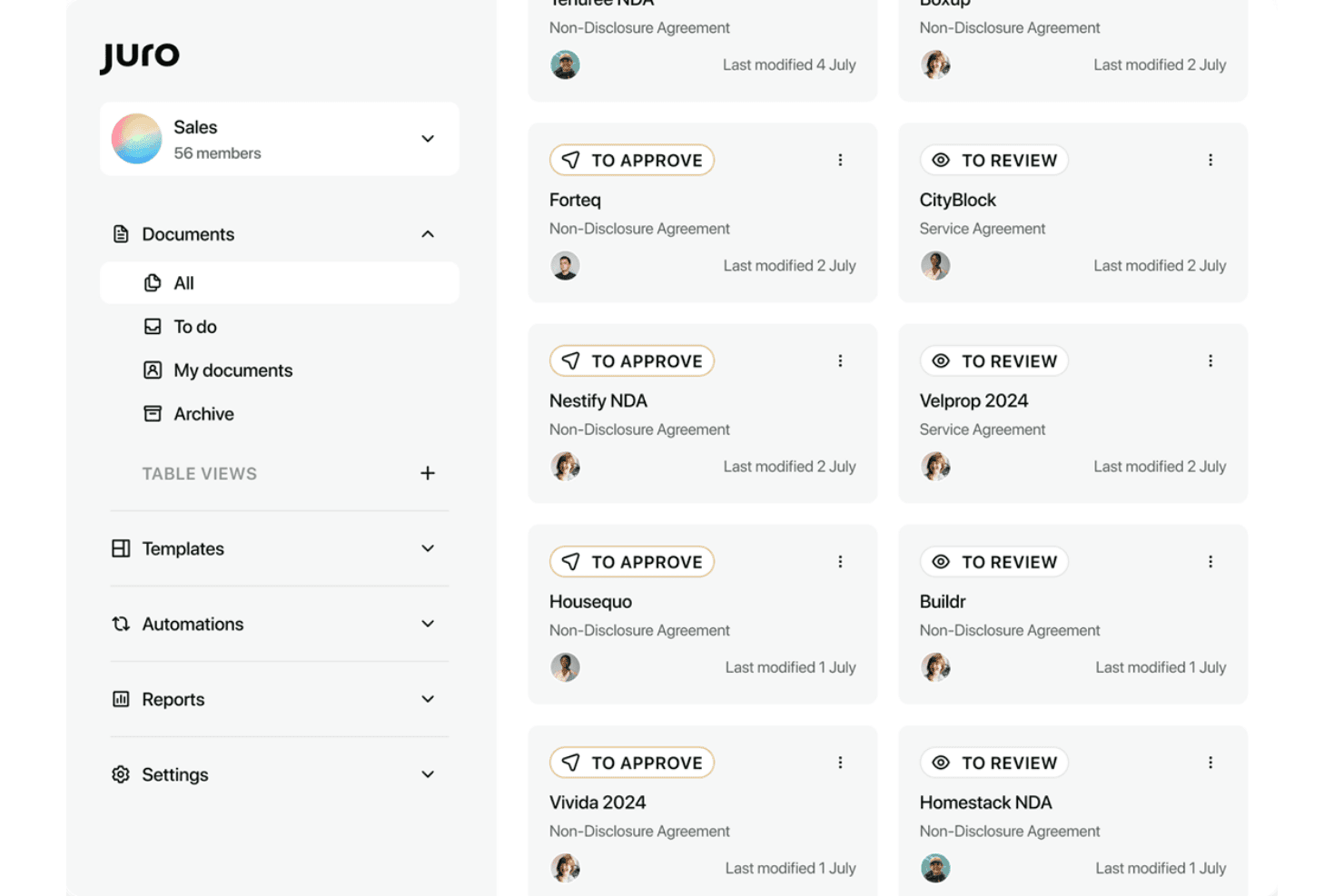
Juro offers a document management dashboard where sales teams can view, approve, and review contracts like NDAs and Service Agreements. Juro is an AI-native contract management platform that covers the full contract lifecycle—from template-based drafting and in-browser negotiation to e-signature, obligation tracking, and an AI-queryable contract repository.
Who Is Juro Best For?
Juro is a strong fit for mid-market legal, finance, and operations teams that manage high contract volumes and need cross-functional visibility without a dedicated contract specialist.
Why I Picked Juro
Juro earns its spot on my shortlist because its browser-native contract editor eliminates the Word-to-email-to-PDF cycle I've long dealt with. Counterparties can comment, redline, and approve directly in the browser without spawning a new document version each time. I also rely on Operator by Juro to query the full contract repository in plain language, which makes pulling obligation data during month-end close considerably faster than digging through a shared drive.
Juro Key Features
- AI clause extraction: Drag and drop third-party contracts or PDFs to auto-extract key data points and tag metadata for search and reporting.
- Configurable approval workflows: Build no-code, role-based review and signature flows to control contract routing and authorization.
- Centralized contract repository: Store, search, and organize contracts with version control, advanced metadata, and a full audit trail.
- AI-powered repository Q&A: Use natural language queries to search contract terms, dates, and obligations across your entire contract portfolio.
Juro Integrations
Juro offers native integrations with Salesforce, HubSpot, Greenhouse, Slack, Google Drive, Ashby, and Salesforce. Zapier is also supported, and an API is available for custom integrations.
Pros and Cons
Pros:
- No-code template builder for non-legal users
- AI repository Q&A surfaces obligations instantly
- Browser-native editing removes Word dependency
Cons:
- Reporting and analytics features are basic
- Limited AI redlining vs. dedicated CLM tools
Learn more about Juro: Best for customizable contract automation
- Free plan available
- Pricing upon request
Visit WebsiteCustomer Rating:4.7/5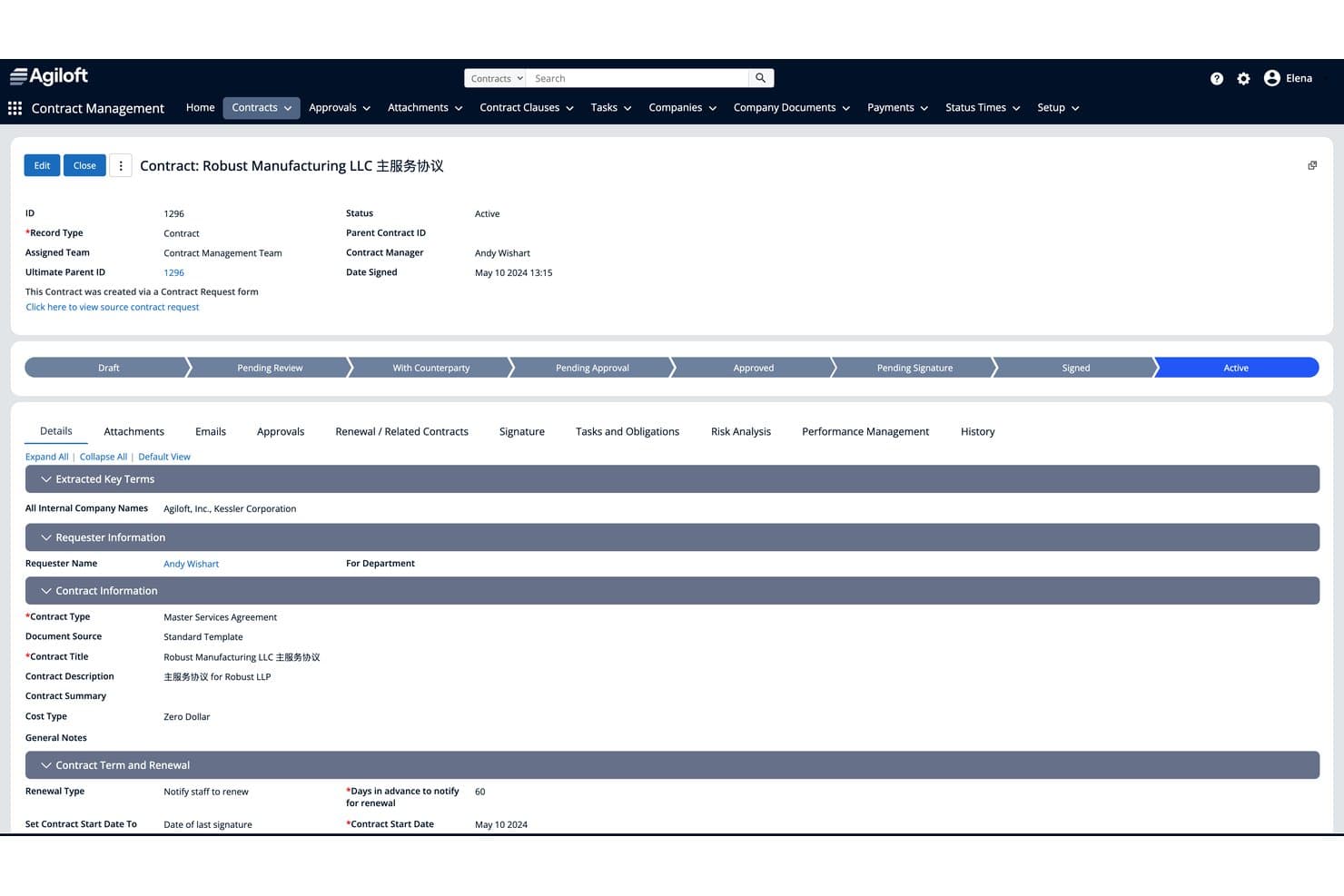
Agiloft offers a detailed contract record view with status tracking, key terms extraction, and contract lifecycle management for active master services agreements. Agiloft is a no-code contract lifecycle management platform that uses AI capabilities to handle clause extraction, obligation tracking, approval workflows, and contract repository management across legal, procurement, and finance teams.
Who Is Agiloft Best For?
Agiloft is a strong fit for mid-market and enterprise organizations that need highly configurable contract workflows across multiple departments without relying on custom development.
Why I Picked Agiloft
I picked Agiloft as one of the best because no other CLM platform gives my team this level of workflow control without writing a single line of code. I use the no-code data model to build custom approval chains for procurement and finance processes, and the AI-driven Obligation Management feature surfaces due dates and financial commitments directly inside each contract record. ConvoAI lets me query the entire repository in plain language, which cuts search time during month-end close.
Agiloft Key Features
- AI-powered clause library: Lets you standardize and manage approved contract language for consistent legal drafting.
- Third-party contract ingestion: Imports and analyzes counterparty contracts to surface risks and deviations.
- Pre-built ERP and procurement integrations: Connects with SAP, Oracle, and Coupa to sync contract-driven financial data.
- Role-based permission controls: Allows you to set granular access levels and approval rights for every user and document type.
Agiloft Integrations
Agiloft offers native integrations with Xero, Salesforce, SAP, Oracle, Coupa, and Workday. An API is available for custom integrations.
Pros and Cons
Pros:
- Custom approval pathways per department
- Fine-grained field rules for conditional routing
- No-code setup for custom workflows
Cons:
- Manual effort required for bespoke schemas
- Out-of-the-box UI appears dated
Learn more about Agiloft: Best for rapid implementation
- Free demo available
- Pricing upon request
Visit WebsiteCustomer Rating:4.7/5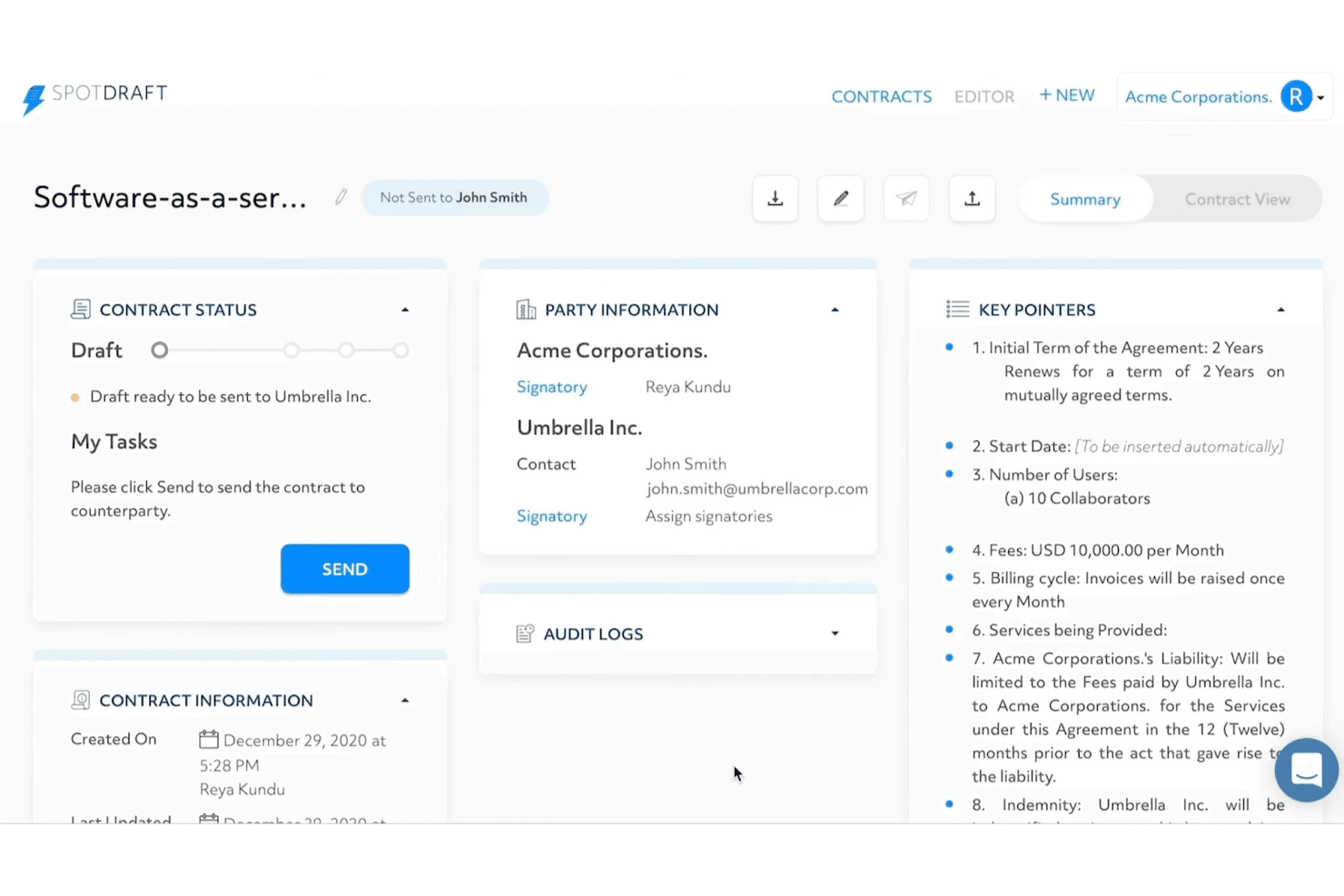
SpotDraft offers a contract summary view with contract status, party information, key pointers, and audit logs. SpotDraft is an AI-powered contract lifecycle management platform that handles contract creation, negotiation, AI-driven clause extraction and risk review, e-signatures, and automated approval workflows across the full contract lifecycle.
Who Is SpotDraft Best For?
SpotDraft is a strong fit for mid-market companies whose legal and business teams need a CLM solution running in weeks, not months.
Why I Picked SpotDraft
SpotDraft earns its spot on my shortlist because the implementation timeline is genuinely different from what I've seen elsewhere. My team is live in 4-6 weeks, with SpotDraft's in-house team handling workflow setup, integration configuration, and legacy contract migration, resulting in cost savings for the team. I also appreciate VerifAI, which runs AI contract reviews directly inside Microsoft Word, so reviewers aren't forced into a new tool from day one.
SpotDraft Key Features
- Smart Data Capture: Extracts financial and legal metadata from executed contracts using AI models.
- Central contract repository: Stores all documents with advanced search, metadata tagging, version control, and audit trails.
- VerifAI contract review: Flags risks, deviations, and obligations against your playbooks inside Microsoft Word.
- Multi-system integrations: Connects with tools like Salesforce, Slack, Google Drive, and Docusign for simplified workflows.
SpotDraft Integrations
SpotDraft offers native integrations with Salesforce, HubSpot, Slack, Microsoft Word, Google Drive, Outlook, Okta, and Dropbox. It also supports Zapier and provides an API for custom integrations.
Pros and Cons
Pros:
- Migrates legacy contracts at no added cost
- VerifAI reviews contracts directly in Word
- Deploys and goes live within weeks
Cons:
- Occasional delays in AI clause extraction accuracy
- Reporting and analytics dashboard is limited
Learn more about SpotDraft: Best for AI-powered contract data insights
- Free demo available
- Pricing upon request
Visit WebsiteCustomer Rating:4.7/5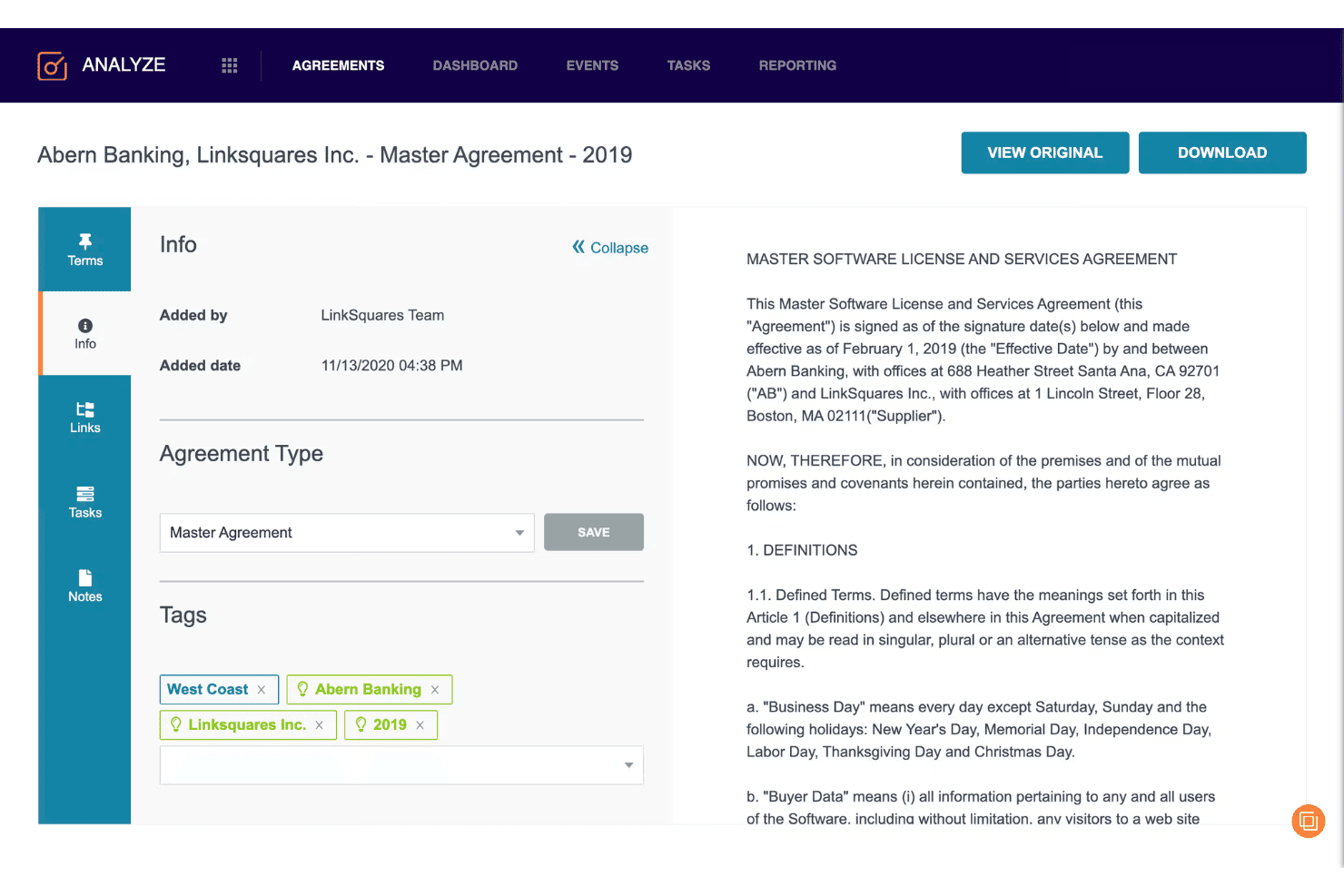
LinkSquares offers a Master Agreement with contract metadata, tags, and full document text in its Analyze platform. LinkSquares is an AI-powered contract lifecycle management platform that handles contract drafting, redlining, risk scoring, e-signature, and post-signature analytics through its proprietary legal-trained AI engine, LinkAI.
Who Is LinkSquares Best For?
LinkSquares is a strong fit for mid-market and enterprise legal and finance teams that manage high contract volumes and need structured data extracted from agreements at scale.
Why I Picked LinkSquares
LinkSquares earns its spot on my shortlist because of how its Analyze module turns static contracts into structured, queryable data. I can search across thousands of agreements and pull specific financial terms, renewal dates, or obligation triggers in seconds. The underlying AI engine, LinkAI, is trained specifically on legal documents, which means the clause-level extraction accuracy I get is noticeably sharper than what you'd expect from a general-purpose AI tool.
LinkSquares Key Features
- Clause library and playbooks: Maintain pre-approved fallback positions with negotiation playbooks to standardize contract terms.
- AI-assisted redlining: Get in-line drafting suggestions and deviation flags directly in MS Word and the browser.
- Third-party paper review: Import and analyze counterparty contracts to highlight risky clauses and missing provisions.
- Conversational contract Q&A: Ask natural language questions across your entire contract repository and receive cited answers.
LinkSquares Integrations
LinkSquares offers native integrations with Salesforce, HubSpot, Adobe Sign, Microsoft Word, Slack, Box, Google Drive, OneDrive, and Amazon S3, and provides an API for custom integrations.
Pros and Cons
Pros:
- Conversational search across entire contract repository
- LinkAI extracts clause data with high accuracy
- Strong post-signature obligation tracking and alerts
Cons:
- Initial contract migration can be time-consuming
- Reporting customization options are limited
Learn more about LinkSquares: Best for vendor and spend oversight
- Free demo available
- Pricing upon request
Visit WebsiteCustomer Rating:4.4/5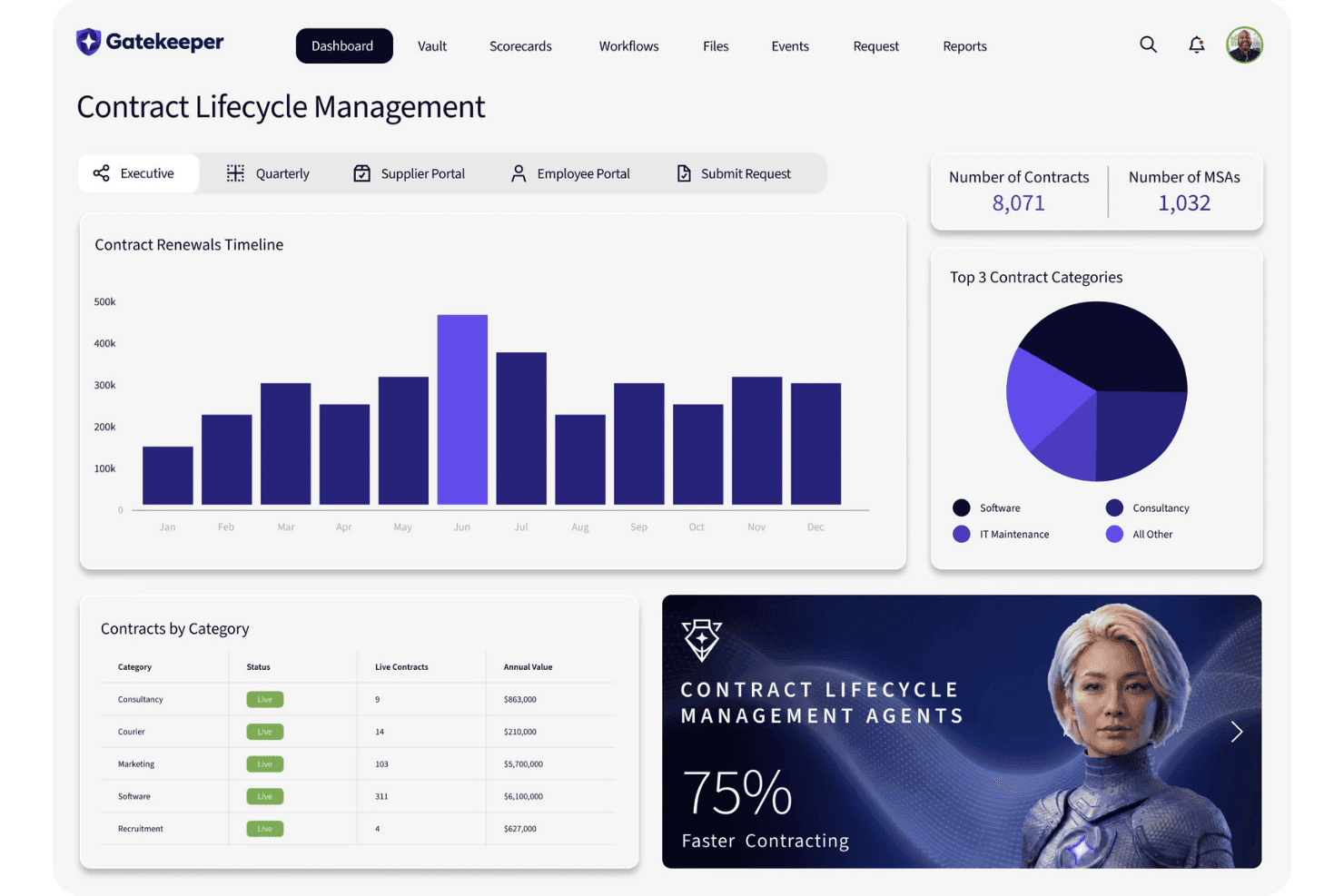
Gatekeeper offers a Contract Lifecycle Management dashboard with renewal timelines, contract categories, and live contract tracking by value. Gatekeeper is a vendor and contract lifecycle management platform that combines AI-powered clause extraction, obligation tracking, risk analysis, and vendor due diligence in a single connected system.
Who Is Gatekeeper Best For?
Gatekeeper suits mid-market to enterprise finance and procurement teams managing large, complex vendor portfolios with ongoing compliance and renewal obligations.
Why I Picked Gatekeeper
Gatekeeper earns its spot as one of the best on my shortlist because no other tool connects vendor risk and contract data in a single record the way it does. I particularly like the Spend Module, which uses AI agents to continuously flag auto-renewals and contracts that are no longer delivering value. In practice, that means my team can catch unwanted renewals before they roll over, rather than discovering them after the fact.
Gatekeeper Key Features
- LuminIQ AI clause extraction: Extracts key terms, clauses, and financial data points from uploaded contracts using AI agents.
- Centralized contract repository: Stores all vendor, customer, and framework contracts with advanced custom metadata and a full audit trail.
- Configurable approval workflows: Supports multi-step, role-based approvals for contract execution, review, and renewal actions.
- MarketIQ continuous risk monitoring: Monitors vendors against financial, sanctions, and cybersecurity databases with automated alerts.
Gatekeeper Integrations
Gatekeeper offers native integrations with Airtable, Slack, Asana, Workday, Zendesk, Jira, and Xero. It also connects with Zapier and provides an API for custom integrations.
Pros and Cons
Pros:
- Continuous vendor risk scoring via MarketIQ
- Auto-renewal alerts flag contracts before rollover
- Vendor and contract data in one record
Cons:
- Custom reporting options are more limited
- AI clause extraction is less advanced
Learn more about Gatekeeper: Best for connected e-signature and contracts
- Free demo available
- Pricing upon request
Visit WebsiteCustomer Rating:4.7/5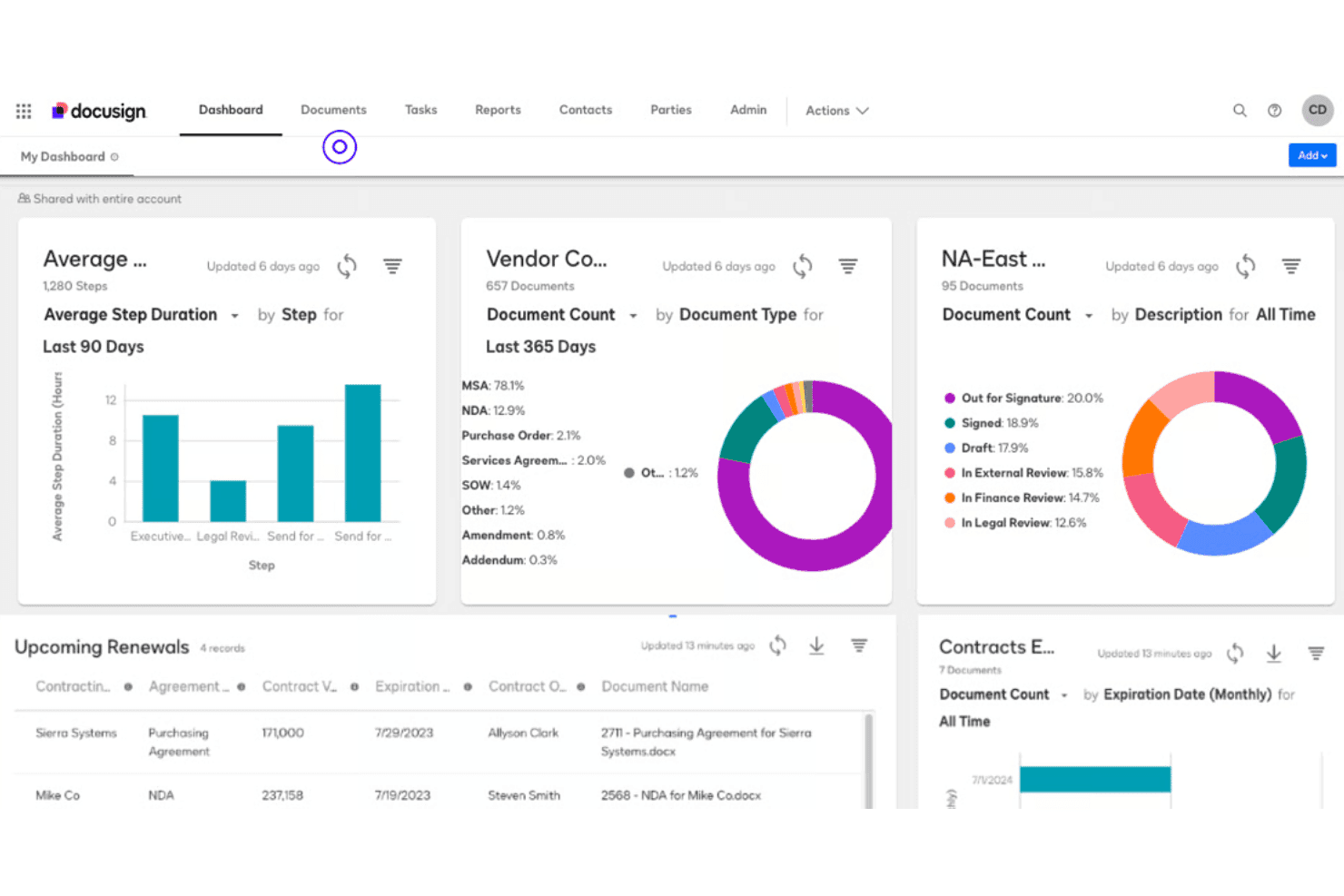
Docusign CLM offers a centralized dashboard with contract analytics, document counts by type, renewal tracking, and step duration metrics. Docusign CLM is an AI-powered contract lifecycle management platform that handles contract creation, negotiation, automated workflows, e-signature, and obligation tracking within a centralized, searchable repository.
Who Is Docusign CLM Best For?
It's a strong fit for mid-market and enterprise legal, finance, and procurement teams that need contract management tightly connected to existing ERP and CRM systems.
Why I Picked Docusign CLM
I've included Docusign CLM in my top picks because the e-signature isn't an add-on; it's native to the platform, which means there's no handoff between contract negotiation and execution. I like how the Iris AI engine runs generative Q&A against contract language and generates risk scorecards, letting my team flag problematic clauses before a document ever goes out for signature. The custom clause playbooks make it easy to define what "acceptable" looks like per contract type.
Docusign CLM Key Features
- Central contract repository: Stores all agreements in a single, searchable location with version control and detailed audit trails.
- Automated workflow editor: Uses a drag-and-drop interface to design contract review, approval, and renewal workflows.
- Salesforce and SAP Ariba integrations: Connects data and contract processes across CRM and procurement systems.
- AI-driven metadata extraction: Identifies and tags terms, dates, and obligations directly from uploaded documents.
Docusign CLM Integrations
Docusign CLM offers native integrations with Salesforce, NetSuite, SAP Ariba, and Microsoft 365. An API is available for custom integrations.
Pros and Cons
Pros:
- Deep audit trails support compliance requirements
- AI risk scoring flags clauses before signing
- Native e-signature built directly into workflows
Cons:
- Workflow configuration demands dedicated admin time
- Implementation timelines stretch into several months
Learn more about Docusign CLM: Best for automated contract analytics workflows
- Free demo available
- Pricing upon request
Visit WebsiteCustomer Rating:4.4/5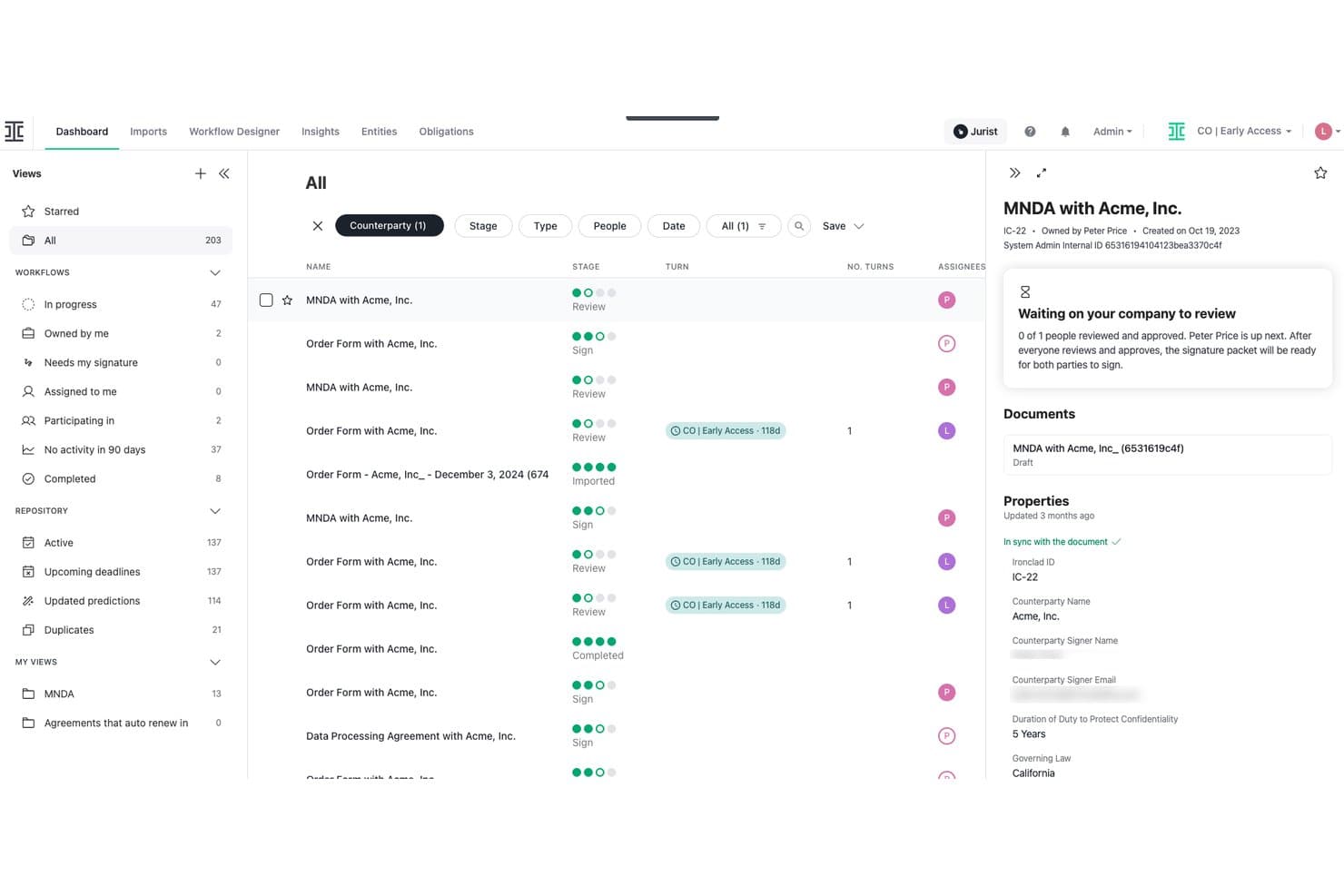
Ironclad offers an AI-powered contract dashboard with workflow tracking, repository management, and automated contract property extraction for CFOs managing agreements. Ironclad is a CLM platform with an AI layer built across the full contract lifecycle—covering drafting, redlining, negotiation, approval routing, e-signature, repository management, and contract analytics.
Who Is Ironclad Best For?
Ironclad is a strong fit for enterprise legal and finance teams managing high contract volumes with complex, multi-stakeholder approval chains.
Why I Picked Ironclad
Ironclad earns its spot on my shortlist because of how its no-code Workflow Designer handles conditional logic at scale. I can build a rule that automatically routes contracts to the CFO whenever indemnity exceeds $1M, with no developer involvement. Jurist, its agentic AI, then flags non-standard clauses and extracts financial obligations into structured, reportable data across every contract in the queue.
Ironclad Key Features
- Smart Import: Use AI to import legacy contracts and auto-tag documents for instant metadata searchability.
- Clause library and negotiation playbooks: Access pre-approved clause language and negotiation fallback positions that guide redlining based on company policy.
- Native e-signature (Ironclad Sign): Execute agreements within the platform using built-in e-signature tools or integrate with DocuSign, Adobe, and more.
- Advanced contract repository: Store every contract in a searchable, version-controlled repository with custom metadata fields and full audit trails.
Ironclad Integrations
Ironclad offers native integrations with NetSuite, SAP, Coupa, Salesforce, Docusign, Adobe Acrobat Sign, Dropbox Sign, Ramp, Zip, Tropic, and Fivetran. An API is available for custom integrations.
Pros and Cons
Pros:
- Scans repositories retroactively for data
- Builds instant visual metric charts
- Auto-extracts metadata via generative AI
Cons:
- Less suited to low-volume, small legal teams
- High custom configuration overhead costs
Learn more about Ironclad: Best for ERP and financial system integration
- Free demo available
- Pricing upon request
Visit WebsiteCustomer Rating:4.3/5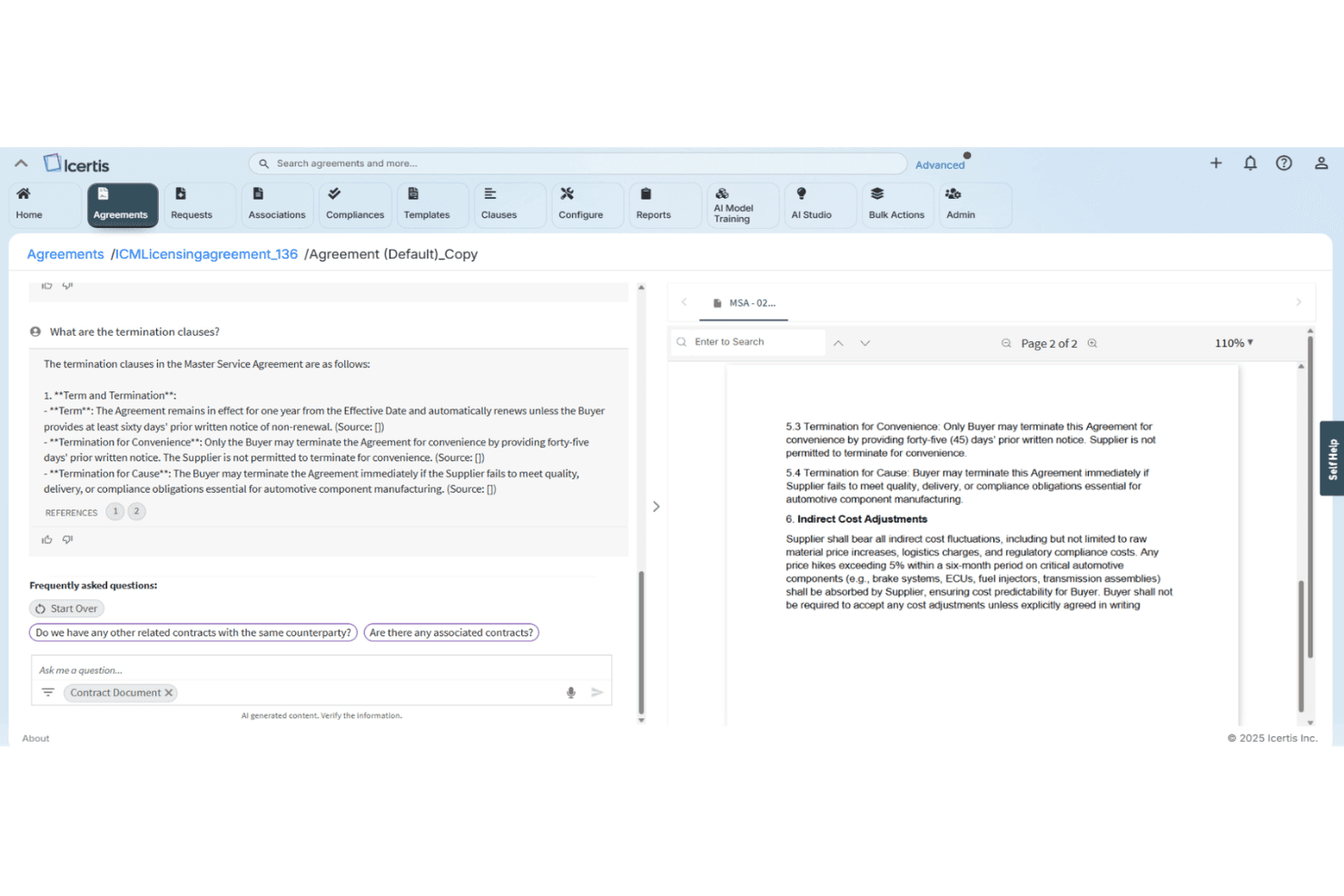
Icertis offers an AI-powered contract intelligence interface that lets users query termination clauses and view referenced contract document sections side by side. Icertis is an AI-native contract lifecycle management platform that handles contract drafting, negotiation, obligation tracking, and portfolio-wide analytics across enterprise procurement, sales, and finance workflows.
Who Is Icertis Best For?
Icertis is built for large enterprises in regulated industries—healthcare, financial services, and manufacturing—that manage high-volume, complex contract portfolios across global operations.
Why I Picked Icertis
Icertis earns its spot on my shortlist because of how deeply it connects contract data to live ERP workflows. The platform's bidirectional SAP connectors sync contract terms directly into S/4HANA and Ariba, so payment milestones, rebates, and supplier obligations don't have to be manually re-entered downstream. I particularly like the Vera Obligations agent, which surfaces active financial commitments and ties them back to the contract record in real time.
Icertis Key Features
- Conversational contract Q&A: Users can query contract data with natural language searches across large repositories.
- Clause library and playbooks: AI-powered clause libraries offer pre-approved templates and negotiation playbooks for faster drafting.
- Third-party paper review: The system ingests and compares counterparty contract language against company-approved playbooks.
- Audit trail and version control: Every contract edit and approval is tracked for compliance and historical reference.
Icertis Integrations
Icertis offers native integrations with SAP S/4HANA, SAP Ariba, Workday, Salesforce, and Microsoft Dynamics 365. An API is available for custom integrations.
Pros and Cons
Pros:
- Flags term deviations using AI
- Direct bi-directional SAP data sync
- Deep AI obligation tracking post-signature
Cons:
- Resource-heavy footprint for mid-sized operations
- Multi-month enterprise deployment timeline
Learn more about Icertis: Best for integration with finance operations
- Free demo available
- Pricing upon request
Visit WebsiteCustomer Rating:4.5/5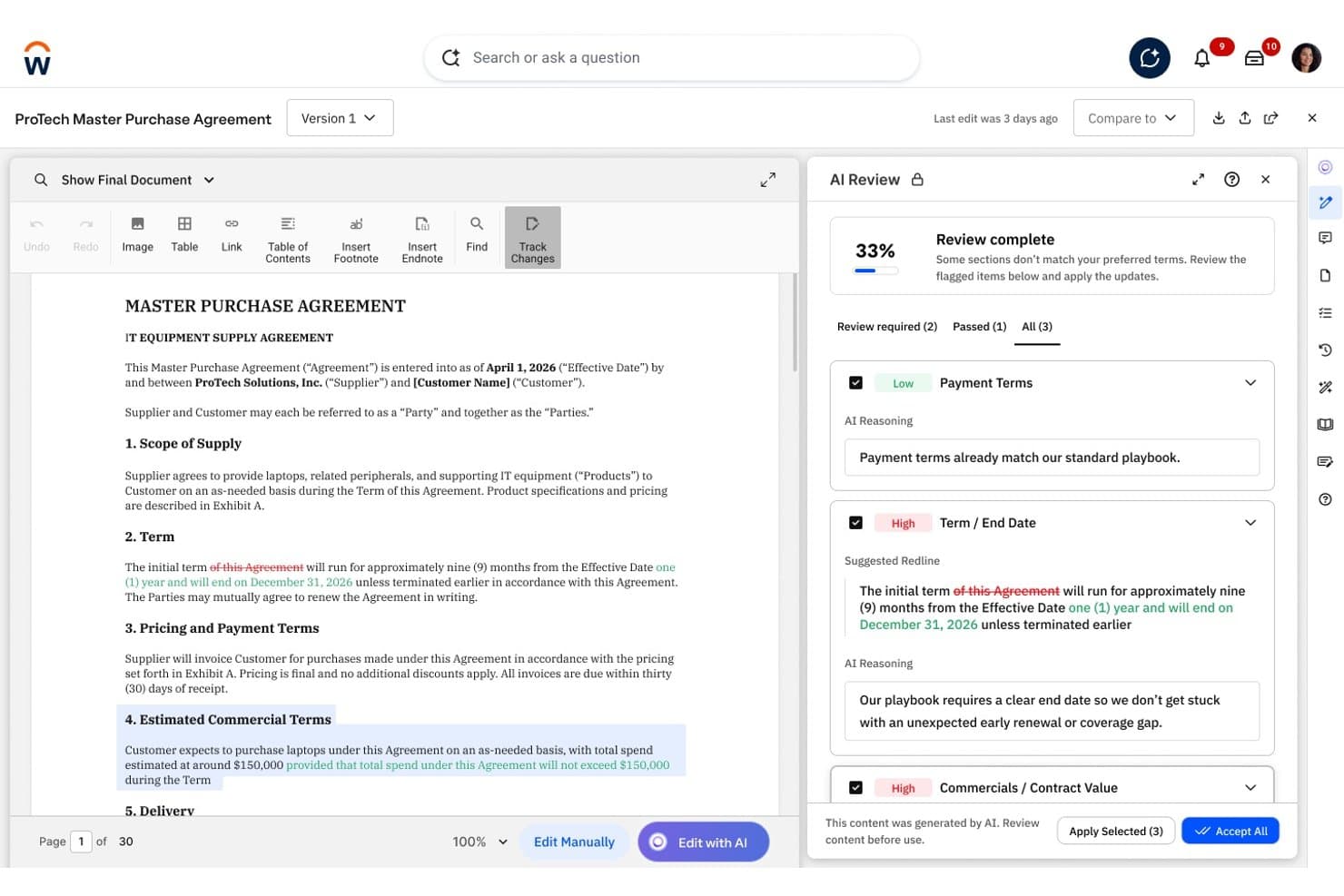
Workday Contract Management offers AI-powered contract review with redlining suggestions, risk scoring, and playbook compliance tracking directly within the document editor. Workday Contract Management is an AI-native CLM platform, powered by Evisort, that covers contract intake, drafting, redlining, approvals, e-signature, and analytics with AI-driven clause extraction and obligation tracking built in.
Who Is Workday Contract Management Best For?
It's a strong fit for enterprise finance and legal professionals already running core operations on the Workday platform.
Why I Picked Workday Contract Management
I've included Workday Contract Management in my top picks because of its native connection to Workday Financial Management. For finance teams already on Workday, contract data flows directly into the systems controllers actually use. The Custom AI Model Library lets finance teams build models to track payment schedules, pricing terms, and renewal triggers from contract text. I also like that "Ask AI" lets controllers query contract obligations in plain language without looping in legal.
Workday Contract Management Key Features
- Clause library and negotiation playbooks: Pre-approved clauses and AI-driven negotiation templates help standardize contract language across different teams.
- Conversational contract Q&A: Natural language search lets users ask questions about contract data and receive clear, cited answers.
- Third-party paper review: AI ingests and normalizes external contracts, flagging risky or missing clauses for legal review.
- Obligation extraction and tracking: Automatically tracks renewal dates, obligations, and SLAs from executed agreements within the main repository.
Workday Contract Management Integrations
Workday Contract Management offers native integrations with Workday Financial Management, Workday Human Capital Management, Salesforce, SAP Ariba, Adobe Sign, Box, and SharePoint. An API is available for custom integrations.
Pros and Cons
Pros:
- Obligation tracking routed to responsible stakeholders
- Custom AI models for finance-specific clauses
- Native sync with Workday financial data
Cons:
- Enterprise-only scope limits smaller team access
- Best value only within the Workday ecosystem
Learn more about Workday Contract Management: 10Best for post-award obligation tracking
Sirion
- Free demo available
- Pricing upon request
Visit WebsiteCustomer Rating:4.5/5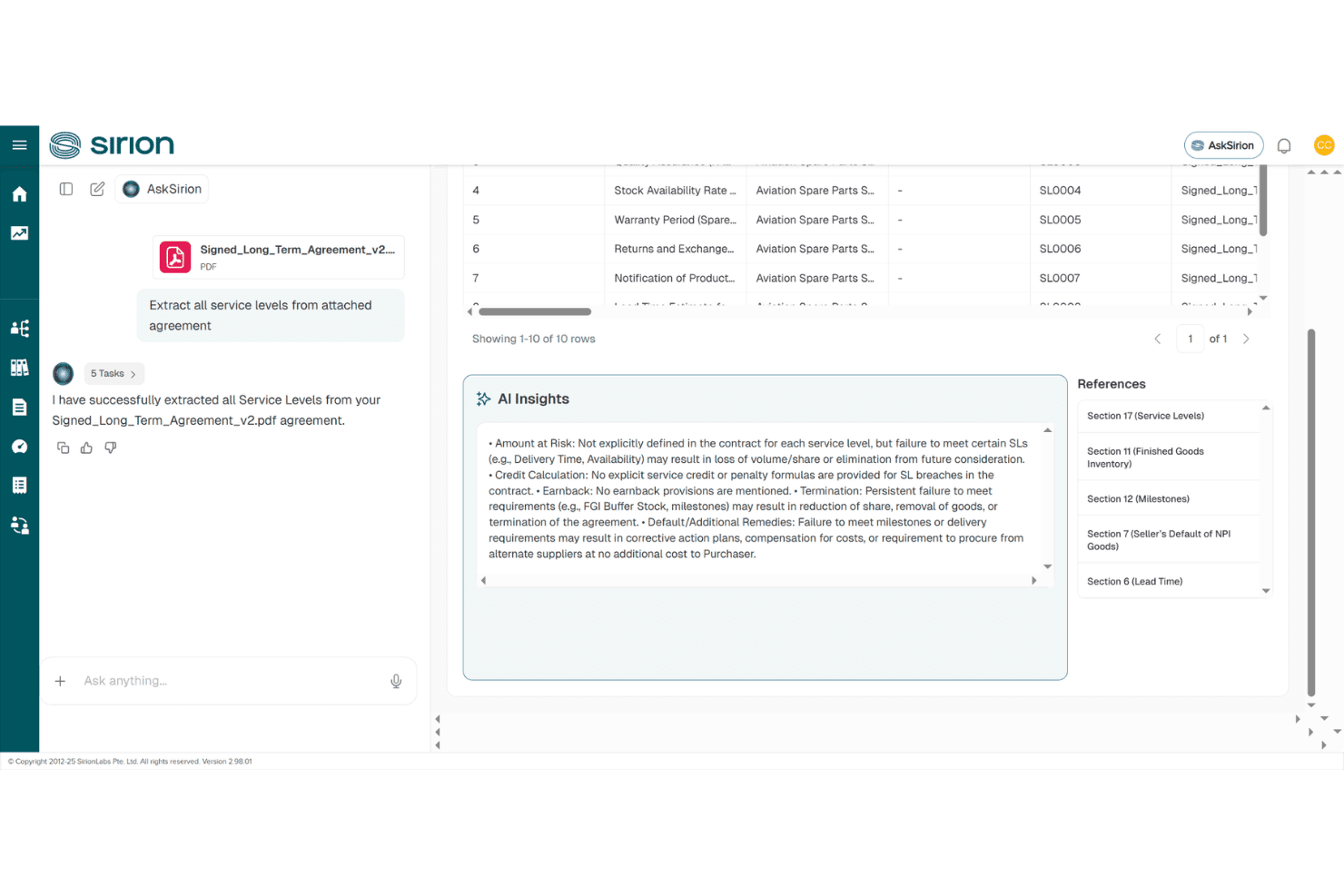
Sirion extracts and analyzes service levels from a long-term agreement, displaying structured data with AI insights and contract references. Sirion is an AI-native contract lifecycle management platform built around agentic AI that handles contract ingestion, drafting, negotiation, obligation monitoring, and performance tracking across the full contract lifecycle.
Who Is Sirion Best For?
Sirion is a strong fit for large enterprises managing high volumes of complex procurement, outsourcing, and vendor contracts across legal, finance, and procurement teams.
Why I Picked Sirion
Sirion earns its spot on my shortlist because of how seriously it treats post-award contract governance. I picked it specifically for its obligation tracking agents, which continuously monitor SLAs, surface compliance gaps, and trigger the right owners without manual follow-up. I also like the Finance solution's dedicated reporting layer, which maps cash-impacting contract terms directly to financial forecasts, so my team can connect vendor commitments to budget impact in real time.
Sirion Key Features
- AI clause extraction and normalization: Agents automatically extract, classify, and organize contract clauses and key financial terms for rapid search and analysis.
- Conversational contract Q&A: Natural language search lets users ask questions across all contracts and receive instant, cited answers.
- Third-party paper review: Sirion ingests and analyzes counterparty contracts, benchmarking deviations and risks against your playbook.
- Clause library and negotiation playbooks: Centralized AI-powered libraries help legal and business teams draft, standardize, and update templates and fallback positions.
Sirion Integrations
Sirion offers native integrations with SAP Ariba, Salesforce, and Oracle. An API is available for custom integrations.
Pros and Cons
Pros:
- Deep contract performance analytics
- AI agents surface SLA breaches early
- Strong post-award obligation monitoring
Cons:
- Substantial compute usage during initial ingestion
- High interface visual density slows navigation
Learn more about Sirion:
Outro software de gestão de contratos com IA
Eis algumas opções adicionais de software de gestão de contratos com IA que não entraram na minha seleção, mas que vale a pena conhecer:
- 11Conga CLMBest for cross-functional workflow automation
- 12AavenirBest for procurement contract lifecycle automation
- 13ConcordBest for unlimited contract collaboration
- 14LeahBest for autonomous contract execution
- 15SummizeBest for instant answers across business tools
- 16ContractSafeBest for fast onboarding with attentive support
- 17MalbekBest for AI-powered commercial insights
- 18PramataBest for contract data accuracy assurance
- 19PandaDocBest for built-in document editing and approvals
- 20LexionBest for email-based contract intake
How I Evaluate AI Contract Management Software
To earn a spot here, a tool needs to deliver genuine AI value—not just surface-level features that don't move the needle for finance teams juggling renewal deadlines and obligation tracking. I split my evaluation into two layers: core functionality every platform must offer to qualify, and the differentiating factors that separate one vendor from another.
Core Functionality (Table Stakes For This List)
When I'm selecting tools for my list, I rank each one on a scale from 0 (does not offer the functionality) to 5 (excels in this area) for each core functionality listed below. Then, I calculate the tool's total score into a percentage. Each tool needs to achieve a minimum total score of 65% to be considered for inclusion.
- AI Clause Extraction: I evaluate how well the AI identifies and pulls out financial terms, payment schedules, and pricing clauses from uploaded contracts without manual tagging.
- Contract Repository: A searchable, centralized repository with metadata tagging and version control makes it easy to locate a specific vendor MSA during an audit cycle.
- Automated Lifecycle Management: I look for full lifecycle coverage—from template creation through renewal alerts—so your team isn't manually tracking expiration dates in spreadsheets.
- AI Risk & Obligation Analysis: The tool should flag non-standard clauses and surface financial obligations, like auto-renewal commitments or SLA penalties, for review before close.
- E-Signature & Approval Workflows: Configurable, role-based approval routing paired with native or integrated e-signature support keeps contracts moving without bottlenecks at sign-off.
- Financial System Integrations: I check for native connectors to ERP, accounting, and procurement systems so contract data syncs directly into your financial workflows.
Once I have a list of tools that meet the criteria, I consider what sets each platform apart.
Differentiating Factors (What Sets Vendors Apart)
Here's how I compare and contrast different vendors:
Standout Features
Obligation extraction and tracking matter most to me—I look for tools that surface renewal dates, SLA milestones, and payment triggers from signed contracts and route alerts to the right stakeholders. Conversational Q&A is another differentiator, letting finance users ask plain-language questions like "Which vendors have price escalation clauses?" without searching manually. I also evaluate third-party paper review, where the platform ingests inbound vendor contracts and flags missing provisions or risky deviations from your playbook.
Beyond Features
Security and AI governance policies are high on my list—I check for SOC 2 Type II certification and whether the vendor uses your contract data to train shared models or offers private instances. Deployment scope also matters because some platforms excel at high-volume procurement contracts while others are built for bespoke enterprise deals. Implementation timelines vary widely across this category, so I evaluate whether a vendor provides migration services for legacy repositories and dedicated support for cross-functional rollout to finance, procurement, and legal teams.
Como escolher um software de gestão de contratos com IA
É fácil perder-se em listas extensas de funcionalidades e estruturas de preços complexas. Para o ajudar a manter o foco enquanto analisa o seu processo específico de seleção de software, apresentamos uma lista de verificação dos fatores a ter em conta:
| Fator | O que considerar |
|---|---|
| FatorEscalabilidade | O que considerarA plataforma suportará o volume dos seus contratos e as alterações aos processos à medida que cresce — sem renegociações frequentes do plano? |
| FatorIntegrações | O que considerarSincroniza os dados dos contratos com as suas ferramentas de ERP, contabilidade, aprovisionamento e CRM para suportar fluxos de trabalho completos? |
| FatorPersonalização | O que considerarPode adaptar os fluxos de aprovação, as bibliotecas de cláusulas ou os relatórios às estruturas e políticas específicas da sua organização? |
| FatorFacilidade de utilização | O que considerarAs equipas de finanças, jurídica e aprovisionamento adotarão rapidamente a ferramenta sem formação extensa ou soluções alternativas? |
| FatorImplementação e integração inicial | O que considerarQue nível de apoio, assistência na migração e orientação de configuração fornece o fornecedor — especialmente para dados antigos? |
| FatorMedidas de segurança | O que considerarA residência dos dados, os registos de auditoria, a encriptação e os controlos de permissões estão alinhados com os padrões de risco da sua empresa? |
| FatorCusto | O que considerarPara além das taxas de licenciamento, o que afeta o seu custo total — suplementos, volume de contratos, integrações ou níveis de suporte premium? |
| FatorRequisitos de conformidade | O que considerarA plataforma ajudará a manter registos de auditoria, automatizar relatórios e cumprir as obrigações regulamentares do seu setor? |
O que é um software de gestão de contratos com IA?
O software de gestão de contratos com IA utiliza inteligência artificial para o ajudar a criar, rever, armazenar e acompanhar contratos durante todo o seu ciclo de vida. Estas plataformas automatizam a extração de cláusulas, sinalizam riscos, gerem renovações e centralizam os acordos num repositório pesquisável, permitindo que as equipas de finanças, aprovisionamento e jurídica reduzam o trabalho manual e reforcem a conformidade com os requisitos internos e regulamentares.
Funcionalidades
Ao selecionar um sistema de gestão de contratos com IA, esteja atento às seguintes funcionalidades essenciais:
- Extração de cláusulas com IA: Identifica e extrai automaticamente termos, obrigações e datas importantes dos contratos, reduzindo a necessidade de revisão e introdução de dados manuais.
- Repositório centralizado de contratos: Armazena todos os acordos num local seguro e pesquisável, com controlo de versões, facilitando o acesso ao histórico dos contratos e o acompanhamento das alterações.
- Fluxos de aprovação automatizados: Encaminha os contratos para revisão e assinatura com base em funções e regras personalizadas, simplificando o processo e minimizando os estrangulamentos.
- Integração de assinaturas eletrónicas: Permite assinaturas digitais juridicamente vinculativas na plataforma ou através de fornecedores de assinaturas eletrónicas ligados, para que os acordos possam ser executados de forma rápida e segura.
- Acompanhamento de riscos e obrigações: Assinala cláusulas não normalizadas, prazos de renovação e riscos de conformidade, ajudando as equipas a evitar obrigações não cumpridas e falhas dispendiosas.
- Modelos e bibliotecas de cláusulas configuráveis: Disponibiliza linguagem e opções de cláusulas pré-aprovadas para garantir a consistência e acelerar a redação e a negociação de contratos.
- Alertas de renovação e expiração: Envia lembretes proativos sobre próximas renovações, rescisões ou marcos críticos, para que nada fique por tratar.
- Rastos de auditoria: Regista todas as alterações e ações, apoiando as verificações de conformidade, a resolução de litígios e os requisitos de auditoria.
- Integrações com sistemas ERP e financeiros: Sincroniza diretamente os dados dos contratos com plataformas de contabilidade, compras ou ERP, para obter relatórios rigorosos e reconhecer as receitas corretamente.
- Pesquisa conversacional de contratos: Permite aos utilizadores consultar o repositório em linguagem corrente para encontrar instantaneamente cláusulas, termos e tipos de contratos específicos quando necessário.
Benefícios
A implementação de inteligência contratual proporciona vários benefícios à sua equipa e à sua empresa. Eis alguns dos benefícios que pode esperar:
- Maior rapidez na conclusão dos contratos: A extração automatizada de cláusulas, a revisão de alterações com IA e os fluxos de trabalho baseados em funções fazem avançar os contratos pelas fases de revisão e aprovação a um ritmo muito mais rápido.
- Maior precisão: A extração de dados orientada por IA e o acompanhamento das obrigações reduzem os erros de introdução manual e garantem que os termos e prazos importantes não são esquecidos.
- Conformidade melhorada: Os registos de auditoria sistemáticos, os modelos normalizados e a análise de contratos integrada ajudam as equipas a manter a conformidade com os regulamentos e as políticas internas.
- Informações contratuais acionáveis: Os repositórios centralizados e as ferramentas de perguntas e respostas em linguagem corrente proporcionam uma visão em tempo real dos riscos contratuais, das obrigações e das datas de renovação.
- Colaboração mais eficaz entre equipas: O acesso baseado na nuvem, o controlo de versões e as funcionalidades integradas de assinatura eletrónica mantêm as equipas jurídica, financeira e de compras alinhadas ao longo de todo o ciclo de vida do contrato.
- Maior visibilidade financeira: As integrações com sistemas ERP e financeiros sincronizam os dados dos contratos com os seus fluxos de trabalho contabilísticos, apoiando previsões rigorosas e a gestão das despesas.
- Menor tempo de preparação para auditorias: Os registos de auditoria e os repositórios pesquisáveis facilitam a obtenção da documentação e a resposta rápida aos pedidos de auditoria.
Custos e preços
A seleção de software de gestão de contratos com IA exige uma compreensão dos vários modelos de preços e planos disponíveis. Os custos variam consoante as funcionalidades, o tamanho da equipa, os complementos, entre outros fatores. A tabela abaixo resume os planos comuns, os respetivos preços médios e as funcionalidades normalmente incluídas nas soluções de software de gestão de contratos com IA:
Tabela de comparação de planos
| Tipo de plano | Preço médio | Funcionalidades comuns |
|---|---|---|
| Tipo de planoPlano gratuito | Preço médio$0 | Funcionalidades comunsArmazenamento limitado, pesquisa básica de cláusulas, repositório simples de contratos e apoio por e-mail. |
| Tipo de planoPlano pessoal | Preço médio$20-$40/utilizador/mês | Funcionalidades comunsRepositório normalizado, automatização de fluxos de trabalho para um único utilizador, relatórios básicos e controlo de versões de documentos. |
| Tipo de planoPlano empresarial | Preço médio$40-$100/utilizador/mês | Funcionalidades comunsFluxos de trabalho multiutilizador, extração de cláusulas com IA, integração de assinaturas eletrónicas, sinalização de riscos e integrações ERP normalizadas. |
| Tipo de planoPlano empresarial avançado | Preço médio$100-$250/utilizador/mês | Funcionalidades comunsAnálises avançadas com IA, manuais personalizados, controlos de SSO/segurança, apoio premium e integrações personalizadas. |
Perguntas frequentes sobre software de gestão de contratos com IA
Eis algumas respostas a perguntas comuns sobre software de gestão de contratos com IA:
Como é que o software de gestão de contratos com IA ajuda na conformidade?
O software de gestão de contratos com IA automatiza a conformidade ao uniformizar modelos, assinalar cláusulas arriscadas ou não normalizadas e garantir que todas as ações relacionadas com contratos ficam registadas para efeitos de auditoria. Isto minimiza a supervisão manual e ajuda as equipas a manterem-se alinhadas com as diretrizes internas e regulamentares.
Estas plataformas podem integrar-se com ferramentas financeiras e sistemas ERP existentes?
Sim, a maioria das plataformas de gestão de contratos com IA oferece integrações com sistemas ERP, de contabilidade, aprovisionamento e CRM. Isto garante que os dados dos contratos são sincronizados com as principais plataformas da empresa, apoiando processos rigorosos de elaboração de relatórios, faturação e gestão de despesas.
O que devem as equipas de finanças e aprovisionamento procurar num repositório de contratos?
Procure um repositório pesquisável, compatível com metadados detalhados e que inclua controlo de versões de documentos. Estas funcionalidades permitem localizar rapidamente os acordos, compreender o histórico de alterações e disponibilizar dados para relatórios ou auditorias sem trabalho manual adicional.
Como é que a IA trata contratos de terceiros ou documentos de contrapartes?
As ferramentas de gestão de contratos com IA podem importar documentação de terceiros, extrair cláusulas relevantes e comparar a linguagem com os seus manuais de referência. Isto facilita a análise de riscos e a identificação de disposições em falta ou de termos que não estejam alinhados com as normas da sua empresa.
Que salvaguardas de segurança estão normalmente incluídas?
Os fornecedores disponibilizam normalmente encriptação de dados em repouso e em trânsito, controlos de acesso baseados em funções, registos de auditoria e certificações de conformidade, como SOC 2 Tipo II ou ISO 27001. Confirme sempre as opções de localização dos dados da plataforma e as políticas de governação da IA, de modo a corresponderem ao perfil de risco da sua organização.