

O software de gestão de contratos empresariais foi concebido para ajudar as empresas a criar, negociar, executar e monitorizar contratos complexos em grande escala. Se está a avaliar estas ferramentas, é provável que esteja a lidar com processos fragmentados, riscos de conformidade e a dificuldade de coordenar várias equipas. Escolher a solução certa é importante — a exposição da sua organização, a preparação para auditorias e a rapidez dos ciclos estão em jogo. Este guia centra-se no que as principais opções oferecem e no que deve procurar, para que possa escolher com confiança uma solução adequada às suas necessidades e minimizar os riscos.
Why Trust Our Software Recommendations
6,700+
Reviews
20
Industry experts
16+
Evaluation factors
14
Years
Our team has been testing and reviewing software since 2012. As finance leaders ourselves, we know how difficult—and important—it is to choose the right software.
For this guide, we evaluated tools using hands-on testing and independent research, scoring tools using our selection criteria.
Our reviews reflect our human editorial judgment, not a sales pitch.
Tabela comparativa de software de gestão de contratos empresariais
Esta tabela comparativa resume os detalhes dos preços das minhas principais escolhas de software de gestão de contratos empresariais.
Sorted by: Default
| Tool | Starting Price | Website | |
|---|---|---|---|
Best for portfolio-wide contract reporting | 4.7 out of 5 | Pricing upon request Free demo available | Website |
Best for AI discovery across contract repositories | 4.5 out of 5 | Pricing upon request Free demo available | Website |
Best for AI contract performance management | 4.5 out of 5 | Pricing upon request Free demo available | Website |
Best for cross-functional contract collaboration | 4.5 out of 5 | Pricing upon request Free demo available | Website |
Best for playbook-driven contract redlining | 4.5 out of 5 | Pricing upon request Free demo available | Website |
Best for CLM with integrated e-signatures | 4.7 out of 5 | Pricing upon request Free demo available | Website |
Best for highly configurable contract processes | 4.7 out of 5 | Pricing upon request Free demo available | Website |
Best for workflow automation with self-serve tools | 4.4 out of 5 | Pricing upon request Free demo available | Website |
Best for enterprise-wide obligation intelligence | 4.3 out of 5 | Pricing upon request Free demo available | Website |
Best for revenue-focused contract management | 4.3 out of 5 | Pricing upon request Free demo available | Website |


Avaliações do melhor software de gestão de contratos empresariais
Apresento abaixo os meus resumos detalhados do melhor software de gestão de contratos empresariais que entrou na minha lista restrita. As minhas avaliações oferecem uma análise detalhada das funcionalidades, integrações e melhores casos de utilização de cada plataforma, para o ajudar a encontrar a melhor opção para si.
 Best for portfolio-wide contract reporting
- Free demo available
- Pricing upon request
Visit WebsiteCustomer Rating:4.7/5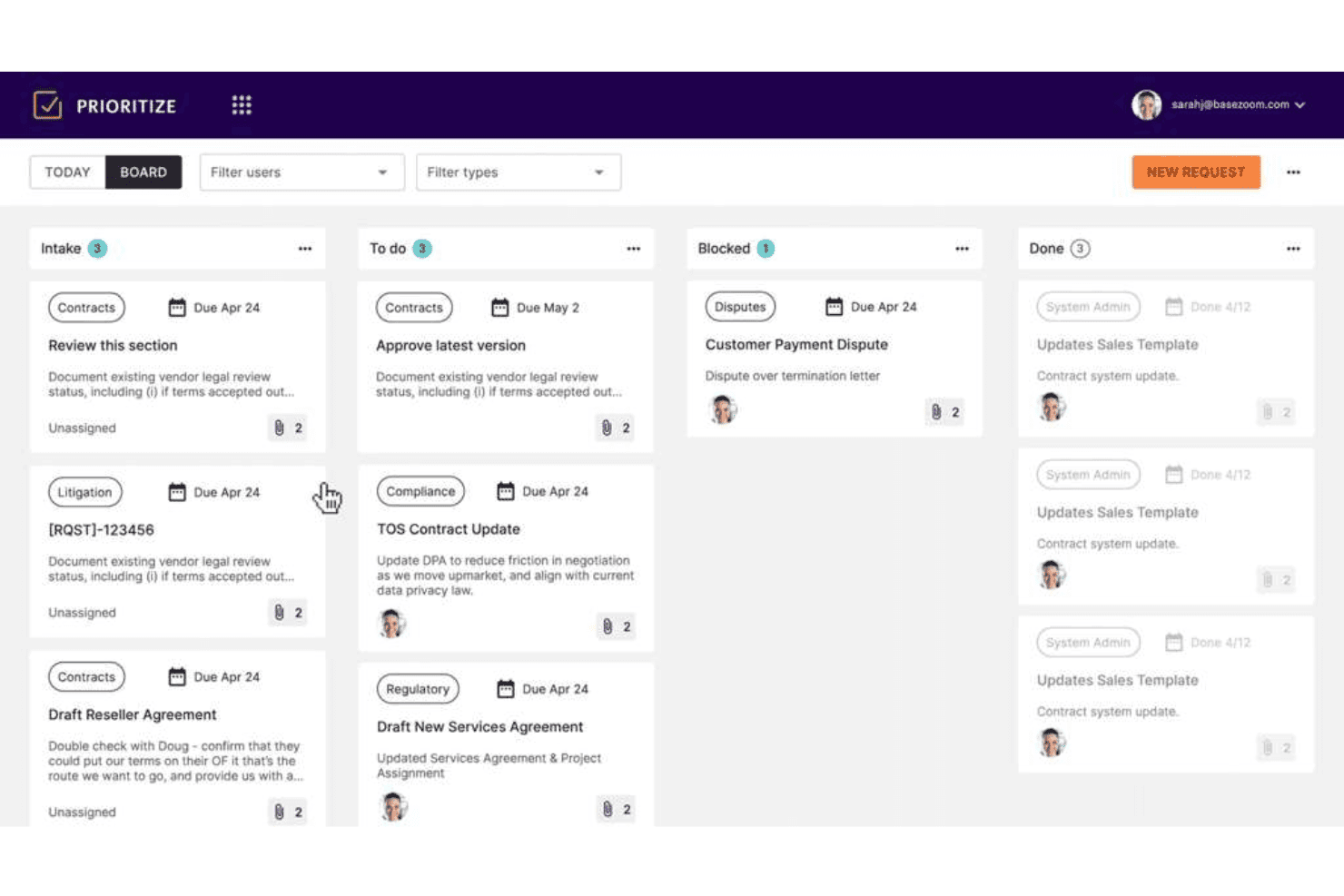
LinkSquares uses a kanban-style Prioritize board to manage legal requests across Intake, To Do, Blocked, and Done stages. LinkSquares is an AI-powered contract lifecycle management platform that covers pre- and post-signature workflows, including drafting, clause management, approval routing, obligation tracking, and portfolio-wide contract analytics.
Who Is LinkSquares Best For?
LinkSquares is a strong fit for mid-market to enterprise organizations with high contract volumes that need legal and finance teams working from a single source of contract data.
Why I Picked LinkSquares
LinkSquares earns its spot on my shortlist because of how it turns contracts into structured, reportable data. Its LinkAI engine auto-extracts 75+ data points from every agreement, including financial obligations, key dates, and renewal terms. I like that you can query and report across an entire contract portfolio at once, and the data export feature makes it straightforward to pipe that output directly into finance reporting workflows.
LinkSquares Key Features
- Contract playbooks and clause library: Store and manage pre-approved language, fallback clauses, and negotiation guidance in one workspace.
- Centralized legal project management: Track, assign, and prioritize internal contract-related requests across legal and finance teams.
- Microsoft Word add-in for AI redlining: Edit, redline, and apply company playbook rules directly within Word using AI suggestions.
- Automated renewal notification system: Schedule and customize alerts for upcoming contract expirations, auto-renewals, and key milestone dates.
LinkSquares Integrations
Native integrations include Salesforce, DocuSign, Adobe Sign, Microsoft Word, SharePoint, Slack, and Ramp Procurement. An open API is available for custom integrations.
Pros and Cons
Pros:
- Covers both pre- and post-signature workflows
- Portfolio-wide contract analytics with exportable dashboards
- AI extracts 75+ data points automatically
Cons:
- Customizing reports requires help from support teams
- Long enterprise implementation and onboarding timeline
Learn more about LinkSquares: Best for AI discovery across contract repositories
- Free demo available
- Pricing upon request
Visit WebsiteCustomer Rating:4.5/5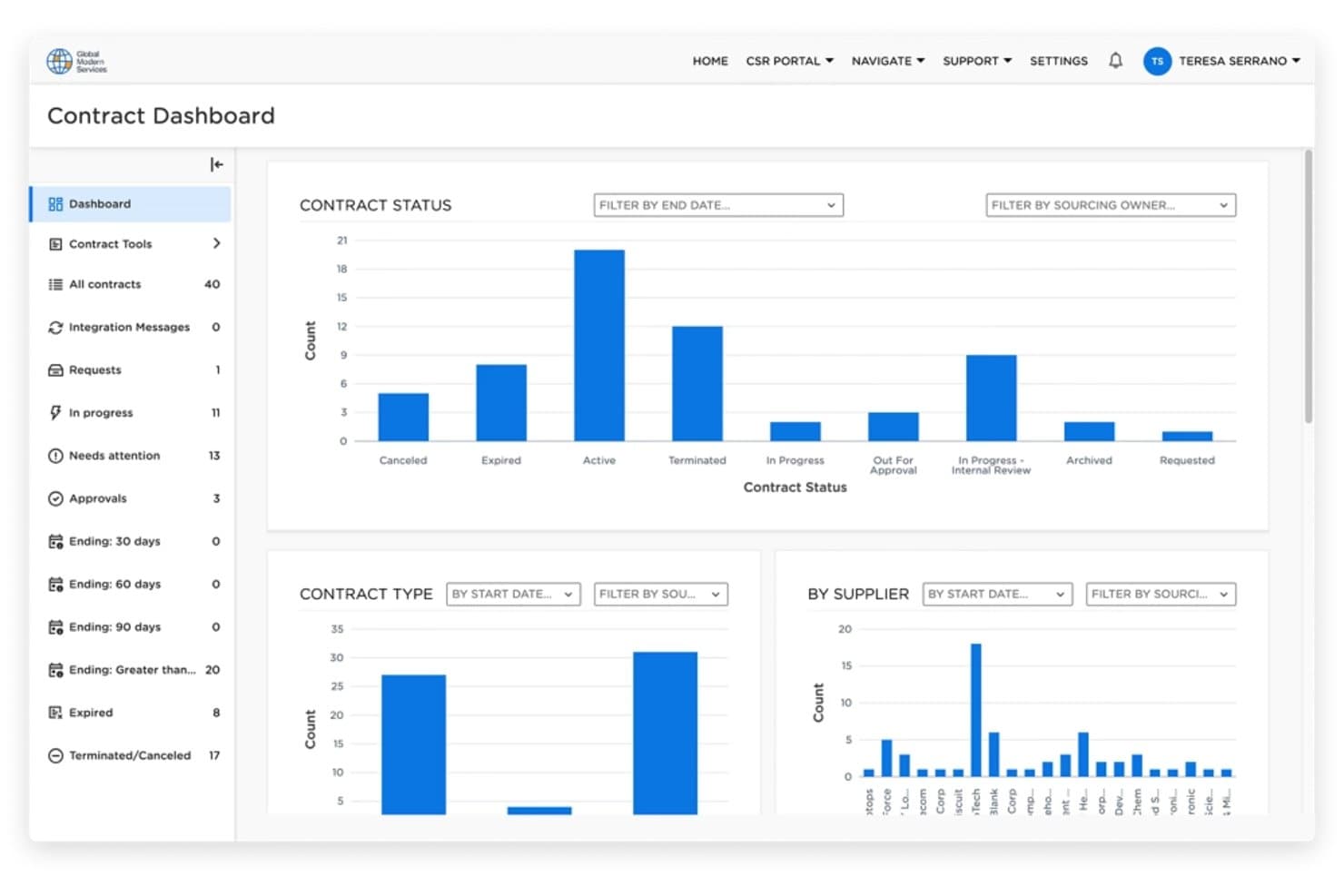
Workday Contract Management includes contract status tracking, contract type breakdowns, and supplier views for enterprise-level contract oversight. Workday Contract Management is an AI-native CLM platform that combines a unified contract repository, end-to-end lifecycle automation, financial obligation tracking, and AI-powered clause extraction across enterprise contract portfolios.
Who Is Workday Contract Management Best For?
It's a strong fit for large enterprises that already run Workday Financials and need CLM capabilities managed within the same finance ecosystem.
Why I Picked Workday Contract Management
Workday Contract Management earns its spot on my shortlist because of how it handles AI discovery across existing contract repositories. I love that it syncs with SharePoint, Box, Salesforce, and even other CLM platforms, then applies OCR+AI to ingest and analyze up to 450,000 documents in 24 hours. The natural-language "Ask AI" search lets my team query the entire contract portfolio in plain English and get sourced, cited answers instantly, without rebuilding the repository from scratch.
Workday Contract Management Key Features
- Custom AI model library: Build and reuse department-specific AI models for tracking complex data points across contracts.
- No-code workflow automation: Configure approval processes, routing, and dashboards without technical skills required.
- Financial obligation extraction: Automatically capture payment schedules, pricing, and milestones from new and legacy contracts.
- Role-based permissions: Manage granular access controls across business units, subsidiaries, and user roles for enterprise governance.
Workday Contract Management Integrations
Workday Contract Management offers native integrations with Workday Financial Management, DocuSign, Adobe Sign, Salesforce, Box, SharePoint, and Google Drive. An API is available for custom integrations.
Pros and Cons
Pros:
- Built-in SOX and ASC 606 compliance controls
- Natural language contract search across entire portfolio
- OCR-powered mass ingestion of legacy contract portfolios
Cons:
- Implementation can take months for large enterprises
- Requires Workday ecosystem for full functionality
Learn more about Workday Contract Management: Best for AI contract performance management
- Free demo available
- Pricing upon request
Visit WebsiteCustomer Rating:4.5/5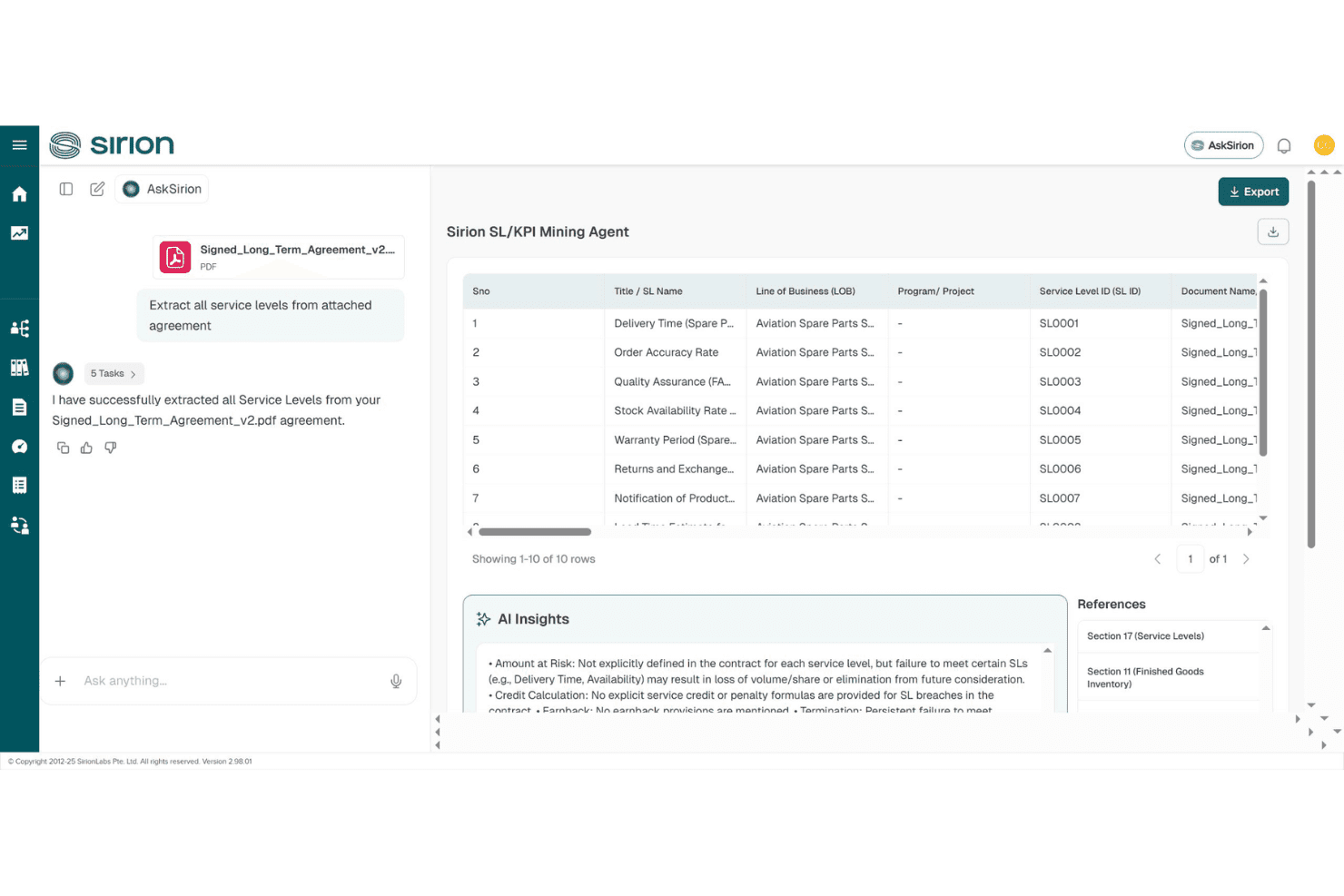
Sirion's AskSirion AI assistant automatically extracts and organizes service levels from contracts using its SL/KPI Mining Agent. Sirion is an AI-native contract lifecycle management platform that uses purpose-built AI agents to handle contract storage, drafting, negotiation, obligation tracking, and invoice reconciliation across enterprise-scale portfolios.
Who Is Sirion Best For?
Sirion is built for large enterprises managing high-volume, complex contract portfolios across legal, procurement, finance, and supplier management functions.
Why I Picked Sirion
Sirion earns its spot on my shortlist because of how its AI agents handle post-signature contract performance. The Obligations Agent automatically tracks contractual commitments, flags at-risk obligations in real time, and triggers escalations before performance gaps become costly. Paired with the Invoice Agent, which reconciles invoices directly against contract terms, I can identify value leakage at the line level rather than discovering it in a quarterly review.
Sirion Key Features
- Centralized contract repository: Collects and organizes executed contracts with metadata, versioning, and granular access controls.
- Configurable workflow automation: Lets you set up customizable drafting, approval, and routing workflows for different contract types.
- Integration studio: Offers no-code connectors for syncing contract data with ERP, CRM, and procurement systems.
- Clause library and playbook agent: Stores pre-approved clauses and transforms internal policies into smart templates for contract drafting.
Sirion Integrations
Sirion offers native integrations with Salesforce, SAP, Oracle, Workday, Microsoft 365, and Slack. An open API and the Sirion Integration Studio let you build custom connections to over 1,000 applications.
Pros and Cons
Pros:
- Scales to millions of contracts natively
- Contract analytics give portfolio-wide performance visibility
- AI agents automate post-execution obligation tracking
Cons:
- Workflow configuration requires substantial upfront effort
- Implementation typically takes several months
Learn more about Sirion: Best for cross-functional contract collaboration
- Free demo available
- Pricing upon request
Visit WebsiteCustomer Rating:4.5/5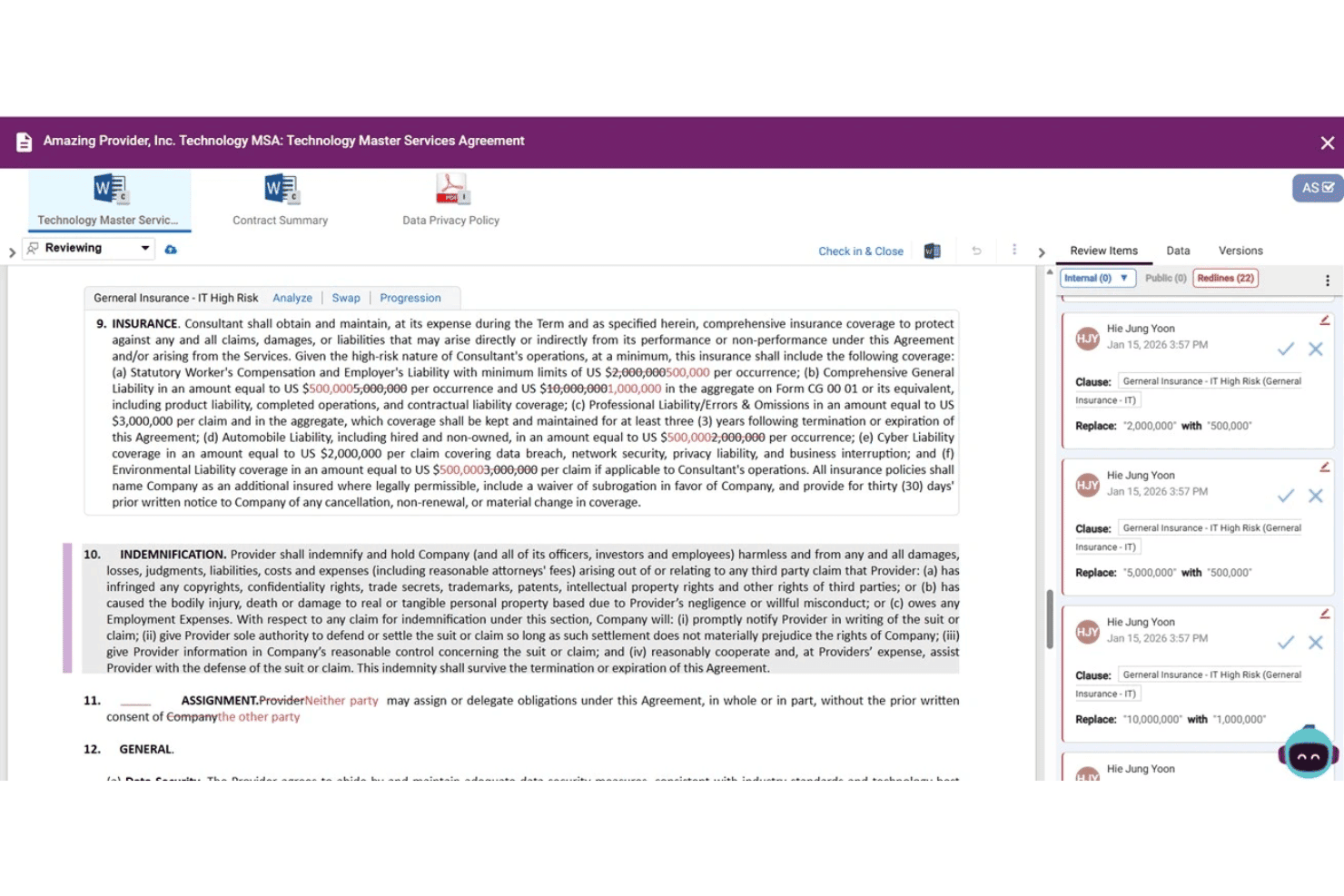
Malbek enables legal teams to review and redline contract insurance clauses with tracked changes and inline comments directly in the contract editor. Malbek is an AI-native contract lifecycle management platform that combines contract authoring, workflow automation, clause analysis, obligation tracking, and cross-functional commercial intelligence for legal, finance, sales, and procurement teams.
Who Is Malbek Best For?
Malbek is a strong fit for enterprise organizations where legal, finance, and procurement teams need a shared contracting process with centralized visibility.
Why I Picked Malbek
I picked Malbek as one of the best because its no-code workflow engine lets legal, finance, sales, and procurement teams move through creation, approval, and negotiation in one shared environment. I also rely on BusinessIQ to pull revenue, risk, and renewal exposure from the contract repository into dashboards the CFO and CPO can act on. On top of that, Bek, the conversational AI assistant, lets any stakeholder query contract data mid-cycle without pulling in a legal analyst.
Malbek Key Features
- Centralized contract repository: Store, search, and control access to all executed contracts with full metadata and version history.
- Advanced workflow automation: Build conditional, multi-step contract approval processes without IT involvement.
- ERP and CRM integrations: Connect natively with Salesforce, SAP, NetSuite, Coupa, and other core enterprise systems.
- Configurable clause library: Maintain a library of pre-approved clauses with version control for consistent legal language.
Malbek Integrations
Malbek offers native integrations with Salesforce, SAP, NetSuite, Oracle, Microsoft Dynamics 365, Coupa, DocuSign, Adobe Sign, OneTrust, and Slack. An API is available for custom integrations.
Pros and Cons
Pros:
- Fast implementation timeline, often live within weeks
- MS Word add-in is cumbersome and disrupts document authoring
- Negotiation cycle time tracking across all contract stages
Cons:
- Amendment workflow supports only one draft at a time
- Native reporting requires external BI tools for deeper analysis
Learn more about Malbek: 5Best for playbook-driven contract redlining
Leah
- Free demo available
- Pricing upon request
Visit WebsiteCustomer Rating:4.5/5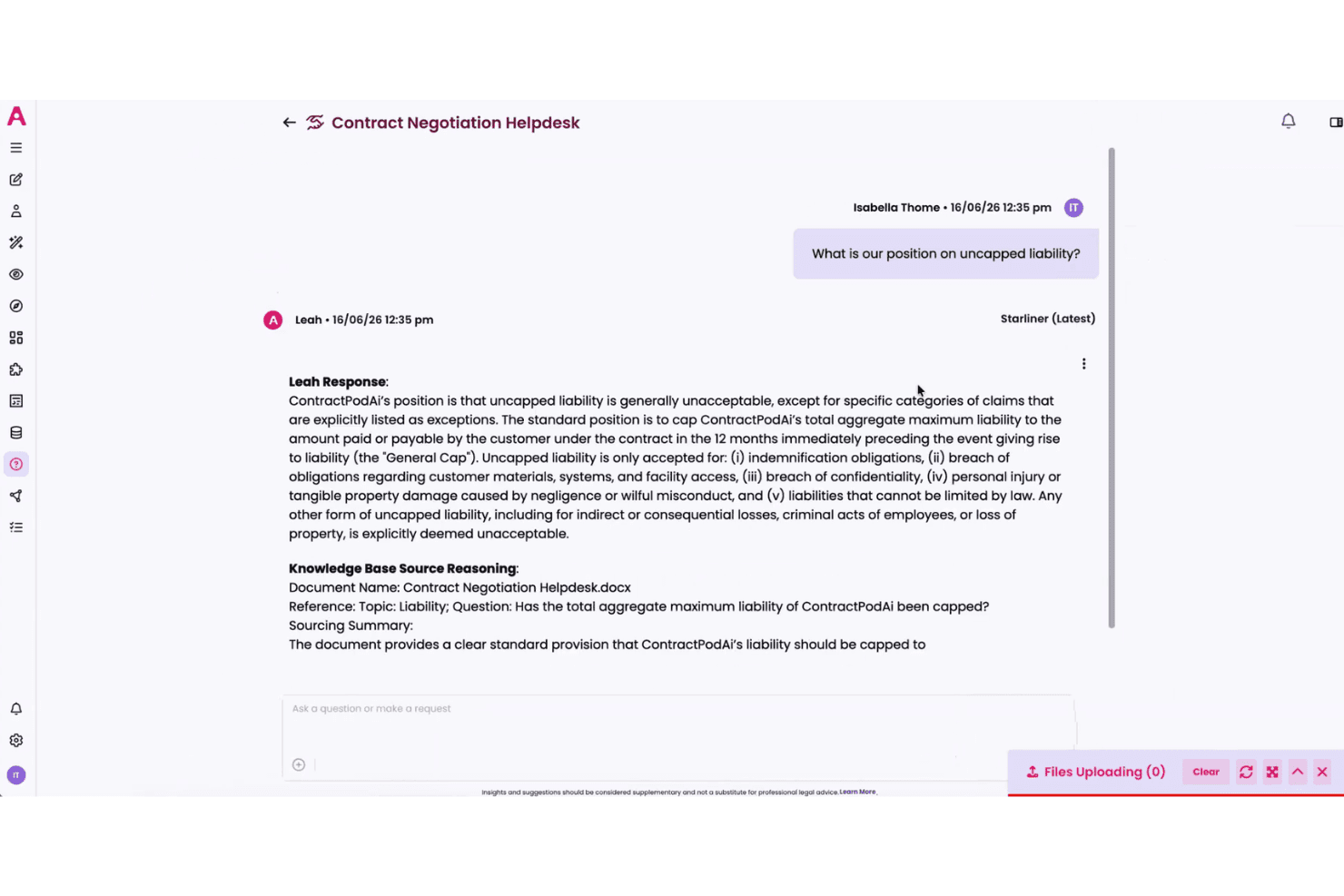
Leah, ContractPodAi's AI assistant, provides a detailed position on uncapped liability exceptions within the Contract Negotiation Helpdesk. Leah is an agentic enterprise CLM platform that combines contract creation, playbook-driven review and negotiation, conditional approval routing, obligation tracking, and CFO-specific financial dashboards in a single system.
Who Is Leah Best For?
Leah is a strong fit for Fortune 500 legal, finance, and procurement teams that manage high volumes of complex contracts across regulated industries.
Why I Picked Leah
Leah earns its spot on my shortlist because of how it handles contract redlining at enterprise scale. I particularly like how the Word Add-in applies your negotiating playbooks directly inside Microsoft Word, keeping reviewers anchored to preferred positions on every deal. The "Ask Leah" feature layers in-document AI guidance on top of that, and prior deal intelligence lets my team reference how similar clauses were resolved in past contracts.
Leah Key Features
- Smart repository: Stores all contracts with advanced search, metadata tagging, and granular role-based access controls.
- Obligation tracking dashboards: Surfaces milestones, renewal dates, and payment schedules in customizable executive dashboards.
- ERP and financial integrations: Connects directly with SAP, NetSuite, Oracle, Coupa, and other core enterprise systems.
- Configurable clause library: Centralizes pre-approved legal language for consistent use across all agreements.
Leah Integrations
Leah offers native integrations with SAP, NetSuite, Oracle, Workday, Coupa, iValua, Salesforce, Microsoft 365, DocuSign, Adobe Sign, and ServiceNow. An open API is also available for custom integrations.
Pros and Cons
Pros:
- AI obligation extraction across large contract volumes
- Highly configurable workflows and admin controls
- Playbook enforcement anchors reviewers on every deal
Cons:
- Misconfigured workflows can't be overridden without backend access
- Implementation process requires heavy customer involvement
Learn more about Leah: Best for CLM with integrated e-signatures
- Free demo available
- Pricing upon request
Visit WebsiteCustomer Rating:4.7/5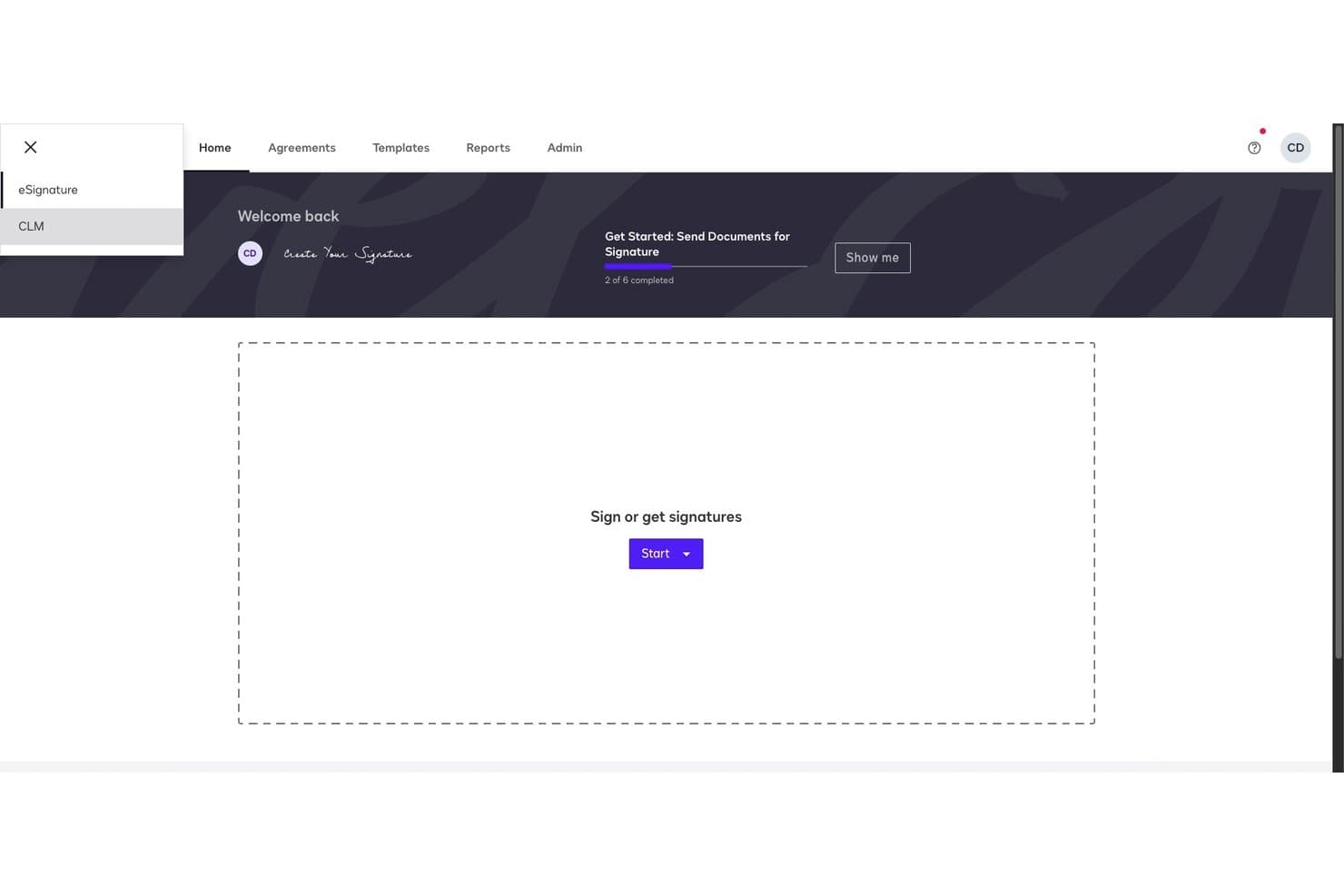
Docusign CLM includes a home dashboard with eSignature and CLM product switching, a getting-started progress tracker, and a 'Sign or get signatures' action area. Docusign CLM is an enterprise contract lifecycle management platform that combines AI-powered contract creation, automated approval workflows, clause library management, obligation tracking, and a centralized repository with native e-signature execution.
Who Is Docusign CLM Best For?
It's a strong fit for large enterprises that already operate within the Docusign ecosystem and need full contract lifecycle control beyond e-signature.
Why I Picked Docusign CLM
Docusign CLM earns its spot on my shortlist because the e-signature step isn't an integration — it's native to the platform. I like that approval workflows can be configured to route contracts directly into signature execution based on deal value thresholds, so there's no handoff between systems at the most critical stage. The Iris AI engine also adds real value here, extracting clause-level data and risk scores before a contract ever reaches the signing stage.
Docusign CLM Key Features
- Centralized contract repository: Store, organize, and search executed contracts with metadata, version history, and granular role-based access.
- Obligation management: Track contract commitments, milestones, renewal dates, and SLA deadlines with built-in alerts for stakeholders.
- Advanced workflow automation: Build automated, no-code workflows with conditional logic for contract creation, negotiation, and renewals.
- ERP and procurement integrations: Connect natively with SAP Ariba, Coupa, and Salesforce to sync contract data with critical financial systems.
Docusign CLM Integrations
Docusign CLM offers native integrations with Salesforce, SAP Ariba, Coupa, Microsoft 365, and Oracle. An API is available for custom integrations.
Pros and Cons
Pros:
- Audit trails support SOX compliance requirements
- AI clause extraction across large contract portfolios
- Native e-signature execution within the same platform
Cons:
- Workflow configuration requires significant admin time
- Implementation complexity for non-Docusign environments
Learn more about Docusign CLM: Best for highly configurable contract processes
- Free demo available
- Pricing upon request
Visit WebsiteCustomer Rating:4.7/5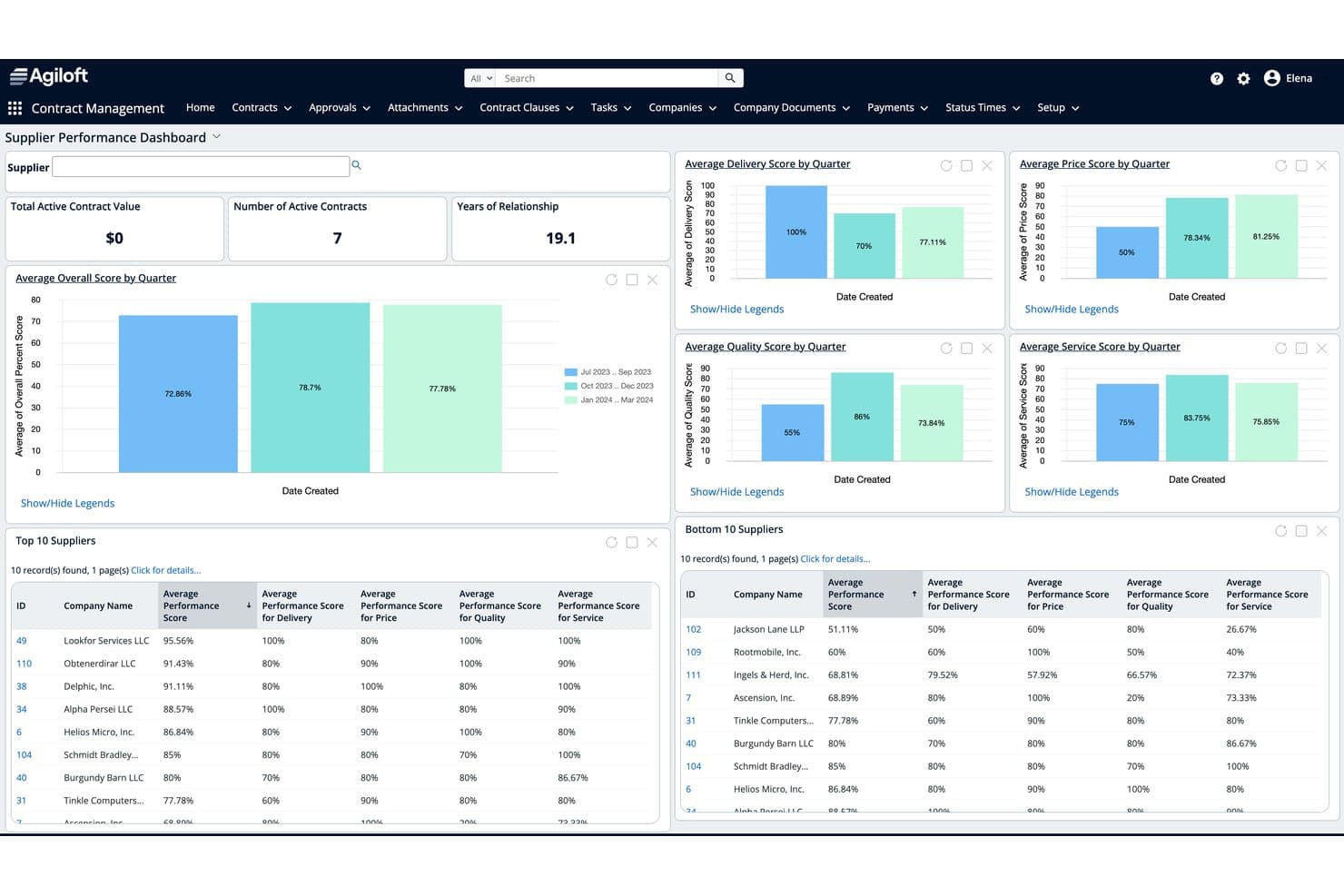
Agiloft’s Supplier Performance Dashboard tracks active contract values, delivery scores, quality metrics, and top and bottom supplier rankings across quarterly periods. Agiloft is a no-code contract lifecycle management platform built for enterprise teams, offering a centralized contract repository, AI-powered clause extraction, configurable approval workflows, and integrations with ERP, procurement, and e-signature systems.
Who Is Agiloft Best For?
Agiloft is a strong fit for large enterprises with complex, cross-functional contract processes spanning legal, finance, and procurement teams.
Why I Picked Agiloft
I picked Agiloft as one of the best because its no-code workflow builder lets me configure contract routing logic that mirrors exactly how my organization operates. I can set a rule that automatically escalates any contract above $50,000 to the CFO for approval, without writing a single line of code. Agiloft's ConvoAI also lets me query the entire contract repository using plain-language questions, so surfacing specific obligation terms or clause language takes seconds, not hours.
Agiloft Key Features
- Centralized contract repository: Store and organize all executed contracts with metadata, version control, and secure, role-based access.
- Financial obligation tracking: Extract and monitor payment schedules, milestones, and renewal dates directly from contract data.
- Enterprise-grade audit controls: Maintain detailed audit trails, e-signature records, and compliance-ready logging for regulated environments.
- ERP and procurement integrations: Connect natively to SAP, Oracle, NetSuite, Coupa, and other major enterprise systems for synchronized contract data.
Agiloft Integrations
Agiloft offers native integrations with SAP, Oracle, NetSuite, Coupa, Tradeshift, Salesforce, DocuSign, and Adobe Sign, and provides an API for custom integrations.
Pros and Cons
Pros:
- Granular role-based permissions suit enterprise governance
- AI extracts clauses across large contract portfolios
- No-code workflow builder is highly configurable
Cons:
- Reporting dashboards feel dated compared to competitors
- Initial deployment requires significant IT involvement
Learn more about Agiloft: Best for workflow automation with self-serve tools
- Free demo available
- Pricing upon request
Visit WebsiteCustomer Rating:4.4/5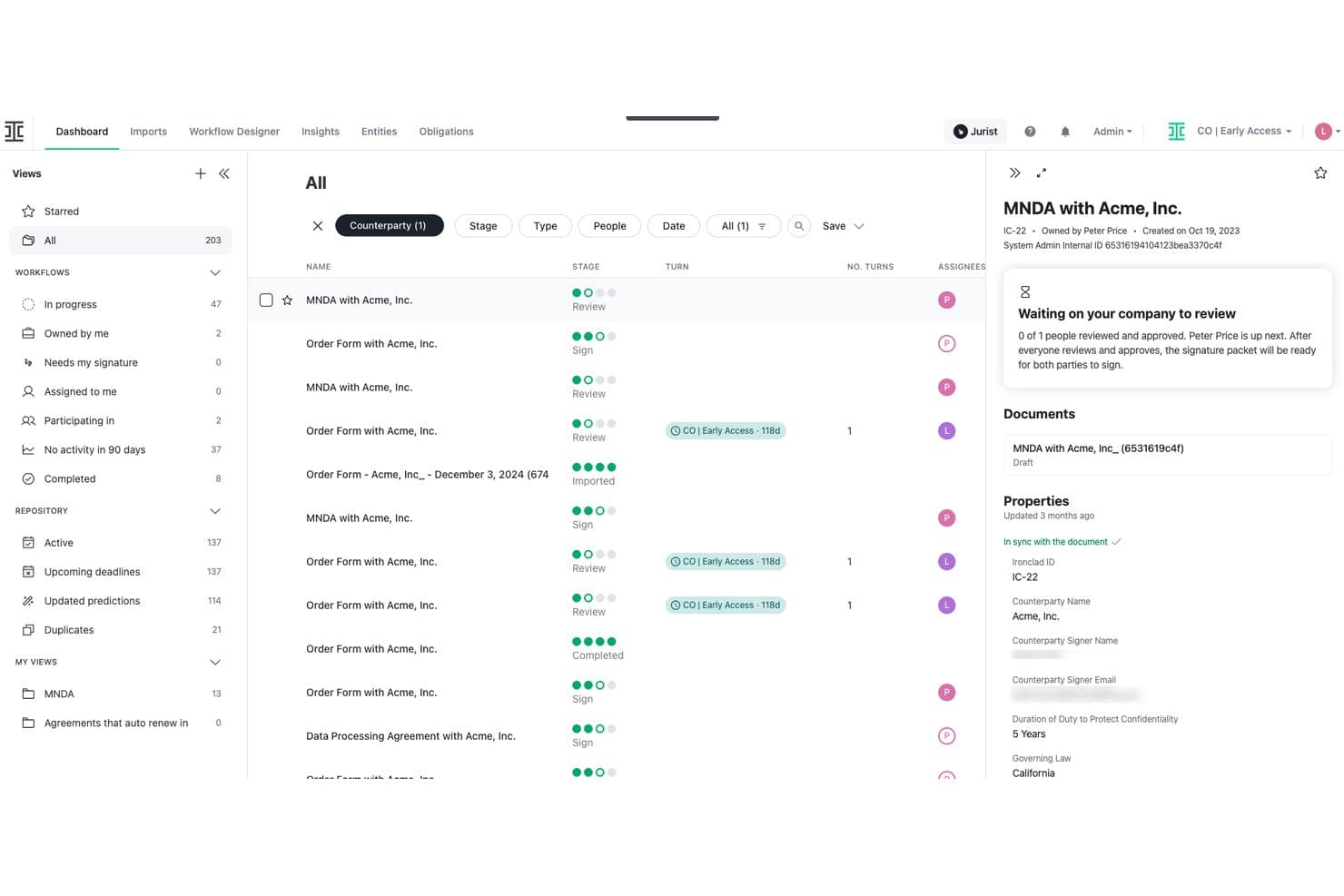
Ironclad lets teams manage contracts with filtering, workflow stages, counterparty details, and document properties. Ironclad is an AI-powered contract lifecycle management platform that handles contract creation, negotiation, approval routing, execution, and renewal management across legal, finance, procurement, and sales teams.
Who Is Ironclad Best For?
Ironclad suits mid-market to enterprise legal and finance teams that manage high contract volumes across multiple departments and need cross-functional approval workflows.
Why I Picked Ironclad
I've included Ironclad in my top picks because its no-code Workflow Designer genuinely sets it apart. I can build conditional approval paths, automated routing, and renewal alerts without touching code, which means finance and procurement teams can trigger and manage their own contracts without routing every request through legal. The Renewals Dashboard is another feature I rely on, tracking opt-out windows and surfacing upcoming renewal dates before they become costly auto-renewals.
Ironclad Key Features
- Centralized contract repository: Store executed contracts with metadata, version control, and role-based access for large volumes.
- AI-powered clause extraction: Identify and extract critical clauses, obligations, and risks across all contract documents.
- ERP and procurement system integrations: Sync contract data with leading ERPs, accounting tools, and procurement platforms through native connectors and APIs.
- Audit trails and compliance controls: Maintain detailed audit logs, electronic signature integrity, and governance for SOX and global regulatory standards.
Ironclad Integrations
Ironclad offers native integrations with Salesforce, SAP, Coupa, Ramp, HubSpot, Box, Slack, and Microsoft Teams, and provides an API for custom integrations.
Pros and Cons
Pros:
- Self-serve contracting for non-legal stakeholders
- AI clause extraction across large contract portfolios
- No-code workflow builder with conditional logic
Cons:
- Reporting customization limited without additional configuration
- Admin configuration requires significant upfront setup time
Learn more about Ironclad: Best for enterprise-wide obligation intelligence
- Free demo available
- Pricing upon request
Visit WebsiteCustomer Rating:4.3/5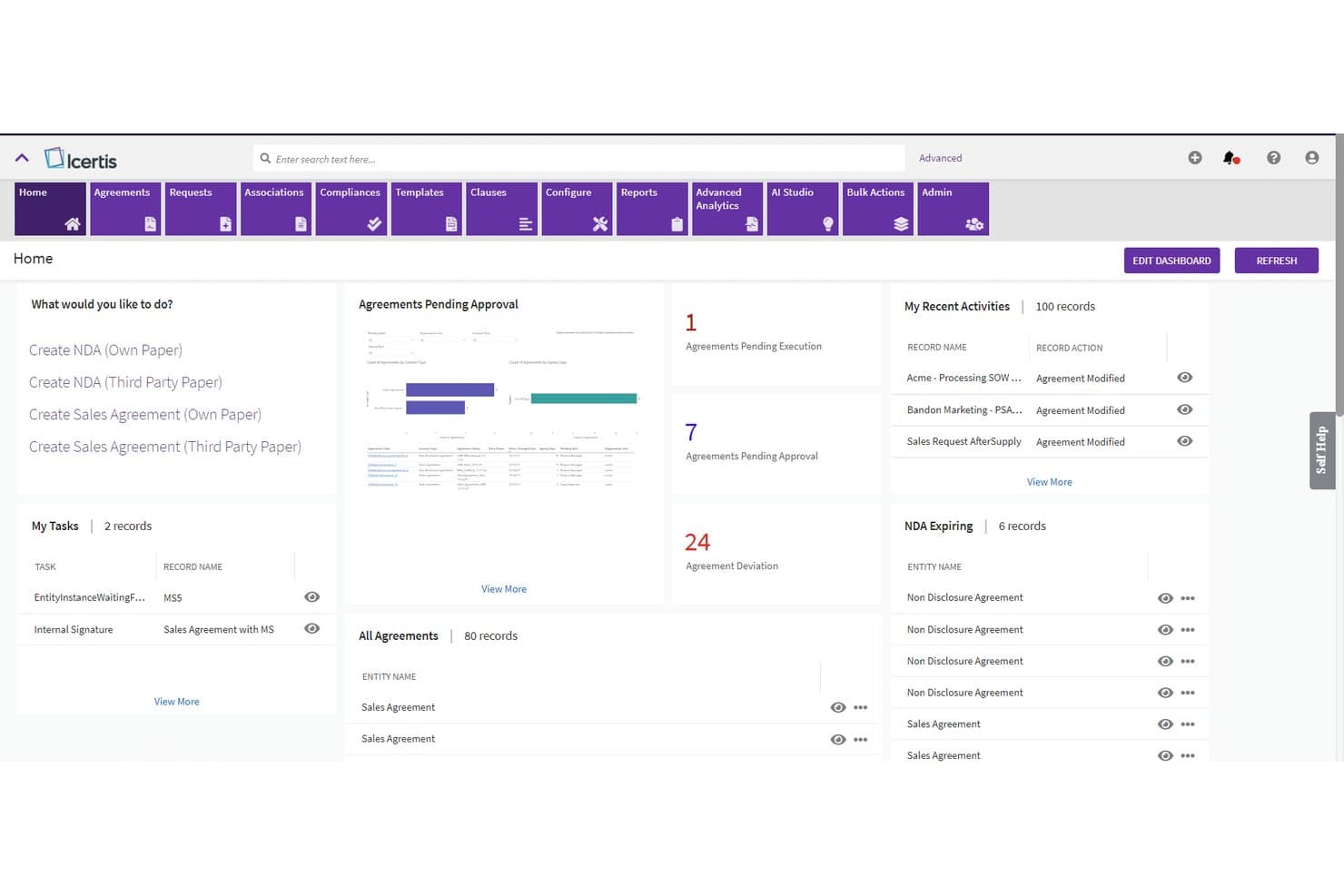
Icertis offers a centralized contract management dashboard with agreement tracking, pending approvals, task management, and NDA expiration alerts for enterprise users. Icertis is an AI-powered contract lifecycle management platform that centralizes contract repositories, automates end-to-end contract workflows, and extracts structured obligation and financial data from enterprise-scale contract portfolios.
Who Is Icertis Best For?
Icertis is a strong fit for large enterprises in regulated industries — financial services, healthcare, and manufacturing — managing high volumes of complex contracts across global operations.
Why I Picked Icertis
Icertis earns its spot on my shortlist because of how it handles obligation tracking at scale. The dedicated Vera Obligations and Vera Fulfillment Agent modules extract financial terms directly from contracts and monitor fulfillment status across the entire portfolio. I particularly like Vera Copilot, which lets me query contracts in plain language to surface payment schedules, pricing milestones, and risk triggers without digging through individual documents.
Icertis Key Features
- Centralized contract repository: Maintain all executed contracts in a searchable, versioned, and access-controlled enterprise repository.
- Configurable clause library: Store, manage, and update pre-approved clauses for use in new contracts across business units.
- Advanced workflow automation: Design no-code workflows for dynamic contract approval routing, negotiation, and renewal management.
- Contract analytics dashboards: Visualize contract risk, cycle times, contract value, and performance with customizable reporting tools.
Icertis Integrations
Icertis offers native integrations with SAP, Microsoft Dynamics, Salesforce, Workday, and DocuSign. An API is available for custom integrations.
Pros and Cons
Pros:
- Built-in SOX and ASC 606 compliance controls
- AI clause extraction from legacy contract portfolios
- Deep obligation tracking across complex contract portfolios
Cons:
- Requires significant IT resources for initial configuration
- Long implementation timelines for enterprise deployments
Learn more about Icertis: Best for revenue-focused contract management
- Free demo available
- Pricing upon request
Visit WebsiteCustomer Rating:4.3/5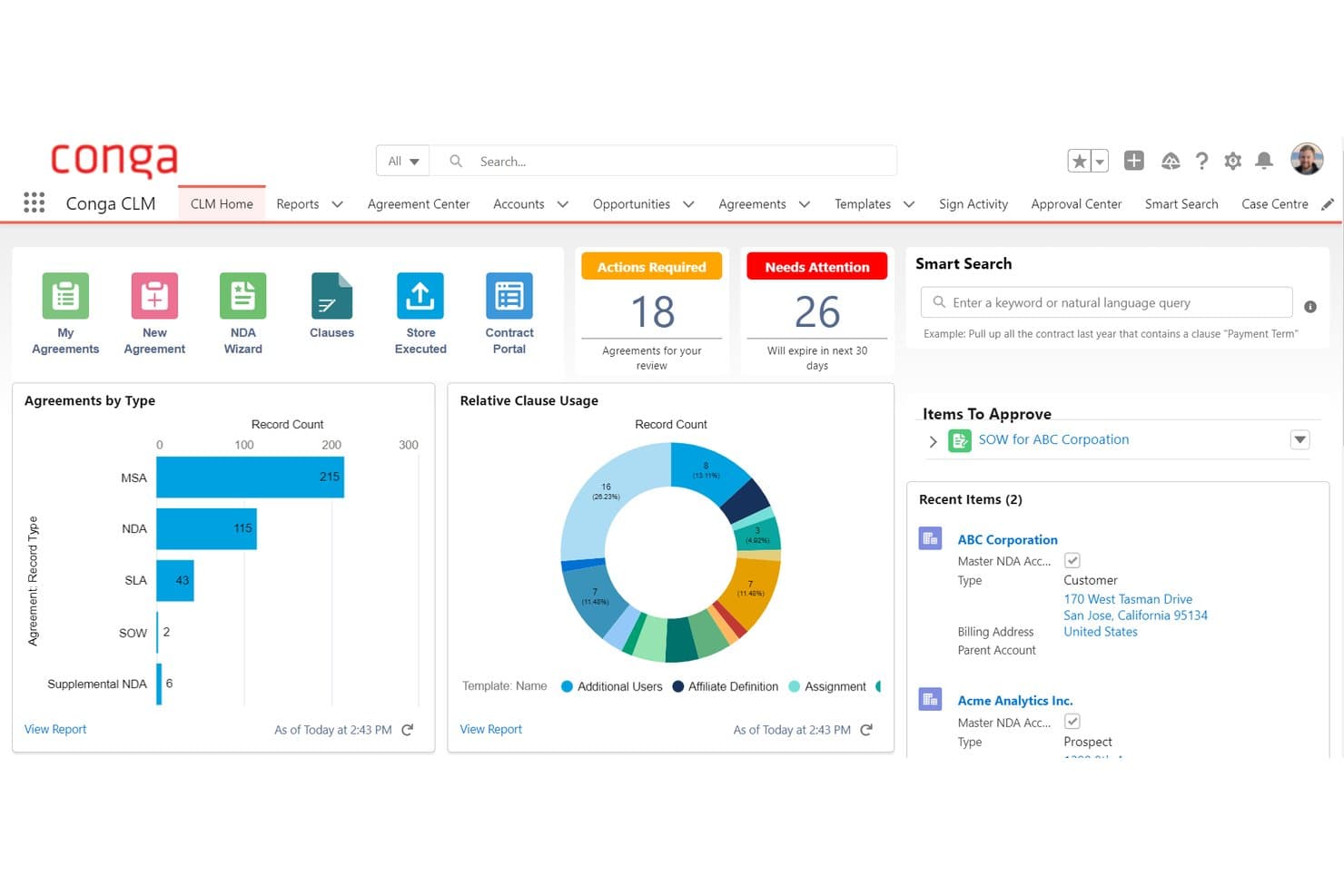
Conga CLM brings together agreement tracking, clause usage analytics, approval workflows, and smart search for enterprise teams. Conga CLM is an AI-powered contract lifecycle management platform built for enterprise teams, covering contract creation, negotiation, approval workflows, obligation tracking, and renewal management across sales, legal, and procurement functions.
Who Is Conga CLM Best For?
Conga CLM is a strong fit for large enterprises running Salesforce-based revenue operations that need contract management connected to their CPQ, billing, and procurement workflows.
Why I Picked Conga CLM
I've included Conga CLM in my top picks because its revenue lifecycle positioning sets it apart from purely legal-focused CLM tools. What I find most compelling is the AI's ability to flag upsell and cross-sell opportunities directly from contract data, something most CLM platforms simply don't do. I also like how obligation extraction connects directly to billing schedules when paired with Conga Billing, so my team isn't manually chasing payment triggers after contracts close.
Conga CLM Key Features
- Centralized contract repository: Stores all contracts with metadata, version control, and enterprise-grade access permissions.
- Configurable clause library: Provides legal-approved standard and fallback language with usage tracking across the portfolio.
- Advanced workflow automation: Enables no-code workflows with conditional routing, parallel approvals, and flexible stakeholder assignments.
- Contract analytics dashboards: Offers customizable reporting on contract value, risk metrics, cycle times, and portfolio performance.
Conga CLM Integrations
Conga CLM offers native integrations with Salesforce, SAP, Oracle, Microsoft 365, Coupa, Ariba, DocuSign, and Adobe Sign. An API is available for custom integrations.
Pros and Cons
Pros:
- Strong audit trail supporting SOX and revenue recognition compliance
- Deep Salesforce-native workflow and approval automation
- AI-powered clause extraction across large contract portfolios
Cons:
- Advanced modules and configurations carry significant added costs
- Heavy Salesforce dependency limits value outside that ecosystem
Learn more about Conga CLM:
Outro software de gestão de contratos empresariais
Eis algumas opções adicionais de software de gestão de contratos empresariais que não entraram na minha lista restrita, mas que ainda vale a pena consultar:
- 11Coupa Contract Lifecycle ManagementBest for connecting contracts with spend data
- 12SAP Ariba ContractsBest for source-to-pay contract compliance
- 13GEP SMARTBest for AI-led procurement contract management
- 14JuroBest for browser-based contract collaboration
- 15SpotDraftBest for fast deployment with native e-signing
- 16GatekeeperBest for unified vendor and contract oversight
- 17JaggaerBest for CLM within source-to-pay operations
- 18OnitBest for contract governance at enterprise scale
How I Evaluate Enterprise Contract Management Software
I split my evaluation into two layers: the core functionality every enterprise CLM must deliver—like obligation extraction and SOX-ready audit trails—and what separates the best options from the rest.
Core Functionality (Table Stakes For This List)
When I'm selecting tools for my list, I rank each one on a scale from 0 (does not offer the functionality) to 5 (excels in this area) for each core functionality listed below. Then, I calculate the tool's total score into a percentage. Each tool needs to achieve a minimum total score of 65% to be considered for inclusion.
- Centralized Contract Repository: I look for full-text search, metadata tagging, version history, and role-based permissions that scale cleanly across multiple business entities.
- Contract Lifecycle Automation: Each platform's workflow engine should handle drafting from templates, conditional approval routing, e-signatures, and automated renewal alerts.
- Financial Obligation Tracking: I evaluate whether the tool surfaces payment milestones, pricing terms, and revenue recognition triggers tied to specific contract clauses.
- Compliance & Audit Controls: SOX-ready audit trails, e-signature integrity, and built-in support for standards like ASC 606 and IFRS 15 are what I check for here.
- ERP & Financial Integrations: Bi-directional sync with platforms like SAP, Oracle, or NetSuite matters—contract data needs to flow into your financial workflows.
- AI Clause & Risk Analysis: Strong tools here can extract obligations, flag risk clauses, and compare language across a portfolio of thousands of contracts.
Once I have a list of tools that meet the criteria, I consider what sets each platform apart.
Differentiating Factors (What Sets Vendors Apart)
Here's how I compare and contrast different vendors:
Standout Features
AI-powered clause extraction is where I see the biggest gap between vendors. The best implementations scan a legacy portfolio and surface hidden commitments—like auto-renewal terms or embedded price escalation clauses—without manual review. Contract analytics dashboards matter just as much, since CFOs need real-time visibility into cycle times, contract value, and risk exposure across business units. Obligation management rounds this out by tracking post-execution milestones and SLA deadlines with automated alerts.
Beyond Features
Integration depth is a major differentiator. I check whether a platform offers bi-directional sync with ERPs and procurement systems—not just one-way data pushes. Cross-departmental usability also matters; if procurement or sales teams can't self-serve within legal-approved guardrails, adoption stalls fast. I also evaluate total cost of ownership, including how pricing scales with user counts and whether AI features or premium connectors carry hidden fees.
Como escolher software de gestão de contratos empresariais
É fácil ficar preso a longas listas de funcionalidades e estruturas de preços complexas. Para o ajudar a manter-se concentrado enquanto percorre o seu processo específico de seleção de software, eis uma lista de fatores a ter em conta:
| Fator | O que deve considerar |
|---|---|
| FatorEscalabilidade | O que deve considerarSuportará o seu volume de contratos, entidades e utilizadores à medida que a sua empresa cresce? Esteja atento a limites ou custos adicionais. |
| FatorIntegrações | O que deve considerarEstabelece ligação nativa aos seus ERP, CRM e ferramentas de assinatura eletrónica? Informe-se sobre a sincronização em tempo real ou em lote e sobre a manutenção. |
| FatorPersonalização | O que deve considerarPode adaptar os fluxos de trabalho, os campos de dados e os relatórios às cadeias de aprovação e aos processos financeiros da sua empresa? |
| FatorFacilidade de utilização | O que deve considerarAs equipas financeira, jurídica e de compras irão realmente utilizá-lo sem formação adicional? Procure interfaces simples e uma navegação fluida. |
| FatorImplementação e integração inicial | O que deve considerarQue recursos serão necessários da sua parte? Verifique se existe apoio à migração, prazos realistas para a entrada em produção e recursos para a gestão da mudança. |
| FatorCusto | O que deve considerarAlém das licenças, tenha em conta as taxas de integração, os escalões de utilizadores, o suporte premium e o crescimento futuro do volume de contratos. |
| FatorMedidas de segurança | O que deve considerarOs controlos correspondem aos requisitos da sua empresa em matéria de dados sensíveis, conformidade regulamentar e políticas de acesso? |
| FatorRequisitos de conformidade | O que deve considerarPode ajudá-lo a cumprir normas como SOX, ASC 606, IFRS 15 ou requisitos específicos de cada região desde o início? |
O que é o software de gestão de contratos empresariais?
O software de gestão de contratos empresariais é um sistema especializado que ajuda as organizações a criar, armazenar, acompanhar e analisar grandes volumes de contratos. Estas plataformas centralizam todos os dados contratuais, automatizam os fluxos de trabalho de aprovação e garantem que os seus compromissos financeiros cumprem os requisitos regulamentares, de auditoria e de reconhecimento de receitas. As equipas utilizam-nas para reduzir os riscos, melhorar a conformidade e obter visibilidade sobre as obrigações contratuais em todos os departamentos.
Funcionalidades do software empresarial de gestão de contratos
Ao selecionar software empresarial de gestão de contratos, tenha em atenção as seguintes funcionalidades essenciais:
- Repositório centralizado de contratos: Uma base de dados única e pesquisável que armazena todos os documentos contratuais, permite a atribuição de etiquetas de metadados e aplica controlos de acesso granulares para diferentes unidades de negócio.
- Gestão automatizada de fluxos de trabalho: Ferramentas para encaminhar contratos ao longo das fases de redação, aprovação, negociação, assinatura e renovação, utilizando fluxos de trabalho configuráveis e baseados em regras.
- Acompanhamento das obrigações financeiras: Extração e monitorização automatizadas de condições de pagamento, marcos, acordos de preços e datas de renovação para ajudar as equipas a gerir compromissos.
- Controlos de auditoria e conformidade: Registos de auditoria detalhados, integridade das assinaturas eletrónicas e suporte para quadros regulamentares como SOX, ASC 606 e IFRS 15.
- Biblioteca de cláusulas e modelos: Armazenamento centralizado de cláusulas e modelos pré-aprovados, permitindo aos utilizadores uniformizar a linguagem e acelerar a criação de contratos com controlo de versões.
- Integrações com ERP e outros sistemas: APIs e conectores pré-criados para sincronizar dados contratuais com ERP, CRM, ferramentas de aprovisionamento e plataformas de contabilidade.
- Análise e extração com IA: Ferramentas de aprendizagem automática que identificam cláusulas essenciais, revelam obrigações, avaliam riscos e analisam tendências em todos os portefólios de contratos.
- Painéis de relatórios personalizados: Painéis visuais que fornecem informações sobre a duração dos ciclos contratuais, a exposição ao risco, os estrangulamentos e os valores dos contratos para análise pela direção.
- Permissões baseadas em funções: Controlos que restringem o acesso e as ações relativas aos contratos com base no utilizador, departamento ou entidade, ajudando a manter a segurança e a conformidade.
- Suporte para importação e migração em massa: Ferramentas para integrar contratos antigos em grande escala, incluindo OCR, carregamentos em massa e mapeamento de dados.
Vantagens do software empresarial de gestão de contratos
A implementação de software empresarial de gestão de contratos proporciona várias vantagens à sua equipa e à sua empresa. Eis algumas das que pode esperar:
- Melhor gestão do risco: A extração automatizada de cláusulas e a análise de riscos assinalam exposições na linguagem dos seus contratos, nas condições de renovação e nos compromissos financeiros antes de estes se agravarem.
- Conformidade melhorada: Os registos de auditoria integrados, a verificação de assinaturas eletrónicas e os controlos concebidos para normas como SOX e ASC 606 reduzem a carga associada aos relatórios regulamentares.
- Maior visibilidade financeira: Os painéis em tempo real e o acompanhamento das obrigações revelam receitas, despesas e principais datas de renovação associadas aos contratos aos responsáveis financeiros.
- Ciclos contratuais mais rápidos: Os fluxos de trabalho automatizados, as bibliotecas de modelos e as ferramentas de autosserviço permitem às equipas encaminhar, negociar e assinar contratos sem atrasos ou estrangulamentos.
- Colaboração entre equipas: As permissões baseadas em funções e as interfaces intuitivas facilitam o trabalho conjunto das equipas jurídica, de aprovisionamento, financeira e de vendas na mesma plataforma.
- Escalabilidade para o crescimento: Os repositórios centralizados e a infraestrutura de nível empresarial acomodam volumes crescentes de contratos e estruturas organizacionais complexas.
- Registos preparados para auditoria: O controlo de versões e os metadados abrangentes garantem que todas as alterações e aprovações de contratos são registadas para auditorias internas e externas.
Custos e preços do software empresarial de gestão de contratos
A seleção de software empresarial de gestão de contratos requer uma compreensão dos vários modelos e planos de preços disponíveis. Os custos variam consoante as funcionalidades, o tamanho da equipa, os complementos, entre outros fatores. A tabela abaixo resume os planos comuns, os seus preços médios e as funcionalidades normalmente incluídas nas soluções de software empresarial de gestão de contratos:
Tabela de comparação de planos de software empresarial de gestão de contratos
| Tipo de plano | Preço médio | Funcionalidades comuns |
|---|---|---|
| Tipo de planoPlano gratuito | Preço médio$0 | Funcionalidades comunsArmazenamento básico de contratos, número limitado de utilizadores, capacidades mínimas de fluxo de trabalho e ferramentas básicas de pesquisa. |
| Tipo de planoPlano pessoal | Preço médio$30–$50/utilizador/mês | Funcionalidades comunsArmazenamento alargado, assinaturas eletrónicas, automatização simples de fluxos de trabalho, acompanhamento básico de obrigações e alertas por e-mail. |
| Tipo de planoPlano empresarial | Preço médio$60–$120/utilizador/mês | Funcionalidades comunsAutomatização avançada de fluxos de trabalho, permissões baseadas em funções, integrações com ERP/CRM, painéis de análise e gestão de obrigações. |
| Tipo de planoPlano empresarial avançado | Preço médio$150+/utilizador/mês | Funcionalidades comunsIntegrações personalizadas, extração de cláusulas com IA, segurança avançada, contratos ilimitados e suporte empresarial. |
Perguntas frequentes sobre software de gestão de contratos empresariais
Eis algumas respostas a perguntas comuns sobre software de gestão de contratos empresariais:
De que forma um software de gestão de contratos empresariais apoia a conformidade?
O software de gestão de contratos empresariais fornece registos de auditoria, controlos de acesso dos utilizadores e lembretes automáticos para prazos importantes, ajudando a cumprir os requisitos de normas como SOX, ASC 606 e GDPR.
Podem diferentes departamentos trabalhar em conjunto na mesma plataforma de gestão de contratos?
Sim, estas plataformas foram concebidas para a colaboração entre departamentos, oferecendo permissões configuráveis, espaços de trabalho personalizáveis e fluxos de trabalho que refletem os diferentes processos das equipas.
Quanto tempo demora normalmente a implementação?
A implementação pode demorar entre algumas semanas e vários meses, dependendo da migração de dados, da complexidade das integrações e do nível de personalização dos fluxos de trabalho para a estrutura da sua empresa.
Que integrações devo esperar?
A maioria das soluções oferece integrações nativas ou através de API com ERPs, CRMs, ferramentas de assinatura eletrónica e sistemas de aprovisionamento, permitindo que os dados dos contratos sejam incorporados nas operações financeiras da sua organização.
Vale a pena considerar a extração de cláusulas com IA?
Sim, a extração de cláusulas com IA ajuda as equipas jurídicas e financeiras a encontrar obrigações, riscos e termos críticos em grandes portefólios, reduzindo o tempo de análise manual e revelando riscos ocultos.
O que devo saber sobre os limites de armazenamento?
Alguns planos limitam o volume de contratos ou o armazenamento, por isso verifique sempre se o plano escolhido consegue acomodar o crescimento previsto dos seus contratos e as suas necessidades de arquivo.