

Un agent AI pentru finanțe este un program autonom care îndeplinește sarcini de finanțe și contabilitate în ceea ce privește datele, fluxurile de lucru și controalele, cu îndrumare umană limitată. Cei mai buni agenți pot sprijini gestionarea închiderii contabile, reconcilierea, evidența contabilă, prognoza, planificarea, conturile de plătit și raportarea financiară.
Acest ghid compară principalele opțiuni în funcție de potrivirea cu fluxurile de lucru, cerințele de audit, integrările, controalele de revizuire și scalabilitatea, astfel încât să poți alege sistemul potrivit pentru echipa ta financiară.
Why Trust Our Software Recommendations
6,700+
Reviews
20
Industry experts
16+
Evaluation factors
14
Years
Our team has been testing and reviewing software since 2012. As finance leaders ourselves, we know how difficult—and important—it is to choose the right software.
For this guide, we evaluated tools using hands-on testing and independent research, scoring tools using our selection criteria.
Our reviews reflect our human editorial judgment, not a sales pitch.
Tabel comparativ: agenți AI pentru finanțe
Compară prețurile și specificațiile, una lângă alta, pentru cei mai buni agenți AI din domeniul financiar care au ajuns pe lista mea scurtă.
Score legend (out of 5)
- Excellent4.5–5
- Good4–4.4
- Average3–3.9
- Below average2–2.9
- Poor1–1.9
Sorted by: Default
| Tool | Starting Price | Website | |||||||||
|---|---|---|---|---|---|---|---|---|---|---|---|
Best for teams building custom treasury systems | Not rated | 4 | 4 | 4 | 4 | 2 | 3 | Not rated | Not rated | Pricing upon request Free plan available | Website |
Best for mid-market planning and analysis | Not rated | 4 | 5 | 5 | 4 | Not rated | Not rated | 3 | 2 | Pricing upon request Free demo available | Website |
Best for hospitality accounting | Not rated | 4 | 4 | 5 | 3 | Not rated | Not rated | 4 | 3 | $299/property/month Free demo available | Website |
Best for SAP-native finance ops | Not rated | 4 | 4 | 4 | 4 | Not rated | Not rated | 4 | 3 | Pricing upon request Free plan available | Website |
Best for AI bookkeeping with audit-proof reconciliation | Not rated | 4 | 4 | 5 | 3 | Not rated | Not rated | 4 | 3 | $65/month Free demo + 30-day free trial available | Website |
Best for confidence-scored audit trails | Not rated | 4 | 4 | 5 | 3 | Not rated | Not rated | 4 | 3 | Pricing upon request Free demo available | Website |
Best for AP and expense managament | Not rated | 4 | 4 | 4 | 2 | Not rated | Not rated | 5 | 4 | Pricing upon request Free demo available | Website |
Best for multi-agent ERP finance | Not rated | 4 | 5 | 4 | 4 | Not rated | Not rated | 5 | 3 | $625/user/month Free demo available | Website |
Best for NetSuite agentic subledgers | Not rated | 4 | 4 | 5 | 4 | Not rated | Not rated | 4 | 3 | Pricing upon request Free demo available | Website |
Best for GL-native materiality approvals | Not rated | 4 | 5 | 5 | 4 | Not rated | Not rated | 4 | 2 | Pricing upon request Free demo available | Website |


Recenzii ale agenților AI pentru finanțe
Mai jos sunt rezumatele mele detaliate ale celor mai buni agenți AI pentru finanțe de pe lista mea scurtă. Recenziile mele oferă o privire detaliată asupra funcțiilor, celor mai bune cazuri de utilizare și capacităților fiecărui instrument AI financiar, pentru a te ajuta să îl găsești pe cel mai potrivit pentru tine.
 Best for teams building custom treasury systems
- Free plan available
- Pricing upon request
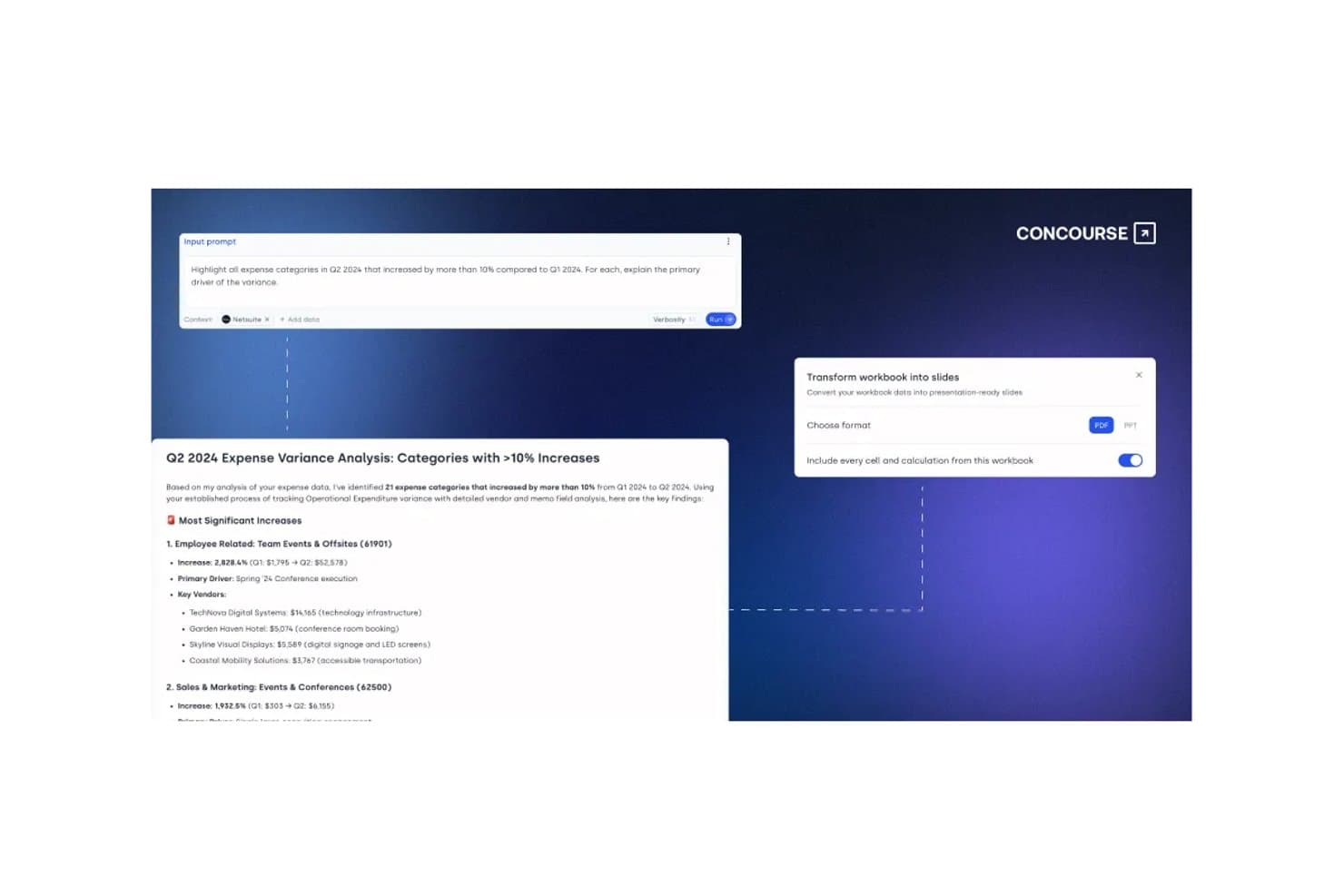
Concourse's AI agent flags Q2 2024 expense categories with over 10% increases and explains each variance driver. Concourse is a finance AI agent platform that lets teams build, run, and manage autonomous agents across accounting, treasury, FP&A, and revenue workflows—connecting directly to ERPs, data warehouses, and billing systems without requiring data migration.
Who Is Concourse Best For?
Concourse is a strong fit for mid-to-large finance teams that want to build and own custom AI agents across treasury, accounting, and FP&A without migrating their existing data.
Why I Picked Concourse
I've included Concourse in my top picks because it's the only platform I've seen that lets treasury teams build a fully custom TMS from scratch, connecting directly to existing banking infrastructure and ERPs without migrating any data. I particularly like how agents can consolidate cash positions across banks, entities, and currencies in real time, then draft transfers or flag limit breaches for human approval. The agent-building process uses natural language, so your treasury team describes the workflow and Concourse handles the rest.
Concourse Key Features
- Multi-surface delivery: Agents push outputs to Slack, Teams, email, Excel, PowerPoint, and Sheets based on schedules, events, or on-demand requests.
- Deterministic calculations: All aggregations and calculations run in code rather than being model-generated, with each result traced back to its source data.
- Continuous control testing: The internal audit module runs agents that test controls on an ongoing basis and scan transactions for anomalies.
- Task-aware model routing: Concourse automatically routes each agent task to the model best suited for it and reroutes if a model fails or hits a rate limit.
Concourse Integrations
Concourse has documented native integrations with Oracle, SAP, NetSuite, QuickBooks, Snowflake, BigQuery, Salesforce, Stripe, Chargebee, and Postgres. It connects agents to ERP, warehouse, CRM, billing, and database data without requiring migration.
Pros and Cons
Pros:
- Builds custom treasury workflows with review checkpoints
- Answers finance questions without SQL
- Reclaims hours in close and variance reporting
Cons:
- Agent configuration can require substantial upfront effort
- Queries and refreshes can run slowly
Learn more about Concourse: Best for mid-market planning and analysis
- Free demo available
- Pricing upon request
Visit WebsiteCustomer Rating:4.5/5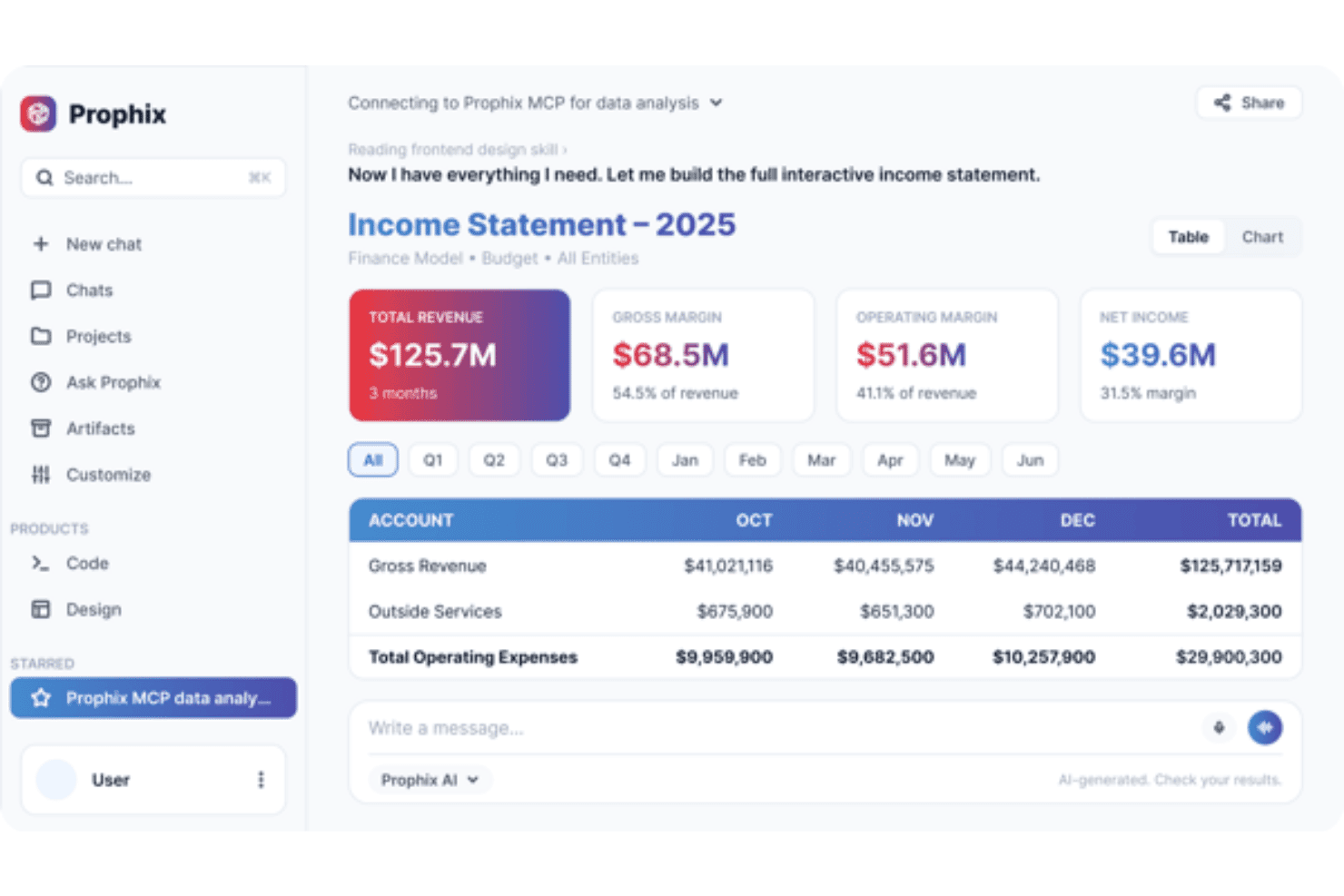
Prophix lets users query financial data to build interactive income statements. Prophix is an autonomous finance platform covering FP&A, financial consolidation and close, account reconciliation, and reporting through a suite of AI agents that execute multi-step workflows.
Who Is Prophix Best For?
Prophix fits mid-market finance teams managing multi-entity planning, consolidation, and close.
Why I Picked Prophix
I've included Prophix because it covers the full planning-to-close cycle with dedicated agents. The Budgeting Agent updates personnel and OPEX budgets when underlying data changes, validates submissions, and fills missing fields with an audit trail behind each change. I also like the Consolidation Agent, which delivers instant, audit-ready answers to consolidation questions without rerunning trial balance variants or exporting to Excel.
Prophix Key Features
- Prophix Copilot: A conversational AI interface built into the platform that lets you query financial data, generate variance analysis, and surface trends using natural language.
- AI-powered transaction matching: Automatically matches high-volume transactions for bank reconciliations and sub-ledger matching, flagging unmatched items for your review.
- Prophix One MCP Server: Exposes governed Prophix data and agents to any MCP-enabled AI platform, including Claude and Microsoft Copilot, so you can act on finance data outside the platform.
- Financial consolidation: Automate multi-entity eliminations and currency translations.
Prophix Integrations
Prophix offers integrations with SAP, Microsoft Dynamics 365, Oracle NetSuite, UKG Pro, Salesforce, Zoho CRM, and HubSpot. It also supports an API for custom connections.
Pros and Cons
Pros:
- Sized for mid-market team structures
- Finance owns the connectors, no IT tickets
- Planning through close in one platform
Cons:
- Advanced reports require admin expertise
- No dedicated AP or AR agent
Learn more about Prophix: Best for hospitality accounting
- Free demo available
- From $299/property/month (billed annually)
Visit WebsiteCustomer Rating:4.7/5
Docyt lets users connect PMS or POS revenue systems directly. Docyt is an AI-native ERP built on a 16-agent architecture covering AP, revenue reconciliation, multi-entity close, and financial reporting.
Who Is Docyt Best For?
Docyt is built for accounting managers and controllers at hospitality and multi-unit businesses—hotel portfolios, restaurant groups, franchises—where nightly revenue reconciliation is routine.
Why I Picked Docyt
I picked Docyt as one of the best because its agents are mapped to hospitality accounting. The Revenue Reconciliation Agent posts night-audit and Point of Sale (POS) revenue daily by 7 am with USALI mapping, while the Revenue Leakage Agent flags short payments and Online Travel Agency (OTA) discrepancies before they compound. The Quality of Books Agent scans for miscoding and variances across ledgers, which is the morning check a controller managing a property portfolio actually runs.
Docyt Key Features
- Multi-entity consolidation: Manage intercompany entries, management fees, and consolidated financials across portfolios of 5–500+ properties from a single ledger.
- GARY reporting agent: Query your financials in plain English and get report outputs with supporting evidence, without building manual exports.
- Forecast Agent: Generates multi-scenario budgets and rolling forecasts in the ledger.
- Immutable audit trail: Every ledger entry logs its source document, confidence score, and reviewer identity, with corrections posted as new entries rather than overwrites.
Docyt Integrations
Docyt integrates with Oracle OPERA Cloud, Toast, Square, Paychex Flex, Dayforce, NetSuite, Xero, and Plaid. An API for custom connections is also available.
Pros and Cons
Pros:
- USALI mapping handled without manual exports
- Scales well across multiple properties
- Daily revenue posted before the morning review
Cons:
- Vendor management and check payments draw complaints
- Built around hospitality workflows only
Learn more about Docyt: Best for SAP-native finance ops
- Free plan available
- Pricing upon request
Visit WebsiteCustomer Rating:4.8/5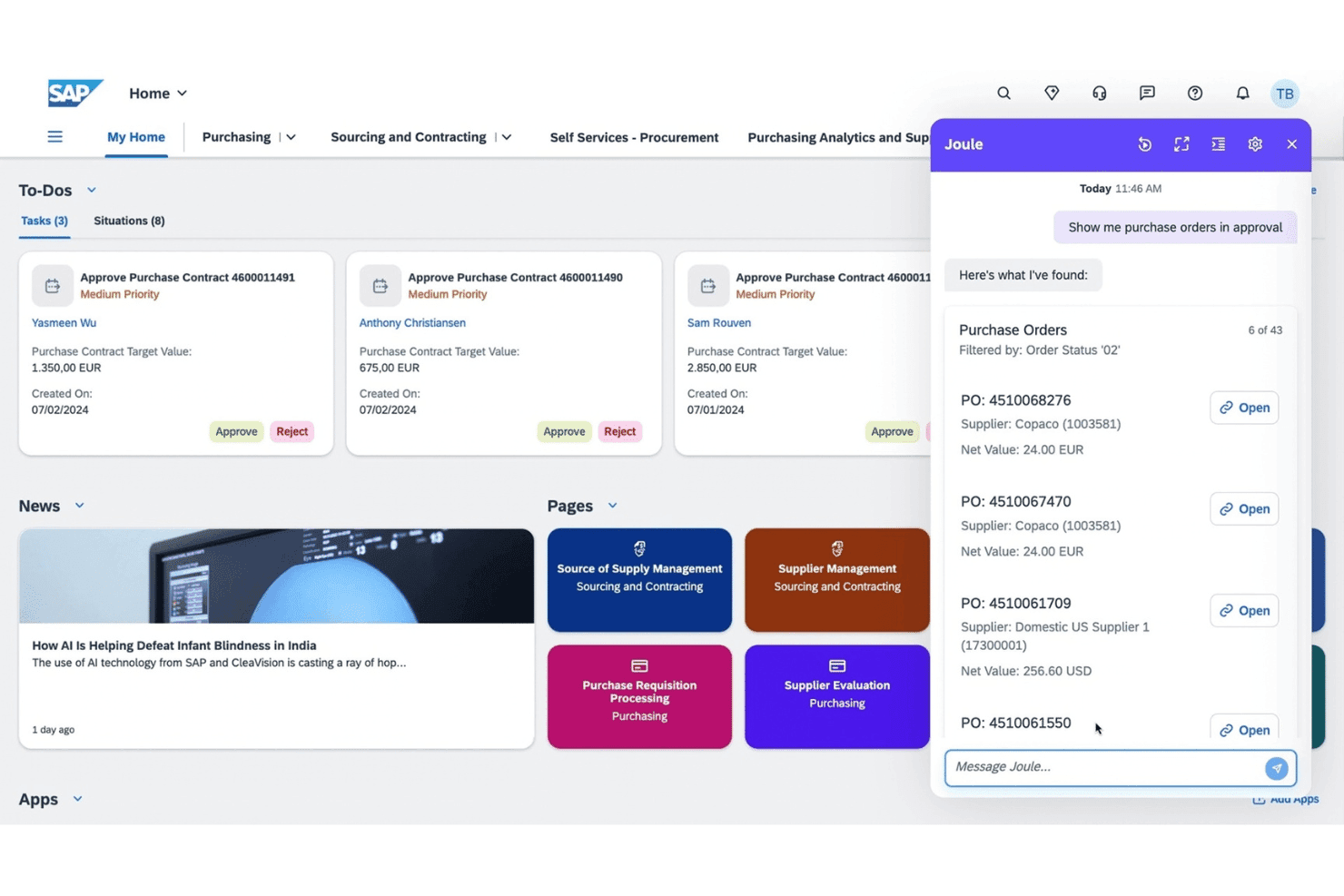
SAP Joule surfaces purchase orders in approval directly in chat. SAP Joule is an AI agent and assistant layer built into SAP's ERP ecosystem, covering accounts payable, accounts receivable, financial close, planning, and tax and compliance monitoring workflows.
Who Is SAP Joule Best For?
SAP Joule is for finance teams already on SAP Cloud ERP or S/4HANA who want AI automation across AP, AR, close, and planning inside their existing environment.
Why I Picked SAP Joule
I included SAP Joule because it operates on live transactional data inside S/4HANA. The Financial Closing Assistant orchestrates specialized agents across the close cycle, flagging bottlenecks and correcting errors in-system with no export step. The Accounts Payable and Accounts Receivable Assistants work the same way, running dispute resolution and payment scheduling with limited human direction.
SAP Joule Key Features
- Financial Planning Assistant: Detects changes in business conditions and models their downstream financial impact to support dynamic planning decisions.
- Joule Studio: A low-code and pro-code agent builder that lets you describe agent behavior in plain language, with support for LangChain and LlamaIndex extensions.
- SAP AI Agent Hub: Deploy, monitor, and govern all agents—including custom and third-party ones—with KPI and ROI tracking.
- Tax and compliance assistant: Cover tax and regulatory compliance workflows within the SAP environment.
SAP Joule Integrations
SAP Joule offers native integrations across SAP Ariba, SAP Concur, SAP SuccessFactors, SAP Datasphere, SAP Incentive Management, and Microsoft 365 Copilot. An API is also available for custom integrations.
Pros and Cons
Pros:
- Automates dispute resolution and cash application
- Flags close anomalies before resolution
- No export step during close
Cons:
- Output depends heavily on data quality
- Complex queries can produce generic answers
Learn more about SAP Joule: Best for AI bookkeeping with audit-proof reconciliation
- Free demo + 30-day free trial available
- From $65/month
Visit WebsiteCustomer Rating:4.9/5
Digits gives users a detailed ledger view of all transactions by account. Digits is an AI-native general ledger covering continuous bookkeeping, automated month-end close, accounts payable, invoicing, and real-time reporting in one platform.
Who Is Digits Best For?
Digits is a good fit for accounting firms and small-to-midsize businesses that want a full general ledger rather than a layer on top of QuickBooks or Xero.
Why I Picked Digits
I picked Digits because its Agentic Close runs continuously rather than as a scheduled batch. Every reconciliation match links to a bounding-box reference on the source statement PDF, so audit evidence is built as the work happens. Exceptions arrive with a plain-language note on what the agent attempted and why, which keeps the review queue readable.
Digits Key Features
- Ask Digits: A conversational AI assistant included on every plan that lets you query your financials and get answers in plain language.
- AI Bill Pay: Extracts bill details via OCR, detects vendor remittance information, and routes payments through customizable approval policies before auto-reconciling to the ledger.
- Category manager: Lets you define and enforce coding logic across transactions for a consistent chart of accounts.
- Live financial statements: Always-current P&L, balance sheet, and cash flow reports that pull from the ledger, with drill-down to individual transactions.
Digits Integrations
Digits connects to 12,000+ financial institutions through the Digits Connect API and offers native integrations with Mercury, Ramp, Gusto, Stripe, Arc, Ignition, Karbon, and Reach Reporting.
Pros and Cons
Pros:
- AI assistant included on every plan
- Replaces the ledger rather than layering on it
- Audit evidence builds as work happens
Cons:
- No scenario forecasting for FP&A
- Complex accruals need manual cleanup
Learn more about Digits: Best for confidence-scored audit trails
- Free demo available
- Pricing upon request
Visit WebsiteCustomer Rating:4.5/5
BlackLine centralizes outstanding payment tracking and aging data in one dashboard. BlackLine is an agentic financial operations platform combining a multi-agent AI suite (Verity) with workflow orchestration, ERP integration, and governance tools across record-to-report and invoice-to-cash.
Who Is BlackLine Best For?
BlackLine fits controllers and accounting managers at large, multi-entity organizations that need close and AR workflows backed by auditable, explainable controls.
Why I Picked BlackLine
BlackLine makes my list on audit transparency at the AI level rather than only the workflow level. Every action Verity takes during reconciliation prep carries a confidence score, its reasoning, and a complete audit trail, so a reviewer can see why the AI flagged or matched something. Verity Prepare splits the work across agents that analyze supporting documentation, draft reconciling items, and generate variance explanations, with human sign-off reserved for exceptions.
BlackLine Key Features
- Multi-agent orchestration: Vera acts as an AI team lead, assigning tasks to specialized sub-agents and tracking progress across close and AR workflows with full auditability.
- Natural-language financial querying: Verity Insights lets you explore financial data using plain-language questions, surfacing analysis without manual report building.
- Automated accruals drafting: Verity Accruals gathers source data and vendor confirmations, then drafts audit-ready journal entries for your team to review.
- Prebuilt process blueprints: Studio360 Blueprint includes 70+ ready-to-use workflow templates built on industry best practices for financial close and AR processes.
BlackLine Integrations
BlackLine integrates with SAP, Oracle NetSuite, Microsoft Dynamics, and Acumatica. An open API is also available for custom integrations.
Pros and Cons
Pros:
- Human approval remains central for exceptions
- Multi-agent workflows cover close and AR
- Confidence-scored actions support audit review
Cons:
- Implementation requires careful planning and training
- Agent features have limited independent validation
Learn more about BlackLine: Best for AP and expense managament
- Free demo available
- Pricing upon request
Visit WebsiteCustomer Rating:4.4/5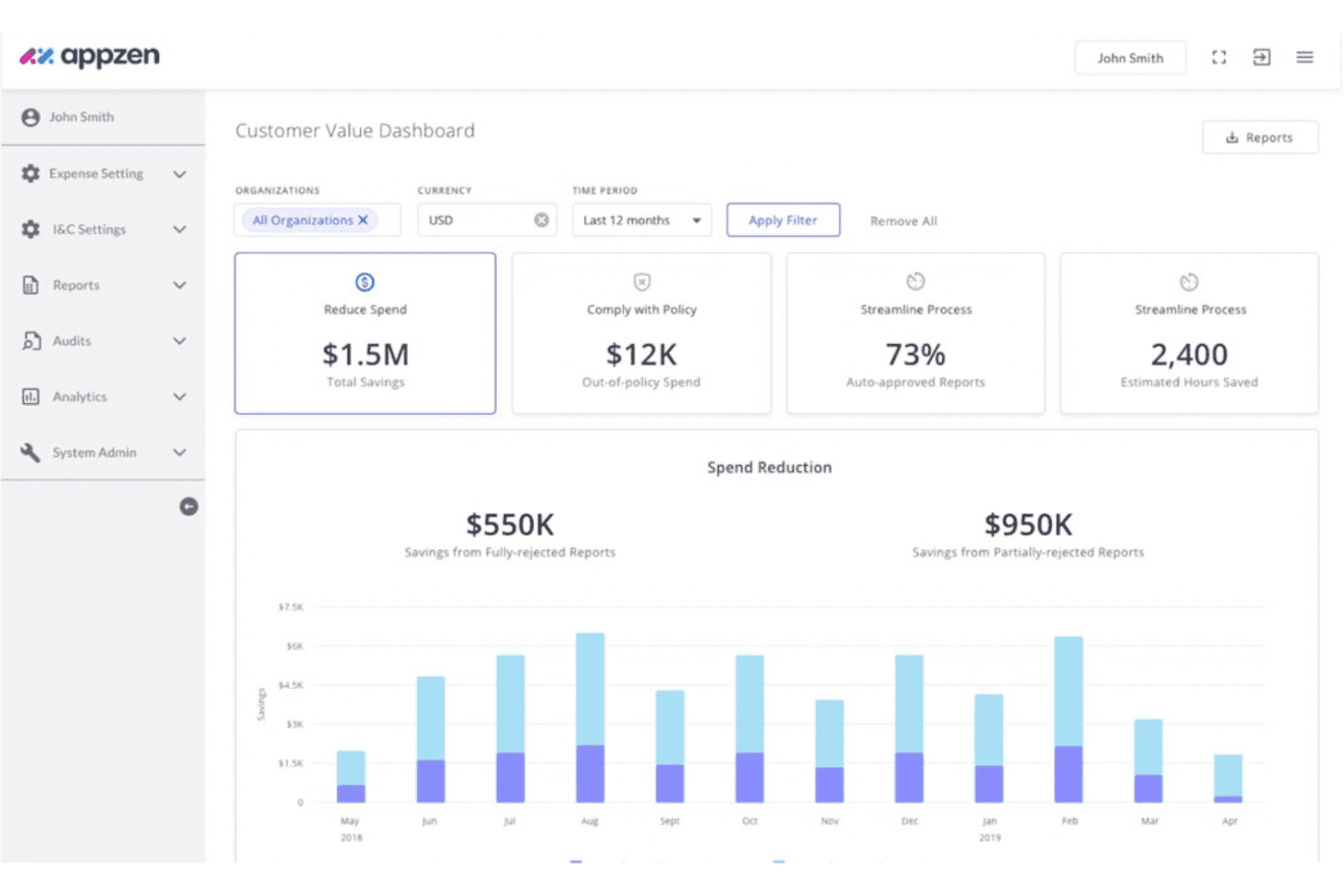
AppZen tracks expense savings, policy compliance, and hours saved. AppZen is an AP and expense management platform with autonomous invoice processing, pre-payment expense auditing, corporate card transaction review, and a no-code agent builder for custom AP and T&E workflows.
Who Is AppZen Best For?
AppZen fits enterprise finance and accounting teams that own AP and T&E and need audit-ready processing at volume.
Why I Picked AppZen
AppZen earns a spot on my shortlist because AP and expense are the full scope of what it does. The pre-payment expense audit screens every report before money moves, catching AI-generated fake receipts, blocklisted merchants, and cross-report duplicates. The no-code AI Agent Studio also lets finance ops staff turn an existing SOP document into a live AP workflow without involving IT.
AppZen Key Features
- GL code prediction: Automatically assigns general ledger codes to non-PO invoices by learning from your historical data and chart of accounts.
- E-invoicing compliance: Validates invoices against global mandates including VAT, OFAC, and Peppol requirements across 40+ languages.
- AI Analytics dashboard: Delivers real-time spend visibility with drill-down reporting and natural-language Q&A for on-demand answers.
- Sandbox testing environment: Lets you test new agents against historical or live data before activation, with pre- and post-launch performance dashboards.
AppZen Integrations
AppZen offers integrations with Oracle NetSuite, Workday, SAP Concur, Coupa, Rydoo, American Express, Mastercard, and Visa card networks. A REST API for custom integrations is also available.
Pros and Cons
Pros:
- Finance ops team can build workflows without IT
- Screens expenses before money moves
- Deepest coverage of AP and T&E on this list
Cons:
- Analytics cannot trigger finance actions
- Scoped to AP and expense only
Learn more about AppZen: Best for multi-agent ERP finance
- Free demo available
- From $625/user/month

Oracle Fusion Cloud ERP lets users monitor ledger prompts by priority. Oracle Fusion Cloud ERP is a cloud-based ERP platform with embedded, finance-specific AI agents spanning accounts payable, accounts receivable, general ledger, expenses, payments, cash processing, reconciliation, and financial planning.
Who Is Oracle Fusion Cloud ERP Best For?
Oracle Fusion Cloud ERP suits large, multi-entity organizations that already run Oracle as their system of record and need agents across the whole finance function.
Why I Picked Oracle Fusion Cloud ERP
Oracle Fusion Cloud ERP is on this list for the breadth of its agent coverage. The Payables Agent handles invoice ingestion through to payment, and the Ledger Agent surfaces GL exceptions and auto-creates adjustment journals, both working on live data in the same system of record. AI Agent Studio also lets finance ops teams build and extend custom agents without developer support, which really matters at enterprise scale.
Oracle Fusion Cloud ERP Key Features
- Planning Agent: Analyzes trends and variances and runs what-if simulations via natural language.
- Expenses Agent: Processes receipts forwarded by email, matches card charges, validates policy, and triggers reimbursement.
- Cash Processing Agent: Matches bank statement lines to AR receipts and auto-creates entries for straight-through cash application.
- Continuous transaction monitoring: Runs 300-plus algorithms across Fusion transactions to detect anomalies, duplicates, and fraud.
Oracle Fusion Cloud ERP Integrations
Oracle Fusion Cloud ERP has native integrations across Fusion Financials, EPM, Procurement, SCM, HCM, CX, J.P. Morgan, Box, and Stripe. An API for custom integrations is also available.
Pros and Cons
Pros:
- Runs on live ERP data in place
- Finance ops can build agents without developers
- Agent coverage spans the full finance function
Cons:
- Agent maturity varies across workflows
- Implementation requires lengthy enterprise projects
Learn more about Oracle Fusion Cloud ERP:

Numeric lets users embed SQL queries and rich text into close checklists. Numeric is an AI-native financial data platform combining agentic subledgers, close management, reconciliation, cash matching, and billing automation into end-to-end accounting workflows.
Who Is Numeric Best For?
Numeric fits accounting teams at growth-stage and mid-market companies on NetSuite that want subledger, close, and cash-matching automation.
Why I Picked Numeric
Numeric earns its spot on my shortlist because its Agentic Subledgers handle NetSuite accounting end-to-end. I've used it to ingest lease agreements and commission plans, and the agent derives the accounting treatment, builds the schedule, and updates balances automatically. When a document changes, it applies the previously approved treatment to correct the downstream accounting on its own, and Prism surfaces the overnight agent actions and exceptions that need sign-off.
Numeric Key Features
- Transaction monitors: Set plain-language rules that flag duplicate transactions, unusual balances, and policy violations against live transaction data before close.
- Cash matching rules engine: Configure rules on any field—memo, amount, date range—to match 90%+ of bank, AR, and AP transactions, including many-to-many scenarios.
- App Studio: Build custom dashboards and workbooks using plain-language prompts, with every app versioned and logged.
- Real-time cycle analytics: Tracks operational trends, cycle times, workflow bottlenecks, and workload distribution to optimize overall close efficiency period-over-period.
Numeric Integrations
Numeric offers integrations with Xero, Stripe, Anrik, Salesforce, HubSpot, Snowflake, Carta, HSBC, Chase Connect, and Databricks. It also offers an MCP server to connect with LLMs like Claude and ChatGPT.
Pros and Cons
Pros:
- Overnight agent work surfaced for sign-off
- MCP actions land in audit logs
- Keeps your existing NetSuite in place
Cons:
- Limited forecasting and scenario modeling
- Full agentic modules need ERP replacement
Learn more about Numeric:

Rillet centralizes financial metrics, close checklists, and AI workflows in one dashboard. Rillet is an AI-native ERP with a general ledger at its core, embedding agents in the ledger for natural-language GL queries, automated close workflows, continuous anomaly monitoring, and materiality-tiered approval routing.
Who Is Rillet Best For?
Rillet fits mid-market and scaling SaaS companies that want a GL-native system with structured approval governance around their existing close workflows.
Why I Picked Rillet
Rillet earns its place on materiality-tiered approval routing. When an agent proposes a journal entry above a set threshold, it routes to the controller, and above a higher one it escalates to the CFO, so the level of review scales with the size of the entry. Every agent action is logged in the Aura Audit Trail with timestamped data snapshots and step-by-step reasoning, which gives approvers a full evidence chain they can export.
Rillet Key Features
- Aura Flow workflow builder: Define multi-step finance workflows in plain English—Rillet breaks them into parallel sub-processes, handles scheduling, and remembers your accounts and dimensions across runs.
- Continuous AI monitoring: Always-on scanning of your books flags anomalies, surfaces exceptions, and proposes accruals as transactions occur, not just during close.
- Aura MCP connectivity: Connects Rillet's live GL data to external tools like Salesforce, Snowflake, and Claude for reads and writes without leaving those environments.
- Automated revenue recognition: Native ASC 606 support handles flat-rate, usage-based, milestone, and hybrid billing models, with auto-generated rev-rec analyses pulled directly from contracts.
Rillet Integrations
Rillet offers native integrations with Salesforce, Snowflake, Stripe, Tipalti, Procurify, Justworks, ADP, Zapier, and Anaplan. An API and MCP are also available for custom workflows.
Pros and Cons
Pros:
- Plain-English workflows support multi-step close tasks
- Audit trails include snapshots and reasoning
- Materiality-based approvals route agent proposals
Cons:
- No native scenario planning
- Human approval prevents fully unattended posting
Learn more about Rillet:
Alți agenți AI pentru finanțe
Iată câteva opțiuni suplimentare care nu au ajuns pe lista mea principală, dar merită totuși verificate:
- 11CampfireBest for AI-native General Ledger
- 12TrintechBest for multi-entity close
- 13ZeniBest for bookkeeping and insights
- 14Sage IntacctBest for close-to-consolidation workflows
- 15RampBest for agents built on real transaction data
- 16PayhawkBest for natural-language spend playbooks
- 17HighRadiusBest for AP/AR coverage
- 18LedgeBest for approval-gated ERP posting
- 19NominalBest for automated account reconciliation
- 20Close AI by FloQastBest for COSO-aligned governance
Related Reviews
How I Evaluate Finance AI Agents
To make this list, a tool's AI must handle real finance work, like reconciling transactions or flagging anomalies. From there, I evaluate three things. Core functionality carries the most weight, like connecting systems and logging actions. Then I look at standout features, like approval controls, and what it offers beyond features, like implementation time.
Core Functionality (Table Stakes For This List)
When I'm selecting tools for my list, I score each one on a scale from 0 (does not offer the functionality) to 5 (excels in this area) for each core functionality listed below. I then convert the total into a percentage to help assess each tool's overall fit, with extra weight on any functionalities I’ve deemed essential.
- Autonomous Task Execution (Essential): I look for multi-step workflows such as reconciliation, invoice processing, and reporting that run with limited human direction.
- Financial Data Integration (Essential): I assess connections to ERP, accounting, banking, payroll, and billing systems, including how data moves between them.
- Natural Language Interaction: I check whether finance teams can query balances, explain variances, or initiate tasks using conversational language.
- Anomaly Detection: I look for discrepancies across transactions, accounts, and reports, with clear exceptions for human review.
- Adaptive Decisioning: I assess whether recommendations improve from historical outcomes, corrections, and recurring finance workflows.
- Audit Trail And Explainability: I review logs, supporting evidence, approvals, and decision context for reconciliations, postings, and other actions.
Once I have a list of tools that meet the criteria, I consider what sets each platform apart.
Differentiating Factors (What Sets Vendors Apart)
Here's how I compare and contrast different vendors:
Standout Features
I look for human-in-the-loop approval controls that let teams set dollar or risk thresholds where an agent pauses for sign-off before posting. A miscoded intercompany entry can cascade across entities, so configurable checkpoints matter more than raw automation speed. I also evaluate multi-agent orchestration—whether AP, AR, and close agents hand off tasks to each other without manual sequencing. Low-code customization is important too; controllers should be able to adjust agent rules without filing engineering tickets.
Beyond Features
I check whether a vendor holds SOC 2 certification and supports role-based access controls, since an agent posting journal entries needs the same permission guardrails you'd apply to a staff accountant. Scalability matters just as much—a tool that works for one entity but buckles across currencies and subsidiaries will force you back to spreadsheets during consolidation. I also evaluate release cadence and roadmap clarity to gauge whether the vendor will keep pace as agentic capabilities evolve.
Cum să alegi un agent AI pentru finanțe
Alege agentul potrivit verificând dacă poate produce lucrări contabile care pot fi revizuite, fără să slăbească mediul tău de control.
| Dacă prioritatea ta este | Caută |
|---|---|
| Dacă prioritatea ta esteRevizuiri mai rapide ale închiderii contabile | CautăReconciliere cu dovezi justificative, confirmarea revizorului și starea excepțiilor |
| Dacă prioritatea ta estePregătirea pentru audit | CautăJurnale de activitate imuabile, justificarea deciziilor, înregistrări-sursă și dovezi care pot fi exportate |
| Dacă prioritatea ta esteÎnregistrarea mai sigură a notelor contabile | CautăPraguri de aprobare configurabile, permisiuni bazate pe roluri și restricții privind înregistrarea |
| Dacă prioritatea ta esteRaportare pentru mai multe entități | CautăGestionarea entităților, valutelor, tranzacțiilor între companii și consolidării, verificată cu datele tale |
| Dacă prioritatea ta esteMai puține corecții manuale | CautăCozi de excepții care identifică neconcordanțele și păstrează istoricul corecțiilor |
Cum să îți verifici lista scurtă
- Desfășoară un test de închidere: Oferă fiecărui furnizor zece reconcilieri reprezentative și solicită documentele de lucru finalizate în termen de cinci zile lucrătoare.
- Solicită un pachet de audit: Cere un exemplu de jurnal de activitate, o atașare de dovezi, o înregistrare a aprobării și formatul de export înainte de semnare.
- Testează regulile de escaladare: Trimite tranzacții care depășesc două praguri de aprobare și confirmă că agentul pune pe pauză, direcționează și înregistrează fiecare decizie.
- Verifică gestionarea datelor: Solicită o diagramă scrisă a fluxului de date care să acopere păstrarea datelor, rolurile de acces, utilizarea datelor clienților și procedurile de ștergere.
- Alege compromisul: Decide dacă acoperirea mai extinsă a fluxurilor de lucru compensează o revizuire umană mai strictă, deoarece agenții AI pentru finanțe rareori le maximizează pe ambele.
Ce sunt agenții AI pentru finanțe?
Agenții AI pentru finanțe sunt programe care îndeplinesc sarcini contabile și financiare cu îndrumare umană limitată. Aceștia pot reconcilia tranzacții, procesa facturi, explica variații, detecta anomalii, pregăti rapoarte și sprijini prognozarea. Echipele financiare continuă să revizuiască excepțiile, să aprobe acțiunile sensibile și să mențină controlul asupra înregistrărilor și datelor financiare.
Caracteristici
Iată principalele caracteristici pe care le caut la orice agent AI financiar performant:
- Executarea autonomă a sarcinilor: Rulează fluxuri de lucru în mai mulți pași, precum procesarea facturilor, reconcilierea conturilor, pregătirea registrelor contabile și generarea rapoartelor, cu îndrumare umană limitată.
- Integrarea datelor financiare: Se conectează la software de contabilitate, sisteme ERP, bănci, platforme de salarizare, instrumente de facturare și depozite de date pentru a colecta și compara informații financiare.
- Interacțiunea în limbaj natural: Îți permite să pui întrebări despre solduri, tranzacții, abateri și previziuni folosind limbajul uzual. De asemenea, poate iniția sarcini financiare acceptate în urma unor solicitări conversaționale.
- Detectarea anomaliilor: Analizează tranzacțiile și activitatea conturilor pentru a identifica sume neobișnuite, înregistrări duplicate, date lipsă, excepții de la politici și modificări neașteptate care necesită verificare umană.
- Fluxuri de lucru pentru reconciliere: Corelează tranzacțiile, facturile, plățile și înregistrările conturilor pe baza unor reguli definite. Evidențiază elementele necorelate și păstrează dovezile care stau la baza fiecărei corelări sugerate.
- Controale de aprobare: Oprește acțiunile sensibile până când o persoană autorizată le verifică. Pragurile configurabile pot direcționa înregistrările contabile, plățile și ajustările în funcție de valoare sau risc.
- Jurnale de audit: Înregistrează acțiunile agentului, datele sursă, recomandările, aprobările, corecțiile și rezultatele înregistrării. Persoanele care efectuează verificarea pot urmări fiecare rezultat până la dovezile justificative.
- Previziuni și analiză a abaterilor: Utilizează date financiare istorice, bugete, rezultate efective și ipoteze de afaceri pentru a pregăti previziuni și a explica diferențele dintre rezultatele preconizate și cele raportate.
Beneficii
Din experiența mea, agenții AI financiari oferă mai multe beneficii practice, printre care:
- Verificări mai rapide la închiderea contabilă: Reconcilierile automatizate, analiza abaterilor și cozile de excepții îi ajută pe verificatori să evalueze mai rapid activitatea financiară.
- Mai puține corecții manuale: Detectarea anomaliilor identifică duplicatele, datele lipsă, neconcordanțele și tranzacțiile neobișnuite înainte de înregistrare.
- Pregătire mai bună pentru audit: Jurnalele de activitate păstrează înregistrările sursă, recomandările agentului, aprobările, corecțiile și rezultatele înregistrării pentru verificări ulterioare.
- Înregistrări contabile mai sigure: Pragurile de aprobare și permisiunile bazate pe roluri opresc înregistrările sensibile până când verificatorii autorizați le aprobă.
- Vizibilitate financiară mai clară: Interogările în limbaj natural ajută echipele să investigheze solduri, tranzacții, previziuni și abateri fără a naviga prin mai multe sisteme.
- Fluxuri de lucru mai consecvente: Integrările cu sistemele de contabilitate, ERP, servicii bancare, salarizare și facturare aplică reguli repetabile în procesele financiare.
Costuri și prețuri
Costurile variază în funcție de caracteristici, dimensiunea echipei, suplimente și cerințele de implementare. Iată intervalele de prețuri la care te poți aștepta de obicei de la agenții AI financiari:
Tabel comparativ al planurilor pentru agenții AI financiari
| Tipul planului | Preț mediu | Caracteristici comune |
|---|---|---|
| Tipul planuluiPlan gratuit | Preț mediu$0/month | Caracteristici comuneInterogări limitate, analiză financiară de bază, fluxuri de lucru demonstrative și utilizare individuală |
| Tipul planuluiPlan personal | Preț mediu$10–$50/user/month | Caracteristici comuneÎntrebări în limbaj natural, analiză a tranzacțiilor, detectare de bază a anomaliilor și integrări limitate |
| Tipul planuluiPlan pentru companii | Preț mediu$50–$200/user/month | Caracteristici comuneReconcilieri automatizate, fluxuri de aprobare, jurnale de audit, raportare și integrări multiple |
| Tipul planuluiPlan pentru întreprinderi | Preț mediu$500–$5,000+/month | Caracteristici comuneCompatibilitate cu mai multe entități, fluxuri de lucru personalizate, permisiuni avansate, implementare dedicată și asistență pentru întreprinderi |
Întrebări frecvente
Câteva răspunsuri la întrebări frecvente despre agenții de inteligență artificială pentru finanțe:
Pot agenții de inteligență artificială pentru finanțe să înregistreze note contabile fără aprobare?
Nu, agenții de inteligență artificială pentru finanțe ar trebui să pună pe pauză notele contabile care necesită aprobare umană. Stabiliți praguri în funcție de sumă, tipul contului, entitate sau nivelul evaluării riscului. Agentul poate pregăti nota contabilă, poate atașa documentele-sursă și își poate explica recomandarea. Apoi, un evaluator autorizat aprobă, respinge sau solicită modificări. Sistemul dumneavoastră contabil ar trebui să păstreze fiecare decizie și rezultatul înregistrării. Testați aceste controale cu înregistrări aflate peste și sub fiecare prag înainte de a implementa agentul în timpul unei închideri contabile reale.
Cum se conectează agenții de inteligență artificială pentru finanțe la sistemele contabile?
Agenții de inteligență artificială din domeniul financiar se conectează prin interfețe de programare a aplicațiilor, importuri de fișiere, acces direct la baze de date sau conectori integrați. Confirmați ce sisteme acceptă agentul înainte de a selecta o platformă. Verificați dacă poate citi planul de conturi, istoricul tranzacțiilor, regulile de aprobare și structura entităților. De asemenea, trebuie să verificați cât de des se sincronizează datele și ce se întâmplă când o conexiune eșuează. Efectuați un test controlat cu înregistrări reprezentative înainte de a acorda acces pentru scriere.
Sunt agenții de inteligență artificială pentru finanțe siguri pentru datele financiare confidențiale?
Agenții de inteligență artificială din domeniul financiar pot gestiona date confidențiale, dar trebuie mai întâi să le verificați controalele de securitate. Întrebați despre criptare, păstrarea datelor, rolurile de acces, jurnalele de audit și utilizarea datelor clienților. Confirmați dacă furnizorul folosește datele dumneavoastră pentru a antrena modele partajate. Solicitați documentație privind statutul SOC 2 și procedurile de ștergere. Limitați accesul la înregistrările de care are nevoie fiecare agent. Începeți cu permisiuni de citire, apoi extindeți accesul după analizarea rezultatelor testelor și a dovezilor privind controalele.
Ce se întâmplă când un agent de inteligență artificială pentru finanțe face o greșeală?
Când un agent face o greșeală, direcționați rezultatul către o coadă de excepții și păstrați istoricul corecturilor. Un evaluator ar trebui să identifice sursa erorii, să corecteze înregistrarea contabilă și să documenteze decizia. Verificați dacă agentul își actualizează recomandările viitoare după corectările aprobate. Nu ștergeți niciodată sugestia originală sau dovezile justificative. În schimb, păstrați ambele versiuni pentru analiză. Testați tranzacțiile duplicate, sumele neobișnuite și înregistrările-sursă lipsă înainte de utilizarea în producție.
Cum ar trebui o echipă financiară să introducă un agent de inteligență artificială?
Începeți cu un flux de lucru repetabil, cum ar fi reconcilierea conturilor sau potrivirea facturilor. Definiți indicatorii succesului, punctele de aprobare, datele permise și regulile de escaladare înainte de configurare. Rulați agentul în modul de citire pe baza tranzacțiilor istorice. Comparați recomandările sale cu documentele de lucru finalizate și deciziile evaluatorilor. Apoi extindeți utilizarea la procesarea în timp real, cu permisiuni limitate. Desemnați un responsabil pentru analiza excepțiilor, feedbackul privind modelul, modificările accesului și testarea periodică a controalelor. Această abordare evidențiază erorile înainte ca acestea să afecteze raportarea financiară.