

Gestionarea achizițiilor poate fi o bătaie de cap pentru directorii financiari. Trebuie să țineți sub control costurile, relațiile cu furnizorii și conformitatea. Software-ul de achiziții bazat pe inteligență artificială poate contribui la reducerea acestor sarcini. Acesta automatizează activitățile, oferă informații utile și îmbunătățește procesul decizional.
Am testat și evaluat aceste instrumente, concentrându-mă pe modul în care abordează provocările dumneavoastră. Scopul meu este să vă ofer o perspectivă imparțială asupra celor mai bune opțiuni disponibile. Veți descoperi cum pot aceste soluții să aducă beneficii echipei dumneavoastră și să îmbunătățească eficiența.
În acest articol, vă voi prezenta alegerile mele principale, evidențiind funcțiile și beneficiile esențiale ale acestora. Fie că sunteți la început cu instrumentele de achiziții bazate pe inteligență artificială, fie că doriți să faceți un upgrade, veți găsi informații adaptate nevoilor dumneavoastră.
Why Trust Our Software Recommendations
6,700+
Reviews
20
Industry experts
16+
Evaluation factors
14
Years
Our team has been testing and reviewing software since 2012. As finance leaders ourselves, we know how difficult—and important—it is to choose the right software.
For this guide, we evaluated tools using hands-on testing and independent research, scoring tools using our selection criteria.
Our reviews reflect our human editorial judgment, not a sales pitch.
Tabel comparativ al software-urilor de achiziții bazate pe inteligență artificială
Acest tabel comparativ sintetizează detaliile privind prețurile pentru selecțiile mele de top de software-uri de achiziții bazate pe inteligență artificială:
Sorted by: Default
| Tool | Starting Price | Website | |
|---|---|---|---|
Best for AI contract review in procurement | 4.8 out of 5 | $499/month Free demo available | Website |
Best for AI-driven PO buying in F&B and retail | 4.3 out of 5 | $100/month 90-day free trial | Website |
Best for AI-driven spend intelligence | Not rated | Pricing upon request Free demo available | Website |
Best for mobile-native procurement | 4.4 out of 5 | Pricing upon request Not available | Website |
Best for spend management | 4.2 out of 5 | Pricing upon request Free plan + 30-day free trial + free demo available | Website |
Best for large enterprises | 3.9 out of 5 | Pricing upon request Free demo available | Website |
Best for global sourcing | 4.1 out of 5 | Pricing upon request Free demo available | Website |
Best for supplier collaboration | Not rated | Pricing upon request Free demo available | Website |
Best for supply chain resilience | Not rated | Pricing upon request Free demo available | Website |
Best for purchase order simplification | Not rated | $598/month Free demo available | Website |


Recenzii ale celor mai bune software-uri de achiziții bazate pe inteligență artificială
Mai jos sunt prezentate rezumatele mele detaliate ale celor mai bune software-uri de achiziții bazate pe inteligență artificială care au ajuns pe lista mea scurtă. Recenziile mele oferă o analiză detaliată a funcțiilor esențiale, avantajelor și dezavantajelor, integrărilor și cazurilor ideale de utilizare pentru fiecare instrument, pentru a vă ajuta să îl găsiți pe cel mai potrivit pentru dumneavoastră.
 Best for AI contract review in procurement
- Free demo available
- From $499/month (billed annually)
Visit WebsiteCustomer Rating:4.8/5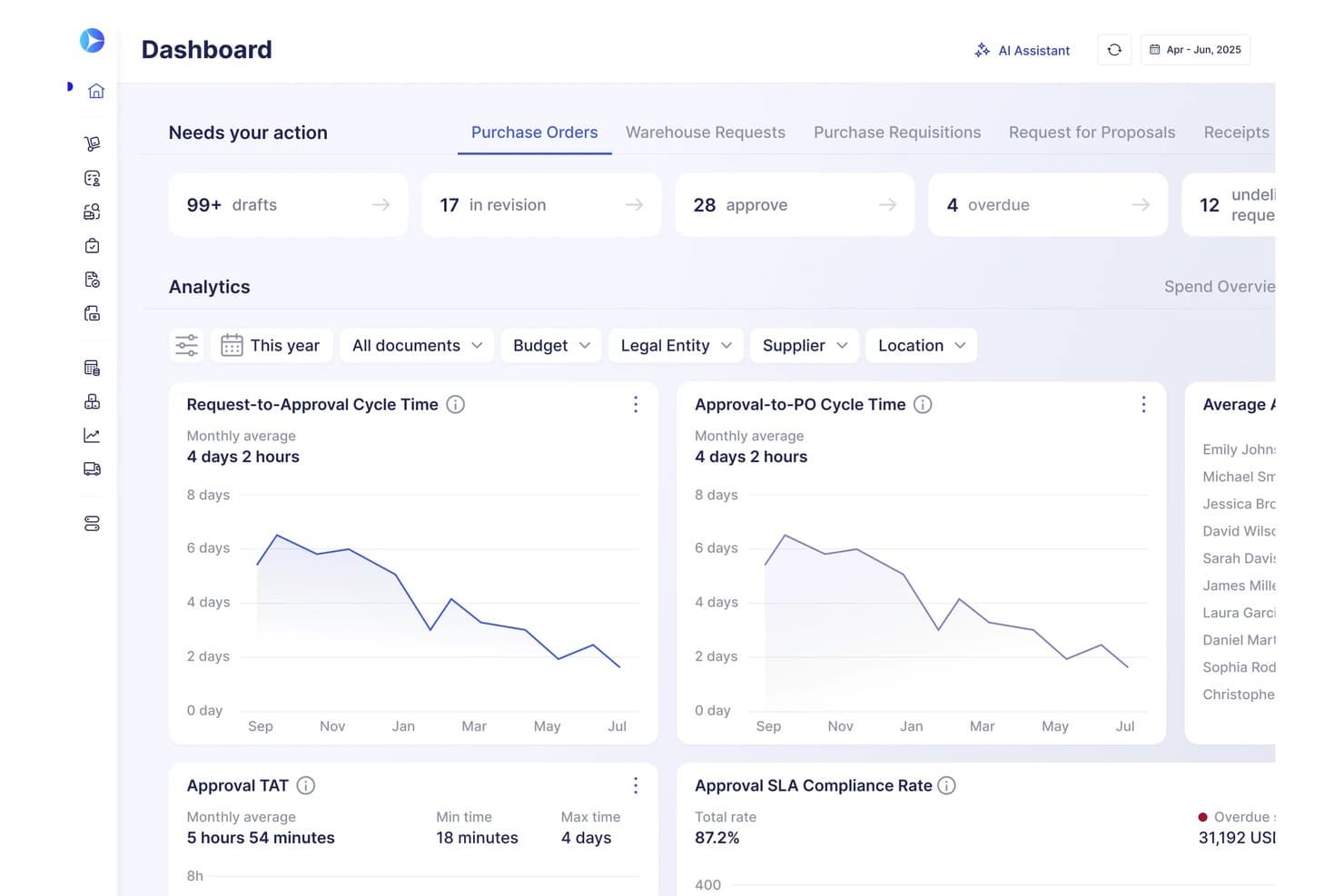
Precoro tracks procurement cycle times and approval metrics in one dashboard. Precoro is a procure-to-pay platform that centralizes purchase requisitions, approval workflows, purchase orders, invoice matching, supplier management, and AI-driven spend analysis in one system.
Who Is Precoro Best For?
Precoro is a strong fit for mid-market procurement and finance teams that need structured purchase-to-pay workflows with AI-assisted contract review and spend analysis.
Why I Picked Precoro
Precoro earns its spot on my shortlist because its AI contract agent does something I find genuinely useful: it scans uploaded PDFs and flags missing terms, conflicting clauses, and upcoming expiration dates before anyone signs. I also like that the AI Assistant goes beyond static dashboards by letting you ask direct questions about spend patterns, such as which suppliers are causing invoice delays or where duplicate purchases are piling up. That combination of contract intelligence and conversational spend analysis is what makes Precoro a strong fit for AI purchasing software.
Precoro Key Features
- Guided purchase requisition forms: Employees submit requests through structured forms that route automatically to the right approvers based on configured spending policies and department rules.
- Three-way invoice matching: Precoro matches invoices against both purchase orders and receipts, flagging price or quantity discrepancies for PO-initiator review before invoice approval proceeds.
- Real-time budget tracking: Committed spend is tracked against project, department, or location budgets as documents move through the approval workflow.
- Mobile procurement app: Available on iOS and Android, the app lets users create documents, approve or reject requests, track order status, and submit expenses from their phone.
Precoro Integrations
Precoro offers native integrations with NetSuite, QuickBooks Online, Xero, BILL, Power BI, Slack, and Microsoft Teams. It also provides an API and SFTP connector for custom data exchange.
Pros and Cons
Pros:
- Connected POs and invoices aid reconciliation
- Approval histories clarify pending purchasing decisions
- AI contract scans flag missing terms
Cons:
- Reporting filters and receipt workflows frustrate reviewers
- Beta AI outputs require human verification
Learn more about Precoro: Best for AI-driven PO buying in F&B and retail
- 90-day free trial
- From $100/month
Visit WebsiteCustomer Rating:4.3/5
LineNow lets users build and manage purchase orders with itemized pricing. LineNow is an AI purchasing software built for F&B and retail SMBs that automates PO creation from live inventory signals, parses supplier emails, and connects order records through receiving and accounting handoff.
Who Is LineNow Best For?
LineNow is a strong fit for F&B and retail SMBs whose purchasing teams manage high supplier email volume and need inventory-triggered PO creation without a full procurement suite.
Why I Picked LineNow
I picked LineNow as one of the best because of how it handles the PO creation process for F&B and retail buyers specifically. The AI reads inbound supplier emails and pulls out confirmations, price changes, and delivery updates automatically, so nothing gets lost in an inbox. I also like how it builds POs directly from live stock signals and reorder points, which means buyers aren't manually triggering orders.
LineNow Key Features
- Supplier portal: Suppliers can view and interact with orders directly through a dedicated portal, keeping communication tied to the original PO record.
- Receiving workflow: Built-in receiving checklists record what arrives against what was ordered, including variance and substitution tracking.
- Weekly procurement digest: LineNow AI generates a weekly summary of spend, inventory, and supplier activity with insights pulled from your live data.
- QuickBooks and Xero sync: Order and receiving data flows directly into your accounting software, reducing manual data entry at the AP handoff stage.
LineNow Integrations
Integration includes QuickBooks Online, Xero, Square, Shopify, Toast, Clover, Lightspeed, Amazon, and Faire.
Pros and Cons
Pros:
- Closed-loop PO, receiving, and accounting workflow
- PO creation triggered by live inventory signals
- AI parses supplier emails for order details
Cons:
- Lacks automated invoice matching and contract tools
- No multi-level approval or policy enforcement
Learn more about LineNow:

Suplari surfaces spend outliers and supplier insights automatically. Suplari is an AI-native procurement intelligence platform that layers over your existing ERP and P2P systems to deliver spend analytics, contract compliance monitoring, supplier risk tracking, and AI-driven anomaly detection.
Who Is Suplari Best For?
Suplari is a strong fit for enterprise procurement and finance teams that need deep spend visibility across complex, multi-ERP environments.
Why I Picked Suplari
I picked Suplari for its AI-powered spend and procurement intelligence, especially for teams managing purchasing data across multiple systems. Its 175+ prebuilt insights and automated spend classification help you identify maverick spend, pricing variances, and supplier consolidation opportunities. Suplari also compares contract terms against invoices and purchase orders, helping your team catch off-contract purchases and missed discounts. Its AI agents can continuously monitor procurement data for savings, compliance issues, and supplier risks. This makes it useful for purchasing teams that want AI to uncover opportunities from existing procurement data.
Suplari Key Features
- Suplari AI Studio: A no-code builder that lets your team create custom AI agents, workflows, and automations without engineering support.
- Supplier Risk Monitor Agent: Continuously tracks supplier financial health, geopolitical signals, and compliance status, alerting your team to emerging risks before they escalate.
- ESG Intelligence Software: Measures your organization's ESG exposure by actual spend amount, connecting supplier sustainability attributes and carbon tracking directly to purchasing data.
- Value Orchestration tracking: Follows every identified savings opportunity from detection through execution to confirmed P&L impact, giving you a verifiable audit trail for CFO reporting.
Suplari Integrations
Integrations include SAP, Oracle, Workday, Microsoft Dynamics, NetSuite, Coupa, SAP Ariba, Snowflake, and Databricks.
Pros and Cons
Pros:
- Natural language analysis for procurement insights
- Automates 95%+ spend classification tasks
- Surfaces contract leakage and maverick spend
Cons:
- Lacks traditional three-way invoice matching
- No purchase requisition or PO engine
Learn more about Suplari: Best for mobile-native procurement
- Not available
- Pricing upon request
Visit WebsiteCustomer Rating:4.4/5
GEP SMART is an AI-powered platform for spend analysis, sourcing, and supplier management. GEP SMART is an AI-powered procurement platform designed for businesses looking to optimize their source-to-pay processes. It caters to procurement teams by providing tools for spend analysis, sourcing, and supplier management.
Why I picked GEP SMART: It excels in AI-driven analytics, offering features that enhance decision-making in procurement. Your team can benefit from its spend analysis tools, which provide deep insights into procurement data. Its sourcing capabilities help you manage supplier relationships effectively. The platform's AI-driven features enable predictive analytics, which are crucial for strategic procurement planning. Fully native apps mean your team can access GEP anytime.
Standout features & integrations:
Features include spend analysis that helps you understand procurement patterns, sourcing tools to manage supplier relationships, and contract management for streamlined procurement processes. These features enhance your team's ability to make informed decisions.
Integrations include SAP, Oracle, JD Edwards, and PeopleSoft. Third‑party software is required for Microsoft Dynamics, Workday, Salesforce, and IBM.
Pros and Cons
Pros:
- Full mobile access for users
- Supports global operations
- Scalable for large enterprises
Cons:
- Extensive training necessary
- No free trial available
Learn more about GEP SMART: Best for spend management
- Free plan + 30-day free trial + free demo available
- Pricing upon request
Visit WebsiteCustomer Rating:4.2/5
Coupa is a spend management platform for expenses, procurement, and supplier collaboration. Coupa is a spend management platform designed for businesses that need to control costs and optimize procurement processes. It serves procurement, finance, and supply chain teams by providing tools for expense management and supplier collaboration.
Why I picked Coupa: It excels in spend management by offering features that enable businesses to track and manage expenses effectively. Your team can benefit from real-time spend visibility and compliance tracking, which are helpful for controlling costs. Coupa's budgeting tools help you align spending with business goals. Its detailed reporting capabilities provide insights that drive strategic decisions.
Standout features & integrations:
Features include predictive spend analytics that offer insights into spending patterns, real-time budget tracking for better financial control, and compliance management to ensure adherence to policies. These features help your team manage expenses efficiently and align spending with business goals.
Integrations include SAP, Oracle, Microsoft Dynamics, NetSuite. Third‑party software is required for Workday, Salesforce, Slack, Amazon Business, Docusign, and Google Workspace.
Pros and Cons
Pros:
- Real-time budget insights
- Strong compliance tracking
- Intuitive user interface
Cons:
- Occasional system lag
- Pricing details are not transparent
Learn more about Coupa:

SAP Ariba is a procurement platform for enterprise spend management and supplier collaboration. SAP Ariba is a procurement platform tailored for large enterprises seeking efficient spend management. It offers a suite for source-to-pay processes, catering to procurement teams that need robust data analytics and supplier collaboration.
Why I picked SAP Ariba: It excels in serving large enterprises by integrating AI-driven features that automate sourcing and approvals. You can develop smart category strategies, which is a great method for managing extensive procurement operations. With centralized data visibility, your team gains insights into spending patterns, enhancing decision-making. Its ability to adapt to procurement trends through automation is key for businesses dealing with complex supply chains.
Standout features & integrations:
Features include AI procurement strategies that automate sourcing, centralized data for spend visibility, and agile automation to adapt to trends. These capabilities help large teams manage procurement operations efficiently and make informed decisions, making it a strong choice for teams exploring modern procurement solutions.
Integrations include SAP ERP / S/4HANA. Third-party software is required for Oracle ERP Cloud, NetSuite, Microsoft Dynamics, JD Edwards, Workday, Salesforce, and IBM.
Pros and Cons
Pros:
- Flexible deployment options
- Advanced analytics
- Strong supplier network
Cons:
- Limited small business support
- Requires technical expertise
Learn more about SAP Ariba:

JAGGAER is a procurement platform for supplier management, sourcing, and spend analytics. JAGGAER is a comprehensive procurement platform designed for businesses involved in global sourcing. It serves procurement teams by offering tools for supplier management, sourcing, and spend analytics.
Why I picked JAGGAER: It focuses on global sourcing, providing features that support international procurement operations. Your team can use its supplier management tools to handle complex supplier relationships across different regions. The sourcing capabilities facilitate effective contract negotiations and compliance management. Its spend analytics offer insights that are crucial for strategic sourcing decisions on a global scale, making it one of the more capable procurement systems for global teams.
Standout features & integrations:
Features include spend analytics that provide insights into procurement data, helping your team make informed decisions. The contract management tools support the negotiation and compliance processes. Supplier management features allow you to maintain strong vendor relationships across diverse regions.
Integrations include SAP, Oracle, Microsoft Dynamics, and NetSuite. Third‑party software is required for Salesforce, Workday, IBM, JD Edwards, PeopleSoft, and Google Workspace.
Pros and Cons
Pros:
- Comprehensive spend analytics
- Strong compliance management
- Supports global procurement operations
Cons:
- No free trial available
- High technical requirements
Learn more about Jaggaer:

Ivalua is a procurement tool for supplier management, sourcing, and contract oversight. Ivalua is a procurement management platform designed for businesses seeking enhanced supplier collaboration. It serves procurement teams by providing tools for supplier management, sourcing, and contract management.
Why I picked Ivalua: It emphasizes supplier collaboration, offering features that strengthen supplier relationships. Your team can use its supplier management tools to track and evaluate supplier performance. The sourcing capabilities facilitate better negotiation and contract management processes. Its analytics offer insights into supplier interactions, supporting strategic procurement decisions.
Standout features & integrations:
Features include contract management that helps you streamline agreements and ensure compliance. Its sourcing tools assist your team in negotiating better deals. The platform's analytics provide valuable insights into procurement data, aiding strategic planning.
Integrations include SAP, Oracle, Microsoft Dynamics, NetSuite. Third‑party software is required for Salesforce, Workday, JD Edwards, Google Workspace, IBM, and PeopleSoft.
Pros and Cons
Pros:
- Provides detailed analytics
- Strong contract management
- Enhances supplier collaboration
Cons:
- Limited mobile functionality
- Steep learning curve
Learn more about Ivalua:

Resilinc is a supply chain tool for assessing, monitoring, and mitigating operational risks. Resilinc is a supply chain risk management platform designed for businesses that need to enhance their supply chain resilience. It serves supply chain managers by providing tools for risk assessment, monitoring, and mitigation strategies.
Why I picked Resilinc: It excels in supply chain resilience by offering features that help you identify and mitigate risks. Your team can leverage its risk assessment tools to evaluate potential vulnerabilities in your supply chain. The platform provides real-time monitoring of supply chain disruptions, keeping you informed of potential threats. Its mitigation strategies ensure you can respond quickly and effectively to any disruptions.
Standout features & integrations:
Features include risk assessment tools that help you analyze potential supply chain vulnerabilities. Real-time monitoring keeps your team informed of any disruptions, allowing for quick responses. The platform's mitigation strategies, such as multi-tier supply mapping, help with handling disruptions effectively and maintaining supply chain integrity.
Integrations include SAP and Oracle. Third‑party software is required for Microsoft Dynamics, Salesforce, Workday, NetSuite, IBM, JD Edwards, PeopleSoft, and Google Workspace.
Pros and Cons
Pros:
- Effective mitigation strategies
- Real-time disruption monitoring
- Strong risk assessment capabilities
Cons:
- High learning curve
- Not ideal for small businesses
Learn more about Resilinc:

ProcureDesk is a tool that automates purchase order creation and approval workflows. ProcureDesk is a procurement software solution designed for businesses looking to enhance their purchase order processes. It primarily serves procurement teams by automating purchase order creation and approval workflows.
Why I picked ProcureDesk: It focuses on purchase order management, providing tools that simplify and automate the entire process. Your team can benefit from automated approval workflows, reducing the time spent on manual work. The software also offers real-time tracking of purchase orders, ensuring transparency and accuracy. Its user-friendly interface allows your team to quickly adapt and manage procurement tasks efficiently.
Standout features & integrations:
Features include real-time budget tracking that helps your team maintain financial control by monitoring spending against budgets. The reporting tools provide insights into purchasing patterns, supporting data-driven decisions. The software's customizable workflows allow you to tailor processes to fit your business needs.
Integrations include QuickBooks, Xero, and SAP. Third‑party software is required for NetSuite, Microsoft Dynamics, Sage, and Salesforce.
Pros and Cons
Pros:
- Customizable workflow options
- Automates purchase workflows
- Efficient purchase order tracking
Cons:
- Not suited for very large enterprises
- Limited advanced features
Learn more about ProcureDesk:
Alte software-uri de achiziții bazate pe inteligență artificială
Iată câteva opțiuni suplimentare de software de achiziții bazate pe inteligență artificială care nu au ajuns pe lista mea scurtă, dar care merită totuși analizate:
- 11GlobalityBest for complex purchasing
- 12Procure.aiBest for automated workflows
- 13Purchasing.aiBest for small businesses
- 14ProcurifyBest for budget control
- 15TropicBest for vendor management
- 16PurchaserBest for automated procurement
- 17HashMicro AI Procurement SoftwareBest for ERP integration
- 18Nova AI (Wonnda)Best for product sourcing
- 19Accio (Alibaba)Best for global market access
- 20LevelpathBest for user-friendly interface
How I Evaluate AI Purchasing Software
Every tool here needs to deliver real AI value—I look for platforms that actually automate PO routing, catch invoice mismatches, or flag spend anomalies. I split my evaluation into two layers: the core functionality a tool needs to make the list and the differentiating factors that set vendors apart.
Core Functionality (Table Stakes For This List)
When I'm selecting tools for my list, I rank each one on a scale from 0 (does not offer the functionality) to 5 (excels in this area) for each core functionality listed below. Then, I calculate the tool's total score into a percentage. Each tool needs to achieve a minimum total score of 65% to be considered for inclusion.
- AI-Powered PO Automation: I look for platforms where AI auto-generates POs from requests, codes line items to the right GL accounts, and routes them without manual input.
- Intelligent Invoice Matching: A strong tool catches mismatches between POs, invoices, and receipts automatically—flagging duplicate charges or quantity errors before payment.
- Spend Analytics & Visibility: I evaluate whether dashboards surface real-time spend by category, vendor, and department so controllers can spot budget overruns early.
- Approval Workflow Engine: The platform should let you configure multi-tier routing rules—like escalating requests over a set threshold to a department head and then a CFO.
- Vendor & Catalog Management: I check for supplier onboarding portals and catalog support, such as punchout connections to preferred vendors that keep buying on-contract.
- ERP & Accounting Integrations: Tools like Coupa, Precoro, and Order.co each handle ERP syncs differently, so I evaluate depth of native connectors for systems like NetSuite and SAP.
Once I have a list of tools that meet the criteria, I consider what sets each platform apart.
Differentiating Factors (What Sets Vendors Apart)
Here's how I compare and contrast different vendors:
Standout Features
Virtual corporate cards tied to approved POs help finance teams lock down spend at the point of purchase. Single-use cards for one-time vendors are especially useful. I also look for AI contract intelligence that extracts renewal dates and pricing from vendor agreements. This helps AP leads catch overbilling before it hits the books. Real-time budget intake and forecasting matters too, especially when it ties requisitions to departmental budgets. Controllers can see a purchase's projected impact before approving it.
Beyond Features
Security and compliance certifications weigh heavily in my evaluation. Finance teams handling purchasing data need SOC 2 Type II coverage and SOX-ready audit trails with segregation of duties built in. Pricing structure matters too—I compare per-seat models against unlimited-user plans, since purchasing tools touch everyone from requesters to approvers. I also consider implementation speed. Some platforms ship with pre-built workflow templates and GL mappings that get teams live in weeks rather than months.
Cum să alegeți
Este ușor să vă pierdeți în liste lungi de funcții și structuri complexe de prețuri. Pentru a vă ajuta să rămâneți concentrați în timp ce parcurgeți procesul de selecție a software-ului, iată o listă de verificare a factorilor de care trebuie să țineți cont:
| Factor | Ce trebuie luat în considerare |
|---|---|
| FactorScalabilitate | Ce trebuie luat în considerarePoate software-ul să susțină dezvoltarea afacerii dumneavoastră? Verificați dacă poate gestiona volume mai mari de tranzacții și un număr mai mare de utilizatori pe măsură ce compania se extinde. |
| FactorIntegrări | Ce trebuie luat în considerareSe integrează cu sistemele existente, precum software-ul ERP și cel de contabilitate? Verificați compatibilitatea și ușurința transferului de date. |
| FactorPosibilități de personalizare | Ce trebuie luat în considerarePuteți adapta software-ul pentru a se potrivi fluxurilor dumneavoastră de lucru specifice? Căutați tablouri de bord și procese personalizabile, aliniate la nevoile afacerii dumneavoastră. |
| FactorUșurința utilizării | Ce trebuie luat în considerareEste software-ul intuitiv pentru echipa dumneavoastră? O interfață ușor de utilizat reduce timpul de instruire și crește rata de adoptare. |
| FactorImplementare și integrare inițială | Ce trebuie luat în considerareCât timp va dura să fie pus în funcțiune? Luați în considerare complexitatea configurării și disponibilitatea resurselor de instruire pentru a vă sprijini echipa. |
| FactorCost | Ce trebuie luat în considerareSe încadrează prețul în bugetul dumneavoastră? Comparați costurile între furnizori, inclusiv eventualele taxe suplimentare pentru funcții sau utilizatori adiționali. |
| FactorMăsuri de securitate | Ce trebuie luat în considerareSunt protejate datele și tranzacțiile dumneavoastră? Evaluați conformitatea software-ului cu standardele de securitate, precum criptarea și controalele de acces. |
| FactorDisponibilitatea asistenței | Ce trebuie luat în considerareEste disponibil ajutorul atunci când aveți nevoie de el? Căutați opțiuni de asistență 24/7 și luați în considerare calitatea serviciului pentru clienți pe baza recenziilor și a timpilor de răspuns. |
Ce este software-ul de achiziții bazat pe inteligență artificială?
Software-ul de achiziții bazat pe inteligență artificială este un instrument care automatizează și optimizează procesele de achiziție pentru companii. Profesioniștii din domeniul achizițiilor, managerii lanțului de aprovizionare și echipele financiare folosesc aceste instrumente pentru a spori eficiența și a reduce costurile. Funcțiile de automatizare a comenzilor de achiziție, de gestionare a furnizorilor și de monitorizare a cheltuielilor contribuie la îmbunătățirea procesului decizional, la asigurarea conformității și la controlul bugetului. În general, aceste instrumente simplifică achizițiile și îmbunătățesc eficiența operațională.
Funcții
Atunci când selectați un software de achiziții bazat pe inteligență artificială, urmăriți următoarele funcții esențiale:
- Automatizarea comenzilor de achiziție: Sprijină crearea comenzilor și reduce introducerea manuală a datelor, economisind timp și minimizând erorile.
- Gestionarea furnizorilor: Ajută la urmărirea și evaluarea performanței furnizorilor, asigurând relații solide cu aceștia și negocieri mai bune.
- Urmărirea cheltuielilor: Monitorizează cheltuielile și bugetele, oferind informații utile pentru planificarea și controlul financiar.
- Fluxuri de lucru personalizabile: Vă permite să adaptați procesele la nevoile specifice ale afacerii dumneavoastră și să îmbunătățiți eficiența.
- Colaborare în timp real: Facilitează comunicarea cu furnizorii, îmbunătățind rezultatele proiectelor și eficiența achizițiilor.
- Urmărirea bugetului: Menține cheltuielile sub control comparând cheltuielile efective cu bugetele alocate.
- Gestionarea conformității: Asigură respectarea politicilor și reglementărilor companiei, reducând riscul de neconformitate.
- Gestionarea mai multor entități: Sprijină operațiunile financiare ale mai multor unități de afaceri, simplificând structurile organizaționale complexe.
- Interfață ușor de utilizat: Oferă un design intuitiv care reduce timpul de instruire și îmbunătățește adoptarea de către utilizatori.
Beneficii
Implementarea unui software de achiziții bazat pe inteligență artificială oferă mai multe beneficii pentru echipa și afacerea dumneavoastră. Iată câteva dintre acestea:
- Eficiență sporită: Automatizarea comenzilor de achiziție și a aprobărilor economisește timp și reduce sarcinile manuale, permițând echipei dumneavoastră să se concentreze asupra activităților strategice.
- Economii de costuri: Urmărirea cheltuielilor și analizele predictive ajută la identificarea oportunităților de reducere a costurilor și la optimizarea bugetelor de achiziții.
- Relații îmbunătățite cu furnizorii: Funcțiile de gestionare a furnizorilor asigură comunicarea constantă și evaluarea performanței, favorizând parteneriate mai solide cu furnizorii.
- Îmbunătățirea luării deciziilor: Datele și analizele în timp real oferă informații care sprijină deciziile de achiziție bine fundamentate și planificarea strategică.
- Conformitate mai bună: Instrumentele de gestionare a conformității ajută echipa dumneavoastră să respecte reglementările și politicile companiei, reducând riscul sancțiunilor.
- Scalabilitate: Gestionarea mai multor entități sprijină dezvoltarea afacerii prin gestionarea unui volum crescut de tranzacții și a extinderii operațiunilor.
Costuri și prețuri
Selectarea unui software de achiziții bazat pe inteligență artificială necesită înțelegerea diferitelor modele și planuri de tarifare disponibile. Costurile variază în funcție de funcții, dimensiunea echipei, modulele suplimentare și alți factori. Tabelul de mai jos rezumă planurile uzuale, prețurile medii ale acestora și funcțiile incluse de obicei în soluțiile software de achiziții bazate pe inteligență artificială:
Tabel comparativ al planurilor pentru software de achiziții bazat pe inteligență artificială
| Tipul planului | Preț mediu | Funcții comune |
|---|---|---|
| Tipul planuluiPlan gratuit | Preț mediu$0 | Funcții comuneGestionarea de bază a comenzilor de achiziție, gestionarea limitată a furnizorilor și raportare de bază. |
| Tipul planuluiPlan individual | Preț mediu$70-$100/utilizator/lună | Funcții comuneAutomatizarea comenzilor de achiziție, urmărirea cheltuielilor, gestionarea furnizorilor și analize simple. |
| Tipul planuluiPlan pentru companii | Preț mediu$100-$850/utilizator/lună | Funcții comuneGestionarea avansată a furnizorilor, urmărirea bugetului, gestionarea conformității și fluxuri de lucru personalizabile. |
| Tipul planuluiPlan pentru întreprinderi | Preț mediu$800-$2500+/lună. | Funcții comuneGestionarea mai multor entități, analize predictive, colaborare în timp real și personalizare completă. |
Întrebări frecvente despre software-ul de achiziții bazat pe inteligență artificială
Iată câteva răspunsuri la întrebările frecvente despre software-ul de achiziții bazat pe inteligență artificială:
Se poate integra software-ul de achiziții bazat pe inteligență artificială cu sistemele existente?
Da, majoritatea programelor software de achiziții bazate pe inteligență artificială se pot integra cu sistemele existente, precum software-ul ERP și cel de contabilitate. Această integrare asigură consecvența datelor și reduce introducerea manuală a acestora. Înainte de achiziție, verificați dacă software-ul acceptă sistemele utilizate deja de echipa dumneavoastră. Dacă utilizați QuickBooks, căutați un software cu integrare nativă QuickBooks pentru a simplifica urmărirea financiară.
Cum gestionează software-ul de achiziții bazat pe inteligență artificială securitatea datelor?
Software-ul de achiziții bazat pe inteligență artificială include de obicei funcții de securitate precum criptarea și controalele de acces pentru a vă proteja datele. Înainte de a alege un instrument, analizați protocoalele sale de securitate și conformitatea cu standardele din industrie. Asigurați-vă că software-ul este aliniat la politicile companiei dumneavoastră privind protecția datelor. Luați în considerare instrumente care oferă actualizări și audituri de securitate periodice pentru un plus de siguranță.
Este necesară instruirea pentru utilizarea software-ului de achiziții bazat pe inteligență artificială?
Da, instruirea este adesea necesară, însă amploarea acesteia depinde de complexitatea software-ului. Mulți furnizori oferă resurse de instruire precum videoclipuri, seminare online și ghiduri de utilizare pentru a ajuta echipa să se familiarizeze rapid cu produsul. Alegeți un software cu asistență completă pentru integrare, pentru a minimiza întreruperile. Dacă echipa dumneavoastră nu a mai utilizat software de achiziții, căutați instrumente cu interfețe intuitive pentru a facilita tranziția.
Ce urmează:
Dacă sunteți în procesul de cercetare a unui software de achiziții bazat pe inteligență artificială, contactați gratuit un consultant SoftwareSelect pentru recomandări.
Completați un formular și aveți o scurtă discuție în care intră în detaliile nevoilor dumneavoastră. Apoi veți primi o listă scurtă de programe software pe care să le evaluați. Vă vor sprijini chiar pe parcursul întregului proces de achiziție, inclusiv în negocierile de preț.