


Dext vs. Briefcase: Comparison and Expert Reviews for 2026
Dext and Briefcase are AI accounting tools designed to reduce repetitive bookkeeping and give finance teams more breathing room. Learn how they approach automation, bookkeeping workflows, and day-to-day accounting work.

We review tools independently, and commissions help fund our testing. See our transparency policy, our methodology, or suggest a tool.
Keeping books current is hard enough without adding receipt chasing, repetitive coding, and constant review work to the mix. For CFOs and accounting teams, the real question is not whether to automate but which tool fits how they already work.
Dext and Briefcase both sit within the bookkeeping automation software category, but they approach automation from different angles. Dext combines document extraction, expense management, practice workflows, and data-quality tools, while Briefcase focuses on AI-led bookkeeping for firms working in Xero and QuickBooks.
In this comparison, I’ll look at their features, pricing, usability, security, strengths, limitations, and best-fit use cases so you can see which one better matches your team’s workload and priorities.
Dext
4.5/5
- 14-day free trial
- Pricing upon request
Briefcase
5/5
- 14-day free trial
- From $12/client/month
Why Trust Our Software Recommendations
6,700+
Reviews
20
Industry experts
16+
Evaluation factors
14
Years
Our team has been testing and reviewing software since 2012. As finance leaders ourselves, we know how difficult—and important—it is to choose the right software.
For this guide, we evaluated tools using hands-on testing and independent research, scoring tools using our selection criteria.
Our reviews reflect our human editorial judgment, not a sales pitch.
| Dext | Briefcase | |
|---|---|---|
| Free Trial | 14-day free trial | 14-day free trial |
| Pricing | Pricing upon request | From $12/client/month |
Dext vs. Briefcase Pricing & Hidden Costs
Dext uses separate pricing models for businesses and accounting practices. Business pricing depends on document allowances and optional add-ons, while practices pay per client and choose between Essentials and Advanced. As a result, costs can increase with paid AI Assist options, advanced extraction, Data Health & Insights, Commerce Lite, or extra Vault storage. Briefcase, meanwhile, includes all AI features, unlimited users, line-item extraction, and close automation across every tier, with pricing based solely on quarterly document volume. However, bank statement extraction and supplier statement reconciliation each count as two documents, so heavier usage can push teams into a higher plan.
Therefore, buyers should compare expected total usage rather than monthly prices alone. Dext may offer better value for firms that need broader practice controls and modular tools, whereas Briefcase is easier to budget for when document volumes are predictable. Before choosing, estimate your quarterly receipts, invoices, bank statements, and supplier statements, then factor in Dext’s likely add-ons or Briefcase’s higher usage tier.
| Dext | Briefcase | |
|---|---|---|
| 2-Factor Authentication | Yes | Yes |
| API | Yes | Yes |
| Balance Sheet | Yes | Yes |
| Billing/Invoicing | Yes | No |
| Budgeting | No | No |
| Calendar Management | No | No |
| Contact Management | Yes | No |
| CRM Integration | No | No |
| Customer Management | Yes | No |
| Dashboard | Yes | Yes |
| Data Export | Yes | Yes |
| Data Import | Yes | Yes |
| Data Visualization | Yes | Yes |
| Expense Tracking | Yes | Yes |
| External Integrations | Yes | Yes |
| Forecasting | No | Yes |
| Inventory Tracking | Yes | No |
| Multi-Currency | Yes | Yes |
| Multi-User | Yes | Yes |
| Notifications | Yes | No |
| P&L | Yes | No |
| SAP Integration | Yes | No |
| Supplier Management | Yes | Yes |
| Integration | Dext | Briefcase |
|---|---|---|
| IntegrationXero | Dext✅ | Briefcase✅ |
| IntegrationQuickBooks Online | Dext✅ | Briefcase✅ |
| IntegrationSage Business Cloud | Dext✅ | Briefcase❌ |
| IntegrationFreeAgent | Dext✅ | Briefcase❌ |
| IntegrationMYOB | Dext✅ | Briefcase❌ |
| IntegrationBill.com | Dext✅ | Briefcase❌ |
| IntegrationZoho Books | Dext✅ | Briefcase❌ |
| IntegrationKashFlow | Dext✅ | Briefcase❌ |
| IntegrationAPI | Dext✅¹ | Briefcase❌² |
| IntegrationZapier | Dext✅ | Briefcase❌ |
¹ Product-specific APIs
²No public API listed
❌ No integration publicly listed as of July 2026
Both Dext and Briefcase integrate with core accounting platforms, but they take different approaches to connectivity. Dext prioritizes breadth, supporting more than 36 accounting systems alongside Zapier and product-specific APIs, which makes it easier to fit into varied finance stacks. Briefcase, by contrast, keeps its ecosystem tightly centered on Xero and QuickBooks, favoring a more focused setup for firms already standardized on those platforms. Overall, Dext offers greater integration flexibility, while Briefcase keeps the experience simpler and more specialized.
| Factor | Dext | Briefcase |
|---|---|---|
| FactorCertifications & Privacy | DextCertified under ISO/IEC 27001:2022 and ISO 9001, with GDPR-compliant data processing and a published Data Processing Agreement. | BriefcaseComplies with UK GDPR and the Data Protection Act 2018. Its public materials do not list ISO 27001 or SOC 2 certification. |
| FactorEncryption & Data Protection | DextUses bank-level encryption, secure information-transfer controls, cryptography policies, and cloud-security safeguards for uploaded and synced financial data. | BriefcaseEncrypts data in transit with TLS 1.2+ and at rest with AES-256, while customer data is logically separated within its database. |
| FactorAccess & Authentication | DextSupports role-based access, approval controls, 2FA, audit trails, and secure development controls. Dext Payments also requires PSD2-compliant Strong Customer Authentication for payment submission. | BriefcaseUses role-based access controls and audit logging, with access limited to authorized personnel. |
| FactorPayments & Fund Protection | DextFor eligible UK customers using Xero, Dext Payments keeps wallet funds segregated and safeguarded through regulated Airwallex infrastructure. It also uses supplier verification, staged approvals, payment thresholds, and fraud-risk warnings before funds are released. | BriefcaseDoes not currently offer an equivalent embedded supplier-payment product, so payment safeguarding and PSD2 controls are not applicable. |
| FactorReliability & Continuity | DextReports 99.97% uptime and publishes a live status page. Its Trust Center also covers information backups, capacity management, ICT readiness, and business continuity and disaster recovery controls. | BriefcaseUses Betterstack for continuous infrastructure and application monitoring, but does not publish a formal uptime SLA or detailed backup and recovery commitments. |
Both platforms provide solid encryption, access controls, and privacy protections. However, Dext offers stronger formal assurance through ISO certifications, published continuity controls, documented uptime, and regulated payment safeguards. Briefcase is notably transparent about its encryption and AI data handling, although firms with formal procurement requirements may need to request independent audit, uptime, and disaster-recovery documentation.
| Factor | Dext | Briefcase |
|---|---|---|
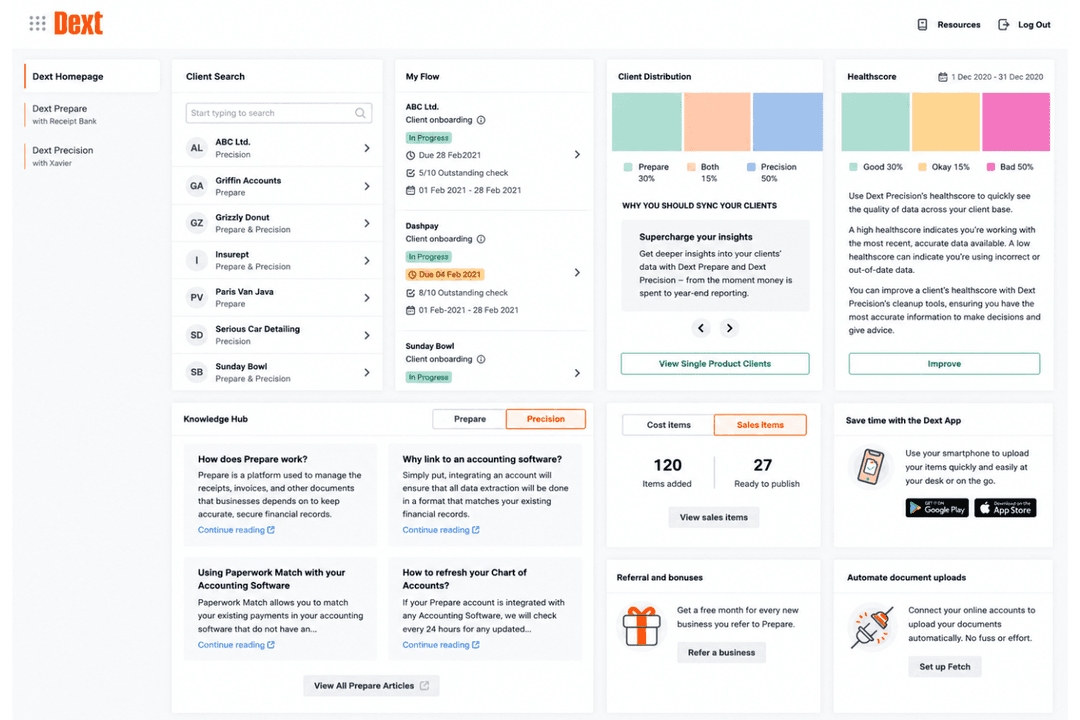
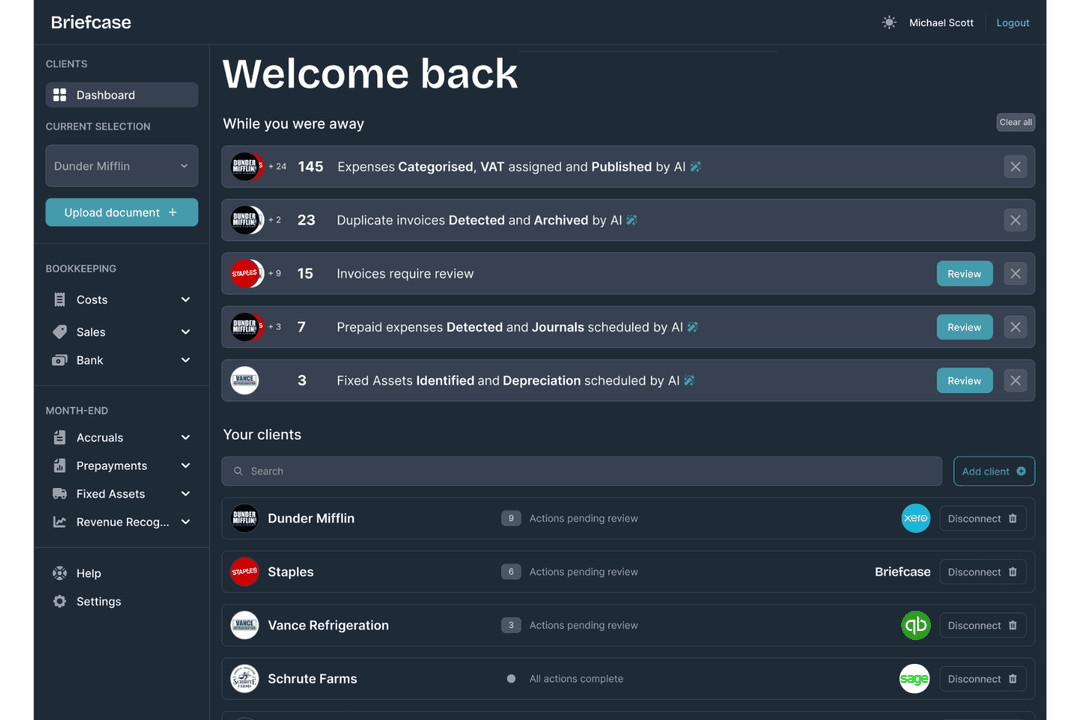
| FactorUser Interface | DextDedicated web and mobile workspaces organize document capture, expenses, publishing, client activity, and practice oversight, giving finance teams broad visibility across bookkeeping operations. | BriefcaseA focused web interface keeps AI-processed transactions, reviews, and publishing to Xero or QuickBooks relatively simple. |
| FactorOnboarding | DextAutomated checklists, product tours, banners, videos, and role-based Intercom guidance walk users through setup, although permissions, approval workflows, and advanced practice tools require more configuration. | BriefcaseOnboarding centers on connecting a Xero or QuickBooks account and testing the AI during a 14-day trial, although less public detail is available on its formal training process. |
| FactorSetup | DextCore capture tools are quick to adopt, while firms can gradually configure Supplier Rules, Auto-Publish, ledger connections, team permissions, client assignments, and recurring practice workflows. | BriefcaseIts narrower Xero and QuickBooks focus reduces the number of integrations and workflow settings teams need to configure. |
| FactorSupport | DextProvides 24/5 human support, Fin AI assistance, an extensive Help Centre, and plan-dependent access to training, account managers, and customer success guidance. | BriefcaseEmail support is available, but its public materials provide limited detail on service hours or dedicated account management. |
| FactorMobile & Workflow Experience | DextNative iOS and Android apps support receipt capture, expenses, mileage, and client submissions, while approvals, automation rules, and practice workflows let teams decide where human review is still needed. | BriefcaseEmail and WhatsApp uploads feed documents into AI-led coding, reconciliation, close, and auto-publishing workflows. |
From an ease-of-use perspective, Dext offers the more complete and guided experience, especially for firms balancing mobile submissions, client collaboration, and practice-wide oversight. Its wider feature set requires more initial configuration, but teams gain clearer control over permissions, rules, approvals, and recurring work. Briefcase is leaner for firms already committed to Xero or QuickBooks that prefer a more automation-first workflow.
Dext
- Proprietary AI and automation rules reduce manual bookkeeping across high document volumes.
- Practice Advanced adds smart workflows, team controls, and firm-wide performance visibility.
- Data Health & Insights helps Xero and QuickBooks Online users catch and fix errors faster.
- Plans, allowances, and overage charges can make pricing difficult to predict.
- Firms may still spend time chasing clients for missing receipts and invoices.
- Fetch, Sage Line 50, and complex ecommerce setups offer more limited automation.
Briefcase
- Automates invoice data extraction and categorization with high accuracy
- Offers real-time financial dashboards and reporting tools
- Slack integration streamlines approvals and communication in-app
- No built-in payroll or HR modules available yet
- Limited support for complex global tax compliance needs
- Custom reporting options are not fully flexible
Dext
- Accounting FirmsMulti-client dashboards, automation rules, workflows, and data-quality tools help firms manage more client work without adding the same amount of manual processing.
- Small and Mid-Sized BusinessesReceipt capture, automated extraction, and expense workflows reduce the time internal teams spend entering and organizing bookkeeping data.
- Multi-Entity Businesses and FranchisesConsistent rules, centralized document collection, and accounting integrations support businesses managing several entities, branches, or locations.
- Retail and Ecommerce BusinessesDext helps process supplier invoices, employee expenses, and ecommerce sales data for businesses with relatively straightforward online selling setups.
- Real Estate and Construction BusinessesMobile capture and expense approvals make it easier to collect receipts and invoices from properties, job sites, employees, and contractors.
- Hospitality and Wellness BusinessesBusinesses handling frequent supplier bills and staff expenses can use Dext to keep documents organized and move data into their bookkeeping software faster.
Briefcase
- SaaS StartupsBriefcase fits SaaS startups that need to digitize all finance ops quickly—its Slack integration and AI routing boost speed and accuracy.
- Marketing AgenciesAgencies handling multiple clients benefit from fast expense approvals and clear audit trails to keep client billing transparent.
- Hybrid WorkplacesCompanies with distributed finance teams can approve, track, and reconcile on the go with Briefcase’s real-time, cloud-based dashboards.
- Series A Finance TeamsEarly-stage but growing companies can automate payables and reporting, freeing up lean teams to focus on analysis.
- Professional Services FirmsFirms with frequent billable hours and client reimbursements get value from categorized expenses and built-in documentation matching.
- Nonprofit Finance DepartmentsNonprofits managing grants and donor funds gain from real-time spend tracking and audit-ready activity logs built into Briefcase.
Who Should Use Dext, and Who Should Use Briefcase?
If you need an established AI accounting platform that combines document capture, expense management, mobile workflows, practice controls, and integrations across more than 36 accounting systems, Dext is likely the better fit. It is especially well suited to accounting firms, CFO-led finance teams, and multi-entity businesses that want reliable automation without losing visibility or control over client work.
If, instead, your firm already runs on Xero or QuickBooks and wants AI to take a more autonomous role in coding, reconciliation, close tasks, and publishing, Briefcase may suit you better. Its narrower focus creates a leaner workflow for accountants and bookkeepers who are comfortable handing more routine bookkeeping decisions to an AI autopilot.
| Dext | Briefcase | |
|---|---|---|
| Accounting Ecosystem | Dext Connects with more than 36 accounting platforms, including Xero, QuickBooks, Sage, FreeAgent, MYOB, and KashFlow. | Briefcase Centers its product experience on Xero and QuickBooks rather than supporting a wider range of accounting systems. |
| AI Approach | Dext Combines proprietary extraction models, Supplier Rules, Auto-Publish, and AI Assist, while letting accountants review and control final coding decisions. | Briefcase Uses AI to learn from ledger history and corrections, complete bookkeeping tasks, and auto-publish transactions when confidence is high. |
| Mobile and Client Workflows | Dext Native mobile apps, mileage tracking, expense claims, Item Messaging, and missing-paperwork requests help firms collect information from clients and employees. | Briefcase Relies mainly on web-based workflows, email, and WhatsApp submissions, without a comparable native mobile bookkeeping app. |
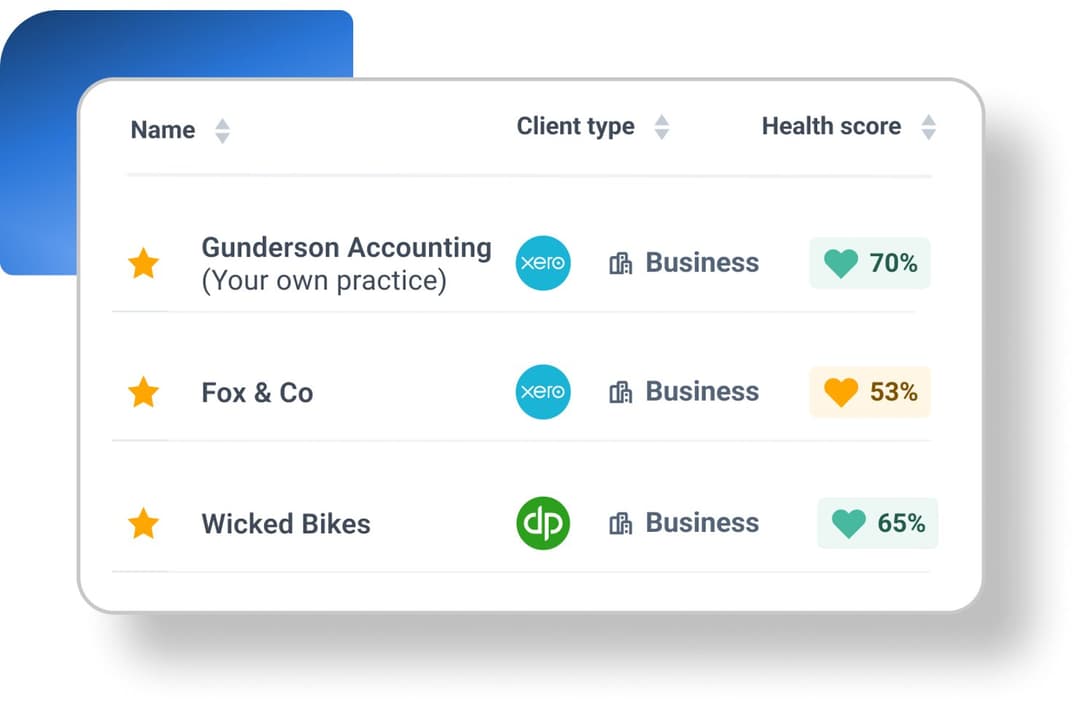
| Practice Oversight | Dext Practice Advanced adds client assignments, deadlines, smart workflows, team controls, advanced client management, and practice-level reporting, while the Data Health & Insights add-on provides Health Scores and data-quality checks. | Briefcase Concentrates more on completing transaction-level and period-end work than on providing broad practice-management controls. |
| Product Scope | Dext Covers document capture, expense management, approvals, supplier payments in supported regions, client data health, and practice-wide workflow management. | Briefcase Focuses more tightly on AI-led bookkeeping, from invoice processing and coding through reconciliation and financial close. |
| AI-Assisted Coding | Both use accounting context, historical ledger activity, and previous user decisions to suggest or apply categories, tax treatments, and other transaction-level bookkeeping details. |
|---|---|
| Bookkeeping Efficiency | Both aim to reduce repetitive capture, coding, reconciliation, and review work so finance professionals can spend more time on close quality, analysis, and client guidance. |
| Document Processing | Both capture receipts, invoices, credit notes, and supporting documents, extract the relevant financial details, and reduce the need for accountants to re-enter information manually. |
| Human Review and Control | Both let accountants review and correct AI-generated decisions, although Briefcase can automatically publish high-confidence transactions without prior review. |
| Team Access | Both support multiple users and role-based access, allowing firms to control who can review, process, and manage accounting data. |