

Gatekeeper Review: Pros, Cons, Features and Pricing
Gatekeeper stands out for its user-friendly interface and adaptability, making it a top choice for teams seeking reliable financial compliance solutions.

We review tools independently, and commissions help fund our testing. See our transparency policy, our methodology, or suggest a tool.
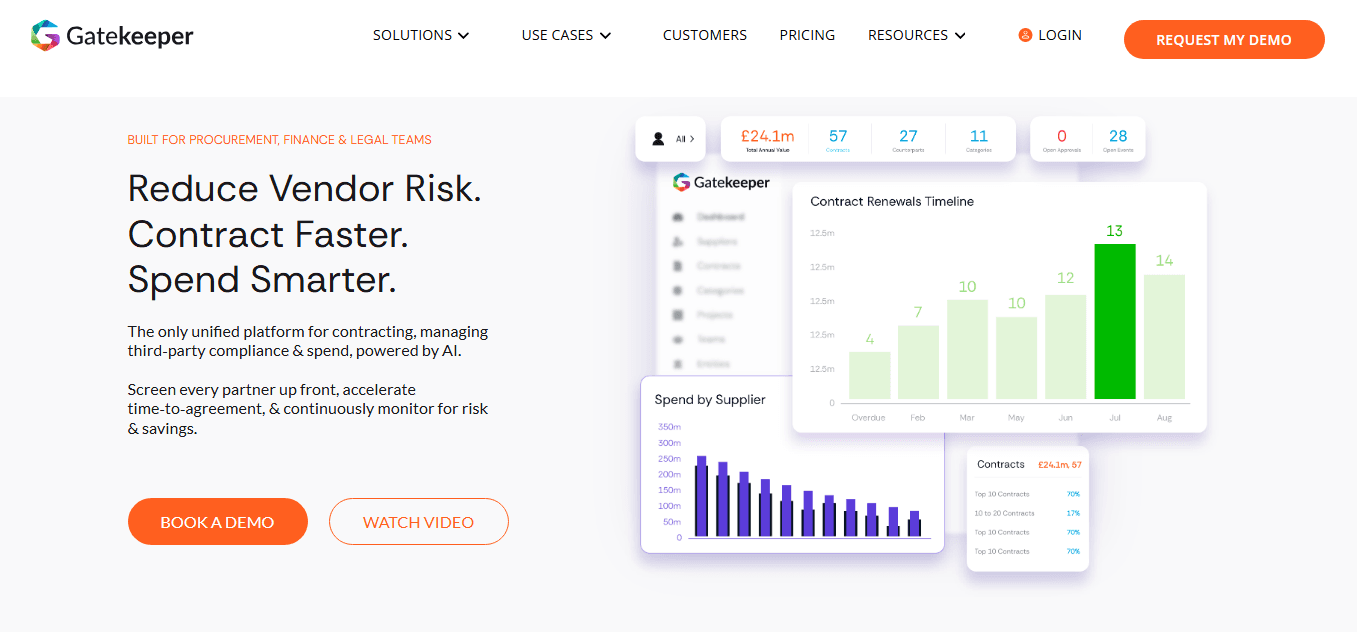
Gatekeeper is a financial compliance software platform built around contract lifecycle management and vendor oversight. It's a strong fit for finance teams that need to track contract obligations, monitor vendor risk, and maintain audit-ready compliance records in a single system. I'd consider it over a tool like Ironclad if your team needs vendor management built directly into your contract workflows—rather than a platform designed primarily around legal team use cases.
Gatekeeper Evaluation Summary
4.5/5
- Pricing upon request
- Free demo available
Why Trust Our Software Recommendations
6,700+
Reviews
20
Industry experts
16+
Evaluation factors
14
Years
Our team has been testing and reviewing software since 2012. As finance leaders ourselves, we know how difficult—and important—it is to choose the right software.
For this guide, we evaluated tools using hands-on testing and independent research, scoring tools using our selection criteria.
Our reviews reflect our human editorial judgment, not a sales pitch.
Gatekeeper Overview
In my opinion, Gatekeeper is a solid choice for Financial Compliance Software, especially for teams focused on vendor management and compliance review. It offers a user-friendly interface and notable features that stand out in the market. However, it may not be the best fit for smaller organizations with limited budgets due to its pricing structure. Compared to competitors, Gatekeeper excels in ease of use but lags slightly in onboarding support. It best suits finance and risk teams in medium to large enterprises that need reliable contract data and compliance solutions. If you're weighing options, consider Gatekeeper for its adaptability and strong customer support, but ensure it aligns with your budget and onboarding expectations.
Pros
- Gatekeeper simplifies vendor management and supplier management for your team.
- Intuitive user interface that’s easy to navigate.
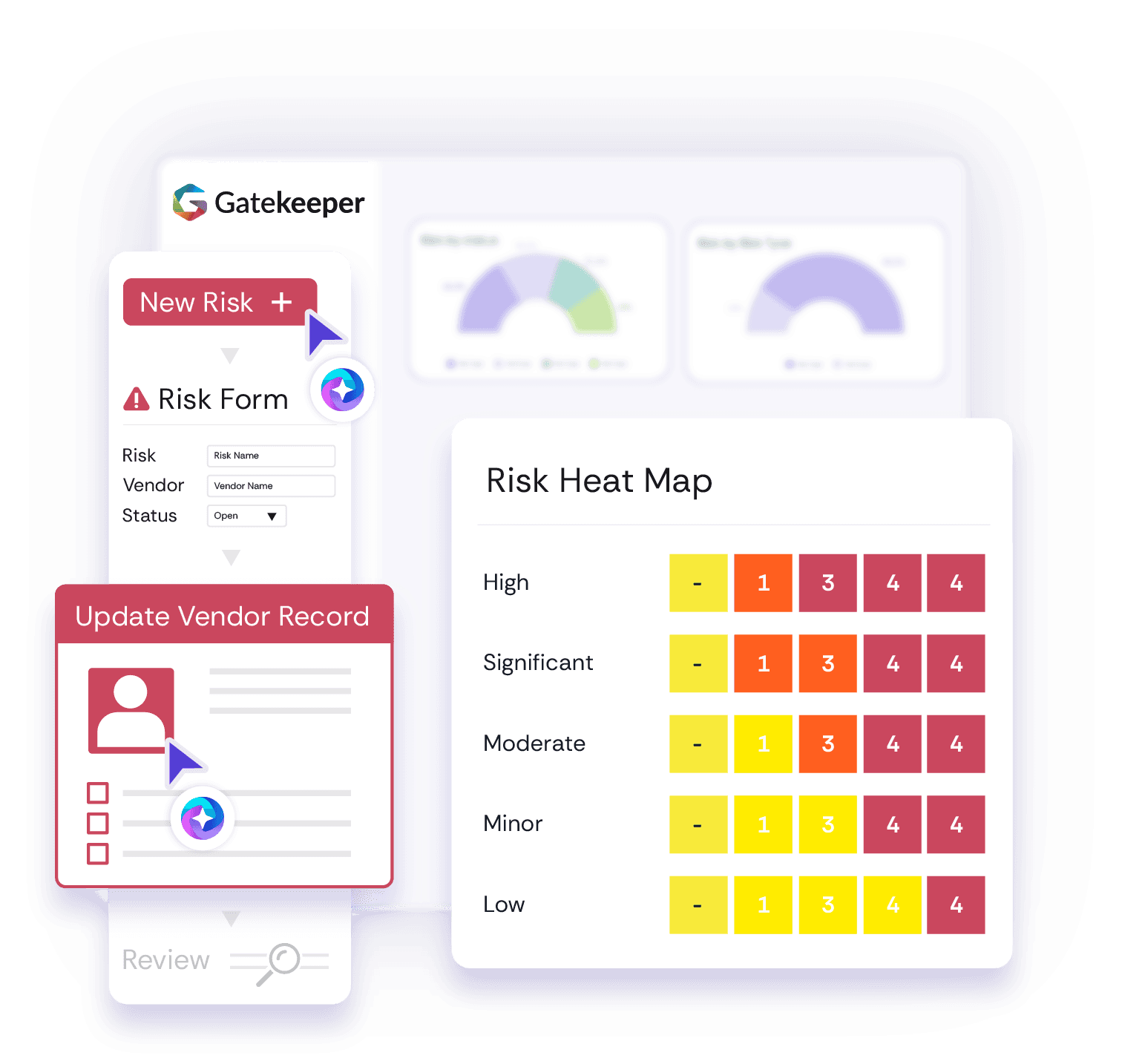
- The software offers strong compliance tracking features, including audit-trail visibility, approval process, and notifications for renewals.
- Users report great support and customer service options.
Cons
- Your team might find the onboarding process a bit challenging.
- Some users report occasional delays in customer support responses.
- The software could be improved by offering more customization options.
- Its pricing is on the higher tier and hence more suited for enterprise-grade operations.
Is Gatekeeper Right For Your Needs?
Who Would be a Good Fit for Gatekeeper?
Gatekeeper is ideal for medium to large enterprises, particularly in industries like finance, healthcare, and retail. Your finance and risk teams will appreciate its strong compliance tracking and vendor management capabilities.
The software’s user-friendly interface and reliable customer support make it a solid choice for departments that need efficient contract management. If your team values adaptability and straightforward compliance solutions, Gatekeeper can meet those needs effectively.
- Finance DepartmentsGatekeeper excels in compliance tracking, making it perfect for finance teams managing complex contracts and vendor relationships.
- Healthcare OrganizationsIts clean and friendly user interface helps healthcare providers maintain compliance with industry regulations without hassle.
- Retail CompaniesRetail businesses benefit from Gatekeeper’s vendor management features that streamline supplier interactions and contract management.
- Risk Management TeamsThe software’s compliance tracking capabilities are crucial for risk management professionals focused on mitigating vendor-related risks.
- Large EnterprisesGatekeeper offers scalability and robust features that suit the complex needs of large organizations.
- Procurement DepartmentsProcurement teams find value in Gatekeeper’s ability to simplify vendor negotiations and track contract compliance efficiently.
Who Would be a Bad Fit for Gatekeeper?
Gatekeeper might not suit small businesses with tight budgets or limited vendor management needs. While it offers a free trial for users and great value for money, its pricing can be high for small companies that don’t require extensive compliance features.
If your team doesn’t handle complex contracts or large volume vendor relationships, Gatekeeper’s full feature set might be more than you need. Additionally, startups or solo practitioners may find the onboarding process cumbersome and the software’s capabilities beyond their current requirements.
- Small StartupsGatekeeper’s comprehensive features can be overwhelming for startups that don't need extensive compliance tracking.
- FreelancersFreelancers might find Gatekeeper’s capabilities excessive for their simple contract needs.
- Single-Person DepartmentsA single-person department may not benefit from Gatekeeper’s vendor management tools, as their needs are likely minimal.
- Non-Profit OrganizationsNon-profits with limited budgets might find Gatekeeper’s pricing unsuitable for their financial constraints.
- Local StoresLocal stores with few vendors and straightforward contracts may not require the advanced features Gatekeeper offers.
- Independent ConsultantsIndependent consultants might find the onboarding process unnecessary for their straightforward compliance tasks.
How We Test & Score Tools
We’ve spent years building, refining, and improving our software testing and scoring system. The rubric is designed to capture the nuances of software selection and what makes a tool effective, focusing on critical aspects of the decision-making process.
Below, you can see exactly how our testing and scoring works across seven criteria. It allows us to provide an unbiased evaluation of the software based on core functionality, standout features, ease of use, onboarding, customer support, integrations, customer reviews, and value for money.
Core Functionality (25% of final scoring)
The starting point of our evaluation is always the core functionality of the tool. Does it have the basic features and functions that a user would expect to see? Are any of those core features locked to higher-tiered pricing plans? At its core, we expect a tool to stand up against the baseline capabilities of its competitors.
Standout Features (25% of final scoring)
Next, we evaluate uncommon standout features that go above and beyond the core functionality typically found in tools of its kind. A high score reflects specialized or unique features that make the product faster, more efficient, or offer additional value to the user.
We also evaluate how easy it is to integrate with other tools typically found in the tech stack to expand the functionality and utility of the software. Tools offering plentiful native integrations, 3rd party connections, and API access to build custom integrations score best.
Ease of Use (10% of final scoring)
We consider how quick and easy it is to execute the tasks defined in the core functionality using the tool. High scoring software is well designed, intuitive to use, offers mobile apps, provides templates, and makes relatively complex tasks seem simple.
Onboarding (10% of final scoring)
We know how important rapid team adoption is for a new platform, so we evaluate how easy it is to learn and use a tool with minimal training. We evaluate how quickly a team member can get set up and start using the tool with no experience. High scoring solutions indicate little or no support is required.
Customer Support (10% of final scoring)
We review how quick and easy it is to get unstuck and find help by phone, live chat, or knowledge base. Tools and companies that provide real-time support score best, while chatbots score worst.
Customer Reviews (10% of final scoring)
Beyond our own testing and evaluation, we consider the net promoter score from current and past customers. We review their likelihood, given the option, to choose the tool again for the core functionality. A high scoring software reflects a high net promoter score from current or past customers.
Value for Money (10% of final scoring)
Lastly, in consideration of all the other criteria, we review the average price of entry level plans against the core features and consider the value of the other evaluation criteria. Software that delivers more, for less, will score higher.
Core Features
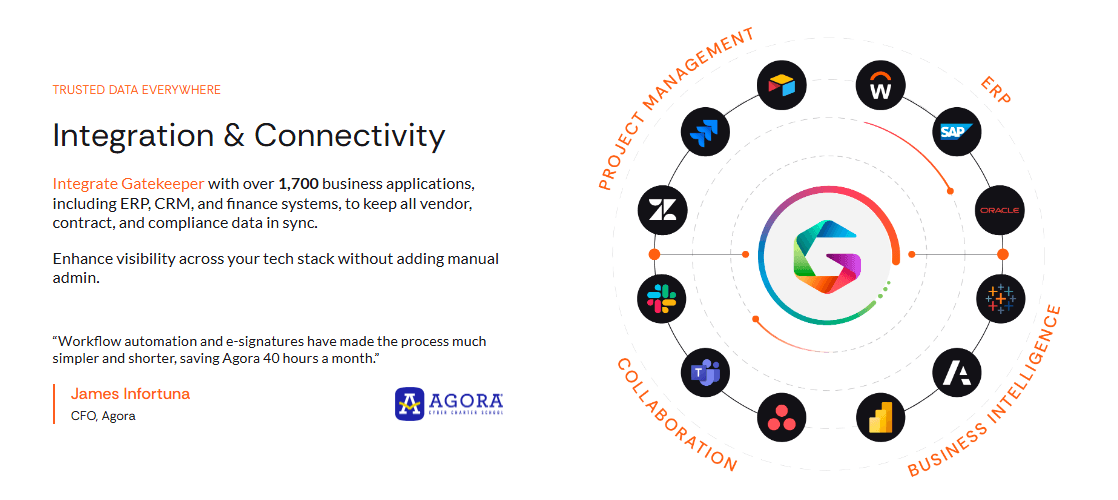
Compliance Tracking: Gatekeeper helps your team monitor compliance with industry regulations through automated alerts and reporting. It stands out by simplifying complex compliance landscapes, keeping you informed and compliant.
Contract Management: You can manage and store all your contracts in one place, making retrieval and updates seamless. This feature ensures you never miss critical contract deadlines.
Vendor Management: Track and evaluate your vendors effectively through its built-in performance metrics tracker. This means your team can easily make informed decisions based on real-time vendor data.
Document Storage: Gatekeeper offers secure document storage, allowing you to organize important files easily. Access them anytime, ensuring your documents are always at your fingertips.
User-Friendly Interface: The intuitive design means your team spends less time learning and more time working. Navigate effortlessly through features without a steep learning curve.
Automated Workflows: Create and manage workflows automatically, reducing manual tasks for your team. This feature boosts efficiency by streamlining routine processes.
Ease of Use
Gatekeeper is user-friendly, offering an intuitive interface that makes navigation easy for your team. Unlike some complex systems, it doesn’t require extensive training, so your team can get started quickly. Users appreciate its straightforward design, which enhances productivity by minimizing the time spent on learning. With features like customizable dashboards and automated workflows, your team can focus on essential tasks without getting bogged down by complicated processes. This makes Gatekeeper a practical choice for efficient compliance management.
Integrations
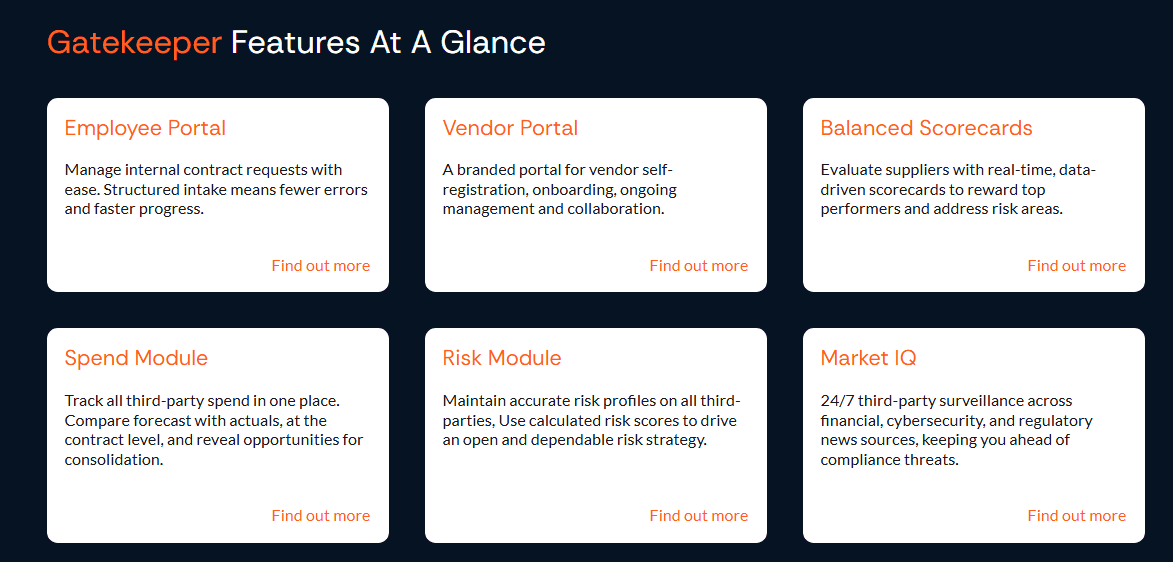
Gatekeeper integrates with over 1700+ apps, including Salesforce, Microsoft Dynamics, DocuSign, Google Workspace, Slack, QuickBooks, Xero, NetSuite, SAP, and Oracle.
Gatekeeper also offers an API and connects with third-party integration tools, allowing for extensive customization and connectivity.
Gatekeeper Specs
- 2-Factor Authentication: Yes
- API: Yes
- Approval Workflows: Yes
- Audit Trail: Yes
- Batch Permissions & Access: Yes
- Calendar Management: Yes
- Compliance Tracking: Yes
- Contact Management: Yes
- Dashboards: Yes
- Database: Yes
- Design Templates: Yes
- Document Comparison: Yes
- Document Management: Yes
- Electronic Signature: Yes
- External Integrations: Yes
- File Sharing: Yes
- File Transfer: Yes
- History/Version Control: Yes
- Multi-User: Yes
- NDA Management: Yes
- Notifications: Yes
- Reports: Yes
- Scheduling: Yes
- Task Scheduling/Tracking: Yes
- Third-Party Plugins/Add-Ons: Yes
- Workflow Management: Yes


