

HighRadius Review 2026: Pros, Cons, Features and Pricing
I weigh whether HighRadius’s accounts receivable capabilities make it a smart fit for your finance team, with a practical look at its strengths, trade-offs, features, and pricing.

We review tools independently, and commissions help fund our testing. See our transparency policy, our methodology, or suggest a tool.
HighRadius is AI-powered accounts receivable software for finance teams that need to manage complex, high-volume AR workflows across collections, cash application, credit, and deductions. If you want AI agents across these processes, I’d choose HighRadius over Billtrust for its 60-plus agents and connected AR workflow.
HighRadius Evaluation Summary
4/5
- Pricing upon request
- Free demo available
Why Trust Our Software Recommendations
6,700+
Reviews
20
Industry experts
16+
Evaluation factors
14
Years
Our team has been testing and reviewing software since 2012. As finance leaders ourselves, we know how difficult—and important—it is to choose the right software.
For this guide, we evaluated tools using hands-on testing and independent research, scoring tools using our selection criteria.
Our reviews reflect our human editorial judgment, not a sales pitch.
HighRadius Overview
I’d choose HighRadius for a large finance team managing high-volume, ERP-centered receivables: its 60-plus AI agents connect collections, cash application, credit, deductions, invoicing, and forecasting. Compared with simpler AR tools, that breadth suits workflows such as matching complex payments and prioritizing collection work, but brings more setup and training. It connects with major ERPs, including SAP and Oracle, while its interface can feel complex. Pricing is enterprise-oriented and outcome-based, so judge the proposed fees against measurable results. Reviews report mixed support experiences and lengthy onboarding, making it a better fit for teams with dedicated implementation capacity than for small businesses seeking a quick setup.
Pros
- AI-assisted cash application matches payments and reduces manual posting.
- Unified collections, credit, deductions, and invoicing cover broad AR workflows.
- Collector worklists and analytics help prioritize overdue accounts.
Cons
- Implementation and configuration can take months across enterprise workflows.
- Complex navigation and rigid rules hinder day-to-day adjustments.
- Support delays and occasional ERP sync failures disrupt processing.


How We Test & Score Tools
We’ve spent years building, refining, and improving our software testing and scoring system. The rubric is designed to capture the nuances of software selection and what makes a tool effective, focusing on critical aspects of the decision-making process.
Below, you can see exactly how our testing and scoring works across seven criteria. It allows us to provide an unbiased evaluation of the software based on core functionality, standout features, ease of use, onboarding, customer support, integrations, customer reviews, and value for money.
Core Functionality (25% of final scoring)
The starting point of our evaluation is always the core functionality of the tool. Does it have the basic features and functions that a user would expect to see? Are any of those core features locked to higher-tiered pricing plans? At its core, we expect a tool to stand up against the baseline capabilities of its competitors.
Standout Features (25% of final scoring)
Next, we evaluate uncommon standout features that go above and beyond the core functionality typically found in tools of its kind. A high score reflects specialized or unique features that make the product faster, more efficient, or offer additional value to the user.
We also evaluate how easy it is to integrate with other tools typically found in the tech stack to expand the functionality and utility of the software. Tools offering plentiful native integrations, 3rd party connections, and API access to build custom integrations score best.
Ease of Use (10% of final scoring)
We consider how quick and easy it is to execute the tasks defined in the core functionality using the tool. High scoring software is well designed, intuitive to use, offers mobile apps, provides templates, and makes relatively complex tasks seem simple.
Onboarding (10% of final scoring)
We know how important rapid team adoption is for a new platform, so we evaluate how easy it is to learn and use a tool with minimal training. We evaluate how quickly a team member can get set up and start using the tool with no experience. High scoring solutions indicate little or no support is required.
Customer Support (10% of final scoring)
We review how quick and easy it is to get unstuck and find help by phone, live chat, or knowledge base. Tools and companies that provide real-time support score best, while chatbots score worst.
Customer Reviews (10% of final scoring)
Beyond our own testing and evaluation, we consider the net promoter score from current and past customers. We review their likelihood, given the option, to choose the tool again for the core functionality. A high scoring software reflects a high net promoter score from current or past customers.
Value for Money (10% of final scoring)
Lastly, in consideration of all the other criteria, we review the average price of entry level plans against the core features and consider the value of the other evaluation criteria. Software that delivers more, for less, will score higher.
Core Features
Collections Management
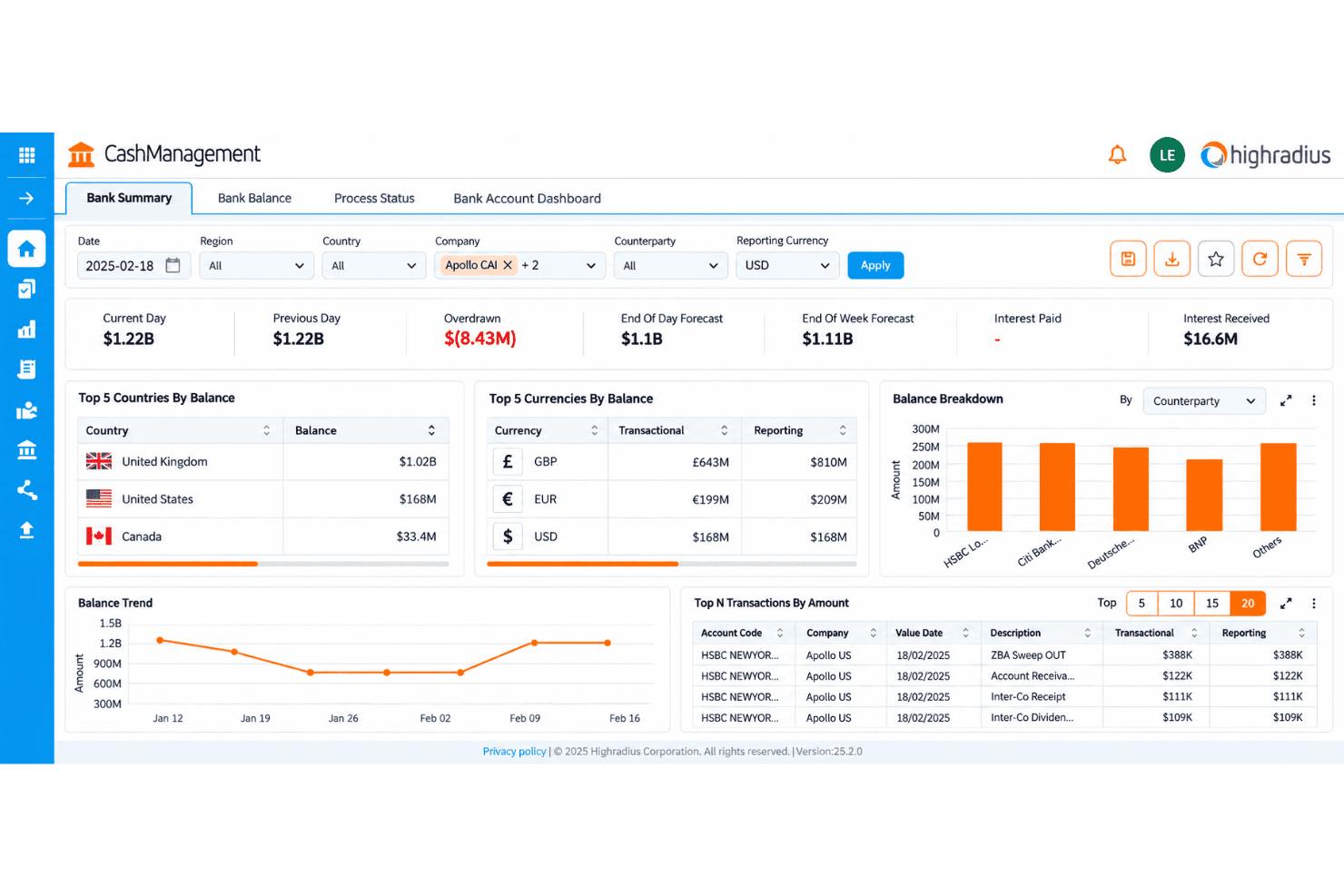
AI worklists rank overdue accounts by risk, value, and delinquency, while predictive tools suggest next actions and time customer reminders. Your team can prioritize high-risk balances and track promises to pay from one workflow.
Cash Application
Thirteen AI agents capture remittance details, match payments to open invoices, and route mismatches for review. This helps your team post routine receipts with less manual matching, even when payment details are incomplete.
Credit Management
The software combines payment history, financial data, and credit reports to score risk and route applications through configurable approval rules. Your team can auto-approve routine requests and review exceptions with decision records and audit trails.
Deductions Management
AI captures claims from email and portals, predicts deduction validity, and matches trade claims against promotion data, invoices, or point-of-sale records. Analysts can focus on disputed or invalid claims, with supporting documents and resolution status kept together.
Electronic Invoicing and Payments
HighRadius generates invoices from ERP data, sends them through email or buyer portals, and lets customers view invoices, raise disputes, and pay online. Your team can track delivery and payment activity, while customers can use options such as cards, ACH, or direct debit.
Accounts Receivable Forecasting
The software predicts payment timing at invoice level using historical customer behavior, then compares forecasts with actual receipts. Finance teams can drill into variances by customer or aging bucket and adjust collection actions when expected cash shifts.
Ease of Use
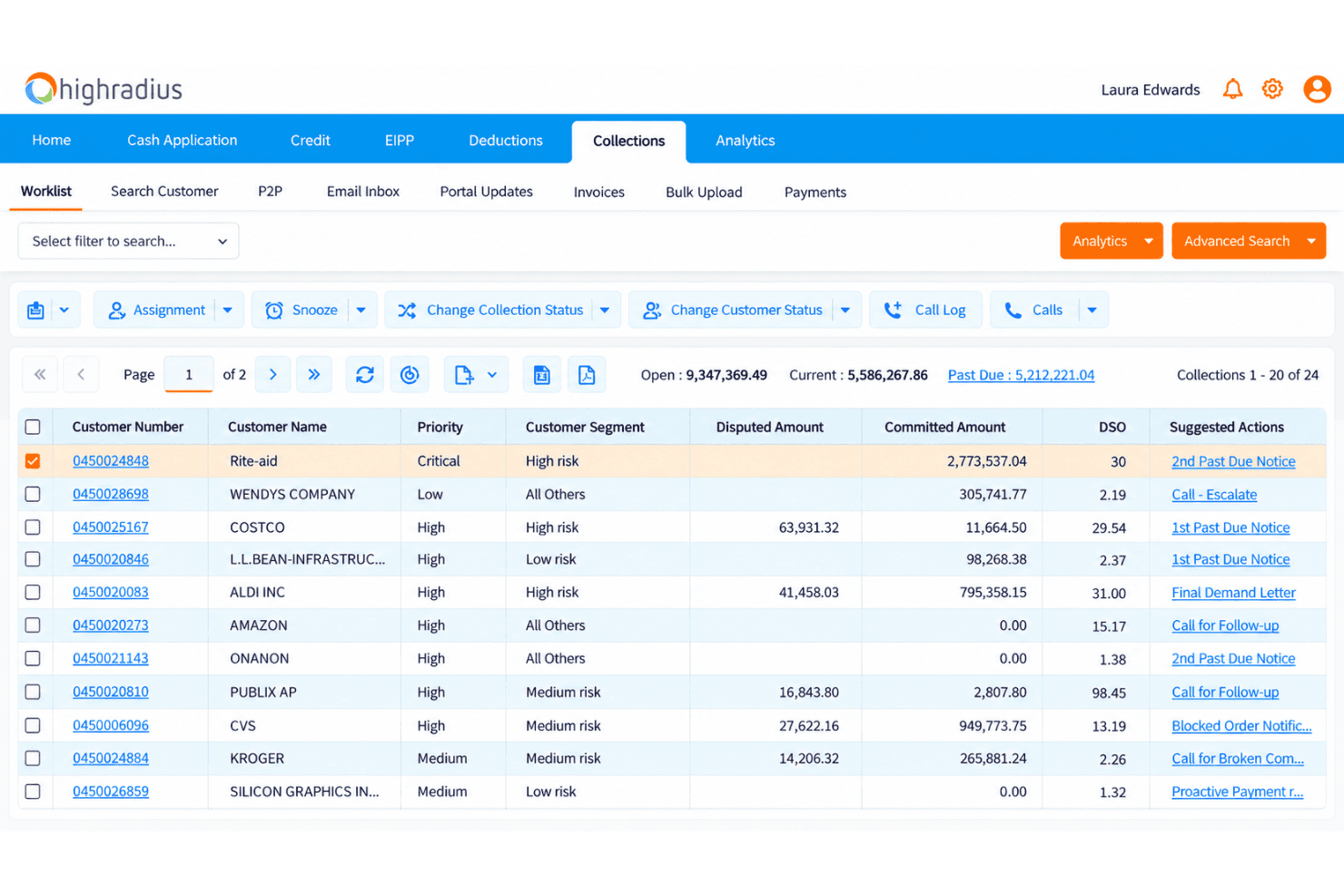
HighRadius is capable but less intuitive than simpler AR software. Its connected collections, cash application, credit, and deductions workflows reduce handoffs, while configurable rules and AI agents handle complex exceptions. That breadth adds a learning curve: users report complex navigation, rigid rules, and onboarding that can take months. I’d recommend it for teams with dedicated implementation support, not those seeking a quick, low-training setup.
Integrations
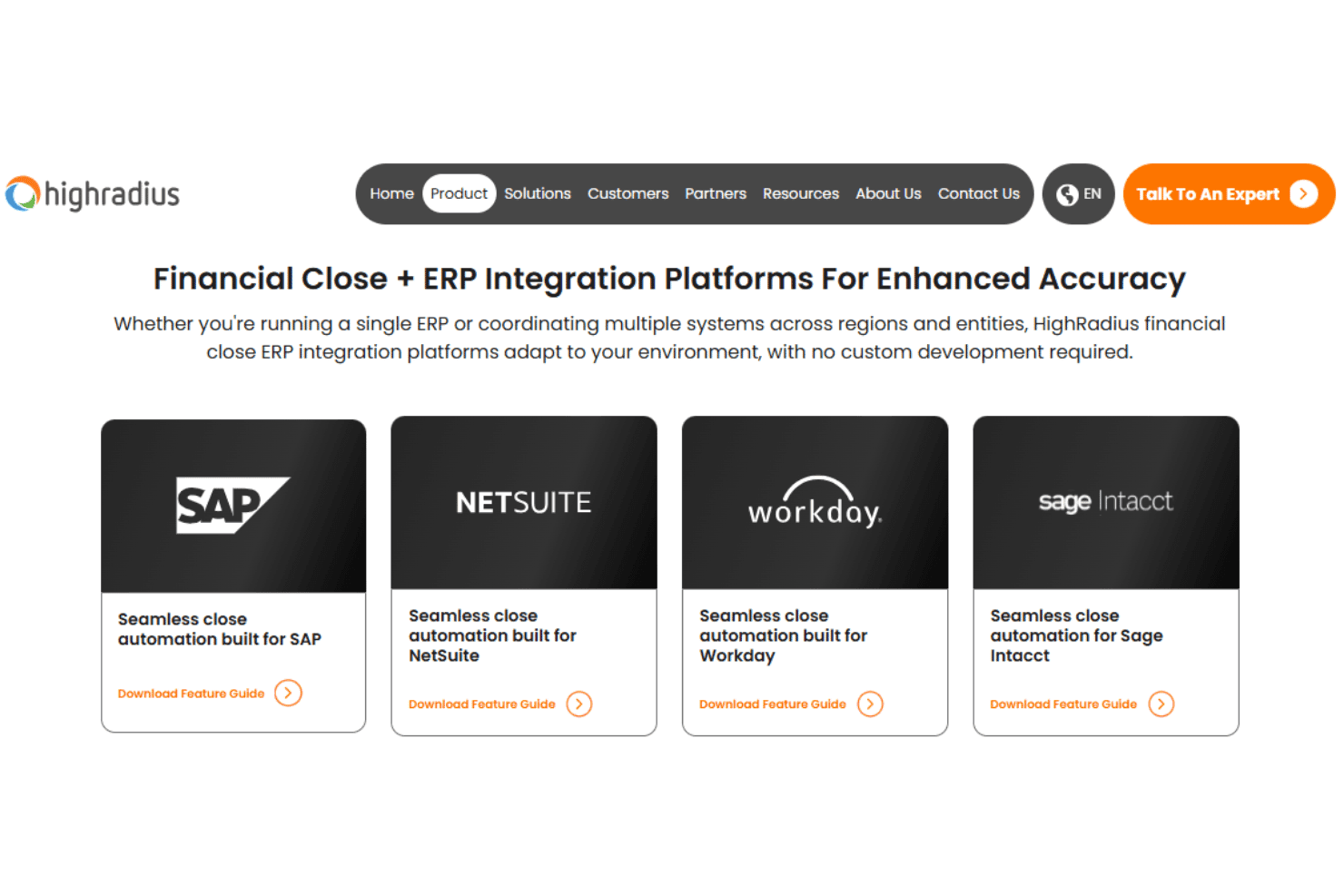
HighRadius integrates with SAP, Oracle, NetSuite, Microsoft Dynamics 365, Workday, and Sage Intacct, among others.
It also supports REST APIs over HTTPS and SFTP for data exchange. Its prebuilt ERP connectors can eliminate the need for third-party middleware platforms such as MuleSoft and Dell Boomi.
HighRadius Specs
- 2-Factor Authentication: Yes
- Accounts Payable: Yes
- Accounts Receivable: Yes
- API: Yes
- Balance Sheet: Yes
- Billing/Invoicing: Yes
- BitCoin: Yes
- Budgeting: Yes
- Calendar Management: Yes
- Contact Management: Yes
- CRM Integration: Yes
- Customer Management: Yes
- Dashboard: Yes
- Data Export: Yes
- Data Import: Yes
- Data Visualization: Yes
- Expense Tracking: Yes
- External Integrations: Yes
- Forecasting: Yes
- General Account Ledger: Yes
- Inventory Tracking: Yes
- Multi-Currency: Yes
- Multi-User: Yes
- Notifications: Yes
- P&L: Yes
- PayPal: Yes
- Payroll: Yes
- SAP Integration: Yes
- Stripe: Yes
- Supplier Management: Yes
- Tax Management: Yes


