


Monk vs. HighRadius: Comparison & Expert Reviews 2026
Monk and HighRadius take different approaches to accounts receivable automation. I break down their features, pricing, and strengths to help you find the right fit for your finance team.

We review tools independently, and commissions help fund our testing. See our transparency policy, our methodology, or suggest a tool.
Monk
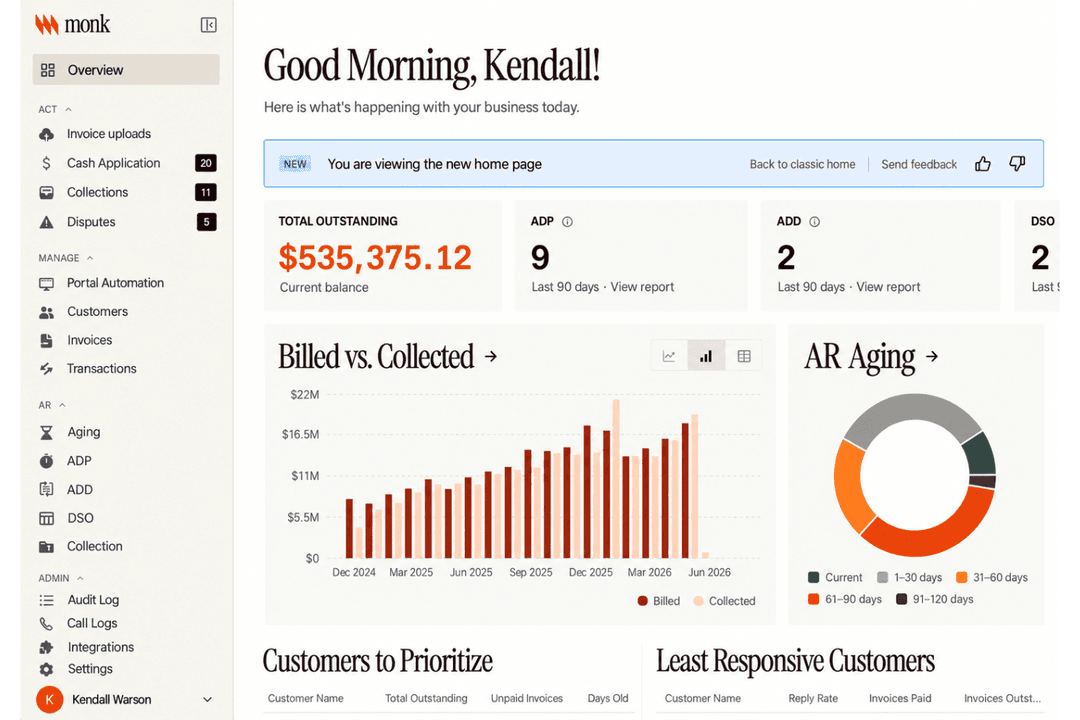
4.5/5
- Demo upon request
- Pricing upon request
HighRadius
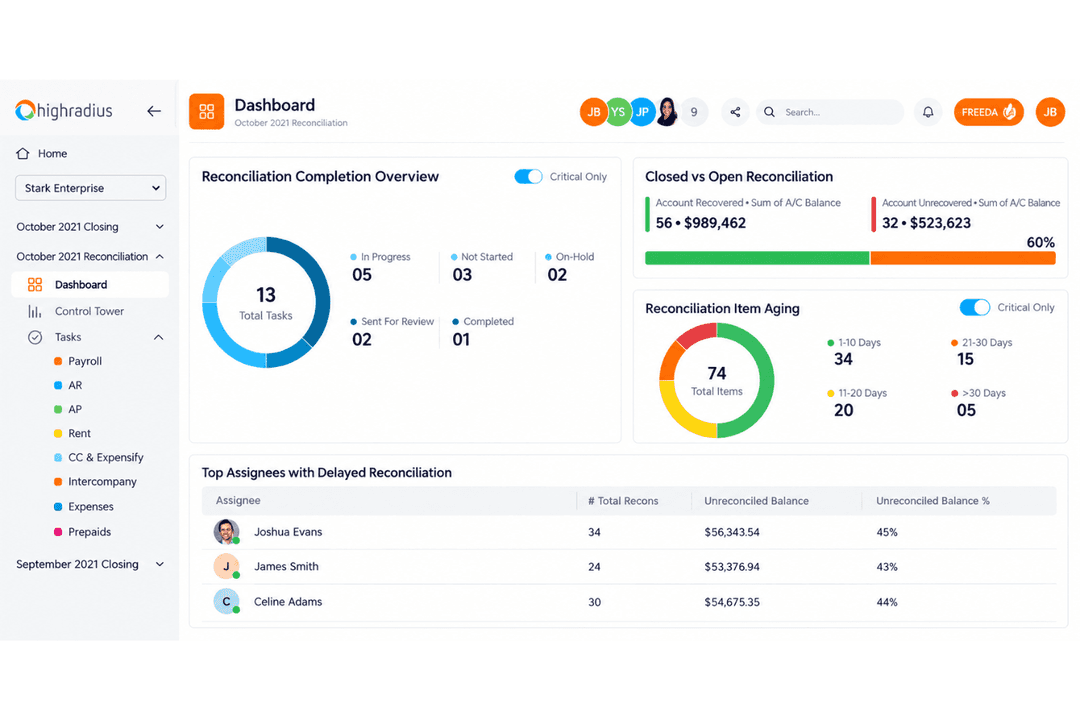
4.3/5
- Free demo available
- Pricing upon request
Why Trust Our Software Recommendations
6,700+
Reviews
20
Industry experts
16+
Evaluation factors
14
Years
Our team has been testing and reviewing software since 2012. As finance leaders ourselves, we know how difficult—and important—it is to choose the right software.
For this guide, we evaluated tools using hands-on testing and independent research, scoring tools using our selection criteria.
Our reviews reflect our human editorial judgment, not a sales pitch.
| Monk | HighRadius | |
|---|---|---|
| Free Trial | Demo upon request | Free demo available |
| Pricing | Pricing upon request | Pricing upon request |
Monk vs. HighRadius Pricing & Hidden Costs
Monk uses a quote-based platform fee that scales with invoice volume, without implementation fees or a percentage of collections. This makes costs relatively predictable, although fees may increase as invoice volumes grow. Meanwhile, HighRadius offers outcome-based pricing, with no implementation fees or charges before go-live. Instead, it takes a percentage of realized gains based on mutually agreed performance targets. Neither platform publishes standard rates, so the final cost depends on your agreement.
Choosing between the two comes down to whether you prefer Monk's volume-based pricing or HighRadius's performance-linked model. With Monk, consider your expected invoice growth and confirm which capabilities are included. For HighRadius, pay close attention to how performance improvements are measured and how gain-sharing fees are calculated. Comparing these terms against your projected collections savings will help you assess long-term value.
| Monk | HighRadius | |
|---|---|---|
| 2-Factor Authentication | Yes | Yes |
| Accounts Payable | No | Yes |
| Accounts Receivable | Yes | Yes |
| API | Yes | Yes |
| Balance Sheet | No | Yes |
| Billing/Invoicing | Yes | Yes |
| Calendar Management | No | No |
| Contact Management | Yes | Yes |
| Customer Management | Yes | Yes |
| Dashboard | Yes | Yes |
| Data Export | Yes | Yes |
| Data Import | Yes | Yes |
| Data Visualization | Yes | Yes |
| Expense Tracking | No | No |
| External Integrations | Yes | Yes |
| General Account Ledger | No | No |
| Multi-Currency | Yes | Yes |
| Notifications | Yes | Yes |
| PayPal | No | Yes |
| Stripe | Yes | Yes |
| Tax Management | No | No |
| Integration | Monk | HighRadius |
|---|---|---|
| IntegrationOracle ERP | Monk✅ | HighRadius✅ |
| IntegrationSAP S/4HANA | Monk✅ | HighRadius✅ |
| IntegrationNetSuite | Monk✅ | HighRadius✅ |
| IntegrationQuickBooks | Monk✅ | HighRadius✅ |
| IntegrationStripe | Monk✅ | HighRadius✅ |
| IntegrationSalesforce | Monk✅ | HighRadius✅ |
| IntegrationGoCardless | Monk✅ | HighRadius❌ |
| IntegrationHubSpot | Monk✅ | HighRadius❌ |
| IntegrationDocusign | Monk✅ | HighRadius❌ |
| IntegrationAPI | Monk✅ | HighRadius✅ |
Both Monk and HighRadius integrate with major ERP, accounting, and financial systems to support accounts receivable automation. Monk offers connectivity across payment processing, CRM, and document workflows, helping finance teams manage collections and reconciliation alongside their existing tools. HighRadius also supports ERP-connected workflows and API-based integrations for enterprise AR operations. Overall, Monk provides broader compatibility across the integrations compared, while both platforms support established finance systems.
| Factor | Monk | HighRadius |
|---|---|---|
| FactorCertifications & Compliance | MonkSOC 2 Type II attestation covering security, availability, and confidentiality; ISO/IEC 27001:2022 certified; GDPR compliance reported. | HighRadiusLists ISO/IEC 27001:2022, SOC 1 Type 2, SOC 2 Type 2, SOC 3, PCI DSS v4.0.1, and GDPR compliance. |
| FactorSecurity Controls | MonkAES-256 encryption at rest, TLS in transit, mandatory 2FA, SSO, role-based access, least-privilege controls, zero-trust networking, endpoint security, and data minimization. | HighRadiusRole-based access, MFA, encryption at rest and in transit, audit logging, penetration testing, and continuous security monitoring. |
| FactorData Privacy | MonkCustomer data is isolated, never used to train shared AI models, and can be deleted subject to retention requirements. Cloud data is stored in the US. | HighRadiusUses encryption, pseudonymization, anonymization, and data masking to protect sensitive information, with documented data processing and deletion procedures. |
| FactorDeployment Options | MonkStandard US-based cloud hosting, with on-premises and bring-your-own-cloud options reported in Monk's questionnaire. | HighRadiusCloud-based deployment with documented data access, infrastructure security, and subprocessor controls. |
| FactorReliability & Assurance | MonkSOC 2 Type II includes availability controls. SOC 2 reports, ISO certificates, and penetration test documentation are available on request. | HighRadiusDocuments business continuity, disaster recovery, data backups, and incident response procedures, with compliance reports available through its Trust Center. |
Both platforms document security controls for sensitive financial data. Monk combines SOC 2 Type II and ISO 27001 certification with explicit customer-data isolation, AI training restrictions, and flexible deployment options. HighRadius also documents extensive compliance and continuity controls. For either platform, request current audit reports, recovery commitments, and data processing terms to confirm they meet your organization's requirements.
| Factor | Monk | HighRadius |
|---|---|---|
| FactorInterface | MonkNatural-language Playbooks, customizable dashboards, and a Needs Review queue help teams manage collections and exceptions. | HighRadiusAI-prioritized worklists, account summaries, and dashboards organize collections activities. |
| FactorSetup | MonkGuided onboarding typically takes less than a week, with dedicated implementation support and an initial AI agent tuning period. | HighRadiusSingle modules can go live in as little as three weeks, while full enterprise AR deployments typically take 12–16 weeks. |
| FactorConfiguration | MonkTeams can define collection strategies, messaging, and escalation rules in plain language without coding. | HighRadiusConfigurable workflows and approval rules let teams tailor collections and credit processes to business requirements. |
| FactorDaily Workflow | MonkContext-aware AI agents handle customer replies, follow-ups, and payment matching, escalating exceptions for review. | HighRadiusAI agents automate routine tasks, while prioritized worklists and configurable workflows support collections and approvals. |
| FactorSupport | MonkDedicated implementation lead, agent strategist, and engineer, plus seven-day Slack or Teams support and direct founder access. | HighRadiusOffers implementation assistance, product training, and technical support resources. |
From an ease-of-use perspective, Monk emphasizes faster onboarding and hands-on automation, with natural-language Playbooks and AI agents that reduce manual collections work. HighRadius provides structured, AI-assisted workflows with configurable controls for enterprise AR operations, although full-suite implementation typically takes longer. For teams looking to automate invoice-to-cash processes without a lengthy rollout, I'd lean toward Monk, while HighRadius may suit organizations prepared for a more involved enterprise deployment.
Monk
- AI email and voice agents answer customer questions, share invoices, track payment promises, and pause follow-ups during disputes.
- Three-tier cash application combines custom rules, exact matching, and AI suggestions to reconcile partial payments and complex remittances.
- AP portal automation submits invoices and monitors their status daily to catch rejections and stalled approvals.
- Doesn't replace an ERP, general ledger, or dedicated revenue recognition software, and unsupported billing integrations may require extra steps.
- AI agents typically need one to two weeks in draft mode, with collections reaching full volume around week four.
- Sensitive disputes, legal escalations, and uncertain payment matches still require human judgment, while portal exceptions may also need review.
HighRadius
- AI-assisted cash application matches payments and reduces manual posting.
- Unified collections, credit, deductions, and invoicing cover broad AR workflows.
- Collector worklists and analytics help prioritize overdue accounts.
- Implementation and configuration can take months across enterprise workflows.
- Complex navigation and rigid rules hinder day-to-day adjustments.
- Support delays and occasional ERP sync failures disrupt processing.
Monk
- Manufacturing and DistributionManufacturers and wholesalers can automate collections, submit invoices through customer AP portals, and reconcile bulk payments. This helps manage high invoice volumes and complex customer accounts.
- Trucking and LogisticsTrucking and logistics companies can automate customer follow-ups, monitor invoice approvals, and reconcile payments across multiple accounts. This helps reduce collection delays and manual AR work.
- Staffing AgenciesStaffing firms can automate collections for recurring invoices, track payment commitments, and manage billing disputes. This helps maintain cash flow while handling frequent billing cycles.
- Food and Beverage SuppliersFood and beverage businesses can reconcile distributor payments, identify short payments, and manage pricing disputes. Automated cash application helps reduce manual reconciliation and track outstanding deductions.
- Medical Device CompaniesMedical device suppliers can automate invoice submissions through buyer AP portals, monitor approval statuses, and manage payment disputes. This helps reduce delays caused by complex purchasing processes.
- SaaS and AI CompaniesGrowing SaaS and AI businesses can connect existing billing systems, including Stripe, to automate collections and payment matching. Customizable Playbooks also support different customer segments and payment terms.
HighRadius
- Large EnterprisesSAP, Oracle, NetSuite, Microsoft Dynamics 365, Workday, and Sage Intacct connectors can support large organizations with established finance systems.
- High-Volume ARTeams processing many payments can use cash application workflows and configurable rules to handle routine work and exceptions.
- Deduction TeamsFinance departments handling complex deductions can manage that work alongside collections and cash application in connected workflows.
- Credit DepartmentsCredit teams can use HighRadius’s credit workflows as part of a broader accounts receivable operation.
- Shared ServicesCentral finance teams can use connected collections, cash application, credit, and deductions workflows to manage related AR processes across their operation.
- Integration ProjectsOrganizations using REST APIs over HTTPS or SFTP can connect HighRadius when they need an integration beyond its prebuilt connectors.
Who Should Use Monk, and Who Should Use HighRadius?
If you're looking for an AI-native accounts receivable platform that automates collections, cash application, and AP portal workflows without replacing your existing systems, Monk is a strong fit. It's particularly useful for B2B companies processing roughly 30–50 or more invoices monthly, including those in manufacturing, distribution, logistics, staffing, and SaaS. Its context-aware agents, customizable Playbooks, and guided onboarding help finance teams reduce manual work and get started within days.
If your organization needs connected workflows across collections, credit management, cash application, and complex deductions, HighRadius is worth considering. It suits enterprise finance teams, shared services operations, and credit departments that rely on configurable approval rules, AI-prioritized worklists, and ERP integrations to coordinate accounts receivable processes across multiple teams.
| Monk | HighRadius | |
|---|---|---|
| AI Collections Approach | Monk Context-aware email and voice agents execute reply-based Playbooks, with deterministic checks and audit logs controlling automated actions. | HighRadius AI agents automate standard replies, prioritize collections worklists, and support inbound and outbound calling. |
| AP Portal Workflows | Monk Uses APIs and browser agents for invoice submissions, vendor registration, and daily monitoring across 600+ portal touchpoints. | HighRadius Automates invoice uploads and status tracking across 600+ AP portals, with tools for dispute prevention. |
| Implementation | Monk Guided setup typically takes less than a week, with collections reaching full volume around week four. | HighRadius Single-module deployments can take as little as three weeks, while full enterprise AR implementations typically take 12–16 weeks. |
| Platform Focus | Monk AI-native invoice-to-cash automation built to work alongside existing ERP and billing systems. | HighRadius Broader autonomous finance platform offering order-to-cash alongside AP, treasury, and financial close solutions. |
| Pricing Model | Monk Platform fee scales with invoice volume, without implementation fees or a percentage of collections. | HighRadius Outcome-based pricing with no upfront implementation fees and gain-sharing tied to measured improvements after go-live. |
| AR Forecasting and Reporting | Both provide receivables forecasts, aging visibility, and performance reporting to help finance teams anticipate collections and monitor cash flow. |
|---|---|
| Cash Application | Both automate payment matching, remittance processing, and reconciliation, including handling partial payments and exceptions that require additional review. |
| Credit Management | Both assess customer payment risk using financial data and payment history, helping teams manage credit decisions and identify risky accounts. |
| Dispute Management | Both support dispute detection, case tracking, and resolution workflows to help finance teams address payment discrepancies and reduce manual follow-ups. |
| ERP Connectivity | Both integrate with major accounting and ERP systems and provide API capabilities to connect AR workflows with existing financial tools. |