
Monk Review 2026: Pros, Cons, Features, Pricing & More
Monk uses AI-powered automation to manage B2B collections, cash application, and other accounts receivable workflows. Find out whether Monk is the right fit for your finance team in my expert review.

We review tools independently, and commissions help fund our testing. See our transparency policy, our methodology, or suggest a tool.
Sending an invoice is one thing. Getting it paid is another, especially when customers go quiet, invoices get stuck in AP portals, and payments arrive without clear remittance details, leaving your finance team chasing answers instead of managing cash flow.
Monk is an accounts receivable automation platform that uses AI agents to handle B2B collections, cash application, dispute management, and AR reporting. Unlike traditional reminder-based workflows, Monk's agents can respond to customer questions, track payment commitments, and flag issues that need human attention. The platform works alongside existing ERP and billing systems, with most customers reportedly going live in under a week.
In this review, I'll break down Monk's features, pricing, and limitations to help you decide if it's the right fit for your finance team.
Monk Evaluation Summary
4.5/5
- Pricing upon request
- Demo upon request
Why Trust Our Software Recommendations
6,700+
Reviews
20
Industry experts
16+
Evaluation factors
14
Years
Our team has been testing and reviewing software since 2012. As finance leaders ourselves, we know how difficult—and important—it is to choose the right software.
For this guide, we evaluated tools using hands-on testing and independent research, scoring tools using our selection criteria.
Our reviews reflect our human editorial judgment, not a sales pitch.
Monk Overview
What I like about Monk is that it goes beyond basic collections automation to address the broader invoice-to-cash process. Its AI-powered collections, intelligent cash application, AP portal automation, and cash forecasting make it particularly appealing to B2B finance teams managing complex receivables. The ability to integrate with existing ERP systems and get started within days is another advantage. Monk also reports an average 40% average reduction in DSO and about 26 hours saved monthly. While its AI agents require some initial tuning and human oversight, I think Monk is a strong option for businesses looking to reduce manual AR work and improve cash flow visibility.
Pros
- AI email and voice agents answer customer questions, share invoices, track payment promises, and pause follow-ups during disputes.
- Three-tier cash application combines custom rules, exact matching, and AI suggestions to reconcile partial payments and complex remittances.
- AP portal automation submits invoices and monitors their status daily to catch rejections and stalled approvals.
Cons
- Doesn't replace an ERP, general ledger, or dedicated revenue recognition software, and unsupported billing integrations may require extra steps.
- AI agents typically need one to two weeks in draft mode, with collections reaching full volume around week four.
- Sensitive disputes, legal escalations, and uncertain payment matches still require human judgment, while portal exceptions may also need review.


How We Test & Score Tools
We’ve spent years building, refining, and improving our software testing and scoring system. The rubric is designed to capture the nuances of software selection and what makes a tool effective, focusing on critical aspects of the decision-making process.
Below, you can see exactly how our testing and scoring works across seven criteria. It allows us to provide an unbiased evaluation of the software based on core functionality, standout features, ease of use, onboarding, customer support, integrations, customer reviews, and value for money.
Core Functionality (25% of final scoring)
The starting point of our evaluation is always the core functionality of the tool. Does it have the basic features and functions that a user would expect to see? Are any of those core features locked to higher-tiered pricing plans? At its core, we expect a tool to stand up against the baseline capabilities of its competitors.
Standout Features (25% of final scoring)
Next, we evaluate uncommon standout features that go above and beyond the core functionality typically found in tools of its kind. A high score reflects specialized or unique features that make the product faster, more efficient, or offer additional value to the user.
We also evaluate how easy it is to integrate with other tools typically found in the tech stack to expand the functionality and utility of the software. Tools offering plentiful native integrations, 3rd party connections, and API access to build custom integrations score best.
Ease of Use (10% of final scoring)
We consider how quick and easy it is to execute the tasks defined in the core functionality using the tool. High scoring software is well designed, intuitive to use, offers mobile apps, provides templates, and makes relatively complex tasks seem simple.
Onboarding (10% of final scoring)
We know how important rapid team adoption is for a new platform, so we evaluate how easy it is to learn and use a tool with minimal training. We evaluate how quickly a team member can get set up and start using the tool with no experience. High scoring solutions indicate little or no support is required.
Customer Support (10% of final scoring)
We review how quick and easy it is to get unstuck and find help by phone, live chat, or knowledge base. Tools and companies that provide real-time support score best, while chatbots score worst.
Customer Reviews (10% of final scoring)
Beyond our own testing and evaluation, we consider the net promoter score from current and past customers. We review their likelihood, given the option, to choose the tool again for the core functionality. A high scoring software reflects a high net promoter score from current or past customers.
Value for Money (10% of final scoring)
Lastly, in consideration of all the other criteria, we review the average price of entry level plans against the core features and consider the value of the other evaluation criteria. Software that delivers more, for less, will score higher.
Core Features
Intelligent Collections
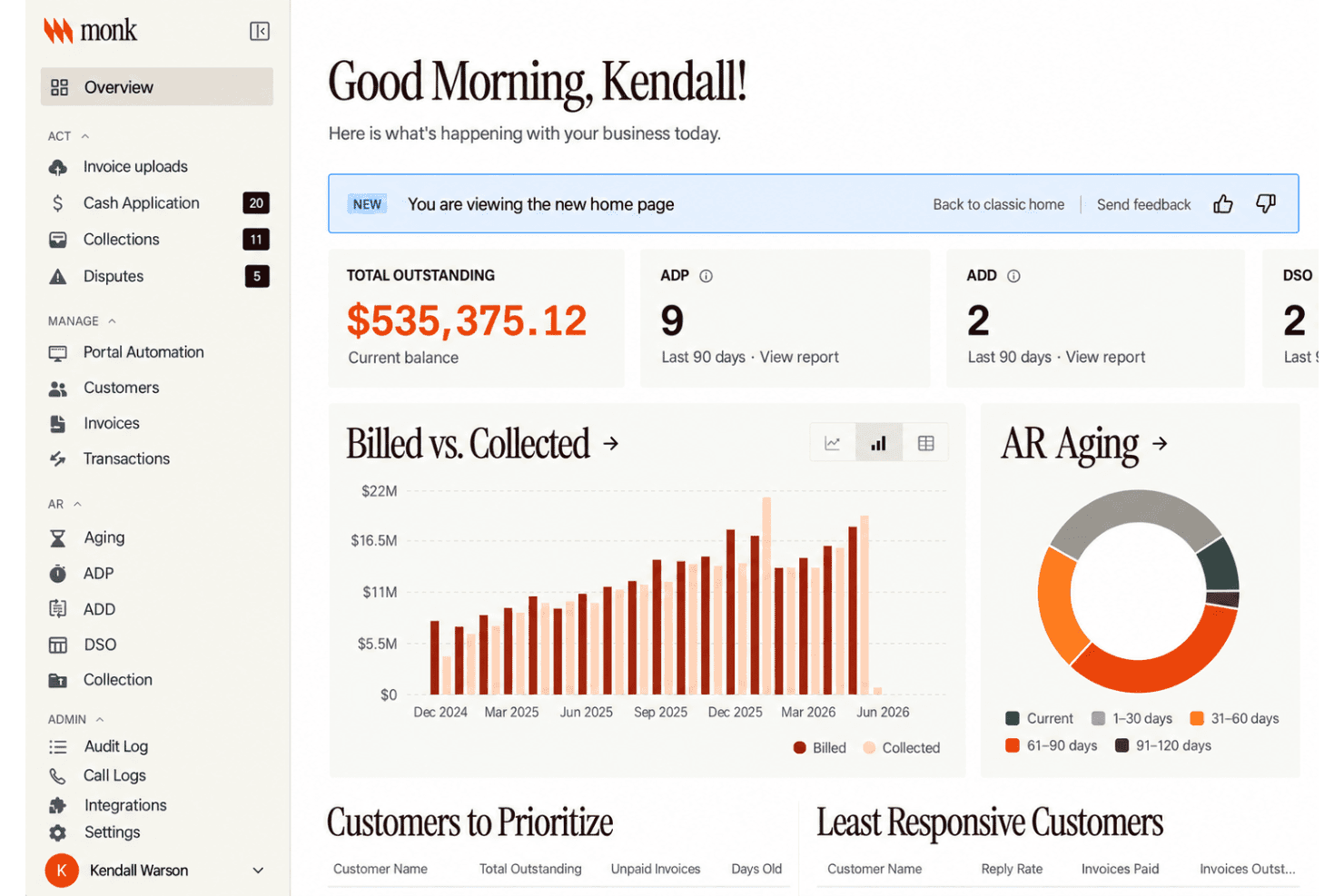
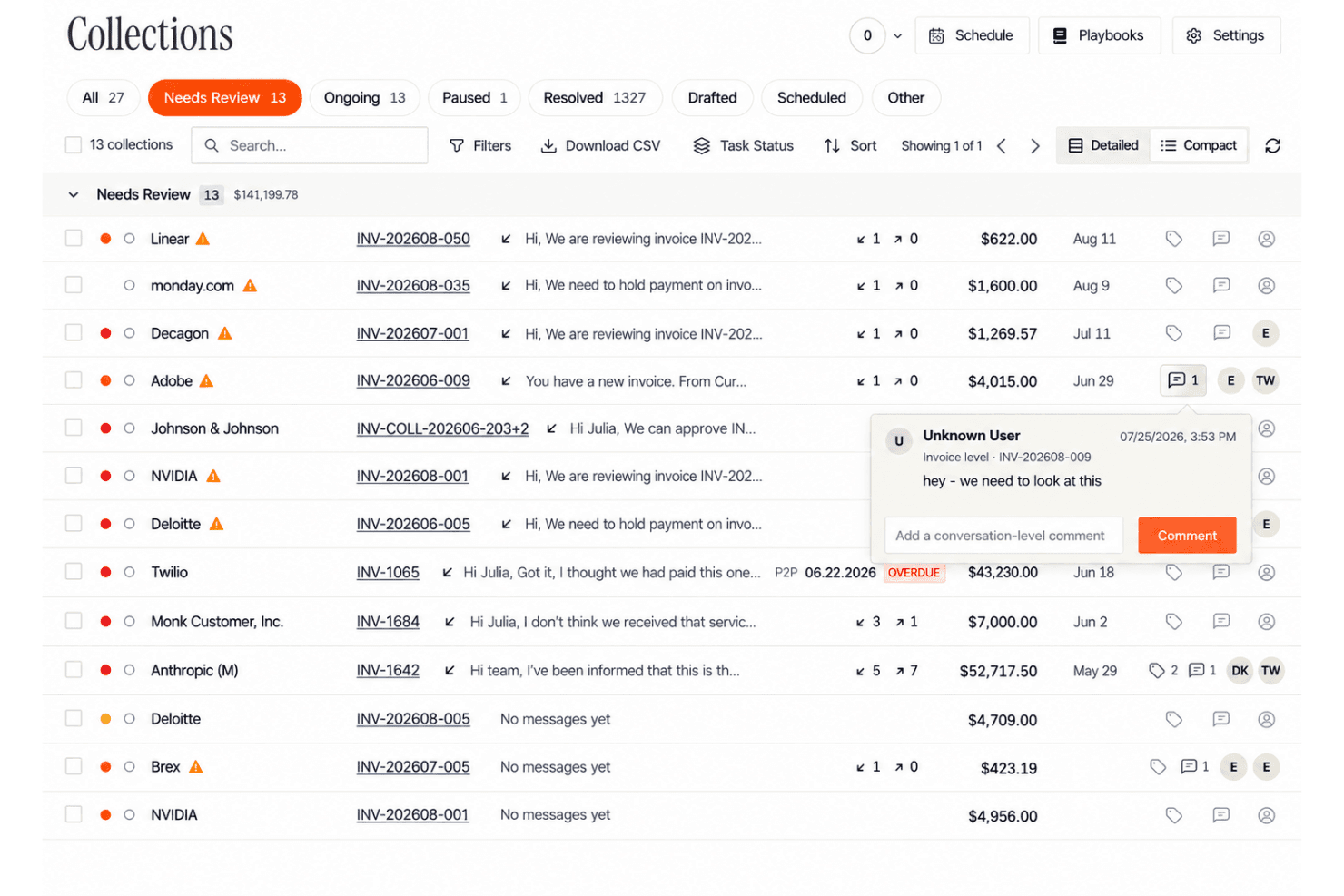
Julia, Monk's AI email agent, reviews invoices, payment history, and customer conversations to personalize collections. It answers billing questions, shares documents, tracks payment promises, and adjusts outreach based on replies. Customers receive consolidated reminders and can pay through a self-service portal, while unresolved issues are flagged for human review.
Intelligent Cash Application
Monk Cash App combines customer-specific rules, exact matching, and AI reasoning to reconcile payments, including partial payments, bulk remittances, and deductions. It extracts payment details from bank feeds and remittance documents, with configurable confidence thresholds for automatic matching. Monk reports an 80% automatic match rate, rising to approximately 95% with suggested rules.
AP Portal Submission and Monitoring
Invoice submissions are automated across buyer portals such as Coupa, Ariba, and Tipalti using APIs or browser agents. The platform handles vendor registration and monitors connected portals daily across 600+ portal touchpoints. Rejections, missing purchase orders, and stalled approvals are flagged for attention, helping your team address submission problems before they delay payment.
Dispute Detection and Resolution
Billing disputes are detected from customer emails and calls, automatically classified, and linked to affected invoices. Collections pause while issues are investigated, preventing unnecessary follow-ups. Each case includes an assigned owner, conversation history, supporting documents, and an audit trail to support resolution.
Credit Management
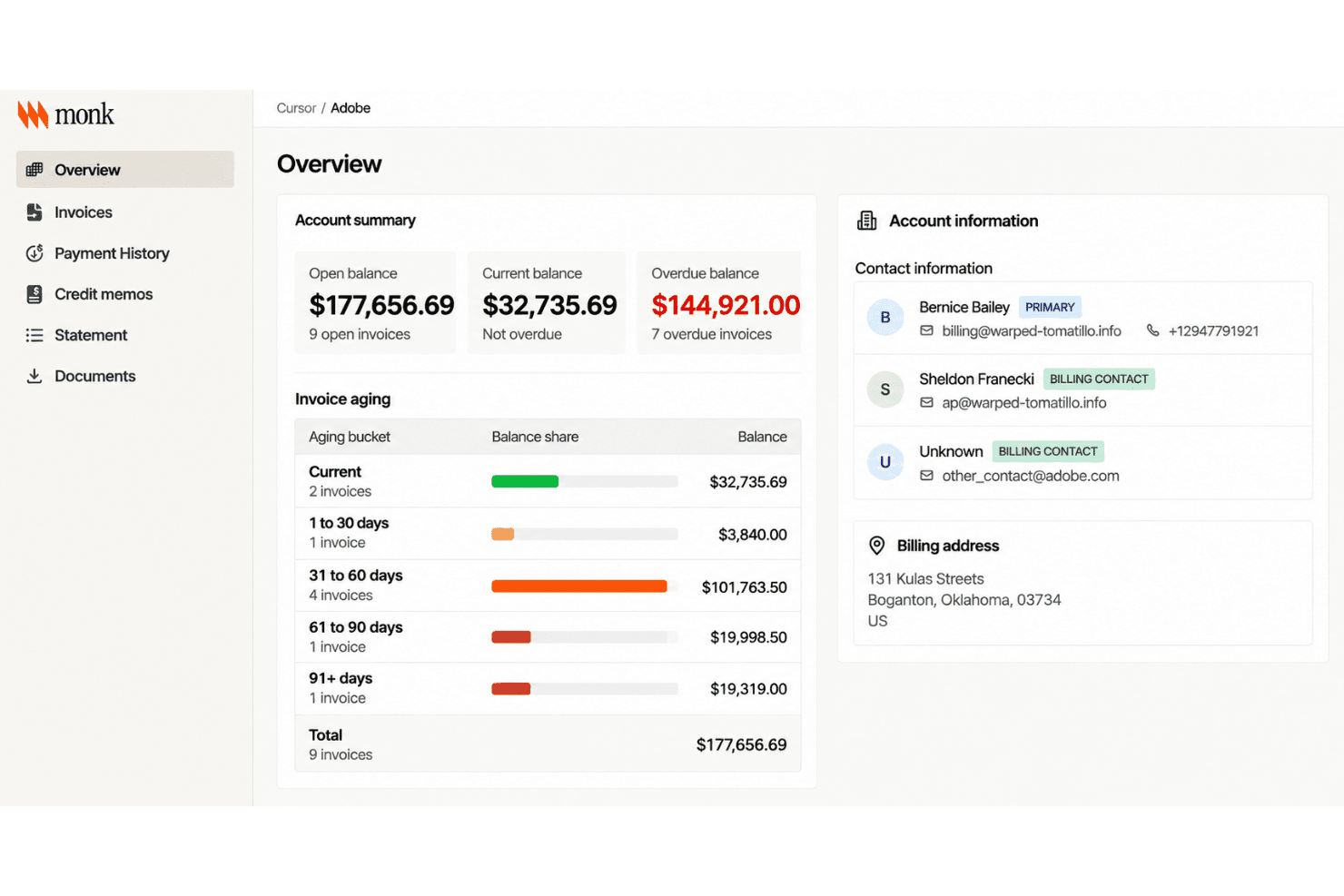
Credit assessments combine customer payment history, collection behavior, and external bureau data to evaluate risk. AI-generated summaries support decisions about credit limits, holds, and payment terms, while behavioral monitoring flags unusual payment patterns. A beta Payment Risk report identifies accounts likely to pay late.
Cash Forecasting and AR Reporting
Forecasts use actual payment behavior, customer commitments, and disputes to estimate collections rather than relying solely on invoice terms. Finance teams can track 30-, 60-, and 90-day projections, DSO, aging, and collection efficiency. Custom dashboards and a natural-language reporting agent support analysis, with 13-week cash forecasting available in beta.
Ease of Use
Monk makes adoption relatively straightforward with natural-language Playbooks that let your team create collection strategies, preview workflows, and adjust follow-ups by customer or invoice conditions. Meanwhile, the Needs Review queue brings exceptions requiring human judgment into one place. However, the agents aren't fully autonomous from day one, so your team still needs to review early drafts and refine their behavior before enabling broader automation.
Integrations
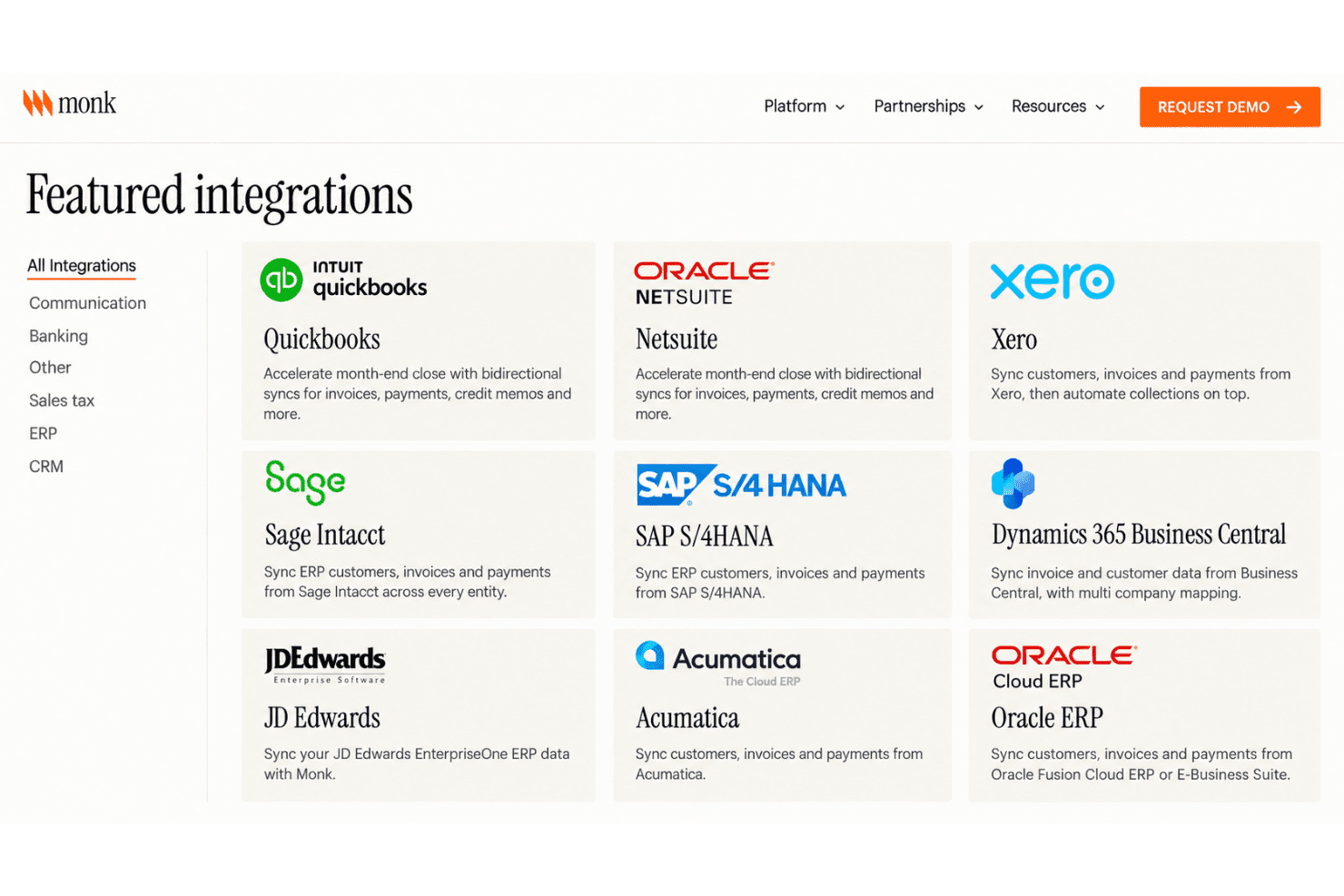
Monk integrates with accounting systems such as QuickBooks, NetSuite, Xero, Sage Intacct, SAP, Microsoft Dynamics 365, Rillet, and Campfire. Other integrations include Salesforce, HubSpot, Stripe, GoCardless, DocuSign, Anrok, Gmail, Outlook/Microsoft 365, Slack, 1Password, Plaid, and Mercury. It also offers a public REST API, beta webhooks, and custom ERP integration support.
Monk Specs
- 2-Factor Authentication: Yes
- Accounts Payable: No
- Accounts Receivable: Yes
- API: Yes
- Audit Trail: Yes
- Balance Sheet: No
- Billing/Invoicing: Yes
- Calendar Management: No
- Contact Management: Yes
- Custom Reports: Yes
- Customer Management: Yes
- Dashboard: Yes
- Data Export: Yes
- Data Import: Yes
- Data Visualization: Yes
- Document Management: Yes
- Expense Tracking: No
- External Integrations: Yes
- Fraud Detection: No
- General Account Ledger: No
- Multi-Account: Yes
- Multi-Currency: Yes
- Notifications: Yes
- Payment Gateway Integration: Yes
- Payment Processor: No
- PayPal: No
- PDF Export: Yes
- Stripe: Yes
- Tax Management: No
- Workflow Management: Yes


