

Intuit Enterprise Suite vs. Microsoft Dynamics 365 Business Central: Vergleich und Bewertungen 2026

Wir bewerten Tools unabhängig; Provisionen helfen, unsere Tests zu finanzieren. Siehe unsere Transparenzrichtlinie und unsere Methodik.
Irgendwann beginnen die Systeme, die einst für Ihr Unternehmen funktioniert haben, Sie auszubremsen. Finanzberichte benötigen länger als nötig, Bestandszahlen stimmen nicht immer mit der Realität überein, und um einen klaren Überblick über Ihre Abläufe zu erhalten, müssen Daten aus mehreren Tools zusammengeführt werden. Anstatt Ihnen dabei zu helfen, schneller voranzukommen, beginnt Ihre Software, Engpässe zu verursachen.
Dann beginnen viele Unternehmen, ERP-Software zu prüfen, um alles an einem Ort zusammenzuführen. Doch die Bewertung von Plattformen kann schnell überwältigend werden, wenn jede Lösung Automatisierung, Transparenz und Skalierbarkeit verspricht. Wenn Sie zwischen Intuit Enterprise Suite und Microsoft Dynamics 365 Business Central entscheiden, bietet Ihnen dieser Artikel einen direkten Vergleich beider Lösungen, Experteneinschätzungen und praxisnahe Orientierung, damit Sie eine sichere und fundierte Entscheidung treffen können.
Intuit Enterprise Suite
4.6/5
- Free demo available
- Pricing upon request
Microsoft Dynamics 365 Business Central

4/5
- 30-day free trial
- From $80/user/month (billed annually)
Warum Sie unseren Software-Empfehlungen vertrauen können
6,700+
Reviews
20
Industry experts
16+
Evaluation factors
14
Years
Unsere Bewertungen spiegeln unser unabhängiges Urteilsvermögen wider – keine Verkaufsstrategie. Erfahren Sie, wie wir transparent bleiben.
Für diesen Leitfaden haben wir Tools mithilfe von praktischen Tests und unabhängiger Recherche bewertet und dabei unsere Bewertungskriterien angewendet.
Unsere Bewertungen spiegeln unser menschliches redaktionelles Urteilsvermögen wider, keine Verkaufsstrategie.
| Intuit Enterprise Suite | Microsoft Dynamics 365 Business Central | |
|---|---|---|
| Free Trial | Free demo available | 30-day free trial |
| Pricing | Pricing upon request | From $80/user/month (billed annually) |
Preise und versteckte Kosten von Intuit Enterprise Suite und Microsoft Dynamics 365 Business Central
Intuit Enterprise Suite verwendet ein abonnementbasiertes Preismodell, bei dem die Kosten typischerweise von Faktoren wie der Anzahl der Unternehmen, Benutzer und in Ihrer Bereitstellung enthaltenen Funktionen abhängen. Da die Preise häufig auf Grundlage der geschäftlichen Anforderungen individuell angepasst werden, sind die genauen Kosten nicht immer öffentlich angegeben. Außerdem können zusätzliche Gebühren für erweiterte Funktionen, Lohnabrechnungsdienste oder Integrationen mit Anwendungen von Drittanbietern anfallen.
Auch Microsoft Dynamics 365 Business Central folgt einem Abonnementmodell, verwendet jedoch festgelegte Lizenzstufen, die je nach Funktionsumfang und Benutzerzugriff variieren. Während das Basisabonnement die zentralen ERP-Funktionen abdeckt, können die Gesamtkosten durch Implementierungsleistungen, Anpassungen, Datenmigration und laufenden Support steigen – insbesondere, wenn Sie für die Einführung und Wartung des Systems mit einem Microsoft-Partner zusammenarbeiten.
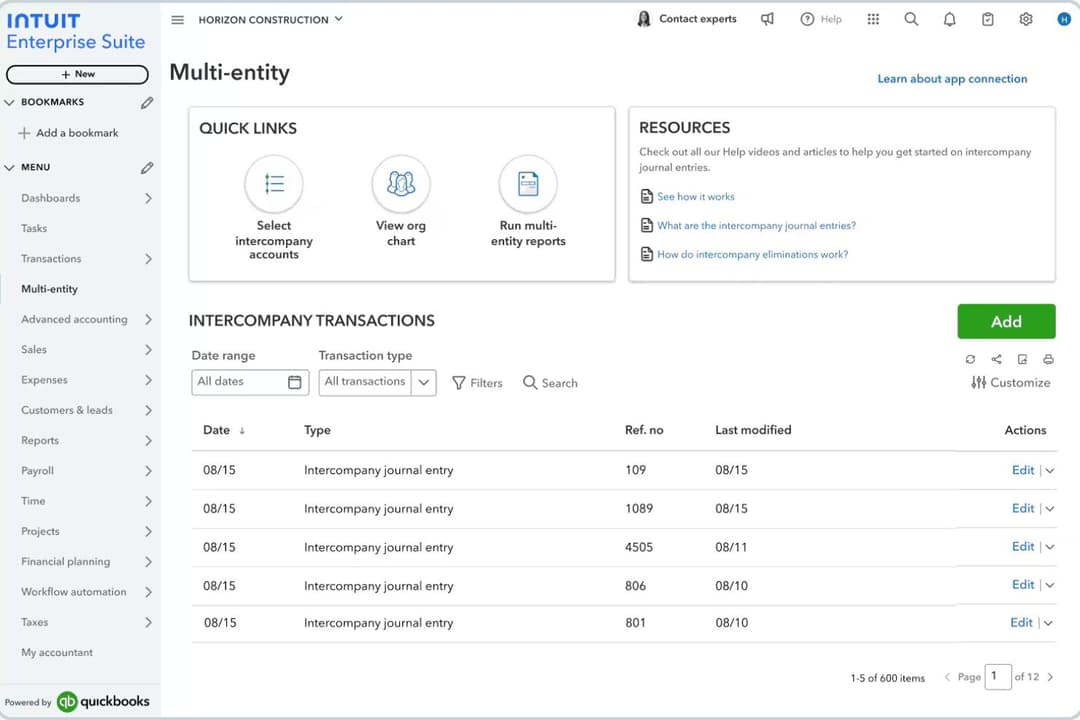
Intuit Enterprise Suite zeichnet sich durch Finanzverwaltung für mehrere Unternehmen und konsolidierte Berichte aus und eignet sich daher besonders für Unternehmen, die mehrere Tochtergesellschaften oder Geschäftsbereiche verwalten. Die Plattform zentralisiert Finanzdaten über mehrere Unternehmen hinweg und automatisiert Buchhaltungsabläufe. Dadurch können Finanzteams den manuellen Konsolidierungsaufwand reduzieren und einen besseren Überblick über die gesamte Organisation erhalten.
Microsoft Dynamics 365 Business Central zeichnet sich durch seinen umfangreichen Funktionsumfang für betriebliche Abläufe und die enge Integration in das Microsoft-Ökosystem aus, einschließlich Tools wie Excel, Outlook, Teams und Power BI. Es verbindet Finanzen, Vertrieb, Lieferkette und Projektmanagement in einem System. Beide Plattformen bieten außerdem zentrale ERP-Funktionen wie Finanzverwaltung, Berichterstellung, Bestandsverfolgung und Workflow-Automatisierung zur Unterstützung der täglichen Abläufe.
| Intuit Enterprise Suite | Microsoft Dynamics 365 Business Central | |
|---|---|---|
| Accounts Payable | Yes | Yes |
| Accounts Receivable | Yes | Yes |
| API | Yes | Yes |
| Budgeting | Yes | Yes |
| Calendar Management | No | No |
| Customer Management | No | Yes |
| Dashboard | Yes | Yes |
| Data Export | Yes | Yes |
| Data Import | Yes | Yes |
| Data Visualization | Yes | Yes |
| Expense Tracking | Yes | Yes |
| External Integrations | Yes | Yes |
| Forecasting | Yes | Yes |
| Inventory Tracking | Yes | Yes |
| Multi-User | Yes | Yes |
| Notifications | Yes | Yes |
| Payroll | Yes | No |
| Project Management | Yes | Yes |
| Scheduling | No | Yes |
| Supplier Management | Yes | Yes |
| Third-Party Plugins/Add-Ons | Yes | Yes |
| Integration | Intuit Enterprise Suite | Microsoft Dynamics 365 Business Central |
| Salesforce | ✅ | ✅ |
| Shopify | ✅ | ✅ |
| Avalara | ✅ | ✅ |
| HubSpot | ✅ | ✅ |
| PayPal | ✅ | ✅ |
| Bill.com | ✅ | ❌ |
| Expensify | ✅ | ❌ |
| Power BI | ❌ | ✅ |
| Microsoft Teams | ❌ | ✅ |
| ADP | ✅ | ❌ |
| API | ✅ | ✅ |
| Zapier | ✅ | ✅ |
Sowohl Intuit Enterprise Suite als auch Microsoft Dynamics 365 Business Central unterstützen Integrationen mit vielen gängigen Geschäftstools, darunter E-Commerce-Plattformen, CRM-Systeme, Zahlungsdienstleister und Dienste zur Steuerautomatisierung. In vielen Fällen können Verbindungen über native Integrationen, APIs, Middleware-Plattformen oder Integrationstools wie Zapier hergestellt werden. So können Unternehmen ihr ERP mit dem übrigen Technologie-Stack verbinden.
Die Plattformen unterscheiden sich vor allem hinsichtlich ihrer Ökosystem-Ausrichtung. Microsoft Dynamics 365 Business Central verfügt über besonders leistungsfähige native Integrationen mit Microsoft-Produkten wie Power BI und Microsoft Teams, während Intuit Enterprise Suite häufig direkter mit finanzorientierten Tools wie Ausgabenverwaltung, Lohnabrechnung und Kreditorenbuchhaltungsplattformen verbunden werden kann, die üblicherweise zusammen mit QuickBooks eingesetzt werden.
| Faktor | Intuit Enterprise Suite | Microsoft Dynamics 365 Business Central |
| Datenverschlüsselung | Verwendet eine 128-Bit-SSL-Verschlüsselung für Daten während der Übertragung und im Ruhezustand. | Verschlüsselt Daten sowohl im Ruhezustand als auch während der Übertragung durch das Sicherheitsframework von Microsoft Azure und eine Verschlüsselung auf Unternehmensniveau. |
| Einhaltung gesetzlicher Vorschriften | Wird durch das umfassendere Compliance-Framework von Intuit unterstützt, einschließlich Standards wie SOC 1, SOC 2, ISO 27001 und PCI DSS in der gesamten Cloud-Infrastruktur. | Übernimmt Microsofts globale Compliance-Programme, einschließlich ISO-Zertifizierungen, SOC-Standards und GDPR-Unterstützung, sowie zusätzliche regulatorische Frameworks über Azure. |
| Zugriffskontrollen | Rollenbasierte Berechtigungen und Benutzerauthentifizierung für den Zugriff auf vertrauliche Daten. | Granulare rollenbasierte Berechtigungen, integriert in Microsoft Entra ID (Azure AD), mit Unterstützung für einmalige Anmeldung, Richtlinien für bedingten Zugriff und Multi-Faktor-Authentifizierung. |
| Betriebszeit & Zuverlässigkeit | Cloud-Infrastruktur mit Backups, Überwachung und Notfallwiederherstellungsmaßnahmen zur Aufrechterhaltung der Dienstverfügbarkeit. | Aufgebaut auf der globalen Infrastruktur von Microsoft Azure mit automatisierten Backups, Redundanz und einer SLA mit 99,9 % Betriebszeit für den Onlinedienst. |
Beide Plattformen bieten solide Sicherheitsgrundlagen mit Verschlüsselung, rollenbasierten Zugriffskontrollen und Unterstützung bei der Einhaltung gesetzlicher Vorschriften. Microsoft Dynamics 365 Business Central profitiert von der globalen Cloud-Infrastruktur und dem umfassenden Compliance-Portfolio von Microsoft Azure, während Intuit Enterprise Suite den Schwerpunkt auf sichere Finanzprozesse und Governance-Kontrollen innerhalb des Intuit-Ökosystems legt. In der Praxis hängt die bessere Wahl häufig davon ab, ob Ihre Organisation die umfassendere Enterprise-Cloud-Umgebung von Microsoft oder die integrierte finanzzentrierte Plattform von Intuit bevorzugt.
| Faktor | Intuit Enterprise Suite | Microsoft Dynamics 365 Business Central |
| Benutzeroberfläche | Übersichtliche, finanzorientierte Benutzeroberfläche, die für Teams entwickelt wurde, die mit moderner Buchhaltungssoftware vertraut sind. | Modernes, anpassbares Dashboard mit umfassender Integration in Microsoft 365. |
| Einstieg | Eine geführte Einrichtung und Tipps in der Anwendung helfen neuen Benutzern, schnell loszulegen. | Schritt-für-Schritt-Assistenten und eine umfangreiche Dokumentation unterstützen die Einarbeitung. |
| Anpassung | Konfigurierbare Workflows, Integrationen und Berichtsoptionen bei vergleichsweise einfacher Bedienung. | Hochgradig anpassbare Workflows und Felder für komplexe Anforderungen. |
| Unterstützung | Zugriff auf Unterstützungsressourcen und Dokumentation von Intuit sowie Unterstützung über Supportkanäle und Implementierungspartner. | Die Unterstützung wird in der Regel über Microsoft-Partner bereitgestellt. Zusätzlich stehen Dokumentation, Community-Ressourcen und Microsoft-Supportpläne zur Verfügung. |
| Lernkurve | Geringe Lernkurve für Benutzer, die mit Buchhaltungssoftware vertraut sind. | Der größere Funktionsumfang kann zu einer steileren Lernkurve führen, ermöglicht jedoch fortschrittlichere betriebliche Workflows. |
Intuit Enterprise Suite lässt sich dank der schlanken Benutzeroberfläche und des buchhaltungsorientierten Designs in der Regel leichter von finanzorientierten Teams schnell einführen. Microsoft Dynamics 365 Business Central bietet mehr Flexibilität und umfassendere betriebliche Funktionen, aber Organisationen benötigen möglicherweise mehr Zeit für Konfiguration, Schulung und Implementierung, um die Plattform vollständig zu nutzen.
Intuit Enterprise Suite
- Multi-entity management supports complex organizational structures.
- AI-powered forecasting and insights help businesses analyze financial data.
- Built-in migration tools support transitions from QuickBooks Desktop and Advanced.
- The platform lacks sufficient training for new releases.
- Features can feel overwhelming.
- Reports take longer than expected to load.
Microsoft Dynamics 365 Business Central
- It offers extensive customization options to fit your business needs.
- The financial management tools provide comprehensive insights for better decision-making.
- It seamlessly integrates with other Microsoft products, enhancing your team's productivity.
- Some users find the initial setup complex and time-consuming.
- The user interface can feel outdated compared to other modern ERP solutions.
- There may be a learning curve for teams not already familiar with Microsoft products.
Intuit Enterprise Suite
- Multi-Entity BusinessesCompanies managing multiple subsidiaries, brands, or locations that need consolidated financial visibility while maintaining separate books.
- Finance Teams Focused on ForecastingOrganizations that rely on financial planning and projections to guide budgeting, expansion, and strategic decisions.
- Businesses With Structured Financial WorkflowsCompanies with complex approval processes that want to automate financial workflows and improve internal controls.
- Growing Service BusinessesService businesses needing project profitability tracking, workforce management, and consolidated financial planning across departments benefit significantly.
- Product-Based BusinessesCompanies that manage inventory and sales orders and need accounting, inventory, and order workflows connected in one system.
- Construction FirmsConstruction companies tracking job costing, project budgets, and multi-entity structures gain stronger operational visibility.
Microsoft Dynamics 365 Business Central
- Retail BusinessesYou can streamline inventory management and gain valuable insights into sales trends with its comprehensive reporting tools.
- Manufacturing CompaniesYour production processes can become more efficient with its detailed planning and scheduling functionalities.
- Service ProvidersYou can manage projects more effectively with its integrated project management features.
- Finance DepartmentsYour team will benefit from advanced financial reporting and analysis capabilities, providing deeper insights into financial health.
- Operations ManagersYou can tailor the system to your specific operational needs with its extensive customization options.
- Microsoft Product UsersYour work becomes more seamless with its native integration with other Microsoft applications, boosting overall productivity.
Wer sollte Intuit Enterprise Suite und wer Microsoft Dynamics 365 Business Central verwenden?
Intuit Enterprise Suite eignet sich am besten für wachsende mittelständische Unternehmen, die aus Tools wie QuickBooks herausgewachsen sind und ein leistungsfähigeres Finanzmanagement für mehrere Unternehmen, Automatisierung und konsolidierte Berichte benötigen, ohne ein vollständiges herkömmliches ERP-System einzuführen.
Microsoft Dynamics 365 Business Central ist ideal für kleine bis mittelgroße Organisationen, die ein umfassenderes ERP-System zur Verwaltung von Finanzen, Lagerbestand, Vertrieb und Betrieb wünschen – insbesondere, wenn sie bereits auf Microsoft-Tools wie Excel, Teams und Outlook setzen.
| Intuit Enterprise Suite | Microsoft Dynamics 365 Business Central | |
|---|---|---|
| Automation | Intuit Enterprise Suite Financial workflow automation and AI-driven insights focused on accounting processes. | Microsoft Dynamics 365 Business Central Advanced automation across finance, supply chain, approvals, and operational workflows. |
| Core Focus | Intuit Enterprise Suite Financial management platform with strong multi-entity accounting and consolidated reporting for growing businesses. | Microsoft Dynamics 365 Business Central Full ERP designed to manage finance, operations, sales, inventory, and projects in one system. |
| Customization | Intuit Enterprise Suite Configurable workflows and integrations with moderate customization. | Microsoft Dynamics 365 Business Central Highly customizable with extensions, workflows, and partner-built apps. |
| Inventory Management | Intuit Enterprise Suite Provides basic inventory visibility for financial tracking. | Microsoft Dynamics 365 Business Central Advanced inventory, warehouse, and supply chain management tools. |
| Learning Curve | Intuit Enterprise Suite Easier adoption for teams familiar with accounting software. | Microsoft Dynamics 365 Business Central Steeper learning curve due to broader operational functionality. |
| Cloud-Based Access | Both offer secure, cloud-based platforms, letting teams access financial data and workflows from anywhere; each provides mobile and web interfaces. |
|---|---|
| Financial Reporting | Each solution includes robust financial reporting tools, with customizable templates and real-time dashboards for tracking performance. |
| Role-Based Permissions | Both platforms allow you to set user roles and permissions, helping control access to sensitive financial data and workflows. |
| Third-Party Integrations | Both support integrations with CRM, ecommerce, and business productivity tools through APIs, connectors, and integration platforms. |
| Workflow Approvals | Both allow businesses to set approval processes for transactions, expenses, or financial workflows. |