

Avis sur Odoo Comptabilité : Avantages, Inconvénients, Fonctionnalités et Tarifs
Odoo Comptabilité se distingue par ses modules personnalisables et son rapport coût-efficacité, ce qui en fait un choix polyvalent pour les petites et moyennes entreprises.

Nous évaluons les outils indépendamment ; les commissions aident à financer nos tests. Consultez notre politique de transparence et notre méthodologie.
Odoo Accounting is an accounting software built into a modular ERP platform, making it a natural fit for growing businesses that want financials, inventory, purchasing, and sales managed in one connected system. I'd consider it over QuickBooks if your team needs accounting that's natively tied to other business operations—rather than patching together integrations to make separate tools talk to each other.
Odoo Accounting Evaluation Summary
4.2/5
- Free plan available
- Free trial available
Pourquoi faire confiance à nos recommandations de logiciels
6,700+
Reviews
20
Industry experts
16+
Evaluation factors
14
Years
Nos avis reflètent notre jugement indépendant — et non un argumentaire de vente. Découvrez comment nous restons transparents.
Pour ce guide, nous avons évalué les outils grâce à des tests pratiques et une recherche indépendante, en notant les outils selon nos critères de sélection.
Nos avis reflètent notre jugement éditorial humain, et non un argumentaire de vente.
Odoo Accounting Overview
Odoo Accounting offers a solid set of features that caters well to small business owners and medium-sized businesses alike. Its user-friendly interface and integration capabilities make it an attractive choice for teams looking to streamline business management. The pricing is competitive, especially given the breadth of functionality.
Some users might find the lack of automation in reconciliations and occasional system crashes to be drawbacks. Compared to other software, Odoo excels in customization and modularity but may fall short in providing seamless automation. It's best suited for businesses that value flexibility and are willing to invest time in setting up the system to match their specific needs.
Pros
- You can customize modules to fit your team's needs.
- It's user-friendly, making it easy for your team to adopt.
- The all-in-one interface is intuitive, simplifying your workflow.
Cons
- Your team might experience occasional system crashes.
- It lacks automation in reconciliations, which could slow your work.
- Customer support response times may not meet your expectations.
Is Odoo Accounting Right For Your Needs?
Who Would be a Good Fit for Odoo Accounting?
Odoo Accounting is a great fit for small to medium-sized businesses that need flexibility and customization. If your team values an intuitive interface and the ability to tailor accounting management tools to specific workflows, this software could be a strong match. Its modular nature supports industries like retail and manufacturing, where diverse accounting needs exist. The user-friendly design helps your team quickly adapt and efficiently manage finances.
- Small RetailersOdoo Accounting's customizable modules help you with inventory management and sales needs.
- Manufacturing CompaniesThe software supports complex cost accounting, which benefits your production and supply chain management.
- Service ProvidersIts intuitive interface simplifies billing and invoicing, making it ideal for your client-based projects.
- Finance TeamsOdoo Accounting's user-friendly setup makes it easier for your team to manage budgets and financial reports.
- StartupsThe cost-effective pricing and flexibility are attractive for growing businesses. Odoo may be perfect for your startup's evolving financial needs.
- NonprofitsCustomizable features help you track donations and grants, aligning with your specific financial goals.
Who Would be a Bad Fit for Odoo Accounting?
Odoo Accounting may not suit large enterprises with complex financial structures that need advanced automation. If your team relies heavily on automated workflows and requires extensive customer support, you might find Odoo lacking in these areas. Businesses that need seamless reconciliation processes or those with high transaction volumes could face challenges due to the software's occasional system crashes and limited automation features.
- Large CorporationsThe software's limited automation might not meet your complex financial processing needs.
- High-Volume RetailersFrequent system crashes could hinder your ability to manage high transaction volume.
- Financial InstitutionsYou might need more advanced features than Odoo offers for intricate financial services.
- Tech-Savvy TeamsIf you rely on automation, Odoo's manual processes could slow your work.
- Multi-National CompaniesHandling diverse international operations can be challenging with Odoo's limited features.
- Heavily Regulated IndustriesOdoo might not meet the strict compliance requirements you need for industry standards.
Comment nous testons et évaluons les outils
Nous avons passé des années à construire, affiner et améliorer notre système de test et d’évaluation des logiciels. Notre grille vise à saisir toute la subtilité de la sélection logicielle et les facteurs déterminant l’efficacité d’un outil, en mettant l’accent sur les aspects essentiels du processus de décision. Ci-dessous, vous pouvez voir exactement comment notre test et notre notation fonctionnent selon sept critères. Cela nous permet de fournir une évaluation impartiale des logiciels sur la base des fonctionnalités principales, des fonctionnalités distinctives, de la facilité d’utilisation, de la prise en main, du service client, des intégrations, des avis clients et du rapport qualité/prix.
Fonctionnalité principale (25 % de la note finale)
Le point de départ de notre évaluation est toujours la fonctionnalité principale de l’outil. Dispose-t-il des caractéristiques de base attendues ? Certaines de ces fonctions de base sont-elles réservées aux plans tarifaires supérieurs ? Fondamentalement, nous attendons d’un outil qu’il soit au moins l’égal de ses concurrents en capacités essentielles.
Fonctionnalités Distinctives (25 % de la note finale)
Ensuite, nous évaluons les fonctionnalités rares ou uniques, allant au-delà de la fonctionnalité principale habituellement trouvée dans ce type d’outil. Un score élevé traduit des fonctionnalités spécialisées ou innovantes qui rendent le produit plus rapide, plus efficace, ou apportent une valeur supplémentaire à l’utilisateur. Nous évaluons aussi la facilité d’intégration avec d’autres outils courants de l’écosystème technologique pour étendre les capacités du logiciel. Les outils offrant de nombreuses intégrations natives, des connexions tierces et un accès API pour des intégrations personnalisées obtiennent le meilleur score.
Facilité d’utilisation (10 % de la note finale)
Nous considérons la rapidité et la facilité d’exécution des tâches essentielles avec l’outil. Un logiciel bien conçu, intuitif, proposant des applications mobiles, des modèles et permettant de simplifier des tâches complexes obtient la meilleure note.
Prise en Main (10 % de la note finale)
Nous savons combien il est important d’adopter rapidement une nouvelle plateforme, c’est pourquoi nous évaluons la facilité d’apprentissage et d’utilisation du logiciel avec un minimum de formation. Nous évaluons la rapidité de mise en place d’un nouveau membre d’équipe sans expérience. Un outil ayant un bon score requiert peu voire aucun support pour la prise en main.
Service Client (10 % de la note finale)
Nous évaluons s’il est rapide et facile d’obtenir de l’aide ou de dépanner par téléphone, chat en direct ou base de connaissances. Les outils et entreprises offrant une assistance en temps réel obtiennent le meilleur score, tandis que les chatbots sont moins bien notés.
Avis Clients (10 % de la note finale)
Au-delà de nos propres tests et évaluations, nous prenons en compte le net promoter score fourni par les clients actuels et passés. Nous vérifions leur probabilité de recommander l’outil et d’en refaire le choix pour ses fonctionnalités principales. Un logiciel bien noté se traduit par un net promoter score élevé.
Rapport Qualité/Prix (10 % de la note finale)
Enfin, en tenant compte de tous les autres critères, nous comparons le prix moyen des plans d’entrée de gamme avec les fonctionnalités principales, et le rapport de valeur avec les autres critères d’évaluation. Les logiciels offrant plus pour moins obtiennent la meilleure note.
Core Features
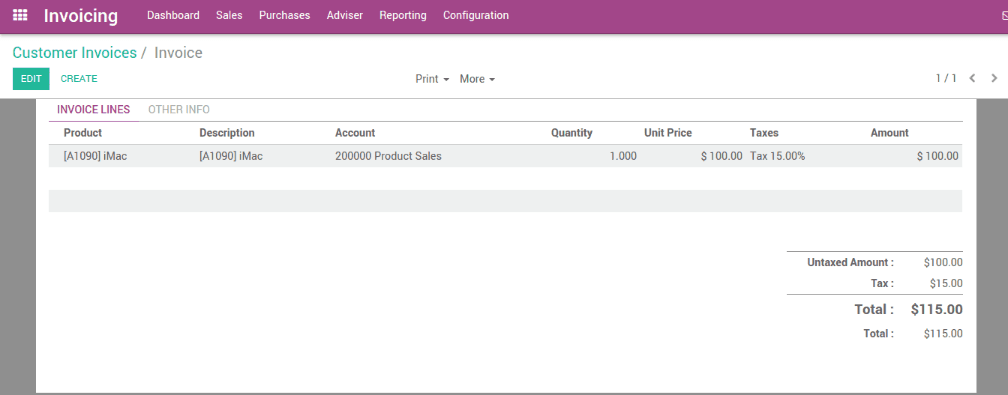
Invoicing: Easily create and send professional invoices to your clients. It lets you track payments and manage your billing efficiently.
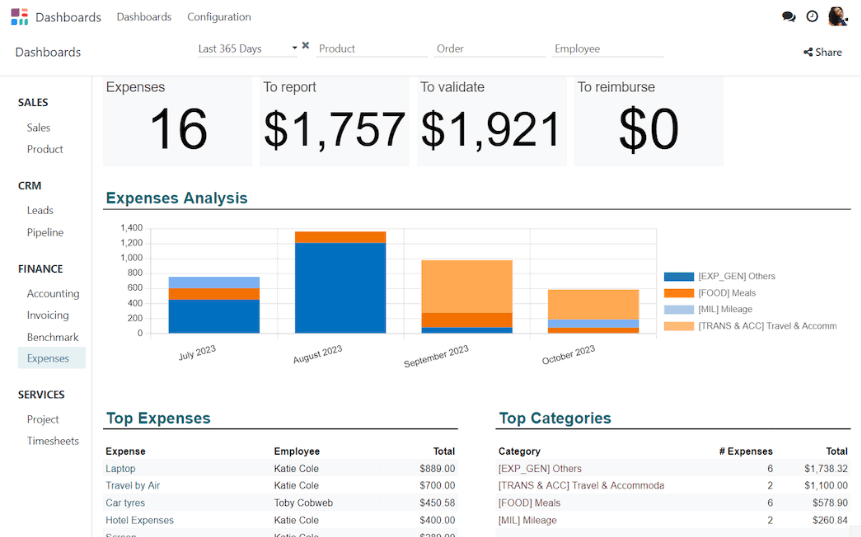
Expense Management: Track and manage your team's expenses with ease. This feature simplifies reimbursement and helps you stay on budget.
Bank Reconciliation: Match transactions with bank statements to ensure accuracy. It saves you time and reduces errors in your financial records.
Reporting: Generate detailed financial reports to analyze your business performance. It provides insights into your sales orders, revenue, expenses, and cash flow.
Tax Management: Calculate and file taxes accurately with built-in tax rules. This feature helps you stay compliant with local regulations.
Multi-Currency Support: Handle transactions in different currencies if your business operates globally. It ensures you manage international finances without hassle.
Website Builder: Odoo includes a fully native, built-in website builder that seamlessly integrates with the rest of its business management ecosystem.
Ease of Use
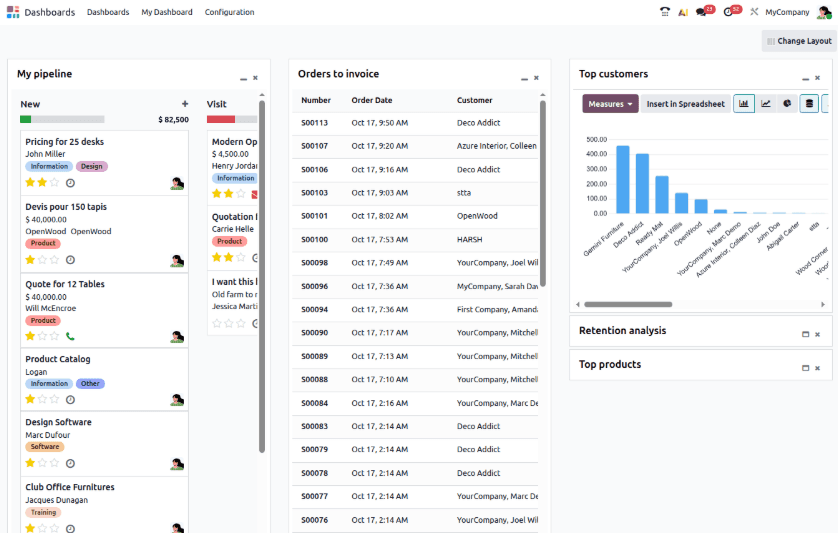
Odoo Accounting is user-friendly, making it easy for your team to adopt. The intuitive interface helps you quickly navigate features such as invoicing and reporting. Its customizable dashboards let you tailor the experience to fit your workflow, enhancing usability.
While some users report occasional system crashes, the overall design simplifies financial management, especially for small- to medium-sized businesses. You’ll find it straightforward to manage tasks without needing extensive training.
Integrations
Odoo Accounting integrates with various systems, including CRM, Microsoft, inventory management, sales management, warehouse management, human resources, e-commerce platforms, project management tools, email marketing services, payment gateways, shipping carriers, and point-of-sale systems. They can also integrate with various accounting software, such as QuickBooks Online and Xero.
Odoo Accounting also has an API offering flexible options, including connectors and custom code, to tailor integrations to specific business needs.
Odoo Accounting Specs
- 2-Factor Authentication: No
- Accounts Payable: Yes
- Accounts Receivable: Yes
- API: Yes
- Balance Sheet: Yes
- Billing/Invoicing: Yes
- BitCoin: No
- Budgeting: Yes
- Calendar Management: Yes
- Contact Management: Yes
- CRM Integration: Yes
- Customer Management: Yes
- Dashboard: Yes
- Data Export: Yes
- Data Import: Yes
- Data Visualization: No
- Expense Tracking: Yes
- External Integrations: Yes
- Forecasting: Yes
- General Account Ledger: Yes
- Inventory Tracking: Yes
- Multi-Currency: Yes
- Multi-User: Yes
- Notifications: No
- P&L: Yes
- PayPal: Yes
- Payroll: No
- SAP Integration: No
- Stripe: Yes
- Supplier Management: Yes
- Tax Management: Yes


