

O software de gestão de deduções ajuda as equipas de contas a receber a identificar, validar, contestar e recuperar deduções e estornos de clientes. As melhores ferramentas automatizam a captura de reclamações, a correspondência de documentos, a codificação de deduções, os fluxos de trabalho de contestação e o acompanhamento de recuperações. Também podem ligar-se a sistemas ERP e portais de retalhistas. Avaliei os principais softwares de gestão de deduções para contas a receber destinados a diferentes setores, fluxos de trabalho e volumes de deduções.
Why Trust Our Software Recommendations
6,700+
Reviews
20
Industry experts
16+
Evaluation factors
14
Years
Our team has been testing and reviewing software since 2012. As finance leaders ourselves, we know how difficult—and important—it is to choose the right software.
For this guide, we evaluated tools using hands-on testing and independent research, scoring tools using our selection criteria.
Our reviews reflect our human editorial judgment, not a sales pitch.
Tabela comparativa de software de gestão de deduções
Esta tabela comparativa resume os detalhes de preços das minhas principais escolhas de software de gestão de deduções:
Sorted by: Default
| Tool | Starting Price | Website | |
|---|---|---|---|
Best for invoice-to-cash dispute workflows | 4.5 out of 5 | Pricing upon request Free demo available | Website |
Best for claim trends by reason and outcome | 4.5 out of 5 | Pricing upon request Free demo available | Website |
Best for SAP chargeback management | 4.3 out of 5 | Pricing upon request Free demo available | Website |
Best for CPG deductions with expert support | Not rated | Pricing upon request Free demo available | Website |
Best for short-pay detection in cash application | Not rated | Pricing upon request Free demo available | Website |
Best for AI-driven deduction workflows | 4.5 out of 5 | Pricing upon request Free demo available | Website |
Best for AI-powered deduction validation | Not rated | Pricing upon request Free demo available | Website |
Best for autonomous deduction resolution | 3.5 out of 5 | Pricing upon request Free demo available | Website |
Best for retailer portal claim automation | Not rated | Pricing upon request Free demo available | Website |
Best for outsourced retail revenue recovery | Not rated | Pricing upon request Free demo available | Website |


Avaliações do melhor software de gestão de deduções
Seguem-se os meus resumos detalhados do melhor software de gestão de deduções que integrou a minha seleção. As minhas avaliações apresentam uma análise detalhada das funcionalidades, capacidades e integrações de cada plataforma, para ajudar a encontrar a melhor opção para si.
 Best for invoice-to-cash dispute workflows
- Free demo available
- Pricing upon request
Visit WebsiteCustomer Rating:4.5/5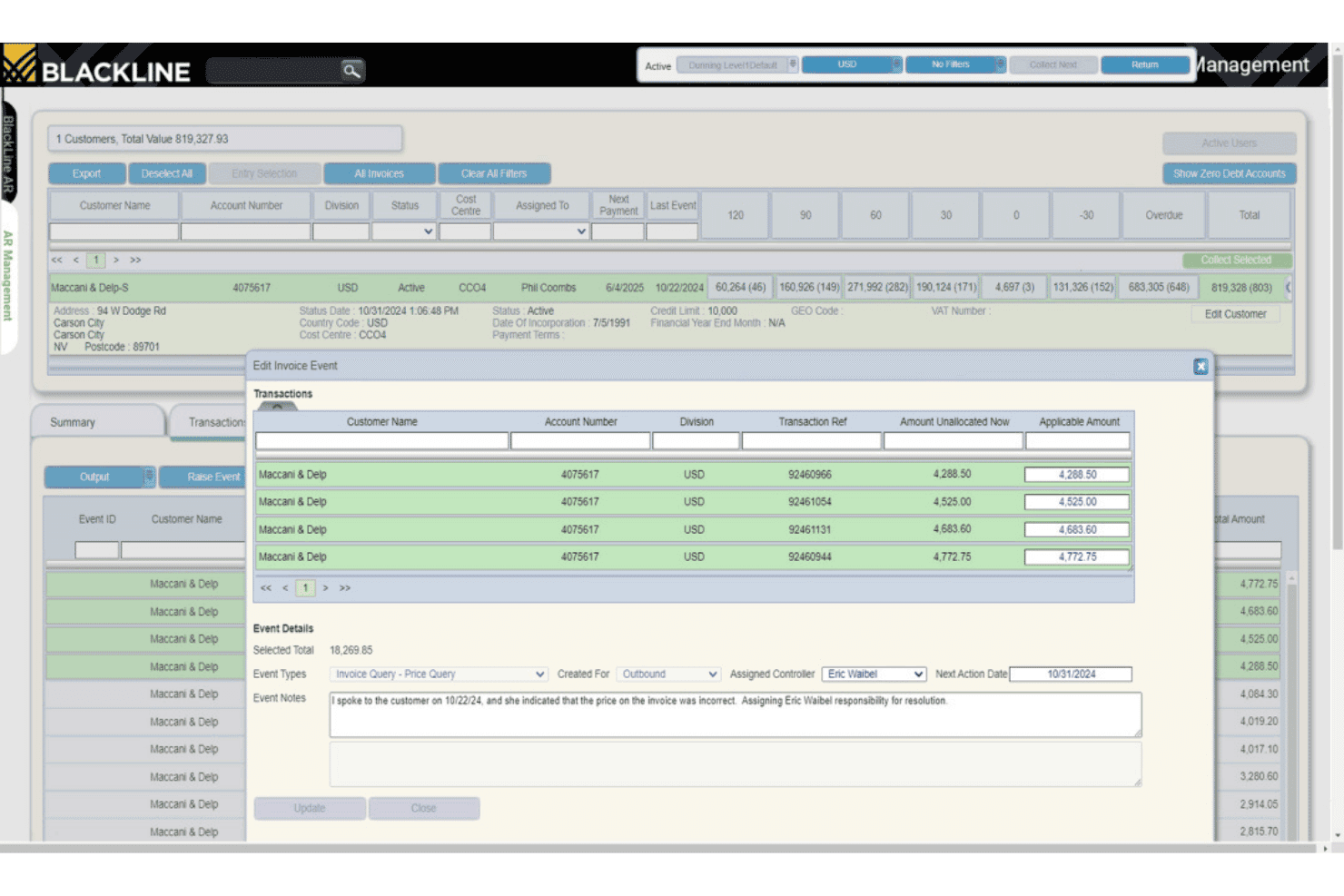
BlackLine lets users log invoice disputes and assign them for resolution. BlackLine Disputes & Deductions Management is an enterprise AR module that combines automated dispute workflows, AI-assisted claim summarization, SLA tracking, and ERP-integrated documentation management within a broader Invoice-to-Cash platform.
Who Is BlackLine Best For?
BlackLine suits mid-market to enterprise finance teams that manage high-volume invoice disputes within an existing ERP environment and need SLA-driven workflows with full audit trails.
Why I Picked BlackLine
I picked BlackLine as one of the best because its dispute workflow engine is built around measurable resolution cycles, not just task tracking. I love how Verity Summarize uses AI to instantly break down complex disputes and surface guided next steps, cutting the time I'd spend manually reviewing invoice histories. The SLA measurement layer ties directly into aged debt and provisioning reporting, so I can see exactly where disputes are stalling and which are putting cash at risk.
BlackLine Key Features
- ERP and CRM integration: Syncs deduction and dispute data directly with supported ERP and CRM platforms.
- Audit-ready documentation management: Centralizes and attaches all supporting documents to each dispute for compliance.
- KPI and SLA monitoring: Tracks dispute cycle times and resolution rates against service level agreements.
- Role-based workflow controls: Assigns, restricts, and manages user access and approval authority across AR, sales, and finance teams.
BlackLine Integrations
BlackLine offers native integrations with SAP, Oracle, NetSuite, Microsoft Dynamics 365, Salesforce, and Workday. An API is also available for custom integrations.
Pros and Cons
Pros:
- Strong audit trail supports SOX compliance requirements
- AI summarization cuts manual invoice review time
- SLA-driven dispute tracking with measurable resolution cycles
Cons:
- Implementation typically requires significant IT resource involvement
- Not purpose-built for CPG deduction workflows
Learn more about BlackLine: 2Best for claim trends by reason and outcome
Monk
- Free demo available
- Pricing upon request
Visit WebsiteCustomer Rating:4.5/5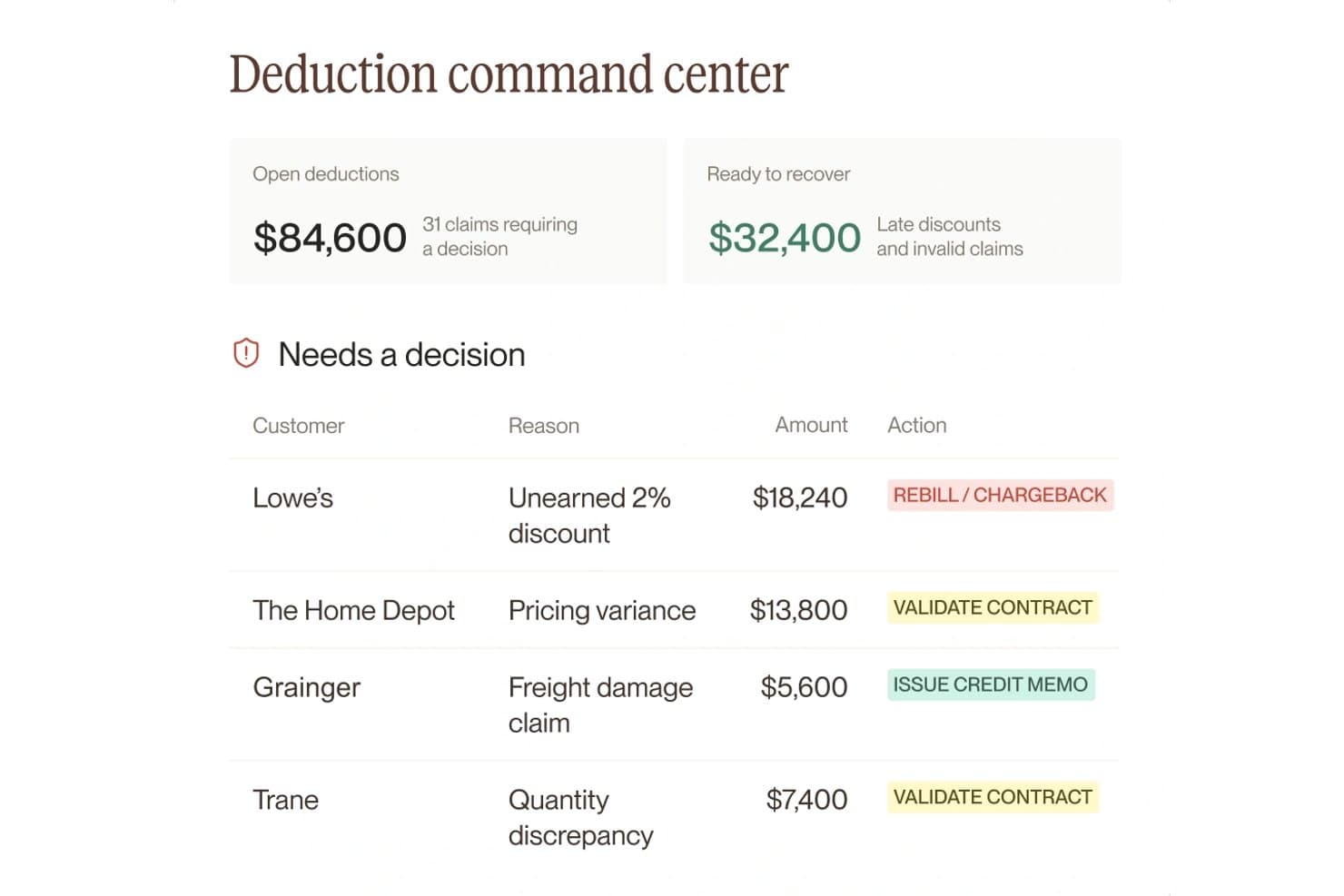
Monk centralizes open deductions and recovery actions in one dashboard. Monk is an AI-native accounts receivable platform that handles deduction matching, reason-code categorization, dispute routing, and claim tracking within a dedicated Deduction Command Center.
Who Is Monk Best For?
Monk is a strong fit for AR managers and deduction analysts who need a clear, structured view of deduction trends broken down by reason code, customer, and resolution outcome.
Why I Picked Monk
I picked Monk as one of the best because its Deduction Command Center gives you a genuinely structured view of every deduction sliced by reason code, customer, age, and resolution outcome. I love that short pays are flagged automatically at cash application and coded to your company's reason codes in the same motion, so you're not manually piecing together what happened after the fact. That combination means I can spot, say, a recurring pricing dispute with a specific customer before it compounds into a write-off pattern.
Monk Key Features
- Dispute case tracking: Each dispute opens a structured case with the invoice, reason, amount, and owner, then moves through open, in-review, and resolved statuses.
- Collections pause on contested invoices: Monk pauses outreach on a disputed invoice while continuing collections on the rest of that customer's account.
- Cash forecasting: The platform projects collections 30, 60, and 90 days out using customer payment behavior and open invoices, including a 13-week rolling forecast.
- ERP and portal sync: Monk integrates natively with NetSuite, SAP, QuickBooks, Dynamics, and 600+ AP portals, keeping your ERP as the system of record.
Monk Integrations
Monk offers native integrations with NetSuite, QuickBooks, SAP S/4HANA, Microsoft Dynamics 365, Sage Intacct, Xero, Salesforce, Stripe, and Plaid, plus support for more than 600 corporate AP portals. It also provides a REST API for custom integrations and connects to more than 12,000 banks.
Pros and Cons
Pros:
- Responsive support helps tune deduction workflows
- Trend reports expose reason, customer, age, outcome
- Short pays get flagged and reason-coded automatically
Cons:
- Dispute workflows lack confirmed SLA tracking
- No explicit recovery-rate tracking for deductions
Learn more about Monk: Best for SAP chargeback management
- Free demo available
- Pricing upon request
Visit WebsiteCustomer Rating:4.3/5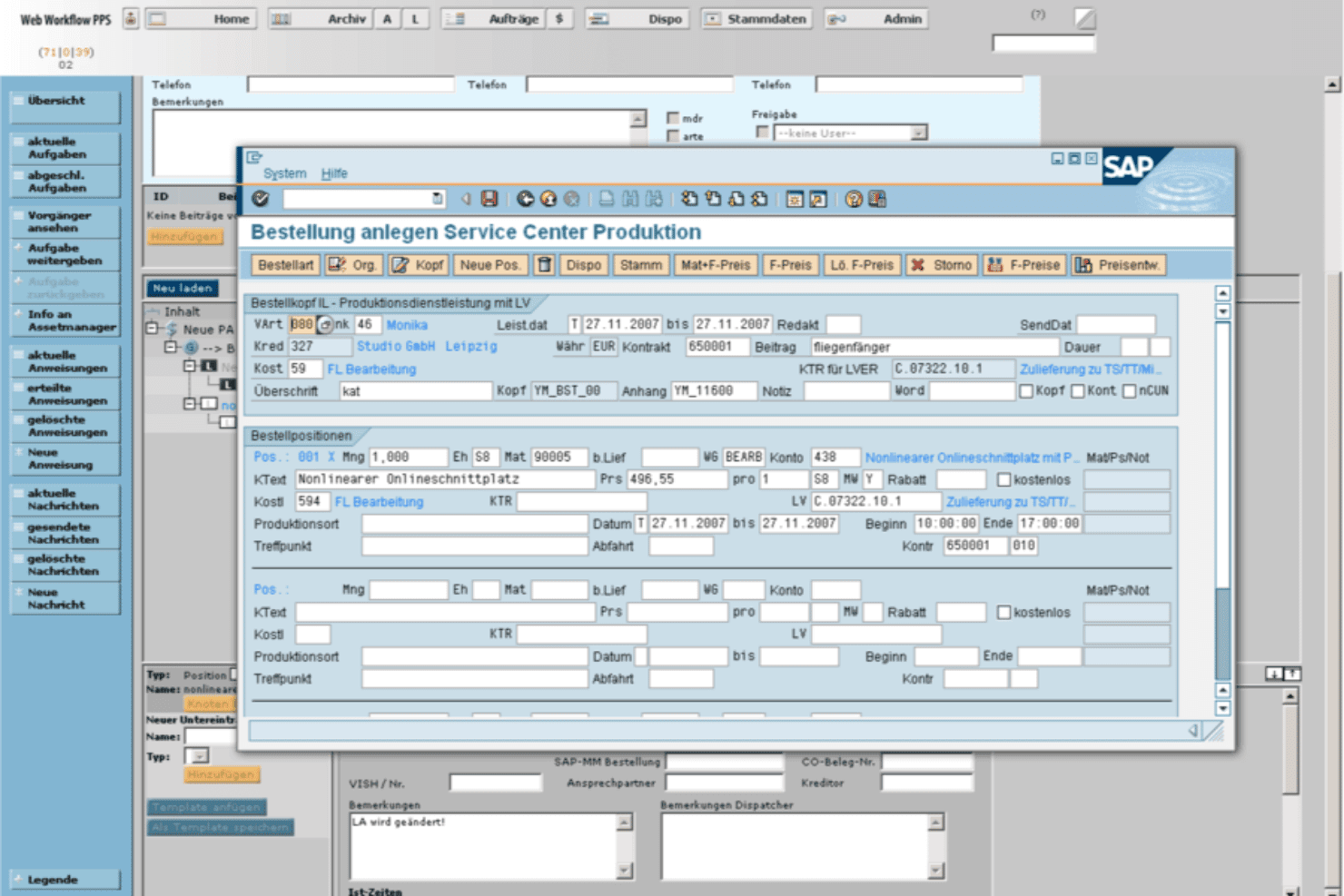
Vistex enables structured service order creation within SAP workflows. Vistex is an SAP-native chargeback and claims management platform that handles claim initiation, reason-code classification, reconciliation, accruals, and settlement—embedded directly within SAP S/4HANA and ECC environments.
Who Is Vistex Best For?
Vistex is a strong fit for large enterprise companies in CPG, manufacturing, or distribution that are already running SAP S/4HANA or ECC and managing high volumes of chargebacks.
Why I Picked Vistex
Vistex earns its spot on my shortlist because of how deeply it's embedded in SAP S/4HANA for chargeback management. I like that it handles the full claim lifecycle, from initiation through reconciliation and settlement, without requiring a separate data integration layer. The automated accrual and simulation tools also let my team forecast cost recovery before claims are submitted, which is a level of pre-claim visibility that's genuinely hard to find in a natively SAP-embedded tool.
Vistex Key Features
- SAP-native settlement workflows: Embedded directly in SAP S/4HANA and ECC for end-to-end claims processing and financial reconciliation.
- Rule-based deduction categorization: Classifies charges and deductions using customizable business rules tied to contract terms and agreement structures.
- Accruals and forecasting tools: Supports real-time accrual management and predictive modeling for upcoming cost recoveries.
- Granular audit trail: Captures detailed claim, settlement, and adjustment history for compliance and financial control purposes.
Vistex Integrations
Vistex is embedded in SAP S/4HANA and ECC environments and offers native integration with core SAP modules. An API is available for custom integrations.
Pros and Cons
Pros:
- Strong accrual management for cost recovery
- Full claim lifecycle tracking within SAP
- Native SAP settlement without third-party middleware
Cons:
- Long implementation timelines for enterprise deployments
- Not suited for non-SAP environments
Learn more about Vistex: Best for CPG deductions with expert support
- Free demo available
- Pricing upon request
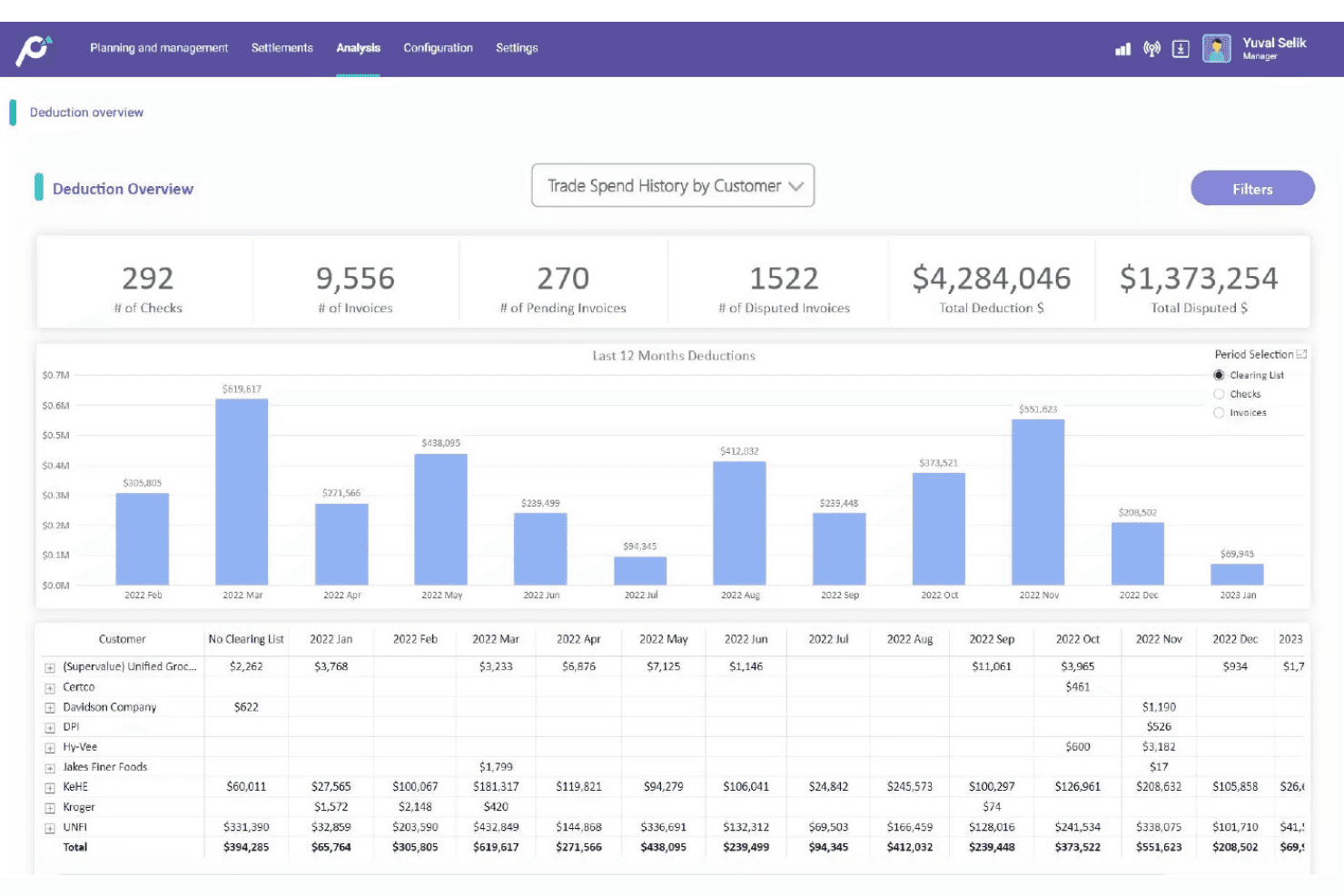
Promomash tracks trade spend deductions by customer over time. Promomash is a CPG-focused deduction management platform that combines AI-assisted deduction capture, coding, validation, and dispute recovery with a team of dedicated specialists who manage the full deduction lifecycle on your behalf.
Who Is Promomash Best For?
Promomash is a strong fit for growing CPG brands that sell through major retailers and distributors but don't have a dedicated in-house deduction management team.
Why I Picked Promomash
Promomash earns its spot on my shortlist because of how it handles the two most time-consuming parts of deduction management: coding and disputing. I love that the platform uses a proprietary catalog of reason codes built for CPG retailers and distributors, so deductions from Walmart, KEHE, and UNFI get categorized accurately without manual intervention. When an invalid deduction needs to be disputed, the CPGenius team steps in to build the case and submit it on your behalf.
Promomash Key Features
- Retailer and distributor integrations: Connects directly with leading portals like Walmart, Target, Amazon, UNFI, and KEHE for deduction data aggregation.
- Cash application add-on: Matches bank payments to open invoices and syncs payment activity with your ERP.
- Deduction analytics dashboard: Provides real-time dashboards to monitor deduction status, trends, and root cause breakdowns.
- Promotion-to-deduction matching: Automatically links deductions to specific trade promotions for proper validation and close-out.
Promomash Integrations
Promomash offers native integrations with NetSuite, QuickBooks, Sage Intacct, Microsoft Dynamics 365, Walmart Retail Link, Target Partners Online, Amazon Vendor Central, UNFI, and KEHE. An API is available for custom integrations.
Pros and Cons
Pros:
- Covers both trade and non-trade deduction types
- CPG-specific reason code library improves coding accuracy
- Managed dispute services reduce internal AR workload
Cons:
- Reporting customization requires support team involvement
- Limited fit for industries outside CPG and grocery
Learn more about Promomash: Best for short-pay detection in cash application
- Free demo available
- Pricing upon request
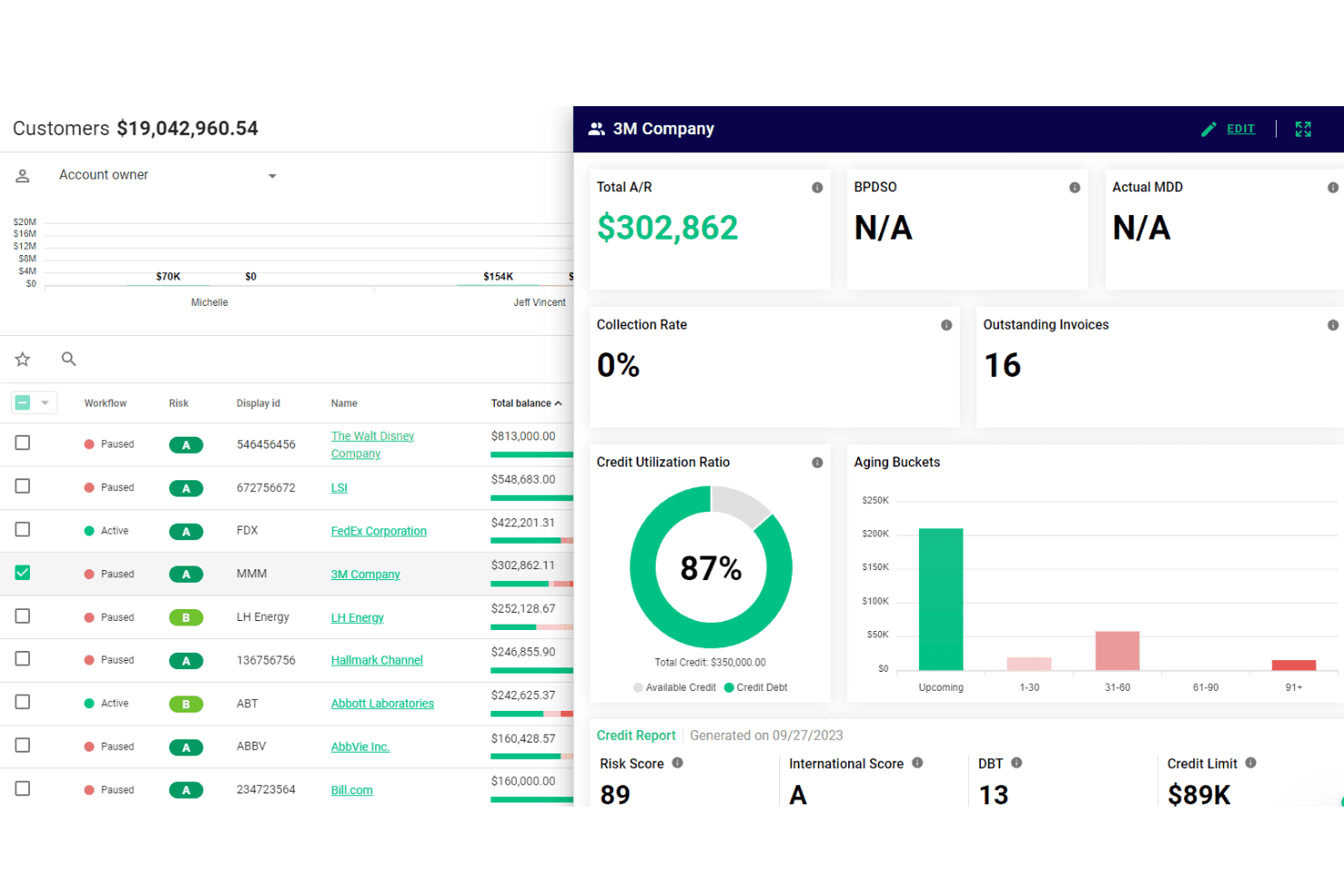
Cforia surfaces customer risk scores and A/R aging in one view. Cforia is an order-to-cash AR automation platform with modules for cash application, collections management, integrated dispute resolution, and deduction tracking built around short-pay detection.
Who Is Cforia Best For?
Cforia is a good fit for enterprise AR and collections teams that process high volumes of customer payments and need automated short-pay detection built into their cash application workflow.
Why I Picked Cforia
I picked Cforia as one of the best because its cash application module catches short-pays at the point of payment matching, not as a manual follow-up step. When a remittance comes in short, Cforia automatically flags it and creates a deduction and dispute record in the same motion. I also like the Customer Auto-Link feature, which matches payments across parent/child account hierarchies so multi-entity accounts don't generate false deduction flags.
Cforia Key Features
- Integrated dispute management: Lets teams log, track, and resolve deduction disputes directly within the platform.
- Customer auto-link matching: Connects payments and open invoices across parent and child account structures for accurate deduction capture.
- Real-time AR dashboards: Provides AR teams with configurable dashboards to monitor deduction status, activity history, and KPIs.
- Multi-source data ingestion: Supports the import of remittance, payment, and short-pay data from banks, lockbox files, and ERP systems.
Cforia Integrations
Native integrations are not clearly documented. Cforia offers an API for custom integrations and can connect to ERP systems through custom setup.
Pros and Cons
Pros:
- Dispute records created automatically at flagging
- Handles complex parent/child account structures
- Short-pay detection is built into cash application
Cons:
- Reporting customization requires vendor involvement
- Implementation timelines can run several months
Learn more about Cforia: Best for AI-driven deduction workflows
- Free demo available
- Pricing upon request
Visit WebsiteCustomer Rating:4.5/5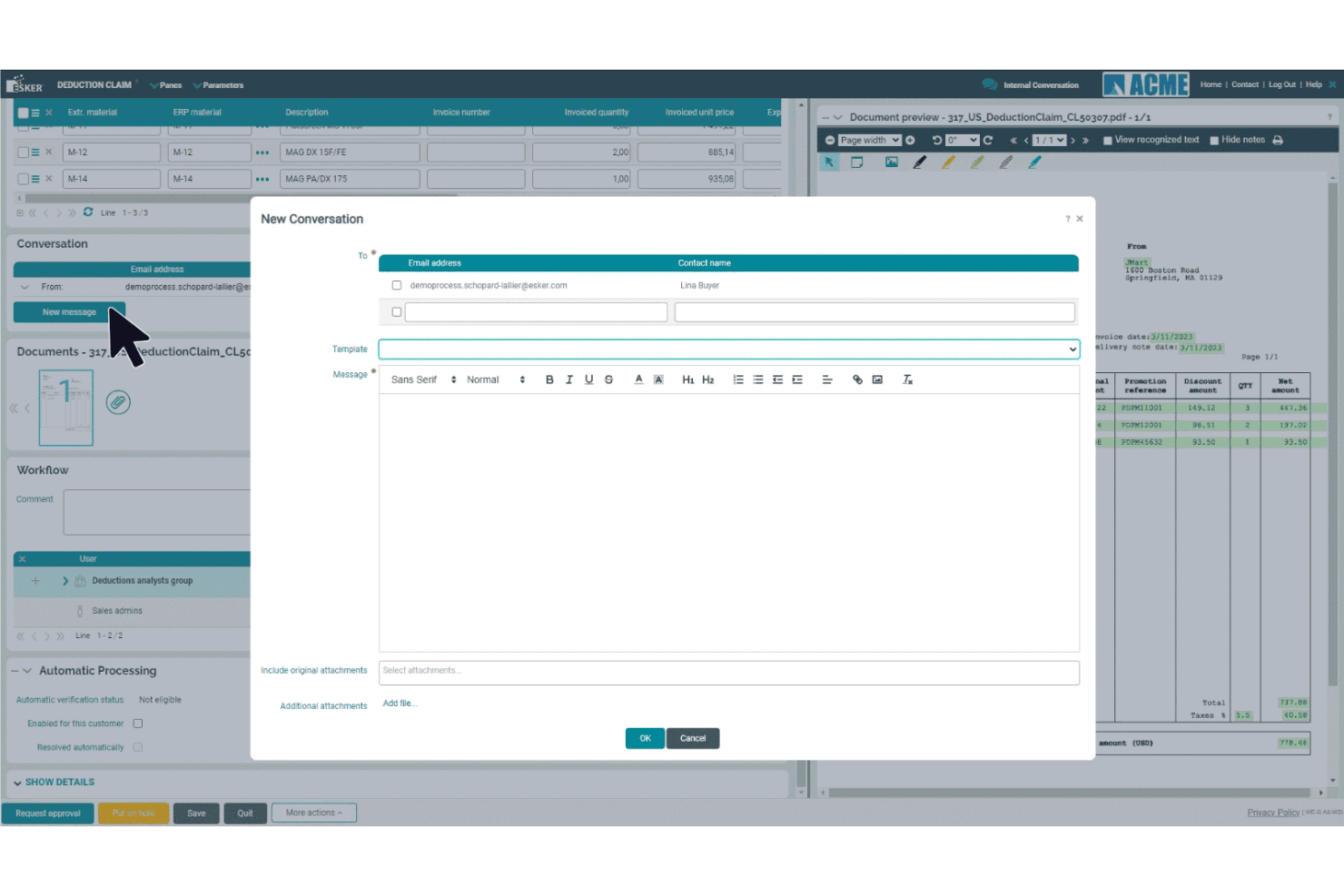
Esker lets users send internal conversations directly from a deduction claim. Esker is a cloud-based AR automation platform with a deductions management module that uses AI data capture, RPA document retrieval, and configurable workflows to handle both trade and non-trade customer deduction claims.
Who Is Esker Best For?
Esker is a strong fit for mid-market and enterprise manufacturers, CPG, and food and beverage companies that deal with high volumes of trade and non-trade customer deductions.
Why I Picked Esker
Esker earns its spot as one of the best on my shortlist because of how Esker Synergy AI handles the heaviest part of deductions work. I like that it automatically extracts and classifies deductions from remittances, debit notes, and promotional invoices into trade or non-trade categories. RPA bots retrieve supporting documents like PODs and BOLs directly from retailer portals. The AI also learns from analyst corrections over time, which sharpens auto-coding accuracy the more I use it.
Esker Key Features
- Multi-level workflow configuration: Set up custom approval processes by deduction type and value, involving AR, sales, and supply chain teams.
- RPA-driven document retrieval: Automate the sourcing of supporting documents directly from retailer and carrier portals.
- Integrated AR analytics dashboard: Monitor real-time KPIs such as DDO, deduction aging, and root cause breakdowns in a single view.
- Salesforce integration: Sync deduction case data and collaborate with sales teams through a direct API connection.
Esker Integrations
Esker offers native integrations with SAP, Oracle, Microsoft Dynamics 365, NetSuite, Sage, Salesforce, and QuickBooks, and provides an API for custom integrations.
Pros and Cons
Pros:
- Real-time DDO and deduction aging visibility
- Handles both trade and non-trade claims
- Auto-coding accuracy improves with analyst corrections
Cons:
- Full configuration requires dedicated admin support
- Implementation timelines can extend several months
Learn more about Esker: Best for AI-powered deduction validation
- Free demo available
- Pricing upon request
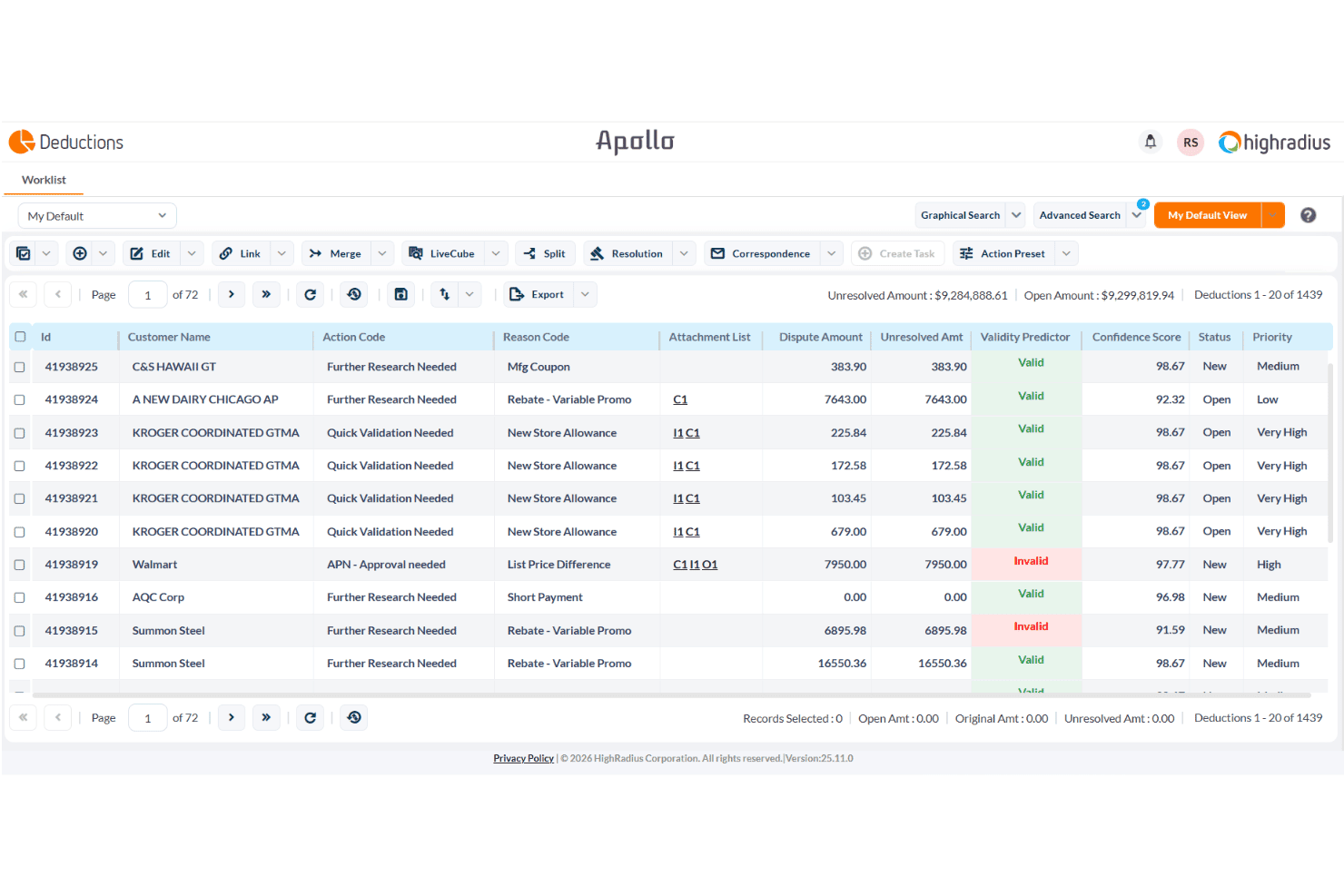
HighRadius helps users manage and prioritize deductions with AI validity predictions. HighRadius is an AI-powered deduction management platform that automates claim capture from retailer portals, backup document matching, deduction coding, and dispute resolution workflows across AR teams.
Who Is HighRadius Best For?
HighRadius is a strong fit for enterprise AR teams in CPG, food and beverage, and manufacturing dealing with high volumes of retailer-portal deductions.
Why I Picked HighRadius
HighRadius earns its spot as one of the best on my shortlist because of the Deductions Validity Predictor, which uses AI confidence scoring to flag whether a deduction is valid or invalid before anyone manually reviews it. I like that the Portal Claim Download agent auto-navigates major retailer portals like Amazon and Kroger to pull claim documents directly, cutting out the repetitive portal logins. The Trade Promotion Matching agent then cross-references those claims against SAP TPM data and POS records for multi-way validation.
HighRadius Key Features
- Shortage variance analysis: Aggregates proof-of-delivery and carrier documentation to link claims to shortages for validation.
- Worklist prioritization: Creates AI-driven, dynamic lists to organize and delegate deduction research tasks across AR teams.
- Invalid claim upload and dispute management: Auto-prepares dispute packets with attachments and submits them to retailer portals.
- Deductions backup linking: Automatically matches and attaches all relevant backup documentation to each open deduction record.
HighRadius Integrations
HighRadius provides native integrations with SAP, Oracle, NetSuite, Microsoft Dynamics 365, QuickBooks, and Sage ERP systems, and offers an API for custom integrations.
Pros and Cons
Pros:
- Multi-way trade promotion matching against TPM data
- Auto-navigates retailer portals for claim documents
- AI validity scoring before manual review begins
Cons:
- Reporting customization requires IT or vendor support
- Long implementation timelines for enterprise deployments
Learn more about HighRadius: Best for autonomous deduction resolution
- Free demo available
- Pricing upon request
Visit WebsiteCustomer Rating:3.5/5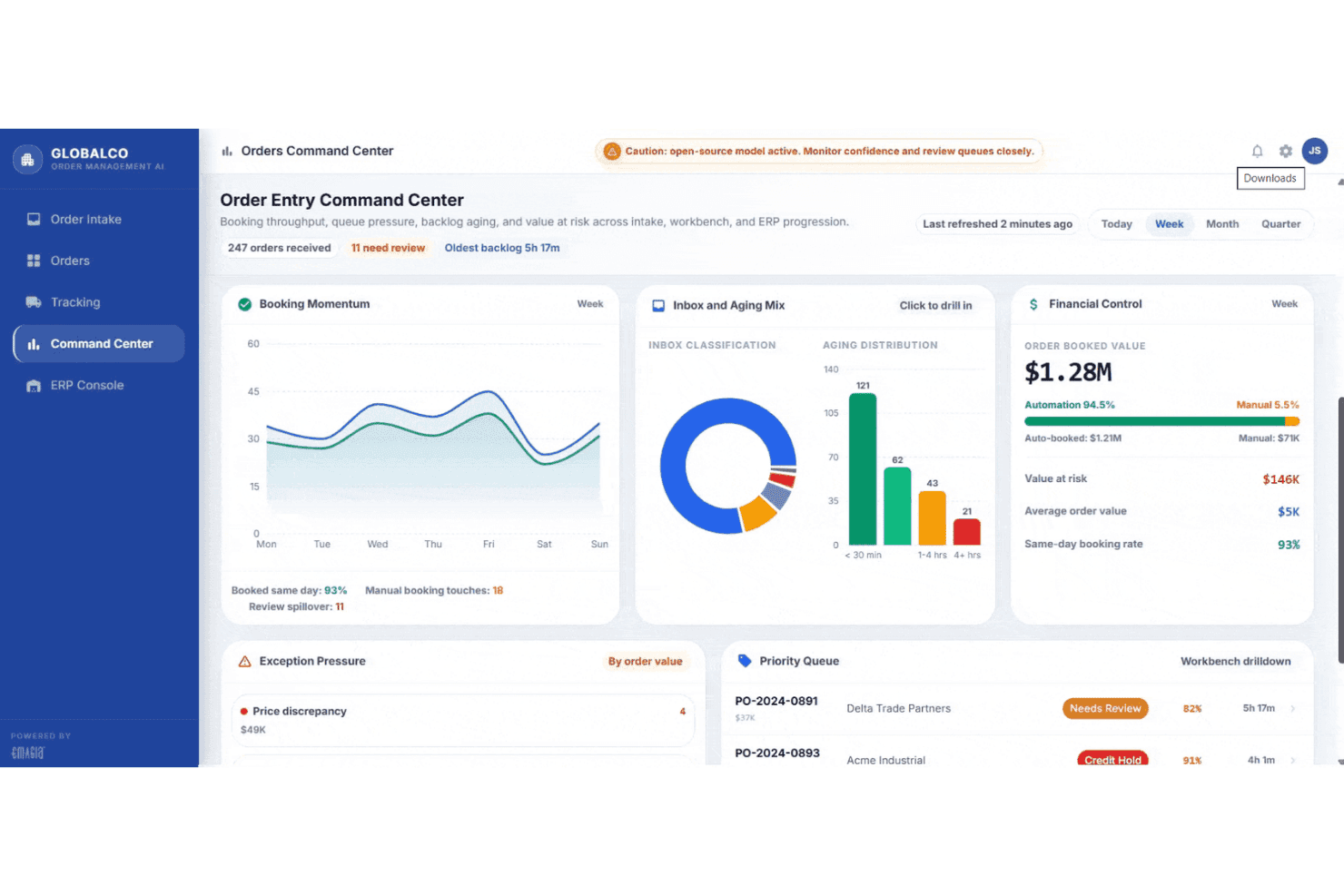
Emagia centralizes order management with AI-driven booking and exception tracking. Emagia is an AI-powered deduction management platform that automates short-pay identification, reason-code classification, dispute workflow routing, and resolution tracking across the accounts receivable function.
Who Is Emagia Best For?
Emagia is a strong fit for enterprise finance teams and shared service centers managing high volumes of deductions across multiple ERPs and business units.
Why I Picked Emagia
I picked Emagia as one of the best because of how far it pushes autonomous resolution in practice. The rules-based bulk claims processing auto-approves deductions based on predefined business decisions, with no analyst touch required. On top of that, Gia AI auto-identifies short pays and over pays, assigns reason codes, and routes each item through the correct workflow immediately, which means my team isn't manually triaging a backlog before resolution work can even begin.
Emagia Key Features
- Configurable reason code library: Build and manage custom deduction reason codes tailored to business needs.
- ERP and financial system integration: Connects with SAP, Oracle, Microsoft Dynamics, NetSuite, Sage, and other leading ERP platforms.
- Document aggregation and linking: Aggregates and attaches supporting documents like invoices, PODs, and BOLs to deduction cases for easy reference.
- Analytics dashboard: Tracks deduction aging, resolution rates, and trends by customer or root cause for management review.
Emagia Integrations
Emagia offers native integrations with SAP, Oracle, NetSuite, PeopleSoft, Workday, Microsoft Dynamics, and Sage. An API is available for custom integrations.
Pros and Cons
Pros:
- Delegation of authority matrix for approval workflows
- Dispute-level line item granularity for invoice disputes
- AI auto-resolves up to 80% of deductions
Cons:
- Implementation complexity for multi-ERP environments
- No self-serve pricing or trial access
Learn more about Emagia: Best for retailer portal claim automation
- Free demo available
- Pricing upon request
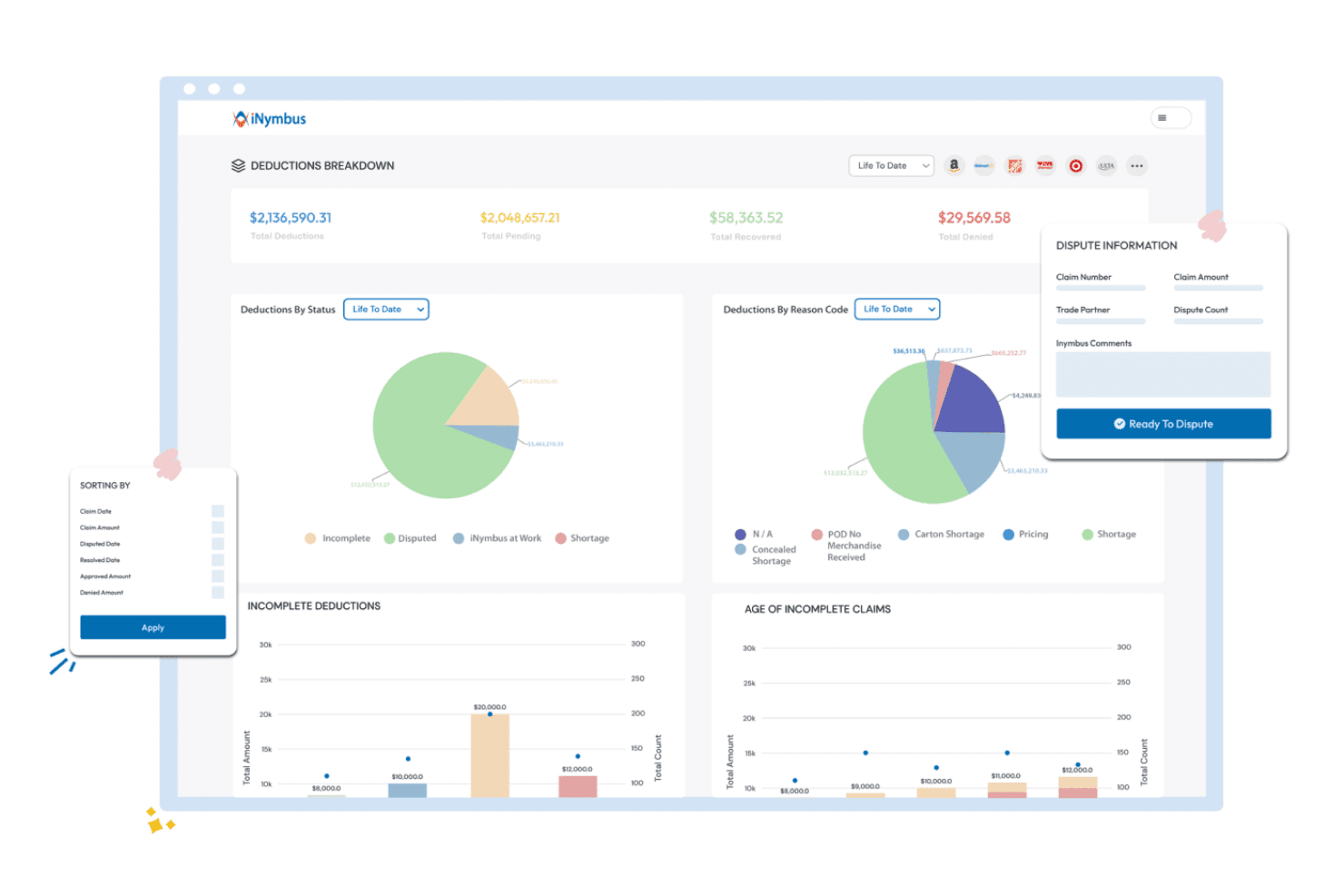
iNymbus DeductionXchange tracks and visualizes deductions by status and reason code. iNymbus DeductionXchange is a cloud-based deduction management platform that uses robotic process automation to capture, match, and dispute retailer chargebacks and claims across 50+ retailer portals, EDI transactions, and email-based channels.
Who Is iNymbus DeductionXchange Best For?
It's a strong fit for CPG manufacturers, distributors, and suppliers that deal with high volumes of retailer deductions from major accounts like Walmart, Amazon, or Target.
Why I Picked iNymbus DeductionXchange
I picked iNymbus DeductionXchange as one of the best because of how it handles retailer portal submission end to end. The RPA robots retrieve claim documents, assemble dispute packets, and auto-fill required portal fields across Walmart Retail Link, Amazon Vendor Central, and 50+ other portals without any manual login. I also appreciate the Walmart SQEP penny-perfect matching, which catches amount discrepancies before submission and reduces rejected disputes.
iNymbus DeductionXchange Key Features
- Centralized deduction dashboard: View and manage all deductions from multiple retailers in one place.
- Automated document aggregation: Pull supporting documents from EDI, ERP, email, and portal sources.
- Flexible file format support: Integrate customized file formats for seamless data processing across sources.
- Root cause analysis tools: Visualize deduction patterns and root causes with detailed analytics dashboards.
iNymbus DeductionXchange Integrations
iNymbus DeductionXchange offers native integrations with SAP, Oracle, NetSuite, Microsoft Dynamics, and QuickBooks, and connects to retailer platforms including Walmart Retail Link and Amazon Vendor Central. An API is available for custom integrations.
Pros and Cons
Pros:
- Cuts manual dispute prep time significantly
- Matches Walmart deductions to the penny
- Handles 50+ retailer portal submissions automatically
Cons:
- Implementation requires heavy retailer portal credential setup
- Reporting customization options are limited out of the box
Learn more about iNymbus DeductionXchange: Best for outsourced retail revenue recovery
- Free demo available
- Pricing upon request
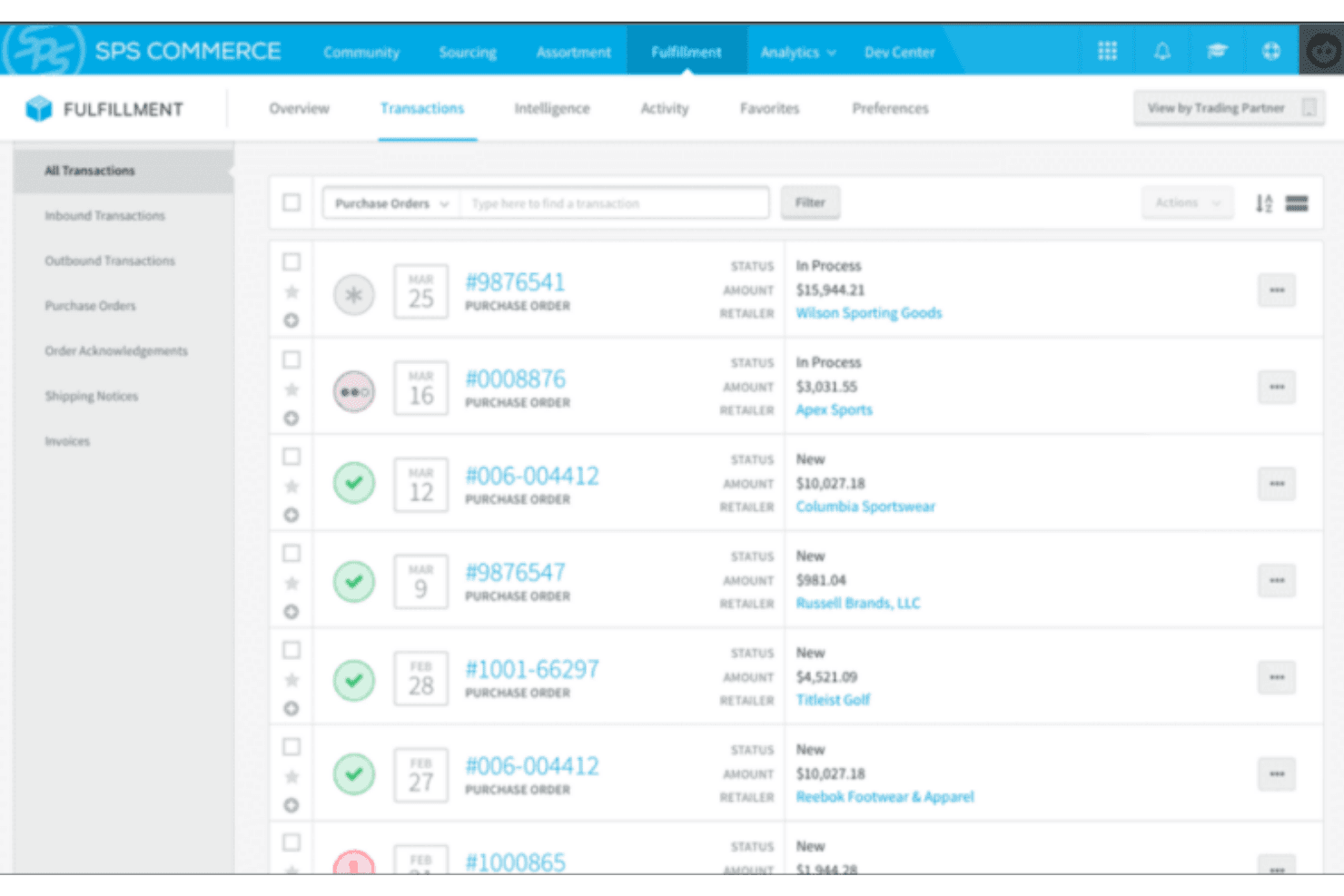
SPS Commerce centralizes purchase order tracking to catch revenue gaps. SPS Commerce Revenue Recovery is a retail deduction management platform that automates deduction capture, backup document retrieval, dispute submission, and root-cause reporting across major retailers, distributors, and marketplace channels.
Who Is SPS Commerce Revenue Recovery Best For?
CPG brands and consumer goods suppliers that sell through major retail chains and want a managed, expert-led approach to deduction recovery.
Why I Picked SPS Commerce Revenue Recovery
I've included SPS Commerce Revenue Recovery in my top picks because it's the only platform I know that offers a genuinely outsourced recovery model, where SPS experts handle the full dispute cycle on your behalf. I like that the platform automatically retrieves retailer-specific backup documents and attaches them to open deductions before submission. The prebuilt partner workflows for retailers like Walmart, Amazon, and Kroger ensure dispute packets are built to each retailer's exact specifications.
SPS Commerce Revenue Recovery Key Features
- Centralized deduction dashboard: View, track, and manage every deduction, dispute, and resolution in a single interface.
- Retailer-specific compliance mapping: Built-in logic addresses chargeback requirements for Walmart, Amazon, Kroger, CVS, and more.
- Automated root cause analysis: Surface deduction trends and patterns across customers, reason codes, and periods for targeted process fixes.
- SOC 2 Type II data security: Protect financial data with hourly backups, encryption, and role-based access management.
SPS Commerce Revenue Recovery Integrations
SPS Commerce Revenue Recovery offers native integrations with major retailer portals such as Walmart Retail Link, Amazon Vendor Central, Target Partners Online, Kroger Partners Portal, and CVS Supplier Portal. An API is available for custom integrations.
Pros and Cons
Pros:
- Root cause insights prevent recurring deduction types
- Up to 99% recovery rate on valid claims
- Fully managed dispute cycle reduces internal AR lift
Cons:
- Less suitable for non-retail or direct-to-consumer channels
- No self-serve pricing; requires a sales conversation
Learn more about SPS Commerce Revenue Recovery:
Outro software de gestão de deduções
Eis algumas opções adicionais de software de gestão de deduções que não entraram na minha seleção, mas que ainda vale a pena conhecer:
Related Reviews
How I Evaluate Deduction Management Software
I split my evaluation into baseline requirements—like automated deduction capture and dispute workflows—and the differentiators, like retailer coverage and ERP fit, that separate good from great.
Core Functionality (Table Stakes For This List)
When I'm selecting tools for my list, I rank each one on a scale from 0 (does not offer the functionality) to 5 (excels in this area) for every core functionality below. I then calculate the total score as a percentage. I use 65% as a benchmark to assess overall fit for the list.
- Deduction Capture: I check whether the tool pulls deduction data from ERP systems, bank remittances, EDI 812/820 feeds, and retailer portals without manual uploads.
- Document Matching: Automatic retrieval and matching of PODs, BOLs, and invoices to open claims saves hours of portal-hopping across retailer systems.
- Deduction Coding: I evaluate how the tool classifies deductions by reason code—shortages, pricing errors, promotional claims—to support root-cause analysis.
- Dispute Workflows: Multi-role workflows with audit trails matter here, especially when AR, sales, and trade teams all need to collaborate on approvals and escalations.
- Recovery Management: I look for automated chargeback packet assembly and submission, plus tracking through to repayment—manual packet building doesn't scale.
- Analytics & Reporting: Dashboards should track deduction aging, recovery rates, and root causes by customer or reason code to surface trends worth acting on.
Next, once I have a list of tools that meet the criteria, I consider what sets each platform apart.
Differentiating Factors (What Sets Vendors Apart)
Here's how I compare and contrast different vendors:
Standout Features
AI-powered deduction coding can automatically classify claims by reason code using historical patterns. This can cut triage time on high-volume accounts. Automated backup document retrieval is another key differentiator. Native retailer portal connectors can pull PODs and claim documents without manual downloads. For CPG brands, I also evaluate trade promotion matching. This helps validate deductions against TPM systems or promotional calendars.
Beyond Features
ERP integration depth also matters. I check whether a platform syncs with AR aging and cash application data in systems like SAP, NetSuite, or Oracle. Similarly, retailer coverage is important for companies selling through major retail or foodservice channels. Pricing models also vary across this space. Some vendors use SaaS subscriptions, while others charge contingency-based recovery fees.
Como escolher software de gestão de deduções
Ao comparar software de gestão de deduções, concentre-se no grau de adequação de cada plataforma ao seu fluxo de trabalho de contas a receber, volume de deduções, ambiente ERP e fontes de reclamações.
| Se a sua prioridade for | Procure |
| Correspondência rápida de documentos | Conectores pré-configurados para portais de retalhistas |
| Informações sobre as causas principais das deduções | Codificação baseada em IA e análises granulares |
| Gerir uma combinação de EDI/portais de retalhistas | Captura automática a partir de EDI 812 e portais que não utilizam EDI |
| Recuperação simplificada de estornos | Envio automatizado de documentos com acompanhamento dos reembolsos |
| Integração com ERP e TPM | Sincronização bidirecional com o seu conjunto principal de sistemas financeiros |
Como avaliar a sua seleção
- Teste a ingestão automática com documentos de pagamento de exemplo: Carregue pelo menos 3 ficheiros variados de deduções de retalhistas e compare as capturas automáticas no prazo de 48 horas.
- Solicite um relatório de anexos de uma reclamação de amostra: Obtenha uma demonstração ao vivo que mostre o POD, a fatura e o BOL associados automaticamente às reclamações de um retalhista relativas a um cliente atual.
- Mapeie as etapas do fluxo de trabalho face ao seu SOP: Solicite cartas de contestação com modelos, funções de utilizador e vias de escalamento e, em seguida, compare-as com o seu próprio processo de AR.
- Exija um registo de auditoria: Solicite um exemplo de registo de auditoria que inclua todas as ações relativas a deduções, os identificadores dos utilizadores e as marcas temporais para validação da conformidade.
- Compromisso entre automatização por IA e personalização: Decida se precisa de automatização de ponta a ponta ou de maior personalização. As ferramentas mais configuráveis podem exigir supervisão adicional.
O que é o software de gestão de deduções?
O software de gestão de deduções é uma ferramenta especializada de contas a receber. Automatiza a captura, codificação, correspondência de documentos e resolução de reclamações de deduções de clientes. Estas plataformas podem estabelecer ligação ao seu ERP, aos seus feeds EDI e aos portais dos retalhistas. Isto ajuda a reduzir o trabalho manual, a melhorar os tempos de resposta às contestações e a identificar as causas dos pagamentos inferiores ou dos débitos. Como resultado, as equipas financeiras podem utilizar estas ferramentas para acelerar a recuperação e monitorizar as tendências das deduções.
Funcionalidades do software de gestão de deduções
Ao comparar software de gestão de reclamações e deduções, procure funcionalidades que suportem todo o processo, desde a captura e validação da reclamação até à resolução da contestação e à recuperação:
- Captura e agregação de deduções: Recolhe automaticamente dados de deduções de sistemas ERP, feeds EDI, avisos de pagamento e portais de retalhistas, eliminando a recolha manual.
- Correspondência entre a reclamação e os documentos comprovativos: Obtém, associa e anexa comprovativos de entrega, conhecimentos de embarque e faturas às reclamações de deduções relacionadas, facilitando a validação.
- Categorização por código de motivo: Atribui cada dedução a códigos de motivo específicos, como faltas, preços ou conformidade, ajudando as equipas de AR a analisar e resolver as causas subjacentes.
- Fluxo de trabalho de contestação e aprovação: Gere cada etapa de validação, escalamento, contestação ou anulação de deduções, utilizando registos de auditoria e vias de aprovação claramente definidas.
- Gerador de dossiês de débitos e recuperação: Reúne a documentação e os formulários relevantes em dossiês de débitos. As equipas podem depois apresentá-los aos clientes para recuperar deduções inválidas.
- Integração com retalhistas e EDI: Estabelece ligação nativa aos principais portais de retalhistas e suporta os formatos EDI 812/820. Isto ajuda as equipas a gerir formatos de reclamação eletrónicos e manuais.
- Relatórios e painéis configuráveis: Disponibiliza painéis que visualizam as tendências, a antiguidade e as taxas de recuperação das deduções, ajudando as equipas a monitorizar os KPIs e a identificar padrões.
- Permissões e funções de utilizador: Permite configurar diferentes níveis de acesso, garantindo a auditabilidade e a conformidade enquanto as equipas de AR, vendas e finanças colaboram.
- Rastreio do registo de auditoria: Regista todas as ações dos utilizadores e alterações efetuadas na plataforma, facilitando o acompanhamento do histórico de decisões e o apoio aos controlos financeiros.
- Notificações automatizadas: Envia alertas relativos a novas reclamações, prazos de aprovação ou escalamentos do fluxo de trabalho, para que nada fique por tratar.
Funcionalidades de IA no software de gestão de deduções
As funcionalidades de IA no software de gestão de deduções podem ajudar as equipas de contas a receber a classificar deduções, validar reclamações, associar documentos comprovativos, dar prioridade às contestações e identificar padrões que possam contribuir para deduções recorrentes. Veja abaixo:
- Codificação de deduções com IA: Utiliza aprendizagem automática para classificar automaticamente as deduções por código de motivo, com base em padrões históricos de reclamações, reduzindo o tempo de análise manual.
- Resolução preditiva de contestações: Analisa resultados anteriores para sugerir as estratégias de contestação mais eficazes e prever a probabilidade de recuperação bem-sucedida de cada reclamação.
- Correspondência automatizada de documentos: Utiliza IA para identificar, extrair e associar documentos comprovativos — como POD e faturas — à dedução correta, mesmo quando os formatos ou as convenções de nomenclatura variam.
- Análise de tendências das causas principais: Utiliza IA para revelar padrões e anomalias emergentes nos dados das deduções. Isto ajuda as equipas a resolver problemas recorrentes e a prevenir futuras reclamações.
- Encaminhamento inteligente de fluxos de trabalho: Atribui dinamicamente os casos de dedução aos membros certos da equipa ou aos percursos de escalamento adequados, com base na complexidade da reclamação, no histórico do cliente e no equilíbrio da carga de trabalho.
- Processamento de linguagem natural para análise de reclamações: Utiliza IA para interpretar e resumir descrições não estruturadas de reclamações ou documentação comprovativa. Isto pode facilitar a validação e resolução de deduções complexas.
Benefícios do software de gestão de deduções
O software de gestão de deduções ajuda as equipas de contas a receber a reduzir o trabalho manual, resolver deduções mais rapidamente, melhorar as taxas de recuperação e obter uma melhor visibilidade sobre as causas das deduções dos clientes. Eis alguns benefícios a esperar:
- Resolução mais rápida das reclamações: A captura automatizada de dados, a correspondência de documentos e o acompanhamento dos fluxos de trabalho ajudam as equipas a processar as reclamações de dedução mais rapidamente.
- Melhoria das taxas de recuperação: A geração de pacotes de recuperação de débitos e a automatização de litígios ajudam a identificar e recuperar um maior número de deduções inválidas.
- Análise mais aprofundada das causas principais: A categorização, a análise de dados e os conhecimentos baseados em IA facilitam a identificação de tendências e a resolução de problemas recorrentes relacionados com deduções.
- Menor esforço manual: As integrações com ERP, EDI e portais de retalhistas minimizam as transferências e carregamentos morosos, bem como a introdução repetitiva de dados.
- Melhor colaboração entre equipas: Os fluxos de trabalho baseados em funções e os registos de auditoria ligam as equipas de contas a receber, vendas e comércio, para que nada seja esquecido ou duplicado.
- Maior confiança na conformidade: Os registos de auditoria e os controlos de permissões facilitam a aplicação das políticas internas e a conformidade com a SOX ou com regulamentações financeiras semelhantes.
- Maior visibilidade financeira: Os painéis personalizados e os relatórios em tempo real clarificam a atividade relacionada com deduções, as taxas de recuperação e os riscos pendentes para a liderança financeira.
Custos & preços
O preço do software de gestão de deduções é normalmente baseado num orçamento personalizado. Os custos podem variar consoante o volume de deduções, o número de utilizadores, as integrações com ERP, a cobertura de retalhistas e os requisitos de implementação. Muitos fornecedores orientados para empresas não publicam preços padrão. Normalmente, será necessário contactar o fornecedor para obter um orçamento personalizado. Consulte abaixo algumas opções de preços típicas:
Tabela de comparação de planos para software de gestão de deduções
| Tipo de plano | Preço médio | Funcionalidades comuns |
|---|---|---|
| Tipo de planoPlano gratuito | Preço médio$0 | Funcionalidades comunsAcompanhamento básico de deduções, carregamentos limitados de documentos, acesso para um único utilizador e suporte por e-mail. |
| Tipo de planoPlano pessoal | Preço médio$50-$150/utilizador/mês | Funcionalidades comunsCaptura padrão de reclamações, correspondência automatizada de documentos, modelos de fluxos de trabalho e painéis de análise básicos. |
| Tipo de planoPlano empresarial | Preço médio$200-$700/utilizador/mês | Funcionalidades comunsColaboração entre vários utilizadores, integração com ERP e EDI, relatórios personalizados, fluxos de trabalho de aprovação configuráveis e registos de auditoria. |
| Tipo de planoPlano empresarial avançado | Preço médio$1,000+/mês | Funcionalidades comunsFuncionalidades avançadas de IA, integrações ilimitadas com portais de retalhistas, suporte premium, ferramentas completas de conformidade e integração com sistemas TPM. |
Perguntas frequentes sobre software de gestão de deduções
\u003cspan data-slate-fragment=\u0022JTVCJTdCJTIyY2hpbGRyZW4lMjIlM0ElNUIlN0IlMjJ0ZXh0JTIyJTNBJTIySGVyZSUyMGFyZSUyMHNvbWUlMjBhbnN3ZXJzJTIwdG8lMjBjb21tb24lMjBxdWVzdGlvbnMlMjBhYm91dCUyMGRlZHVjdGlvbiUyMG1hbmFnZW1lbnQlMjBzb2Z0d2FyZSUzQSUyMiU3RCU1RCUyQyUyMnR5cGUlMjIlM0ElMjJwJTIyJTJDJTIyaWQlMjIlM0ElMjJXUTFxbk9fa0p3JTIyJTdEJTVE\u0022\u003eEis algumas respostas a perguntas frequentes sobre software de gestão de deduções:\u003c/span\u003e
Como é que o software de gestão de deduções trata a documentação das reclamações dos retalhistas?
\u003cspan data-slate-fragment=\u0022JTVCJTdCJTIyY2hpbGRyZW4lMjIlM0ElNUIlN0IlMjJ0ZXh0JTIyJTNBJTIyRGVkdWN0aW9uJTIwbWFuYWdlbWVudCUyMHNvZnR3YXJlJTIwY29ubmVjdHMlMjB0byUyMHJldGFpbGVyJTIwcG9ydGFscyUyMGFuZCUyMHB1bGxzJTIwY2xhaW0lMjBwYWNrZXRzJTJDJTIwaW52b2ljZXMlMkMlMjBhbmQlMjBzdXBwb3J0aW5nJTIwZG9jdW1lbnRzJTIwYXV0b21hdGljYWxseSUyQyUyMHNvJTIweW91ciUyMHRlYW0lMjBkb2VzbiVFMiU4MCU5OXQlMjBoYXZlJTIwdG8lMjBkb3dubG9hZCUyMGFuZCUyMHNvcnQlMjBmaWxlcyUyMGJ5JTIwaGFuZC4lMjIlN0QlNUQlMkMlMjJ0eXBlJTIyJTNBJTIycCUyMiUyQyUyMmlkJTIyJTNBJTIyVXVCUURJTENIVyUyMiU3RCU1RA==\u0022\u003eO software de gestão de deduções liga-se aos portais dos retalhistas e obtém automaticamente os dossiês das reclamações, as faturas e os documentos comprovativos, para que a sua equipa não tenha de descarregar e ordenar ficheiros manualmente.\u003c/span\u003e
O software de gestão de deduções pode integrar-se com o nosso ERP ou sistema de contabilidade?
\u003cspan data-slate-fragment=\u0022JTVCJTdCJTIyY2hpbGRyZW4lMjIlM0ElNUIlN0IlMjJ0ZXh0JTIyJTNBJTIyWWVzJTJDJTIwbW9zdCUyMHNvbHV0aW9ucyUyMG9mZmVyJTIwbmF0aXZlJTIwY29ubmVjdG9ycyUyMGZvciUyMEVSUHMlMjBsaWtlJTIwTmV0U3VpdGUlMkMlMjBTQVAlMkMlMjBNaWNyb3NvZnQlMjBEeW5hbWljcyUyQyUyMGFuZCUyMFF1aWNrQm9va3MlMkMlMjBhbGxvd2luZyUyMGRlZHVjdGlvbiUyMGRhdGElMjB0byUyMHN5bmMlMjB3aXRoJTIweW91ciUyMEFSJTJDJTIwY2FzaCUyMGFwcGxpY2F0aW9uJTJDJTIwYW5kJTIwZ2VuZXJhbCUyMGxlZGdlci4lMjIlN0QlNUQlMkMlMjJ0eXBlJTIyJTNBJTIycCUyMiUyQyUyMmlkJTIyJTNBJTIyQkg4bU5DRUNWbiUyMiU3RCU1RA==\u0022\u003eSim, a maioria das soluções disponibiliza conectores nativos para ERPs como NetSuite, SAP, Microsoft Dynamics e QuickBooks, permitindo sincronizar os dados das deduções com as suas áreas de contas a receber, aplicação de recebimentos e razão geral.\u003c/span\u003e
Como são validadas as deduções de promoções comerciais nestas plataformas?
\u003cspan data-slate-fragment=\u0022JTVCJTdCJTIyY2hpbGRyZW4lMjIlM0ElNUIlN0IlMjJ0ZXh0JTIyJTNBJTIyVGhlc2UlMjB0b29scyUyMG9mdGVuJTIwbWF0Y2glMjByZXRhaWxlciUyMGNsYWltcyUyMGFnYWluc3QlMjB5b3VyJTIwdHJhZGUlMjBwcm9tb3Rpb24lMjBtYW5hZ2VtZW50JTIwKFRQTSklMjBzeXN0ZW0lMjBvciUyMHByb21vdGlvbmFsJTIwY2FsZW5kYXIlMkMlMjBoZWxwaW5nJTIweW91JTIwY29uZmlybSUyMHdoZXRoZXIlMjBkZWR1Y3Rpb25zJTIwYWxpZ24lMjB3aXRoJTIwYXBwcm92ZWQlMjBwc m9tb3Rpb25hbCUyMGRlYWxzJTIwb3IlMjBuZWVkJTIwdG8lMjBiZSUyMGRpc3B1dGVkLiUyMiU3RCU1RCUyQyUyMnR5cGUlMjIlM0ElMjJwJTIyJTJDJTIyaWQlMjIlM0ElMjJ1Rk1QUE1tVXlfJTIyJTdEJTVE\u0022\u003eEstas ferramentas comparam frequentemente as reclamações dos retalhistas com o seu sistema de gestão de promoções comerciais (TPM) ou calendário promocional, ajudando-o a confirmar se as deduções estão de acordo com as promoções aprovadas ou se devem ser contestadas.\u003c/span\u003e
Qual é o primeiro passo para automatizar os fluxos de trabalho de deduções?
\u003cspan data-slate-fragment=\u0022JTVCJTdCJTIyY2hpbGRyZW4lMjIlM0ElNUIlN0IlMjJ0ZXh0JTIyJTNBJTIyU3RhcnQlMjBieSUyMHRlc3RpbmclMjB0aGUlMjBzeXN0ZW0lMjB3aXRoJTIweW91ciUyMG93biUyMGNsYWltJTIwZGF0YSVFMiU4MCU5NHVwbG9hZCUyMHNhbXBsZSUyMGZpbGVzJTIwYW5kJTIwcmV2aWV3JTIwaG93JTIwZGVkdWN0aW9uJTIwY29kZXMlMjBhcmUlMjBhc3NpZ25lZCUyQyUyMGRvY3VtZW50cyUyMGFyZSUyMGF1dG8tbWF0Y2hlZCUyQyUyMGFuZCUyMGRpc3B1dGVzJTIwZmxvdyUyMHRocm91Z2glMjB0aGUlMjBhcHByb3ZhbCUyMHBhdGguJTIyJTdEJTVEJTJDJTIydHlwZSUyMiUzQSUyMnAlMjIlMkMlMjJpZCUyMiUzQSUyMnNtek54VUlrNlQlMjIlN0QlNUQ=\u0022\u003eComece por testar o sistema com os seus próprios dados de reclamações — carregue ficheiros de amostra e analise como são atribuídos os códigos de dedução, como os documentos são associados automaticamente e como as contestações percorrem o processo de aprovação.\u003c/span\u003e
Está disponível o registo de auditoria e o acompanhamento da conformidade com a SOX?
\u003cspan data-slate-fragment=\u0022JTVCJTdCJTIyY2hpbGRyZW4lMjIlM0ElNUIlN0IlMjJ0ZXh0JTIyJTNBJTIyWWVzJTJDJTIwbGVhZGluZyUyMGRlZHVjdGlvbiUyMG1hbmFnZW1lbnQlMjBzb2Z0d2FyZSUyMHByb3ZpZGVzJTIwZGV0YWlsZWQlMjBhdWRpdCUyMGxvZ3MlMjBvZiUyMGFsbCUyMHVzZXIlMjBhY3Rpb25zJTJDJTIwZG9jdW1lbnQlMjBjaGFuZ2VzJTJDJTIwYW5kJTIwc3lzdGVtJTIwZXZlbnRzJTIwdG8lMjBzdXBwb3J0JTIwU09YJTIwY29tcGxpYW5jZSUyMGFuZCUyMGludGVybmFsJTIwZmluYW5jaWFsJTIwY29udHJvbHMuJTIyJTdEJTVEJTJDJTIydHlwZSUyMiUzQSUyMnAlMjIlMkMlMjJpZCIlM0ElMjJGpcFJ2RWFsJTIyJTdEJTVE\u0022\u003eSim, o software líder de gestão de deduções fornece registos de auditoria detalhados de todas as ações dos utilizadores, alterações aos documentos e eventos do sistema, para apoiar a conformidade com a SOX e os controlos financeiros internos.\u003c/span\u003e
O que é um software de gestão de deduções de contas a receber?
O software de gestão de deduções de contas a receber ajuda as equipas de contas a receber a identificar, validar, acompanhar, contestar e recuperar deduções de clientes. Pode automatizar tarefas como a codificação de deduções, a associação de documentos, a validação de reclamações, a gestão de contestações e o acompanhamento de recuperações, ligando simultaneamente os fluxos de trabalho de deduções aos sistemas ERP e de contas a receber.