

Programele de contabilitate bazate pe blockchain utilizează tehnologia registrelor descentralizate pentru a înregistra, verifica și automatiza tranzacțiile financiare, oferind transparență și securitate sporite. Pentru directorii financiari din sectorul tehnologic, acest lucru înseamnă vizibilitate în timp real asupra tranzacțiilor, piste de audit rezistente la modificări și gestionarea simplificată a activelor cripto sau a operațiunilor financiare globale.
În calitate de persoană specializată în programe digitale și cu experiență în domeniul financiar, petrec mult timp testând instrumente noi care contribuie la evoluția industriei. Am ajutat liderii departamentelor financiare să găsească soluții inteligente și sigure, care le fac munca mai ușoară și mai precisă. Sistemele bazate pe blockchain transformă modul în care sunt gestionate datele financiare, iar pentru directorii financiari familiarizați cu tehnologia acestea reprezintă o oportunitate puternică de a-și pregăti operațiunile pentru viitor.
Dar, având în vedere că apar constant atât de multe platforme noi, poate fi dificil să știi care merită timpul tău. De aceea, mi-am permis să analizez și să testez cele mai bune programe de contabilitate bazate pe blockchain disponibile pe piață. Indiferent dacă gestionezi dețineri cripto, ai nevoie de jurnale de audit imuabile sau vrei să eficientizezi fluxurile de lucru din domeniul finanțelor descentralizate, această listă oferă soluții concepute pentru strategia ta financiară orientată spre viitor.
Why Trust Our Software Recommendations
6,700+
Reviews
20
Industry experts
16+
Evaluation factors
14
Years
Our team has been testing and reviewing software since 2012. As finance leaders ourselves, we know how difficult—and important—it is to choose the right software.
For this guide, we evaluated tools using hands-on testing and independent research, scoring tools using our selection criteria.
Our reviews reflect our human editorial judgment, not a sales pitch.
Tabel comparativ al programelor de contabilitate bazate pe blockchain
Acest tabel comparativ rezumă detaliile privind prețurile pentru selecțiile mele de top de programe de contabilitate bazate pe blockchain.
Score legend (out of 5)
- Excellent4.5–5
- Good4–4.4
- Average3–3.9
- Below average2–2.9
- Poor1–1.9
Sorted by: Default
| Tool | Starting Price | Website | |||||||
|---|---|---|---|---|---|---|---|---|---|
Best for real-time financial data | 3.2 out of 5 | 3 | 4 | 3 | 3 | 3 | 3 | Pricing upon request Free demo available | Website |
Best for user-friendly interface | Not rated | 3 | Not rated | 4 | 5 | 2 | 5 | $49 Free plan available | Website |
Best for portfolio tracking | 3.7 out of 5 | 3 | 4 | 2 | 5 | 4 | 4 | $350/month 7-day free trial + free plan available | Website |
Best for tax reporting integration | Not rated | 3 | Not rated | 4 | 5 | 2 | 4 | $50/year Free demo available | Website |
Best for crypto tax compliance | 4.8 out of 5 | 5 | 5 | 5 | 5 | 4 | 5 | Pricing upon request Free demo available | Website |
Best for enterprise-grade security | 4.7 out of 5 | 5 | 4 | 5 | 5 | 4 | 5 | Pricing upon request Free demo available | Website |
Best for CPA and tax professionals | 4.0 out of 5 | 4 | 4 | 4 | 4 | 4 | 4 | $49/user/year Free demo available | Website |
Best for automated reconciliation | 4.3 out of 5 | 4 | 5 | 4 | 5 | 3 | 5 | Pricing upon request Free demo available | Website |
Best for multi-currency support | 4.7 out of 5 | 5 | 4 | 5 | 5 | 4 | 5 | $99/month Free demo available | Website |
Best for enterprise-level scalability | 4.7 out of 5 | 5 | 4 | 5 | 5 | 5 | 4 | Pricing upon request Free demo available | Website |


Recenzii ale celor mai bune programe de contabilitate bazate pe blockchain
Mai jos sunt prezentate rezumatele mele detaliate ale celor mai bune programe de contabilitate bazate pe blockchain care au ajuns pe lista mea scurtă. Recenziile mele oferă o analiză aprofundată a funcțiilor principale, avantajelor și dezavantajelor, integrărilor și cazurilor de utilizare ideale pentru fiecare instrument, pentru a te ajuta să îl găsești pe cel mai potrivit pentru tine.
 Best for real-time financial data
- Free demo available
- Pricing upon request
Visit WebsiteCustomer Rating:4.6/5
SoftLedger integrates crypto and fiat accounting with real-time visibility. SoftLedger is a cloud-based blockchain accounting software designed for businesses needing real-time financial insights. It caters to finance teams looking for a flexible solution to manage crypto assets and streamline financial operations.
Why I picked SoftLedger: SoftLedger offers real-time financial data, which is vital for making informed decisions. With its general ledger, you can view up-to-date financial information at any moment. Additionally, the software’s multi-entity management feature allows you to handle multiple subsidiaries without hassle. These features, combined with SoftLedger’s API-first design, helps to ensure seamless data flow across various applications, enhancing your team's efficiency.
Standout features & integrations:
Features include automated consolidation, which simplifies managing multiple entities by streamlining financial data. The software’s customizable reporting also allows your team to generate reports tailored to specific business needs. Additionally, SoftLedger supports multi-currency transactions, making it suitable for global operations.
Integrations include QuickBooks Online, Xero, Stripe, PayPal, Salesforce, Shopify, Amazon, NetSuite, and Square.
Pros and Cons
Pros:
- Real-time data access
- Customizable reporting options
- Automated consolidation feature
Cons:
- May require technical setup
- No mobile app support
Learn more about SoftLedger: Best for user-friendly interface
- Free plan available
- From $49 (one-time purchase)
Visit WebsiteCustomer Rating:4.6/5
CoinLedger offers easy import, classification, and tax-ready crypto reports. CoinLedger is a blockchain accounting software designed for individuals and businesses managing cryptocurrency transactions. It serves users who need an intuitive platform for tax reporting and financial management of digital assets.
Why I picked CoinLedger: CoinLedger provides an intuitive design that simplifies complex crypto tax processes for users of all experience levels. It features a clean, navigable dashboard that guides users step-by-step through importing transactions from multiple wallets and exchanges, categorizing them accurately, and generating tax reports with minimal effort. Additionally, visual cues, contextual tips, and automation of routine tasks make it accessible even to non-technical users, making the entire blockchain accounting workflow less intimidating and more efficient.
Standout features & integrations:
Features include automated tax calculations, which simplify the process of determining your tax obligations. The platform also offers a real-time portfolio tracker, keeping you informed about your asset performance. Plus, CoinLedger supports CSV import, allowing you to upload transaction data efficiently.
Integrations include Coinbase, Binance, Kraken, Gemini, Bitfinex, Bittrex, Poloniex, Blockchain.com, Ledger, and Trezor.
Pros and Cons
Pros:
- Easy transaction importing
- Automated tax calculations
- Real-time portfolio tracking
Cons:
- Limited advanced features
- May not suit large enterprises
Learn more about CoinLedger: Best for portfolio tracking
- 7-day free trial + free plan available
- From $350/month

CoinTracker Enterprise offers portfolio tracking and tax automation at scale. CoinTracker Enterprise is a blockchain accounting tool tailored for businesses managing extensive crypto portfolios. It serves finance teams that require accurate tracking and reporting of digital assets to support strategic decision-making.
Why I picked CoinTracker Enterprise: CoinTracker Enterprise provides a strong, enterprise-grade infrastructure that seamlessly aggregates transaction data across wallets, exchanges, and blockchains. It excels in reconciling and classifying crypto assets automatically, thereby reducing manual intervention and errors. Additionally, the platform supports real-time tracking of cost basis, capital gains/losses, and asset performance, which is essential for businesses needing accurate financial reporting and tax compliance.
Standout features & integrations:
Features include detailed tax reporting, which helps your team navigate complex crypto tax regulations. The software’s real-time transaction history feature also gives you up-to-date insights into your financial activities. Plus, CoinTracker supports multiple wallet connections, ensuring comprehensive asset management.
Integrations include Coinbase, Binance, Kraken, Gemini, Bitfinex, Bittrex, Poloniex, Blockchain.com, Ledger, and Trezor.
Pros and Cons
Pros:
- Automatic syncing with exchanges
- Real-time performance insights
- Comprehensive tax reporting
Cons:
- Limited customization options
- Occasional syncing issues
Learn more about CoinTracker Enterprise:

ZenLedger simplifies tax reporting for crypto investors and accountants. ZenLedger is a blockchain accounting software aimed at individuals and businesses managing crypto tax obligations. It supports accountants and finance teams by simplifying tax reporting and ensuring compliance with regulations.
Why I picked ZenLedger: ZenLedger offers an advanced and automated approach to reconciling crypto transactions across wallets, exchanges, and blockchains. It seamlessly aggregates data from DeFi protocols, NFTs, staking, and centralized exchanges, ensuring tax professionals and individual users receive accurate, IRS-ready reports. Additionally, the software’s strong integrations with popular tax filing software (like TurboTax and TaxAct) streamline the end-to-end process, reducing the risk of manual errors and saving time.
Standout features & integrations:
Features include a portfolio tracker that gives you an overview of your crypto assets' performance. The tax-loss harvesting tool also identifies opportunities to minimize tax liabilities. Plus, the capital gains calculator simplifies the process of calculating your tax obligations.
Integrations include Coinbase, Binance, Kraken, Gemini, Bitfinex, Bittrex, Poloniex, Blockchain.com, Ledger, and Trezor.
Pros and Cons
Pros:
- Automated tax form generation
- Clear audit trails
- Tax-loss harvesting tool
Cons:
- Limited customization options
- May require technical knowledge
Learn more about ZenLedger:

Bitwave automates crypto bookkeeping, tax, and audit workflows for enterprises. Bitwave is a blockchain accounting software designed for enterprises dealing with cryptocurrency. It mainly serves high-volume crypto teams, exchanges, NFT creators, and institutions by automating back-office operations and enhancing data management.
Why I picked Bitwave: Bitwave specializes in crypto tax compliance, making it ideal for businesses focused on regulatory adherence. It offers features like stablecoin payments and audit-ready reporting, which support tax compliance efforts. Additionally, the on-chain accounting functionality ensures transparency in financial records, while its data fusion capabilities allow seamless integration with various ERPs, providing a complete view of financial data.
Standout features & integrations:
Features include real-time syncing of blockchain activity and transaction categorization. It also supports advanced reconciliation workflows to ensure accuracy across wallets and ledgers. Plus, role-based access controls and customizable approval processes further enhance governance and operational oversight for finance teams working in digital assets.
Integrations include QuickBooks, Oracle NetSuite, Sage Intacct, Xero, Workday, and API options for custom setups.
Pros and Cons
Pros:
- Automation capabilities enhance efficiency
- Compliance readiness for regulatory needs
- Customizable data integrations
Cons:
- Requires technical knowledge
- Limited user support options
Learn more about Bitwave:

Cryptio tracks digital asset transactions with enterprise-grade compliance tools. Cryptio is a blockchain accounting software solution tailored for enterprises needing secure and compliant financial reporting. It serves finance teams that manage complex crypto assets and require high levels of data protection.
Why I picked Cryptio: Enterprise-grade security is important for safeguarding financial data, and Cryptio delivers on this front. The platform offers advanced encryption and compliance features, ensuring all transactions are secure. Its audit trail capabilities also provide transparency and traceability of financial records, further enhancing overall financial data protection. Cryptio also supports multiple asset types, making it suitable for diverse crypto portfolios.
Standout features & integrations:
Features include customizable reporting, allowing your team to generate precise financial insights tailored to your business needs. The real-time dashboard also provides instant access to financial metrics, enhancing decision-making. Additionally, Cryptio supports automated transaction categorization, reducing manual entry errors.
Integrations include QuickBooks, Xero, Sage Intacct, Oracle NetSuite, Microsoft Dynamics 365, SAP, Coinbase, Kraken, and Bitfinex.
Pros and Cons
Pros:
- High level of data encryption
- Supports diverse asset types
- Customizable reporting options
Cons:
- Limited mobile functionality
- Occasional performance lags
Learn more about Cryptio: Best for CPA and tax professionals
- Free demo available
- $49/user/year
Visit WebsiteCustomer Rating:4.5/5
Ledgible bridges accounting systems with blockchain transaction reconciliation. Ledgible is a blockchain accounting software designed for CPAs and tax professionals managing cryptocurrency portfolios. It aids finance teams in tracking crypto transactions and ensuring compliance with tax regulations.
Why I picked Ledgible: Ledgible offers purpose-built features tailored to the needs of financial experts working with digital assets. It provides AICPA SOC 1 & 2 Type 2 certified security, detailed tax reporting, and real-time reconciliation tools that align with traditional accounting practices, allowing professionals to seamlessly integrate crypto data into existing workflows. Additionally, the software’s advanced tracking, audit trail transparency, and scalability also make it well-suited for firms managing multiple clients or high transaction volumes in the cryptocurrency space.
Standout features & integrations:
Features include advanced reporting capabilities that help you generate advanced financial insights. The platform offers a user-friendly dashboard for easy navigation and data management. Plus, it supports real-time transaction monitoring, ensuring your financial data is always up to date.
Integrations include QuickBooks, Xero, Sage Intacct, Oracle NetSuite, TurboTax, TaxAct, Coinbase, Binance, Kraken, and Gemini.
Pros and Cons
Pros:
- Detailed transaction tracking
- Audit-ready documentation
- Real-time transaction monitoring
Cons:
- Requires initial setup time
- Occasional update delays
Learn more about Ledgible:

Integral syncs wallets and exchanges for automated crypto accounting entries. Integral is a blockchain accounting software designed for businesses that need automated reconciliation of their financial data. It primarily serves finance teams looking for efficiency in managing crypto transactions and ensuring accurate financial records.
Why I picked Integral: Integral provides seamless integration with on-chain data and real-time syncing capabilities. It specializes in capturing transactions directly from blockchain networks and crypto exchanges, ensuring that all financial data remains accurate and up-to-date without requiring manual entry. This automated approach not only reduces the risk of human error but also significantly speeds up the reconciliation process.
Standout features & integrations:
Features include customizable workflows that allow your team to tailor processes to specific business needs. The platform also offers in-depth analytics, providing insights into financial performance at a glance. Plus, its multi-currency support enables you to handle transactions across different currencies seamlessly.
Integrations include QuickBooks, Xero, Sage, Oracle NetSuite, SAP, Microsoft Dynamics, Stripe, PayPal, Coinbase, and Kraken.
Pros and Cons
Pros:
- Efficient automated reconciliation
- Real-time transaction matching
- Customizable workflows
Cons:
- High initial setup cost
- Requires technical expertise
Learn more about Integral:

Cryptoworth supports multi-entity reporting with audit-ready crypto ledgers. Cryptoworth is a blockchain accounting platform tailored for businesses managing multiple cryptocurrencies. It caters to finance teams needing efficient handling of various digital assets and comprehensive financial reporting.
Why I picked Cryptoworth: Cryptoworth excels in multi-currency support by automatically syncing and converting thousands of crypto and fiat currencies across wallets, exchanges, and blockchains into a unified, audit-ready ledger. Its advanced reconciliation engine ensures accurate, real-time accounting that complies with global standards, making it ideal for enterprises managing diverse, cross-border crypto portfolios without the manual hassle.
Standout features & integrations:
Features include automated reconciliation, which reduces manual entry errors and saves time. The platform’s customizable dashboard also allows you to tailor views to your team's needs, providing clarity in data analysis. Additionally, its tax reporting feature simplifies compliance with various regulatory requirements.
Integrations include QuickBooks, Xero, Sage, Oracle NetSuite, SAP, Microsoft Dynamics, Coinbase, Binance, Kraken, and Bitfinex.
Pros and Cons
Pros:
- Detailed transaction history
- Real-time conversion rates
- Customizable dashboard
Cons:
- Complex initial setup
- Limited mobile functionality
Learn more about Cryptoworth: Best for enterprise-level scalability
- Free demo available
- Pricing upon request
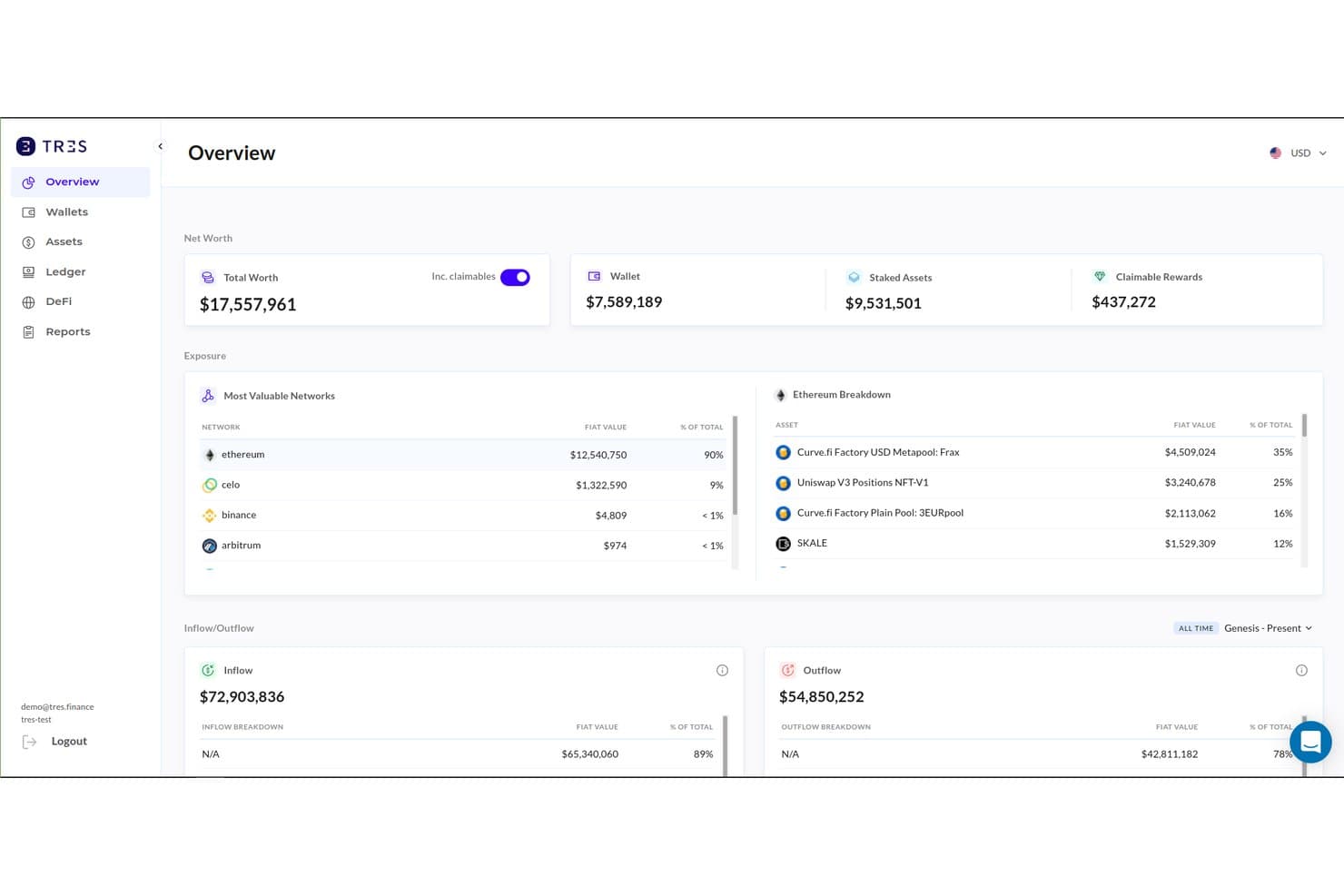
TRES Finance gives users a full net worth and portfolio overview. TRES FinOS is a crypto accounting platform that automates sub-ledger management, multi-chain reconciliation, cost-basis tracking, and ERP synchronization across 220+ blockchain networks.
Who Is TRES FinOS Best For?
TRES FinOS is built for institutional finance teams—think crypto exchanges, custodians, and digital asset funds—that need to reconcile thousands of wallets across hundreds of blockchains at scale.
Why I Picked TRES FinOS
TRES FinOS earns its spot on my shortlist because it's genuinely built for the scale that institutional digital asset operations demand. I'm talking 220+ blockchain networks, 100M+ transactions processed, and a five-dimension reconciliation engine that matches token amounts, fiat values, transaction counts, cost basis, and ending balances in a single pass. I also like the ERP Pre-Sync control report, which catches unmapped chart of accounts entries and missing cost basis data before anything posts to your GL—that's the kind of governance layer that matters when you're managing thousands of wallets across custodians, DeFi positions, and exchanges.
TRES FinOS Key Features
- Proof-of-Funds attestation: Reconciles balances across millions of client wallets to generate auditor- and regulator-ready attestation reports.
- ERP Pre-Sync control report: Flags unmapped chart of accounts entries, missing fiat values, and missing cost basis data before journal entries post to your GL.
- TRES Analyst AI assistant: Answers natural-language queries about historical balances, token exposure, and gas-fee spend, and can classify transactions or trigger ERP syncs directly.
- Alerts Centre: Delivers real-time anomaly and exception alerts that push directly into your existing finance workflows.
TRES FinOS Integrations
TRES FinOS has three documented native integrations: QuickBooks, NetSuite, and Xero. Its Universal ERP Link supports custom connections to SAP, Oracle, Workday, and Microsoft Dynamics, with APIs available for custom data integrations.
Pros and Cons
Pros:
- Robust support for cost basis revaluation
- Five-dimension reconciliation with audit-ready trails
- Handles 220+ chains including L2s and Cosmos
Cons:
- Thin independent review presence online
- No public pricing or self-serve signup
Learn more about TRES Finos:
How I Evaluate Blockchain Accounting Software
I split my evaluation into two layers: baseline requirements a tool must meet—like multi-chain wallet ingestion and GL sync—and the differentiators that distinguish one platform from another.
Core Functionality (Table Stakes For This List)
When I'm selecting tools for my list, I rank each one on a scale from 0 (does not offer the functionality) to 5 (excels in this area) for each core functionality listed below. Then, I calculate the tool's total score into a percentage. Each tool needs to achieve a minimum total score of 55% to be considered for inclusion.
- Multi-Chain Wallet Integration: I check how many chains and wallet types a tool supports natively, from Ethereum and Solana to L2s like Arbitrum and Base.
- Crypto Sub-Ledger: Each platform should maintain lot-level cost basis, fair value, and impairment data for every token rather than just wallet balances.
- Cost Basis & Gain/Loss Engine: I evaluate which accounting methods are supported—FIFO, LIFO, WAC, specific ID—and whether unrealized gains are tracked alongside realized.
- GL/ERP Synchronization: Pushing journal entries into systems like NetSuite, QuickBooks, or Xero matters, so I look for native two-way sync rather than CSV-only exports.
- Crypto-Specific Reporting & Compliance: The tool should generate GAAP- and IFRS-aligned reports with audit trails and tax form output like IRS Form 8949.
- Transaction Classification & Reconciliation: I look at how well the platform auto-categorizes swaps, staking rewards, DeFi yields, and bridging activity against wallet balances.
Once I have a list of tools that meet this criteria, I consider what sets each platform apart.
Differentiating Factors (What Sets Vendors Apart)
Here's how I compare and contrast different vendors:
Standout Features
DeFi and staking activity create some of the trickiest accounting scenarios—liquidity pool positions, yield farming rewards, rebasing tokens—so I look at how well each tool handles income recognition and cost basis for these transactions. Fair value and impairment automation matters just as much, especially since FASB ASU 2023-08 changed how organizations measure crypto assets. For teams managing wallets across multiple subsidiaries, multi-entity consolidation with intercompany transfer tracking can save hours during close.
Beyond Features
Security is a top concern—I check whether platforms use read-only wallet connections so your private keys never leave your custody. Scalability also matters more than people expect; a fund processing millions of on-chain transactions monthly needs a platform that won't choke during month-end close. I also evaluate implementation support, particularly whether the vendor offers historical data backfill and chart of accounts mapping, since migrating years of crypto activity into a new system is one of the biggest adoption hurdles I see.
Cum să alegi un program de contabilitate bazat pe blockchain
Este ușor să te pierzi în liste lungi de funcții și structuri complexe de prețuri. Pentru a te ajuta să rămâi concentrat în timp ce parcurgi procesul unic de selectare a programului potrivit, iată o listă de verificare cu factorii de care trebuie să ții cont:
| Factor | Aspecte de luat în considerare |
| Scalabilitate | Poate programul să se dezvolte odată cu afacerea ta? Ține cont de limitele privind volumul tranzacțiilor și de capacitatea instrumentului de a gestiona un volum mai mare de date pe măsură ce operațiunile tale se extind. |
| Integrări | Se integrează programul cu sistemele tale existente, precum ERP sau CRM? Verifică compatibilitatea cu instrumentele populare și cu API-urile pentru integrări personalizate. |
| Posibilități de personalizare | Poți adapta programul la fluxurile tale de lucru? Caută opțiuni pentru modificarea rapoartelor, tablourilor de bord și permisiunilor utilizatorilor, astfel încât să corespundă nevoilor tale specifice. |
| Ușurința utilizării | Este instrumentul intuitiv pentru echipa ta? Evaluează interfața și navigarea. Ia în considerare accesul la o versiune de test pentru a evalua experiența utilizatorilor înainte de a lua o decizie. |
| Implementare și integrare inițială | Cât de repede poți începe să lucrezi? Evaluează disponibilitatea resurselor de instruire, asistența oferită în timpul configurării și ușurința migrării datelor din sistemul actual. |
| Cost | Care este costul total de deținere? Compară taxele abonamentului, costurile suplimentare pentru integrări sau utilizatori și dacă sunt oferite reduceri pentru facturarea anuală. |
| Măsuri de securitate | Sunt datele și tranzacțiile tale securizate? Evaluează standardele de criptare, controalele de acces și conformitatea cu reglementările din industrie, precum GDPR sau HIPAA. |
| Cerințe de conformitate | Îndeplinește instrumentul cerințele tale de reglementare? Asigură-te că acceptă formularele fiscale necesare și standardele de raportare specifice industriei și locației tale. |
Ce este un program de contabilitate bazat pe blockchain?
Un program de contabilitate bazat pe blockchain este o soluție digitală concepută pentru gestionarea și urmărirea tranzacțiilor cu criptomonede și a evidențelor financiare. Aceste instrumente sunt utilizate, în general, de contabili, echipe financiare și companii care lucrează cu active digitale, oferind transparență și conformitate cu reglementările financiare.
De obicei, programele de contabilitate bazate pe blockchain includ funcții esențiale precum urmărirea tranzacțiilor, raportarea fiscală și pistele de audit, pentru a sprijini gestionarea financiară precisă și conformitatea cu reglementările. În general, aceste instrumente le oferă utilizatorilor posibilitatea de a gestiona eficient tranzacțiile cripto complexe și raportarea aferentă.
Funcțiile programelor de contabilitate bazate pe blockchain
Atunci când alegi un program de contabilitate bazat pe blockchain, acordă atenție următoarelor funcții esențiale:
- Urmărirea tranzacțiilor: Înregistrează și monitorizează automat toate tranzacțiile cu criptomonede pentru a asigura acuratețea și transparența evidențelor financiare.
- Raportarea fiscală: Generează formularele și rapoartele fiscale necesare, simplificând respectarea cerințelor de reglementare și ușurând procesul de depunere a declarațiilor fiscale.
- Jurnale de audit: Oferă un istoric detaliat al tuturor tranzacțiilor financiare, sporind responsabilitatea și facilitând auditurile.
- Asistență pentru mai multe monede: Gestionează tranzacții în diverse criptomonede, fiind potrivită pentru companiile care operează cu mai multe monede digitale.
- Analiză a datelor în timp real: Oferă informații despre performanța financiară pe baza unor date actualizate, sprijinind luarea unor decizii informate.
- Reconciliere automatizată: Reduce erorile manuale prin potrivirea automată a tranzacțiilor și asigurarea consecvenței evidențelor financiare.
- Tablouri de bord personalizabile: Permite utilizatorilor să își adapteze interfața, facilitând concentrarea asupra celor mai relevante date și valori.
- Capacități de integrare: Se conectează la sisteme existente, precum ERP sau CRM, asigurând un flux fluid al datelor între platforme.
- Măsuri de securitate: Implementează criptarea și controale de acces pentru a proteja datele financiare sensibile și a asigura conformitatea cu standardele industriei.
- Sistem de facturare: Facilitează trimiterea și primirea cu ușurință a plăților în criptomonede, simplificând operațiunile financiare pentru companiile care gestionează active digitale.
Beneficiile software-ului de contabilitate bazat pe blockchain
Implementarea software-ului de contabilitate bazat pe blockchain oferă mai multe beneficii pentru echipa și compania dumneavoastră. Iată câteva dintre acestea:
- Transparență sporită: Datorită jurnalelor de audit detaliate, obțineți o vizibilitate clară asupra tuturor tranzacțiilor, îmbunătățind încrederea și responsabilitatea.
- Conformitate îmbunătățită: Raportarea fiscală automatizată și funcțiile de reglementare asigură respectarea cu ușurință a reglementărilor financiare de către compania dumneavoastră.
- Economisirea timpului: Reconcilierea automatizată și urmărirea tranzacțiilor reduc munca manuală, eliberând timp pentru ca echipa dumneavoastră să se concentreze asupra sarcinilor strategice.
- Luarea unor decizii mai bune: Analiza datelor în timp real oferă informații actualizate despre fluxul de numerar, ajutându-vă să luați decizii financiare informate.
- Siguranță sporită: Măsurile avansate de securitate vă protejează datele financiare, oferindu-vă siguranță în ceea ce privește integritatea datelor.
- Acoperire globală: Asistența pentru mai multe monede permite companiei dumneavoastră să gestioneze tranzacții în diverse criptomonede, extinzându-i accesul pe piață.
- Plăți simplificate: Un sistem de facturare eficient facilitează tranzacțiile rapide și ușoare cu criptomonede, sporind eficiența operațională.
Costurile și prețurile software-ului de contabilitate bazat pe blockchain
Selectarea software-ului de contabilitate bazat pe blockchain necesită înțelegerea diferitelor modele și planuri de preț disponibile. Costurile variază în funcție de funcții, dimensiunea echipei, suplimente și alți factori. Tabelul de mai jos sintetizează planurile obișnuite, prețurile medii ale acestora și funcțiile incluse de obicei în soluțiile software de contabilitate bazate pe blockchain:
Tabel comparativ al planurilor pentru software-ul de contabilitate bazat pe blockchain
| Tipul planului | Preț mediu | Funcții obișnuite |
| Plan gratuit | $0 | Urmărirea de bază a tranzacțiilor, raportare fiscală limitată și gestionarea de bază a portofoliului. |
| Plan personal | $10-$30/user/month | Raportare fiscală extinsă, asistență pentru mai multe monede și integrări de bază. |
| Plan pentru companii | $50-$100/user/month | Analiză avansată, reconciliere automatizată și tablouri de bord personalizabile. |
| Plan pentru întreprinderi | $200-$500/user/month | Funcții complete de securitate, asistență dedicată și capacități complete de integrare. |
Întrebări frecvente despre software-ul de contabilitate blockchain
Iată câteva răspunsuri la întrebările frecvente despre software-ul de contabilitate blockchain:
Care sunt provocările blockchainului în contabilitate?
Blockchainul în contabilitate se confruntă cu provocări precum integrarea complexă cu sistemele actuale și costurile ridicate de implementare. Este posibil ca multe echipe să nu înțeleagă pe deplin beneficiile tehnologiei, ceea ce poate împiedica adoptarea acesteia. Este important să evaluați dacă echipa dumneavoastră dispune de resursele și cunoștințele necesare pentru a implementa eficient soluții blockchain.
Cum funcționează blockchainul în contabilitate?
Blockchainul funcționează ca un registru descentralizat, înregistrând tranzacțiile într-un mod rezistent la modificări neautorizate. Acest lucru asigură transparența și acuratețea evidențelor financiare. Tehnologia conectează blocurile de date în ordine cronologică, menținând o evidență clară și inalterabilă a tuturor tranzacțiilor în timp.
Care sunt dezavantajele contabilității bazate pe blockchain?
Dezavantajele includ costurile ridicate de implementare și potențialele probleme de securitate a rețelei. Tehnologia poate genera, de asemenea, preocupări legate de mediu din cauza consumului de energie. În plus, anonimatul și caracterul imuabil al blockchainului pot crea provocări în gestionarea datelor și asigurarea conformității.
Care sunt implicațiile tehnologiei blockchain în contabilitate?
Tehnologia blockchain simplifică auditarea și reconcilierea, oferind o evidență în timp real și imuabilă a tranzacțiilor. Acest lucru reduce timpul și efortul necesare pentru verificările financiare. Cu toate acestea, companiile trebuie să fie pregătite să gestioneze integrarea blockchainului cu sistemele lor contabile existente.
Cum asigură blockchainul securitatea datelor în contabilitate?
Blockchainul asigură securitatea datelor prin natura sa descentralizată și criptată. Tranzacțiile sunt înregistrate într-un mod care împiedică modificările neautorizate. Fiecare înregistrare este verificată de mai multe noduri, asigurând faptul că datele rămân sigure și de încredere pe parcursul procesului contabil.
Se poate integra software-ul de contabilitate blockchain cu sistemele contabile tradiționale?
Da, multe soluții software de contabilitate blockchain oferă posibilități de integrare cu sisteme tradiționale precum ERP și CRM. Acest lucru permite o tranziție și un flux de date fără probleme între sisteme. Înainte de a alege un software, verificați dacă acesta acceptă integrările de care aveți nevoie pentru infrastructura existentă.