

QAD Adaptive ERP Review: Pros, Cons, Features, and Pricing
QAD Adaptive ERP isn’t just another upgrade—it’s a rethink on ERP flexibility. Here’s how it can actually scale with your manufacturing needs, minus the usual headaches.

We review tools independently, and commissions help fund our testing. See our transparency policy, our methodology, or suggest a tool.
QAD Adaptive ERP is a cloud-based ERP software built specifically for manufacturing companies in industries like automotive, life sciences, consumer products, food and beverage, high-tech, and industrial. I'd consider it if you run a mid-market or global manufacturing operation that needs deep production, supply chain, and financial capabilities without the heavy customization overhead of SAP S/4HANA. Compared with general-purpose cloud suites, QAD gives you stronger out-of-the-box manufacturing depth and industry-specific process models, so your finance team spends less time bending a generic ERP to fit shop-floor and compliance realities. QAD Cloud ERP is the deployment most mid-market buyers land on.
QAD Adaptive ERP Evaluation Summary
3.4/5
- Pricing upon request
- Free demo available
Why Trust Our Software Recommendations
6,700+
Reviews
20
Industry experts
16+
Evaluation factors
14
Years
Our team has been testing and reviewing software since 2012. As finance leaders ourselves, we know how difficult—and important—it is to choose the right software.
For this guide, we evaluated tools using hands-on testing and independent research, scoring tools using our selection criteria.
Our reviews reflect our human editorial judgment, not a sales pitch.
QAD Adaptive ERP Overview
If you’re judging ERP systems for manufacturing, I think QAD Adaptive ERP is an option that earns serious consideration. Its built-in industry models, manufacturing-centric features, and strong compliance tools are far ahead when you need out-of-the-box depth—instead of endless tailoring. QAD frames its buyers as adaptive manufacturing enterprises, and the ERP solution genuinely is built around change rather than a fixed template. The interface is modern, though you’ll notice a learning curve during onboarding. Integrations target real factory requirements, and the modular design keeps support and upgrades simple. Pricing is best suited to companies ready for enterprise capabilities. I’d suggest it especially for mid-sized and global manufacturers who want rapid deployment without sacrificing industry fit.
Pros
- Built-in industry-specific manufacturing and compliance process models
- Advanced supply chain planning and analytics for manufacturers
- Modular deployment speeds up rollout and future upgrades
Cons
- Limited vendor support for niche non-manufacturing workflows
- Complex configuration for international tax and localization needs
- User interface feels dated compared to top-tier ERP competitors
Is QAD Adaptive ERP Right For Your Needs?
Who Would be a Good Fit for QAD Adaptive ERP?
QAD Adaptive ERP is a strong fit for manufacturing-driven businesses or finance teams handling complex global operations. You’ll get the most out of it if you need industry-specific modules, advanced multinational compliance tools, and deep customization. Customer relationship management sits alongside the production and finance modules rather than in a separate system, which matters for order-to-cash visibility. I think midsize to large enterprises with multiple entities, controlled environments, or highly regulated workflows are going to benefit most from the adaptive features and integration options QAD provides.
- Global ManufacturingQAD Adaptive ERP’s manufacturing-specific modules, localization features, and support for multinational tax compliance are designed for complex production and global distribution environments.
- Automotive SuppliersQAD’s support for electronic data interchange (EDI), compliance, and supply chain traceability aligns well with the demands of automotive supplier networks.
- Life SciencesBuilt-in validation, QMS audit trails, and regulatory reporting features help life sciences companies meet FDA, EMA, and other compliance requirements.
- Multinational FinanceQAD handles international financial operations, sophisticated tax calculations, and multi-entity consolidations for companies operating across borders.
- Enterprise OperationsLarge organizations with intricate processes can leverage QAD’s modular workflows, role-based dashboards, and API-based integrations to coordinate finance, supply chain, and manufacturing.
- Project-Based ManufacturingCompanies with engineer-to-order or configure-to-order needs will find QAD’s adaptive project management and production planning tools useful for non-standard workflows.
Who Would be a Bad Fit for QAD Adaptive ERP?
QAD Adaptive ERP is not a good match for small organizations with straightforward needs or businesses outside manufacturing-focused industries. If your team relies on out-of-the-box simplicity, avoids heavy customization, or works in sectors with few regulatory obligations, you’re likely to find QAD too complex and costly for your operations.
- Small RetailersThe setup complexity, higher costs, and manufacturing-centered features do not align with the needs of a small retail business.
- Creative AgenciesQAD lacks specialized tools for client billing, campaign management, and project workflows common to design and marketing agencies.
- Local NonprofitsNonprofits with basic accounting requirements and minimal compliance obligations will not benefit from QAD’s advanced finance features or pricing.
- Early-Stage StartupsStartups needing quick setup, low overhead, and simple accounting would find QAD’s onboarding and customization unnecessary and cumbersome.
- Food Service ChainsFood service and hospitality businesses require point-of-sale, inventory turnover, and scheduling features not prioritized in QAD’s manufacturing focus.
- Construction ManagementConstruction firms typically need industry-specific field operations, subcontractor management, and project costing tools not provided by QAD Adaptive ERP.
How We Test & Score Tools
We’ve spent years building, refining, and improving our software testing and scoring system. The rubric is designed to capture the nuances of software selection and what makes a tool effective, focusing on critical aspects of the decision-making process.
Below, you can see exactly how our testing and scoring works across seven criteria. It allows us to provide an unbiased evaluation of the software based on core functionality, standout features, ease of use, onboarding, customer support, integrations, customer reviews, and value for money.
Core Functionality (25% of final scoring)
The starting point of our evaluation is always the core functionality of the tool. Does it have the basic features and functions that a user would expect to see? Are any of those core features locked to higher-tiered pricing plans? At its core, we expect a tool to stand up against the baseline capabilities of its competitors.
Standout Features (25% of final scoring)
Next, we evaluate uncommon standout features that go above and beyond the core functionality typically found in tools of its kind. A high score reflects specialized or unique features that make the product faster, more efficient, or offer additional value to the user.
We also evaluate how easy it is to integrate with other tools typically found in the tech stack to expand the functionality and utility of the software. Tools offering plentiful native integrations, 3rd party connections, and API access to build custom integrations score best.
Ease of Use (10% of final scoring)
We consider how quick and easy it is to execute the tasks defined in the core functionality using the tool. High scoring software is well designed, intuitive to use, offers mobile apps, provides templates, and makes relatively complex tasks seem simple.
Onboarding (10% of final scoring)
We know how important rapid team adoption is for a new platform, so we evaluate how easy it is to learn and use a tool with minimal training. We evaluate how quickly a team member can get set up and start using the tool with no experience. High scoring solutions indicate little or no support is required.
Customer Support (10% of final scoring)
We review how quick and easy it is to get unstuck and find help by phone, live chat, or knowledge base. Tools and companies that provide real-time support score best, while chatbots score worst.
Customer Reviews (10% of final scoring)
Beyond our own testing and evaluation, we consider the net promoter score from current and past customers. We review their likelihood, given the option, to choose the tool again for the core functionality. A high scoring software reflects a high net promoter score from current or past customers.
Value for Money (10% of final scoring)
Lastly, in consideration of all the other criteria, we review the average price of entry level plans against the core features and consider the value of the other evaluation criteria. Software that delivers more, for less, will score higher.
Core Features
Manufacturing Process Modeling
Prebuilt process models cover automotive, life sciences, high-tech, and industrial manufacturing. Manufacturing ERP setup shortens because the rules already fit.
Advanced Supply Chain Planning
Forecast demand and plan inventory with multi-site MRP, supplier management, and scenario modeling. QAD DSCP handles supply chain management when orders shift.
Global Financial Management
Multi-entity, multi-currency accounting with automated tax, consolidation, and asset management. Financial close stays accurate and group reporting meets standards.
Compliance and Quality Management
Track regulations, automate documentation, and manage audit trails for certifications. QAD EQMS runs the quality management system, so traceability is provable.
Analytics and Reporting
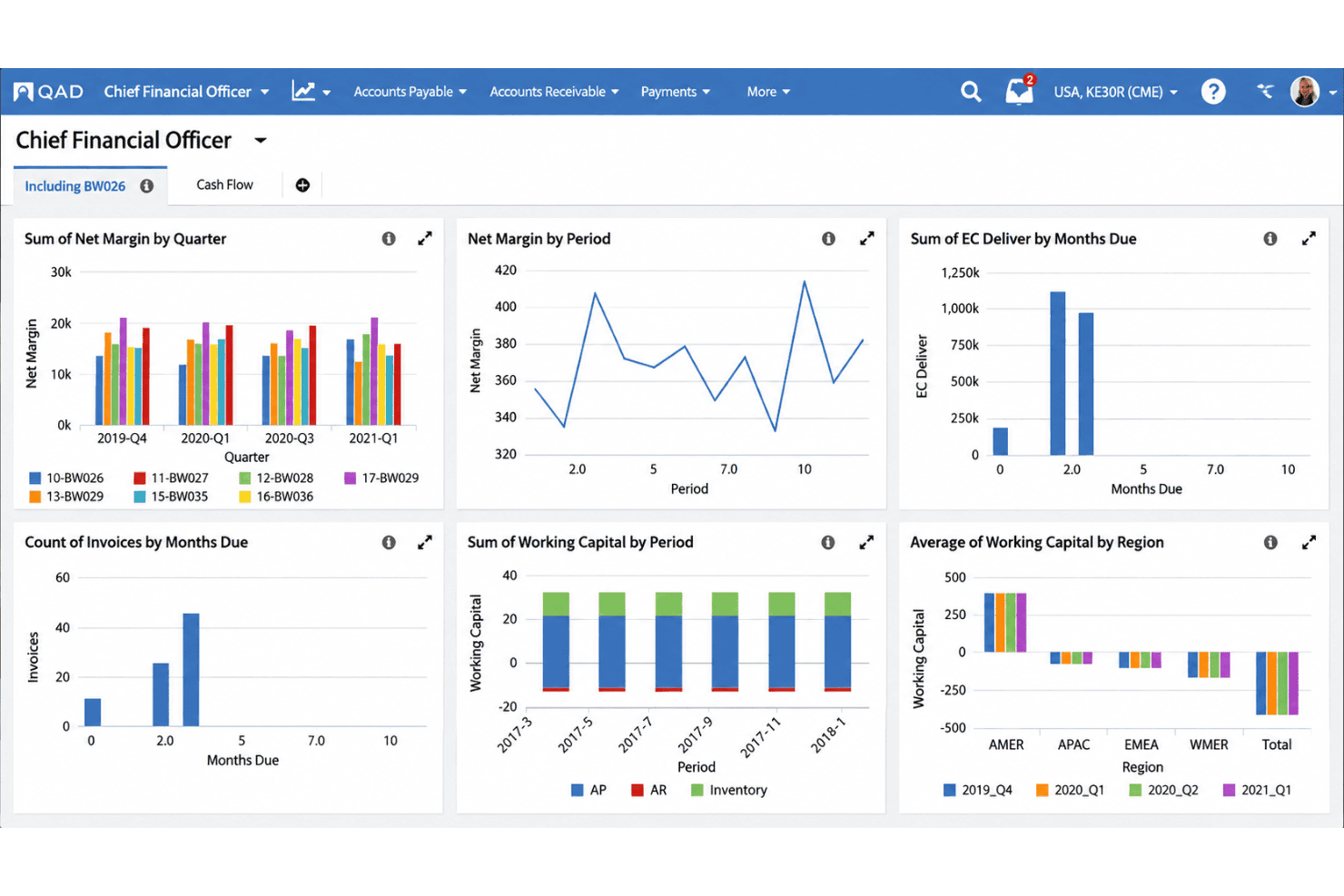
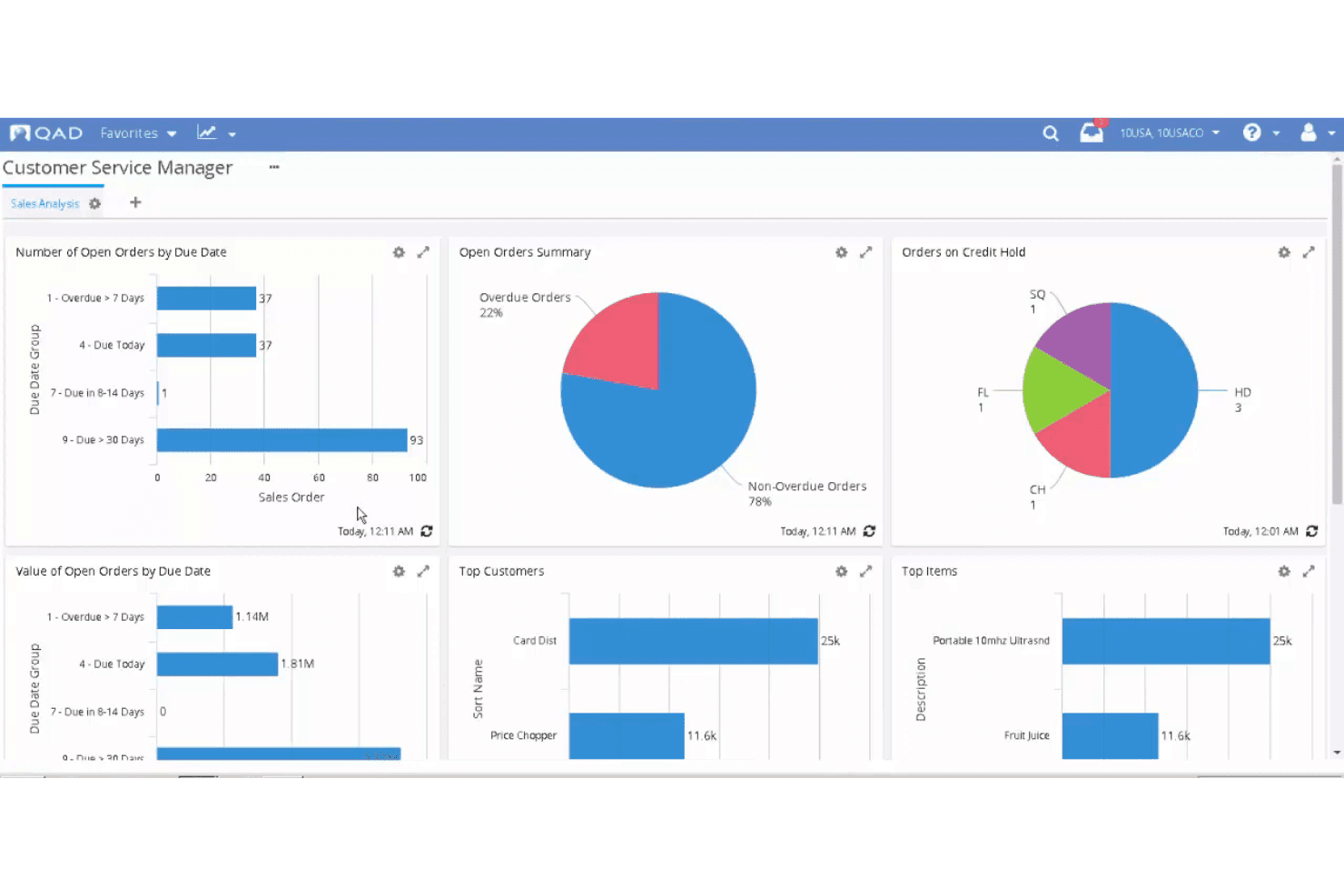
Real-time dashboards and role-based analytics for finance, operations, and supply chain. Mobile access lets you drill into transactions or trends wherever you are.
Modular Platform Upgrades
Add or update modules—production, inventory management, procurement—without breaking existing workflows. Upgrades stay manageable as ERP functions scale.
Ease of Use
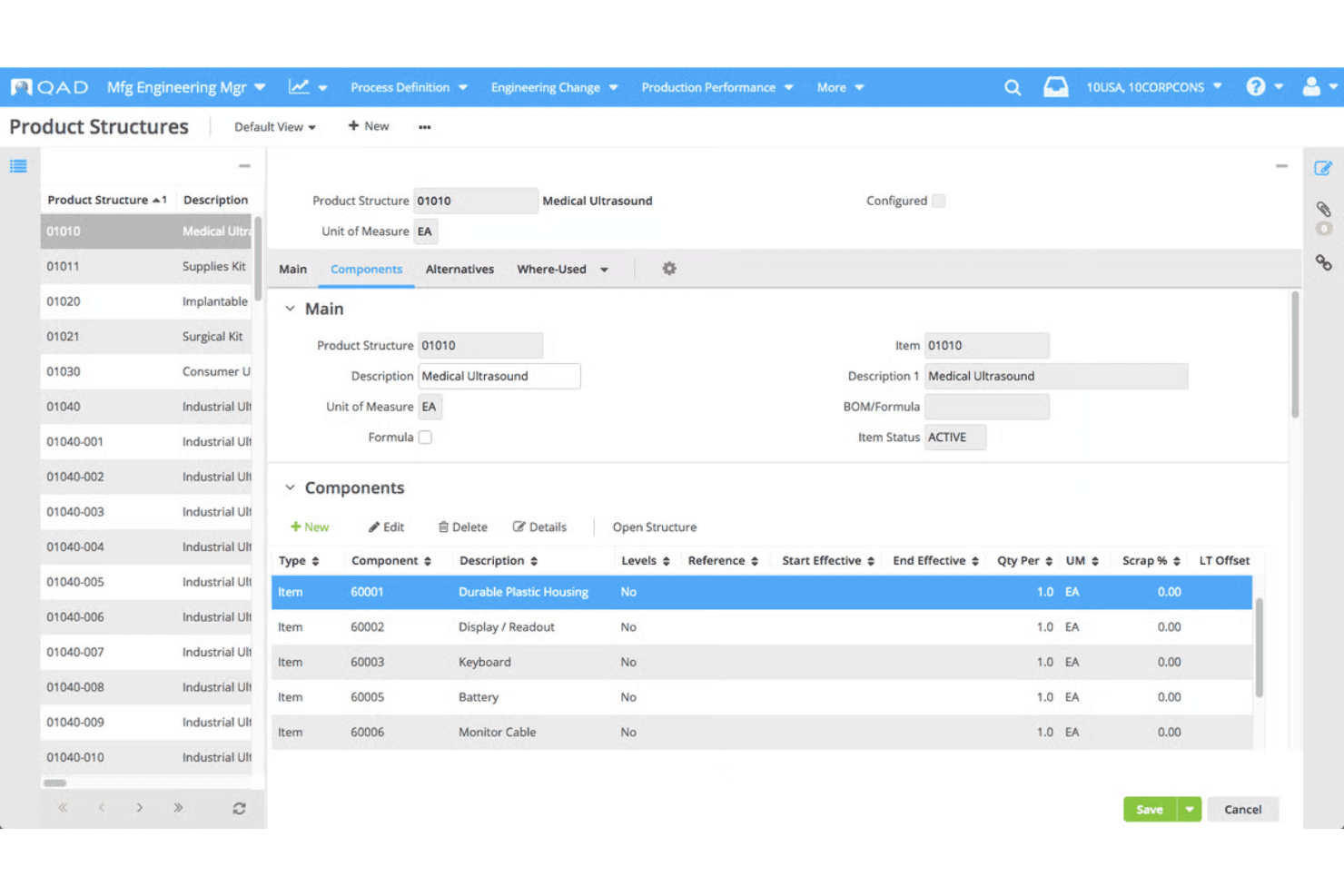
QAD Adaptive ERP’s interface feels modern but has a learning curve, especially for teams used to less specialized ERP platforms. Once configured, I think the modular workflows, customizable dashboards, and adaptive user features make it much easier to use for ongoing operations. Routine tasks become faster as users tailor screens by role, but initial setup and complex configurations like multinational tax rules can slow down adoption.
Integrations
QAD Adaptive ERP integrates with Salesforce, Oracle NetSuite, Microsoft Dynamics 365, SAP, ADP, Avalara, Vertex, Shopify, Dell Boomi, and Tableau, among others.
QAD Adaptive ERP also offers a robust API and supports integration with third-party tools such as Dell Boomi and MuleSoft.
QAD Adaptive ERP Specs
- API: Yes
- Calendar Management: Yes
- Customer Management: Yes
- Dashboard: Yes
- Data Export: Yes
- Data Import: Yes
- Data Visualization: Yes
- External Integrations: Yes
- Inventory Tracking: Yes
- Multi-User: Yes
- Natural Resources: Yes
- Notifications: Yes
- Order Management: Yes
- Project Management: Yes
- Scheduling: Yes
- Shipping Management: Yes
- Supplier Management: Yes


