

10 mejores alternativas a Domo para informes financieros en 2026

Lista de alternativas a Domo


Las mejores alternativas a Domo ofrecen paneles financieros personalizables y fáciles de usar, integración de datos en tiempo real y funciones flexibles de generación de informes que te ayudan a gestionar conjuntos de datos financieros complejos y de gran tamaño con confianza. Si estás buscando alternativas a Domo, probablemente necesites una solución que admita informes financieros precisos y puntuales, y que proporcione a tu equipo una visibilidad clara de las métricas clave, análisis avanzados y datos prácticos.
Esta lista te ayudará a comparar las principales opciones de software de paneles financieros para que encuentres una plataforma que se adapte a tus requisitos de generación de informes, se integre con tus sistemas actuales y respalde los objetivos financieros de tu organización.
¿Qué es Domo?
Domo es un software de paneles financieros basado en la nube que conecta, visualiza y analiza datos de múltiples fuentes en tiempo real. Ayuda a los equipos financieros a crear paneles interactivos, automatizar la generación de informes y supervisar indicadores clave de rendimiento.
Domo se utiliza para mejorar la visibilidad financiera, respaldar la toma de decisiones y agilizar los flujos de trabajo de datos en las organizaciones. Sus integraciones y funciones personalizables lo convierten en una opción popular para las empresas que gestionan datos financieros complejos.
Resumen de las mejores alternativas a Domo
Esta tabla comparativa resume los detalles de precios de mi selección de las mejores alternativas a Domo para ayudarte a encontrar la opción más adecuada para tu presupuesto y las necesidades de tu empresa.
| Tool | Best For | Trial Info | Price | ||
|---|---|---|---|---|---|
| 1 | Ideal para paneles de análisis visual interactivo | Prueba gratuita + plan gratuito disponible | Desde $15/usuario/mes (facturado anualmente) | Website | |
| 2 | Ideal para la exploración flexible de datos con análisis asociativo | Prueba gratuita de 30 días + demostración gratuita disponible | Desde $300/mes (facturado anualmente) | Website | |
| 3 | Ideal para análisis modelados e informes integrados en Google Cloud | Plan gratuito disponible | Desde $9/usuario/proyecto/mes | Website | |
| 4 | Ideal para análisis a gran escala con procesamiento en el chip | Prueba gratuita de 7 días + demostración gratuita disponible | Precio bajo solicitud | Website | |
| 5 | Ideal para análisis escalables en AWS con precios por usuario | Plan gratuito disponible | Desde $3/usuario/mes | Website | |
| 6 | Ideal para informes basados en Microsoft y seguimiento de datos en directo | Plan gratuito disponible | Desde £10.80/usuario/mes (facturado anualmente) | Website | |
| 7 | Ideal para la exploración y visualización de datos de código abierto | Descarga gratuita | Gratuito y de código abierto | Website | |
| 8 | Ideal para inteligencia empresarial de código abierto con un generador de consultas sencillo | Plan gratuito disponible | Desde $90/mes (facturado anualmente) | Website | |
| 9 | Ideal para análisis basados en búsquedas y perspectivas impulsadas por IA | Prueba gratuita de 14 días + demostración gratuita disponible | Desde $25/usuario/mes (facturado anualmente) | Website | |
| 10 | Ideal para la gestión del rendimiento y la planificación estratégica | Prueba gratuita y demostración gratuita disponibles | Precio bajo solicitud | Website |
Por qué confiar en nuestras recomendaciones de software
Nuestras reseñas reflejan nuestro criterio independiente, no un discurso de ventas. Descubra cómo mantenemos la transparencia.
Para esta guía, evaluamos las herramientas mediante pruebas prácticas e investigación independiente, puntuando las herramientas según nuestros criterios de selección.
Nuestras reseñas reflejan nuestro criterio editorial humano, no un discurso de ventas.
Opiniones sobre las alternativas a Domo
A continuación encontrarás mis resúmenes detallados de las alternativas a Domo que llegaron a mi lista. Mis reseñas ofrecen un análisis detallado de las funciones, integraciones y precios de cada software para ayudarte a encontrar la opción más adecuada para ti.

Tableau
Ideal para paneles de análisis visual interactivo
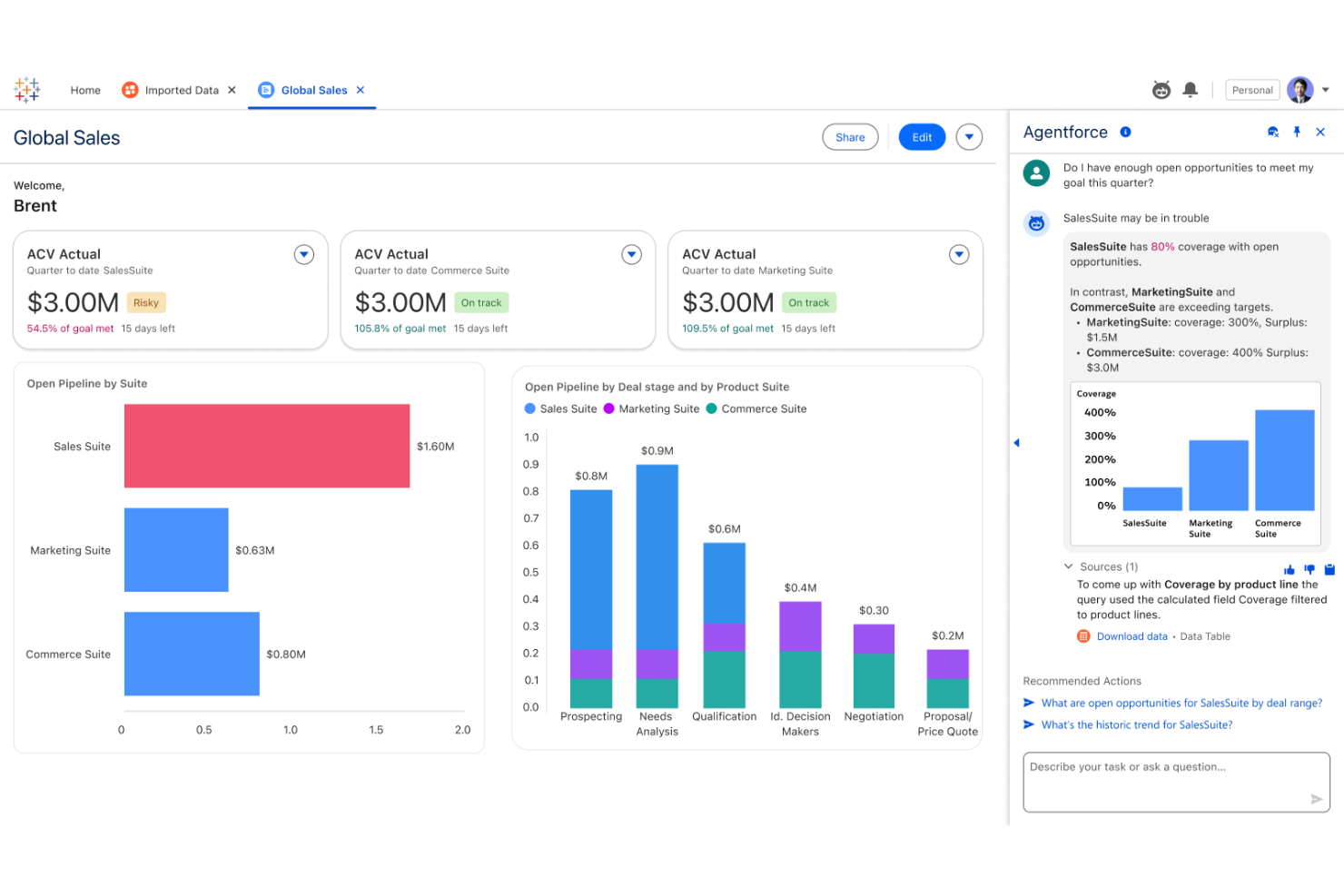
Tableau está diseñado para equipos financieros y analistas que necesitan convertir datos financieros complejos en paneles interactivos y claros. Sus flexibles opciones de visualización ayudan a descubrir tendencias, supervisar KPI y compartir información con las partes interesadas de toda la organización.
¿Para quién es mejor Tableau?
Los profesionales financieros y analistas de organizaciones medianas y grandes necesitan visualización avanzada de datos y personalización de paneles.
Por qué Tableau es una buena alternativa a Domo
Elegí Tableau para esta lista por su profundidad en análisis visual y diseño de paneles interactivos. Me gusta cómo la interfaz de arrastrar y soltar de Tableau permite a mi equipo crear paneles financieros personalizados sin escribir código, extrayendo datos en tiempo real de fuentes como bases de datos SQL y hojas de cálculo.
También valoro la función de campos calculados de Tableau, que permite crear métricas financieras personalizadas directamente dentro de una visualización. En la práctica, eso significa que mi equipo puede crear paneles de análisis de variaciones que se actualizan automáticamente a medida que ingresan nuevos datos.
Funciones principales de Tableau
- Predicciones basadas en IA: Tableau se integra con R, Python y MATLAB para ejecutar modelos predictivos y visualizar los resultados directamente en los paneles.
- Consultas en lenguaje natural: Haz preguntas sobre los datos en lenguaje sencillo y obtén respuestas visuales instantáneas sin crear un gráfico manualmente.
- Aceleradores de paneles: Plantillas de paneles prediseñadas y específicas para cada sector que puedes implementar y completar con tus propios datos financieros.
- Acceso a datos sin conexión: Tableau Desktop permite conectarte a los datos, explorarlos y analizarlos sin conexión a Internet.
Integraciones de Tableau
Las integraciones incluyen Salesforce, Google Analytics, Amazon Redshift, Microsoft Excel, Snowflake, Oracle, SAP, Google BigQuery, Microsoft SQL Server y Dropbox.
Pros and Cons
Pros:
- Opciones avanzadas de visualización para datos financieros
- Excelente compatibilidad con conexiones de datos en tiempo real
- Amplia biblioteca de plantillas de paneles prediseñadas
Cons:
- Requiere licencias independientes para la implementación en servidores
- Capacidades limitadas de escritura de datos

Qlik
Ideal para la exploración flexible de datos con análisis asociativo
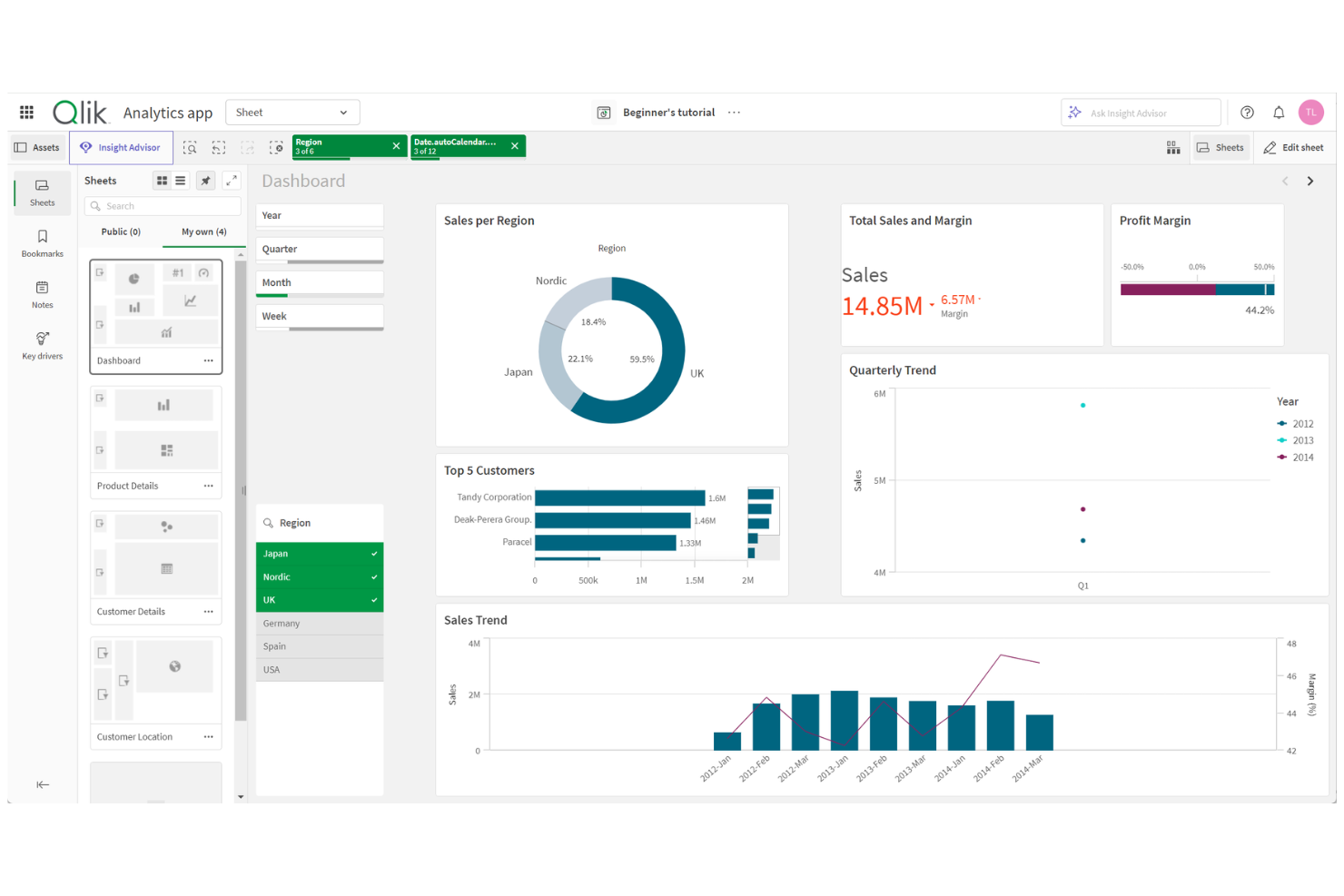
Qlik es una plataforma de análisis de datos diseñada para equipos financieros y analistas que necesitan explorar y visualizar datos financieros complejos de múltiples fuentes. Su motor asociativo ayuda a los usuarios a descubrir tendencias y relaciones ocultas que los paneles tradicionales podrían pasar por alto.
¿Para quién es más adecuado Qlik?
Equipos financieros y de análisis de empresas medianas y grandes que necesitan explorar datos avanzados en memoria desde múltiples fuentes.
Por qué Qlik es una buena alternativa a Domo
Elegí Qlik porque su motor asociativo permite a mi equipo explorar los datos financieros de formas que las herramientas lineales basadas en consultas simplemente no permiten. A diferencia de los paneles tradicionales, Qlik mantiene en memoria todas las relaciones entre los datos, por lo que puedo hacer clic en distintas dimensiones—como centro de costos, período o entidad—y ver al instante cómo las selecciones repercuten en cada métrica conectada.
También valoro la búsqueda inteligente de Qlik Sense, que permite a mi equipo escribir consultas en lenguaje natural directamente en un panel financiero y encontrar datos relevantes sin tener que crear un informe nuevo. En la práctica, esto significa que podemos investigar variaciones presupuestarias o anomalías en los ingresos sobre la marcha, sin esperar a que un analista de datos ejecute una nueva consulta.
Características principales de Qlik
- Qlik Predict: Ejecuta modelos predictivos sin código y escenarios hipotéticos directamente en los paneles para pronosticar resultados financieros, como tendencias de ingresos o costos.
- Alertas inteligentes: Configura alertas basadas en datos que supervisan continuamente todos tus datos, no solo visualizaciones individuales, y activan acciones automatizadas cuando se alcanzan los umbrales.
- Informes programados: Crea y distribuye informes con formato en Microsoft Office y PDF según un calendario establecido, con entrega por correo electrónico o carpetas compartidas.
- Catálogo de datos autogestionado: Explora un catálogo con función de búsqueda de conjuntos de datos preparados para el análisis, con detalles sobre su linaje y origen, para que los equipos financieros puedan localizar y confiar en los datos que utilizan.
Integraciones de Qlik
Las integraciones incluyen AWS, Google, Microsoft, Snowflake, SAP, Databricks, Cloudera, Salesforce, Oracle y Teradata.
Pros and Cons
Pros:
- El motor asociativo descubre relaciones financieras ocultas
- El análisis en memoria permite explorar los datos rápidamente
- Alertas avanzadas para la supervisión financiera en tiempo real
Cons:
- Las visualizaciones pueden requerir ajustes manuales
- Requisitos de recursos elevados para implementaciones grandes

Looker
Ideal para análisis modelados e informes integrados en Google Cloud
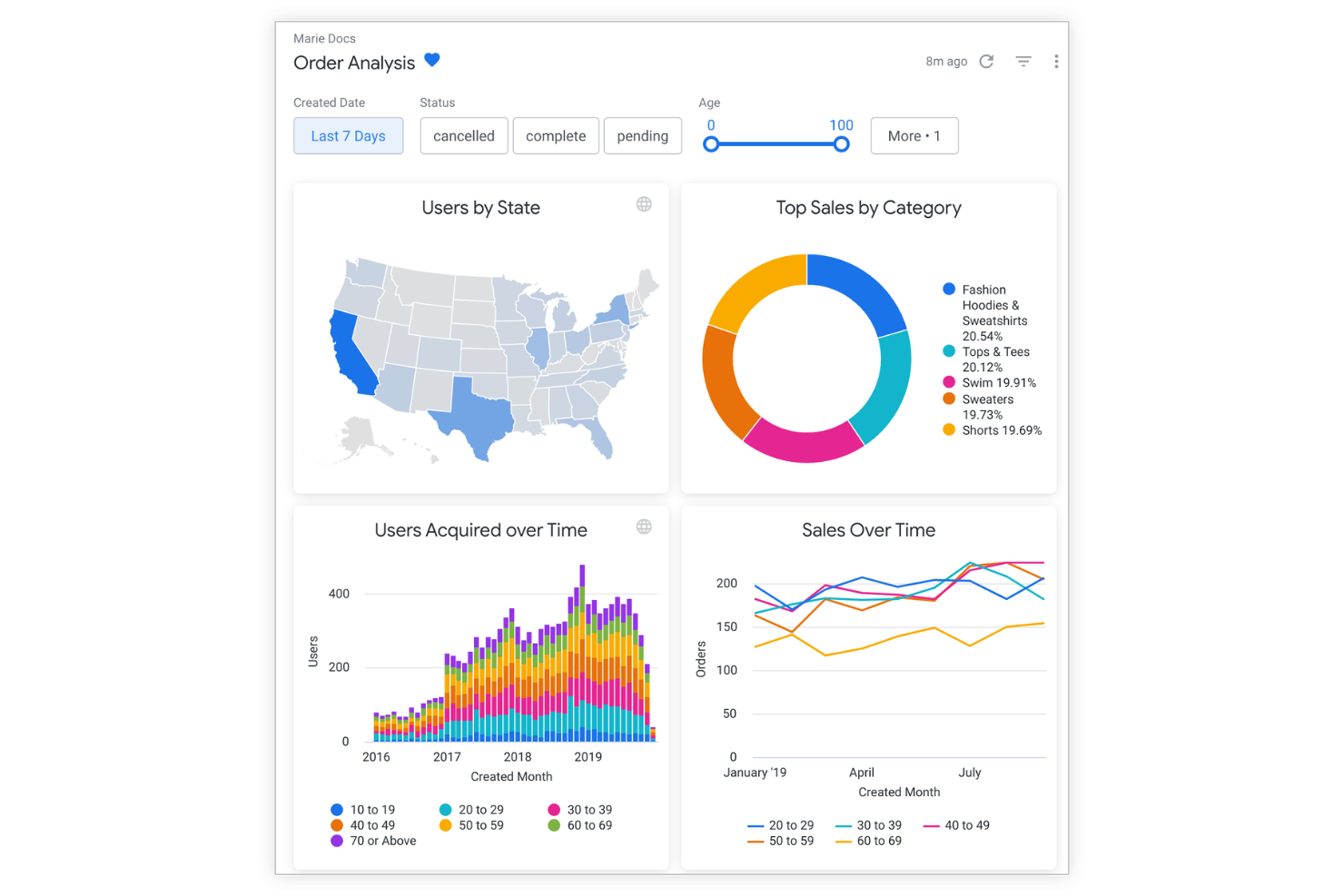
Looker es una plataforma de análisis basada en la nube diseñada para equipos financieros y analistas que necesitan ofrecer informes gobernados y coherentes en todos los departamentos. Su capa de modelado resulta atractiva para las organizaciones que buscan paneles fiables y escalables alineados con las métricas y definiciones de toda la empresa.
¿Para quién es más adecuado Looker?
Los equipos financieros y de análisis de grandes organizaciones necesitan informes gobernados para toda la empresa y definiciones de métricas coherentes.
Lo que me atrae de Looker es su capa de modelado LookML, que permite a mi equipo definir métricas como el margen bruto o el reconocimiento de ingresos una sola vez y reutilizarlas de forma coherente en cada panel e informe. Esa única fuente de verdad es importante cuando los equipos financieros de distintas unidades de negocio necesitan obtener los mismos KPI sin recibir cifras diferentes.
También valoro que la función Explore de Looker permita a los analistas pasar de un resumen financiero de alto nivel al detalle de las transacciones a nivel de fila sin salir del panel. En la práctica, esto significa que mi equipo puede investigar una variación en los gastos operativos y rastrearla hasta las partidas individuales en cuestión de minutos, no de días.
Características principales de Looker
- Análisis conversacional: Haz preguntas sobre los datos en lenguaje natural mediante la interfaz de chat impulsada por Gemini, sin necesidad de conocimientos especializados en inteligencia empresarial.
- Integración con Connected Sheets: Explora datos modelados con LookML directamente desde Google Sheets e incorpora métricas gobernadas a los flujos de trabajo con hojas de cálculo.
- Distribución programada: Configura el envío automatizado de paneles e informes según una programación recurrente por correo electrónico u otros destinos.
- Acceso de usuarios basado en roles: Asigna roles de usuario de espectador, estándar o desarrollador para controlar lo que cada usuario puede consultar, crear o administrar dentro de la plataforma.
Integraciones de Looker
Las integraciones incluyen BigQuery, Google Sheets, Google Analytics, Vertex AI, Google Workspace, Gmail, Google Drive, Google Meet, Looker Studio y Connected Sheets.
Pros and Cons
Pros:
- La capa de modelado gobernada garantiza la coherencia de las métricas
- Integración profunda con Google Cloud Platform
- Admite la exploración detallada de datos a nivel de fila
Cons:
- Menos plantillas prediseñadas de paneles financieros
- No incluye herramientas integradas de ETL ni de preparación de datos

Sisense
Ideal para análisis a gran escala con procesamiento en el chip
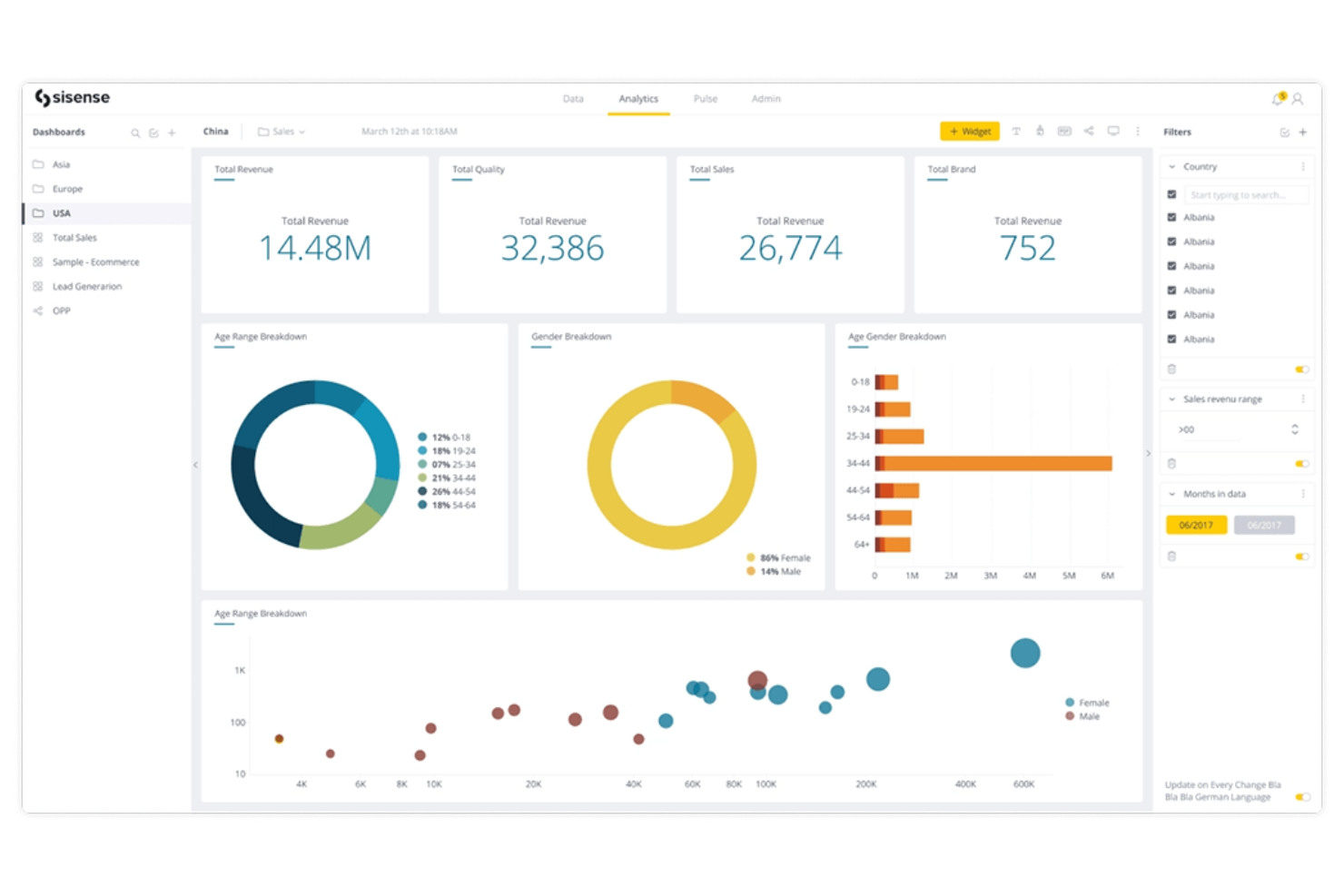
Sisense ofrece una plataforma de análisis flexible diseñada para equipos financieros y responsables de producto que necesitan integrar paneles directamente en sus propias aplicaciones o flujos de trabajo. Su enfoque personalizable ayuda a las organizaciones a proporcionar a los usuarios información financiera adaptada sin depender de informes genéricos listos para usar.
¿Para quién es más adecuado Sisense?
Equipos financieros y de producto de empresas SaaS que necesitan integrar análisis en sus propias plataformas.
Por qué Sisense es una buena alternativa a Domo
Elegí Sisense específicamente por su capacidad de análisis integrado, que permite a mi equipo crear paneles financieros directamente en nuestras propias herramientas internas y aplicaciones orientadas a clientes mediante la API de JavaScript y el SDK de Sisense. Lo que más valoro es el marco Fusion, que me permite personalizar el aspecto, la sensación y el comportamiento de cada panel para que coincida con la interfaz de nuestro producto, en lugar de parecer una herramienta de terceros.
En la práctica, esto significa que las partes interesadas del área financiera obtienen los KPI financieros dentro de las plataformas que ya utilizan a diario. Para los equipos que necesitan algo más que una herramienta de BI independiente, es difícil igualar ese nivel de flexibilidad de integración.
Funciones principales de Sisense
- Asistente de IA: Permite hacer preguntas sobre los datos en lenguaje natural para generar visualizaciones y resúmenes sin escribir consultas.
- Conectividad de datos: Permite conectarse a más de 400 fuentes de datos, con opciones para consolidar los datos en Sisense o mantener una conexión activa con el almacén de datos.
- Previsión y detección de tendencias: Muestra información predictiva y anomalías dentro de los paneles para ayudar a los equipos financieros a anticipar cambios en las métricas clave.
- Implementación en la nube: Proporciona acceso a un entorno alojado en la nube con actualizaciones automáticas y colaboración multiusuario en paneles y modelos de datos.
Integraciones de Sisense
Las integraciones incluyen Snowflake, Amazon Redshift, Google BigQuery, Microsoft SQL Server, Oracle, Salesforce, Google Analytics, PostgreSQL, MySQL y MongoDB.
Pros and Cons
Pros:
- Integra paneles directamente en aplicaciones web
- Opciones muy personalizables para el diseño de paneles
- Gestiona grandes volúmenes de datos con tecnología de procesamiento en el chip
Cons:
- No incluye herramientas integradas de ETL ni de preparación de datos
- Las visualizaciones requieren configuración manual

Ideal para análisis escalables en AWS con precios por usuario
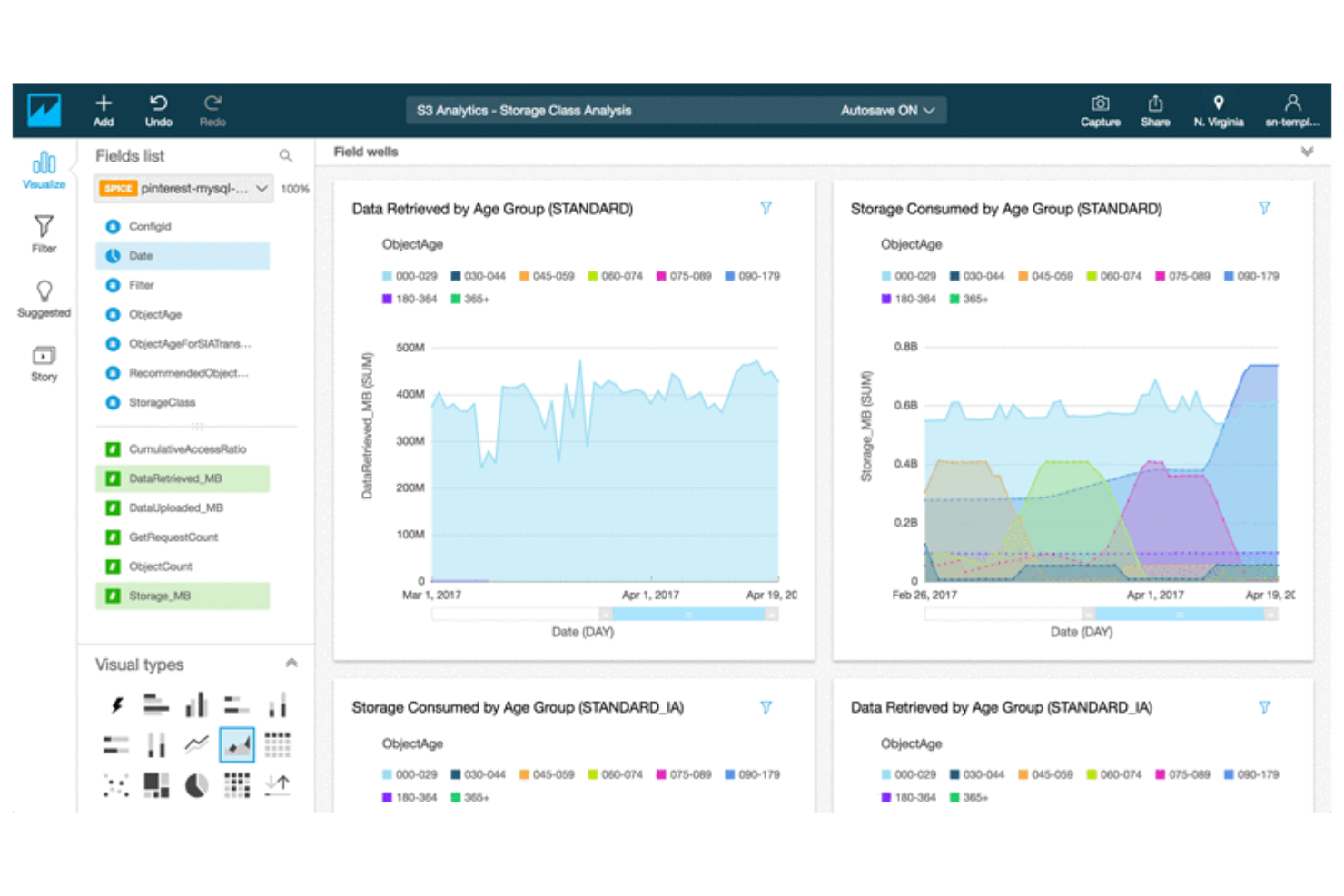
Amazon QuickSight es una plataforma de inteligencia empresarial nativa de la nube diseñada para organizaciones que desean analizar y compartir datos financieros a gran escala dentro del ecosistema de AWS. Resulta atractiva para los equipos financieros que buscan análisis integrados, paneles interactivos e informes escalables conectados directamente a sus fuentes de datos de AWS.
¿Para quién es más adecuado Amazon QuickSight?
Equipos financieros y de análisis de empresas centradas en AWS que necesitan paneles e informes integrados y escalables.
Por qué Amazon QuickSight es una buena alternativa a Domo
Elegí Amazon QuickSight porque su modelo de precios por sesión significa que mi equipo solo paga cuando alguien abre realmente un panel, no una tarifa fija por usuario independientemente del uso. Esto lo hace mucho más rentable para las organizaciones cuyos paneles financieros se comparten ampliamente entre los departamentos, pero no se consultan a diario.
También valoro SPICE, el motor de cálculo en memoria de QuickSight, que permite a mi equipo ejecutar consultas rápidas en grandes conjuntos de datos financieros sin cargar directamente la base de datos de origen.
Para las arquitecturas nativas de AWS, las conexiones directas con S3, Redshift y Athena nos permiten crear y publicar paneles financieros sin mover los datos mediante una canalización independiente.
Características principales de Amazon QuickSight
- Análisis integrados: Permite a los desarrolladores integrar paneles y visualizaciones interactivas directamente en aplicaciones internas o destinadas a clientes mediante un SDK de JavaScript.
- Controles de acceso basados en roles: Asigna permisos de datos a nivel de usuario o grupo, para que los equipos financieros puedan compartir paneles ampliamente sin exponer datos restringidos.
- Análisis de escenarios: Permite a los usuarios ejecutar consultas de tipo 'qué pasaría si' en lenguaje natural para modelar resultados financieros y comprobar supuestos sin escribir código.
- Compatibilidad con el cumplimiento normativo: Cumple con los estándares FedRAMP, HIPAA, PCI DSS, ISO y SOC, y respalda a los equipos financieros que operan bajo estrictos requisitos normativos.
Integraciones de Amazon QuickSight
Entre las integraciones se incluyen Amazon Redshift, Amazon RDS, Amazon S3, Amazon Athena, Amazon Aurora, Amazon DynamoDB, AWS Glue, Salesforce, Snowflake y ServiceNow.
Pros and Cons
Pros:
- Los precios por usuario reducen los costes de licencias no utilizadas
- La integración nativa con las fuentes de datos de AWS es fluida
- El motor SPICE permite realizar consultas rápidas a gran escala
Cons:
- Se aplica una tarifa de infraestructura de $250/mes a las cuentas de usuarios Pro y a determinadas funciones
- Carece de funciones integradas de automatización de flujos de trabajo

Ideal para informes basados en Microsoft y seguimiento de datos en directo
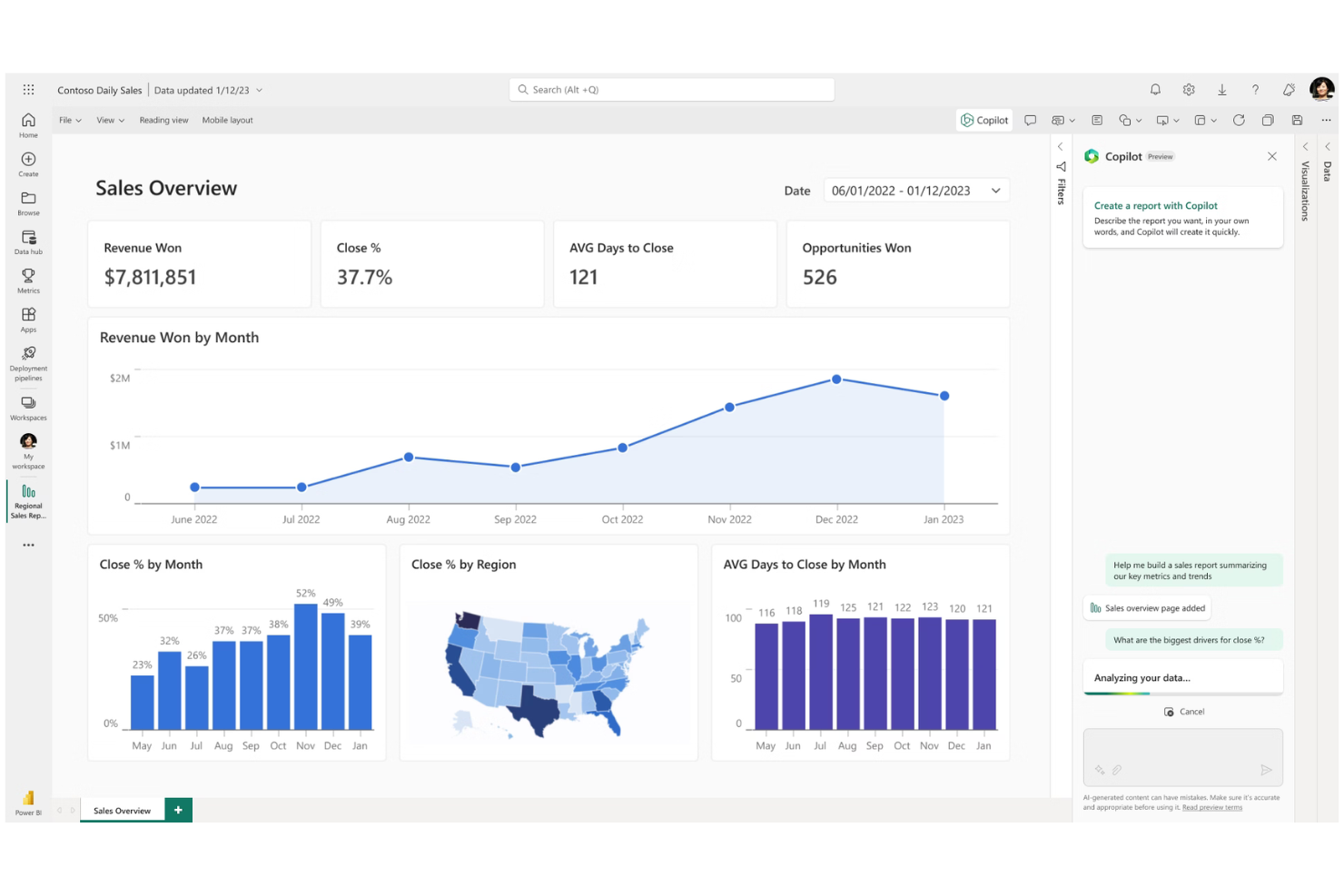
Microsoft Power BI es una plataforma de análisis empresarial diseñada para equipos financieros y analistas que necesitan visualizar, compartir y colaborar con datos financieros. Su integración con las herramientas de Microsoft 365 la convierte en una opción sólida para las organizaciones que ya utilizan Excel y otros productos de Microsoft.
¿Para quién es más adecuado Microsoft Power BI?
Profesionales financieros y analistas empresariales de organizaciones que utilizan Microsoft 365 y necesitan crear y compartir paneles financieros interactivos.
Elegí Microsoft Power BI por lo estrechamente que se conecta con las herramientas de Microsoft 365 que los equipos financieros ya utilizan a diario. Valoro que la función 'Analizar en Excel' permita a mi equipo importar directamente los conjuntos de datos de Power BI a Excel para crear tablas dinámicas y gráficos, sin salir del entorno de la hoja de cálculo.
También me gusta que Power BI inserte informes activos directamente en Microsoft Teams y SharePoint, de modo que los paneles financieros sean accesibles desde las herramientas de colaboración en las que mi equipo ya trabaja. En la práctica, esto significa que mi equipo puede compartir informes de variación presupuestaria o paneles de flujo de caja sin exigir a las partes interesadas que inicien sesión en una plataforma de inteligencia empresarial independiente.
Características principales de Microsoft Power BI
- Vista de consultas DAX: Escribir, ejecutar y depurar cálculos DAX directamente en la interfaz de Power BI para crear métricas y medidas financieras personalizadas.
- Centro de datos OneLake: Centralizar conjuntos de datos de múltiples fuentes en un único repositorio de datos gobernado que los equipos puedan buscar, validar y reutilizar.
- Servidor de informes de Power BI: Implementar y gestionar informes localmente para organizaciones con requisitos de residencia de datos o cumplimiento normativo.
- Etiquetado de confidencialidad mediante Microsoft Purview: Aplicar etiquetas de clasificación de datos a informes y conjuntos de datos para imponer controles de acceso en todo el contenido financiero.
Integraciones de Microsoft Power BI
Las integraciones incluyen Microsoft Excel, Microsoft Teams, SharePoint, Dynamics 365, Azure Synapse Analytics, Salesforce, Google Analytics, SAP HANA, Oracle Database y Microsoft OneDrive.
Pros and Cons
Pros:
- Integración profunda con el ecosistema de Microsoft 365
- Sólidas capacidades de modelado de datos basadas en Excel
- Opciones flexibles de implementación local y en la nube
Cons:
- Licenciamiento complejo para implementaciones empresariales
- Colaboración en tiempo real limitada en los paneles
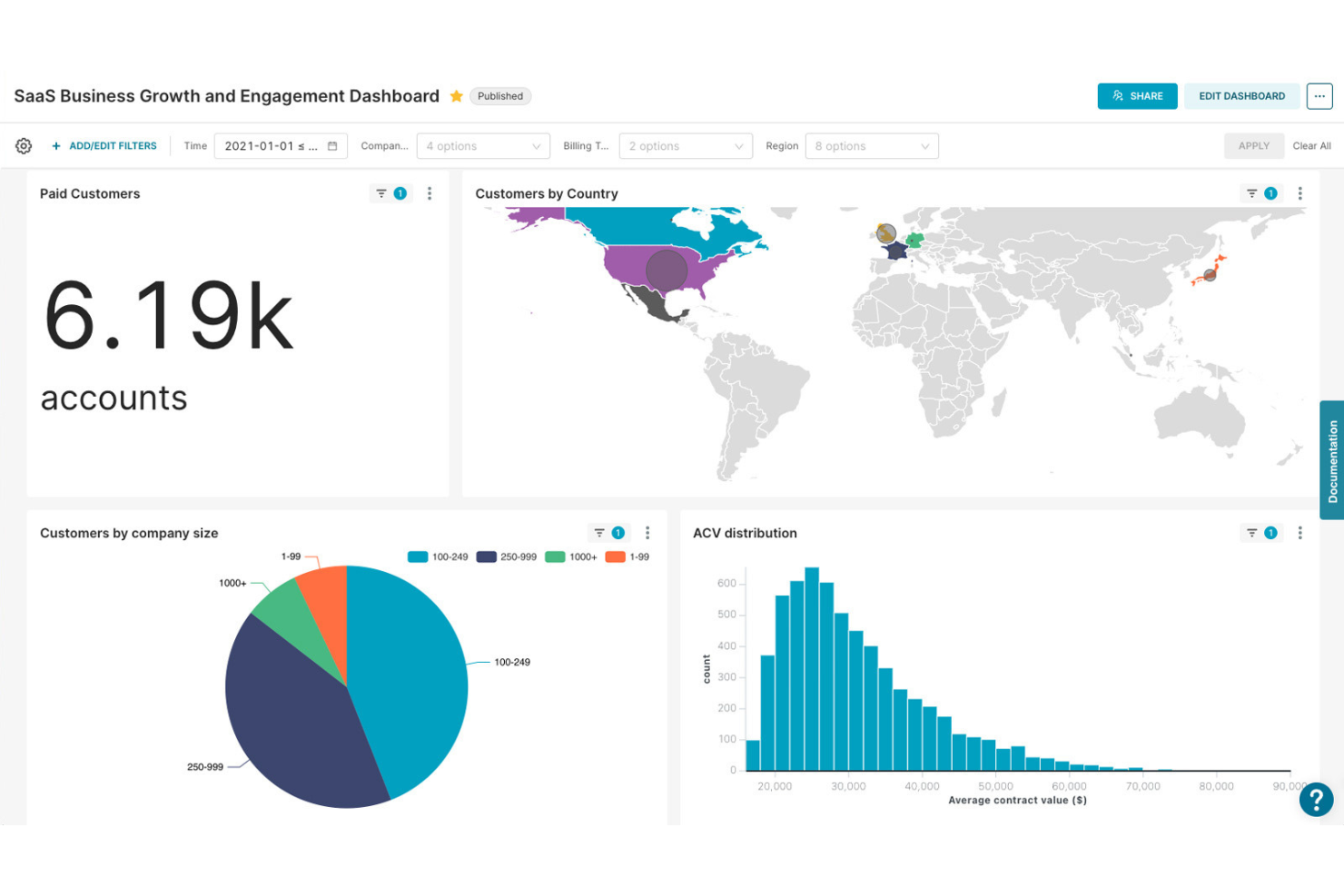
Superset es una plataforma de código abierto para la exploración de datos y la creación de paneles, diseñada para equipos que necesitan personalización avanzada y control sobre los análisis financieros. Resulta atractiva para profesionales de finanzas y equipos de datos que desean diseñar paneles y visualizaciones altamente personalizados para necesidades complejas de generación de informes.
¿Para quién es más adecuado Superset?
Los equipos de datos y finanzas de empresas medianas y grandes necesitan una plataforma de código abierto para crear paneles con personalización avanzada.
Por qué Superset es una buena alternativa a Domo
La arquitectura de código abierto de Superset fue lo que me atrajo como alternativa a Domo: mi equipo puede alojar toda la plataforma por sí mismo y configurarla para que coincida exactamente con nuestros requisitos de seguridad e infraestructura.
Aprecio SQL Lab, que permite a los analistas escribir y probar consultas personalizadas directamente en bases de datos financieras como Snowflake o BigQuery sin salir de la plataforma. La arquitectura de complementos de Superset también permite a mi equipo crear tipos de gráficos personalizados más allá de las más de 40 opciones integradas, algo importante cuando las visualizaciones estándar no se adaptan a las necesidades complejas de generación de informes financieros.
Funciones principales de Superset
- Capa semántica: Define métricas virtuales y columnas calculadas una sola vez, lo que permite reutilizarlas en todos los gráficos y paneles.
- Control de acceso basado en roles (RBAC): Asigna permisos sobre conjuntos de datos y paneles según el rol, controlando quién puede ver o editar los datos financieros.
- Barra de filtros nativa: Añade filtros interactivos entre paneles para que los usuarios puedan segmentar los datos financieros por periodo, región o categoría.
- Generador de paneles mediante arrastrar y soltar: Organiza y cambia el tamaño de los gráficos en un diseño de cuadrícula sin escribir código.
Integraciones de Superset
Entre las integraciones se incluyen Amazon Redshift, Google BigQuery, Snowflake, Microsoft SQL Server, PostgreSQL, MySQL, Oracle, MongoDB, Apache Druid y Google Sheets.
Pros and Cons
Pros:
- La implementación de código abierto permite controlar totalmente los datos
- Admite análisis financieros avanzados basados en SQL
- Comunidad activa para solucionar problemas y ampliar funciones
Cons:
- Plantillas financieras prediseñadas limitadas
- Requiere configuración técnica y mantenimiento continuo

Metabase
Ideal para inteligencia empresarial de código abierto con un generador de consultas sencillo
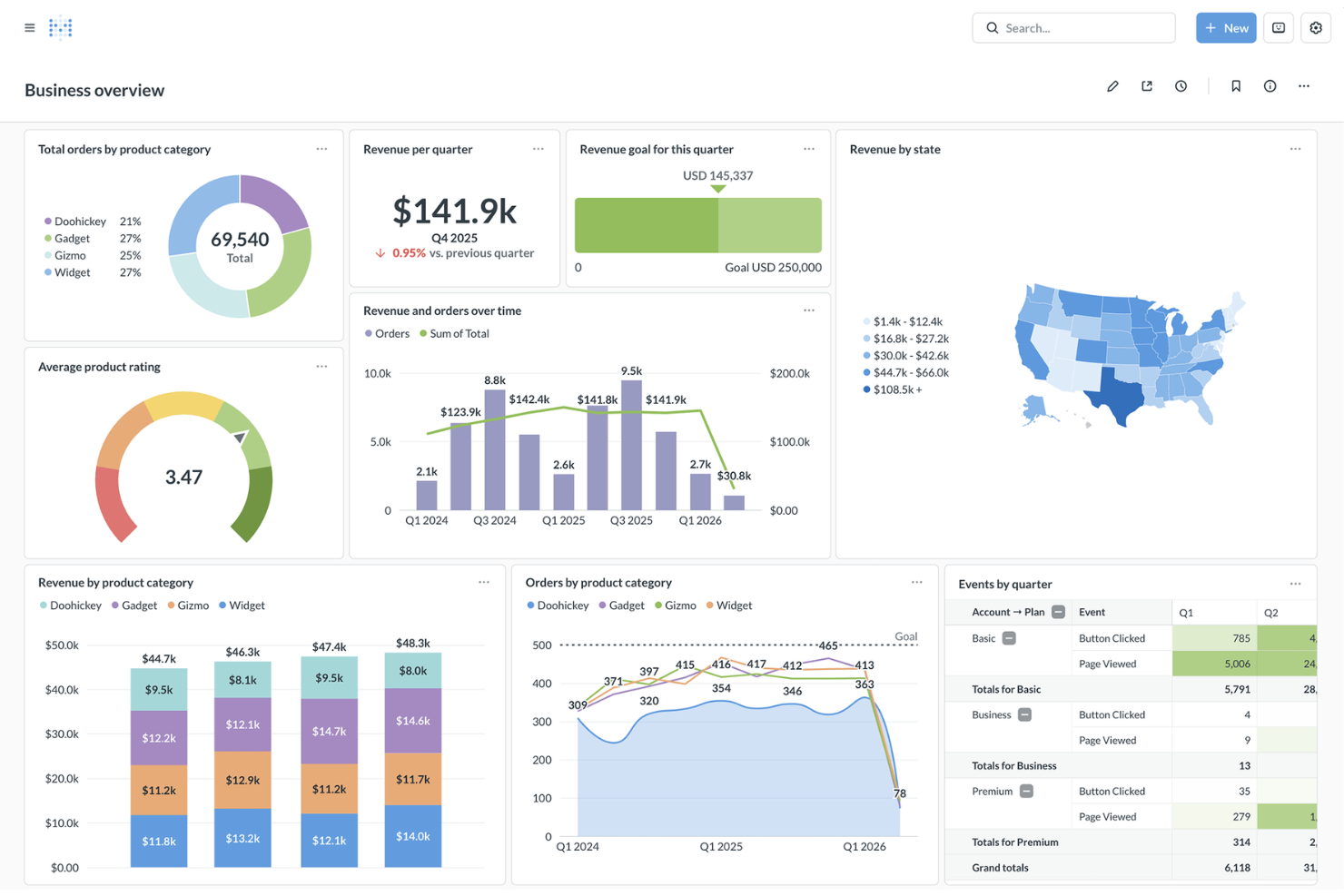
Metabase ofrece análisis y paneles de control de código abierto diseñados para equipos financieros que desean acceso autoservicio a los datos sin una gran intervención del departamento de TI. Resulta atractivo para las organizaciones que buscan capacitar a analistas y usuarios empresariales para explorar, visualizar y compartir rápidamente información financiera.
¿Para quién es más adecuado Metabase?
Equipos financieros y de análisis de startups y empresas medianas que buscan paneles de control de autoservicio de código abierto.
Por qué Metabase es una buena alternativa a Domo
Elegí Metabase porque su base de código abierto brinda a los equipos financieros control directo sobre la forma en que se implementan los análisis, sin quedar atados a una plataforma propietaria. El generador visual de consultas permite a los analistas crear consultas financieras mediante combinaciones y agregaciones sin escribir SQL, lo que significa que las partes interesadas no técnicas pueden explorar datos de presupuestos o ingresos de forma independiente.
También valoro los permisos a nivel de fila, tabla y panel de control, que permiten a mi equipo controlar exactamente quién puede ver los datos financieros confidenciales. Para los equipos que desean análisis de autoservicio sin la sobrecarga empresarial, esa combinación es difícil de igualar.
Funciones principales de Metabase
- Metabot AI: Un asistente basado en IA que responde preguntas sobre datos en lenguaje natural directamente dentro de Metabase en la nube.
- Exploración detallada: Permite a los usuarios hacer clic en cualquier gráfico para explorar los datos subyacentes sin crear una nueva consulta.
- Informes automatizados: Programa el envío de paneles de control por correo electrónico o Slack, con alertas que se activan cuando cambian los datos.
- Carga de CSV: Carga datos de hojas de cálculo directamente en Metabase para realizar consultas y visualizarlos.
Integraciones de Metabase
Entre las integraciones se incluyen Amazon Redshift, Google BigQuery, Snowflake, PostgreSQL, MySQL, MongoDB, Google Sheets, SQL Server, Presto y Druid.
Pros and Cons
Pros:
- La implementación de código abierto permite un control total de los datos
- Generador visual de consultas para usuarios no técnicos
- Permisos a nivel de fila para datos financieros confidenciales
Cons:
- No ofrece compatibilidad nativa con flujos de trabajo de escritura de datos
- Los informes programados solo están disponibles en los planes de pago

Ideal para análisis basados en búsquedas y perspectivas impulsadas por IA
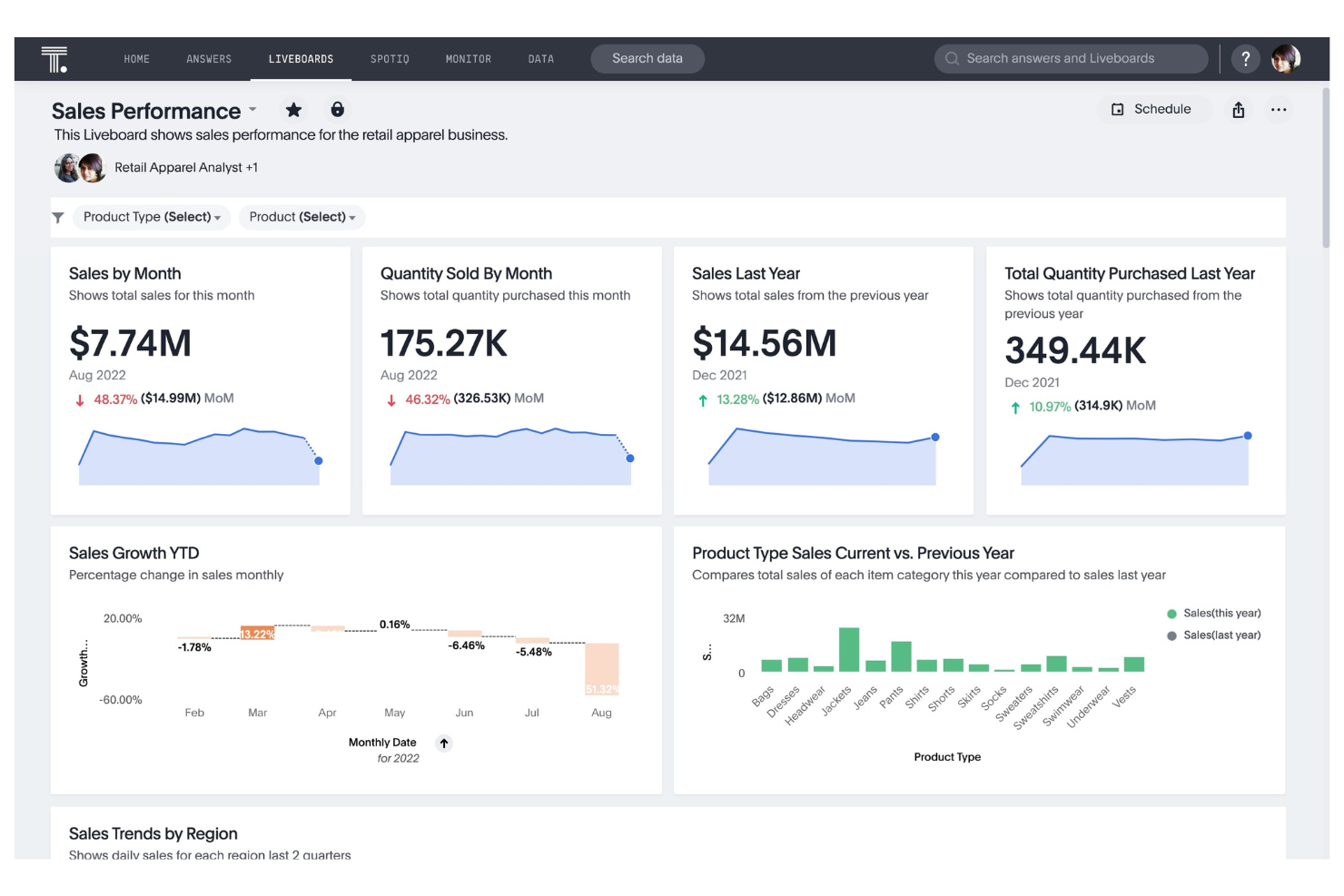
ThoughtSpot ofrece análisis basados en búsquedas diseñados para equipos financieros y líderes empresariales que necesitan respuestas instantáneas a partir de datos activos en la nube. Su interfaz intuitiva atrae a las organizaciones que buscan capacitar a usuarios no técnicos para crear y compartir paneles financieros bajo demanda.
¿Para quién es mejor ThoughtSpot?
Equipos de finanzas y operaciones de empresas medianas y grandes que necesitan análisis activos basados en búsquedas.
Por qué ThoughtSpot es una buena alternativa a Domo
Elegí ThoughtSpot porque su enfoque basado en búsquedas permite a mi equipo escribir una pregunta en lenguaje sencillo, como 'muéstrame los ingresos por región frente al trimestre pasado', y obtener una respuesta activa directamente del almacén de datos en la nube, sin necesidad de contar con un informe prediseñado.
Me gustan especialmente los Liveboards, el formato de panel interactivo de ThoughtSpot que consulta datos activos en lugar de instantáneas almacenadas en caché, de modo que los equipos financieros siempre ven cifras actualizadas sin tener que esperar a un ciclo de actualización. También valoro SpotterViz, que genera paneles listos para producción a partir de una instrucción en lenguaje natural en cuestión de minutos.
Para los equipos que se están alejando de la estructura de paneles más rígida de Domo, esa combinación de consultas activas y generación de paneles bajo demanda supone un cambio significativo.
Características principales de ThoughtSpot
- Análisis aumentado de SpotIQ: Detecta anomalías automáticamente, revela tendencias ocultas y genera análisis de cambios en los KPI mediante aprendizaje automático.
- Búsqueda relacional: Permite a los usuarios escribir consultas en lenguaje natural en una barra de búsqueda y ajustar las respuestas generadas por IA editando los tokens de búsqueda sin escribir SQL.
- Analyst Studio: Un espacio de trabajo basado en código donde los equipos de datos pueden escribir SQL, Python o R para preparar, transformar y visualizar datos dentro de la misma plataforma.
- Analista de IA Spotter: Un agente de IA conversacional que responde preguntas de datos complejas en lenguaje sencillo, con comentarios de intervención humana para mejorar la precisión con el tiempo.
Integraciones de ThoughtSpot
Las integraciones incluyen Snowflake, Databricks, Google BigQuery, Amazon Redshift, Microsoft Azure Synapse, Google Sheets, dbt, Fivetran, Alation y DataRobot.
Pros and Cons
Pros:
- Análisis basados en búsquedas para obtener respuestas instantáneas sobre los datos
- Consultas activas de almacenes de datos en la nube
- Detección de anomalías y tendencias impulsada por IA
Cons:
- Opciones limitadas de personalización de visualizaciones
- No incluye herramientas integradas de automatización de flujos de trabajo

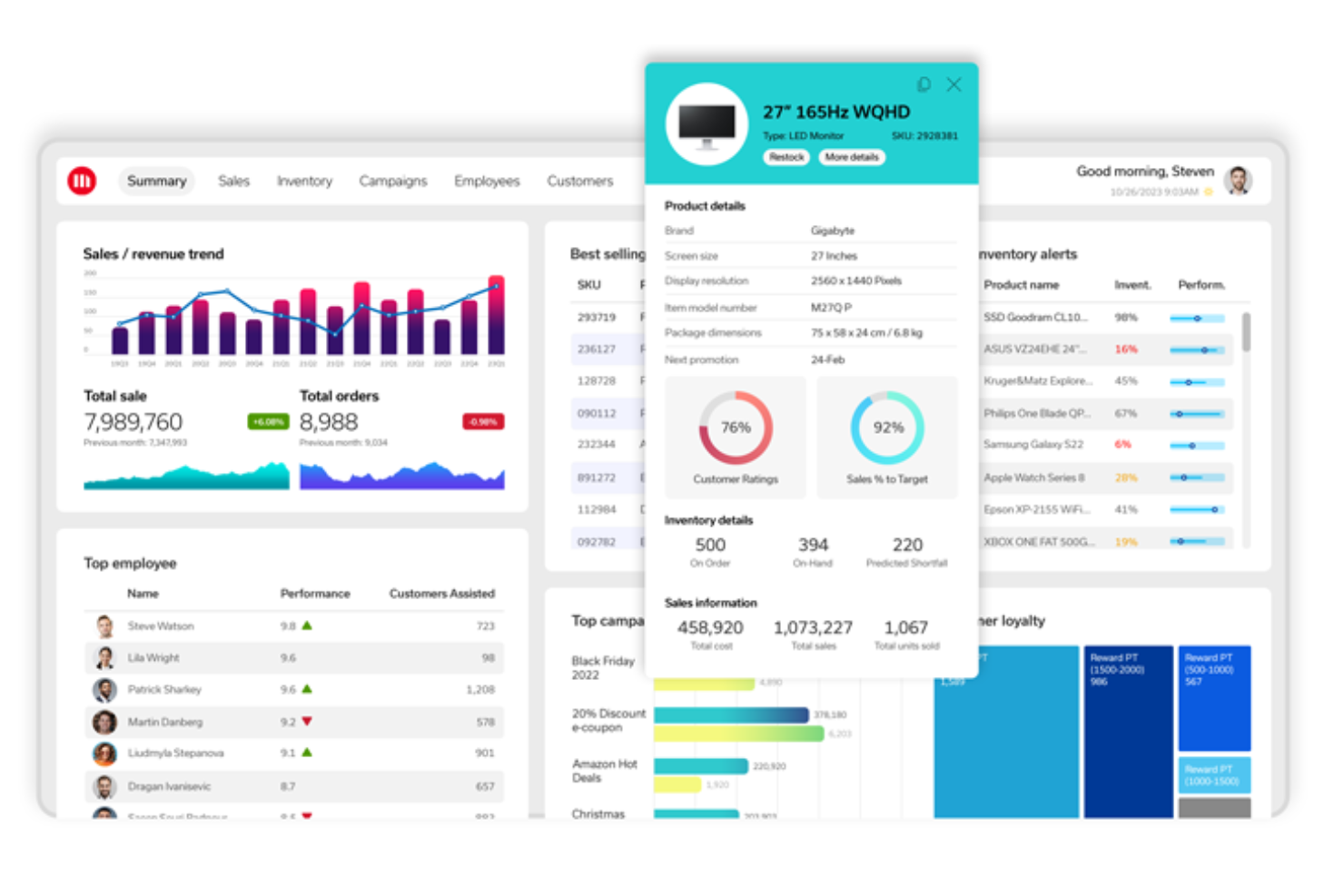
Strategy One es una plataforma de planificación financiera y modelado de escenarios diseñada para equipos financieros que gestionan organizaciones complejas con múltiples entidades. Es ideal para profesionales que necesitan alinear los planes estratégicos con datos financieros en tiempo real y visualizar el impacto de las decisiones empresariales.
¿Para quién es más adecuada Strategy One?
Líderes financieros de grandes empresas que buscan capacidades avanzadas de modelado de escenarios y planificación estratégica.
Por qué Strategy One es una buena alternativa a Domo
Elegí Strategy One porque su capa semántica gobernada permite que mi equipo defina métricas financieras —como ingresos, margen o abandono— una sola vez, y esas definiciones se aplican de forma coherente en todos los paneles y reportes. En la práctica, esto significa que no existe riesgo de que haya cálculos contradictorios de los KPI cuando distintos departamentos obtienen sus propios datos.
También valoro las funciones de generación automática de paneles y narrativas automáticas, que permiten a mi equipo convertir datos financieros sin procesar en paneles anotados y listos para generar perspectivas, sin necesidad de aplicar formato manualmente. Para los equipos financieros que gestionan entornos de datos grandes y provenientes de múltiples fuentes, la combinación de análisis basados en IA y gobernanza de nivel empresarial es algo que la mayoría de las herramientas de paneles independientes no ofrecen a esta escala.
Características principales de Strategy One
- Hiperinteligencia: Superpone tarjetas de datos contextuales en las aplicaciones web que tu equipo ya utiliza, sin necesidad de escribir código.
- Análisis móvil: Ofrece paneles optimizados para pantallas táctiles y acceso sin conexión a los informes directamente en dispositivos móviles.
- Análisis integrado: Integra los paneles y reportes de Strategy One en productos externos con tu propia identidad de marca.
- Informes empresariales: Genera informes paginados de gran volumen y con precisión de píxel en una plataforma nativa de la nube.
Integraciones de Strategy One
Las integraciones incluyen Microsoft Azure, Microsoft Power BI, Google Workspace, BigQuery, Gemini, AWS, Databricks, Snowflake y muchas más.
Pros and Cons
Pros:
- El modelado de escenarios admite estructuras complejas con múltiples entidades
- La capa semántica gobernada garantiza la coherencia de los KPI
- Las narrativas automáticas generan perspectivas anotadas en los paneles
Cons:
- Requiere asistencia de TI para la implementación inicial
- Personalización limitada de los paneles mediante autoservicio
Otras alternativas a Domo
Estas son algunas opciones adicionales de alternativas a Domo que no llegaron a mi lista, pero que aún merece la pena consultar:
- SAP BusinessObjects BI Suite
Ideal para informes empresariales en operaciones complejas
- Zoho Analytics
Ideal para inteligencia empresarial de autoservicio con combinación automatizada de datos
- Dot
Ideal para obtener información empresarial automatizada impulsada por IA


Wie ich Domo-Alternativen bewerte
Ich teile jede Bewertung in zwei Ebenen auf: die grundlegenden Fähigkeiten, die ein Tool haben muss, um Domo für Finanzberichterstattung zu ersetzen, und die Unterscheidungsmerkmale, die Anbieter für bestimmte Arbeitsabläufe hervorheben.
Kernfunktionen (Mindestanforderungen für diese Liste)
Wenn ich Tools für meine Liste auswähle, bewerte ich jedes einzelne auf einer Skala von 0 (bietet die Funktionalität nicht an) bis 5 (übertrifft in diesem Bereich) für jede unten aufgeführte Kernfunktion. Anschließend rechne ich den Gesamtscore des Tools in einen Prozentsatz um. Jedes Tool muss eine Mindestgesamtpunktzahl von 65 % erreichen, um berücksichtigt zu werden.
- Finanzdaten-Konnektoren: Ich prüfe auf native Integrationen mit wichtigen ERP- und Buchhaltungssystemen wie NetSuite, SAP, QuickBooks und Sage Intacct – also nicht nur auf allgemeine Datenbank-Konnektoren.
- Interaktive Dashboards: Jedes Tool sollte es Finanzteams ermöglichen, visuelle, detaillierte Dashboards für KPIs wie Cashflow, Margen und Forderungsalterung zu erstellen, ohne dass Entwicklerunterstützung erforderlich ist.
- Automatisierte Berichtsverteilung: Ich achte darauf, dass formatierte Berichte geplant an Stakeholder versendet werden – Board-Pakete, Monatsabschlüsse, Abweichungsberichte – per E-Mail und über andere Kanäle.
- Self-Service-Analysen: Finanzanwender sollten in der Lage sein, Abfragen und Visualisierungen per Drag-and-Drop zu erstellen, anstatt SQL zu schreiben oder Anfragen an die IT zu stellen.
- Datenmodellierung & -verknüpfung: Die Plattform muss die Verknüpfung und Transformation von Daten aus mehreren Quellen unterstützen, z. B. die Kombination von Hauptbuchbuchungen mit CRM-Umsatzdaten für konsolidierte Sichten.
- Governance & Zugriffskontrollen: Rollenbasierte Berechtigungen und Zeilenebenen-Sicherheit sind entscheidend, insbesondere für Teams, die sensible Daten abteilungs- oder organisationsübergreifend verwalten.
Wenn ich eine Liste von Tools habe, die diese Kriterien erfüllen, prüfe ich, wodurch sich die einzelnen Plattformen auszeichnen.
Unterscheidungsmerkmale (Was Anbieter besonders macht)
So vergleiche und kontrastiere ich verschiedene Anbieter:
Herausragende Funktionen
Write-back-Fähigkeiten machen aus einem Berichterstattungstool eine Planungsplattform, sodass Finanzteams Budgetszenarien durchführen und Prognosen aktualisieren können, ohne Exporte in Tabellenkalkulationen. Außerdem achte ich auf Multi-Entity-Konsolidierung, was für Organisationen relevant ist, die Tochtergesellschaften mit unterschiedlichen Währungen oder Kontenrahmen verwalten. Vorgefertigte Finanzvorlagen für GuV, Cashflow und Abweichungsberichte verkürzen die Einrichtungszeit – besonders für Teams, die Domo während eines laufenden Zyklus ersetzen möchten.
Über die Funktionen hinaus
Die Gesamtkosten spielen eine der wichtigsten Rollen bei meiner Bewertung, da unvorhersehbare Preise oft der Grund dafür sind, dass Finanzteams von Domo wechseln. Ich prüfe, ob die Lizenzkosten bei steigender Nutzer- oder Datenzahl vernünftig skalieren. Die Compliance ist ebenso wichtig – SOC 2 Type II und SOX-konforme Prüfpfade sind Standardanforderungen beim Umgang mit Hauptbuchdaten. Auch die Implementierungsdauer variiert stark zwischen den Anbietern, daher schaue ich mir an, wie schnell ein Finanzteam von der Anmeldung bis zum Live-Dashboard kommt, ohne dass externe Berater intensiv eingebunden werden müssen.
¿Por qué buscar una alternativa a Domo?
Aunque Domo es una buena opción de software de paneles financieros, hay varios motivos por los que algunos usuarios buscan soluciones alternativas. Es posible que estés buscando una alternativa a Domo porque necesitas…
- Un mayor control sobre el alojamiento y la seguridad de los datos
- Deshacerte de los elevados costes sin sacrificar funciones avanzadas
- Opciones avanzadas de personalización
- Una preferencia por sistemas de gestión de datos de código abierto o autoalojados
- Menos carencias de integración con fuentes de datos especializadas
- Una curva de aprendizaje menor y una mayor facilidad de uso
Si te identificas con alguno de estos puntos, has llegado al lugar adecuado. Mi lista incluye varias opciones de software de paneles financieros más adecuadas para los equipos que afrontan estos desafíos con Domo y buscan soluciones alternativas.
Funciones principales de Domo
Estas son algunas de las funciones principales de Domo, que te ayudarán a contrastar y comparar lo que ofrecen las soluciones alternativas:
- Conectores de datos: Domo ofrece cientos de conectores prediseñados para fuentes de datos en la nube y locales, lo que permite centralizar datos financieros y operativos de plataformas como Salesforce, NetSuite, Google Analytics y muchas más.
- Magic ETL: Esta herramienta visual de transformación de datos permite a los usuarios limpiar, combinar y preparar datos para su análisis sin escribir código, lo que facilita la creación de paneles financieros precisos.
- Generador de tarjetas: El generador de tarjetas de Domo permite a los usuarios crear visualizaciones interactivas y paneles mediante una interfaz de arrastrar y soltar, compatible con una amplia variedad de tipos de gráficos y diseños personalizados.
- Flujos de datos: Automatiza canalizaciones complejas de procesamiento de datos encadenando varios pasos de transformación, para garantizar que tus paneles financieros siempre reflejen los datos más recientes.
- Cálculos de Beast Mode: Crea métricas personalizadas y campos calculados directamente dentro de la plataforma mediante un sencillo editor de fórmulas, compatible con análisis e informes financieros avanzados.
- Alertas y notificaciones: Configura alertas automáticas basadas en umbrales o anomalías en tus datos financieros, para que tu equipo reciba notificaciones sobre cambios importantes en tiempo real.
- Aplicación móvil: Accede a paneles, informes y visualizaciones de datos estés donde estés con las aplicaciones móviles nativas de Domo para dispositivos iOS y Android.
- Controles de acceso basados en roles: Gestiona los permisos de los usuarios con un nivel de detalle preciso, garantizando que los datos financieros confidenciales solo sean accesibles para los miembros autorizados del equipo.
- Appstore: Amplía las funcionalidades de Domo con aplicaciones y soluciones prediseñadas de Domo Appstore, incluidas herramientas de análisis financiero específicas para cada sector.
- Herramientas de colaboración: Comparte paneles, comenta los datos y asigna tareas dentro de la plataforma para mantener a los equipos financieros coordinados e informados.