

AI contract management software uses artificial intelligence to automate how you create, review, track, and analyze contracts. If you’re trying to reduce tedious manual work, control legal risk, or surface key obligations faster, finding the right platform is more than a time-saver—it’s a way to support compliance and keep critical business processes humming.
In this guide, you’ll see how top AI contract management tools stack up, what sets each apart, and tips for choosing software that fits your team’s goals and workflows.
Why Trust Our Software Recommendations
6,700+
Reviews
20
Industry experts
16+
Evaluation factors
14
Years
Our team has been testing and reviewing software since 2012. As finance leaders ourselves, we know how difficult—and important—it is to choose the right software.
For this guide, we evaluated tools using hands-on testing and independent research, scoring tools using our selection criteria.
Our reviews reflect our human editorial judgment, not a sales pitch.
AI Contract Management Software Comparison Table
This comparison table summarizes pricing details for my top AI contract management software selections:
| Tool | Best For | Trial Info | Price | ||
|---|---|---|---|---|---|
| 1 | Best for collaborative contract editing in-browser | Free demo available | Pricing upon request | Website | |
| 2 | Best for customizable contract automation | Free plan available | Pricing upon request | Website | |
| 3 | Best for rapid implementation | Free demo available | Pricing upon request | Website | |
| 4 | Best for AI-powered contract data insights | Free demo available | Pricing upon request | Website | |
| 5 | Best for vendor and spend oversight | Free demo available | Pricing upon request | Website | |
| 6 | Best for connected e-signature and contracts | Free demo available | Pricing upon request | Website | |
| 7 | Best for automated contract analytics workflows | Free demo available | Pricing upon request | Website | |
| 8 | Best for ERP and financial system integration | Free demo available | Pricing upon request | Website | |
| 9 | Best for integration with finance operations | Free demo available | Pricing upon request | Website | |
| 10 | Best for post-award obligation tracking | Free demo available | Pricing upon request | Website |


Best AI Contract Management Software Reviews
Below are my detailed summaries of the best AI contract management software that made it onto my shortlist. My reviews offer a detailed look at the features, integrations, and best use cases of each platform to help you find the best one for you.
 1Best for collaborative contract editing in-browser
Juro
- Free demo available
- Pricing upon request
Visit WebsiteCustomer Rating:4.8/5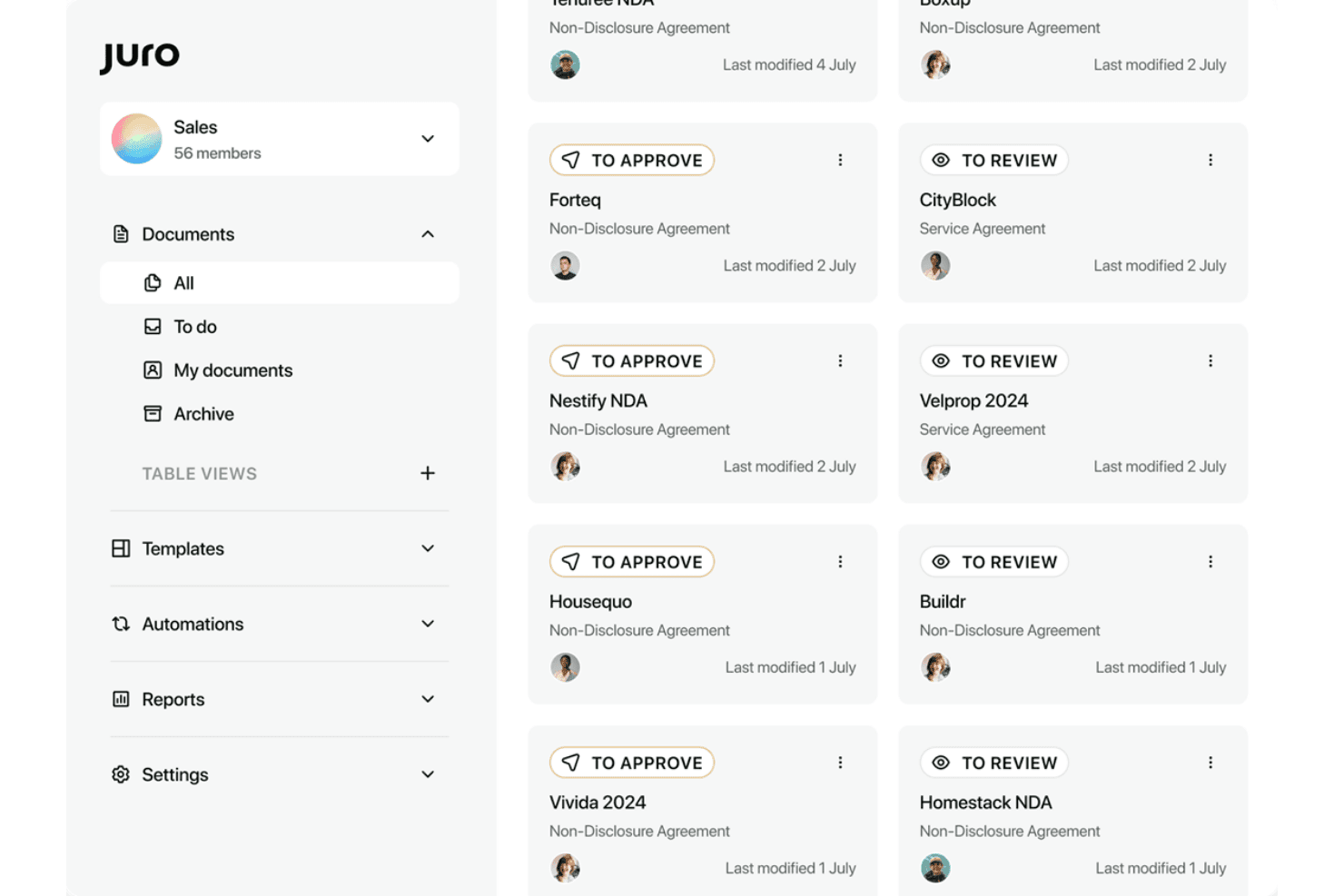
Juro offers a document management dashboard where sales teams can view, approve, and review contracts like NDAs and Service Agreements. Juro is an AI-native contract management platform that covers the full contract lifecycle—from template-based drafting and in-browser negotiation to e-signature, obligation tracking, and an AI-queryable contract repository.
Who Is Juro Best For?
Juro is a strong fit for mid-market legal, finance, and operations teams that manage high contract volumes and need cross-functional visibility without a dedicated contract specialist.
Why I Picked Juro
Juro earns its spot on my shortlist because its browser-native contract editor eliminates the Word-to-email-to-PDF cycle I've long dealt with. Counterparties can comment, redline, and approve directly in the browser without spawning a new document version each time. I also rely on Operator by Juro to query the full contract repository in plain language, which makes pulling obligation data during month-end close considerably faster than digging through a shared drive.
Juro Key Features
- AI clause extraction: Drag and drop third-party contracts or PDFs to auto-extract key data points and tag metadata for search and reporting.
- Configurable approval workflows: Build no-code, role-based review and signature flows to control contract routing and authorization.
- Centralized contract repository: Store, search, and organize contracts with version control, advanced metadata, and a full audit trail.
- AI-powered repository Q&A: Use natural language queries to search contract terms, dates, and obligations across your entire contract portfolio.
Juro Integrations
Juro offers native integrations with Salesforce, HubSpot, Greenhouse, Slack, Google Drive, Ashby, and Salesforce. Zapier is also supported, and an API is available for custom integrations.
Pros and Cons
Pros:
- No-code template builder for non-legal users
- AI repository Q&A surfaces obligations instantly
- Browser-native editing removes Word dependency
Cons:
- Reporting and analytics features are basic
- Limited AI redlining vs. dedicated CLM tools
Learn more about Juro: Best for customizable contract automation
- Free plan available
- Pricing upon request
Visit WebsiteCustomer Rating:4.7/5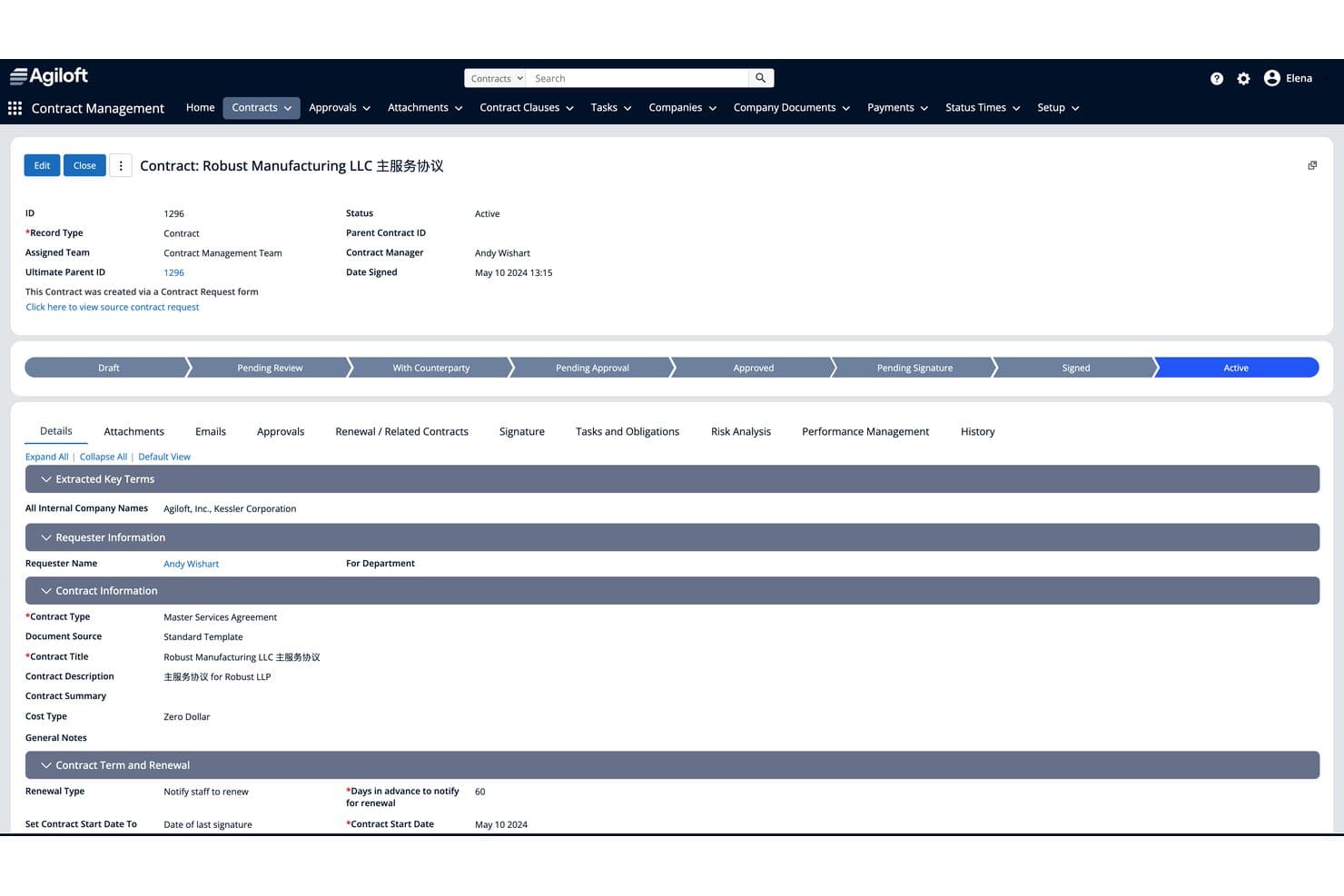
Agiloft offers a detailed contract record view with status tracking, key terms extraction, and contract lifecycle management for active master services agreements. Agiloft is a no-code contract lifecycle management platform that uses AI capabilities to handle clause extraction, obligation tracking, approval workflows, and contract repository management across legal, procurement, and finance teams.
Who Is Agiloft Best For?
Agiloft is a strong fit for mid-market and enterprise organizations that need highly configurable contract workflows across multiple departments without relying on custom development.
Why I Picked Agiloft
I picked Agiloft as one of the best because no other CLM platform gives my team this level of workflow control without writing a single line of code. I use the no-code data model to build custom approval chains for procurement and finance processes, and the AI-driven Obligation Management feature surfaces due dates and financial commitments directly inside each contract record. ConvoAI lets me query the entire repository in plain language, which cuts search time during month-end close.
Agiloft Key Features
- AI-powered clause library: Lets you standardize and manage approved contract language for consistent legal drafting.
- Third-party contract ingestion: Imports and analyzes counterparty contracts to surface risks and deviations.
- Pre-built ERP and procurement integrations: Connects with SAP, Oracle, and Coupa to sync contract-driven financial data.
- Role-based permission controls: Allows you to set granular access levels and approval rights for every user and document type.
Agiloft Integrations
Agiloft offers native integrations with Xero, Salesforce, SAP, Oracle, Coupa, and Workday. An API is available for custom integrations.
Pros and Cons
Pros:
- Custom approval pathways per department
- Fine-grained field rules for conditional routing
- No-code setup for custom workflows
Cons:
- Manual effort required for bespoke schemas
- Out-of-the-box UI appears dated
Learn more about Agiloft: Best for rapid implementation
- Free demo available
- Pricing upon request
Visit WebsiteCustomer Rating:4.7/5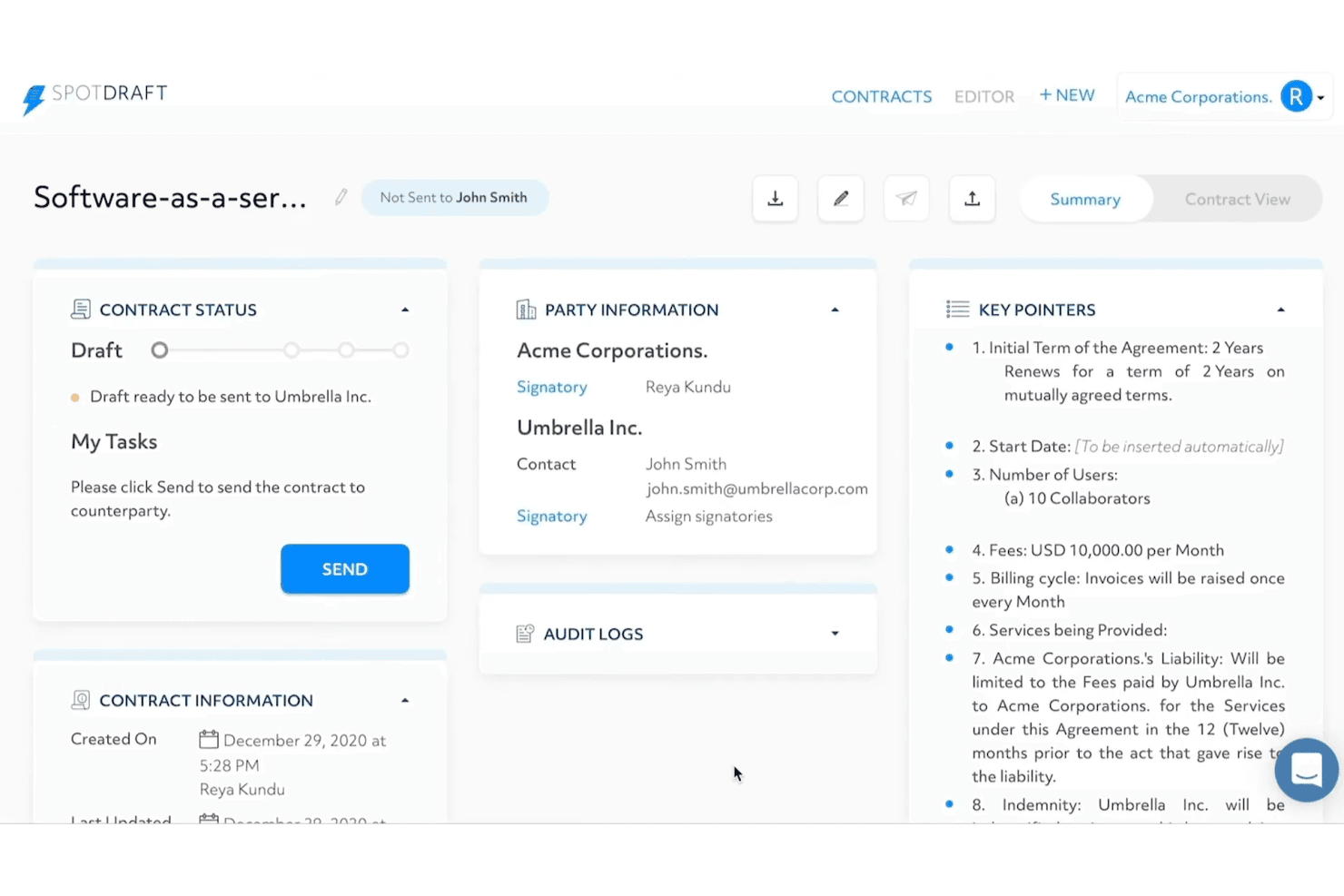
SpotDraft offers a contract summary view with contract status, party information, key pointers, and audit logs. SpotDraft is an AI-powered contract lifecycle management platform that handles contract creation, negotiation, AI-driven clause extraction and risk review, e-signatures, and automated approval workflows across the full contract lifecycle.
Who Is SpotDraft Best For?
SpotDraft is a strong fit for mid-market companies whose legal and business teams need a CLM solution running in weeks, not months.
Why I Picked SpotDraft
SpotDraft earns its spot on my shortlist because the implementation timeline is genuinely different from what I've seen elsewhere. My team is live in 4-6 weeks, with SpotDraft's in-house team handling workflow setup, integration configuration, and legacy contract migration, resulting in cost savings for the team. I also appreciate VerifAI, which runs AI contract reviews directly inside Microsoft Word, so reviewers aren't forced into a new tool from day one.
SpotDraft Key Features
- Smart Data Capture: Extracts financial and legal metadata from executed contracts using AI models.
- Central contract repository: Stores all documents with advanced search, metadata tagging, version control, and audit trails.
- VerifAI contract review: Flags risks, deviations, and obligations against your playbooks inside Microsoft Word.
- Multi-system integrations: Connects with tools like Salesforce, Slack, Google Drive, and Docusign for simplified workflows.
SpotDraft Integrations
SpotDraft offers native integrations with Salesforce, HubSpot, Slack, Microsoft Word, Google Drive, Outlook, Okta, and Dropbox. It also supports Zapier and provides an API for custom integrations.
Pros and Cons
Pros:
- Migrates legacy contracts at no added cost
- VerifAI reviews contracts directly in Word
- Deploys and goes live within weeks
Cons:
- Occasional delays in AI clause extraction accuracy
- Reporting and analytics dashboard is limited
Learn more about SpotDraft: Best for AI-powered contract data insights
- Free demo available
- Pricing upon request
Visit WebsiteCustomer Rating:4.7/5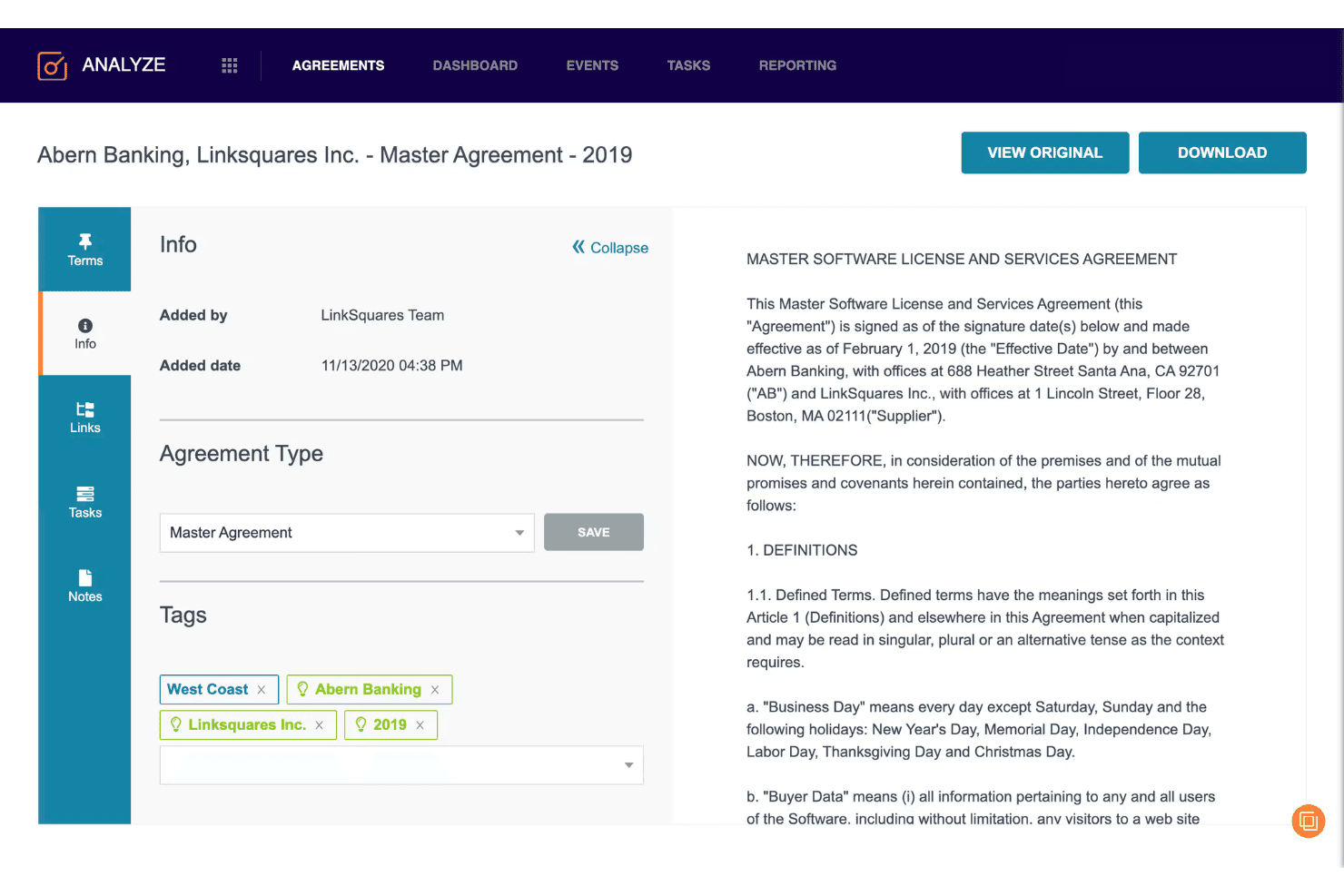
LinkSquares offers a Master Agreement with contract metadata, tags, and full document text in its Analyze platform. LinkSquares is an AI-powered contract lifecycle management platform that handles contract drafting, redlining, risk scoring, e-signature, and post-signature analytics through its proprietary legal-trained AI engine, LinkAI.
Who Is LinkSquares Best For?
LinkSquares is a strong fit for mid-market and enterprise legal and finance teams that manage high contract volumes and need structured data extracted from agreements at scale.
Why I Picked LinkSquares
LinkSquares earns its spot on my shortlist because of how its Analyze module turns static contracts into structured, queryable data. I can search across thousands of agreements and pull specific financial terms, renewal dates, or obligation triggers in seconds. The underlying AI engine, LinkAI, is trained specifically on legal documents, which means the clause-level extraction accuracy I get is noticeably sharper than what you'd expect from a general-purpose AI tool.
LinkSquares Key Features
- Clause library and playbooks: Maintain pre-approved fallback positions with negotiation playbooks to standardize contract terms.
- AI-assisted redlining: Get in-line drafting suggestions and deviation flags directly in MS Word and the browser.
- Third-party paper review: Import and analyze counterparty contracts to highlight risky clauses and missing provisions.
- Conversational contract Q&A: Ask natural language questions across your entire contract repository and receive cited answers.
LinkSquares Integrations
LinkSquares offers native integrations with Salesforce, HubSpot, Adobe Sign, Microsoft Word, Slack, Box, Google Drive, OneDrive, and Amazon S3, and provides an API for custom integrations.
Pros and Cons
Pros:
- Conversational search across entire contract repository
- LinkAI extracts clause data with high accuracy
- Strong post-signature obligation tracking and alerts
Cons:
- Initial contract migration can be time-consuming
- Reporting customization options are limited
Learn more about LinkSquares: Best for vendor and spend oversight
- Free demo available
- Pricing upon request
Visit WebsiteCustomer Rating:4.4/5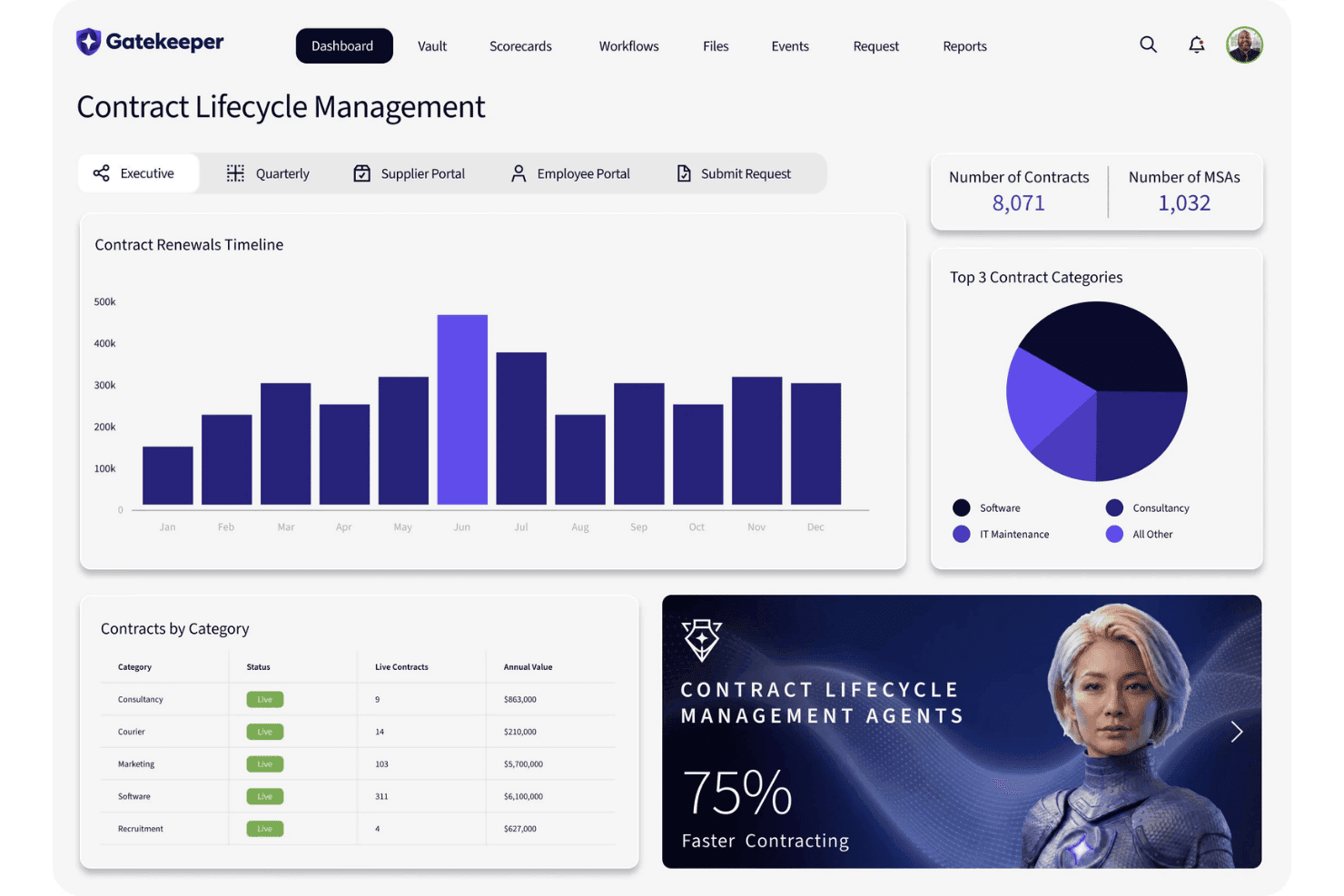
Gatekeeper offers a Contract Lifecycle Management dashboard with renewal timelines, contract categories, and live contract tracking by value. Gatekeeper is a vendor and contract lifecycle management platform that combines AI-powered clause extraction, obligation tracking, risk analysis, and vendor due diligence in a single connected system.
Who Is Gatekeeper Best For?
Gatekeeper suits mid-market to enterprise finance and procurement teams managing large, complex vendor portfolios with ongoing compliance and renewal obligations.
Why I Picked Gatekeeper
Gatekeeper earns its spot as one of the best on my shortlist because no other tool connects vendor risk and contract data in a single record the way it does. I particularly like the Spend Module, which uses AI agents to continuously flag auto-renewals and contracts that are no longer delivering value. In practice, that means my team can catch unwanted renewals before they roll over, rather than discovering them after the fact.
Gatekeeper Key Features
- LuminIQ AI clause extraction: Extracts key terms, clauses, and financial data points from uploaded contracts using AI agents.
- Centralized contract repository: Stores all vendor, customer, and framework contracts with advanced custom metadata and a full audit trail.
- Configurable approval workflows: Supports multi-step, role-based approvals for contract execution, review, and renewal actions.
- MarketIQ continuous risk monitoring: Monitors vendors against financial, sanctions, and cybersecurity databases with automated alerts.
Gatekeeper Integrations
Gatekeeper offers native integrations with Airtable, Slack, Asana, Workday, Zendesk, Jira, and Xero. It also connects with Zapier and provides an API for custom integrations.
Pros and Cons
Pros:
- Continuous vendor risk scoring via MarketIQ
- Auto-renewal alerts flag contracts before rollover
- Vendor and contract data in one record
Cons:
- Custom reporting options are more limited
- AI clause extraction is less advanced
Learn more about Gatekeeper: Best for connected e-signature and contracts
- Free demo available
- Pricing upon request
Visit WebsiteCustomer Rating:4.7/5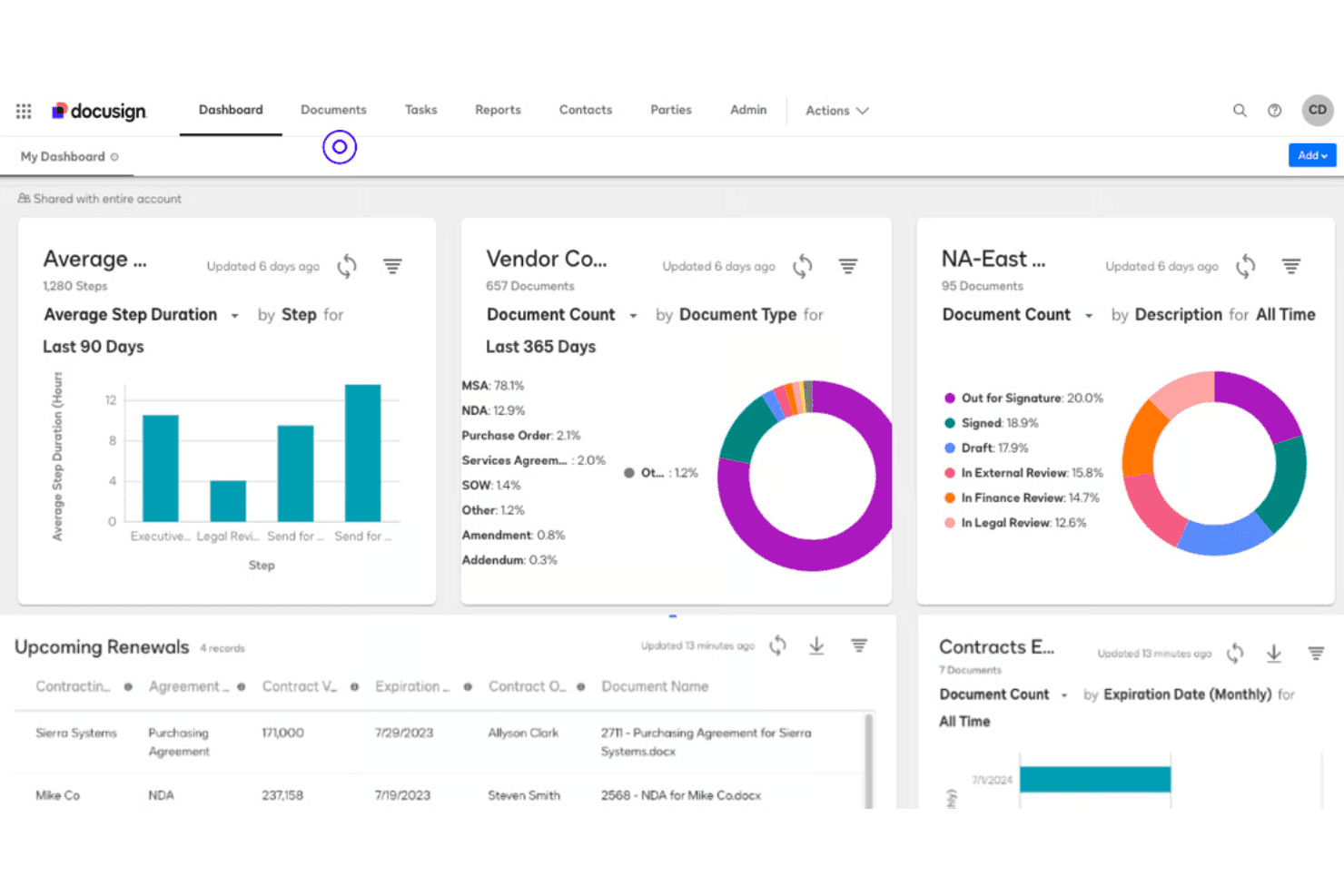
Docusign CLM offers a centralized dashboard with contract analytics, document counts by type, renewal tracking, and step duration metrics. Docusign CLM is an AI-powered contract lifecycle management platform that handles contract creation, negotiation, automated workflows, e-signature, and obligation tracking within a centralized, searchable repository.
Who Is Docusign CLM Best For?
It's a strong fit for mid-market and enterprise legal, finance, and procurement teams that need contract management tightly connected to existing ERP and CRM systems.
Why I Picked Docusign CLM
I've included Docusign CLM in my top picks because the e-signature isn't an add-on; it's native to the platform, which means there's no handoff between contract negotiation and execution. I like how the Iris AI engine runs generative Q&A against contract language and generates risk scorecards, letting my team flag problematic clauses before a document ever goes out for signature. The custom clause playbooks make it easy to define what "acceptable" looks like per contract type.
Docusign CLM Key Features
- Central contract repository: Stores all agreements in a single, searchable location with version control and detailed audit trails.
- Automated workflow editor: Uses a drag-and-drop interface to design contract review, approval, and renewal workflows.
- Salesforce and SAP Ariba integrations: Connects data and contract processes across CRM and procurement systems.
- AI-driven metadata extraction: Identifies and tags terms, dates, and obligations directly from uploaded documents.
Docusign CLM Integrations
Docusign CLM offers native integrations with Salesforce, NetSuite, SAP Ariba, and Microsoft 365. An API is available for custom integrations.
Pros and Cons
Pros:
- Deep audit trails support compliance requirements
- AI risk scoring flags clauses before signing
- Native e-signature built directly into workflows
Cons:
- Workflow configuration demands dedicated admin time
- Implementation timelines stretch into several months
Learn more about Docusign CLM: Best for automated contract analytics workflows
- Free demo available
- Pricing upon request
Visit WebsiteCustomer Rating:4.4/5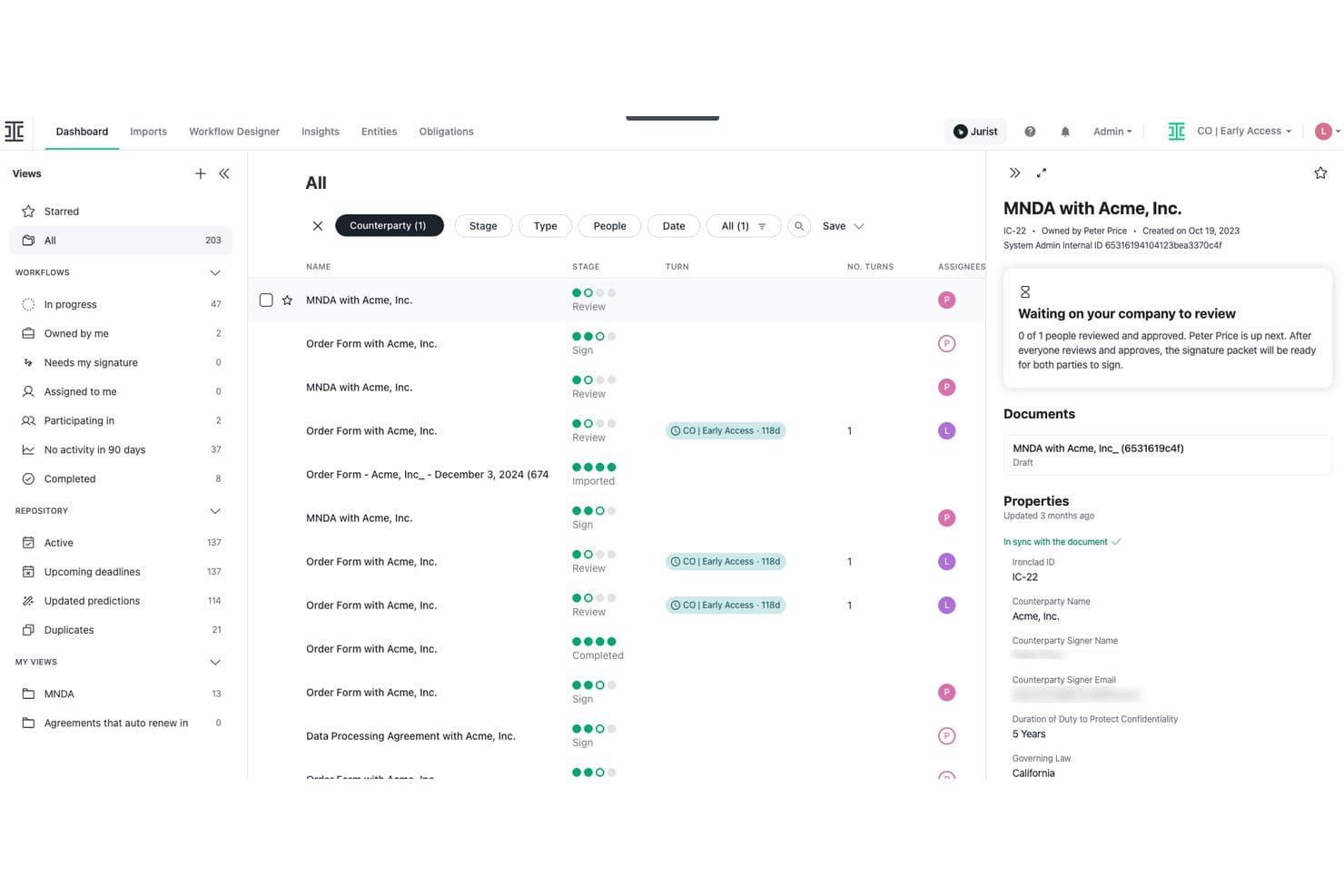
Ironclad offers an AI-powered contract dashboard with workflow tracking, repository management, and automated contract property extraction for CFOs managing agreements. Ironclad is a CLM platform with an AI layer built across the full contract lifecycle—covering drafting, redlining, negotiation, approval routing, e-signature, repository management, and contract analytics.
Who Is Ironclad Best For?
Ironclad is a strong fit for enterprise legal and finance teams managing high contract volumes with complex, multi-stakeholder approval chains.
Why I Picked Ironclad
Ironclad earns its spot on my shortlist because of how its no-code Workflow Designer handles conditional logic at scale. I can build a rule that automatically routes contracts to the CFO whenever indemnity exceeds $1M, with no developer involvement. Jurist, its agentic AI, then flags non-standard clauses and extracts financial obligations into structured, reportable data across every contract in the queue.
Ironclad Key Features
- Smart Import: Use AI to import legacy contracts and auto-tag documents for instant metadata searchability.
- Clause library and negotiation playbooks: Access pre-approved clause language and negotiation fallback positions that guide redlining based on company policy.
- Native e-signature (Ironclad Sign): Execute agreements within the platform using built-in e-signature tools or integrate with DocuSign, Adobe, and more.
- Advanced contract repository: Store every contract in a searchable, version-controlled repository with custom metadata fields and full audit trails.
Ironclad Integrations
Ironclad offers native integrations with NetSuite, SAP, Coupa, Salesforce, Docusign, Adobe Acrobat Sign, Dropbox Sign, Ramp, Zip, Tropic, and Fivetran. An API is available for custom integrations.
Pros and Cons
Pros:
- Scans repositories retroactively for data
- Builds instant visual metric charts
- Auto-extracts metadata via generative AI
Cons:
- Less suited to low-volume, small legal teams
- High custom configuration overhead costs
Learn more about Ironclad: Best for ERP and financial system integration
- Free demo available
- Pricing upon request
Visit WebsiteCustomer Rating:4.3/5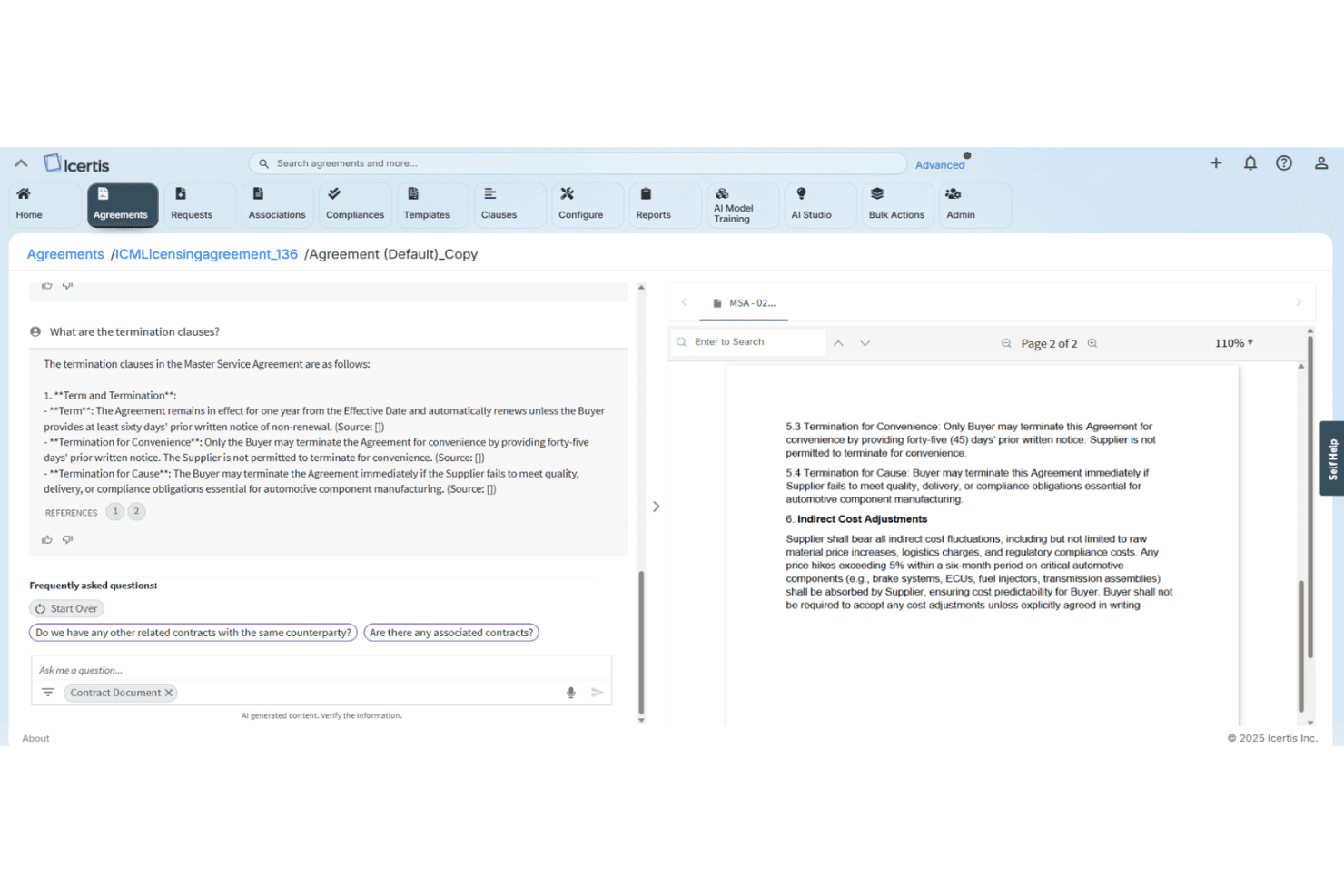
Icertis offers an AI-powered contract intelligence interface that lets users query termination clauses and view referenced contract document sections side by side. Icertis is an AI-native contract lifecycle management platform that handles contract drafting, negotiation, obligation tracking, and portfolio-wide analytics across enterprise procurement, sales, and finance workflows.
Who Is Icertis Best For?
Icertis is built for large enterprises in regulated industries—healthcare, financial services, and manufacturing—that manage high-volume, complex contract portfolios across global operations.
Why I Picked Icertis
Icertis earns its spot on my shortlist because of how deeply it connects contract data to live ERP workflows. The platform's bidirectional SAP connectors sync contract terms directly into S/4HANA and Ariba, so payment milestones, rebates, and supplier obligations don't have to be manually re-entered downstream. I particularly like the Vera Obligations agent, which surfaces active financial commitments and ties them back to the contract record in real time.
Icertis Key Features
- Conversational contract Q&A: Users can query contract data with natural language searches across large repositories.
- Clause library and playbooks: AI-powered clause libraries offer pre-approved templates and negotiation playbooks for faster drafting.
- Third-party paper review: The system ingests and compares counterparty contract language against company-approved playbooks.
- Audit trail and version control: Every contract edit and approval is tracked for compliance and historical reference.
Icertis Integrations
Icertis offers native integrations with SAP S/4HANA, SAP Ariba, Workday, Salesforce, and Microsoft Dynamics 365. An API is available for custom integrations.
Pros and Cons
Pros:
- Flags term deviations using AI
- Direct bi-directional SAP data sync
- Deep AI obligation tracking post-signature
Cons:
- Resource-heavy footprint for mid-sized operations
- Multi-month enterprise deployment timeline
Learn more about Icertis: Best for integration with finance operations
- Free demo available
- Pricing upon request
Visit WebsiteCustomer Rating:4.5/5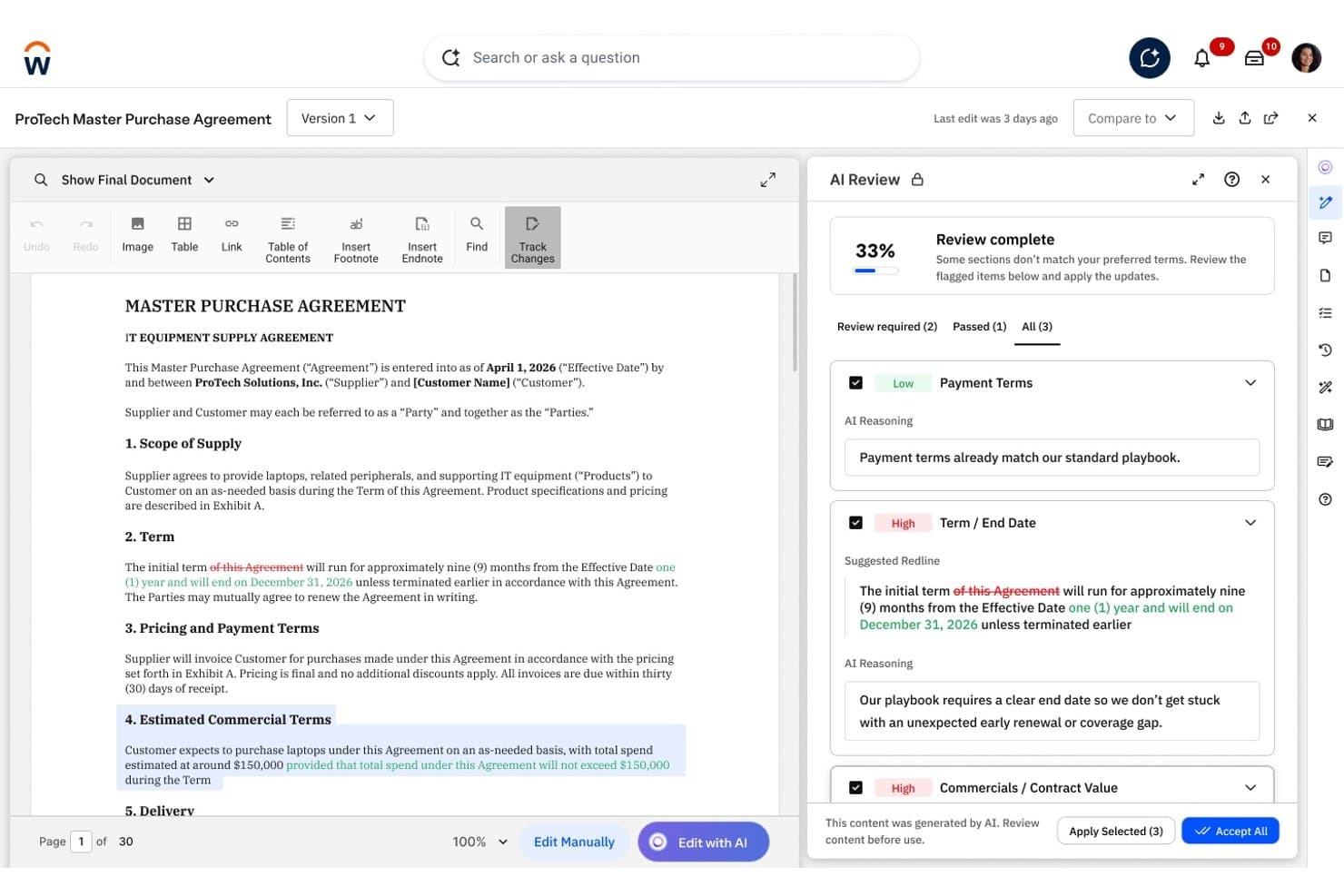
Workday Contract Management offers AI-powered contract review with redlining suggestions, risk scoring, and playbook compliance tracking directly within the document editor. Workday Contract Management is an AI-native CLM platform, powered by Evisort, that covers contract intake, drafting, redlining, approvals, e-signature, and analytics with AI-driven clause extraction and obligation tracking built in.
Who Is Workday Contract Management Best For?
It's a strong fit for enterprise finance and legal professionals already running core operations on the Workday platform.
Why I Picked Workday Contract Management
I've included Workday Contract Management in my top picks because of its native connection to Workday Financial Management. For finance teams already on Workday, contract data flows directly into the systems controllers actually use. The Custom AI Model Library lets finance teams build models to track payment schedules, pricing terms, and renewal triggers from contract text. I also like that "Ask AI" lets controllers query contract obligations in plain language without looping in legal.
Workday Contract Management Key Features
- Clause library and negotiation playbooks: Pre-approved clauses and AI-driven negotiation templates help standardize contract language across different teams.
- Conversational contract Q&A: Natural language search lets users ask questions about contract data and receive clear, cited answers.
- Third-party paper review: AI ingests and normalizes external contracts, flagging risky or missing clauses for legal review.
- Obligation extraction and tracking: Automatically tracks renewal dates, obligations, and SLAs from executed agreements within the main repository.
Workday Contract Management Integrations
Workday Contract Management offers native integrations with Workday Financial Management, Workday Human Capital Management, Salesforce, SAP Ariba, Adobe Sign, Box, and SharePoint. An API is available for custom integrations.
Pros and Cons
Pros:
- Obligation tracking routed to responsible stakeholders
- Custom AI models for finance-specific clauses
- Native sync with Workday financial data
Cons:
- Enterprise-only scope limits smaller team access
- Best value only within the Workday ecosystem
Learn more about Workday Contract Management: 10Best for post-award obligation tracking
Sirion
- Free demo available
- Pricing upon request
Visit WebsiteCustomer Rating:4.5/5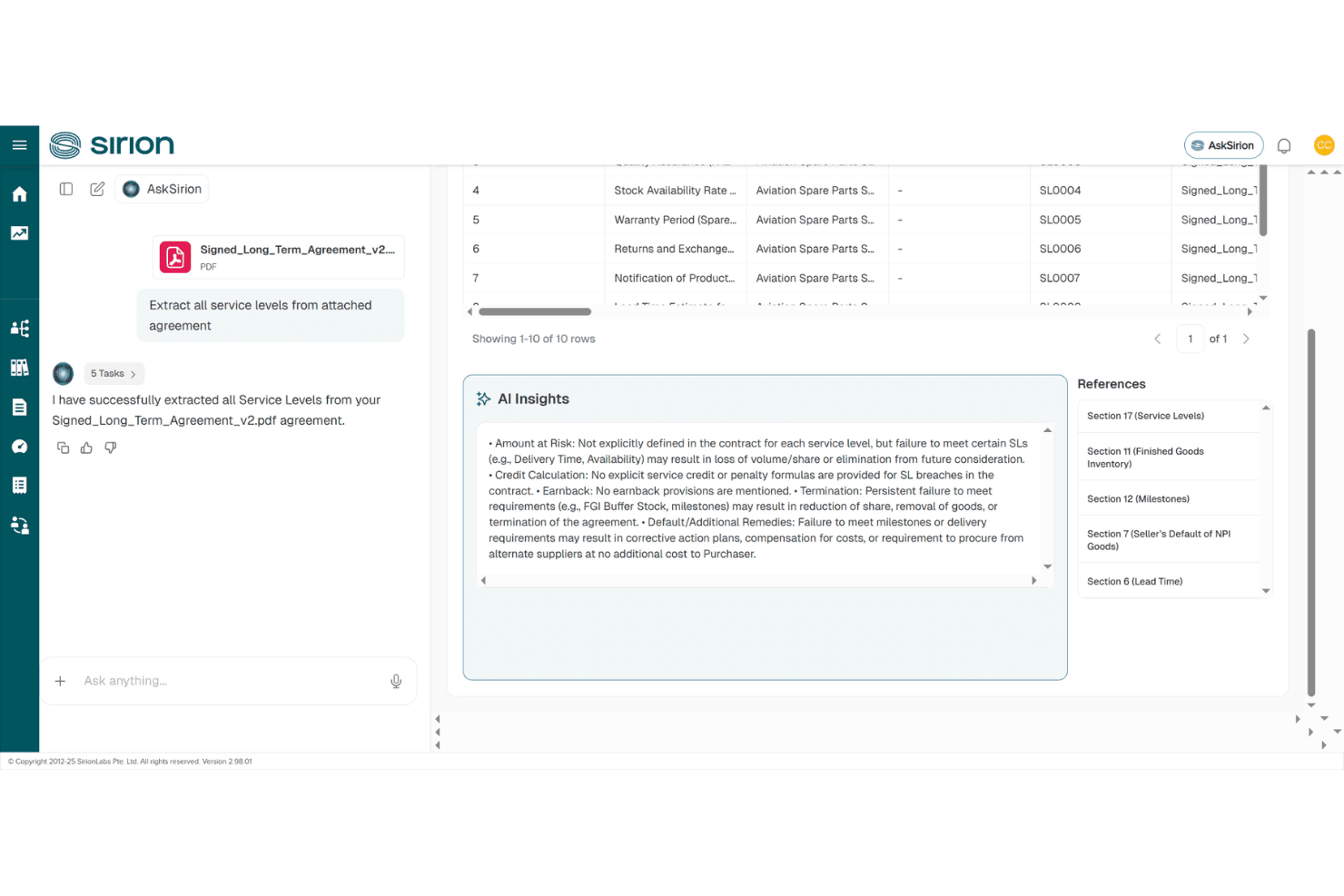
Sirion extracts and analyzes service levels from a long-term agreement, displaying structured data with AI insights and contract references. Sirion is an AI-native contract lifecycle management platform built around agentic AI that handles contract ingestion, drafting, negotiation, obligation monitoring, and performance tracking across the full contract lifecycle.
Who Is Sirion Best For?
Sirion is a strong fit for large enterprises managing high volumes of complex procurement, outsourcing, and vendor contracts across legal, finance, and procurement teams.
Why I Picked Sirion
Sirion earns its spot on my shortlist because of how seriously it treats post-award contract governance. I picked it specifically for its obligation tracking agents, which continuously monitor SLAs, surface compliance gaps, and trigger the right owners without manual follow-up. I also like the Finance solution's dedicated reporting layer, which maps cash-impacting contract terms directly to financial forecasts, so my team can connect vendor commitments to budget impact in real time.
Sirion Key Features
- AI clause extraction and normalization: Agents automatically extract, classify, and organize contract clauses and key financial terms for rapid search and analysis.
- Conversational contract Q&A: Natural language search lets users ask questions across all contracts and receive instant, cited answers.
- Third-party paper review: Sirion ingests and analyzes counterparty contracts, benchmarking deviations and risks against your playbook.
- Clause library and negotiation playbooks: Centralized AI-powered libraries help legal and business teams draft, standardize, and update templates and fallback positions.
Sirion Integrations
Sirion offers native integrations with SAP Ariba, Salesforce, and Oracle. An API is available for custom integrations.
Pros and Cons
Pros:
- Deep contract performance analytics
- AI agents surface SLA breaches early
- Strong post-award obligation monitoring
Cons:
- Substantial compute usage during initial ingestion
- High interface visual density slows navigation
Learn more about Sirion:
Other AI Contract Management Software
Here are some additional AI contract management software options that didn’t make it onto my shortlist, but are still worth checking out:
- 11Conga CLMBest for cross-functional workflow automation
- 12AavenirBest for procurement contract lifecycle automation
- 13ConcordBest for unlimited contract collaboration
- 14LeahBest for autonomous contract execution
- 15SummizeBest for instant answers across business tools
- 16ContractSafeBest for fast onboarding with attentive support
- 17MalbekBest for AI-powered commercial insights
- 18PramataBest for contract data accuracy assurance
- 19PandaDocBest for built-in document editing and approvals
- 20LexionBest for email-based contract intake
How I Evaluate AI Contract Management Software
To earn a spot here, a tool needs to deliver genuine AI value—not just surface-level features that don't move the needle for finance teams juggling renewal deadlines and obligation tracking. I split my evaluation into two layers: core functionality every platform must offer to qualify, and the differentiating factors that separate one vendor from another.
Core Functionality (Table Stakes For This List)
When I'm selecting tools for my list, I rank each one on a scale from 0 (does not offer the functionality) to 5 (excels in this area) for each core functionality listed below. Then, I calculate the tool's total score into a percentage. Each tool needs to achieve a minimum total score of 65% to be considered for inclusion.
- AI Clause Extraction: I evaluate how well the AI identifies and pulls out financial terms, payment schedules, and pricing clauses from uploaded contracts without manual tagging.
- Contract Repository: A searchable, centralized repository with metadata tagging and version control makes it easy to locate a specific vendor MSA during an audit cycle.
- Automated Lifecycle Management: I look for full lifecycle coverage—from template creation through renewal alerts—so your team isn't manually tracking expiration dates in spreadsheets.
- AI Risk & Obligation Analysis: The tool should flag non-standard clauses and surface financial obligations, like auto-renewal commitments or SLA penalties, for review before close.
- E-Signature & Approval Workflows: Configurable, role-based approval routing paired with native or integrated e-signature support keeps contracts moving without bottlenecks at sign-off.
- Financial System Integrations: I check for native connectors to ERP, accounting, and procurement systems so contract data syncs directly into your financial workflows.
Once I have a list of tools that meet the criteria, I consider what sets each platform apart.
Differentiating Factors (What Sets Vendors Apart)
Here's how I compare and contrast different vendors:
Standout Features
Obligation extraction and tracking matter most to me—I look for tools that surface renewal dates, SLA milestones, and payment triggers from signed contracts and route alerts to the right stakeholders. Conversational Q&A is another differentiator, letting finance users ask plain-language questions like "Which vendors have price escalation clauses?" without searching manually. I also evaluate third-party paper review, where the platform ingests inbound vendor contracts and flags missing provisions or risky deviations from your playbook.
Beyond Features
Security and AI governance policies are high on my list—I check for SOC 2 Type II certification and whether the vendor uses your contract data to train shared models or offers private instances. Deployment scope also matters because some platforms excel at high-volume procurement contracts while others are built for bespoke enterprise deals. Implementation timelines vary widely across this category, so I evaluate whether a vendor provides migration services for legacy repositories and dedicated support for cross-functional rollout to finance, procurement, and legal teams.
How to Choose AI Contract Management Software
It’s easy to get bogged down in long feature lists and complex pricing structures. To help you stay focused as you work through your unique software selection process, here’s a checklist of factors to keep in mind:
| Factor | What to Consider |
|---|---|
| FactorScalability | What to ConsiderWill the platform support your contract volume and process changes as you grow—without frequent plan renegotiation? |
| FactorIntegrations | What to ConsiderDoes it sync contract data with your ERP, accounting, procurement, and CRM tools to support end-to-end workflows? |
| FactorCustomizability | What to ConsiderCan you tailor approval flows, clause libraries, or reporting to your organization’s unique structures and policies? |
| FactorEase of use | What to ConsiderWill finance, legal, and procurement teams quickly adopt the tool without extensive training or workarounds? |
| FactorImplementation and onboarding | What to ConsiderHow much support, migration help, and configuration guidance does the vendor provide—especially for legacy data? |
| FactorSecurity safeguards | What to ConsiderAre data residency, audit trails, encryption, and permission controls aligned with your company’s risk standards? |
| FactorCost | What to ConsiderBeyond license fees, what impacts your total cost—add-ons, contract volume, integrations, or premium support tiers? |
| FactorCompliance requirements | What to ConsiderWill the platform help maintain audit trails, automate reporting, and support regulatory obligations for your industry? |
What Is AI Contract Management Software?
AI contract management software uses artificial intelligence to help you create, review, store, and track contracts throughout their entire lifecycle. These platforms automate clause extraction, flag risks, handle renewals, and centralize agreements in a searchable repository, allowing finance, procurement, and legal teams to reduce manual work and boost compliance with internal and regulatory requirements.
Features
When selecting AI contract management system, keep an eye out for the following key features:
- AI clause extraction: Automatically identifies and pulls key terms, obligations, and dates from contracts, reducing the need for manual review and data entry.
- Centralized contract repository: Stores all agreements in a secure, searchable location with version control, making it easy to access contract history and track changes.
- Automated approval workflows: Routes contracts for review and signature based on custom roles and rules, simplifying the process and minimizing bottlenecks.
- E-signature integration: Supports legally binding digital signatures within the platform or via connected e-sign providers so agreements can be executed quickly and securely.
- Risk and obligation tracking: Flags non-standard clauses, renewal deadlines, and compliance risks, helping teams avoid missed obligations and costly oversights.
- Configurable templates and clause libraries: Offers pre-approved language and clause options to ensure consistency and speed up contract drafting and negotiation.
- Renewal and expiration alerts: Sends proactive reminders for upcoming renewals, terminations, or critical milestones so nothing slips through the cracks.
- Audit trails: Logs every change and action, supporting compliance checks, dispute resolution, and audit requirements.
- ERP and financial system integrations: Syncs contract data directly with accounting, procurement, or ERP platforms for accurate reporting and revenue recognition.
- Conversational contract search: Lets users query the repository in plain language to instantly find specific clauses, terms, and contract types when needed.
Benefits
Implementing contract intelligence provides several benefits for your team and your business. Here are a few you can look forward to:
- Faster contract turnaround: Automated clause extraction, AI redlining, and role-based workflows move contracts through review and approval at a much quicker pace.
- Greater accuracy: AI-driven data extraction and obligation tracking reduce manual entry errors and ensure key terms and deadlines don’t get missed.
- Improved compliance: Systematic audit trails, standardized templates, and built-in contract analysis help teams maintain regulatory and internal policy compliance.
- Actionable contract insights: Centralized repositories and plain-language Q&A tools give you a real-time view of contractual risks, obligations, and renewal dates.
- Stronger cross-team collaboration: Cloud-based access, version control, and integrated e-signature features keep legal, finance, and procurement teams aligned throughout the contract lifecycle.
- Enhanced financial visibility: ERP and financial system integrations sync contract data with your accounting workflows, supporting accurate forecasting and spend management.
- Reduced audit preparation time: Audit trails and searchable repositories make it easier to pull documentation and respond to audit requests quickly.
Costs and Pricing
Selecting AI contract management software requires an understanding of the various pricing models and plans available. Costs vary based on features, team size, add-ons, and more. The table below summarizes common plans, their average prices, and typical features included in AI contract management software solutions:
Plan Comparison Table
| Plan Type | Average Price | Common Features |
|---|---|---|
| Plan TypeFree Plan | Average Price$0 | Common FeaturesLimited storage, basic clause search, simple contract repository, and email support. |
| Plan TypePersonal Plan | Average Price$20-$40/user/month | Common FeaturesStandard repository, single-user workflow automation, basic reporting, and document version control. |
| Plan TypeBusiness Plan | Average Price$40-$100/user/month | Common FeaturesMulti-user workflows, AI clause extraction, e-signature integration, risk flagging, and standard ERP integrations. |
| Plan TypeEnterprise Plan | Average Price$100-$250/user/month | Common FeaturesAdvanced AI analytics, custom playbooks, SSO/security controls, premium support, and bespoke integrations. |
AI Contract Management Software FAQs
Here are some answers to common questions about AI contract management software:
How does AI contract management software help with compliance?
AI contract management software automates compliance by standardizing templates, flagging risky or non-standard clauses, and ensuring every contract action is logged for audit purposes. This minimizes manual oversight and helps teams stay aligned with internal and regulatory guidelines.
Can these platforms integrate with existing finance and ERP tools?
Yes, most AI contract management platforms offer integrations with ERP, accounting, procurement, and CRM systems. This ensures contract data syncs with your core business platforms, supporting accurate reporting, billing, and spend management processes.
What should finance and procurement look for in a contract repository?
Look for a repository that’s searchable, supports detailed metadata, and includes document version control. These features let you locate agreements quickly, understand amendment history, and provide data for reporting or audits without extra manual work.
How does AI handle third-party contracts or counterparty documents?
AI-powered contract management tools can ingest third-party paper, extract relevant clauses, and benchmark language against your playbooks. This makes it easier to analyze risk and identify missing provisions or terms that don’t align with your company’s standards.
What security safeguards are usually included?
Vendors typically offer data encryption at rest and in transit, role-based access controls, audit trails, and compliance certifications such as SOC 2 Type II or ISO 27001. Always confirm the platform’s data residency options and AI governance policies to match your organization’s risk profile.