

10 Best Accounting Software With Payroll In 2026

Best Accounting Software With Payroll for Small Businesses Shortlist


Running a small business is tough enough. Finding an accounting software is easy, but finding an accounting software with payroll for small businesses is another headache on its own.
As a digital software expert, I’ve tested a ton of systems and know how draining the search can be (especially for something so niche). So, I’ve done the work for you.
This list focuses on tools built for small business needs—easy to set up, clear reporting, and stress-free payroll. If you're tired of cobbling things together, these picks will help you find a solution that actually works.
Why Trust Our Software Recommendations
Our team has been testing and reviewing software since 2012. As finance leaders ourselves, we know how difficult—and important—it is to choose the right software.
For this guide, we evaluated tools using hands-on testing and independent research, scoring tools using our selection criteria.
Our reviews reflect our human editorial judgment, not a sales pitch.
Comparison Table: Accounting Software With Payroll for Small Businesses
I made this quick cost summary chart with pricing and trial info for my favorite accounting software with payroll for small businesses.
| Tool | Best For | Trial Info | Price | ||
|---|---|---|---|---|---|
| 1 | Best for accounts payable automation | Free plan available | Pricing upon request | Website | |
| 2 | Best for real-time bank reconciliation | 30-day free trial | From $25/month | Website | |
| 3 | Best for integrated payroll and HR solutions | Free demo available | From $49/month + $6/month/user | Website | |
| 4 | Best for AI-powered bookkeeping | 30-day free trial | From £7.50/user/month (billed annually) | Website | |
| 5 | Best for free accounting and payroll | 30-day free trial | From $40/month | Website | |
| 6 | Best for user-friendly interface | Free plan + 30-day free trial available | From $15/month | Website | |
| 7 | Best for customizable accounting tools | Free plan + free demo available | From $15/month (billed annually) | Website | |
| 8 | Best for simplicity and automation | 14-day free trial available | From $30/month | Website | |
| 9 | Best for customizable and integrated financial management | 14-day free trial + free demo available | From £1.35/month | Website | |
| 10 | Best for scalable business solutions | 14-day free trial available | From $21/month | Website |

Best Accounting Software With Payroll for Small Businesses Reviews
If you’re needing more information, here’s a closer look at each of my accounting software with payroll for small businesses options. I’ve broken down the pros and cons, key features, and who each one is best for.

Payouts
Best for accounts payable automation

Payouts is a payment automation platform focused on accounts payable, offering tools for managing vendor payments, approvals, and payment workflows.
Who Is Payouts Best For?
Payouts is a good fit for small businesses that manage high volumes of vendor payments and need structured AP workflows and approval controls.
Why I Picked Payouts
I picked Payouts as one of the best because of how far its AP automation goes beyond basic invoice processing. The intelligent invoice capture uses OCR technology to pull data from PDFs, scanned images, and EDI files—so my team isn't manually keying in vendor invoices. I also like the automatic invoice matching, which reconciles invoices against purchase orders and receipts without manual intervention. The customizable approval workflows let you route invoices based on amount, vendor, or department, which keeps the right people in the loop without creating bottlenecks.
Payouts Key Features
- Dynamic tax engine: Automates tax form collection, validates submissions, and calculates withholding rates across multiple jurisdictions.
- Vendor portal: Gives vendors a self-service interface to submit invoices, track payment statuses, and update their own profiles.
- Real-time spend dashboards: Provides real-time insights into payment cycles, cash flow, and vendor activity through custom reporting tools.
- Multi-currency global payments: Processes vendor payments across 150+ countries with automatic routing for optimal fees and delivery.
Payouts Integrations
Integrations include Everflow, CJ Affiliate, Awin, PayPal, Venmo, Payoneer, NetSuite, Priority, Workday, Skrill, and Tune.
Pros and Cons
Pros:
- Comprehensive automation of accounts payable processes
- Multiple payout methods
- Supports scaling operations
Cons:
- Potential challenges integrating with existing systems
- May require time to fully customize

Xero
Best for real-time bank reconciliation
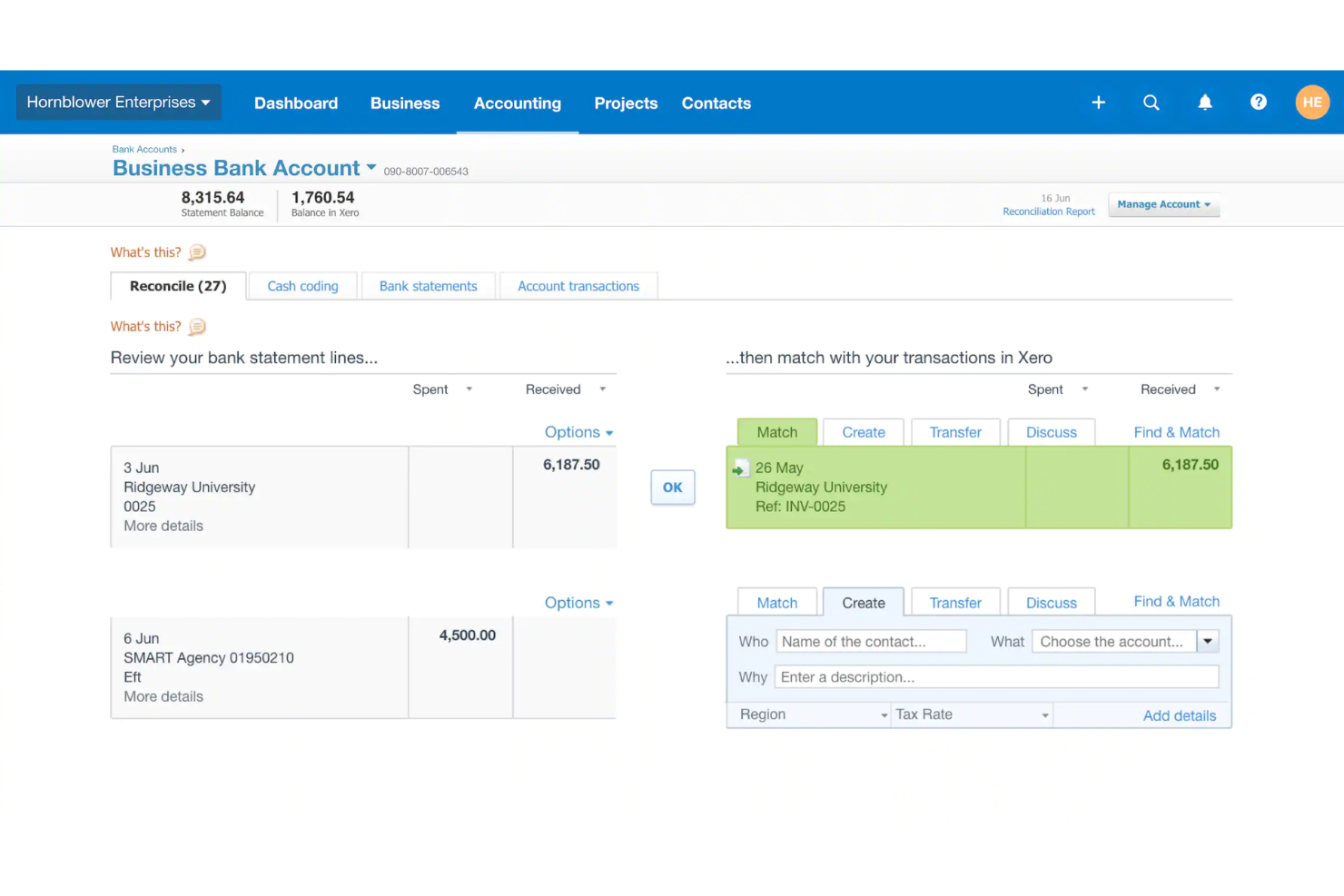
Xero is an online accounting platform for small businesses that combines invoicing, payroll, bank feeds, expense tracking, and financial reporting in one system.
Who Is Xero Best For?
Xero is a good fit for small business owners and their accountants or bookkeepers who need a cloud-based system to manage day-to-day finances.
Why I Picked Xero
Xero earns its spot on my shortlist because of how well its bank reconciliation tools hold up in day-to-day use. Bank transactions flow directly into Xero via automated bank feeds, and JAX—Xero's AI financial assistant—automatically categorizes and matches transactions when it can confidently match them, so I'm only reviewing transactions that need my attention. I also like the bulk reconciliation feature, which lets me sort, group, and code multiple transactions at once instead of working through them one by one. The dashboard also shows each bank account's statement balance alongside the Xero balance, so discrepancies are visible the moment they appear rather than at month-end.
Xero Key Features
- Pay run reporting: Run reports to review pay runs and view a breakdown of amounts paid to all employees or to a single employee in a selected pay period, ready to file with the CRA.
- Online invoicing: Create, send, and track invoices from the desktop or the Xero Accounting mobile app, with automatic GST/HST calculations applied as you build each invoice.
- Sales tax reporting: Generate GST/HST and provincial sales tax summaries directly from your records to simplify filing and meet CRA compliance requirements.
- Inventory tracking: Monitor real-time data on stock levels, what's selling, and what needs restocking directly within your Xero organization.
Xero Integrations
Xero offers hundreds of integrations through its App Store, including native integrations with Stripe, GoCardless, and Interac e-Transfer for payments. An API is available for custom integrations.
Pros and Cons
Pros:
- Supports multiple currencies for global business operations
- Mobile app provides access to data on the go
- Real-time bank reconciliation enhances financial accuracy
Cons:
- Some users report occasional performance issues
- Project tools require higher tiers
New Product Updates from Xero
Xero Adds Supplier Days to Pay Detail Report
Xero adds a Supplier Days to Pay Detail report with bill-level payment timing, aging categories, and exportable data. This helps businesses track supplier payment performance and prepare Fair Payment Code evidence. For more information, visit Xero’s official site.
 .
.
Gusto
Best for integrated payroll and HR solutions

Gusto is a cloud-based payroll and HR platform for small businesses that combines automated payroll processing, tax filing, benefits administration, and basic time tracking in one system.
Who Is Gusto Best For?
Gusto is a good fit for small business owners who need to manage payroll, taxes, and HR in one place without a dedicated HR team.
Why I Picked Gusto
Gusto earns its spot on my shortlist because payroll and HR live in the same system, which means there's no manual syncing between separate tools. I particularly like the AutoPilot™ feature, which lets you schedule payroll to run automatically on a set cadence—so if you're running a lean operation, you're not blocked waiting on someone to manually trigger each pay run. I also find the built-in onboarding checklists genuinely useful: new hires can self-onboard, e-sign documents, and enroll in benefits before their first day, all without you having to chase paperwork across different platforms.
Gusto Key Features
- Automated tax filing: Gusto calculates, files, and pays federal, state, and local payroll taxes automatically every time you run payroll.
- Workers' compensation management: Set up and sign a workers' comp policy online and pay premiums on a pay-as-you-go basis instead of in a lump sum.
- Applicant tracking system: Post jobs, syndicate listings to boards like LinkedIn and Indeed, and manage candidates from one place.
- Compliance alerts: Gusto flags state tax registration requirements and changing employment laws so you can stay ahead of compliance issues.
Gusto Integrations
Gusto offers native integrations with QuickBooks Online, Xero, FreshBooks, Expensify, Deputy, and TSheets, and connects with Zapier. An API is available for custom integrations.
Pros and Cons
Pros:
- Employee benefits management
- Automated payroll processing
- Comprehensive HR tools
Cons:
- Setup complexity
- Limited customization options
New Product Updates from Gusto
Gusto Adds Solo Advisory Tools and Mobile Money Features
Gusto adds Solo S-Corp Advisory Tools and Gusto Money on Mobile for tax guidance, invoicing, and bill payments. These updates help accountants advise solopreneurs and let users manage business finances from their phones. For more information, visit Gusto’s official site.

Best for AI-powered bookkeeping

Clear Books is an accounting and payroll platform for small businesses that combines bookkeeping, invoicing, payroll processing, expense management, and tax tools in one system.
Who Is Clear Books Best For?
Clear Books is a good fit for UK-based small business owners who need a straightforward platform to manage their accounting, payroll, and tax obligations in one place.
Why I Picked Clear Books
Clear Books earns its spot on my shortlist because of Auto Code, its AI-powered bank transaction categorization tool. When you import bank transactions—whether via a live bank feed or a CSV file—Auto Code automatically assigns the right account code to each one, processing hundreds of entries in seconds. I find this especially useful during month-end close, when manually coding a backlog of transactions is the last thing you want to do. The Auto Bills add-on complements this well, using OCR technology to extract data from supplier invoices and receipts captured by phone, email, or file upload, then matching them to the right supplier automatically.
Clear Books Key Features
- Payroll and accounting integration: When you run payroll, Clear Books automatically creates the corresponding entries in your accounts, keeping your bookkeeping complete without manual reconciliation.
- RTI submissions to HMRC: Submit Real Time Information directly to HMRC with one click, including Full Payment Submissions and Employer Payment Summaries.
- MTD VAT filing: Record VAT and file VAT returns to HMRC directly from Clear Books, fully compliant with Making Tax Digital requirements.
- Employee leave management: Employees can request leave through a self-service portal, and you can track remaining days and absences without spreadsheets.
Clear Books Integrations
Integrations include PayPal, GoCardless, Stripe, and more. An API is available for custom integrations.
Pros and Cons
Pros:
- Flexible payment options
- Professional invoicing
- AI-powered bookkeeping
Cons:
- No mobile app
- Advanced features may be overwhelming

Wave
Best for free accounting and payroll

Wave is an accounting software platform for small businesses that combines invoicing, expense tracking, financial reporting, and integrated payroll services in one system.
Who Is Wave Best For?
Wave is a good fit for freelancers, sole proprietors, and very small businesses that need core accounting and payroll tools without a large software budget.
Why I Picked Wave
Wave is one of my top picks because I love that its free accounting tier is genuinely functional—not a stripped-down teaser. You get double-entry bookkeeping, income and expense tracking, and financial reports like cash flow statements and balance sheets without paying anything. When you're ready to add payroll, Wave's automatic payroll journal entries sync directly with your accounting records, so you're not manually reconciling payroll runs against your books. I also like that Wave handles W-2, 1099, and tax filing automatically across all 50 US states, which removes a real compliance burden for small business owners running lean.
Wave Key Features
- Invoice creation: Build and send professional invoices directly from Wave, with options to add your logo, set payment terms, and accept online payments.
- Multi-user access: Invite your accountant, bookkeeper, or business partner as a collaborator with controlled access to your Wave account.
- Direct deposit: Pay employees directly into their bank accounts each payday without any additional per-transaction fees.
- Employee self-service portal: Employees can log into Wave to view pay stubs, access W-2s, and update their own banking and contact details.
Wave Integrations
Native integrations are not clearly documented. Wave supports data imports from QuickBooks, FreshBooks, and spreadsheets, and offers an API for custom integrations.
Pros and Cons
Pros:
- Comprehensive financial management
- User-friendly interface
- Free accounting tools
Cons:
- Reports customization
- Limited customer support

ZipBooks
Best for user-friendly interface
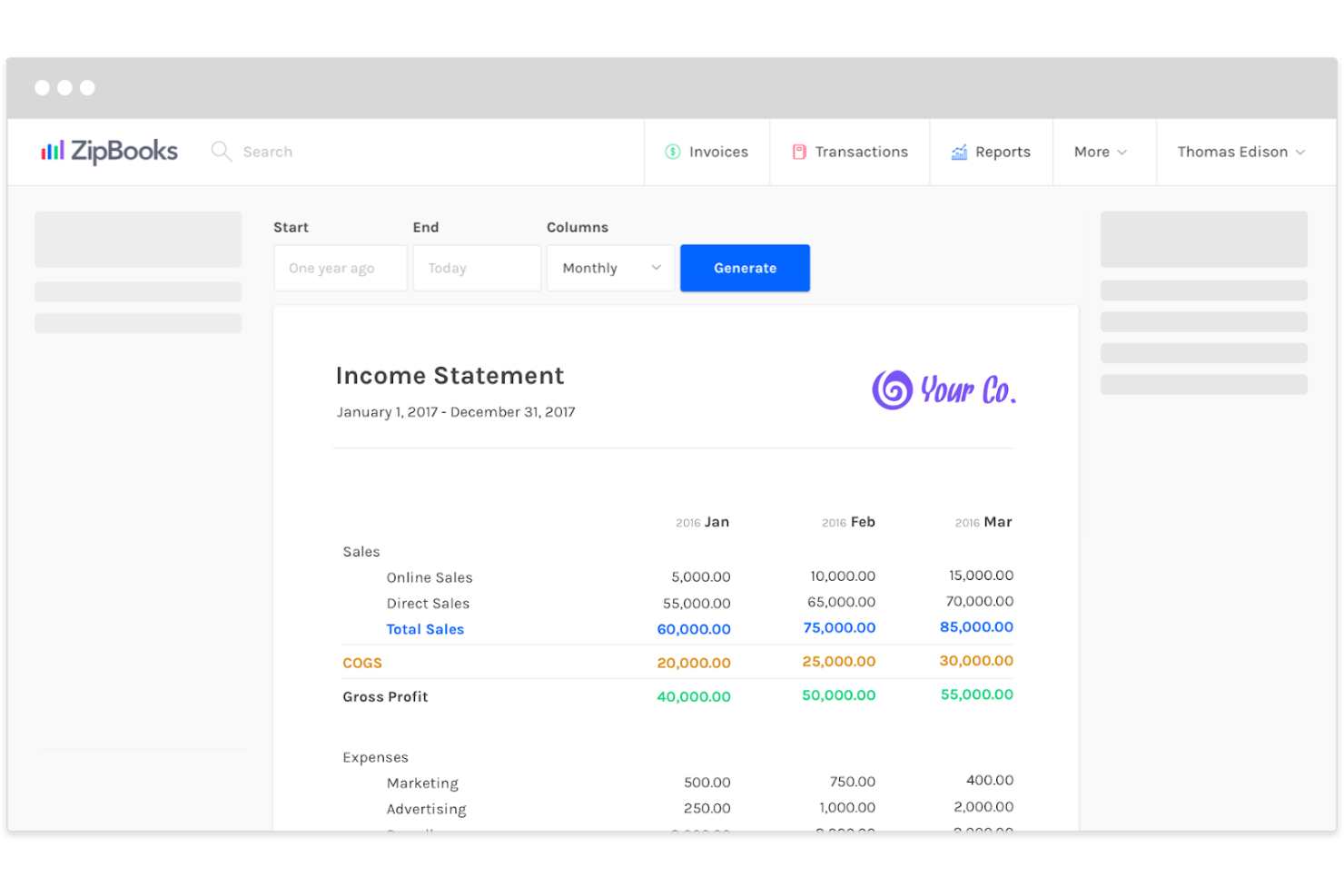
ZipBooks is an online accounting platform for small businesses that handles invoicing, expense tracking, bank reconciliation, time tracking, and third-party payroll integrations.
Who Is ZipBooks Best For?
ZipBooks is a good fit for small business owners and freelancers who need straightforward accounting tools without a steep learning curve.
Why I Picked ZipBooks
ZipBooks earns its spot on my shortlist because its interface is genuinely one of the cleanest I've seen in small business accounting software. I particularly like the single transactions interface, which lets you view, categorize, and reconcile everything in one place without jumping between screens. The auto-categorization feature does a lot of the heavy lifting too—ZipBooks learns from your transaction history and tags expenses automatically, which cuts down on manual data entry during month-end close. The intuitive color-coding on reports also makes it easy to spot patterns at a glance, even if you're not a trained accountant.
ZipBooks Key Features
- Invoicing and billing: Create and send invoices, accept credit card payments, and set up recurring auto-bills with automated payment reminders.
- Bank Connect: Link your bank account or credit card so ZipBooks pulls in daily transactions and balances for reconciliation.
- Smart tagging: Tag transactions by customer, project, or location, then generate income statements filtered by those tags.
- Time tracking: Log time against projects and tasks, then pull tracked hours directly into a client invoice with one click.
ZipBooks Integrations
ZipBooks offers native integrations with PayPal, Square, Stripe, and Gusto. An API is available for custom integrations.
Pros and Cons
Pros:
- Smart expense tracking
- Efficient invoicing
- User-friendly interface
Cons:
- Steep learning curve
- Limited advanced features
Best for customizable accounting tools

Zoho Books is an accounting platform for small businesses that covers invoicing, expense tracking, bank reconciliation, payroll integration, and customizable workflows.
Who Is Zoho Books Best For?
Zoho Books is a strong fit for small business owners and accountants who want to tailor their accounting setup without relying on a developer.
Why I Picked Zoho Books
Zoho Books earns its spot on my shortlist because of how far its customization goes beyond surface-level branding. I particularly like the custom fields feature, which lets you add text boxes, dropdowns, checkboxes, and formula fields to any transaction record—and even set validation rules to catch bad data at entry. That's genuinely useful when your business tracks information that doesn't fit standard invoice or bill fields. I also use the custom workflow automation to trigger actions like sending payment reminders or updating fields based on specific conditions, without writing any code. On top of that, custom reporting tags let you slice financial reports by division, project, or cost center, which makes period-over-period analysis much more targeted.
Zoho Books Key Features
- Bank reconciliation: Automatically import bank transactions and use bank rules to categorize and match them against your records for faster month-end closing.
- Project budgeting and billing: Set cost and revenue budgets per project, log time against tasks, and invoice clients based on hours, tasks, or total cost.
- Audit trail: Track every transaction and change in a tamper-proof log that shows who did what and when across all records.
- 70+ built-in reports: Access pre-built reports covering sales, expenses, purchases, inventory, and taxes, all updated in real time and ready to export or schedule.
Zoho Books Integrations
Zoho Books offers native integrations with Zoho Payroll, Zoho CRM, Zoho Inventory, Stripe, PayPal, Square, Braintree, G Suite, Office 365, and Avalara. An API is available for custom integrations.
Pros and Cons
Pros:
- Multi-language invoicing
- Customized workflows
- Built-in client portal
Cons:
- Lack of fixed asset management
- Restricted offline access

Kashoo
Best for simplicity and automation

Kashoo is an online accounting platform for small businesses that covers invoicing, expense tracking, bank reconciliation, and basic financial reporting.
Who Is Kashoo Best For?
Kashoo is a good fit for small business owners and sole proprietors who want straightforward bookkeeping without a steep learning curve.
Why I Picked Kashoo
Kashoo earns its spot on my shortlist because of how much manual bookkeeping work it eliminates through automation. I like that it auto-imports bank transactions from 5,000+ banks and credit unions in real time, so I'm not spending time on manual data entry at the end of each week. The payroll integration means I can connect payroll data directly to my books without juggling separate exports. I also find the receipt upload feature useful for keeping expense records clean without a separate workflow.
Kashoo Key Features
- Invoice creation and payment collection: Create and send invoices to clients, then accept payments directly from those invoices via Stripe.
- Sales tax tracking: Track sales tax across transactions without needing a separate tool or manual calculations.
- Multi-currency support: Record and manage transactions in multiple currencies, useful for small businesses with international clients.
- Double-entry ledger: Maintain accurate books using a double-entry accounting system that keeps your financial records audit-ready.
Kashoo Integrations
Integrations include Square, Stripe, and more.
Pros and Cons
Pros:
- Multi-currency support
- User-friendly interface
- Automated accounting
Cons:
- Limited international support
- Limited advanced features

KashFlow
Best for customizable and integrated financial management

KashFlow is a cloud-based accounting and payroll platform for small businesses that brings together bookkeeping, invoicing, VAT management, and integrated payroll in one system.
Who Is KashFlow Best For?
KashFlow is a good fit for UK-based small business owners who need straightforward accounting and payroll tools without a steep learning curve.
Why I Picked KashFlow
KashFlow earns its spot on my shortlist because of how well it ties accounting and payroll together in one place, without forcing you to juggle separate platforms. I particularly like the customizable invoicing—you can add your own logo and branding, convert quotes to invoices in one click, and set up automatic payment reminders. That kind of flexibility matters when you're running a small business and need your financial documents to reflect your brand. The customizable dashboard also lets me keep the metrics I actually care about front and center, rather than wading through data that isn't relevant to my business.
KashFlow Key Features
- VAT return submission: Connect directly to HMRC to file VAT returns without leaving the platform, keeping you compliant with Making Tax Digital requirements.
- Bank feeds: Link multiple bank accounts to pull in transaction data automatically and reconcile payments in real time.
- Payroll management: Run HMRC-accredited payroll, manage employee payslips, and handle workplace pension contributions from one place.
- Purchases and expenses tracking: Create and email purchase invoices to suppliers, set up recurring purchases, and log expenses and receipts on the go.
KashFlow Integrations
KashFlow offers native integrations with PayPal, GoCardless, HMRC, and Barclays, and provides an API for custom integrations.
Pros and Cons
Pros:
- Comprehensive payroll features
- VAT compliant
- In-depth reporting
Cons:
- Steep learning curve for new users
- Limited mobile functionality

MYOB
Best for scalable business solutions

MYOB is an accounting and payroll platform for small businesses that combines invoicing, expense tracking, payroll processing, and employee management in one system.
Who Is MYOB Best For?
MYOB is a strong fit for small to medium-sized businesses in Australia and New Zealand that need accounting and payroll tools that can grow with them.
Why I Picked MYOB
MYOB earns its spot on my shortlist because it's one of the few accounting and payroll platforms that scales with your business rather than forcing you to switch tools as you grow. I like that you can start on the Lite plan with payroll for up to two employees and move up to Pro or Plus as your headcount and complexity increase—adding features like timesheets, rosters, and unlimited inventory without migrating to a new system. The built-in Single Touch Payroll reporting sends data directly to the ATO at the end of each pay cycle, which reduces the compliance burden for small business owners. When a business outgrows the SMB plans entirely, MYOB Acumatica is available as a full ERP upgrade path, keeping everything within the same ecosystem.
MYOB Key Features
- Bank feeds: Pull transactions from connected bank accounts into MYOB for real-time income and expense tracking.
- GST tracking and BAS lodgment: Calculate GST and prepare and lodge your BAS with the ATO from within the platform.
- Job and project tracking: Track income, expenses, and profit and loss across individual jobs from quote to final invoice.
- Inventory management: Monitor stock levels in real time, get low-stock alerts, and generate reorder reports to avoid running out.
MYOB Integrations
MYOB offers native integrations with major Australian and New Zealand banks, Shopify, Square, PayPal, and WooCommerce, and provides an API for custom integrations.
Pros and Cons
Pros:
- Award-winning software
- Comprehensive features
- Scalable solutions
Cons:
- Limited multi-currency support
- Complex setup
Other Accounting Software With Payroll for Small Businesses
Here are a few more accounting software with payroll for small businesses that almost made my top 10. They didn’t quite make the final cut, but they’re still solid options and definitely worth a closer look!
- Patriot
For affordability and value
- AccountEdge
For desktop accounting
- Heard
For tax-ready accounting support
- ADP Workforce Now
For comprehensive HR and online payroll features
- QuickBooks
For integration with other financial tools
- Sage Accounting
For scalability for growing businesses
- Unanet
For project-based accounting and payroll
- Odoo
For customization options for various industries


How I Evaluate Accounting Software With Payroll for Small Business
I split my evaluation into two layers: the baseline accounting and payroll functions a small business or their bookkeeper relies on to close the books and pay employees, then the differentiators that separate the strongest tools.
Core Functionality (Table Stakes For This List)
When I'm selecting tools for my list, I rank each one on a scale from 0 (does not offer the functionality) to 5 (excels in this area) for each core functionality listed below. Then, I calculate the tool's total score into a percentage. Each tool needs to achieve a minimum total score of 65% to be considered for inclusion.
- General Ledger Accounting: I check for true double-entry bookkeeping with a proper chart of accounts, journal entries, and the ability to generate standard financial statements like P&L and balance sheets.
- Integrated Payroll Processing: The tool should include native payroll, not just a third-party add-on. I look for the ability to run full pay cycles with wage calculations, withholdings, and deductions built in.
- Payroll Tax Compliance: I evaluate whether the platform handles tax calculations, filings, and remittances automatically, plus year-end form generation for W-2s and 1099s.
- Accounts Payable & Receivable: Creating invoices, tracking what clients owe, and managing bills to vendors are daily tasks for small businesses. I look at how well each tool handles both sides.
- Bank Feeds & Reconciliation: Connecting bank and credit card accounts to auto-import transactions saves hours of manual data entry. I check how each tool matches and categorizes those transactions against the ledger.
- Employee & Contractor Payments: Small businesses often pay a mix of salaried staff and freelancers. I look for direct deposit support for both W-2 employees and 1099 contractors, along with onboarding and self-service options.
Once I have a list of tools that meet the criteria, I consider what sets each platform apart.
Differentiating Factors (What Sets Vendors Apart)
Here's how I compare and contrast different vendors:
Standout Features
Multi-state payroll matters once a small business hires its first remote worker in a different jurisdiction. I check whether a tool handles new-state registration and jurisdiction-specific taxes automatically. Benefits administration is another differentiator—platforms like Gusto and QuickBooks Payroll that bundle health insurance and retirement plan management with payroll deductions save owners from juggling separate brokers. I also look for built-in time tracking that feeds directly into pay runs, which cuts manual entry for businesses with hourly staff.
Beyond Features
Pricing transparency is a big one—I evaluate whether payroll is bundled or sold as a separate add-on, since per-employee fees can add up fast for growing teams. Accountant collaboration features also matter. Tools like Xero and QuickBooks offer dedicated advisor portals where your bookkeeper or CPA can access your books with their own login, which makes year-end handoffs much cleaner. I also consider how well a platform supports mid-year migration, since many small businesses switch tools partway through a fiscal year and need prior payroll data imported correctly.
How to Choose Accounting Software With Payroll for Small Businesses
It’s super easy to get lost in endless feature lists and confusing pricing. To keep things simple while you figure out what’s right for your business, here’s a quick checklist to help you stay on track:
| Factor | What to Consider |
|---|---|
| Scalability | Ensure the software can grow with your business, as you shift from a small company to a midsize organization. Look for options that allow you to add users and features as your needs increase. |
| Integrations | Check if the software integrates with tools you already use, like CRM or inventory management systems, to streamline processes. |
| Customizability | Choose a solution that allows you to tailor reports and dashboards to fit your business needs, ensuring relevant data is at your fingertips. |
| Ease of Use | Opt for user-friendly interfaces that make it simple for you and your team to manage payroll and accounting tasks without extensive training. |
| Budget | Compare pricing plans and ensure there are no hidden fees. Consider the total cost of ownership, including setup and ongoing support. |
| Security Safeguards | Verify that the software provides robust security measures like encryption and two-factor authentication to protect your financial data. |
| Customer Support | Look for solutions offering reliable customer service through various channels, ensuring you get help when needed. |
| Reporting Features | Ensure the software provides comprehensive reporting capabilities, allowing you to easily generate financial statements and payroll summaries. |
Trends in Accounting Software With Payroll for Small Business
I’ve been keeping an eye on trends in accounting software with payroll for small businesses, and a few things really stood out. After digging through tons of product updates, release notes, and announcements, I pulled together the biggest takeaways—and what they might mean going forward.
- Cloud-Based Solutions: Cloud payroll systems are a game changer for small businesses. They’re flexible, easy to scale, and let you manage wages without needing fancy hardware. Plus, when your payroll is connected with your accounting and HR tools, everything flows smoother—less manual entry, fewer mistakes, and more time back in your day.
- Mobile Applications: More business owners are turning to mobile apps to handle HR and payroll on the go. It just makes life easier. Whether you're approving timesheets or running payroll from your phone, it gives you the freedom to work from anywhere—and teams love the convenience too.
- Integrated Systems: Payroll tools that are fully integrated with HR and accounting are on the rise. This is because having everything in one place keeps things simple, streamlines processes, saves time, and helps make sure you’re staying on top of compliance without bouncing between systems.
- Automation and AI: Smart software is getting even smarter. With automation and AI, routine tasks like data entry or reconciling transactions can be handled for you. That means fewer errors and more time to focus on the parts of your business that really need your attention.
- Compliance and Security: Keeping up with tax rules and labor laws is a job on its own—but your payroll software can help with that. The right tool will stay updated for you and keep your data safe, so you can focus on running your business without worrying about compliance headaches or data risks.
What Is Accounting Software With Payroll for Small Businesses?
Accounting software with payroll for small businesses helps manage financial transactions and payroll processes, enabling small business owners and accountants to track income and expenses, generate financial reports, and ensure timely and accurate employee payments.
Typically, this software includes components such as a general ledger, accounts payable, accounts receivable, payroll processing, and tax compliance. These features allow users to maintain precise financial records, automate payroll calculations, and comply with tax regulations efficiently.
Features of Accounting Software With Payroll for Small Businesses
Picking the right accounting software with payroll for small businesses can make your life way easier—saving time, keeping things compliant, and helping everything run smoother. Here are a few key features to keep an eye out for:
- Core Accounting Functions: Core accounting functions include recording transactions, managing the general ledger, and generating financial statements. These are essential for tracking revenue, expenses, and cash flow, ensuring the financial health of your business.
- Payroll Management: Payroll management automates payroll calculations, tax withholdings, and benefits. It ensures timely and accurate payment to employees, which is vital for maintaining employee satisfaction and compliance with tax laws.
- Budgeting and Forecasting: Budgeting and forecasting tools help businesses create financial plans based on historical and real-time data. This feature is important for tracking performance against budgets and making informed financial decisions.
- Billing and Invoicing: Automated billing and invoicing streamline the process of generating invoices and tracking payments. This feature helps maintain cash flow and reduces the time spent on manual billing tasks.
- Project Accounting: Project accounting allows businesses to track revenue and expenses on a project basis. This is particularly useful for businesses that undertake project-based work, ensuring accurate financial tracking and billing.
- Asset Tracking: Asset tracking manages the value and details of long-term and short-term assets. This feature is essential for maintaining accurate records of asset values, depreciation, and inventory levels.
- Reporting and Analytics: Advanced reporting and analytics provide real-time insights into financial performance. Customizable dashboards and reports help businesses monitor key metrics and make data-driven decisions.
- Mobile Support: Mobile support allows access to financial data from anywhere, ensuring that employees can manage workflows on the go. This feature is particularly useful for businesses with remote or mobile workforces.
- Tax Management: Tax management automates complex tax calculations and ensures compliance with local, national, and global tax requirements. This feature reduces the risk of errors and penalties associated with tax filings.
- Integration: Integration with other business applications, such as ERP systems and CRM software, ensures seamless data flow across the organization. This feature enhances efficiency and reduces the likelihood of data-entry errors.
Benefits of Accounting Software With Payroll for Small Businesses
When you're picking accounting software with payroll for small businesses, you want something that makes life easier—not more complicated. Here are some of the biggest perks for small business owners:
- Time Savings: Automating payroll processes reduces the time spent on manual calculations and data entry, allowing business owners to focus on other critical tasks.
- Accuracy: The software minimizes human errors in payroll calculations, ensuring employees are paid correctly and on time, which helps maintain employee satisfaction and compliance with tax regulations.
- Cost Efficiency: By reducing the need for external payroll services or additional staff, businesses can save money and allocate resources more effectively.
- Compliance: The software helps ensure that payroll processes adhere to the latest tax laws and regulations, reducing the risk of costly penalties and audits.
- Data Integration: Seamless integration with other accounting functions provides a holistic view of the business’s financial health, aiding in better decision-making and financial planning.
Costs & Pricing of Accounting Software With Payroll for Small Businesses
Choosing an accounting software with payroll for small businesses? Prices and features can vary a lot. Here’s a quick table to help you compare plan types, average costs, and what you typically get with each.
Plan Comparison Table for Accounting Software With Payroll for Small Businesses
| Plan Type | Average Price | Common Features |
|---|---|---|
| Free Plan | $0 | Basic invoicing, limited transactions, and community support. |
| Personal Plan | $5-$25/user/month | Basic payroll processing, tax calculation, and email support. |
| Business Plan | $25-$50/user/month | Advanced reporting, multiple user access, priority support, and integrations. |
| Enterprise Plan | Custom pricing | Custom workflows, dedicated account manager, enhanced security, and compliance. |
Accounting Software With Payroll for Small Businesses FAQs
Here are some commonly asked questions about accounting software with payroll for small business:
How do I integrate my accounting software with my payroll system?
Integrating your accounting software with your payroll system typically involves using built-in integration features or third-party connectors. Most modern accounting software solutions offer direct integration with popular payroll services. You will need to follow the specific instructions provided by your software vendor, which usually involves setting up API keys or using pre-built connectors. Ensure that both systems are compatible and that you regularly sync data to avoid discrepancies.
What are the tax compliance features available in accounting software with payroll?
Accounting software with payroll often includes tax compliance features such as automatic tax calculations, electronic tax filing, and updates on tax law changes. These features help ensure that your payroll processes adhere to federal, state, and local tax regulations. Some software also provides alerts for upcoming tax deadlines and generates necessary tax forms like W-2s and 1099s.
How do I handle payroll for remote employees using accounting software?
Handling payroll for remote employees involves ensuring that your accounting software can manage multi-state payroll and comply with varying state tax laws. You will need to set up the correct tax jurisdictions for each remote employee and ensure that your software can handle different state tax withholdings. Additionally, consider using direct deposit features to streamline payments to remote employees.
Is it possible to manage employee benefits through accounting software with payroll?
Yes, many accounting software solutions with payroll capabilities allow you to manage employee benefits. This includes tracking health insurance, retirement plans, and other benefits. You can usually set up benefit plans within the software, assign them to employees, and manage contributions and deductions. Some software also integrates with benefits providers to streamline administration.
How secure is my payroll data in accounting software?
Payroll data security is a critical concern, and most reputable accounting software providers implement robust security measures. These measures typically include data encryption, secure user authentication, regular security audits, and compliance with data protection regulations like GDPR or CCPA. Always ensure that your software provider follows industry best practices for data security and consider additional measures like two-factor authentication.
What support options are available if I encounter issues with payroll in my accounting software?
Support options vary by software provider but typically include online resources like FAQs, user guides, and video tutorials. Many providers also offer customer support through email, phone, or live chat. Some may provide dedicated account managers or premium support plans for more personalized assistance. Check your software’s support section to understand the available options and response times.