

An employer of record for Brazil is a third-party service that hires employees on your behalf and manages all aspects of Brazilian employment law, payroll, and compliance, so you don’t have to set up your own local entity or risk missteps with CLT and CBA rules. If you’re a finance leader trying to expand or support hiring in Brazil, choosing the right EOR can make or break your control over employer costs, minimize currency risks, and ensure every payroll is audit-ready.
This list shows you which EOR providers are equipped to deliver the compliance, payroll integration, and transparency your business needs to scale in Brazil without headaches.
Why Trust Our Software Recommendations
6,700+
Reviews
20
Industry experts
16+
Evaluation factors
14
Years
Our team has been testing and reviewing software since 2012. As finance leaders ourselves, we know how difficult—and important—it is to choose the right software.
For this guide, we evaluated tools using hands-on testing and independent research, scoring tools using our selection criteria.
Our reviews reflect our human editorial judgment, not a sales pitch.
Employer of Record for Brazil Comparison Table
Compare pricing and key specs for my top employer of record services for Brazil in the table below.
| Tool | Best For | Trial Info | Price | ||
|---|---|---|---|---|---|
| 1 | Best for employer-cost transparency at scale | Free demo available | From $599/employee/month | Website | |
| 2 | Best for multi-model Brazil hiring on flat fees | Free demo available | From $199/employee/month | Website | |
| 3 | Best for no FX markups | Free demo available | From $199/user/month | Website | |
| 4 | Best for multi-currency payroll ERP exports | Free demo available | Pricing upon request | Website | |
| 5 | Best for contractor-to-CLT conversion risk coverage | Free demo available | From $199/user/month | Website | |
| 6 | Best for owned-entity Brazil hiring with ERP sync | Free demo available | From $599/user/month | Website | |
| 7 | Best for flat-rate BRL hiring with CCT monitoring | Free demo available | From $399/user/month | Website | |
| 8 | Best for AI-driven Brazil payroll cost analytics | Free demo available | From $599/user/month | Website | |
| 9 | Best for hiring with ESOP across borders | Free demo available | From $459/user/month (billed annually) | Website | |
| 10 | Best for GL-ready payroll across ERPs | Free demo available | From $399/employee/month | Website |


Best Employer of Record for Brazil Reviews
Below are my detailed summaries of the best employer of record for Brazil that made it onto my shortlist. My reviews offer a detailed look at the features, capabilities, and integrations of each platform to help you find the best one for you.
 Best for employer-cost transparency at scale
- Free demo available
- From $599/employee/month
Visit WebsiteCustomer Rating:4.9/5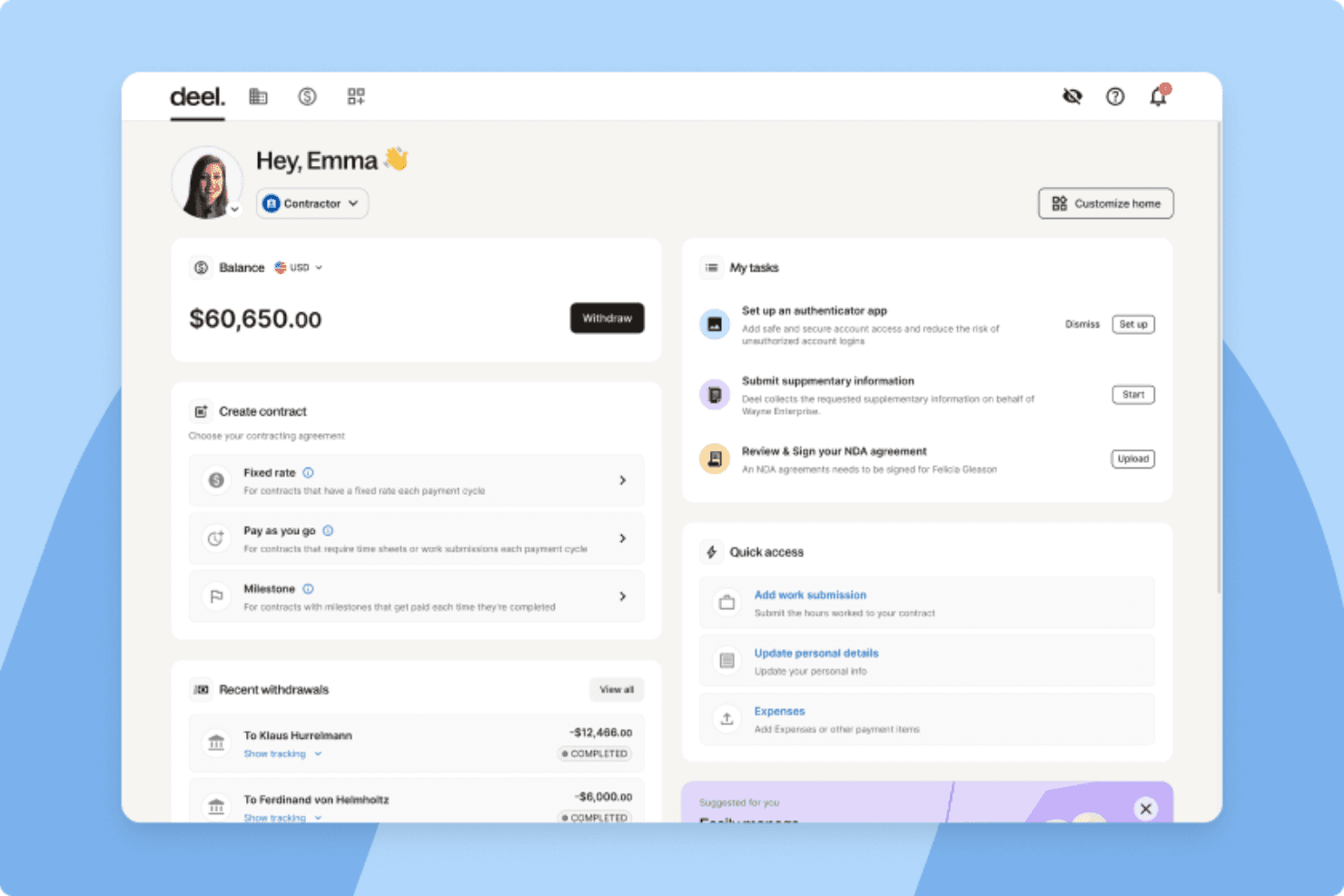
Deel lets contractors manage payments, contracts, and tasks in one dashboard. Deel Hire is an employer of record platform that lets you hire full-time employees in Brazil and 130+ other countries, handling CLT contracts, BRL payroll, eSocial filings, and statutory benefits administration through Deel's own CNPJ-registered entity in São Paulo.
Who Is Deel Hire Best For?
Deel Hire is a strong fit for finance and people operations teams at multinational companies that need full employer-cost visibility across Brazil and multiple other countries on a single platform.
Why I Picked Deel Hire
I've included Deel Hire in my top picks because it's one of the few EOR platforms that publishes a full employer-cost breakdown for Brazil—showing the ~35.9% statutory burden (INSS, FGTS, RAT, Sistema S, meal vouchers) directly on its hiring page, which makes budgeting across a multi-country headcount plan far more predictable. Deel owns its CNPJ-registered entity in São Paulo, so there's no partner network involved, and its native eSocial integration handles event transmission for admissions, payroll runs, and terminations automatically.
Deel Hire Key Features
- CLT contract generation: Deel issues employment contracts in Portuguese that include all mandatory CLT provisions—probationary periods, notice periods, vacation accrual, and IP assignment clauses.
- Pay equity reporting: Automated biannual gender pay gap reports support compliance with Brazil's Equal Salary Law (Lei 14.611/2023) for companies with 100+ employees.
- GL sync with cost-center mapping: A dedicated plugin syncs payroll data as journal entries to NetSuite, SAP, QuickBooks, Xero, Sage, and Microsoft Dynamics Finance, with department and project allocations.
- Foreign national onboarding: Deel collects Residence Visa and RNE card documentation and processes eSocial admission events for non-Brazilian hires working in-country.
Deel Hire Integrations
Deel Hire offers documented integrations with NetSuite, SAP, Microsoft Dynamics Finance, QuickBooks, Xero, Sage, Workday, HiBob, and BambooHR. Its API supports custom HRIS, ERP, and finance integrations.
Pros and Cons
Pros:
- Native eSocial payroll and event integration
- Publishes full statutory employer cost breakdown
- Owned Brazilian entity with local data storage
Cons:
- Limited detail on automated CCT compliance tracking
- Customer support delays on complex Brazil cases
Learn more about Deel Hire: Best for multi-model Brazil hiring on flat fees
- Free demo available
- From $199/employee/month
Visit WebsiteCustomer Rating:4.7/5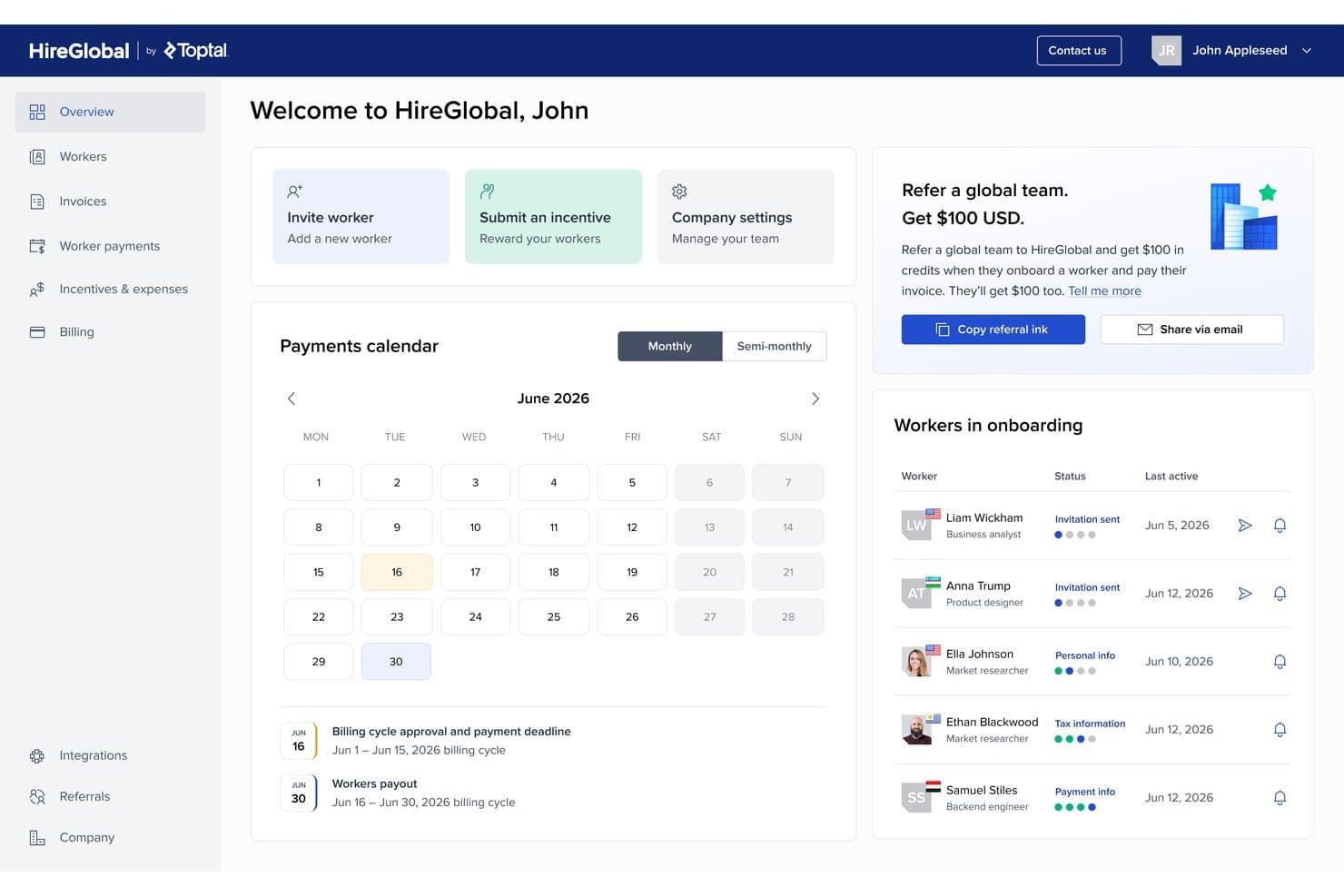
HireGlobal's dashboard tracks worker onboarding and global payroll deadlines. HireGlobal is a multi-model employer of record platform, built by Toptal, that covers contractor management, agent of record, and full EOR hiring across 180+ countries, including Brazil.
Who Is HireGlobal Best For?
HireGlobal suits companies that want to hire in Brazil across multiple worker types—contractors, AOR, and full EOR employees—under one flat-fee contract.
Why I Picked HireGlobal
I've included HireGlobal in my top picks because it lets you bring on Brazilian workers across contractor, AOR, and full CLT employment models under one contract and one monthly invoice. The flat $399-per-worker EOR fee covers payroll, taxes, and statutory benefits, with no setup costs or currency markups billed on top. I particularly like that switching a worker from a contractor arrangement to full CLT employment doesn't require a separate vendor relationship or contract renegotiation.
HireGlobal Key Features
- Multi-model hiring platform: Manage contractors, AOR, Virtual EOR, and full CLT employees under one contract and a single monthly invoice.
- $1M indemnification cover: Virtual EOR workers include per-worker legal indemnification and dedicated legal support.
- LexisNexis and Veriff identity checks: KYC verification and optional background screening are built into the worker onboarding flow.
- SOC 2 Type 1 and Type 2 certification: Data is protected with AES-256 encryption and optional isolated virtual environments per client.
HireGlobal Integrations
HireGlobal's native integrations are not clearly documented. A third-party review lists Workday, BambooHR, Rippling, Gusto, Slack, Jira, TopTracker, Claude, and ChatGPT, plus an API for custom integrations; no ERP or accounting connectors are confirmed.
Pros and Cons
Pros:
- Offers indemnification and dedicated legal support
- Includes Brazil-specific statutory payroll guidance
- Supports contractors, AOR, and CLT employees
Cons:
- Omits documented eSocial and holerite workflows
- Relies on partner entities in Brazil
Learn more about HireGlobal:
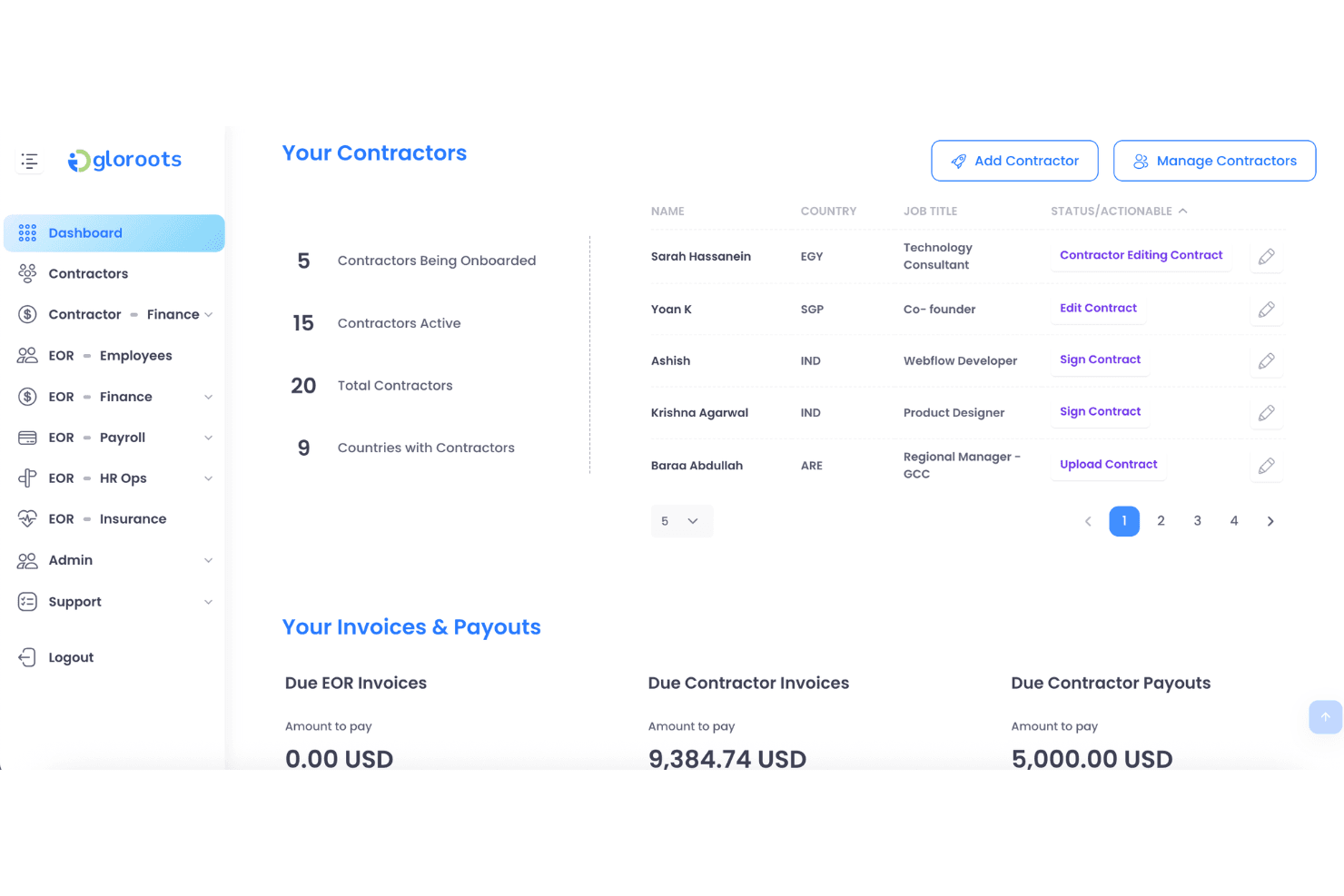
Gloroots lets users manage contractors and track invoices in one dashboard. Gloroots is an employer of record platform covering 150+ countries, including Brazil, that handles CLT-compliant employment contracts, local payroll, statutory benefits, and eSocial filings on behalf of companies hiring without a local entity.
Who Is Gloroots Best For?
Gloroots is a strong fit for cost-conscious finance teams hiring in Brazil who need flat-fee, FX-transparent payroll without percentage-of-salary pricing surprises.
Why I Picked Gloroots
I've included Gloroots in my top picks because its no-FX-markup policy is the most finance-friendly pricing structure I've seen in Brazil EOR. When Gloroots invoices you in BRL, the rate reflects live market FX with zero hidden spread, and each invoice itemizes the EOR management fee separately from statutory contributions like INSS, FGTS, and IRRF. That level of transparency makes month-end reconciliation genuinely cleaner, especially when you're managing a flat $199/employee/month fee rather than a percentage-of-salary model that balloons with senior hires.
Gloroots Key Features
- CLT contract lifecycle management: Gloroots issues Portuguese-language CLT-compliant contracts covering probation periods, overtime rules, notice periods, and protected employee categories from hire through offboarding.
- eSocial event filing: Admission events are registered within 48 hours of hire, with payroll events (S-1200 and S-1210) filed by the 15th of the following month.
- Statutory benefits administration: Gloroots administers vale-transporte, vale-refeição, 13th salary, 30-day paid leave with a 1/3 vacation bonus, and maternity and paternity leave under the Empresa Cidadã program.
- Misclassification risk calculator: A free self-service tool that helps you assess the reclassification risk of Brazilian PJ contractors before converting them to CLT employment.
Gloroots Integrations
Gloroots connects with Brazil’s eSocial, FGTS Digital, and CTPS systems for statutory filings and registrations. Native HRIS and ERP integrations, including QuickBooks, Xero, NetSuite, and Workday, aren’t publicly documented, and API availability is unclear.
Pros and Cons
Pros:
- Fast, bilingual onboarding and CLT contract handling
- Transparent, itemized invoice breakdowns for audits
- Flat-fee model for predictable payroll budgeting
Cons:
- No confirmed ERP or HRIS system integrations
- Entity ownership structure not explicitly disclosed
Learn more about Gloroots: Best for multi-currency payroll ERP exports
- Free demo available
- Pricing upon request
Visit WebsiteCustomer Rating:4.8/5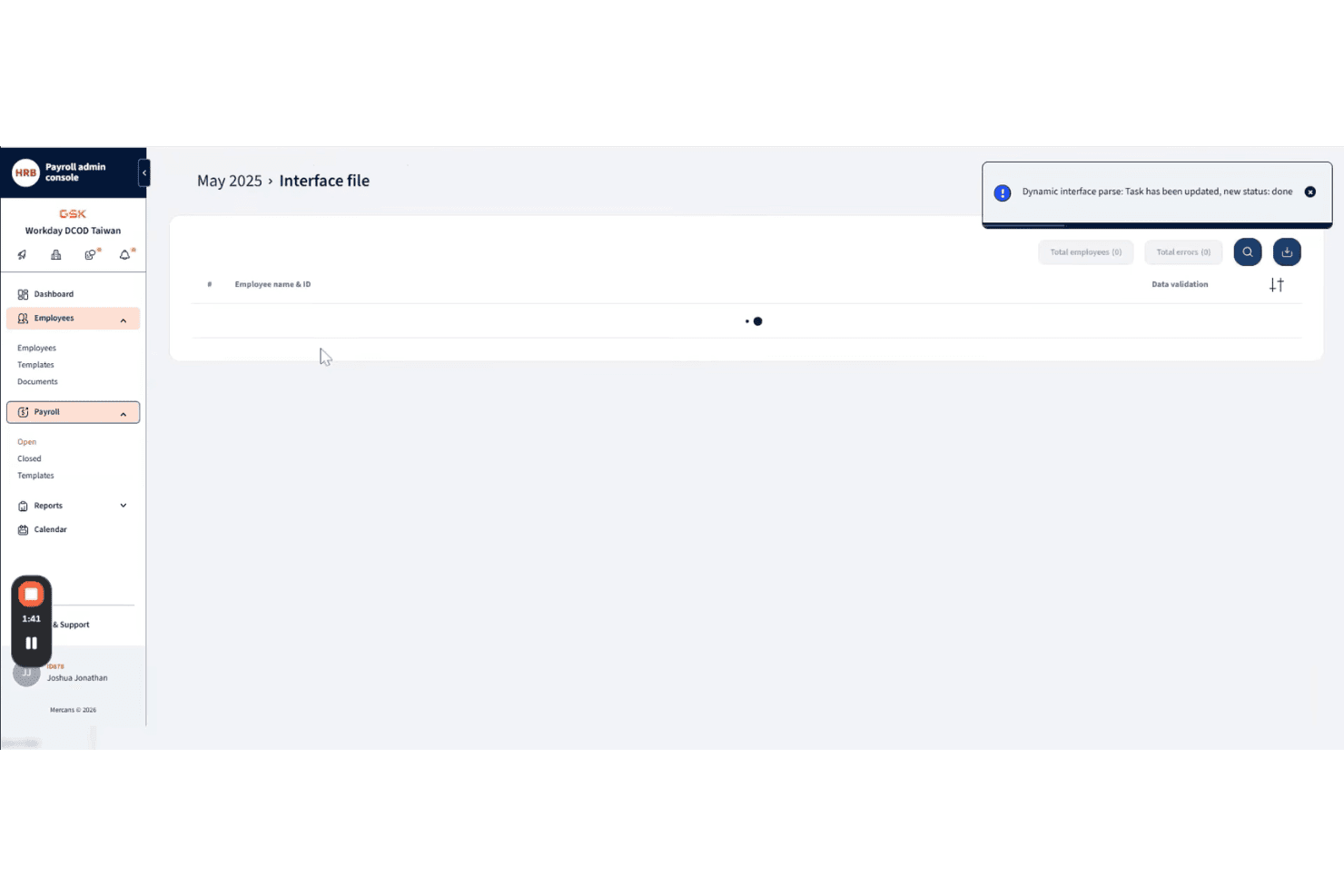
Mercans lets users parse and validate dynamic payroll interface files. Mercans is an employer of record platform with an owned legal entity in Brazil that handles CLT-compliant employment contracts, BRL payroll, statutory filings, and multi-currency ERP-integrated reporting across 52 countries.
Who Is Mercans Best For?
Mercans is a strong fit for enterprise finance teams managing multi-country payroll who need consolidated GL-ready reporting and ERP-integrated exports alongside Brazil employment.
Why I Picked Mercans
Mercans earns its spot on my shortlist because of how it handles multi-currency payroll reporting for finance teams running Brazil alongside other markets. I like that the HR Blizz platform consolidates payroll across countries into a single GL-ready invoice in any of 103 currencies, which cuts real complexity from month-end close when you're reconciling BRL against USD or EUR in the same cycle. The pre-built bi-directional connectors for Oracle, SAP, and Workday push payslips and statutory reports back into your ERP post-processing, so your general ledger stays current without manual exports.
Mercans Key Features
- Zero Aggregator Model: Mercans owns its Brazilian legal entity directly, so your employment contracts and statutory filings run through in-country staff rather than a third-party partner.
- Multi-user approval workflows: HR Blizz supports configurable approval chains for payroll runs, letting multiple stakeholders review and sign off before processing.
- Work visa and immigration support: Mercans manages labor authorization and residence permits for employees relocating to Brazil, valid for up to two years.
- ISO 27001 and SOC 1 & 2 certification: The platform holds independently verified security and data integrity certifications relevant to finance teams with audit and controls requirements.
Mercans Integrations
Mercans supports 100+ inbound and outbound integrations, including Oracle Cloud HCM, SAP SuccessFactors, Workday, UKG Pro, BambooHR, and Bullhorn. It also offers a custom API for bespoke HR, payroll, and finance connections.
Pros and Cons
Pros:
- Bi-directional ERP data sync for finance
- Multi-currency GL-ready payroll exports
- Owns Brazilian legal entity directly
Cons:
- Onboarding timeline often exceeds stated 48 hours
- eSocial and CCT coverage not detailed
Learn more about Mercans: Best for contractor-to-CLT conversion risk coverage
- Free demo available
- From $199/user/month
Visit WebsiteCustomer Rating:5/5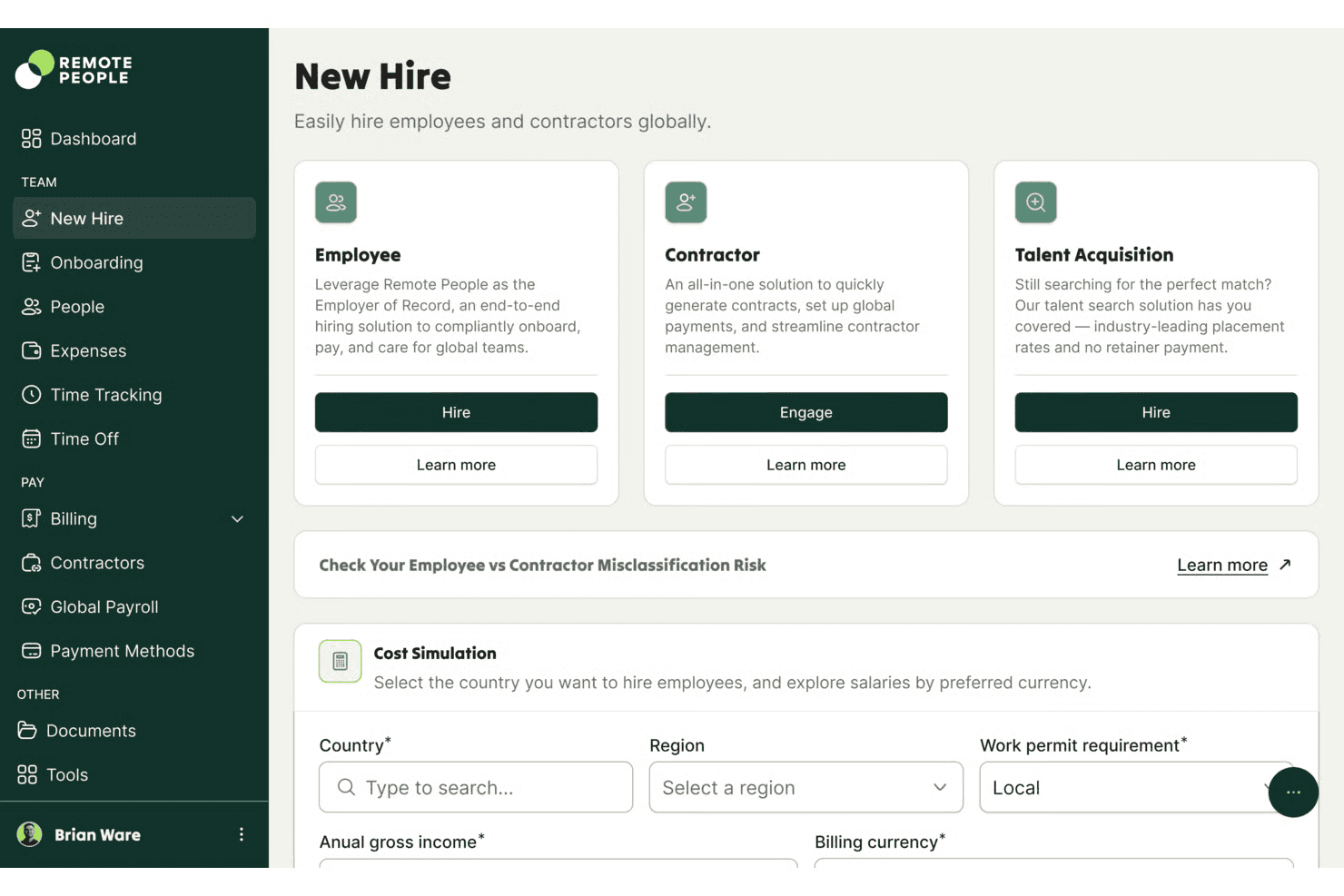
RemotePeople lets users hire employees or contractors globally from one dashboard. RemotePeople is an employer of record platform with owned legal entities in 150+ countries, including Brazil, that handles CLT-compliant employment contracts, BRL payroll, statutory benefits, eSocial filings, and contractor-to-employee conversion.
Who Is RemotePeople Best For?
RemotePeople is a strong fit for finance and HR teams converting Brazilian contractors to CLT employees and needing a provider that assumes full misclassification liability.
Why I Picked RemotePeople
I've included RemotePeople in my top picks because it's the only provider on this list that explicitly assumes full misclassification liability under its Contractor of Record model, which is a concrete legal commitment, not just a policy. When you're converting a PJ (pessoa jurídica) contractor to a CLT employee, RemotePeople's Contractor Compliance Assessor evaluates your existing arrangement and flags back-pay exposure across FGTS, INSS, and 13th salary, then transitions the worker into a CLT contract with eSocial admission events filed before day one.
RemotePeople Key Features
- AI Command Center: Initiate payroll runs, approve leave, and onboard employees using plain-English commands, with every output verified by a human expert before execution.
- Global Benefits add-on: Access locally benchmarked health, dental, vision, pension, and mental health plans for Brazilian employees, with broker support and annual renewals included.
- 70+ HRIS integrations: Connect RemotePeople directly to platforms like BambooHR, HiBob, SAP SuccessFactors, Rippling, and Personio to sync Brazilian employee data without manual re-entry.
- Real-time compliance monitoring: Receive automatic alerts when Brazilian labor laws change, keeping CLT contracts, eSocial filings, and CBA obligations current without manual tracking.
RemotePeople Integrations
RemotePeople supports 70+ integrations, including BambooHR, HiBob, SAP SuccessFactors, Rippling, Personio, ADP Workforce Now, and Gusto. It has no open API, and QuickBooks and Xero integrations are limited to US Payroll.
Pros and Cons
Pros:
- Provides CBA sector-level CLT contract coverage
- Onboards Brazilian employees in 48 hours
- Assumes full misclassification liability for contractors
Cons:
- Real-time eSocial sync details not transparent
- No open API for custom finance tools
Learn more about RemotePeople: Best for owned-entity Brazil hiring with ERP sync
- Free demo available
- From $599/user/month
Visit WebsiteCustomer Rating:4.6/5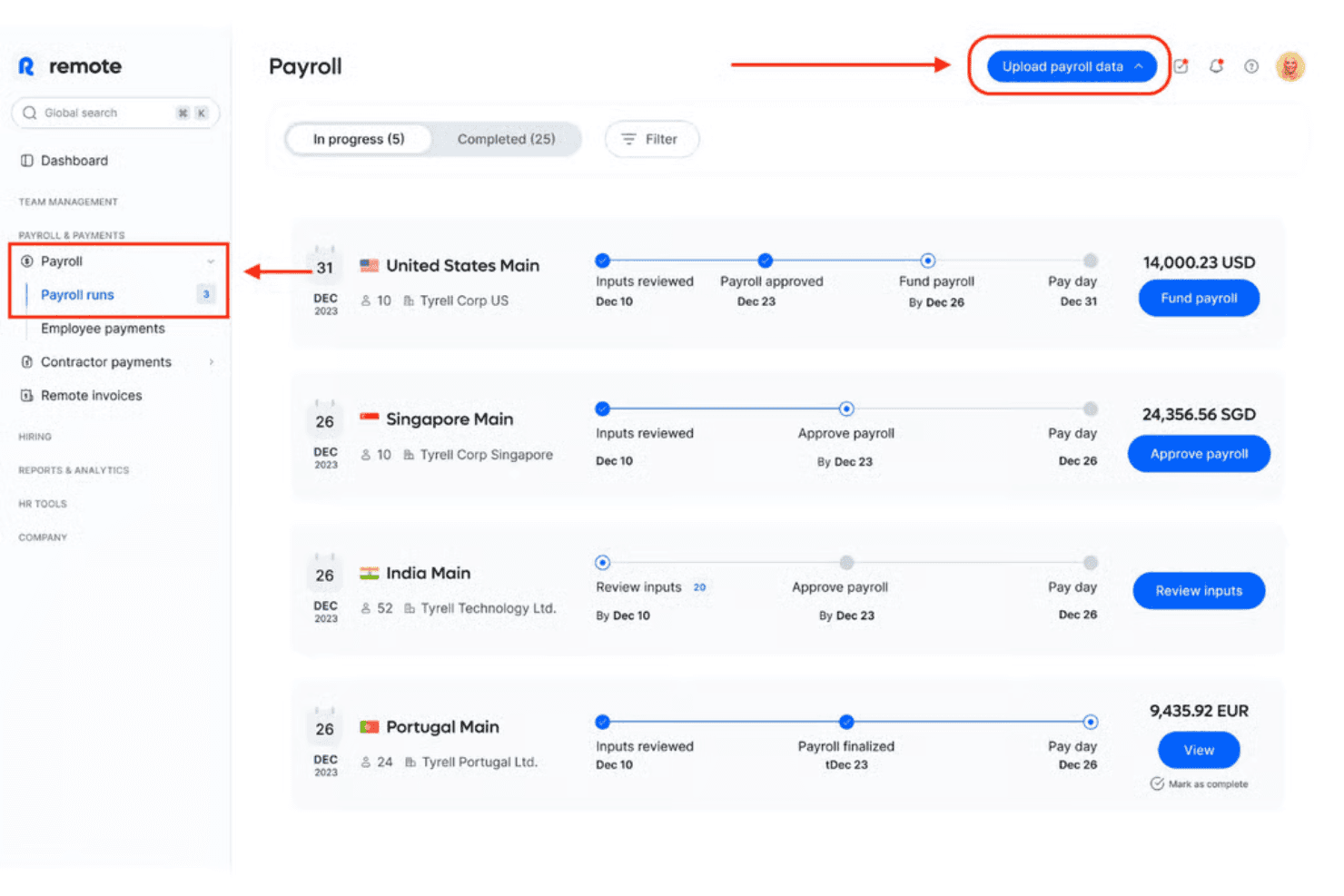
Remote centralizes multi-country payroll runs in one dashboard. Remote is an employer of record platform that lets you hire full-time employees in Brazil through its own local legal entity, handling CLT contracts, BRL payroll, statutory benefits, and contractor management.
Who Is Remote Best For?
Remote is a strong fit for finance-led teams that need predictable, flat-fee Brazil hiring costs with direct ERP integration into NetSuite, QuickBooks, or Xero.
Why I Picked Remote
Remote earns its spot on my shortlist because it operates through a 100% owned legal entity in Brazil, meaning no third-party partners sit between your employees and their CLT contracts, INSS filings, or FGTS contributions. I particularly like how its native NetSuite, QuickBooks, and Xero integrations push GL-ready payroll data directly into your accounting stack, which matters when you're reconciling BRL-denominated payroll against multi-currency invoices across billing currencies like USD or EUR. Its unlimited EOR indemnity coverage is also notable given Brazil's active labor courts (Justiça do Trabalho).
Remote Key Features
- Contractor of Record (COR): Remote directly engages and pays Brazilian contractors under its own entity, with uncapped indemnity coverage against misclassification risk.
- Compliance Watchtower: Monitors legal and regulatory changes across 90+ countries, including Brazil, flagging CLT and tax updates in real time.
- Tiered benefits administration: Remote manages multiple benefit tiers for Brazilian employees, including meal vouchers, CBA life insurance, health, dental, and mental health plans.
- E-signature workflows: Employment contracts in Portuguese are issued and signed digitally through the platform, with a dedicated onboarding specialist assigned to each hire.
Remote Integrations
Remote offers 40+ native integrations, including NetSuite, QuickBooks, Xero, Workday, BambooHR, HiBob, Personio, and Greenhouse. It also supports REST API, webhooks, Remote MCP, and Zapier for custom finance and HR data flows.
Pros and Cons
Pros:
- Unlimited indemnity coverage for worker misclassification
- Flat-fee predictability for Brazilian employment costs
- Owned-entity model ensures direct local compliance
Cons:
- Transportation vouchers missing from listed benefit administration
- eSocial reporting not explicitly described publicly
Learn more about Remote: Best for flat-rate BRL hiring with CCT monitoring
- Free demo available
- From $399/user/month
Visit WebsiteCustomer Rating:4.7/5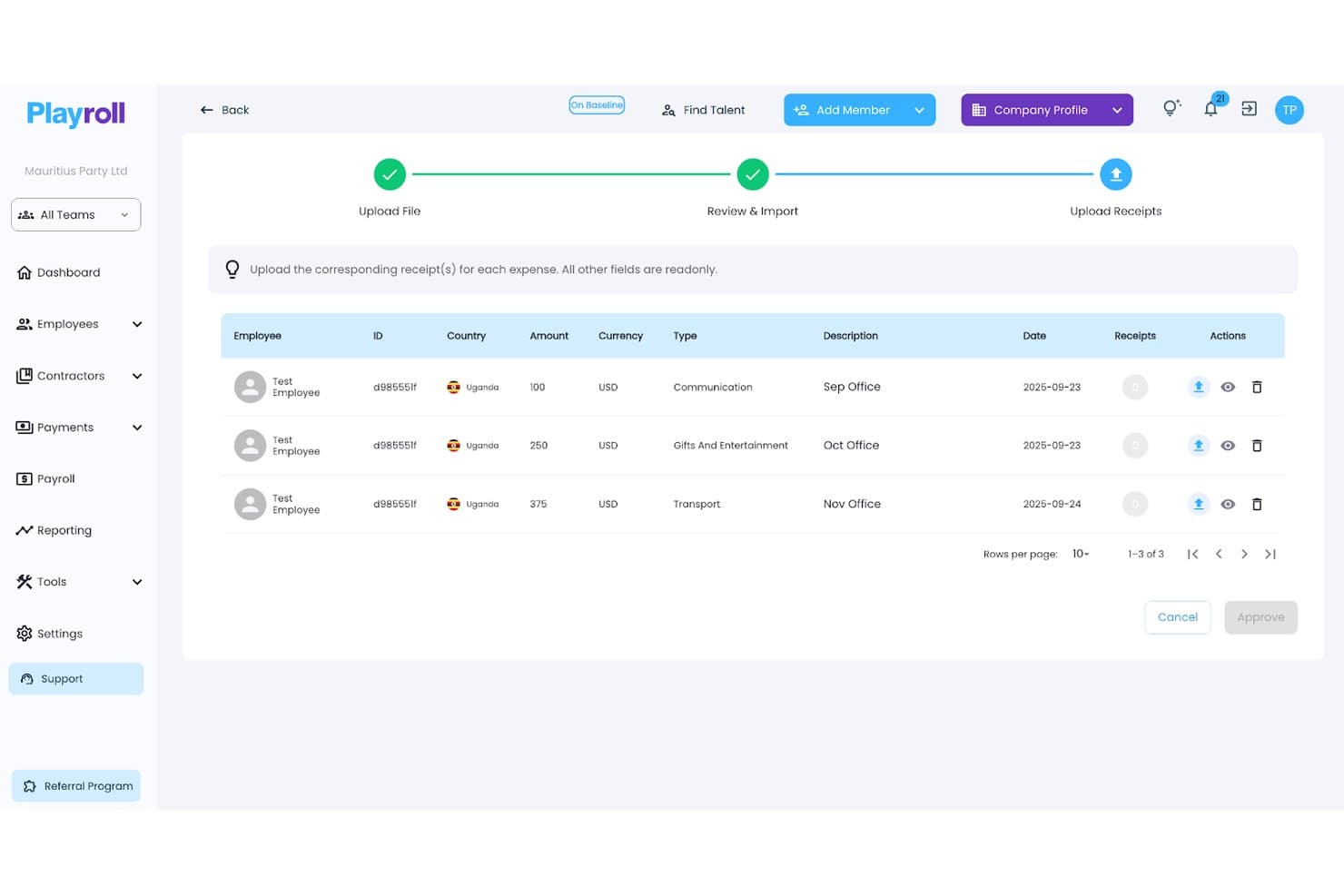
Playroll lets users upload receipts for bulk-imported expenses before approval. Playroll is an employer of record platform that handles CLT-compliant employment contracts, BRL payroll processing, eSocial filings, and collective bargaining agreement (CCT) monitoring for companies hiring in Brazil without a local entity.
Who Is Playroll Best For?
Playroll is a strong fit for finance teams at mid-sized companies that need predictable, flat-rate pricing and collective bargaining agreement monitoring when hiring in Brazil.
Why I Picked Playroll
Playroll earns its spot on my shortlist because of how it handles collective bargaining agreement (CCT) monitoring at the role-definition stage, flagging salary floor violations before a contract is even signed. I've found this particularly valuable in Brazil, where CCT violations carry retroactive liability and sector-specific wage floors vary by region. Paired with a flat $399/employee/month fee and itemized invoices that separate statutory costs from service fees, it gives finance teams real cost predictability on Brazilian hires.
Playroll Key Features
- CLT termination workflow automation: Playroll calculates and applies notice period escalation (30 days plus 3 days per year of service, capped at 90 days) and the 40% FGTS penalty on dismissals without just cause.
- PJ-to-CLT misclassification audit tool: A built-in assessment tool reviews contractor arrangements for misclassification risk and guides you through conversion to full CLT employment.
- Multi-currency invoicing with itemized cost breakdowns: Invoices separate statutory employer costs from the EOR service fee across 60+ currencies, with territory- and team-based breakdowns.
- eSocial and annual statutory filings: Playroll handles all eSocial event reporting alongside GFIP, DCTF, RAIS, and CAGED filings as part of the standard EOR service.
Playroll Integrations
Playroll offers native integrations with BambooHR and HiBob, plus partner integrations with Expensify, Jobbatical, and Veremark. It supports custom integrations through an API, but native ERP connectors for NetSuite, SAP, QuickBooks, and Xero aren't documented.
Pros and Cons
Pros:
- Built-in PJ-to-CLT misclassification audit
- Transparent invoicing with statutory cost breakdowns
- Flags salary floor compliance at contract stage
Cons:
- No published native ERP system connectors
- Onboarding process may take up to 15 days
Learn more about Playroll: Best for AI-driven Brazil payroll cost analytics
- Free demo available
- From $599/user/month
Visit WebsiteCustomer Rating:4.6/5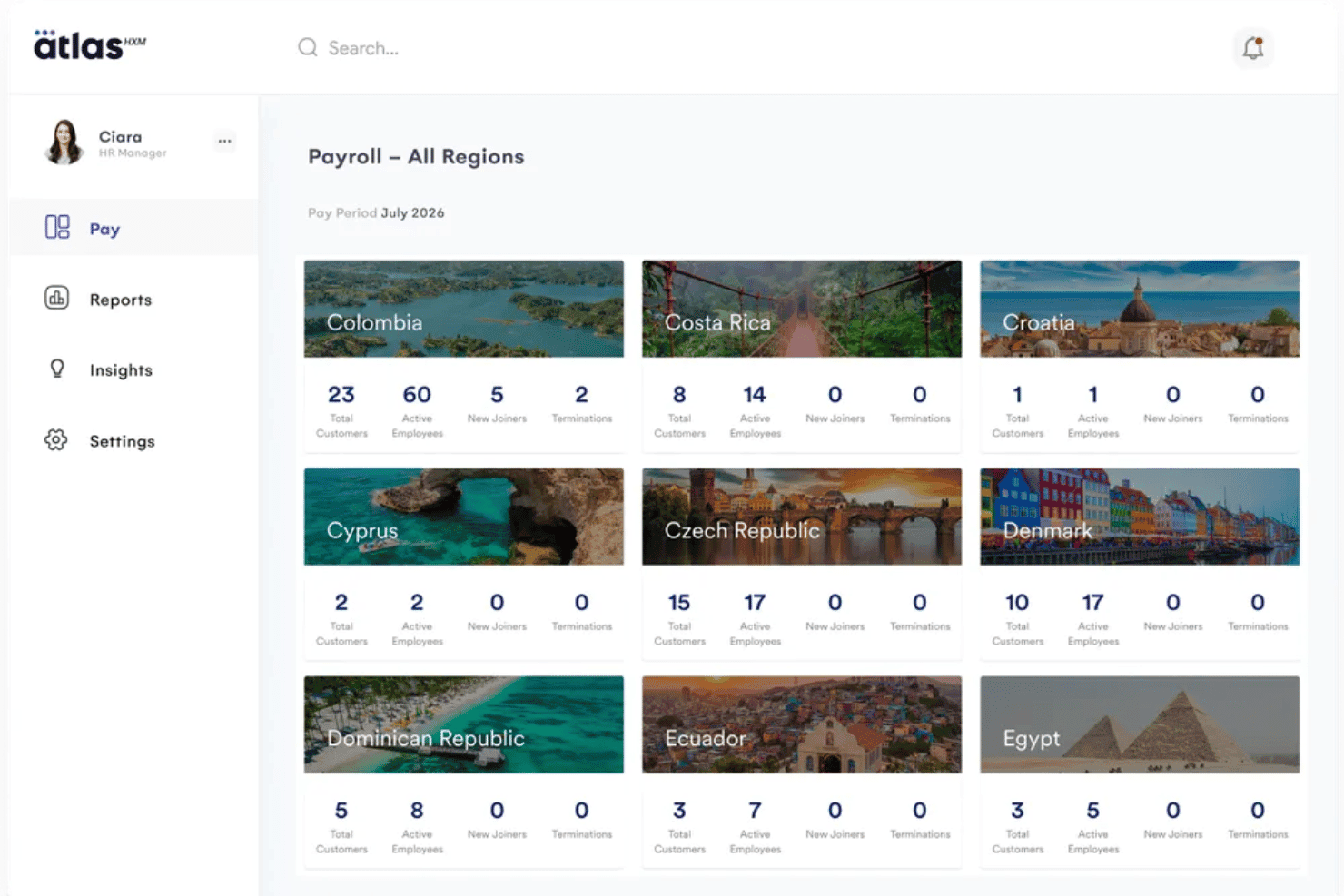
Atlas HXM centralizes global payroll data across countries in one view. Atlas HXM is a direct employer of record platform that manages CLT-compliant hiring, BRL payroll processing, statutory benefits administration, and eSocial filings for companies employing workers in Brazil without a local entity.
Who Is Atlas HXM Best For?
Atlas HXM is a strong fit for finance-led organizations that need predictable, flat-fee Brazil EOR pricing with GL-ready cost reporting and AI-powered payroll analytics built into the platform.
Why I Picked Atlas HXM
Atlas HXM earns its spot on my shortlist because of how it handles payroll cost visibility for Brazil, specifically the AI-powered analytics that break down headcount costs across INSS, FGTS, and 13th salary obligations in GL-ready format. I like that the consolidated monthly invoice separates statutory contributions, benefits premiums, and platform fees, so finance teams can map each line directly to their chart of accounts. The flat per-employee fee also means your Brazil payroll costs don't balloon unpredictably as salaries scale.
Atlas HXM Key Features
- CLT contract management: Atlas HXM drafts and administers Portuguese-language employment contracts that cover probation periods, notice terms, overtime rules, and termination payroll calculations.
- eSocial filing automation: The platform handles admission events, payroll events, and annual statutory filings (including RAIS, DIRF, and CAGED) directly through eSocial.
- Worker classification assessment: Built-in assessment tools help you evaluate whether a Brazilian worker should be engaged as a CLT employee or a PJ contractor before you commit to an engagement type.
- Misclassification reimbursement coverage: Atlas HXM's Agent of Record product includes up to $100,000 per contractor and $1 million in aggregate reimbursement for documented misclassification costs.
Atlas HXM Integrations
Atlas HXM has documented integrations with Workday, BambooHR, Sage, UKG, Dayforce, Paycor, and Ashby, plus SSO with Okta, Microsoft, and Google. Accounting and ERP integrations aren't clearly documented publicly.
Pros and Cons
Pros:
- AI analytics break down payroll obligations
- Direct Brazilian entity ensures local accountability
- GL-ready cost reporting for finance teams
Cons:
- No payroll-only service for local entities
- No public documentation of ERP integrations
Learn more about Atlas HXM: Best for hiring with ESOP across borders
- Free demo available
- From $459/user/month (billed annually)
Visit WebsiteCustomer Rating:4.7/5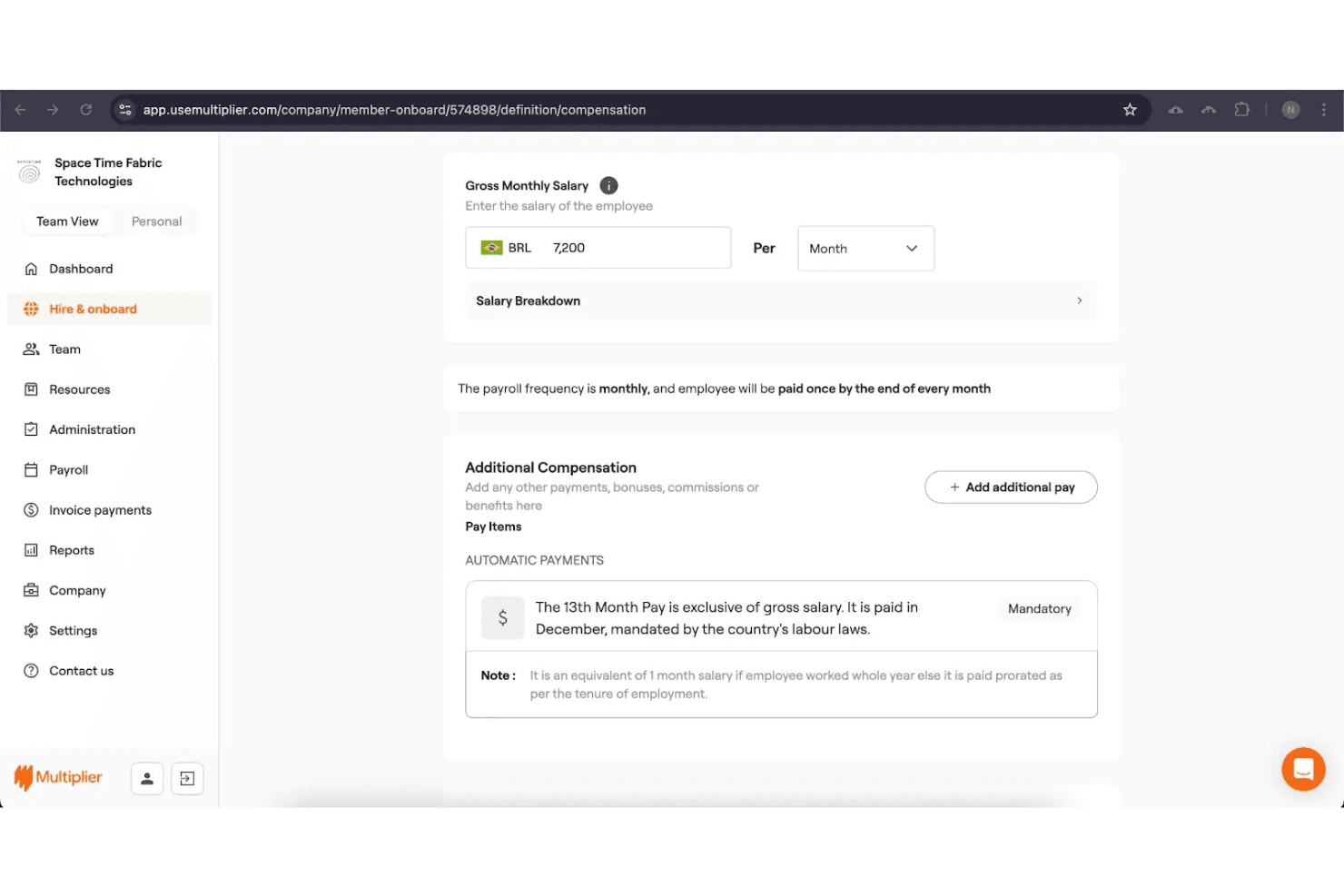
Multiplier lets users configure gross monthly salary and mandatory pay items. Multiplier is an employer of record platform with a wholly owned Brazilian legal entity that handles CLT-compliant contracts, BRL payroll, statutory benefits, eSocial filings, and native ESOP management across 150+ countries.
Who Is Multiplier Best For?
Multiplier is a strong fit for growth-stage and tech companies hiring Brazilian employees across borders, especially those offering equity compensation through ESOP.
Why I Picked Multiplier
I've included Multiplier in my top picks because it's the only EOR on this list with native ESOP management built directly into the platform, which matters when you're hiring Brazilian employees and offering equity as part of their compensation. In practice, that means my team can grant and manage stock options across jurisdictions without routing through a separate equity tool. Multiplier also runs a wholly owned Brazilian legal entity, handling CLT contracts, INSS, FGTS, 13th salary, and eSocial filings under one roof.
Multiplier Key Features
- BRL payroll automation: Multiplier calculates and remits INSS, IRRF, FGTS, and 13th-month salary, and files all required eSocial payroll events on your behalf.
- CCT/CBA compliance support: Employment contracts account for collective bargaining agreements by role and location across Brazil.
- Digital employee onboarding portal: Employees complete document collection, CPF/RG verification, and CTPS registration through a guided digital interface.
- Employee Cost Calculator: Estimate total Brazil employment costs—salary, taxes, and benefits—across 120+ countries before making a hire.
Multiplier Integrations
Multiplier offers integrations with BambooHR, Workday, Greenhouse, Microsoft 365, and Power Automate. It also provides an API for custom integrations, although accounting and ERP integrations such as QuickBooks, Xero, NetSuite, and SAP aren't documented.
Pros and Cons
Pros:
- Fast onboarding with owned Brazilian entity
- Native ESOP management for equity grants
- Handles CLT contracts with CCT/CBA support
Cons:
- Invoice inconsistencies reported by finance users
- No direct ERP or accounting integrations
Learn more about Multiplier: 10Best for GL-ready payroll across ERPs
Pebl
- Free demo available
- From $399/employee/month
Visit WebsiteCustomer Rating:4.6/5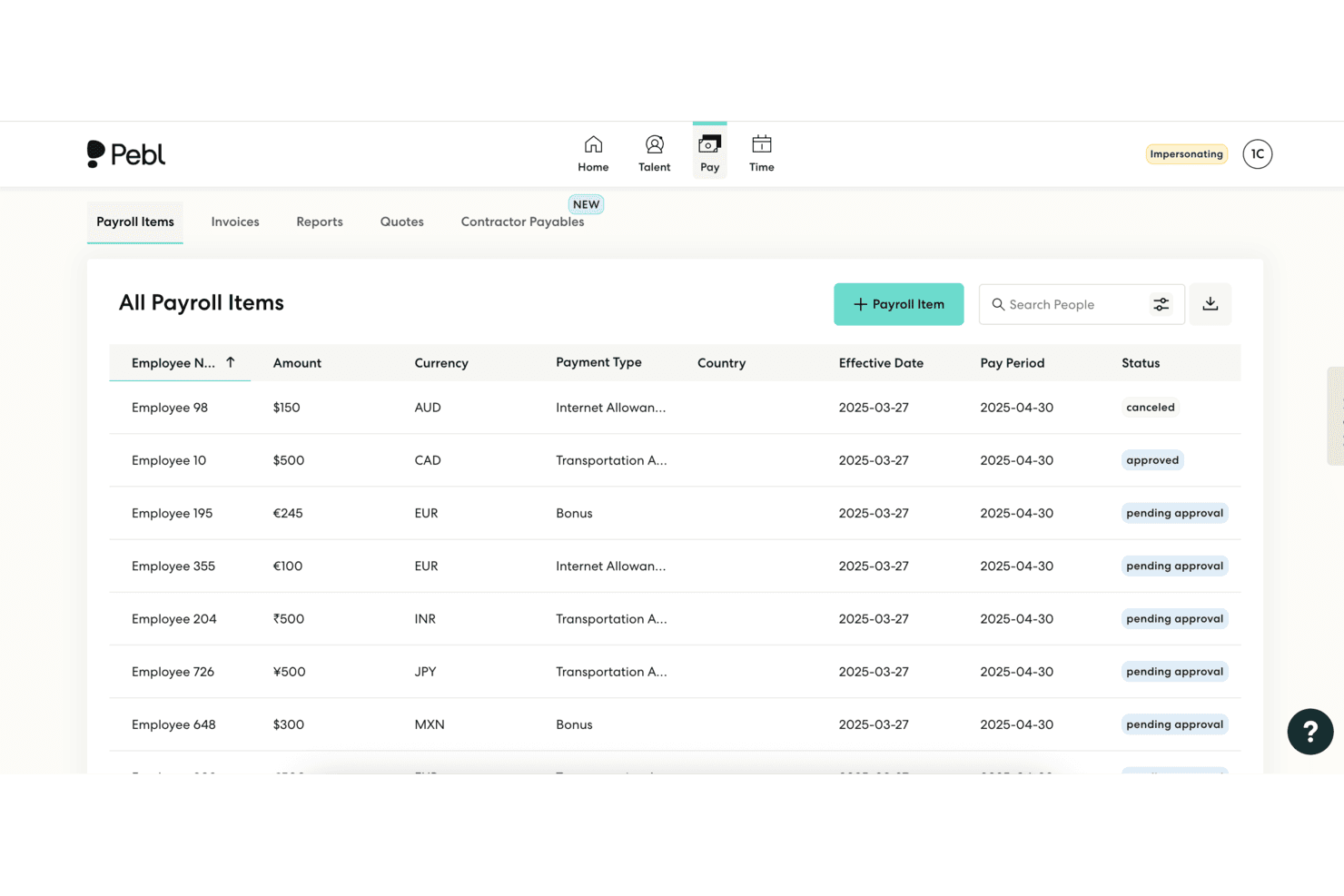
Pebl lets users manage and track all payroll items across currencies and statuses. Pebl is an employer of record platform that handles CLT-compliant employment contracts, BRL payroll, statutory benefits, and multi-ERP integrations for companies hiring in Brazil without a local entity.
Who Is Pebl Best For?
Pebl is a strong fit for finance teams managing multi-country payrolls who need GL-ready exports that sync directly into ERPs like NetSuite, Oracle, or SAP.
Why I Picked Pebl
I've included Pebl in my top picks because its GL-ready payroll exports are genuinely built for finance teams running multi-ERP environments. Where most EOR platforms stop at payroll processing, Pebl goes further with native connectors to NetSuite, Oracle, and SAP that push journal-ready payroll data directly into your general ledger, cutting the manual reconciliation work that typically piles up at month-end close. I also like that BRL payroll outputs, covering INSS, FGTS, IRRF, and the 13th salary, arrive as a single consolidated invoice.
Pebl Key Features
- Dedicated onboarding specialist: Each new hire in Brazil gets an assigned onboarding specialist who manages document collection, ID verification, and contract setup from start to finish.
- AI compliance assistant (Alfie): An embedded AI tool that answers payroll, compliance, and onboarding questions in 50+ languages, including Portuguese, directly within the platform.
- Contractor management: The platform supports PJ-to-CLT conversion workflows, letting you manage both contractors and employees from a single dashboard.
- Open API: A developer-accessible API that lets your team build custom integrations and automate data flows between Pebl and your existing finance or HR systems.
Pebl Integrations
Pebl offers 250+ integrations, including NetSuite, Oracle, SAP, QuickBooks, Workday, and BambooHR. Its open API supports custom connections for payroll journals, employee data, onboarding triggers, and invoice automation.
Pros and Cons
Pros:
- AI assistant answers compliance questions in Portuguese
- GL-ready payroll exports to major ERPs
- Local compliance teams with Brazilian statutory expertise
Cons:
- eSocial automation features not clearly documented
- No public confirmation of Brazil legal entity
Learn more about Pebl:
Other Employer of Record Options for Brazil
Here are some additional employer of record for Brazil options that didn’t make it onto my shortlist, but are still worth checking out:
- 11G-PBest for indemnified Brazil CLT via owned entity
- 12Papaya GlobalBest for sub-1% FX BRL payroll with ERP sync
- 13Oyster HRBest for CBA-monitored Brazil CLT hiring
- 14RipplingBest for global finance stack with Brazil payroll
- 15Safeguard GlobalBest for Workday-linked Brazil spend reporting
- 16Payoneer Workforce ManagementBest for Payoneer FX-backed BRL hiring
- 17TarmackBest for with single-invoice billing
- 18Wide Brazil PeopleBest for Brazil-only local entity hiring
Related Reviews
How I Evaluate Employer of Record for Brazil
I split my evaluation into baseline criteria every provider must meet—CLT contracts, BRL payroll, eSocial filings—and differentiators like FX transparency and ERP integration that separate the best from the rest.
Core Functionality (Table Stakes for This List)
When I'm selecting tools for my list, I rank each one on a scale from 0 (does not offer the functionality) to 5 (excels in this area) for each core functionality listed below. I then calculate the tool's total score into a percentage, using 65% as a benchmark to help assess its overall fit for the list.
- Brazilian legal entity: I check whether a provider owns its entity in Brazil or relies on third-party partners, and how much local legal and HR infrastructure backs it up.
- CLT-compliant employment: I look for full CLT contract handling, including automated vacation accruals, notice periods, termination workflows, and collective bargaining agreement coverage.
- Local payroll and taxes: Proper BRL payroll means automated INSS, IRRF, FGTS, and 13th salary calculations plus eSocial submissions—I evaluate how much of this runs without manual intervention.
- Statutory benefits administration: Beyond basic vale-transporte and vale-refeição, I evaluate whether providers offer supplemental health and dental plans with local carriers and dependent coverage options.
- Onboarding and documentation: I look for digital collection of CPF, CTPS, and admissional exams, along with Portuguese-language contracts and e-signature support that can get a hire started within days.
- Finance and reporting integration: GL-ready exports and native connections to ERPs like NetSuite, QuickBooks, or Xero matter here—I evaluate multi-currency invoicing and cost-breakdown detail for finance teams.
Once I have a list of tools that meet the criteria, I consider what sets each platform apart.
Differentiating Factors (What Sets Vendors Apart)
Here's how I compare and contrast different vendors:
Standout Features
I evaluate how each provider handles union and collective bargaining agreement (Convenção Coletiva de Trabalho) tracking, since wage floors and benefit minimums shift by category and region. Vendors like Playroll and Oyster HR differ in how much of that research they automate versus leave to your team. Contractor-to-CLT conversion tooling also matters—I look for built-in misclassification risk scoring and back-pay estimation, which directly reduces exposure in Brazil's labor courts. Finally, multi-currency FX locking with transparent BRL rates gives finance teams predictable landed costs each month.
Beyond Features
I look at how each provider handles misclassification and labor court liability, since Brazil's labor court system (Justiça do Trabalho) generates real financial exposure from PJ-to-CLT disputes. Vendors like G-P and Deel Hire differ in whether they fully indemnify you or cap coverage. Total cost transparency matters just as much—I check whether per-employee dashboards break out statutory contributions, benefits, EOR margin, and FX spread so your team isn't budgeting blind. I also evaluate ERP fit, specifically whether payroll data flows into NetSuite or SAP with cost-center and project-level allocations intact.
How to Choose an Employer of Record for Brazil
Use this table to map your priorities when choosing an employer of record for Brazil:
| If your priority is... | Look for... |
|---|---|
| If your priority is...Reducing employer cost surprises | Look for...FX margin caps and transparent monthly invoices |
| If your priority is...Avoiding misclassification and liabilities | Look for...Indemnification for CLT disputes in writing |
| If your priority is...Fast month-end financial close | Look for...Native GL/ERP payroll exports in BRL and USD |
| If your priority is...Keeping CBAs up to date | Look for...Automated CBA research and wage floor tracking |
How to Vet Your Shortlist
- Check payroll test exports: Request a sample GL-export file for a prior Brazilian payroll run—confirm line-item statutory costs within 3 days.
- Request CBA handling evidence: Ask for a redacted employee contract showing applied union wage floors or CBA annex integration.
- Verify FX transparency: Insist on a pro-forma invoice that clearly separates FX markups, EOR fees, and statutory contributions.
- Audit indemnification coverage: Get a copy of the vendor’s indemnification clause for CLT misclassification; review exclusions and coverage caps in writing.
- Decide: owned-entity control vs. aggregator scale: Weigh the tradeoff between single-country providers with full Brazilian infrastructure and “global EORs” relying on local partners for CLT risk—prioritize based on your threshold for liability and payroll accuracy.
What Is Employer of Record for Brazil?
Employer of record for Brazil are third-party providers that hire employees on your behalf, handling Brazilian labor law, payroll processing, social security, and compliance obligations. These services let your business employ workers in Brazil without setting up a local legal entity. Finance teams rely on employer of record for Brazil to ensure cost control, reduce risks under CLT and collective bargaining agreements, and keep every payroll cycle compliant and auditable.
Why Use an Employer of Record Service in Brazil?
An employer of record (EOR) can help your company hire employees in Brazil without first establishing and operating its own local legal entity. This can make sense when you’re entering the Brazilian market, hiring a small local team, or testing expansion before committing to the cost and administration of a subsidiary.
Brazil has relatively complex employment, payroll, and statutory benefit requirements. An EOR takes responsibility for employing workers locally and managing much of this administration, while your company directs their day-to-day work.
An EOR doesn't remove every financial or tax risk associated with operating in Brazil. As your local headcount and commercial activity increase, finance and tax teams should assess whether establishing an entity is more economical and whether your activities could create permanent establishment or other corporate tax obligations.
Deciding Between an EOR and a Legal Entity in Brazil
An EOR is generally suited to companies hiring a limited number of employees, testing the Brazilian market, or needing to hire before an entity is operational. Establishing your own entity involves more upfront setup and ongoing administration but gives your company direct control over employment, payroll, and local operations.
| Factor | EOR | Legal Entity |
| Entity setup | No Brazilian entity required for employment | Requires establishing and registering a Brazilian entity |
| Time to hire | Typically faster because the EOR already has local infrastructure | Hiring depends on completing required registrations and payroll setup |
| Upfront costs | Lower; primarily provider onboarding and service fees | Higher due to incorporation, registrations, advisors, and operational setup |
| Ongoing costs | Recurring EOR fee per employee or percentage-based fee | Accounting, payroll, tax, legal, compliance, and entity maintenance costs |
| Payroll administration | Managed by the EOR | Your company is responsible, directly or through local providers |
| Employment compliance | EOR manages local employment administration | Your company assumes direct employer responsibilities |
| Operational control | Less control over employment administration | Greater control over employment policies and processes |
| Scalability | Practical for smaller or transitional teams | May become more practical as headcount and operations grow |
| Market commitment | Useful for testing or entering the market | Better aligned with an established, long-term local presence |
| Corporate tax considerations | Does not by itself eliminate Brazilian tax or PE exposure | Entity generally has its own Brazilian tax and reporting obligations |
There isn't a universal headcount at which establishing an entity becomes cheaper than using an EOR. Finance teams should compare the EOR's recurring fees against the full cost of maintaining a Brazilian entity, including accounting, payroll, tax compliance, legal support, and internal administration.
EOR vs. Permanent Establishment in Brazil
Using an employer of record allows you to employ workers in Brazil without establishing your own local entity, but it does not automatically prevent your company from creating a permanent establishment (PE).
A PE is a taxable business presence that can arise when a foreign company conducts certain activities in Brazil. Whether a PE exists depends on the company's activities and the applicable Brazilian tax rules and tax treaty, if any—not simply on who appears as the employee's legal employer.
How EORs Protect From Permanent Establishment Risk
An EOR can help reduce some factors associated with PE exposure, but it cannot guarantee that your company will avoid creating a permanent establishment in Brazil.
The EOR provides the local employment infrastructure, so your company does not need to establish a Brazilian entity solely to hire employees. It also manages employment contracts, payroll, statutory contributions, and other employer obligations locally.
For CFOs, the key distinction is that an EOR can solve the employment infrastructure problem, but it does not automatically solve the corporate tax presence problem. PE exposure should therefore be assessed separately as part of the company's international tax strategy.
Hiring in Brazil: Important Details
Brazil has detailed employment requirements that affect payroll costs, contracts, benefits, working hours, and termination. When budgeting for a Brazilian hire, finance teams should therefore consider the employee's total statutory employment cost rather than base salary alone.
Important areas to account for include:
- Employment contracts: Employment relationships are primarily governed by Brazil's Consolidation of Labor Laws (CLT). Employers should document compensation, working arrangements, responsibilities, and other applicable employment terms.
- 13th-month salary: Employees are generally entitled to an additional annual salary payment, typically paid in two installments. This should be included when forecasting annual employment costs.
- Paid vacation: Employees generally accrue 30 days of paid annual vacation after each 12-month period of employment, subject to applicable rules, plus a constitutional vacation bonus equal to one-third of normal salary.
- FGTS contributions: Employers generally contribute 8% of an employee's monthly remuneration to the Severance Indemnity Fund (FGTS), with different rules applying to certain worker categories.
- Social security: Employers generally have payroll-related social security obligations in addition to amounts withheld from employees. The actual employer cost can vary based on factors such as the company's tax regime and business activity.
- Working hours and overtime: Standard working time is generally limited to eight hours per day and 44 hours per week, with additional rules governing overtime, rest periods, and certain alternative schedules.
- Collective bargaining agreements: Industry- or location-specific collective agreements can establish additional requirements for compensation, benefits, working hours, and other employment conditions.
- Termination costs: Depending on the circumstances, termination can trigger notice, accrued salary and vacation payments, proportional 13th-month salary, and FGTS-related costs.
- Payroll reporting: Employers must maintain employment and payroll records and comply with applicable government reporting requirements, including Brazil's eSocial system.
An EOR can administer many of these requirements on your behalf, but finance teams should still understand how statutory costs and locally required benefits affect the total cost of each Brazilian employee.
Tax Overview for Employers in Brazil
Employers in Brazil are responsible for calculating, reporting, and remitting several payroll-related taxes and contributions. Under the standard payroll regime, these generally include employer INSS, FGTS, work accident insurance (RAT), and applicable third-party contributions.
Key employer obligations can include:
- Employer social security (INSS): Companies under applicable regimes generally pay an employer contribution based on payroll, although the rate and calculation can vary depending on the company's tax treatment.
- FGTS: Employers generally deposit 8% of an employee's remuneration into the employee's Severance Indemnity Fund (FGTS) account.
- Work accident insurance (RAT): Employers may owe additional payroll contributions based on the occupational risk associated with their business activity.
- Third-party contributions: Depending on the employer, payroll can also be subject to contributions to entities and programs within Brazil's broader social contribution system.
- Employee withholding: Employers are responsible for calculating and withholding applicable employee social security contributions and individual income tax from payroll.
- Payroll reporting and remittance: Employment and payroll information must be reported through applicable government systems, including eSocial, with taxes and contributions remitted according to statutory deadlines.
Total Cost of Employment in Brazil
When budgeting for an employee in Brazil, start with gross salary and add the statutory costs the employer must fund.
For many employers, the major costs include:
| Aspect | Typical Cost |
|---|---|
| AspectBase salary | Typical Cost12 months of salary |
| Aspect13th-month salary | Typical Cost1 additional month's salary |
| AspectVacation bonus | Typical Cost1/3 of vacation pay |
| AspectEmployer INSS | Typical CostGenerally 20% of payroll under the standard regime |
| AspectFGTS | Typical CostGenerally 8% of remuneration |
| AspectRAT | Typical CostGenerally 1%–3%, based on occupational risk |
| AspectThird-party contributions | Typical CostVaries by business activity and classification |
| AspectBenefits | Typical CostVaries by employment terms and collective agreements |
| AspectEOR fee | Typical CostProvider-specific |
RAT and third-party contributions can push the employer payroll burden higher. The exact amount depends on factors such as your business activity, occupational risk classification, tax regime, and applicable contribution rules.
For example, an employee earning R$10,000 per month has a base annual salary of R$120,000, but that isn't the amount you should use as the total employment budget. You also need to fund the 13th-month salary, vacation bonus, FGTS, employer social security and other applicable payroll charges, plus benefits and the EOR fee.
For forecasting, use:
Base salary + 13th salary + vacation costs + employer contributions + benefits + EOR fee = estimated total employment cost.
Ask prospective EORs for a fully loaded cost breakdown for the specific employee before comparing providers. It should separate salary, statutory employer costs, benefits, and the EOR's own fee so you can see which costs would exist regardless of provider.
Features of Employer of Record for Brazil
When selecting an employer of record for Brazil, keep an eye out for the following key features:
- Brazilian legal entity ownership: The provider should own and operate a registered legal entity in Brazil, not rely solely on third-party local partners. This gives your team stronger compliance assurance and more direct control over employment arrangements.
- CLT-compliant employment contracts: Look for full handling of Brazil’s employment laws (Consolidação das Leis do Trabalho), including vacation accruals, termination, and collective bargaining agreement adherence. This keeps your hires protected under the correct local frameworks.
- End-to-end payroll processing in BRL: The EOR must run compliant payroll in Brazilian reais, including accurate calculations for INSS (social security), IRRF (income tax), FGTS (severance fund), 13th salary, and eSocial filings. This reduces manual intervention and keeps your payroll fully auditable.
- Statutory and supplemental benefits administration: Providers should manage all legally required benefits like transportation and meal vouchers, while also offering local health, dental, and life insurance options for you to remain competitive in the Brazilian market.
- Digital onboarding and documentation management: Expect hiring with digital collection of key documents (CPF, CTPS, admissional exams), e-signature contracts in Portuguese, and support to onboard employees rapidly.
- Multi-currency and FX management: Transparent invoicing in both BRL and your home currency, with clear FX rates and margin disclosure, helps finance teams control costs and reduce risk from currency fluctuations.
- CBA and union agreement tracking: Automated research for applicable wage floors and benefits under regional collective bargaining agreements (Convenção Coletiva de Trabalho) ensures every hire meets local requirements wherever they work in Brazil.
- Indemnification and misclassification risk coverage: The provider should offer written indemnity against CLT misclassification and disputes, so you have clarity on your potential exposure to labor court liabilities.
- Payroll integration with ERPs: Easy exports or direct connections to your general ledger and ERP platforms (like NetSuite, QuickBooks, SAP, Xero) allow for easier reconciliations and financial reporting at month-end.
- Employee lifecycle support: Ongoing HR support for routine changes (pay raises, leave, terminations) with local expertise ensures your Brazilian workforce remains compliant and engaged throughout their employment.
Benefits of Employer of Record for Brazil
Implementing an employer of record for Brazil provides several benefits for your team and your business. Here are a few you can look forward to:
- Accelerated market entry: Hire employees in Brazil without setting up your own entity thanks to local legal presence and infrastructure.
- Full CLT compliance: Ensure every hire meets Brazil’s strict labor laws with automated CLT contract handling, notice periods, and vacation accruals.
- Automated payroll and tax filings: Rely on accurate BRL payroll that handles INSS, IRRF, FGTS, 13th salary, and required eSocial submissions every cycle.
- Integrated statutory and supplemental benefits: Offer mandated transportation and meal vouchers along with local healthcare and dental options to compete for talent.
- Auditable financial integration: Export payroll data directly to your ERP or general ledger with multi-currency invoicing and cost breakdowns for faster close and clear controls.
- Transparent cost structure: Review invoices with a clear split of statutory contributions, EOR fees, and FX margins to avoid budget surprises.
- Indemnification against misclassification risks: Get written coverage for CLT and labor court liability so your business is protected from local employment disputes.
Costs and Pricing
Selecting an employer of record for Brazil requires an understanding of the various pricing models and plans available. Costs vary based on features, team size, add-ons, and more. The table below summarizes common plans, their average prices, and typical features included in employer of record for Brazil solutions:
Plan Comparison Table for Employer of Record for Brazil
| Plan Type | Average Price | Common Features |
|---|---|---|
| Plan TypeFree Plan | Average Price$0 | Common FeaturesAccess to basic resources, vendor support information, and limited feature overviews. |
| Plan TypePersonal Plan | Average Price$200-$400/employee/month | Common FeaturesCore CLT contract support, BRL payroll processing, and compliance documentation. |
| Plan TypeBusiness Plan | Average Price$400-$700/employee/month | Common FeaturesFull payroll automation, statutory benefits, digital onboarding, CBA tracking, and reporting. |
| Plan TypeEnterprise Plan | Average Price$700-$1,000/employee/month | Common FeaturesDedicated account management, ERP integration, multi-country support, indemnification, and detailed cost breakdowns. |
Employer of Record for Brazil FAQs
Here are some answers to common questions about employer of record for Brazil:
How does an EOR handle IP transfer upon termination?
An EOR typically includes IP assignment and confidentiality terms in the Brazilian employee’s contract from the start. When the employee leaves, the EOR handles the termination paperwork and ensures any continuing IP and confidentiality obligations are documented.
Brazilian law can limit which IP rights can be transferred, so confirm that the EOR’s agreements protect your company’s ownership rights for the type of work the employee will create.
How quickly can you onboard employees in Brazil using an employer of record?
Most employer of record providers can onboard employees in Brazil within one to two weeks, as long as all required documentation—like a CPF number and CTPS—is complete. Delays usually happen if candidates are missing requested documents or need a pre-employment medical exam (admissional exam).
Does an employer of record handle collective bargaining agreements (CBAs) for Brazilian employees?
Yes, reputable employer of record providers research and apply the right CBA coverage based on employee role and location. This includes wage floors, benefits, and work hours. It’s important to ask for evidence—like a sample contract—showing that these obligations are actively tracked and enforced.
Can you pay Brazilian employees in both BRL and foreign currency through an employer of record?
You typically pay the invoices in your home currency, and the employer of record handles payroll in Brazilian reais (BRL). Some providers offer invoices split by currency or disclose the exact FX rate and margin, giving your finance team better control over costs.
How does indemnification for misclassification work with employer of record services in Brazil?
Indemnification means the provider covers your business for specific liabilities if a worker is found to be misclassified under Brazil’s strict CLT rules. The scope, limits, and process vary by vendor, so always review their indemnification clause closely—look for coverage caps and exclusions.
What payroll systems and ERPs can you integrate with employer of record platforms in Brazil?
Most leading employer of record providers offer general ledger export files compatible with ERPs like NetSuite, QuickBooks, SAP, and Xero. For deeper integrations, some offer native connectors or custom exports—always confirm your provider’s capabilities before committing.
What’s included in a typical employer of record fee in Brazil?
Fees generally cover entity sponsorship, CLT employment contract management, payroll calculations, statutory filings, and local HR support. Some plans also include benefit administration, CBA compliance, FX management, reporting, and indemnification. Always ask for a detailed breakdown of costs, including statutory charges and FX margin.