

TaxDome Bewertung: Vorteile, Nachteile, Funktionen und Preise


TaxDome is a financial compliance software solution that helps accounting firms manage workflows and client interactions. It best serves small to mid-sized accounting firms, tax professionals, and finance teams that need integrated tools for client management and document storage. TaxDome offers an efficient platform for handling client communication, document sharing, and task automation.
In this article, I'll cover TaxDome's features, pros and cons, use cases, and pricing, so you can decide if this software aligns with your compliance and efficiency needs.
TaxDome excels at helping accounting firms bring all their operations into one platform, automating much of the administrative work and keeping the client experience consistent across the board.
TaxDome Evaluation Summary

- From $700/year/seat (with a 3-year commitment)
- Free demo available
Why Trust Our Software Reviews
TaxDome Overview
TaxDome is an end-to-end practice management platform built for accounting, tax, and bookkeeping firms. Its product suite covers everything from CRM and document management with e-signatures and organizers to team collaboration, time and billing, proposals and engagement letters, invoicing, and AI-powered reporting. Full tax and bookkeeping workflows are also set to be released inside the platform soon, extending its reach even further.
TaxDome integrates with major tax software, the IRS, QuickBooks Online, payment processors like CPACharge and Stripe, and other tools through Zapier, making it flexible for a range of firm setups. Overall, its pricing is competitive and offers solid value for the depth of features provided. But considering the range of capabilities and level of customization available, the initial setup can take time.
pros
-
Secure client portal
-
Admin and client follow-up automation
-
Comprehensive Firm Management Tools
cons
-
Learning curve for advanced features
-
Initial setup requires time and planning
-

LiveFlow
Visit WebsiteThis is an aggregated rating for this tool including ratings from Crozdesk users and ratings from other sites.4.9 -
Float Financial
Visit WebsiteThis is an aggregated rating for this tool including ratings from Crozdesk users and ratings from other sites.4.1 -
Rippling Spend
Visit WebsiteThis is an aggregated rating for this tool including ratings from Crozdesk users and ratings from other sites.4.8


How We Test & Score Tools
We’ve spent years building, refining, and improving our software testing and scoring system. The rubric is designed to capture the nuances of software selection and what makes a tool effective, focusing on critical aspects of the decision-making process.
Below, you can see exactly how our testing and scoring works across seven criteria. It allows us to provide an unbiased evaluation of the software based on core functionality, standout features, ease of use, onboarding, customer support, integrations, customer reviews, and value for money.
Core Functionality (25% of final scoring)
The starting point of our evaluation is always the core functionality of the tool. Does it have the basic features and functions that a user would expect to see? Are any of those core features locked to higher-tiered pricing plans? At its core, we expect a tool to stand up against the baseline capabilities of its competitors.
Standout Features (25% of final scoring)
Next, we evaluate uncommon standout features that go above and beyond the core functionality typically found in tools of its kind. A high score reflects specialized or unique features that make the product faster, more efficient, or offer additional value to the user.
We also evaluate how easy it is to integrate with other tools typically found in the tech stack to expand the functionality and utility of the software. Tools offering plentiful native integrations, 3rd party connections, and API access to build custom integrations score best.
Ease of Use (10% of final scoring)
We consider how quick and easy it is to execute the tasks defined in the core functionality using the tool. High scoring software is well designed, intuitive to use, offers mobile apps, provides templates, and makes relatively complex tasks seem simple.
Onboarding (10% of final scoring)
We know how important rapid team adoption is for a new platform, so we evaluate how easy it is to learn and use a tool with minimal training. We evaluate how quickly a team member can get set up and start using the tool with no experience. High scoring solutions indicate little or no support is required.
Customer Support (10% of final scoring)
We review how quick and easy it is to get unstuck and find help by phone, live chat, or knowledge base. Tools and companies that provide real-time support score best, while chatbots score worst.
Customer Reviews (10% of final scoring)
Beyond our own testing and evaluation, we consider the net promoter score from current and past customers. We review their likelihood, given the option, to choose the tool again for the core functionality. A high scoring software reflects a high net promoter score from current or past customers.
Value for Money (10% of final scoring)
Lastly, in consideration of all the other criteria, we review the average price of entry level plans against the core features and consider the value of the other evaluation criteria. Software that delivers more, for less, will score higher.
Core Features
Workflow automation: Automate repetitive steps like sending organizers, reminders, and follow-ups to reduce manual work.
Client portal: Give clients a secure space to scan and upload documents, sign forms, make payments, and message your team.
CRM: Keep all client information, notes, and communication in one place for quick access and better visibility across your team.
Document management: Upload, organize, and share documents securely, with built-in e-signatures and customizable organizers.
Project management: Assign work, track progress, and control user access to keep projects on schedule and responsibilities clear.
Billing and payments: Create invoices, track time, and process payments in one place.

Ease of Use
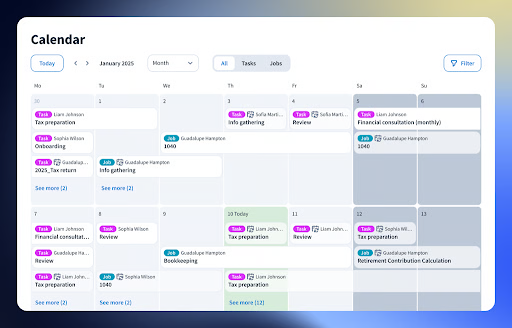
TaxDome offers a user-friendly interface that's intuitive for most of your team, making it easy to navigate and manage tasks. Its layout simplifies finding and using key features like client portals and task management. While some users report that the initial setup can be a bit challenging, the platform overall feels accessible, even for those less tech-savvy.
Integrations
TaxDome integrates with QuickBooks Online, the IRS, Zapier, Right Networks, Calendly, Acuity, Youcanbookme, Schedulista, CPACharge, and Stripe.
However, TaxDome does not have a public API but connects with third-party integration tools like Zapier to enable integrations with other applications.

TaxDome Specs
- Accounts Payable
- Accounts Receivable
- Analytics
- API
- Billing/Invoicing
- Customer Management
- Dashboard
- Data Export
- Data Import
- Data Visualization
- Email Integration
- External Integrations
- Mobile App
- Multi-User
- Process Modeling
- Process Reporting
- Project Management
- Task Scheduling/Tracking
- Time Management
- Workflow Management

