


Acumatica Enterprise Resource Planning (ERP) Software Review for 2026



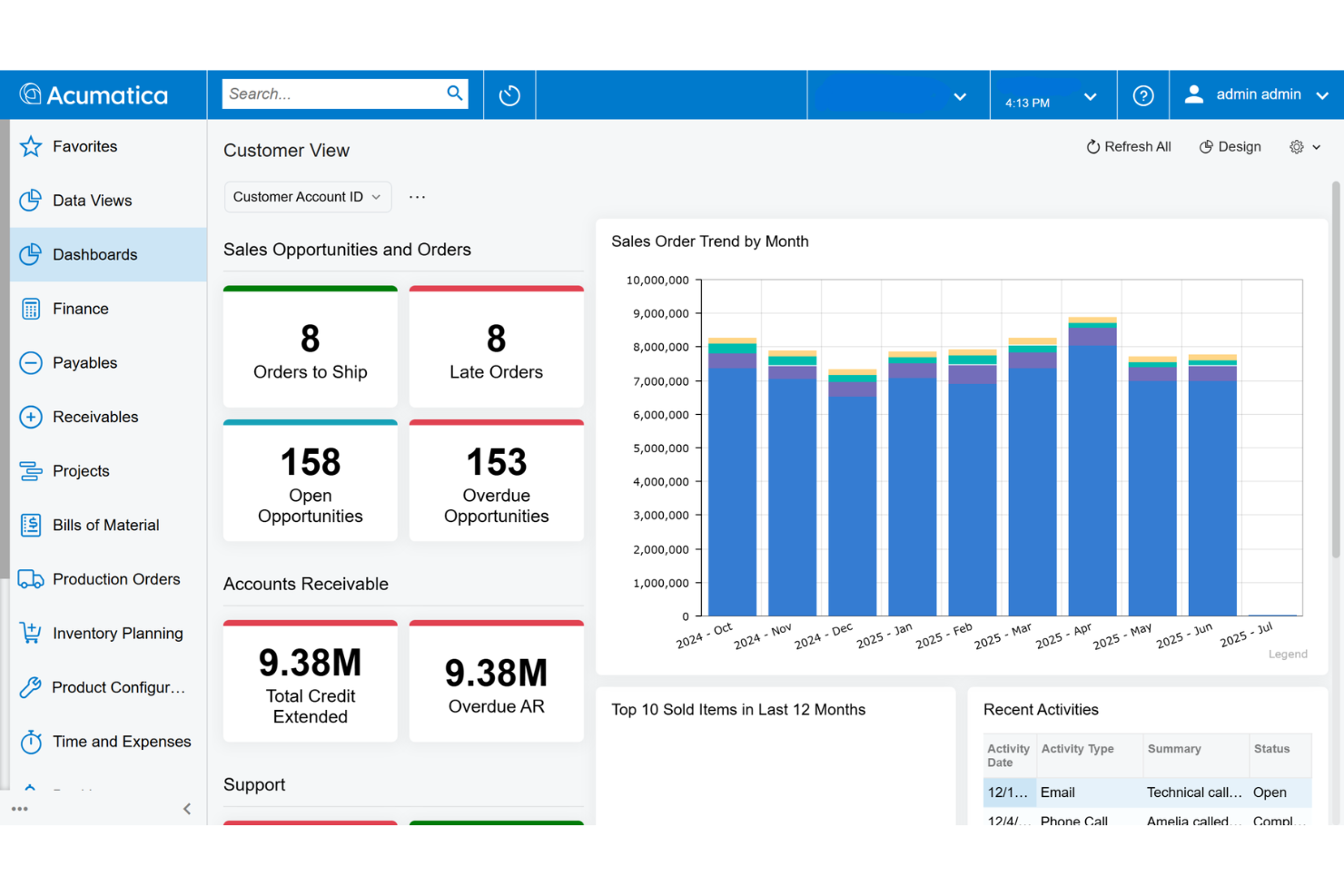
Acumatica is a cloud-based CFO ERP software built for mid-market companies that need to manage financials, inventory, and operations in a single system. I'd consider it if you're scaling past what basic accounting tools can handle and want a platform that doesn't charge per user—which is where it has a clear edge over NetSuite. That pricing model makes Acumatica significantly easier to justify as your headcount grows.
Acumatica Evaluation Summary
- Pricing upon request
- Free demo available
Why Trust Our Software Recommendations
Our team has been testing and reviewing software since 2012. As finance leaders ourselves, we know how difficult—and important—it is to choose the right software.
For this guide, we evaluated tools using hands-on testing and independent research, scoring tools using our selection criteria.
Our reviews reflect our human editorial judgment, not a sales pitch.
Acumatica Overview
When judging Acumatica as an ERP software, its flexible pricing, open API integrations, and intuitive interface set it apart for mid-sized businesses seeking adaptability. Compared to others, Acumatica’s customizable modules and responsive support team make onboarding and daily use straightforward, though advanced manufacturing features may require extra configuration.
If you’re selecting an ERP for a growing company with evolving needs, Acumatica’s cloud-first approach and strong reporting tools make it a compelling choice, especially for organizations prioritizing remote access and scalable workflows.
pros
-
Responsive customer support and active user community.
-
Strong reporting and dashboard customization options.
-
Transparent pricing with unlimited user licensing.
cons
-
Some updates can disrupt custom workflows or settings.
-
Mobile app functionality is limited compared to desktop.
-
Advanced manufacturing features require extra configuration.
-

Rippling Spend
Visit WebsiteThis rating combines scores from multiple user review sites to reflect overall customer sentiment about the product.4.8 -
DealHub AI
Visit WebsiteThis rating combines scores from multiple user review sites to reflect overall customer sentiment about the product.4.7 -
LiveFlow
Visit WebsiteThis rating combines scores from multiple user review sites to reflect overall customer sentiment about the product.4.9


How We Test & Score Tools
We’ve spent years building, refining, and improving our software testing and scoring system. The rubric is designed to capture the nuances of software selection and what makes a tool effective, focusing on critical aspects of the decision-making process.
Below, you can see exactly how our testing and scoring works across seven criteria. It allows us to provide an unbiased evaluation of the software based on core functionality, standout features, ease of use, onboarding, customer support, integrations, customer reviews, and value for money.
Core Functionality (25% of final scoring)
The starting point of our evaluation is always the core functionality of the tool. Does it have the basic features and functions that a user would expect to see? Are any of those core features locked to higher-tiered pricing plans? At its core, we expect a tool to stand up against the baseline capabilities of its competitors.
Standout Features (25% of final scoring)
Next, we evaluate uncommon standout features that go above and beyond the core functionality typically found in tools of its kind. A high score reflects specialized or unique features that make the product faster, more efficient, or offer additional value to the user.
We also evaluate how easy it is to integrate with other tools typically found in the tech stack to expand the functionality and utility of the software. Tools offering plentiful native integrations, 3rd party connections, and API access to build custom integrations score best.
Ease of Use (10% of final scoring)
We consider how quick and easy it is to execute the tasks defined in the core functionality using the tool. High scoring software is well designed, intuitive to use, offers mobile apps, provides templates, and makes relatively complex tasks seem simple.
Onboarding (10% of final scoring)
We know how important rapid team adoption is for a new platform, so we evaluate how easy it is to learn and use a tool with minimal training. We evaluate how quickly a team member can get set up and start using the tool with no experience. High scoring solutions indicate little or no support is required.
Customer Support (10% of final scoring)
We review how quick and easy it is to get unstuck and find help by phone, live chat, or knowledge base. Tools and companies that provide real-time support score best, while chatbots score worst.
Customer Reviews (10% of final scoring)
Beyond our own testing and evaluation, we consider the net promoter score from current and past customers. We review their likelihood, given the option, to choose the tool again for the core functionality. A high scoring software reflects a high net promoter score from current or past customers.
Value for Money (10% of final scoring)
Lastly, in consideration of all the other criteria, we review the average price of entry level plans against the core features and consider the value of the other evaluation criteria. Software that delivers more, for less, will score higher.
Core Features
Financial Management
Manage general ledger, accounts payable, receivable, and cash flow in real time. Automated workflows and multi-entity support help streamline complex accounting tasks.
Project Accounting
Track project budgets, costs, billing, and profitability from a single dashboard. Real-time reporting supports accurate forecasting and resource allocation.
Inventory Management
Monitor inventory levels, automate replenishment, and manage multiple warehouses. Lot and serial tracking help maintain accuracy and compliance.
Order Management
Automate sales and purchase order processing with configurable workflows. Real-time status updates improve order accuracy and customer satisfaction.
Customer Relationship Management (CRM)
Centralize customer data, manage sales pipelines, and track communications. Built-in CRM tools connect directly to financial and project modules.
Field Service Management
Schedule, dispatch, and track field service operations from any device. Mobile access enables real-time updates and efficient resource allocation.
Ease of Use
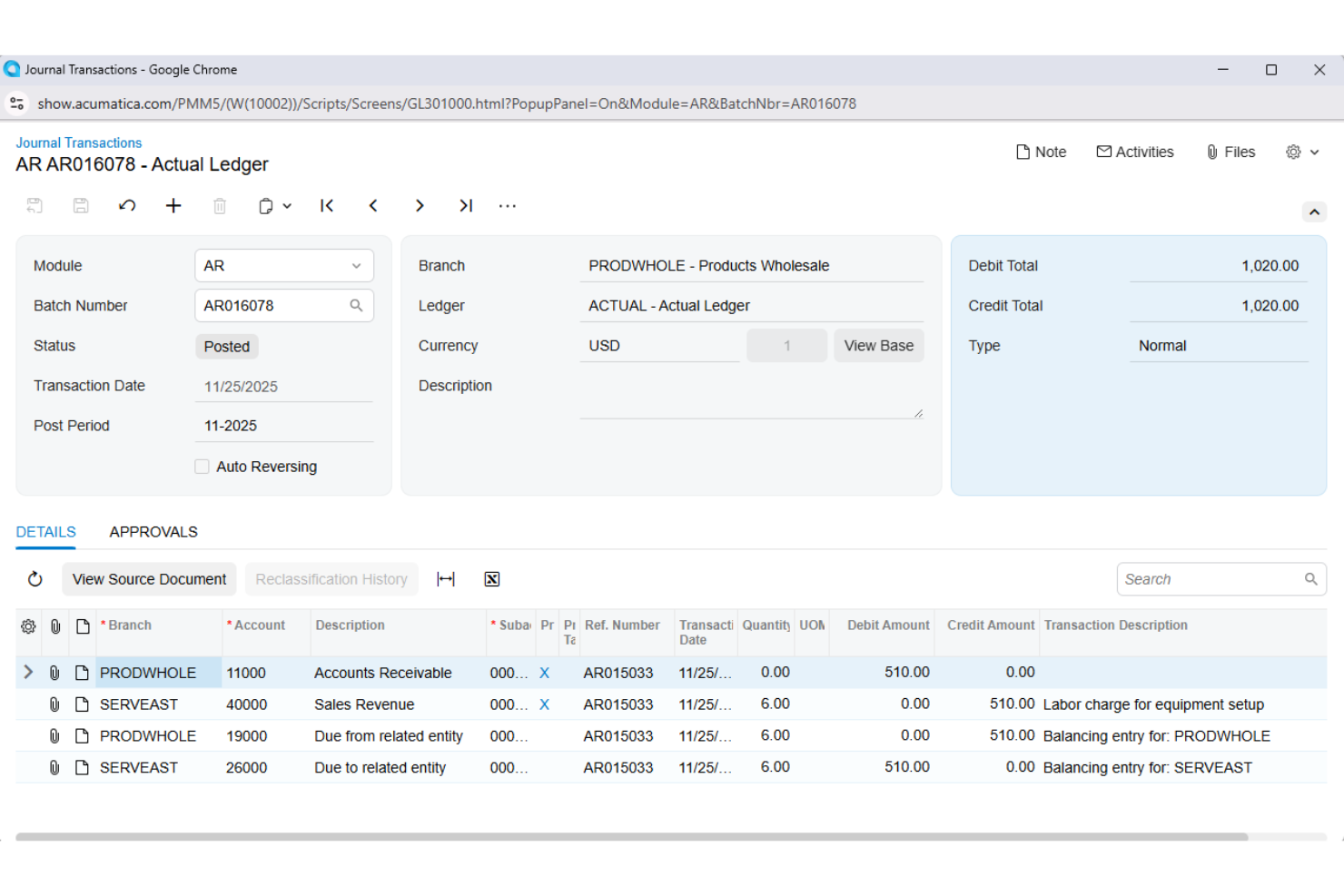
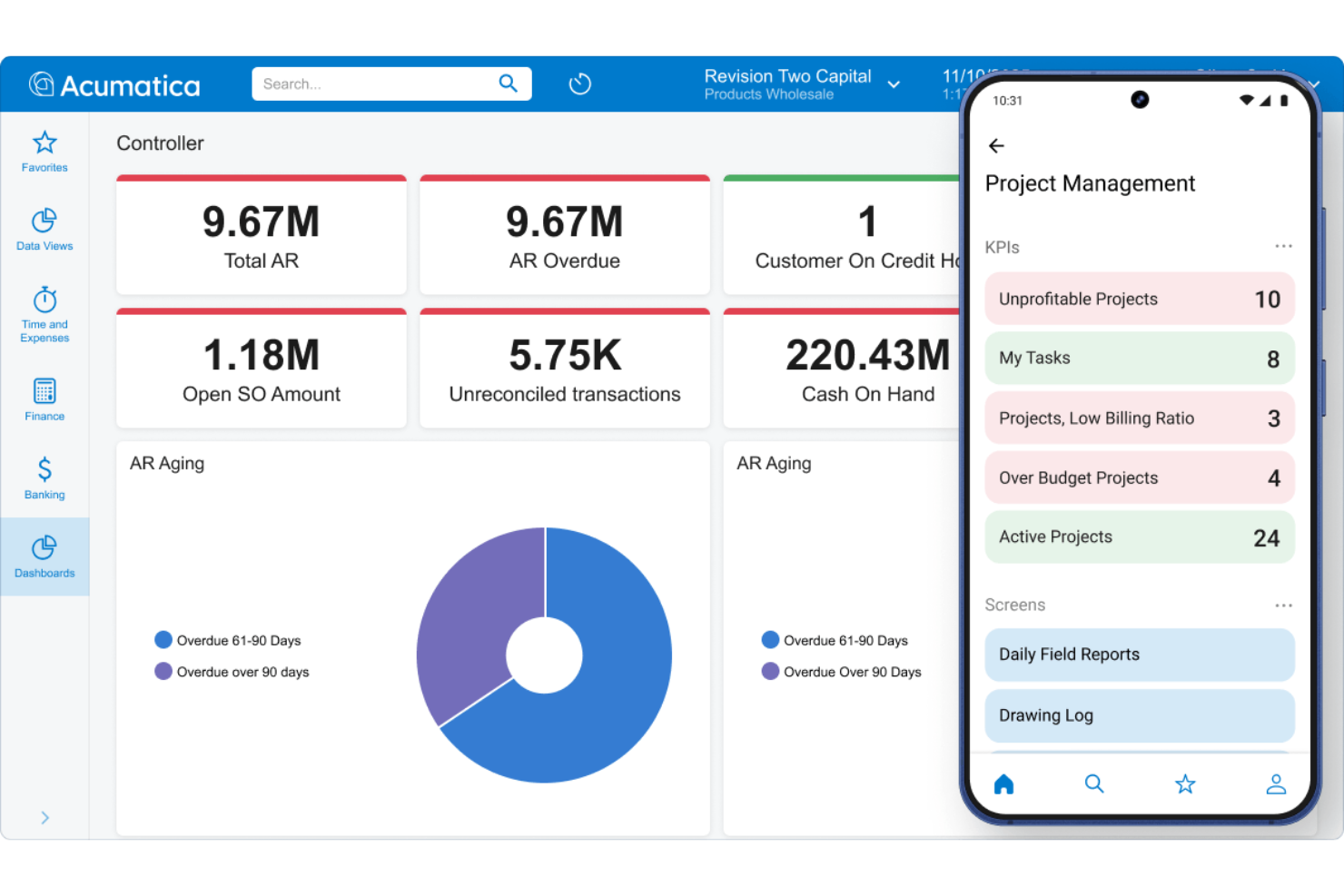
Acumatica offers a modern, intuitive interface that most users find easy to navigate, especially compared to traditional ERP systems. Dashboards are customizable, and workflows can be tailored to fit specific roles, reducing clutter and confusion. Users often highlight the clear menu structure and responsive design, which supports both desktop and mobile access.
However, some advanced features may require initial setup or training, particularly for teams with complex requirements.
Integrations
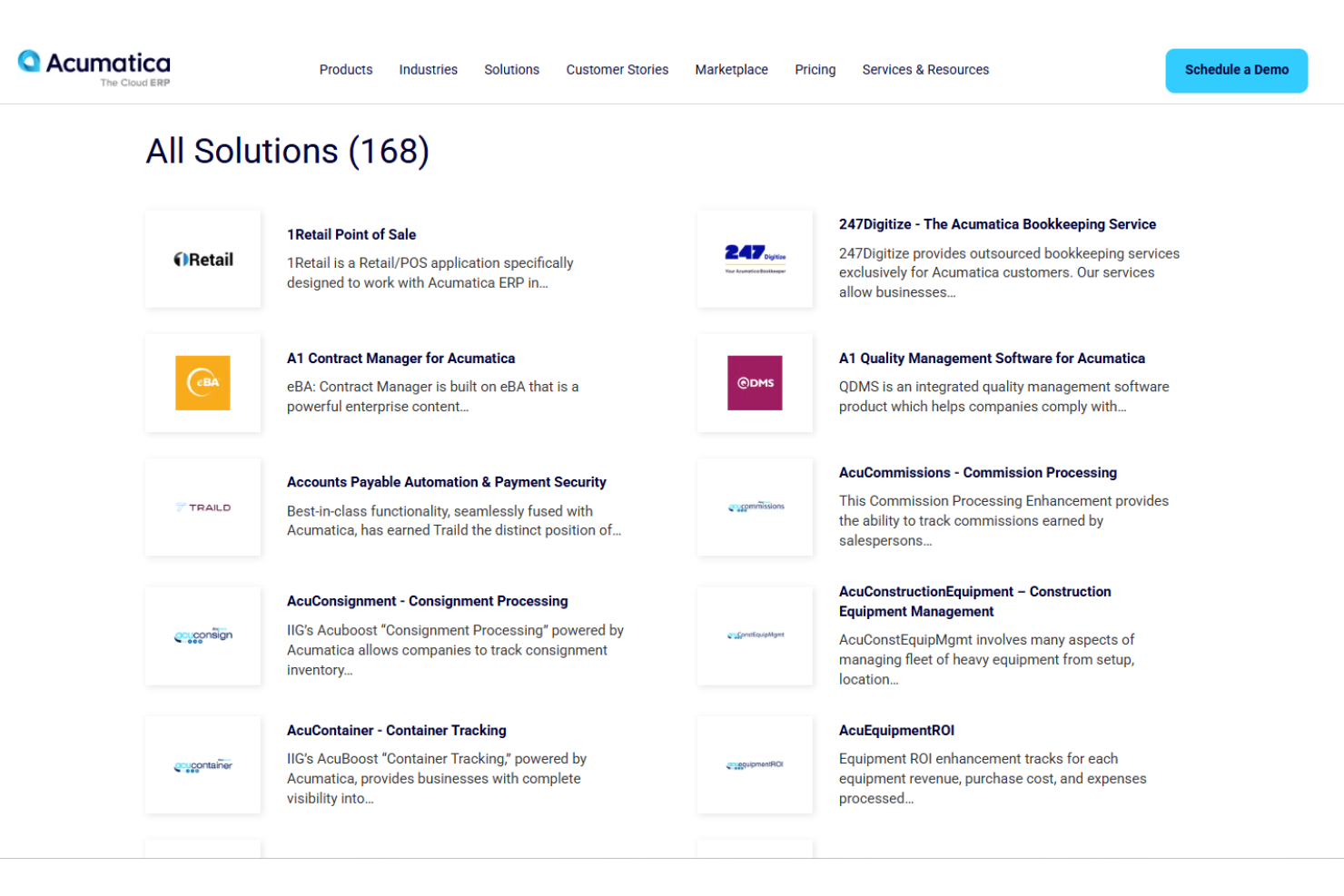
Acumatica integrates with Microsoft Office 365, Salesforce, Shopify, BigCommerce, Avalara, Adobe Document Cloud, HubSpot, DocuSign, Magento, and Amazon, among others.
Acumatica also offers an open API and connects with third-party integration tools for custom connectivity.
Acumatica Specs
- Accounts Payable
- Accounts Receivable
- API
- Budgeting
- Calendar Management
- Compliance Tracking
- Customer Management
- Dashboard
- Data Export
- Data Import
- Data Visualization
- Expense Tracking
- External Integrations
- Financial Analysis
- Forecasting
- Inventory Tracking
- Multi-Currency
- Multi-User
- Notifications
- Order Management
- Payroll
- Project Management
- Purchase Orders
- Resource Management
- Scheduling
- Supplier Management
- Task Scheduling/Tracking
- Third-Party Plugins/Add-Ons
- Warehouse Management
- Workflow Management


