

10 Best Aerospace ERP Software Reviewed in 2026

Best Aerospace ERP Software Shortlist


Aerospace companies require strong solutions that can handle stringent regulatory requirements, intricate manufacturing processes, and global operations. However, finding the best ERP software for the aerospace industry can be challenging when there are so many options available.
With my extensive background in ERP software, I tested and compared several of the top solutions on the market to get teams started in their search. Regardless of your company goals and need requirements, you’ll be able to use my in-depth reviews to find the right ERP solution to help you achieve success while remaining compliant.
Why Trust Our Software Recommendations
Our team has been testing and reviewing software since 2012. As finance leaders ourselves, we know how difficult—and important—it is to choose the right software.
For this guide, we evaluated tools using hands-on testing and independent research, scoring tools using our selection criteria.
Our reviews reflect our human editorial judgment, not a sales pitch.
Best Aerospace ERP Software Summary
| Tool | Best For | Trial Info | Price | ||
|---|---|---|---|---|---|
| 1 | Best for end-to-end material traceability | 30-day free trial | From $49/user/month | Website | |
| 2 | Best for detailed inventory tracking | 30-day free trial | From $50/user/month | Website | |
| 3 | Best for project-based ERP and compliance solutions | Free demo available | Pricing upon request | Website | |
| 4 | Best for compliance and security in aerospace and defense | Free demo available | Pricing upon request | Website | |
| 5 | Best for comprehensive asset lifecycle management | Free demo available | Pricing upon request | Website | |
| 6 | Best for integrated ERP with traceability and document management | Not available | Pricing upon request | Website | |
| 7 | Best for Salesforce integration and project lifecycle management | Free demo available | From $100/user/month | Website | |
| 8 | Best for customizable ERP solutions for aerospace manufacturers | Not available | Pricing upon request | Website | |
| 9 | Best for managing cost challenges and regulatory compliance | Free demo available | Pricing upon request | Website | |
| 10 | Best for integrated operations environment for aerospace suppliers | Not available | Pricing upon request | Website |
Best Aerospace ERP Software Reviews
My in-depth analysis provides overviews of each aerospace ERP software. Below, I will walk you through each tool’s pros and cons, features, and best use cases.

MRPeasy
Best for end-to-end material traceability
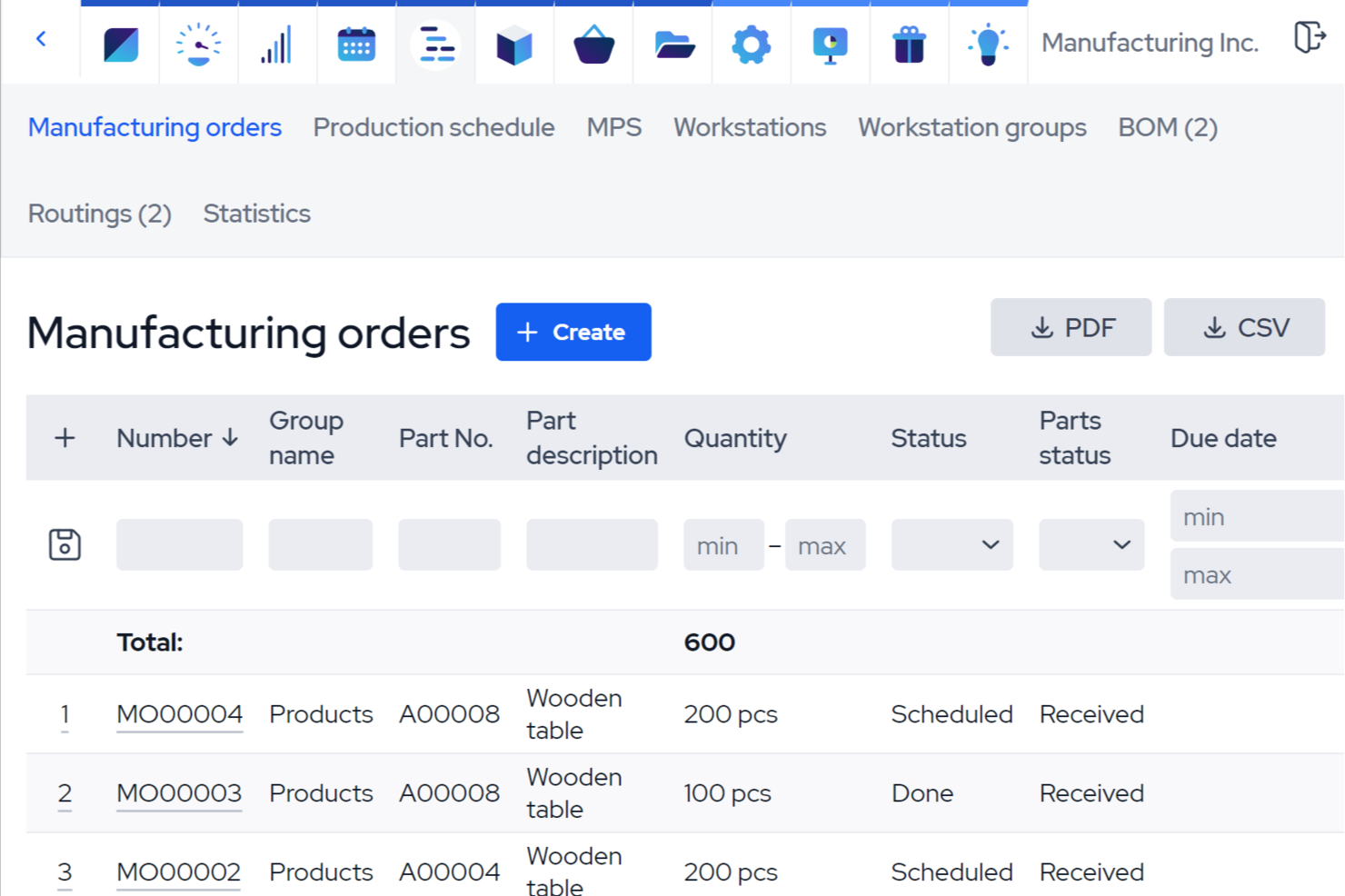
MRPeasy is a cloud-based ERP and MRP platform built for small manufacturers, covering production planning, inventory control, procurement, sales management, and financials in one system.
Who Is MRPeasy Best For?
MRPeasy is a good fit for small aerospace and defense manufacturers with 10 to 200 employees who need structured production and inventory control.
Why I Picked MRPeasy
MRPeasy earns its spot on my shortlist because its lot and serial number tracking covers every stage of the supply chain. In aerospace, where a single non-conformant component can ground a program, I like that you can trace a raw material lot from supplier receipt through production and all the way to the shipped unit. The RMA and callback functionality lets you isolate exactly which serialized products are affected without pulling back unrelated inventory. The integrated quality inspection tools, which flag non-conformity at goods receipt before materials ever hit the production floor, round out a traceability picture that's genuinely thorough.
MRPeasy Key Features
- Multi-level bill of materials: Build and manage complex, nested BOMs that reflect the full component hierarchy of aerospace assemblies.
- Production scheduling with Gantt charts: Schedule and reschedule manufacturing orders visually using a drag-and-drop Gantt interface.
- BOM revision control: Track and manage engineering change orders across BOM versions to keep production aligned with the latest specifications.
- Barcode scanning for shop floor reporting: Workers scan barcodes to log time, materials used, and job progress directly from the production floor.
Pros and Cons
Pros:
- Quality control tracking for compliance documentation
- Drag-and-drop production scheduling for planning
- Provides production cost tracking
Cons:
- User roles and permissions lack fine granularity
- No native document management for certifications
New Product Updates from MRPeasy
MRPeasy Expands REST API v2 With New Data Endpoints
MRPeasy expands REST API v2 with new endpoints for reports, dashboard data, production resources, stock, and settings. This gives users broader programmatic access to operational data. For more information, visit MRPeasy’s official site.
 .
.
Best for detailed inventory tracking

Cetec ERP is a full-suite, cloud-based manufacturing ERP platform built for aerospace and defense manufacturers, covering production, quoting, inventory, quality management, and financials in one integrated system.
Who Is Cetec ERP Best For?
Cetec ERP is a good fit for small to mid-sized aerospace and defense contract manufacturers that need AS9100-compliant quality controls and traceability built into their core operations.
Why I Picked Cetec ERP
I picked Cetec ERP as one of the best because its inventory tracking goes well beyond simple stock counts. In aerospace, every lot, serial number, heat code, and certificate of conformance needs to be tied to a specific part from receiving through final shipment—and Cetec handles all of that natively. I especially like the FIFO/FEFO bin-level tracking, which is critical when managing shelf life on materials. The as-used reporting also lets me trace exactly what material went into which work order, giving me the documentation I'd need for an audit or a customer CoC request without hunting across multiple systems.
Cetec ERP Key Features
- Non-conformance reporting (NCR): Log, track, and resolve quality failures directly within the platform, with linked disposition workflows and failure code assignment.
- Revision-controlled BOMs and routers: Manage engineering changes with version-controlled bills of materials and production routers, including routed approval workflows.
- ITAR and DFARS compliance tools: Built-in access controls and audit logging support regulatory requirements common in aerospace and defense production environments.
- Supplier quality tracking: Record and track supplier certifications, inspection results, and material rejections tied directly to purchase orders and receiving records.
Pros and Cons
Pros:
- Supports businesses of different sizes with real-time data access
- Strong fit for manufacturing and distribution sectors
- Covers finance, inventory, production, CRM, and quality assurance
Cons:
- Advanced customizations may require technical expertise
- Integration scope is limited
New Product Updates from Cetec ERP
Cetec ERP Adds Boardera Integration for PCB Quoting
Cetec ERP adds a Boardera integration that connects PCB analysis, costing, and quoting with live inventory data. This helps EMS providers and contract manufacturers move from RFQ to production-ready quote with fewer manual lookups. For more information, visit Cetec ERP’s official site.
 .
.
Deltek
Best for project-based ERP and compliance solutions

Deltek is a project-based ERP platform built specifically for aerospace and defense contractors, covering the full contract lifecycle with tools for project accounting, quality management, compliance, supply chain, and proposal pricing.
Who Is Deltek Best For?
Deltek is a strong fit for aerospace and defense contractors of all sizes that manage government contracts and need to stay compliant with DCAA, DFARS, and other federal regulations.
Why I Picked Deltek
Deltek earns its spot as one of the best on my shortlist because its Costpoint ERP is built around government contract structures—not retrofitted from a generic ERP platform. I rely on its project accounting module to track costs at the contract, CLIN, and WBS level in real time, and the built-in earned value management keeps my team audit-ready for DCAA reviews without manual reconciliation. The compliance framework isn't an add-on; it's woven directly into core ERP workflows.
Deltek Key Features
- Quality management system (QMS): Deltek TIPQA tracks part and process compliance against AS9100 and FAA requirements, with FAA Safety Element Approval built in.
- Supply chain management: Manage vendor qualifications, purchase orders, and counterfeit-part risk tracking across your A&D supply chain.
- Proposal pricing: Build and validate cost proposals against government pricing standards directly within the platform.
- Manufacturing execution: Track shop floor operations, work orders, and labor in real time against contract requirements.
Pros and Cons
Pros:
- Comprehensive financial management
- Project-based ERP
- Strong compliance tools
Cons:
- Limited customization options
- Complex setup

Infor
Best for compliance and security in aerospace and defense

Infor CloudSuite Aerospace & Defense is a purpose-built ERP platform for aerospace and defense manufacturers, contractors, and suppliers, covering contract management, supply chain, cost tracking, compliance, and MRO service management.
Who Is Infor Best For?
Infor CloudSuite Aerospace & Defense is a strong fit for mid-to-large defense contractors and aerospace manufacturers operating under government contracts with strict regulatory and security requirements.
Why I Picked Infor
Infor stands out because no other ERP I've reviewed comes pre-configured for the compliance frameworks defense contractors must follow. ITAR and EAR export controls are built into the system, so my team doesn't have to manage trade compliance separately. CMMC 2.0 and FedRAMP-ready deployment options let me show the platform as part of our security posture instead of constructing that evidence from scratch.
Infor Key Features
- Contract management and flow-down: Manage government and commercial contracts with clause flow-down to subcontractors built directly into the system.
- Project cost accounting: Track program costs, budgets, and actuals at the project level with A&D-specific KPIs and cost pegging.
- MRO service management: Schedule and manage maintenance, repair, and overhaul work orders alongside core manufacturing operations.
- Multi-site production planning: Coordinate materials, capacity, and supply across multiple facilities within a single planning environment.
Pros and Cons
Pros:
- Comprehensive project management
- Advanced analytics
- Robust cloud-based platform
Cons:
- Limited customer support
- Customization and upgrade challenges


IFS Cloud is an ERP platform built specifically for aerospace and defense organizations, integrating engineering, manufacturing, MRO, supply chain, and enterprise asset management into a single system.
Who Is IFS Cloud Best For?
IFS Cloud is a strong fit for mid-to-large aerospace and defense manufacturers, MRO providers, and defense contractors managing complex operations across multiple sites.
Why I Picked IFS Cloud
IFS Cloud earns its spot on my shortlist for its end-to-end asset lifecycle management. The IFS Cloud EAM module tracks assets from design through decommissioning, giving you a complete view of asset position at any point in time. Asset Performance Management lets teams monitor asset health in real time, which feeds into smarter maintenance planning and fewer unplanned outages. The aviation maintenance tools connect planning, scheduling, and execution in a single system, so MRO teams aren't working across disconnected platforms.
IFS Cloud Key Features
- Supply chain management: Plan, source, and track materials across complex aerospace and defense supply chains, with tools for inventory optimization and supplier management.
- Manufacturing execution system: Monitor shop floor operations in real time, tracking production progress, quality, and resource usage at the line level.
- Regulatory compliance management: Built-in tools to support certification and audit requirements for AS9100, FAA, and EASA standards.
- End-to-end traceability: Track components at the serial number level from initial receipt all the way through the full MRO lifecycle.
Pros and Cons
Pros:
- Extensive integrations
- Robust compliance features
- Comprehensive asset management
Cons:
- Requires training for full utilization
- Complex implementation

WinMan
Best for integrated ERP with traceability and document management

WinMan is a manufacturing ERP platform that covers production management, supply chain, planning and scheduling, document management, finance, CRM, and warehouse management within a single integrated system built specifically for manufacturers.
Who Is WinMan Best For?
WinMan is a strong fit for small to mid-sized aerospace and defense manufacturers that need a single system to manage production, quality, and supply chain.
Why I Picked WinMan
WinMan earns its spot on my shortlist because traceability and document management aren't add-ons here—they're built into the core of how the system works. I like that every item can be assigned a unique serial or batch number, giving my team full traceability from goods inwards all the way to the finished product. On the document side, technical drawings, contracts, and design files attach directly to individual records, so nothing lives outside the system.
WinMan Key Features
- Quality control logging: Record defects, assign work processes, and set quality milestones directly against production jobs.
- Engineer-to-order configurator: Build accurate bills of materials from a sales order and track engineering project costs in real time.
- Shop floor data capture: Log live production activity at the machine or workstation level to monitor job progress.
- Planning and scheduling: Manage capacity, production schedules, and material requirements from a single planning workspace.
Pros and Cons
Pros:
- Advanced production scheduling
- Strong compliance management
- Comprehensive traceability features
Cons:
- May require extensive training
- Complex ERP implementation process

Best for Salesforce integration and project lifecycle management

Rootstock is a cloud-based ERP platform built natively on Salesforce, for aerospace and defense manufacturers to manage project lifecycles, production operations, supply chain, traceability, and cost controls.
Who Is Rootstock Aerospace ERP Best For?
Rootstock suits mid-market aerospace and defense manufacturers that already use Salesforce and need a unified ERP built on the same platform.
Why I Picked Rootstock Aerospace ERP
Rootstock earns its spot on my shortlist because it's the only aerospace ERP that runs natively on the Salesforce Platform, which means your CRM and ERP data live in the same place. I like that project lifecycle management is built directly into production operations—you can plan, track, and cost by project using built-in Project Control, with real-time visibility from estimating and engineering all the way through shop floor scheduling. I also find the real-time cost accumulation across multiple projects genuinely useful, since you can drill down into any specific cost element without jumping between systems.
Rootstock Aerospace ERP Key Features
- Full configuration traceability: Track lot and serial numbers across device history records from engineering and production through to service.
- Automated audit trails: Automatically record all inventory material movements, revisions, and assembly or kitting requirements for regulatory documentation.
- eQMS with ComplianceQuest: Manage quality and regulatory compliance through a native partnership with ComplianceQuest, running on the Salesforce Platform.
- Engineering management tools: Manage components, BOMs, and engineering changes from within the same ERP environment as production and supply chain.
Pros and Cons
Pros:
- Real-time data visibility
- Comprehensive project lifecycle management
- Strong Salesforce integration
Cons:
- Complex setup process
- May require Salesforce expertise


Captivea is an Odoo Gold Partner and ERP implementation consultancy that deploys and customizes Odoo ERP for aerospace and defense manufacturers, covering manufacturing planning, supply chain management, quality control, compliance tracking, and financial management.
Who Is Captivea Best For?
Captivea is a strong fit for small to mid-sized aerospace and defense manufacturers that need a tailored Odoo ERP deployment built around their specific production and compliance workflows.
Why I Picked Captivea
I've included Captivea in my top picks because it's one of the few Odoo partners with a clear specialization in aerospace and defense manufacturing. I particularly like that it doesn't just deploy a generic Odoo instance—Captivea's team maps your specific production workflows and regulatory requirements into the system during implementation. Non-conformance tracking and quality audits are built into the quality management setup, which matters when you're operating under AS9100 or similar standards.
Captivea Key Features
- MRP scheduling: Plan production runs using bills of materials, work orders, and routings configured for aerospace part complexity.
- Lot and serial number traceability: Track individual components and assemblies across the full production lifecycle with end-to-end traceability.
- Project-based cost accounting: Monitor labor, materials, and overhead costs at the project level for accurate job costing.
- Demand forecasting: Generate replenishment recommendations based on historical usage and open sales orders.
Pros and Cons
Pros:
- Strong compliance tools
- Industry-specific features
- Highly customizable
Cons:
- Complex implementation process
- Limited global support


DELMIAWorks is a manufacturing ERP and MES platform built for mid-market discrete, repetitive, and batch process manufacturers, with integrated quality management, shop floor monitoring, supply chain control, and compliance tools built into a single system.
Who Is DELMIAWorks Best For?
DELMIAWorks is a strong fit for mid-size aerospace and defense manufacturers that need tight integration between shop floor operations, quality compliance, and financial controls in a single ERP platform.
Why I Picked DELMIAWorks
I've included DELMIAWorks in my top picks because it directly tackles two of the toughest problems in aerospace and defense manufacturing: tight cost control and regulatory compliance. I particularly like how ITAR certification management for export shipments is built right into the ERP, so there's no separate system to maintain. DELMIAWorks also has AS9100 Rev. C and D compliance integrated into its quality suite, covering nonconformance tracking, corrective actions, and document control from a single database, which makes audit prep far less painful.
DELMIAWorks Key Features
- Real-time shop floor monitoring: Track work-in-process, machine status, and production performance across the shop floor from a live data feed.
- Material requirements planning (MRP): Run MRP to align material procurement, inventory levels, and production scheduling with actual demand.
- Traceability and lot tracking: Trace materials and components across the full production lifecycle, from raw goods receipt through finished part shipment.
- Warehouse management: Manage inventory handling, bin locations, and material movement directly within the ERP without a separate warehouse system.
Pros and Cons
Pros:
- ITAR certification management
- Detailed MRP planning
- Comprehensive data management
Cons:
- Resource-intensive updates
- Complex customization options


ERP.aero is a cloud-based ERP and CRM platform built exclusively for aerospace parts suppliers, manufacturers, and MRO organizations, covering inventory management, order processing, RFQ automation, aviation marketplace integrations, and built-in e-commerce.
Who Is ERP.aero Best For?
ERP.aero is a strong fit for small to mid-sized aerospace parts suppliers and MRO companies that need an industry-specific system to manage sales, inventory, and marketplace operations in one place.
Why I Picked ERP.aero
ERP.aero earns its spot on my shortlist because it's built around a single, unified operational environment designed specifically for aerospace suppliers. I like that RFQ management, inventory, order processing, and invoicing all live within one platform, so your team isn't juggling disconnected tools. The built-in API connections to ILS, PartsBase, and Locatory let you list and sync inventory across leading aviation marketplaces directly from the ERP, with no manual exports or third-party middleware needed. The Store.aero e-commerce portal adds another layer, letting you manage product listings, customer relationships, and payments without ever leaving the system.
ERP.aero Key Features
- Work order management: Create and track repair and maintenance work orders tied directly to parts and customer records within the platform.
- Bill of materials (BOM) builder: Build and manage multi-level BOMs for aerospace parts manufacturing to support accurate job costing and production planning.
- Shipping and logistics management: Generate shipments and manage carrier bookings through built-in integrations with EasyPost and FlyCovr.
- Employee training module: Assign, track, and manage staff training courses and certifications from within the ERP to support compliance requirements.
Pros and Cons
Pros:
- Multilingual support
- Integrated warehouse equipment
- Cloud-based ERP/CRM
Cons:
- Less customization options
- Limited vendor support network
Other Aerospace ERP Software
Below is a list of additional aerospace ERP software that I shortlisted. While they didn’t make the top 10, they’re still valuable and worth further research.
- OnRamp Solutions
For real-time reporting and manpower tracking
- Deskera
For multi-currency accounting and data security
- DualEntry
For audit trails & anomaly detection
- Ramco ERP
For comprehensive aviation management
- Acumatica
For cloud-based ERP with flexible deployment
- Epicor
For scalable solutions for growing businesses


How I Evaluate Aerospace ERP Software
I split my evaluation into baseline acceptance criteria—like DCAA compliance and WBS-level costing—and differentiating factors that separate vendors for specific program types and contract structures.
Core Functionality (Table Stakes For This List)
When I'm selecting tools for my list, I rank each one on a scale from 0 (does not offer the functionality) to 5 (excels in this area) for each core functionality listed below. Then, I calculate the tool's total score into a percentage. Each tool needs to achieve a minimum total score of 55% to be considered for inclusion.
- Aerospace Compliance Accounting: I check whether the platform supports DCAA-compliant timekeeping, DFARS/FAR reporting, and ITAR audit trails—the kind of structure you'd need to survive a government contract audit intact.
- Project & Contract Costing: I evaluate how well each tool tracks costs at the program, contract, and WBS level, especially for multi-year programs where indirect rate allocation can make or break margin visibility.
- Government Contract Billing: Aerospace vendors deal with cost-plus, T&M, fixed-price, and milestone billing all at once. I look for platforms that handle these billing types and tie them to percentage-of-completion revenue recognition.
- Manufacturing Financial Integration: The GL needs to stay connected to MRP, BOM costing, and shop floor actuals. I look for real-time linkage between production data and financial records with lot and serial traceability baked in.
- Earned Value Management: For defense programs, I evaluate whether EVM reporting (CPI, SPI, BCWP, ACWP) is built in or requires manual workarounds, and whether it aligns with ANSI/EIA-748 standards for DoD reporting.
- Multi-Entity Consolidation: Global aerospace operations mean multi-currency, multi-company, and intercompany eliminations. I look at how each platform handles FX revaluation and subsidiary-level financial roll-ups.
Once I have a list of tools that meet this criteria, I consider what sets each platform apart.
Differentiating Factors (What Sets Vendors Apart)
Here's how I compare and contrast different vendors:
Standout Features
Configurable indirect rate modeling matters when you're juggling provisional and actual rates across multiple contracts. I look for tools that let you run what-if scenarios on forward pricing without exporting to spreadsheets. Estimating and proposal pricing is closely related—platforms that connect should-cost analysis to historical actuals give your team a real advantage during RFP cycles. I also evaluate MRO and aftermarket accounting, since shops handling repair work need tail number tracking and service contract billing tied to revenue schedules.
Beyond Features
Deployment model is a big consideration—if you're handling ITAR-controlled data, you need to confirm whether a vendor offers GovCloud, on-premise, or FedRAMP-authorized hosting. I also evaluate the integration ecosystem, particularly pre-built connectors to PLM tools like Siemens Teamcenter or PTC Windchill, since disconnected product and financial data creates real headaches at close. Scalability matters too. A Tier 3 supplier growing into prime contract work needs a platform that scales with program complexity without requiring a full replatform.
How to Choose Aerospace ERP Software
As you work through your own unique software selection process, keep the following points in mind:
- Industry-Specific Functionality: Aerospace and defense industries have unique requirements such as project management, raw materials management, quality standards, and shop floor automation. As such, ERP systems tailored to these needs can significantly streamline operations and aid companies dealing with complex projects and stringent regulations.
- Scalability and Flexibility: The ability of the ERP system to scale with your business and adapt to changing needs is vital. Find a software solution that’s known for their flexibility and customization options, so they’ll always be suitable for your evolving requirements.
- Integration Capabilities: Aerospace companies often use various specialized software for different functions. Therefore, an ERP system that integrates with existing tools can save time and reduce errors.
- Cost and Complexity: The total cost of ownership, including implementation, customization, and ongoing maintenance, should be carefully evaluated when choosing an ERP. It's important to balance the system's capabilities with your budget and resource availability.
- Vendor Support and Ecosystem: The quality of vendor support and the availability of a strong implementation ecosystem can greatly influence the success of your ERP deployment. Advanced training programs, ongoing technical assistance, and a strong network of implementation partners are important factors that ensure a smooth transition and long-term sustainability of the ERP system.
Trends in Aerospace ERP Software
Here are some trends I’ve noticed for aerospace ERP software, plus what they might mean for the future. I sourced countless product updates, press releases, and release logs to tease out the most important insights.
- AI and Machine Learning Integration: AI and machine learning are being integrated into ERP systems. These technologies help in predictive maintenance and optimizing supply chains. This trend is important for reducing downtime and increasing efficiency.
- Cloud-Based Solutions: Cloud ERP solutions are gaining traction. Compared to on-premise solutions, they offer scalability and remote access, which are essential for global operations. This trend supports the need for flexibility and real-time data access.
- Enhanced Cybersecurity Measures: Cybersecurity is becoming a top priority. Aerospace companies are investing in advanced security protocols to protect sensitive data. This trend is vital due to the increasing number of cyber threats.
- IoT Connectivity: IoT devices are being connected to ERP systems. This allows for real-time monitoring and data collection from various assets. This trend is significant for improving operational efficiency and asset management.
- Customizable User Interfaces: Customizable user interfaces are becoming more common. They allow users to tailor the ERP system to their specific needs. This trend is important for improving user experience and productivity.
What is Aerospace ERP Software?
An enterprise resource planning (ERP) system is an integrated software platform used by organizations to manage and automate core business processes across various departments.
When designed for the aerospace industry, ERPs help aerospace manufacturers, suppliers, and maintenance organizations maintain high product quality, increase production capacity, and quickly respond to market disruptions.
Features of Aerospace ERP Software
When selecting ERP software for the aerospace industry, it's important to understand the top features that will support your business operations. The right ERP system can help manage complex processes, ensure compliance, and improve overall efficiency. Here are some of the key features your ERP software should have:
- Compliance Management: Ensures adherence to industry regulations and standards, which is vital for maintaining certifications and avoiding penalties.
- Supply Chain Management: Manages the flow of materials and components, ensuring timely delivery and reducing the risk of production delays.
- Quality Control: Monitors and maintains product quality, which is essential for meeting stringent aerospace standards and customer expectations.
- Inventory Management: Tracks inventory levels and movements, helping to reduce excess stock and avoid shortages.
- Production Planning: Schedules and monitors production activities, ensuring efficient use of resources and meeting delivery deadlines.
- Financial Management: Handles accounting, budgeting, and financial reporting, providing a clear picture of the company's financial health.
- Project Management: Manages projects from inception to completion, ensuring they stay on track and within budget.
- Maintenance Management: Schedules and tracks maintenance activities, ensuring equipment and machinery are in optimal condition.
- Human Resources Management: Manages employee records, payroll, and benefits, supporting workforce planning and development.
- Customer Relationship Management (CRM): Manages customer interactions and data, helping to improve customer satisfaction and retention.
The features of aerospace ERP software are meticulously crafted to address the industry's complex demands, ensuring seamless integration and efficient management of critical operations. Investing in a good aerospace ERP solution not only enhances operational efficiency but also supports innovation and long-term growth within the industry.
Benefits of Aerospace ERP Software
Implementing aerospace ERP software can revolutionize your business operations by streamlining processes, ensuring compliance, and improving overall efficiency. Here are some of the primary benefits that this software can offer to users and organizations:
- Enhanced Compliance Management: Aerospace ERP software ensures adherence to industry regulations, reducing the risk of non-compliance and associated penalties.
- Improved Operational Efficiency: By integrating various business processes, the software minimizes manual tasks and errors, leading to more efficient operations.
- Real-Time Data Analytics: Access to real-time data enables better decision-making helps businesses to respond swiftly to market changes and operational demands.
- Streamlined Supply Chain Management: Aerospace ERP software optimizes the supply chain, improving inventory management and reducing lead times, which enhances overall productivity.
- Comprehensive Project Management: The software provides tools for detailed project planning and execution, ensuring projects are completed on time and within budget.
Choosing the right aerospace ERP software can significantly benefit your organization by enhancing compliance, improving efficiency, and providing valuable insights through real-time data. By streamlining supply chain and project management, you can ensure smoother operations and better financial outcomes.
Costs & Pricing of Aerospace ERP Software
When evaluating aerospace ERP software, it’s essential to understand the various pricing plans and what features each plan offers. This information helps software buyers make informed decisions based on their specific needs and budget. Below is a breakdown of common pricing plans and their features to guide you through the selection process.
Plan Comparison Table for Aerospace ERP Software
| Plan Type | Average Price | Common Features |
| Free | $0/user/month | Basic functionalities, limited user support, restricted data storage, and essential reporting tools |
| Basic | $50/user/month | Core ERP features, standard reporting, email support, basic analytics, and limited integrations |
| Standard | $100/user/month | Advanced analytics, supply chain management, compliance tools, project management, and chat support |
| Premium | $200/user/month | All Standard features, real-time data analytics, extensive integrations, 24/7 support, and mobile access |
| Enterprise | $500/user/month | Full suite features, custom integrations, dedicated account manager, enhanced security, and unlimited storage |
Choosing the right aerospace ERP software plan depends on your organization's size, budget, and specific needs. Make sure to carefully evaluate the features and support offered by each plan to find the best fit for your business.
Aerospace ERP Software FAQs
Here are some of the frequently asked questions I get asked about aerospace ERP software.
How does aerospace ERP software improve compliance?
Aerospace ERP software integrates regulatory requirements into its workflows, ensuring all processes comply with industry standards. It automates documentation and reporting, reducing human error and audit trails.
What is the typical implementation time for aerospace ERP software?
Implementation time varies but generally ranges from a few months to a year. Factors influencing this include company size, complexity of processes, and level of customization.
Is training provided with aerospace ERP software?
Most vendors offer training programs, which can include on-site training, online courses, and user manuals. Training is crucial for maximizing the software’s benefits and ensuring smooth adoption.
How does aerospace ERP software handle data security?
Aerospace ERP software typically includes robust security measures like encryption, access controls, and regular audits. These features help protect sensitive data from breaches and ensure compliance with data protection regulations.
What kind of support is available for aerospace ERP software?
Support options usually include email, phone, and live chat support. Higher-tier plans often come with dedicated account managers and 24/7 support.
What's Next?
Ready to compound your abilities as a finance professional? Subscribe to our free newsletter.