

10 Best Discrete Manufacturing ERP Software in 2026

Best Discrete Manufacturing ERP Software Shortlist


Discrete manufacturing ERP software simplifies your manufacturing processes and improves efficiency, which can lead to significant cost savings and increased profits. It is specifically designed for discrete manufacturing industries, where the final product is distinct and easily identifiable.
Given the many options available, choosing the appropriate discrete manufacturing ERP software can be challenging. Drawing from my extensive experience with various ERP systems in diverse and complex projects, I can offer valuable guidance to help you make the best selection.
Let me help you identify the optimal software solutions for your operational challenges. Here are my picks of the top discrete manufacturing ERP software.
Why Trust Our Software Recommendations
Our team has been testing and reviewing software since 2012. As finance leaders ourselves, we know how difficult—and important—it is to choose the right software.
For this guide, we evaluated tools using hands-on testing and independent research, scoring tools using our selection criteria.
Our reviews reflect our human editorial judgment, not a sales pitch.
Discrete Manufacturing ERP Software Comparison Table
This comparison table summarizes pricing details for my top discrete manufacturing ERP software selections:
| Tool | Best For | Trial Info | Price | ||
|---|---|---|---|---|---|
| 1 | Best with embedded AI-driven analytics | Free demo available | Pricing upon request | Website | |
| 2 | Best for detailed BOM creation | 30-day free trial | From $49/user/month | Website | |
| 3 | Best for real-time production tracking | 30-day free trial | From $50/user/month | Website | |
| 4 | Best for real-time inventory management | Free plan available | From $299/month | Website | |
| 5 | Best for open-source ERP solutions | Free trial + free download available | From $50/month (unlimited users) | Website | |
| 6 | Best for scalable manufacturing ERP | Free demo available | Pricing upon request | Website | |
| 7 | Best for small to medium-sized manufacturers | Not available | Pricing upon request | Website | |
| 8 | Best for manufacturing and distribution sectors | Free demo available | Pricing available upon request | Website | |
| 9 | Best for integrated discrete manufacturing ERP | Not available | Pricing upon request | Website | |
| 10 | Best for complete manufacturing ERP | Free demo available | Pricing upon request | Website |

Best Discrete Manufacturing ERP Software Reviews
This in-depth analysis provides overviews of each discrete manufacturing ERP software. I will walk you through the pros and cons of each tool, their features, and their best use cases.

Priority
Best with embedded AI-driven analytics
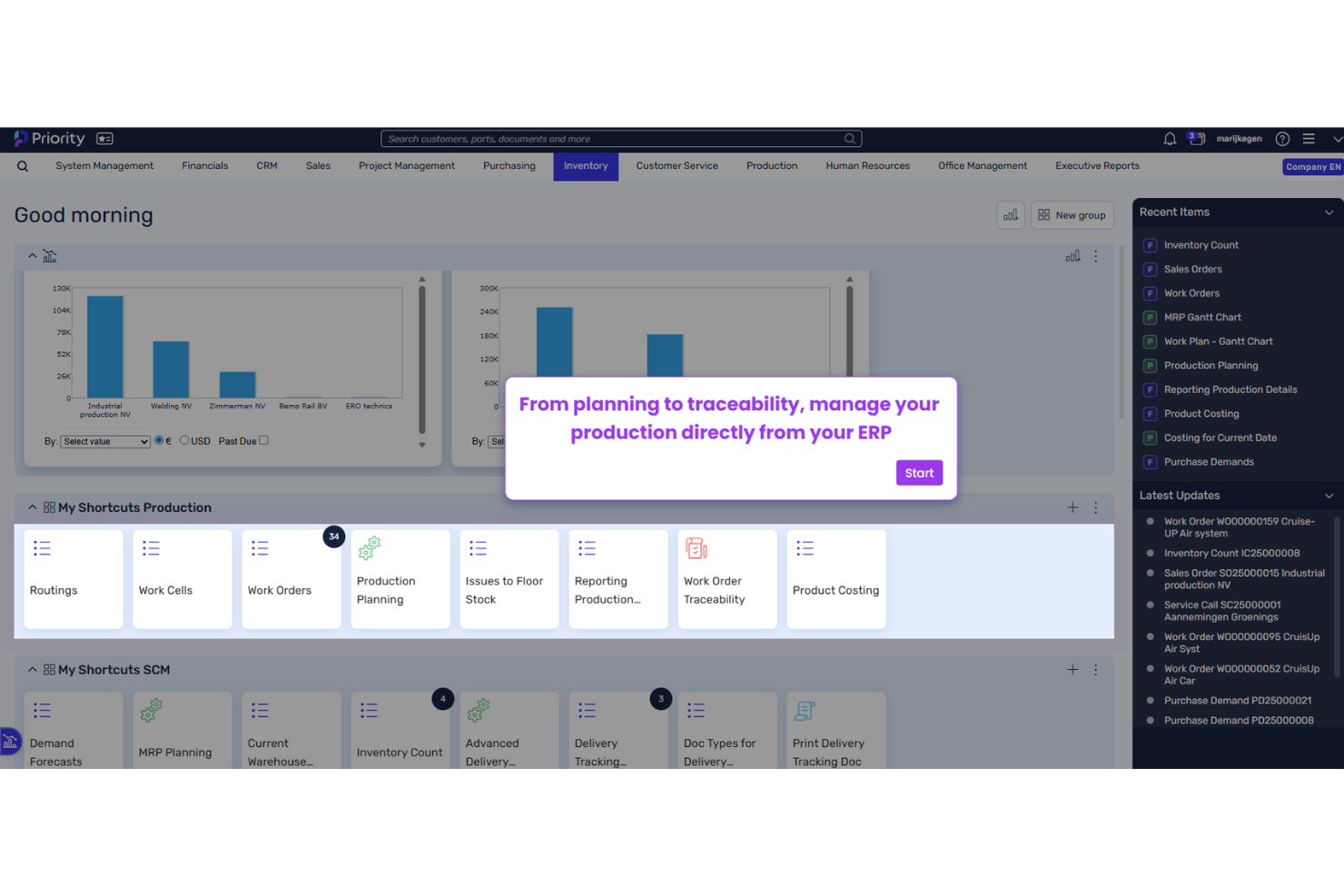
Priority is a cloud ERP platform covering production planning, MRP, financials, supply chain, and CRM, with an embedded AI suite called aiERP built directly into its core architecture.
Who Is Priority Best For?
Priority is well-suited to mid-sized discrete and mixed-mode manufacturers that need a single platform to manage production, finance, and supply chain across multiple sites.
Why I Picked Priority
I've included Priority in my top picks because its aiERP suite is genuinely embedded in the platform's architecture—not bolted on as an afterthought. What I find especially useful for discrete manufacturers is the machine learning-powered prediction engine: it trains forecasting models on historical data to flag inventory gaps and delivery risks before they hit production. I also like the aiERP Companion, which lets planners and ops teams query live production and supply chain data in plain language, without building reports manually. On top of that, AI-driven descriptive analytics surface explanations for trend shifts directly inside charts, so your team spends less time interpreting data and more time acting on it.
Priority Key Features
- MRP: Calculates material and capacity needs from demand signals, BOMs, and inventory levels across multiple production sites.
- BOM management: Builds and manages multi-level BOMs with revision control and ECO workflows for engineering changes.
- Serial and lot traceability: Tracks components and finished goods by serial number or lot from receipt through production.
- Work order management: Creates and monitors work orders with routing steps, labor assignments, and real-time status on the shop floor.
Pros and Cons
Pros:
- Multilingual and multicurrency features included
- Offers real-time shop floor data collection
- Handles complex BOMs and engineering changes
Cons:
- Custom report building can be time-consuming
- Mobile app functionality is somewhat restricted

MRPeasy
Best for detailed BOM creation

MRPeasy is a cloud-based manufacturing ERP built for small manufacturers, covering production planning, BOM management, inventory control, procurement, shop floor reporting, and financials in one system.
Who Is MRPeasy Best For?
MRPeasy is a good fit for small and mid-sized discrete manufacturers looking for a structured ERP without the complexity or cost of enterprise systems.
Why I Picked MRPeasy
MRPeasy is one of my top picks because of how much flexibility it gives you in structuring product BOMs. You can build single-level BOMs for simple assemblies, multi-level BOMs for products with nested subassemblies, and Matrix BOMs for configurable products with parameter-driven variations—all within the same system. I also like the Disassembly BOM and Co-product BOM options, which cover edge cases like kitting, raw material cutting, and scrap tracking that most small-manufacturer ERPs skip. The built-in version control and revision system lets you track every BOM change over time, which is especially useful when a customer requests a rollback to a previously used configuration.
MRPeasy Key Features
- MRP scheduling: Calculates material and capacity needs from sales orders and forecasts, then generates planned production and purchase orders.
- Shop floor reporting: Workers log job times, material consumption, and output quantities via a dedicated shop floor terminal.
- Lot and serial number tracking: Assign lot or serial numbers to materials and finished goods for end-to-end traceability.
- Subcontracting management: Create subcontracting purchase orders for outsourced operations and track them within production routing.
Pros and Cons
Pros:
- Wide range of functionalities
- Effective inventory management
- Real-time visibility into operations
Cons:
- The initial setup can be lengthy and complex
- Learning curve for new users
New Product Updates from MRPeasy
MRPeasy Expands REST API v2 With New Data Endpoints
MRPeasy expands REST API v2 with new endpoints for reports, dashboard data, production resources, stock, and settings. This gives users broader programmatic access to operational data. For more information, visit MRPeasy’s official site.
 .
.
Best for real-time production tracking

Cetec ERP is a cloud-based, full-suite manufacturing ERP that covers quoting, BOM management, MRP, shop floor control, work order tracking, inventory, quality management, and financials in one connected platform built specifically for discrete manufacturers.
Who Is Cetec ERP Best For?
Cetec ERP is well-suited for small to mid-sized discrete manufacturers running high-mix, low-volume production environments who need a single system across operations and finance.
Why I Picked Cetec ERP
Cetec ERP's shop floor tracking ties work order progress, labor, and WIP costs together in real time—not after the fact. Production supervisors can track pieces through each operation as they're completed, with labor clocked against the work order. Actual costs update live as production moves, so job costing reflects what's happening on the floor. The customizable dashboards and real-time BI reporting surface production KPIs and exceptions without manual data pulls.
Cetec ERP Key Features
- MRP planning: Calculates material demand across open work orders and purchase orders to flag shortages before production starts.
- BOM management: Build and manage multi-level bills of materials with revision control tied directly to work orders and quoting.
- Lot and serial traceability: Track parts and finished goods by lot or serial number from receiving through shipping.
- Integrated quality management: Log inspections, NCRs, and CARs directly against work orders and inventory records.
Pros and Cons
Pros:
- Workflows and reports can be adapted to business needs
- Supports multiple manufacturing modes – discrete, process, and mixed mode production
- Real-time production tracking
Cons:
- System can slow with very large data sets
- Integration scope is limited
New Product Updates from Cetec ERP
Cetec ERP Adds Boardera Integration for PCB Quoting
Cetec ERP adds a Boardera integration that connects PCB analysis, costing, and quoting with live inventory data. This helps EMS providers and contract manufacturers move from RFQ to production-ready quote with fewer manual lookups. For more information, visit Cetec ERP’s official site.
 .
.
Katana
Best for real-time inventory management

Katana is a cloud-based inventory and manufacturing management platform that tracks stock across multiple locations, manages production orders, and syncs sales channels—all from a single real-time system built for product businesses.
Who Is Katana Best For?
Katana is a strong fit for small to mid-sized manufacturers and product businesses that sell across multiple channels and need live visibility into stock and production.
Why I Picked Katana
Katana earns its spot on my shortlist because real-time inventory visibility is genuinely central to how it works, not just a feature tacked on. I love how stock levels update the moment a sales order comes in or a production order is fulfilled, so I'm never working from stale numbers. The multi-location tracking lets me see exactly which components are at which warehouse or production floor at any given moment. Katana's available-to-promise calculations also update live as demand changes, which matters when you're assembling to order.
Katana Key Features
- Bill of materials (BOM) management: Build single-level and multi-level BOMs with subassemblies to define exactly what components go into each finished product.
- Shop Floor App: Assign production tasks to operators, track work-in-progress, and log time against specific manufacturing orders from the floor.
- Batch and serial number traceability: Track raw materials and finished goods by batch or serial number for end-to-end traceability.
- Purchase order management: Create and manage purchase orders based on reorder points and current stock shortfalls.
Pros and Cons
Pros:
- Intuitive interface
- Complete task management
- Real-time stock tracking
Cons:
- Initial setup complexity
- Basic reporting tools


ERPNext is a 100% open-source ERP platform with dedicated manufacturing, inventory, accounting, procurement, and quality modules built for discrete manufacturers who want full control over their software without per-user pricing.
Who Is ERPNext Best For?
ERPNext is a strong fit for small to mid-sized manufacturers who want a self-hosted or cloud ERP they can customize without licensing costs.
Why I Picked ERPNext
ERPNext is one of my top picks because I love that it's built entirely on an open-source framework, which means your team can modify anything from custom BOMs to production dashboards without paying for a developer license. In practice, that means you can build multi-level BOMs that link sub-assemblies, raw materials, and operations costs, then run production planning directly against live sales orders and warehouse stock. I also find the work order system particularly well-suited to discrete manufacturing, since it generates job cards per operation and triggers raw material transfers automatically.
ERPNext Key Features
- Subcontracting management: Send raw materials to third-party vendors and track returned finished goods against open purchase orders.
- Quality inspections: Configure inspection criteria at goods receipt, in-process, or delivery stages, with pass/fail outcomes logged against each transaction.
- Serial and batch tracking: Assign serial numbers or batch IDs to finished goods and trace them back through every production and inventory movement.
- Workstation and routing: Define machine workstations, set capacity hours, and map multi-step routings to control production sequencing.
Pros and Cons
Pros:
- Flexible and scalable
- Complete feature set
- Open-source customization
Cons:
- Limited built-in reporting capabilities
- Learning-curve for customization

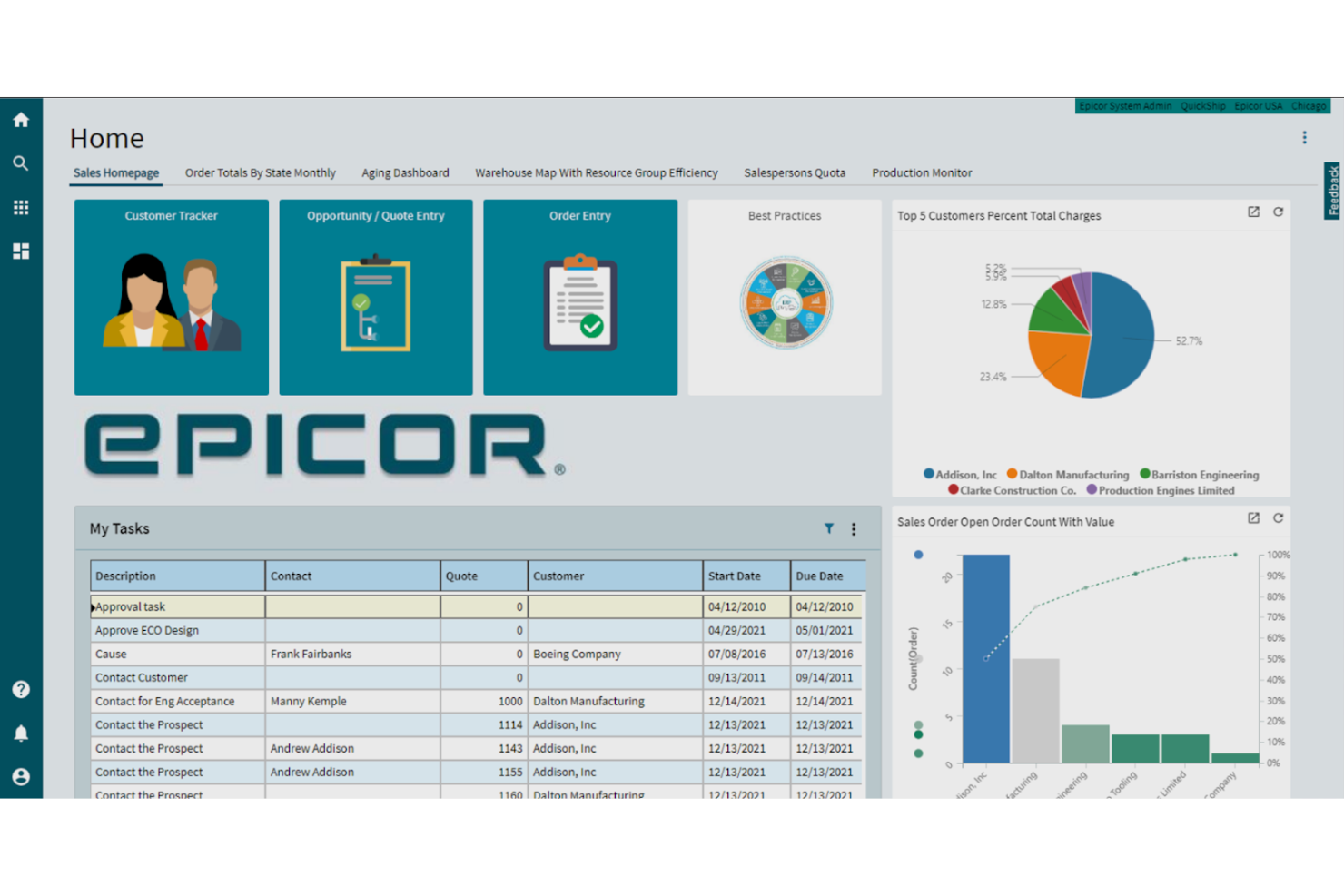
Epicor Kinetic is a manufacturing ERP platform built specifically for discrete producers, job shops, and multi-plant operations, covering production planning, shop floor control, supply chain management, financial management, and CPQ.
Who Is Epicor Manufacturing Best For?
Epicor Kinetic is a strong fit for mid-market to enterprise discrete manufacturers across industries like industrial machinery, automotive, aerospace, and electronics.
Why I Picked Epicor Manufacturing
I've included Epicor Kinetic in my top picks because it's one of the few ERP platforms that scales from a single job shop to a multi-site global operation without requiring a platform switch. What I like most is that Epicor IP&O uses machine learning to automate demand forecasting and materials planning, so as your production volume grows, your planning process doesn't fall apart under the weight of more SKUs and suppliers. The multi-plant management and real-time shop floor visibility through Epicor Advanced MES also mean your operations stay connected and accountable at every level of growth.
Epicor Manufacturing Key Features
- Visual CPQ: Configure complex, customizable products with a visual configurator that generates accurate pricing and quotes directly from the product model.
- Engineering change management: Track and control changes to BOMs, routings, and product specs with revision control and approval workflows.
- Quality management: Define inspection plans, capture non-conformance events, and manage corrective actions at the job or lot level.
- Supplier portal: Share POs, delivery schedules, and RFQs with suppliers through a self-service portal with built-in EDI support.
Pros and Cons
Pros:
- Industry focus
- Complete feature set
- Highly scalable
Cons:
- Complicated customization for some users
- Implementation can be complex

ECI Solutions is a suite of cloud-based ERP and business management products built for manufacturers, with dedicated solutions for discrete manufacturing, job shops, and batch and process operations—covering everything from shop floor control and job costing to inventory, scheduling, and production planning.
Who Is ECI Solutions Best For?
ECI Solutions is a natural fit for small to mid-sized discrete manufacturers, job shops, and make-to-order operations that need industry-specific ERP without enterprise-level complexity.
Why ECI Solutions Stands Out
M1 ERP is purpose-built for small to mid-sized discrete manufacturers. M1 handles multi-location inventory tracking with real-time demand forecasting and automated reorder triggers, so you're not scrambling when materials run short. I also like its integrated quoting and estimating feature, which pulls from historical job and part data to generate accurate quotes, then converts them directly into work orders without re-entry. For SMBs running tight margins, that end-to-end connection between estimating, production, and financials is critical.
ECI Solutions Key Features
- Bill of materials management: Build and manage multi-level BOMs with revision tracking, linking components directly to work orders and production routings.
- Visual scheduling board: Drag-and-drop production scheduling gives you a real-time view of shop floor capacity so you can reassign jobs as priorities shift.
- Quality control with non-conformance tracking: Log, track, and resolve quality issues at any stage of production with built-in inspection checklists and corrective action workflows.
- MRP engine: Generate material requirements based on current demand, open orders, and on-hand inventory to drive purchasing decisions.
Pros and Cons
Pros:
- Tailored for small to medium-sized manufacturers
- User-friendly interface
- Complete feature set
Cons:
- Initial setup can be complex
- Limited scalability for larger enterprises


SYSPRO ERP is an industry-specific ERP platform built for manufacturing and distribution, covering production planning, BOM, MRP, work in progress, supply chain, quality management, and financials in a single modular system.
Who Is SYSPRO ERP Best For?
SYSPRO ERP is a strong fit for mid-market manufacturers and distributors who need an industry-specific ERP without the complexity of a large enterprise platform.
Why I Picked SYSPRO ERP
SYSPRO ERP earns its spot on my shortlist because it's purpose-built for manufacturing and distribution, rather than adapted from a generic business platform. I particularly like its engineering change control module, which lets discrete manufacturers manage product design revisions without disrupting active production jobs. Its lot traceability functionality also stands out—I can track components from receipt through to finished goods, which is critical in industries with strict compliance or recall requirements.
SYSPRO ERP Key Features
- Bill of materials (BOM): Build multi-level product structures that link components, quantities, and routing steps to each finished item.
- Material requirements planning (MRP): Generate purchase and production recommendations based on demand, inventory levels, and lead times.
- Work in progress (WIP) tracking: Monitor labor, material costs, and job status at each stage of the production floor.
- Quality management: Configure inspection checkpoints and non-conformance workflows across purchasing, production, and inventory.
Pros and Cons
Pros:
- Complete industry-specIfic solutions
- Advanced inventory management
- Solid analytics and reporting
Cons:
- Outdated documentation
- Complex implementation process


xTuple is a cloud-based ERP platform built for small to mid-sized manufacturers and distributors, covering production planning, inventory management, supply chain, and warehouse operations.
Who Is xTuple Best For?
xTuple is a strong fit for small to mid-sized discrete manufacturers who need an ERP that covers both production and distribution in a single system.
Why I Picked xTuple
I've included xTuple in my top picks because it keeps manufacturing and financial operations in one place, which is a common struggle for small to mid-sized discrete manufacturers. I like that multi-level MRP ties directly into Bills of Materials and work orders, so when a sales order comes in you can see if you have the components to fulfill it. The Master Production Schedule ties purchasing decisions to real demand signals rather than guesswork. That kind of integration across production, inventory, and finance is rare without paying enterprise-tier prices.
xTuple Key Features
- Assemble-to-order configurator: Build custom product configurations at order entry, so sales teams can quote and commit to customer-specific assemblies without involving production manually.
- Shop floor time clock: Track labor hours directly on the shop floor, so production managers can log and review actual time spent against each work order.
- Warranty and RMA management: Manage product returns, warranty claims, and replacement workflows within the same system where orders and inventory live.
- Warehouse management: Supports multi-location inventory tracking, bin-level storage, and lot and serial number traceability across receiving, picking, and shipping.
Pros and Cons
Pros:
- Complete management features
- Automates manual tasks
- Integrates disparate systems
Cons:
- Slower updates compared to competitors
- Limited customization options


Global Shop Solutions is a manufacturing ERP platform with 35+ integrated applications covering scheduling, shop floor data collection, quality management, inventory, purchasing, job costing, and financial management.
Who Is Global Shop Solutions Best For?
Global Shop Solutions is a strong fit for small to mid-sized discrete manufacturers, particularly job shops and make-to-order production environments.
Why I Picked Global Shop Solutions
Global Shop Solutions earns its spot on my shortlist because it covers the entire manufacturing workflow in a single system, from initial quote through final delivery. What I find especially compelling is that job costing runs as a thread through every module, so when a shop order is created, costs automatically flow through production, materials, and labor without manual reconciliation. I also like the built-in shop floor data collection, which lets floor operators log labor and material usage in real time, keeping WIP and job cost data current throughout the production cycle.
Global Shop Solutions Key Features
- Finite capacity scheduling: Plan and sequence production jobs based on real machine and labor capacity across your shop floor.
- Bill of materials management: Build and manage multi-level BOMs with revision control tied directly to shop orders.
- Quality management: Create inspection plans, log non-conformances, and track corrective actions within the ERP.
- Purchasing and vendor management: Generate purchase orders, track receipts, and manage vendor performance from a single module.
Pros and Cons
Pros:
- Extensive integrations
- Cloud and on-premise options
- Complete feature set
Cons:
- Limited scalability options
- Requires training
Other Discrete Manufacturing ERP Software
Below is a list of additional discrete manufacturing ERP software that we shortlisted, but did not make it to the top list. Still definitely worth checking out!
- Kenandy ERP
For Salesforce-based ERP integration
- eresource
For production management
- Xledger
For financial management and automation
- Microsoft Dynamics 365 Business Central
For seamless integration with Microsoft products
- IFS
For asset-intensive industries
- Aptean
For specialized industry solutions
- Acumatica Cloud ERP
For scalable cloud-based solutions
- Odoo ERP
For modular and customizable options
- Infor CloudSuite Industrial
For industry-specific functionalities
- SAP ERP
For large enterprises with complex needs


How I Evaluate Discrete Manufacturing ERP Software
I evaluate each platform in two layers: baseline must-haves like WIP-to-GL automation and work order costing, and the differentiators that signal a genuine fit.
Core Functionality (Table Stakes For This List)
When I'm selecting tools for my list, I rank each one on a scale from 0 (does not offer the functionality) to 5 (excels in this area) for each core functionality listed below. Then, I calculate the tool's total score into a percentage. Each tool needs to achieve a minimum total score of 65% to be considered for inclusion.
- Discrete Manufacturing Costing: I check whether a platform supports standard, actual, and average costing tied to BOMs and routings—like running a cost roll-up after a material price change.
- Integrated GL & Financials: The tool should include native AP, AR, and GL modules so manufacturing transactions post without needing a separate accounting system.
- Inventory & WIP Accounting: I look for real-time GL posting of material movements, WIP balances, scrap, and production variances rather than batch or manual journal entries.
- BOM & Work Order Management: Multi-level BOMs, routings, and discrete work orders should drive financial postings—for example, closing a work order and seeing variances post automatically.
- Multi-Entity & Compliance Reporting: I evaluate whether the system handles multi-currency consolidation and supports GAAP/IFRS reporting across plants and legal entities.
- Production-to-Finance Traceability: Finance teams need to drill from a GL variance down to a specific work order, lot, or serial number without pulling separate reports.
Once I have a list of tools that meet this criteria, I consider what sets each platform apart.
Differentiating Factors (What Sets Vendors Apart)
Here's how I compare and contrast different vendors:
Standout Features
I look for embedded manufacturing analytics that go beyond standard reports—pre-built dashboards for margin analysis by product line or plant help finance teams spot cost trends without building custom queries. Real-time shop floor data collection is another differentiator, because when labor and machine actuals feed directly into cost accounting, your variance analysis reflects what actually happened on the floor. I also evaluate demand and supply planning, since MRP tied to financial forecasts gives FP&A teams a clearer picture of cash flow and inventory commitments.
Beyond Features
Integration ecosystem matters a lot here. I check whether a platform offers prebuilt connectors to CAD/PLM systems, tax engines, and EDI partners, because finance teams in discrete manufacturing rely on data flowing cleanly between engineering, procurement, and the GL. Implementation support is equally important—I look for vendors with certified partners who have hands-on experience setting up cost models and running parallel close cycles in manufacturing environments. SOC 1/SOC 2 attestations and SOX-ready audit logging also weigh into my evaluation, since external auditors expect that level of control.
How to Choose Discrete Manufacturing ERP Software
Remember the following points as you work through your unique software selection process.
- Address Business Issues: When selecting discrete manufacturing ERP software, choosing an application that addresses your specific business issues is essential. For example, if your business struggles with managing customer expectations and order visibility, look for an ERP system that provides enterprise visibility into the entire order cycle.
- Planning and Scheduling: Efficient planning and scheduling are essential for discrete manufacturers. Many manufacturers still rely on manual processes, which can be inefficient and error-prone. An ERP system should help you quickly schedule and sequence activities to meet deadlines. This ensures that your entire organization is in sync.
- Inventory and Procurement: Accurate inventory management is vital for informed materials management decisions. The right ERP system should provide tools that make it easy to collect, reconcile, and post-count quantities against on-hand inventory balances. For example, everyday inventory transactions such as transfers, movements, and scraps should support the demands of your business without slowing down processes.
- Shop Floor Efficiency: To make the shop floor as efficient as possible, it's important to eliminate the need for paperwork. An ERP system should digitize processes and communications, providing real-time insight into production, employee, and material status. This helps update production schedules, work order instructions, and material lists.
- Quality Management: An ERP system should help automate and manage quality audits and compliance. It should track the cost and frequency of quality events, initiate non-conformances and corrective actions, and manage compliance with quality systems such as ISO and FDA.
Trends For Discrete Manufacturing ERP Software
Discrete manufacturing ERP software is advancing to meet changing industry demands. Here are several emerging trends shaping the future of ERP solutions for discrete manufacturing.
- AI and Machine Learning Integration: AI and machine learning are transforming ERP systems by enabling predictive maintenance and demand forecasting. These technologies help manufacturers optimize processes and reduce downtime. Their impact on decision-making and efficiency is significant.
- IoT and Real-Time Monitoring: Integrating IoT devices with ERP systems allows for real-time monitoring of manufacturing processes. This connectivity provides instant data on machine performance and production metrics. It enhances visibility and control across the production floor.
- Cloud-Based Solutions: Cloud-based ERP solutions offer scalability, flexibility, and cost-efficiency. They enable manufacturers to access data from anywhere, aiding remote work and collaboration. This trend supports the growing need for digital transformation in manufacturing.
- Advanced Analytics and Big Data: Advanced analytics tools and big data capabilities are becoming standard in ERP systems. These features provide deep insights into production trends, helping manufacturers make data-driven decisions. Enhanced analytics improve overall operational efficiency.
- Sustainability and Green Manufacturing: ERP systems are increasingly incorporating features that support sustainable practices. These include modules for energy management and waste reduction. Emphasizing sustainability helps manufacturers meet regulatory requirements and corporate social responsibility goals.
These trends highlight the changes in discrete manufacturing ERP software and what drives efficiency, innovation, and sustainability.
What Is Discrete Manufacturing ERP Software?
Discrete manufacturing ERP software is a specialized enterprise resource planning system designed to manage the production of distinct, countable items for industries like automotive, electronics, and machinery. It centralizes data from inventory, production, and customer information to simplify operations, reduce costs, and improve efficiency. This software provides manufacturers with control and visibility over their production processes.
The key components of discrete manufacturing ERP software include parts management, bill of materials (BOM), production planning, purchasing, inventory management, production management, quality control, and shipping. These components track materials, forecast and schedule production, manage work orders, ensure product quality, and handle logistics. Each element is essential for efficient manufacturing operations, from acquiring raw materials to delivering finished goods.
Features
Below, I outline essential features to look for in discrete manufacturing ERP software to help you make an informed decision.
- Inventory Management: This feature ensures you have the proper inventory to build products, avoiding shortages and excess stock. It tracks the status and location of every inventory item in real time, helping you plan for demand and manage safety stock levels.
- Supply Chain Management: Effective supply chain management is important for maintaining the flow of materials needed for production. This feature allows real-time communication with suppliers, monitors supplier performance, and provides alerts for potential disruptions.
- Material Requirements Planning (MRP): MRP helps determine the inventory needed for production by consolidating demand, scheduling, and inventory requirements. It uses sales orders and patterns to forecast needed inventory and plans for the materials, resources, and capacity required for production.
- Advanced Planning & Scheduling: This feature simulates your production environment, considering resource capacity and analyzing 'what if' scenarios to create optimized production plans. It balances demand and capacity using advanced algorithms and allows manual adjustments to the schedule.
- Shop Floor Execution: It is important to ensure smooth operations on the shop floor. This feature provides process instructions to workers, allows task management via touch screens, and lets supervisors monitor production status remotely. It helps track the source of defects and manage worker productivity.
- Quality Management: Maintaining high-quality standards is essential, especially in regulated industries. This feature helps identify and resolve quality issues, execute inspection plans, and evaluate vendor performance. It also provides documentation for audits and compliance.
- Job Costing: Accurate job costing is vital for financial management. This feature uses data from various modules to calculate the cost of each job in real-time, allowing you to compare estimated vs. actual costs and analyze cost differences.
- Analytics and Business Intelligence: Real-time data and role-based dashboards enable informed decision-making. This feature provides pre-built and customizable reports, reveals patterns for actionable insights, and forecasts future outcomes to guide strategic planning.
- Production Management: This feature includes a Bill of Materials (BOM) to list all materials and resources needed for production. It monitors job performance, manages material requests, and tracks direct and indirect costs. It also allows for BOM revisions and engineering change orders.
- Fulfillment Tracking: Ensuring timely delivery of finished goods is important for customer satisfaction. This feature tracks work orders, accounts for consumed raw inventory, and manages the shipping process to meet customer expectations.
Choosing the right discrete manufacturing ERP software with these features will help simplify your operations, improve efficiency, and maintain high-quality standards. Finding a modern system that meets your current needs and can scale with your manufacturing business as it grows is important.
Benefits
Implementing discrete manufacturing ERP software offers significant advantages for users and organizations, enhancing overall efficiency and productivity. These benefits are important for potential buyers looking for simplified manufacturing processes and optimized business operations.
- Improved Production Planning: The software enables scheduling and resource allocation, ensuring production runs smoothly and on time.
- Enhanced Inventory Management: It provides real-time inventory tracking and management, reducing waste and ensuring that materials are available when needed.
- Cost Reduction: The software helps identify cost-saving opportunities and reduces operational expenses by centralizing data and automating processes.
- Increased Data Accuracy: The software minimizes errors through automation, leading to more accurate data and better decision-making.
- Better Customer Service: ERP software integrates customer information to improve order tracking and responsiveness, increasing customer satisfaction.
These benefits make discrete manufacturing ERP software a valuable tool for manufacturing companies aiming to enhance operations and achieve greater efficiency. This technology supports better resource management, cost control, and overall business performance.
Costs and Pricing
Below is a breakdown of different types of plans available for discrete manufacturing ERP software, their average prices, and the common features included in each plan.
Plan Comparison Table for Discrete Manufacturing ERP Software
| Plan Type | Average Price | Common Features |
| Free | $0 | Basic inventory management, order processing, and limited reporting |
| Basic | $40/user/month | Inventory management, order processing, and basic financial management |
| Standard | $125/user/month | Advanced inventory management, production planning, and financial management |
| Professional | $250/user/month | Full production management, supply chain management, and customer relationship management (CRM) |
| Enterprise | $5000/user/month | complete ERP suite including advanced analytics, multi-site support, and extensive customization options |
When selecting an ERP plan, consider the size of your business, the complexity of your operations, and your budget. Each plan offers different features and capabilities, so choose the one that best aligns with your business needs.
FAQs
Need clarity on how discrete manufacturing ERP software can simplify your production processes? Here are answers to frequently asked questions to help you better understand its functionality.
How does discrete manufacturing ERP software improve production efficiency?
This software improves production efficiency by automating and streamlining various business processes. It helps optimize resource allocation, reduce production downtime, and ensure timely delivery of products. Real-time data analytics also provide insights into production performance, enabling better decision-making.
Can discrete manufacturing ERP software be customized?
Yes, most discrete manufacturing ERP software solutions offer customization options to meet the needs of a business. Customization can include modifying workflows, adding modules, or integrating with other business systems to ensure seamless operation and data flow.
What are the benefits of integrating discrete manufacturing ERP software with other business systems?
Integrating discrete manufacturing ERP software with other business systems, such as CRM or SCM, can provide a unified view of operations, upgrade data accuracy, and enhance collaboration across departments. This integration helps in better demand forecasting, inventory management, and customer service.
How does discrete manufacturing ERP software handle quality control?
Quality control is managed through various modules that track production processes, monitor compliance with industry standards, and record inspection results. The software can also automate quality checks, generate reports on product quality, and alert managers to any deviations from set quality parameters.
What are the deployment options for discrete manufacturing ERP software?
Deployment options typically include on-premise, cloud-based, and hybrid solutions. On-premise deployment involves installing the software on local servers, while cloud-based solutions are hosted on the vendor’s servers and accessed via the Internet. Hybrid solutions combine both approaches, offering flexibility and scalability.