

10 Best Field Service ERP Software Reviewed In 2026

Best Field Service ERP Software Shortlist


Picking the right field service ERP software can be tough with so many choices out there. You want to streamline and optimize your field operations, but finding the perfect tool isn’t easy. With years of experience using different ERP systems, I can help you find the right fit.
To get you started, I tested and compared several field service ERP softwares and cut down the list to the top choices. Using my detailed reviews, I’m sure you’ll find your ideal ERP solution to increase team coordination and drive overall customer efficiency.
Why Trust Our Software Recommendations
Our team has been testing and reviewing software since 2012. As finance leaders ourselves, we know how difficult—and important—it is to choose the right software.
For this guide, we evaluated tools using hands-on testing and independent research, scoring tools using our selection criteria.
Our reviews reflect our human editorial judgment, not a sales pitch.
Field Service ERP Software Comparison Table
This comparison table summarizes pricing details for my top field service ERP software selections:
| Tool | Best For | Trial Info | Price | ||
|---|---|---|---|---|---|
| 1 | Best for all-in-one field service management for residential services | Free demo available | Pricing upon request | Website | |
| 2 | Best for asset-centric field service management | Free demo available | Pricing upon request | Website | |
| 3 | Best for smart workforce management tools | Free tier available | From $31.25/month (billed annually) | Website | |
| 4 | Best for streamlining field service management | Free demo available | From $165/user/month (billed annually) | Website | |
| 5 | Best for AI-enabled field service management | Not available | From $936 (auto-renewal plan, billed annually) | Website | |
| 6 | Best for industry-specific ERP solutions | Free demo available | Pricing available upon request | Website | |
| 7 | Best for IT field service labor marketplace | Not available | Pricing upon request | Website | |
| 8 | Best for intelligent business solutions with operational agility | Free demo available | Pricing upon request | Website | |
| 9 | Best for customizable field service management solutions | Free demo available | Pricing upon request | Website | |
| 10 | Best for integrated ERP for specialty contractors | Not available | Pricing upon request | Website |
Best Field Service ERP Software Reviews
Here are my in-depth analyses and reviews of each field service ERP software. Below, I will walk you through the pros and cons of each tool, their features, and their top use cases to help you find the best field service management software.

Best for all-in-one field service management for residential services

ServiceTitan is a field service management and ERP platform for commercial and residential trade contractors, covering job costing, scheduling, dispatch, CRM, accounting, service agreements, and project management in one system.
Who Is ServiceTitan Best For?
ServiceTitan is a strong fit for residential and commercial trade contractors, including HVAC, plumbing, electrical, and roofing companies.
Why I Picked ServiceTitan
I've included ServiceTitan in my top picks because it covers the full cycle of residential field service work in one platform, from the first call to the final invoice. I especially like how service agreements and automated renewals work together with scheduling and dispatch, so recurring residential maintenance visits don't fall through the cracks. The job costing module also gives real-time visibility into labor and materials on every job, which means I can catch margin issues on a residential HVAC or plumbing call before the invoice goes out.
ServiceTitan Key Features
- Technician mobile app: Field techs can view job details, capture photos, collect customer signatures, and process payments directly from their mobile device on-site.
- Inventory and purchase order management: Track parts and materials across warehouse and truck stock, and issue purchase orders directly within the platform.
- Flat-rate pricebook: Build and manage a customizable pricebook with pre-set labor and parts pricing that techs can present to customers in the field.
- Payroll and timekeeping: Track technician hours, run payroll reports, and sync time data to accounting without manual entry.
Pros and Cons
Pros:
- Advanced reporting tools
- User-friendly interface
- Comprehensive feature set
Cons:
- Limited to residential services
- Complex setup

Best for asset-centric field service management

ServiceMax is a cloud-based field service management platform built on Salesforce that covers work order management, asset lifecycle tracking, scheduling and dispatch, contract and warranty management, and mobile tools for field technicians.
Who Is ServiceMax Best For?
ServiceMax is a strong fit for enterprise-level manufacturers, medical device companies, and industrial equipment providers with complex field service operations.
Why I Picked ServiceMax
I picked ServiceMax as one of the best because its installed base and asset lifecycle management goes deeper than most field service platforms. When a technician is on-site, they have the full service history, warranty status, and entitlements for that specific asset right on their mobile device. I also like that the entitlements engine automates contract and warranty visibility across every work order, so there's no manual checking. For teams managing large fleets of complex equipment, that combination of asset intelligence and contract automation is what separates it from the rest.
ServiceMax Key Features
- Work order management: Create, assign, and track work orders from initial request through completion, with full visibility into status, priority, and technician assignment.
- Scheduling and dispatch: Match jobs to technicians based on skills, location, and availability using an interactive dispatch console with drag-and-drop scheduling.
- Parts and inventory tracking: Monitor parts usage, manage van stock, and trigger replenishment requests directly from within a work order.
- Service analytics: Track field performance metrics like mean time to repair, first-time fix rate, and technician utilization through built-in dashboards.
Pros and Cons
Pros:
- Mobile technician tools
- Real-time analytics
- Asset uptime optimization
Cons:
- Limited small business focus
- Complex setup

Zoho FSM
Best for smart workforce management tools
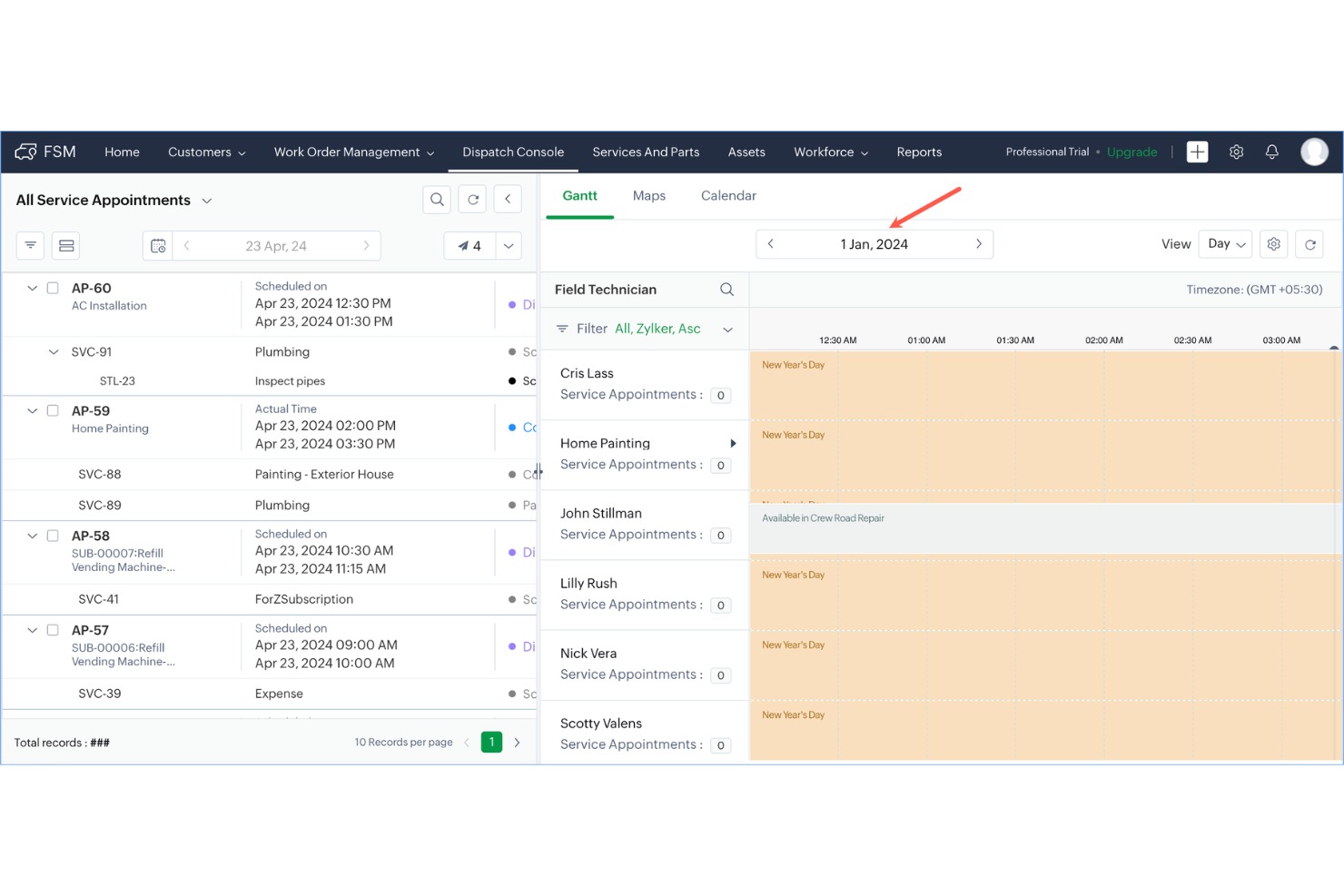
Zoho FSM is a field service management platform that handles work order management, scheduling, dispatching, workforce coordination, invoicing, and job tracking across both office and field operations.
Who Is Zoho FSM Best For?
Zoho FSM is a strong fit for small to mid-sized field service businesses already using or considering the broader Zoho ecosystem for finance, CRM, or inventory.
Why I Picked Zoho FSM
Zoho FSM is one of my top picks because the workforce management tools go well beyond basic scheduling. I love the skills-based technician matching, where you define each technician's qualifications and the system filters agents for a job based on those exact skills. That directly cuts repeat visits. I also use the crews feature to group technicians for complex multi-person jobs, assign a crew leader, and track each member's time spent. The time-off module feeds directly into the dispatch console, so I'm never accidentally assigning a job to someone who's unavailable.
Zoho FSM Key Features
- Work order management: Create and manage work orders from initial request through estimate, scheduling, and completion in a single workflow.
- Job sheets: Field technicians document parts used, services performed, and customer signatures in real time directly from the mobile app.
- Invoicing and payments: Generate invoices from completed work orders and collect payments through integrated payment gateways.
- Live location tracking: Monitor field agents' real-time GPS location from the dispatch console during active jobs.
Pros and Cons
Pros:
- Integrates well with other Zoho products and offers REST APIs for third-party integrations
- One-click invoicing and online payment options
- Supports management of large teams in a multi-user environment
Cons:
- Certain features are limited to paid tiers
- Limited scalability for larger organizations with complex project requirements

Best for streamlining field service management

Service Fusion is a field service management platform for contractors that covers job creation, scheduling and dispatch, technician mobile access, GPS fleet tracking, customer management, and payment processing.
Who Is Service Fusion Best For?
Service Fusion is a good fit for small to mid-sized home service contractors in trades like HVAC, plumbing, electrical, and appliance repair that need to manage scheduling, dispatch, and field operations in one place.
Why I Picked Service Fusion
I've included Service Fusion in my top picks because it keeps every part of the field service workflow—from the first customer call to final payment—in a single platform. I especially like the drag-and-drop dispatch board, which lets you shift job times and reassign technicians in real time without leaving the scheduling view. The one-click estimate-to-job conversion is a feature I use often; it cuts out duplicate data entry and gets technicians on-site faster. The built-in VoIP call tracking ties each inbound call to a referral source, so you're not just managing jobs—you're tracking which marketing channels are driving work.
Service Fusion Key Features
- GPS fleet tracking: Track every vehicle's real-time location directly from the dispatch board.
- Technician mobile app: Technicians can view job details, collect signatures, and accept payments from the field.
- Inventory management: Track parts and stock levels and assign inventory items directly to open jobs.
- Customer history log: View a complete record of past jobs, estimates, invoices, and notes for any customer.
Pros and Cons
Pros:
- Robust automation capabilities
- Comprehensive feature set
- User-friendly interface
Cons:
- Requires annual billing
- Limited customization options


SAP Field Service Management is an end-to-end field service platform that handles work order management, AI-driven scheduling and dispatching, mobile workforce tools, asset management, and customer self-service within SAP's broader ERP ecosystem.
Who Is SAP Field Service Management Best For?
It's a strong fit for large enterprises and asset-intensive industries like manufacturing, utilities, and telecoms that need field service tightly integrated with ERP operations.
Why I Picked SAP Field Service Management
I picked SAP Field Service Management as one of the best because of how deeply AI is embedded into the core scheduling engine. Rather than offering AI as a bolt-on feature, the platform uses predictive models to estimate job duration and traffic, then matches the best-fit technician automatically using a no-code policy designer. I find the appointment booking API particularly useful because it allows real-time scheduling decisions without manual dispatcher intervention. The result is a system where AI is actively driving dispatch logic, not just surfacing suggestions.
SAP Field Service Management Key Features
- Offline-first mobile app: Technicians can access work orders, complete smart forms, and confirm jobs without an internet connection, syncing data once reconnected.
- Crowd service management: Extend field capacity by managing third-party contractors through a partner portal with integrated scheduling and procurement.
- Customer self-service portal: Customers can submit service requests, participate in scheduling, and track job status without contacting a dispatcher.
- Demand and capacity planning: Balance incoming service demand against workforce availability using skills-based planning views and schedule visibility.
Pros and Cons
Pros:
- Real-time data insights and metrics
- Mobile workforce enablement
- AI-based scheduling
Cons:
- Complex setup
- High minimum seat requirement


Aptean Field Service Traverse Edition is a field service ERP platform built for electrical, mechanical, hydraulic, and fluid repair businesses, combining work order management, dispatching, inventory, quoting, and financial reporting in one system.
Who Is Aptean Best For?
Aptean Field Service Traverse Edition is a good fit for small to midsize service repair businesses in the electrical, mechanical, hydraulic, and fluid industries that need an ERP built around their specific trade workflows.
Why I Picked Aptean
Aptean is one of the few ERP platforms built specifically around service repair trade workflows rather than adapted from a generic ERP. The industry-specific job portal lets technicians log inspection results, capture digital images, and update job statuses from the field without workarounds. The planning board and dynamic scheduling tools are designed for repair dispatch, providing visibility into technician availability, job priority, and route logistics.
Aptean Key Features
- Work order calendar: View all active jobs in a calendar layout with drill-down access to individual work order details, technician assignments, and status updates.
- Equipment history tracking: Maintain a full service history for each piece of customer equipment, including past repairs, parts used, and inspection records.
- Job-based cost tracking: Build job-based estimates and track actual costs against them throughout the job lifecycle, from quote to invoice.
- Integrated accounting: Run financial reporting, billing, and general ledger functions directly within the platform without a separate accounting system.
Pros and Cons
Pros:
- Scalable cloud software
- Real-time insights
- Industry-specific features
Cons:
- Complex implementation
- May require customization


Field Nation is an on-demand IT labor marketplace that lets service companies find, dispatch, manage, and pay independent field technicians for on-site work orders across the US.
Who Is Field Nation Best For?
Field Nation is a strong fit for IT service companies and managed service providers that rely on contract or contingent labor to fulfill on-site work orders across multiple locations.
Why I Picked Field Nation
I've included Field Nation in my top picks because it's the only tool on this list built specifically around an IT labor marketplace model, which makes it a genuinely different approach to field service workforce management. I really like its SmartMatch feature, which lets service companies auto-dispatch work orders to pre-vetted technicians based on skillset, location, and custom project specs—without manually sourcing each job. The provider scoring system, including Timeliness Score and Buyer Satisfaction ratings, gives my team real visibility into contractor reliability before assigning them to a customer site.
Field Nation Key Features
- Work order builder: Create detailed work orders with custom fields, task checklists, and required deliverables that technicians must complete before closing a job.
- Contractor compliance management: Verify technician credentials, background checks, and proof of insurance directly within the platform before assigning work.
- Automated payment processing: Release payments to contractors automatically upon work order approval, with no manual invoicing required.
- Performance reporting: Track work order completion rates, on-time arrival, and field activity data across your entire contractor pool.
Pros and Cons
Pros:
- Cost reduction
- Real-time visibility
- Extensive technician network
Cons:
- Requires internet access
- Limited to IT services


Focus is a cloud ERP platform that unifies field service operations, finance, inventory, CRM, and workforce management with AI-embedded analytics and customizable workflows across industries.
Who Is Focus Best For?
Focus is a strong fit for mid-size to large field service businesses across industries like HVAC, utilities, and facilities management that need a fully integrated ERP rather than a standalone service tool.
Why I Picked Focus
Focus earns its spot on my shortlist because its AIFA engine embeds AI directly into field service workflows rather than bolting it on as a reporting add-on. I can use voice or text commands to pull real-time job status, inventory levels, or cash flow data on mobile without touching a single menu. Focus X's fully customizable workflows let my team adapt approval chains and service processes to match how we actually operate, not how the software assumes we do.
Focus Key Features
- Work order management: Create, assign, and track work orders from a centralized dashboard with real-time status updates across all jobs.
- Technician GPS tracking: Monitor field technician locations in real time to support accurate dispatching and job ETAs.
- Inventory control: Track parts and materials across multiple warehouses with automated replenishment triggers.
- Integrated billing: Generate invoices directly from completed work orders and sync them with the financial module.
Pros and Cons
Pros:
- Omnichannel integration
- AI-driven applications
- Customizable solutions
Cons:
- Limited free trial options
- May require extensive training


Fieldpoint is a field service management platform built for commercial contractors, covering work order management, project and job costing, scheduling and dispatch, service contracts, and ERP integrations.
Who Is Fieldpoint Best For?
Fieldpoint is a strong fit for mid-to-large commercial service contractors in industries like HVAC, fire and life safety, and IT services.
Why Choose Fieldpoint
Fieldpoint is one of the few field service platforms built to flex around how your business works. The configurable technician forms and custom workflow automation let you shape work order processes to match your service delivery model. The business intelligence module lets you build dashboards using KPI combinations specific to your operation, so reporting isn't one-size-fits-all.
Fieldpoint Key Features
- Service contract management: Create and manage recurring maintenance agreements, entitlements, and SLA terms tied directly to work orders.
- Project and job costing: Track labor, materials, and subcontractor costs against specific jobs in real time to support accurate billing.
- Scheduling and dispatch board: Assign and manage field technicians using a visual drag-and-drop dispatch console with availability and skill-set filters.
- Subcontractor management: Issue work orders to third-party vendors, track their progress, and manage their invoicing from within the platform.
Pros and Cons
Pros:
- Comprehensive mobile app
- Strong ERP integrations
- Highly customizable
Cons:
- May require extensive setup
- Limited to medium and enterprise businesses


SAMPro ERP is a field service ERP platform by Data-Basics built for specialty service contractors, covering work order management, scheduling and dispatching, construction management, mobile tools, and fully integrated back-office accounting in a single system.
Who Is SAMPro ERP Best For?
SAMPro ERP is a strong fit for mid-sized specialty service contractors in trades like HVAC, plumbing, electrical, and mechanical who need a single system managing both field operations and financials.
Why I Picked SAMPro ERP
SAMPro ERP earns its spot on my shortlist because it's one of the few platforms I've found that genuinely integrates field service and full ERP accounting in a single system built specifically for specialty contractors. I particularly like the Rules-Based Management (RBM) automation, which enforces preset business rules the moment a potential issue surfaces, so my team isn't manually catching problems across work orders or billing. The combination of job costing, construction project management, and service scheduling in one system means my team isn't reconciling data across separate platforms at month-end close.
SAMPro ERP Key Features
- Mobile workforce tools: Field technicians can access work orders, capture signatures, and update job status from a mobile device in real time.
- Preventive maintenance management: Schedule and track recurring maintenance tasks automatically against customer equipment records.
- Inventory and equipment tracking: Monitor parts, materials, and equipment across warehouses and field locations from a centralized view.
- Customer web portal: Give customers direct access to service history, work order status, and invoice records online.
Pros and Cons
Pros:
- Advanced mobile components
- Industry-specific features
- Comprehensive integration
Cons:
- Requires training
- Complex implementation
Other Field Service ERP Software
Below is a list of additional field service ERP software that I shortlisted. While they didn’t make the top 10, they’re still valuable and worth further research.
- Accolent ERP
For customizable field service and delivery management
- Striven
For small to midsized businesses needing total transparency
- Housecall Pro
For home service business management
- Simpro
For project management and job costing
- Acumatica
For comprehensive cloud ERP solutions
- FieldEdge
For real-time dispatching and scheduling


How I Evaluate Field Service ERP Software
I split my evaluation into two layers: the baseline capabilities a platform must have—like native job costing and work order billing—and the differentiators that set one vendor apart from another.
Core Functionality (Table Stakes For This List)
When I'm selecting tools for my list, I rank each one on a scale from 0 (does not offer the functionality) to 5 (excels in this area) for each core functionality listed below. Then, I calculate the tool's total score into a percentage. Each tool needs to achieve a minimum total score of 65% to be considered for inclusion.
- Integrated Financial Management: I check whether the platform includes a native GL, AP, AR, and financial reporting suite rather than relying on a bolt-on accounting integration.
- Work Order & Dispatch Management: Scheduling and dispatching service calls should tie directly to customer and financial records, not live in a separate system.
- Job Costing & Project Accounting: I look for real-time cost tracking across labor, parts, and overhead at the individual work order level so margins are visible before a job closes.
- Service Contract & Billing: The platform should handle recurring service agreements, warranty terms, and T&M invoicing without requiring manual workarounds in the billing cycle.
- Inventory & Parts Management: I evaluate how well the system tracks both warehouse and truck stock, especially whether parts consumption posts automatically to COGS and inventory accounts.
- Mobile Field Technician Access: Field techs need to log labor, capture parts usage, and collect signatures on-site through a mobile app that syncs those entries back to the ERP financials.
Once I have a list of tools that meet this criteria, I consider what sets each platform apart.
Differentiating Factors (What Sets Vendors Apart)
Here's how I compare and contrast different vendors:
Standout Features
Revenue recognition automation matters here. When you're managing multi-element service contracts with deferred revenue, a platform that handles ASC 606/IFRS 15 natively saves real month-end effort. I also evaluate subcontractor financial management, since many service firms dispatch 1099 subs and need margin visibility per job across both internal and external labor. Embedded BI with role-based dashboards is another differentiator, especially when a controller can drill from a P&L line item down to a specific work order.
Beyond Features
Industry-specific fit is one of the first things I evaluate. A platform built for HVAC contractors handles flat-rate pricing and equipment changeouts differently than one designed for industrial equipment maintenance. That vertical depth shapes the chart of accounts, workflow templates, and reporting you get out of the box. Compliance and audit readiness also carry weight—I check for built-in audit trails, segregation of duties, and role-based access controls that finance teams need during year-end audits. Integration depth with payroll, tax engines, and CRM platforms rounds out my evaluation.
How to Choose a Field Service ERP Software
As you work through your unique software selection process, keep the following points in mind:
- Identify Your Business Needs: Understanding your business needs is important when selecting field service ERP software. Make sure to consult with field service workers, help desk agents, and supply chain partners to identify bottlenecks and gaps.
- Integration Capabilities: Field service ERP software should integrate with your existing systems like CRM, inventory management, and accounting software. This integration ensures data consistency and streamlines workflows.
- Mobile Accessibility: Field service ERP software must have strong mobile capabilities for remote work. Features should include real-time updates, GPS tracking, and offline functionality. Additionally, technicians should be able to update work orders, track parts used, and communicate with the office from their mobile devices, even with poor internet connectivity.
- Scalability and Flexibility: Your software should grow with your business, supporting more users, work orders, and customers without losing performance.
- Support and Training: Effective support and training are crucial for successful field service ERP software implementation. Ensure you choose vendors that offer advanced training, detailed documentation, and responsive customer support.
Trends for Field Service ERP Software
Here are some trends in field service ERP software and their potential impact on the marketing industry. I analyzed numerous product updates, press releases, and release logs to identify key insights for the coming years, including:
- AI-Driven Predictive Maintenance: AI-driven predictive maintenance is gaining traction. In field service, it helps by predicting equipment failures before they happen. With this trend, businesses can effectively manage and reduce downtime and maintenance costs.
- IoT Integration: IoT integration is becoming more prevalent, with connected devices providing real-time data and insights. This trend enhances decision-making and operational efficiency by allowing field service teams to monitor equipment performance, predict maintenance needs, and address issues before they become vital.
- Mobile-First Solutions: Mobile-first solutions are on the rise, enabling technicians to access ERP systems while on the go. This improves field service response times and customer satisfaction by allowing technicians to retrieve job details, update statuses, and communicate with the home office from anywhere.
- Augmented Reality (AR) Support: AR support is emerging as a valuable tool in field service ERP software, allowing technicians to visualize complex repairs and receive real-time guidance. This leads to faster and more accurate service delivery, reducing downtime and improving customer experiences.
- Cloud-Based ERP Systems: Cloud-based ERP systems are becoming increasingly popular, offering scalability and remote access. This trend makes them ideal for distributed field service teams, as it ensures that data is accessible from anywhere, facilitates collaboration, and supports seamless updates and scalability as the business grows.
What is Field Service ERP Software?
Field service ERP software is a specialized system designed to manage and optimize the operations of field service businesses. It integrates various functions such as scheduling, dispatching, inventory management, and real-time tracking to streamline workflows, improve efficiency, and enhance customer service. This software helps field service companies coordinate their teams, manage resources effectively, and deliver timely and high-quality service to their clients.
Features of Field Service ERP Software
Here are some of the key features that your field service ERP software should have:
- Scheduling and Dispatching: Efficient scheduling and dispatching are important for managing field operations. This feature allows you to assign jobs to technicians based on their availability and proximity, ensuring timely service delivery.
- Mobile Accessibility: Mobile access enables field technicians to view schedules, access customer information, and update job statuses in real-time. This feature enhances productivity and reduces the need for paperwork.
- Customer Management: Strong customer management capabilities allow you to store and retrieve customer information, service history, and preferences. This helps in providing personalized service and building strong customer relationships.
- Work Order Management: Effective work order management is essential for tracking and managing tasks. This feature allows you to create, assign, and monitor work orders, ensuring that jobs are completed efficiently.
- Inventory and Parts Management: Managing inventory and parts is vital for businesses that deal with equipment and supplies. This feature helps track inventory levels, manage stock, and facilitate easy ordering, ensuring that technicians have the necessary parts for their jobs.
- Asset Management: Asset management features allow you to keep detailed records of equipment, including maintenance history and service schedules. This helps in preventive maintenance and prolonging the life of assets.
- Billing and Invoicing: Integrated billing and invoicing capabilities enable you to generate invoices, accept payments, and track outstanding payments. This feature streamlines financial processes and ensures timely payment collection.
- Reporting and Analytics: Reporting and analytics tools provide insights into various aspects of your operations, such as technician performance and job completion times. These insights help in making informed business decisions and driving continuous improvement.
- GPS and Mapping Integration: GPS and mapping features optimize travel routes and provide real-time tracking of field technicians. This reduces travel time and fuel costs while improving customer communication by providing accurate arrival times.
- Integration and Customization: The ability to integrate with other business systems, such as CRM and accounting software, is crucial. Customization options allow you to tailor the software to meet your specific business needs and processes.
Benefits of Field Service ERP Software
Leveraging field service ERP software streamlines and optimizes operations for businesses providing field services. Here are some primary benefits of field service ERP software for users and organizations:
- Improved Scheduling and Dispatching: The software allows for real-time scheduling and dispatching, ensuring that the right technician is sent to the right job at the right time, which enhances productivity and reduces downtime.
- Enhanced Inventory Management: By providing real-time visibility into inventory levels, the software helps businesses maintain optimal stock levels, reducing the risk of stockouts and overstocking, and ensuring that technicians have the necessary parts and tools for their tasks.
- Better Customer Relationship Management: Field service ERP software integrates customer data and service history, enabling businesses to provide personalized and timely service, which improves customer satisfaction and loyalty.
- Increased Operational Efficiency: The software automates various administrative tasks such as invoicing, reporting, and compliance management, freeing up time for employees to focus on more strategic activities and reducing the likelihood of human error.
- Data-Driven Decision Making: With comprehensive reporting and analytics features, the software provides valuable insights into business performance, helping managers make informed decisions that drive growth and profitability.
Investing in field service ERP software significantly enhances the efficiency and effectiveness of field service operations. It improves service delivery, reduces costs, and increases customer satisfaction.
Costs & Pricing of Field Service ERP Software
When shopping for a field service ERP software, the first step is understanding the costs and pricing options. Below is a detailed overview of the different plan options and their pricing.
Plan Comparison Table for Field Service ERP Software
| Plan Type | Average Price | Common Features |
| Free | $0 | Basic scheduling, limited users, basic reporting, and mobile access |
| Basic | $20 - $75/month | Scheduling, dispatching, invoicing, customer management, and mobile access |
| Standard | $76 - $149/month | All Basic features, advanced reporting, inventory management, and GPS tracking |
| Premium | $150 - $299/month | All Standard features, unlimited users, custom integrations, and 24/7 support |
| Enterprise | Custom Pricing | All Premium features, dedicated account manager, custom development, and full support |
Each plan for field service ERP software should match the size of your business, the number of users, and the specific features you need. Carefully assess these financial aspects to help you ensure that you choose a solution that delivers value and supports the growth of your field service operations.
Field Service ERP Software FAQs
Here are some of the commonly asked questions about field service ERP software:
How does field service ERP software improve efficiency?
Field Service ERP software enhances efficiency by automating and integrating field service processes. Automated scheduling and dispatching reduce travel time and ensure the right technician is assigned to each job. Real-time inventory management maintains optimal stock levels, reducing delays from out-of-stock parts. Mobile access lets field technicians update job status and access information on the go, reducing paperwork and administrative tasks. Overall, the software centralizes field service operations, improving resource utilization and response times.
What are the deployment options for field service ERP software?
Field Service ERP software can be deployed in three ways. On-premises software is installed on company servers, offering greater control and customization but requiring significant hardware and IT investment. Cloud-based software is hosted on vendor servers and accessed via the Internet, providing lower upfront costs, scalability, and automatic updates. Hybrid deployment combines on-premises and cloud-based options, leveraging the benefits of both.
How secure is field service ERP software?
Security is crucial for field service ERP software. Reputable providers use encryption, multi-factor authentication, and regular security audits to protect data. Cloud-based solutions offer extra security features like data redundancy, disaster recovery, and compliance with industry standards. Choose a provider with a strong security record and follow best practices for data protection.
What kind of support and training is available for field service ERP software?
Most field service ERP software providers offer support and training to help businesses maximize software use. These options include online resources like documentation, tutorials, and knowledge bases. Customer support is available via phone, email, or live chat for troubleshooting. Training programs, such as webinars, workshops, and on-site sessions, help users effectively utilize the software. Community forums let users share experiences, ask questions, and get advice. Choosing a provider with comprehensive support and training ensures smooth implementation and ongoing success with your Field Service ERP software.
Can field service ERP software handle both preventive and reactive maintenance?
Yes, most field service ERP software software solutions can manage both preventive and reactive maintenance. The software schedules regular maintenance tasks and tracks emergency repairs, ensuring efficient resource allocation and timely service delivery.
How do I customize field service ERP software software to fit my business processes?
Most field service ERP software provides customization options such as configurable workflows, custom fields, and tailored reporting. These features allow you to adapt the software to your specific business processes and requirements