

Reseña del Software de Planificación de Recursos Empresariales (ERP) Acumatica para 2026
Acumatica destaca por su plataforma ERP en la nube flexible, que ofrece una gran personalización y escalabilidad. Es ideal para empresas medianas en crecimiento que buscan soluciones modernas y fáciles de usar.

Revisamos las herramientas de forma independiente, y las comisiones ayudan a financiar nuestras pruebas. Consulta nuestra política de transparencia, nuestra metodología o sugiere una herramienta.
Acumatica is a cloud-based CFO ERP software built for mid-market companies that need to manage financials, inventory, and operations in a single system. I'd consider it if you're scaling past what basic accounting tools can handle and want a platform that doesn't charge per user—which is where it has a clear edge over NetSuite. That pricing model makes Acumatica significantly easier to justify as your headcount grows.
Acumatica Evaluation Summary

4.4/5
- Pricing upon request
- Free demo available
Por qué confiar en nuestras recomendaciones de software
6,700+
Reviews
20
Industry experts
16+
Evaluation factors
14
Years
Nuestras reseñas reflejan nuestro criterio independiente, no un discurso de ventas. Descubra cómo mantenemos la transparencia.
Para esta guía, evaluamos las herramientas mediante pruebas prácticas e investigación independiente, puntuando las herramientas según nuestros criterios de selección.
Nuestras reseñas reflejan nuestro criterio editorial humano, no un discurso de ventas.
Acumatica Overview
When judging Acumatica as an ERP software, its flexible pricing, open API integrations, and intuitive interface set it apart for mid-sized businesses seeking adaptability. Compared to others, Acumatica’s customizable modules and responsive support team make onboarding and daily use straightforward, though advanced manufacturing features may require extra configuration.
If you’re selecting an ERP for a growing company with evolving needs, Acumatica’s cloud-first approach and strong reporting tools make it a compelling choice, especially for organizations prioritizing remote access and scalable workflows.
Pros
- Responsive customer support and active user community.
- Strong reporting and dashboard customization options.
- Transparent pricing with unlimited user licensing.
Cons
- Some updates can disrupt custom workflows or settings.
- Mobile app functionality is limited compared to desktop.
- Advanced manufacturing features require extra configuration.
Is Acumatica Right For Your Needs?
Who Would be a Good Fit for Acumatica?
Acumatica is a strong choice for organizations that need flexible, cloud-based ERP software with customizable modules and transparent pricing. Its unlimited user licensing, open API, and strong reporting tools make it especially appealing for growing mid-sized businesses, distributed teams, and industries with complex operational needs.
Companies that value remote access, scalable workflows, and responsive support will find Acumatica’s platform well-suited to their requirements.
- Growing Mid-Sized CompaniesScalable modules and unlimited users accommodate rapid business growth.
- Field Service TeamsMobile field service management tools support dispatch and scheduling.
- Multi-Entity OrganizationsCentralized financials and intercompany accounting simplify multi-entity management.
- Professional ServicesTime tracking and billing modules help manage client projects and resources.
- Wholesale DistributionInventory management and order automation tools fit distribution operations.
- Construction FirmsAcumatica’s project accounting and job costing features support complex construction workflows.
Who Would be a Bad Fit for Acumatica?
Acumatica may not be the best fit for very small businesses, highly specialized industries, or organizations with limited IT resources. Companies needing deep industry-specific features out of the box, or those with simple accounting needs, may find Acumatica’s platform more complex and costly than necessary. Businesses with strict on-premise requirements or limited budgets may also face challenges.
- On-Premise Only ITCloud-first design does not support strict on-premise deployments.
- Solo ConsultantsOverly robust for single-user or micro-business operations.
- Food ManufacturingLimited compliance and traceability features for food safety standards.
- Large EnterprisesMay not scale to the needs of global, multi-billion-dollar corporations.
- Nonprofit OrganizationsLacks built-in nonprofit fund accounting and donor management features.
- Small Retail ShopsThe platform’s complexity and cost exceed most small retail needs.
Cómo probamos y puntuamos las herramientas
Hemos dedicado años a construir, perfeccionar y mejorar nuestro sistema de evaluación y puntuación de software. La rúbrica está diseñada para capturar los matices de la selección de software y lo que hace que una herramienta sea efectiva, enfocándose en los aspectos críticos del proceso de toma de decisiones. A continuación, puedes ver exactamente cómo funcionan nuestras pruebas y puntuación en siete criterios. Esto nos permite proporcionar una evaluación imparcial del software basada en la funcionalidad principal, características destacadas, facilidad de uso, onboarding, atención al cliente, integraciones, opiniones de clientes y relación calidad-precio.
Funcionalidad principal (25% de la puntuación final)
Nuestro punto de partida siempre es la funcionalidad principal de la herramienta. ¿Tiene las funciones básicas que un usuario esperaría ver? ¿Alguna de estas características principales está limitada a planes de precios superiores? En esencia, esperamos que una herramienta esté a la altura de las capacidades básicas de sus competidores.
Características destacadas (25% de la puntuación final)
A continuación, evaluamos las características únicas y sobresalientes que van más allá de la funcionalidad principal normalmente encontrada en herramientas de este tipo. Una puntuación alta refleja funciones especializadas o únicas que hacen el producto más rápido, eficiente o que aportan valor adicional al usuario. También evaluamos lo fácil que es integrarse con otras herramientas que normalmente forman parte del stack tecnológico para ampliar la funcionalidad y utilidad del software. Las herramientas que ofrecen numerosas integraciones nativas, conexiones con terceros y acceso API para crear integraciones personalizadas obtienen la mejor puntuación.
Facilidad de uso (10% de la puntuación final)
Consideramos cuán rápido y fácil es ejecutar las tareas definidas en la funcionalidad principal usando la herramienta. El software que obtiene la puntuación más alta está bien diseñado, es intuitivo, ofrece aplicaciones móviles, proporciona plantillas y hace que tareas relativamente complejas parezcan simples.
Onboarding (10% de la puntuación final)
Sabemos lo importante que es una adopción rápida del equipo para una nueva plataforma, por lo que evaluamos cuán sencillo es aprender y utilizar una herramienta con una formación mínima. Analizamos lo rápido que un miembro del equipo puede configurarse y empezar a usar la herramienta sin experiencia previa. Las soluciones con alta puntuación indican que se requiere poco o ningún soporte.
Atención al cliente (10% de la puntuación final)
Revisamos cuán rápido y sencillo es salir de un atasco y encontrar ayuda por teléfono, chat en vivo o base de conocimiento. Las herramientas y empresas que proporcionan soporte en tiempo real obtienen la mejor puntuación, mientras que los chatbots obtienen la peor.
Opiniones de clientes (10% de la puntuación final)
Además de nuestras propias pruebas y evaluaciones, consideramos el net promoter score de clientes actuales y anteriores. Revisamos la probabilidad de que, de tener la opción, elijan nuevamente la herramienta por su funcionalidad principal. Un software con alta puntuación refleja un alto net promoter score de clientes presentes o pasados.
Relación calidad-precio (10% de la puntuación final)
Por último, considerando todos los demás criterios, revisamos el precio medio de los planes de entrada frente a las funciones principales y analizamos el valor de los demás criterios de evaluación. El software que ofrece más por menos obtiene una puntuación superior.
Core Features
Financial Management
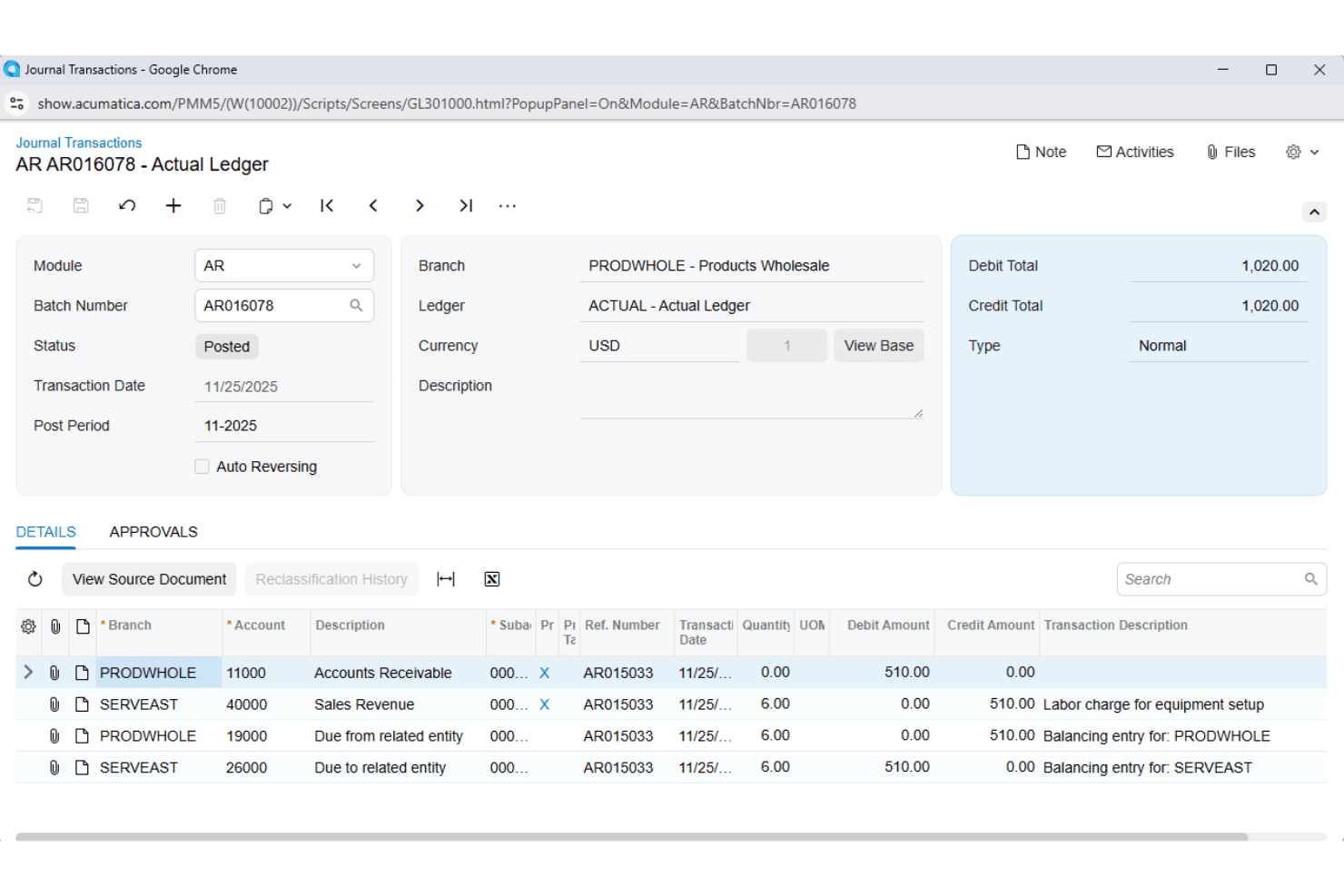
Manage general ledger, accounts payable, receivable, and cash flow in real time. Automated workflows and multi-entity support help streamline complex accounting tasks.
Project Accounting
Track project budgets, costs, billing, and profitability from a single dashboard. Real-time reporting supports accurate forecasting and resource allocation.
Inventory Management
Monitor inventory levels, automate replenishment, and manage multiple warehouses. Lot and serial tracking help maintain accuracy and compliance.
Order Management
Automate sales and purchase order processing with configurable workflows. Real-time status updates improve order accuracy and customer satisfaction.
Customer Relationship Management (CRM)
Centralize customer data, manage sales pipelines, and track communications. Built-in CRM tools connect directly to financial and project modules.
Field Service Management
Schedule, dispatch, and track field service operations from any device. Mobile access enables real-time updates and efficient resource allocation.
Ease of Use
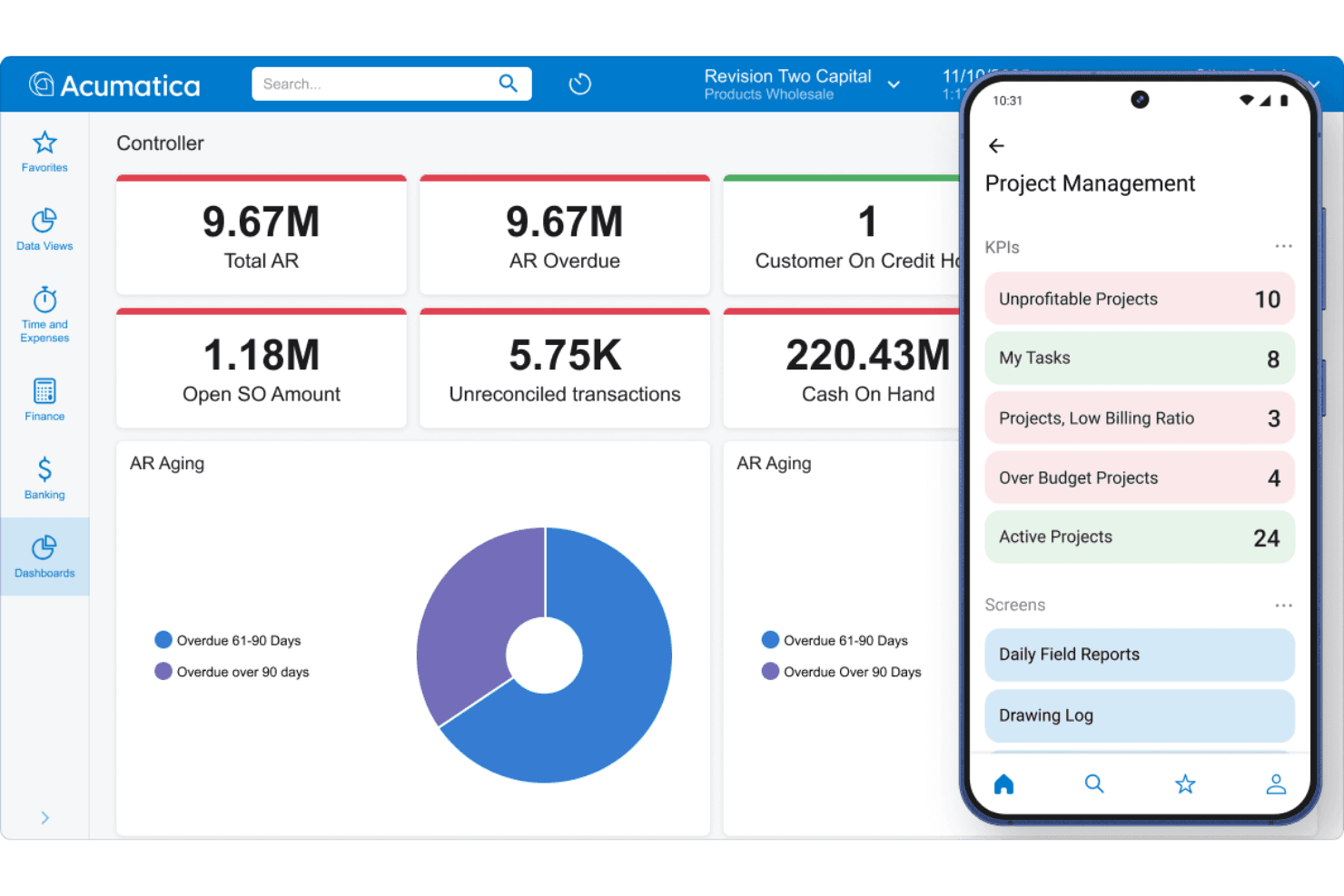
Acumatica offers a modern, intuitive interface that most users find easy to navigate, especially compared to traditional ERP systems. Dashboards are customizable, and workflows can be tailored to fit specific roles, reducing clutter and confusion. Users often highlight the clear menu structure and responsive design, which supports both desktop and mobile access.
However, some advanced features may require initial setup or training, particularly for teams with complex requirements.
Integrations
Acumatica integrates with Microsoft Office 365, Salesforce, Shopify, BigCommerce, Avalara, Adobe Document Cloud, HubSpot, DocuSign, Magento, and Amazon, among others.
Acumatica also offers an open API and connects with third-party integration tools for custom connectivity.

Acumatica Specs
- Accounts Payable: Yes
- Accounts Receivable: Yes
- API: Yes
- Budgeting: Yes
- Calendar Management: Yes
- Compliance Tracking: No
- Customer Management: Yes
- Dashboard: Yes
- Data Export: Yes
- Data Import: Yes
- Data Visualization: Yes
- Expense Tracking: Yes
- External Integrations: Yes
- Financial Analysis: No
- Forecasting: Yes
- Inventory Tracking: Yes
- Multi-Currency: Yes
- Multi-User: Yes
- Notifications: Yes
- Order Management: Yes
- Payroll: Yes
- Project Management: Yes
- Purchase Orders: Yes
- Resource Management: Yes
- Scheduling: Yes
- Supplier Management: Yes
- Task Scheduling/Tracking: Yes
- Third-Party Plugins/Add-Ons: Yes
- Warehouse Management: Yes
- Workflow Management: Yes


