


BILL vs. Brex: Comparison and Expert Reviews for 2026
I compare BILL and Brex to see which platform delivers better control over AP, expenses, cards, and financial workflows for growing businesses.

We review tools independently, and commissions help fund our testing. See our transparency policy, our methodology, or suggest a tool.
If you’re comparing BILL and Brex, you’re probably trying to simplify financial operations—not add more complexity to your workflows. Maybe your team is struggling with disconnected approvals, manual expense tracking, AP bottlenecks, or limited visibility into company spending. While both BILL and Brex help finance teams automate payments, expenses, and financial workflows, they take very different approaches to spend management and operational control.
In this article, I’ll break down where each financial management tool shines—and where they come up short. You’ll get a clear look at their pros and cons, use cases, pricing, security, and usability, so you can pick the best fit for your business.
BILL
4.5/5
- Free plan + free demo available
- From$49/user/month
Brex
4.5/5
- Free plan available
- From $12/user/month
Why Trust Our Software Recommendations
6,700+
Reviews
20
Industry experts
16+
Evaluation factors
14
Years
Our team has been testing and reviewing software since 2012. As finance leaders ourselves, we know how difficult—and important—it is to choose the right software.
For this guide, we evaluated tools using hands-on testing and independent research, scoring tools using our selection criteria.
Our reviews reflect our human editorial judgment, not a sales pitch.
| BILL | Brex | |
|---|---|---|
| Free Trial | Free plan + free demo available | Free plan available |
| Pricing | From$49/user/month | From $12/user/month |
BILL vs. Brex Pricing & Hidden Costs
BILL and Brex both combine subscription pricing with transaction-based costs, but they structure pricing differently. BILL charges per-user fees for its AP and AR platform, plus transaction fees for payments and transfers, while also offering a free Spend & Expense plan with corporate cards and budgeting tools. Brex offers a free Essentials tier and paid Premium plans, though advanced global features, implementation services, and enterprise capabilities may require higher-tier or custom pricing.
From my view, BILL’s costs tend to scale with payment volume and AP workflows through ACH, check, card, and international transaction fees, while Brex’s costs are more connected to user tiers, global capabilities, implementation services, and premium controls.
Both BILL and Brex offer core financial operations features like bill payments, approval workflows, expense management, accounting integrations, and real-time spend visibility. Each platform also helps automate repetitive finance tasks through workflows, policy controls, and centralized dashboards that give teams more oversight into company spending.
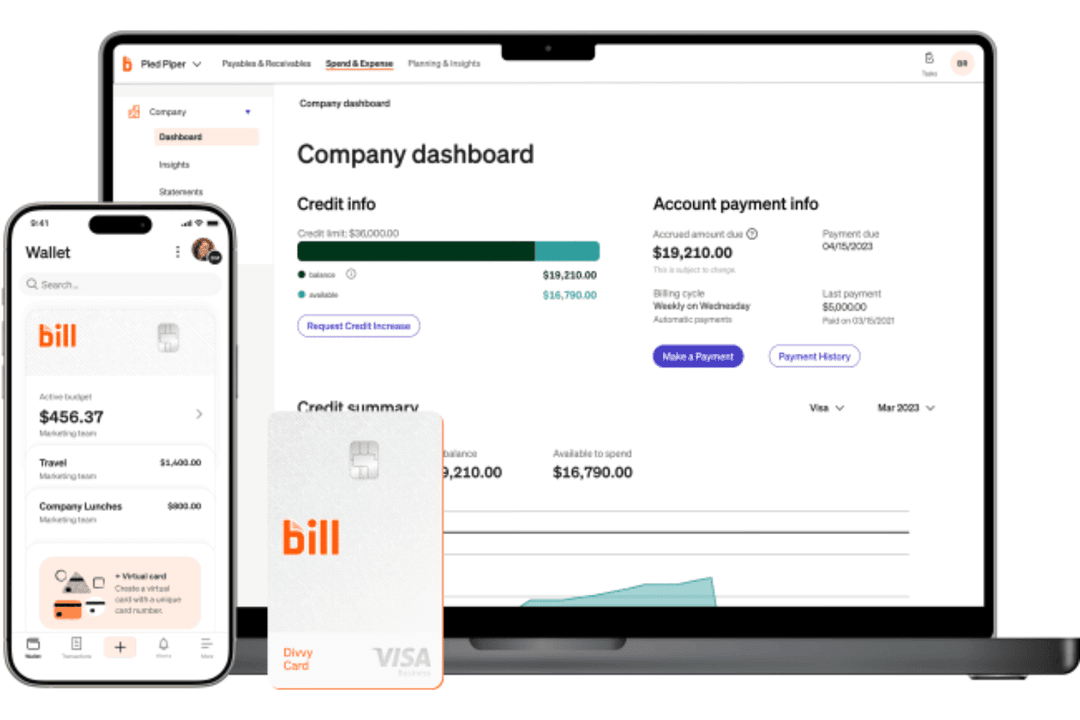
Where they differ is in their overall focus. BILL is more finance-operations-focused, with stronger accounts payable and receivable automation, deeper invoice and vendor payment workflows, and centralized controls built for accounting and finance teams. It also extends beyond traditional AP software through BILL Spend & Expense and the BILL Divvy Card, which combine corporate cards, virtual cards, budget controls, rewards, and real-time spend visibility into unified finance workflows.
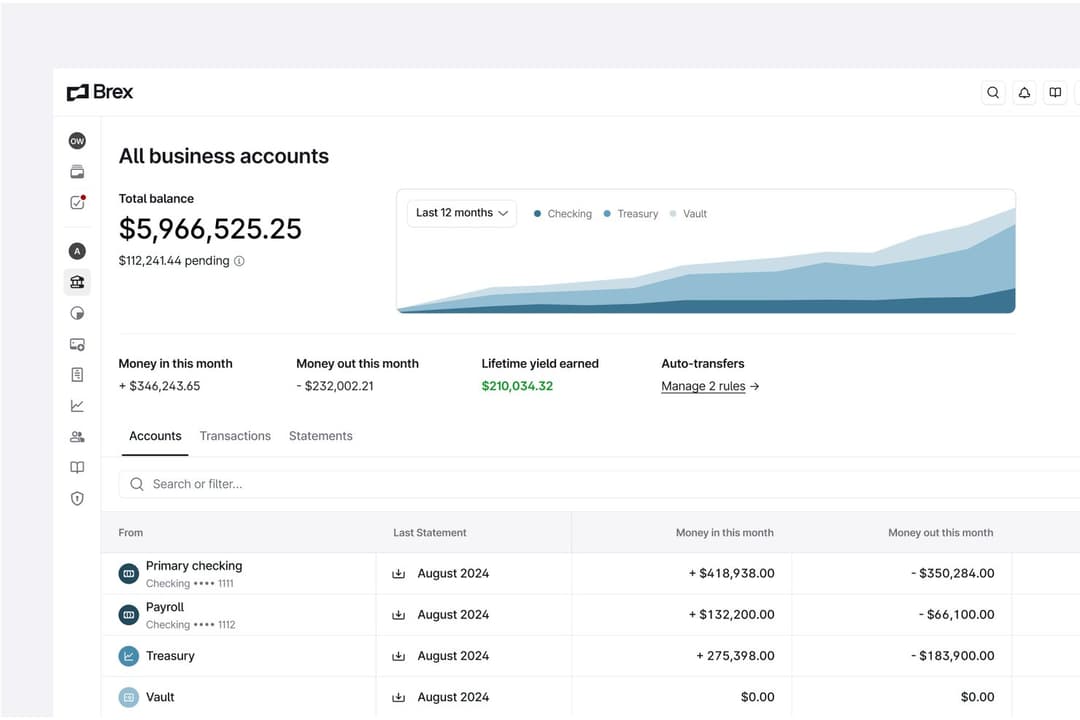
Brex is more employee-spend-focused, combining corporate cards, expense management, travel, reimbursements, business accounts, and Live Budgets into a platform designed to help fast-moving and globally distributed teams manage spending with greater speed and flexibility.
| BILL | Brex | |
|---|---|---|
| 2-Factor Authentication | Yes | No |
| Accounts Payable | Yes | Yes |
| Accounts Receivable | Yes | Yes |
| API | Yes | Yes |
| Balance Sheet | No | No |
| Billing/Invoicing | Yes | Yes |
| BitCoin | No | No |
| Budgeting | Yes | Yes |
| Calendar Management | No | No |
| Contact Management | No | Yes |
| CRM Integration | No | Yes |
| Customer Management | No | Yes |
| Dashboard | Yes | Yes |
| Data Export | Yes | Yes |
| Data Import | Yes | Yes |
| Data Visualization | Yes | Yes |
| Expense Tracking | Yes | Yes |
| External Integrations | Yes | Yes |
| Forecasting | Yes | Yes |
| General Account Ledger | No | No |
| Inventory Tracking | No | No |
| Multi-Currency | Yes | No |
| Multi-User | Yes | Yes |
| Notifications | Yes | Yes |
| P&L | No | No |
| PayPal | Yes | No |
| Payroll | No | No |
| SAP Integration | No | No |
| Stripe | No | No |
| Supplier Management | Yes | Yes |
| Tax Management | Yes | Yes |
| Integration | BILL | Brex |
|---|---|---|
| IntegrationQuickBooks Online | BILL✅ | Brex✅ |
| IntegrationNetSuite | BILL✅ | Brex✅ |
| IntegrationXero | BILL✅ | Brex✅ |
| IntegrationSage Intacct | BILL✅ | Brex✅ |
| IntegrationMicrosoft Dynamics 365 | BILL✅ | Brex✅ |
| IntegrationExpensify | BILL❌ | Brex✅ |
| IntegrationGusto | BILL✅ | Brex✅ |
| IntegrationRippling | BILL❌ | Brex✅ |
| IntegrationAPI | BILL✅ | Brex✅ |
| IntegrationZapier | BILL❌ | Brex✅ |
Both BILL and Brex integrate with major accounting and ERP systems, giving finance teams reliable synchronization across platforms like QuickBooks, NetSuite, Xero, Sage Intacct, and Microsoft Dynamics 365. The biggest difference is breadth: Brex offers a wider ecosystem of integrations across HRIS, automation, and expense-related tools like Expensify, Rippling, and Zapier, while BILL stays more focused on finance and accounting workflows.
| Factor | BILL | Brex |
|---|---|---|
| FactorData Encryption | BILLUses encryption and secure transmission protocols to protect financial data. | BrexUses AES-256 encryption at rest and TLS 1.2+ in transit. |
| FactorRegulatory Compliance | BILLSOC 1, SOC 2 Type II, and PCI-DSS compliant. | BrexSOC 1 Type II, SOC 2 Type II, and PCI-DSS compliant. |
| FactorMulti-Factor Authentication | BILLSupports MFA and role-based user permissions. | BrexSupports MFA, SSO, SCIM provisioning, and custom roles. |
| FactorUptime & Reliability | BILLProvides real-time payment tracking and operational monitoring. | BrexPublic status page with published uptime history and incident reporting. |
| FactorFraud Detection | BILLIncludes audit trails, approval controls, and payment monitoring. | BrexOffers real-time fraud monitoring, device verification, and AI-assisted security protections. |
Both BILL and Brex offer strong security foundations with encryption, compliance certifications, audit controls, and role-based access management. BILL stands out for finance-focused controls like approval tracking, audit trails, and payment oversight, while Brex delivers more enterprise-grade identity management, operational transparency, and real-time fraud monitoring features.
| Factor | BILL | Brex |
|---|---|---|
| FactorUser Interface | BILLClean dashboards and finance-focused workflows built for AP and AR management. | BrexModern, intuitive interface optimized for cards, expenses, and employee spending workflows. |
| FactorOnboarding | BILLStraightforward for SMBs, though complex ERP or multi-entity setups take more configuration. | BrexFast onboarding for smaller teams, with more structured setup for enterprise deployments. |
| FactorTask Automation | BILLStrong AP and AR automation for invoices, approvals, payments, and reconciliation workflows. | BrexStrong spend automation for cards, reimbursements, policies, budgets, and expense reporting. |
| FactorSupport | BILLOffers live chat, phone support, onboarding sessions, and help center resources. | BrexProvides 24/7 multichannel support with VIP and enterprise support tiers available. |
| FactorLearning Curve | BILLEasy to learn for core workflows, but advanced finance configurations require more setup. | BrexGenerally easier for employees and managers to adopt with minimal training required. |
Brex feels more approachable for companies prioritizing employee spend management, corporate cards, and fast day-to-day usability. BILL, on the other hand, is more finance-operations-focused, with deeper AP and AR workflows that can take longer to fully configure but provide stronger accounting and payment controls once implemented.
BILL
- Built for finance and accounting teams managing AP, AR, spend controls, and payment operations at scale.
- Combines approvals, payments, invoicing, expense management, and corporate cards in one centralized financial workflow.
- Strong accounting integrations streamline AP and AR financial workflows.
- ERP syncs sometimes require manual troubleshooting or cleanup.
- Reporting customization feels limited for complex organizational requirements.
- Transaction and international payment fees can be higher than others.
Brex
- Strong AI automation streamlines expense tracking, approvals, and invoice processing.
- Real-time budgeting and reporting improve financial visibility and spending control.
- Extensive integrations support seamless workflows across finance and HR systems.
- International transactions may incur costly foreign exchange markup fees.
- Not ideal for sole proprietors and many international-only businesses.
- Brex's approval workflow can be frustrating for larger teams.
BILL
- Midsize BusinessesBILL’s automation and approval workflows help growing companies scale financial operations without adopting a full ERP system.
- Accounting & Finance TeamsDeep accounting integrations and centralized workflows simplify reconciliations, approvals, and month-end financial management.
- NonprofitsAudit trails, approval controls, and digital payment workflows support stronger financial accountability and compliance oversight.
- Multi-Entity OrganizationsCentralized controls and shared workflows help finance teams manage subsidiaries, locations, or multiple business units more efficiently.
- Professional Service FirmsRecurring vendor payments, invoice management, and streamlined approvals help service-based businesses reduce administrative overhead.
- Businesses with Complex Approval WorkflowsCustom approval routing and role-based permissions improve oversight for organizations with layered financial approval structures.
Brex
- Tech StartupsBrex helps fast-growing startups manage corporate cards, approvals, budgets, and reimbursements within one scalable platform.
- Global and Multi-Entity BusinessesBrex supports local-currency cards, reimbursements, and multi-entity spend management for internationally distributed companies.
- Finance TeamsAI-powered automation, ERP integrations, and real-time reporting help finance teams streamline expense and bill workflows.
- Remote WorkforcesMobile expense management and virtual cards simplify spending controls for employees working across multiple locations.
- Companies Seeking Unified Financial OperationsBrex combines cards, expense management, bill pay, travel, and reporting within one centralized finance platform.
- Scaling Mid-Market CompaniesAdvanced approvals, policy controls, and live budgets help growing businesses manage increasingly complex financial operations.
Who Should Use BILL, and Who Should Use Brex?
BILL is the better fit for finance and accounting teams that want strong control over AP, AR, spend management, and payment operations in one centralized platform. I think it works especially well for growing businesses, nonprofits, and multi-entity organizations that need structured approval workflows, accounting synchronization, vendor management, expense oversight, and better visibility into company spending. If your priorities center around automating financial operations while maintaining tighter accounting and compliance controls, BILL is the stronger choice.
Brex is a better option for companies that want a more employee-centric spend platform built around corporate cards, reimbursements, travel, budgeting, and real-time spend controls. In my experience, it’s especially well suited for startups, scaling companies, and globally distributed teams that want employees to move quickly while finance maintains oversight through policies, Live Budgets, and automation. Teams looking for a highly modern interface with deeper travel, card, and budgeting functionality will probably get more value from Brex.
| BILL | Brex | |
|---|---|---|
| Accounts Receivable | BILL Built-in AR workflows for invoicing and receivables management. | Brex More focused on spend controls than dedicated AR automation. |
| Core Focus | BILL AP, AR, spend management, and financial operations automation. | Brex Corporate cards, spend management, travel, and employee expense workflows. |
| Global Capabilities | BILL Supports payments across 130+ countries with local-currency transfers, international payment workflows, and multi-entity financial controls. | Brex More focus on global employee spend management and localized controls rather than finance-operations-focused payments and multi-entity governance. |
| Rewards & Perks | BILL Balances operational controls with rewards programs, cash-back incentives, and card-based payment workflows designed to improve cash flow management. | Brex Places greater emphasis on employee spend perks, travel rewards, partner discounts, and card incentives rather than finance-operations-focused cash flow management and AP controls. |
| Travel Management | BILL Offers integrated travel management through BILL Travel, including booking, policy controls, travel budgets, receipt syncing, and centralized expense reporting tied closely to AP and spend workflows. | Brex Provides a more travel-centric experience with integrated booking, travel policies, employee reimbursements, global card support, and spend controls designed for fast-moving and distributed teams. |
| Automated Workflows | Both automate approvals, payments, expense processes, and repetitive finance workflows. |
|---|---|
| Corporate Card Support | Both offer corporate card capabilities tied to spend controls and policy management. |
| Mobile Accessibility | Both offer mobile-friendly experiences for approvals, expense tracking, and spend management. |
| Multi-Level Approvals | Both support customizable approval chains for stronger financial oversight and compliance. |
| Real-Time Visibility | Both provide centralized dashboards for monitoring spend, payments, and financial activity. |