


Younium vs. FastSpring: Comparison and Expert Reviews for 2026

We review tools independently, and commissions help fund our testing. See our transparency policy, our methodology, or suggest a tool.
Choosing between Younium and FastSpring often means you’re already running into the limits of your current billing solution—whether that’s handling complex subscriptions, keeping financial data audit-ready, or managing global payments and tax compliance without creating more operational overhead. You may also be trying to improve cash flow, reduce churn, and better understand key metrics across your business.
At a high level, this comparison comes down to a key decision: do you need a subscription system-of-record to manage financial complexity, or a merchant of record to handle payments, tax, and subscription billing for you?
In this article, you’ll get a side-by-side look at Younium and FastSpring, with expert insights, real-world pros and cons, and practical advice to help you pick the right fit for your next subscription billing platform.
Younium

4.2/5
- Free demo available
- Pricing upon request
FastSpring
4.5/5
- Free trial available
- Pricing upon request
Why Trust Our Software Recommendations
6,700+
Reviews
20
Industry experts
16+
Evaluation factors
14
Years
Our team has been testing and reviewing software since 2012. As finance leaders ourselves, we know how difficult—and important—it is to choose the right software.
For this guide, we evaluated tools using hands-on testing and independent research, scoring tools using our selection criteria.
Our reviews reflect our human editorial judgment, not a sales pitch.
| Younium | FastSpring | |
|---|---|---|
| Free Trial | Free demo available | Free trial available |
| Pricing | Pricing upon request | Pricing upon request |
Younium vs. FastSpring Pricing & Hidden Costs
Younium uses a custom, quote-based pricing model based on your business size, contract complexity, and feature needs, so you’ll need to engage with sales to get exact pricing. FastSpring, on the other hand, primarily uses a transaction-based pricing model (typically a percentage of each sale plus a fixed fee), meaning costs scale with your sales volume.
However, the cost structures differ in what’s included. Younium’s pricing typically covers the software itself, while implementation, consulting services, and additional features may be billed separately. FastSpring’s fee generally bundles payment processing, tax compliance, fraud management, and support into a single rate, helping SaaS companies simplify vendor management, but the overall cost can increase as your transaction volume grows.
Both Younium and FastSpring cover core subscription and billing functionality, including recurring billing, plan changes (like upgrades or downgrades), invoicing, and reporting. They also support subscription-based business models and provide tools to manage the full subscription lifecycle, including accounts receivable workflows, making them viable billing software options for companies with recurring revenue.
Overall, Younium distinguishes itself with built-in revenue recognition (ASC 606/IFRS 15) and its role in revenue management as a subscription system-of-record for finance teams. FastSpring, on the other hand, stands out with its merchant of record model, handling global payments, tax compliance, and fraud—effectively offloading operational complexity so you can focus on growth.
| Younium | FastSpring | |
|---|---|---|
| 2-Factor Authentication | Yes | No |
| A/B Testing | No | Yes |
| API | Yes | Yes |
| BitCoin | No | No |
| Conversion Tracking | No | Yes |
| Dashboard | Yes | Yes |
| Data Export | Yes | Yes |
| Data Import | Yes | Yes |
| Data Visualization | Yes | No |
| External Integrations | Yes | Yes |
| Marketing Automation | No | No |
| Multi-User | Yes | Yes |
| Notifications | Yes | Yes |
| PayPal | No | Yes |
| Scheduling | Yes | No |
| Stripe | Yes | No |
| Third-Party Plugins/Add-Ons | Yes | Yes |
| Integration | Younium | FastSpring |
| Salesforce | ✅ | ✅ |
| HubSpot | ✅ | ✅ |
| NetSuite | ✅ | ❌ |
| Xero | ✅ | ❌ |
| QuickBooks Online | ✅ | ❌ |
| Microsoft Dynamics | ✅ | ❌ |
| Shopify | ❌ | ✅ |
| WooCommerce | ❌ | ✅ |
| API | ✅ | ✅ |
| Zapier | ✅ | ❌ |
Younium focuses on deep integrations with CRM and ERP systems, making it a strong fit for finance-driven operations, while FastSpring is more aligned with ecommerce and global commerce workflows, including checkout and payments. Both offer API access for custom integrations, including connections to payment gateways, but Younium is better suited for structured RevOps stacks, whereas FastSpring supports growth-focused, monetization-first use cases.
| Factor | Younium | FastSpring |
| Data Privacy | Follows GDPR and uses technical and organizational safeguards to protect data. | Supports global privacy compliance (including GDPR), with controls for handling customer data worldwide. |
| Regulatory Compliance | Supports IFRS 15 and ASC 606 revenue recognition standards. | Handles global tax compliance, including VAT, GST, and sales tax. |
| Encryption | Uses end-to-end encryption for data in transit and at rest. | Encrypts all sensitive data and payment information using industry standards. |
| Uptime & Reliability | Aims for high availability with 24/7 access, but no explicit uptime SLA is publicly guaranteed. | Provides reliable global infrastructure and a public status page, but uptime guarantees are not clearly published. |
| Payment Security | Supports secure authentication (MFA, SSO) and general security controls; not a payment processor itself. | Handles payment security as merchant of record, including PCI-compliant processing. |
Both Younium and FastSpring offer strong security and compliance foundations, but they focus on different areas. Younium stands out for supporting financial compliance and audit readiness, while FastSpring excels at global tax, payment, and transaction compliance as a merchant of record. In practice, Younium is better suited for internal financial governance, whereas FastSpring reduces external regulatory and payment-related risk.
| Factor | Younium | FastSpring |
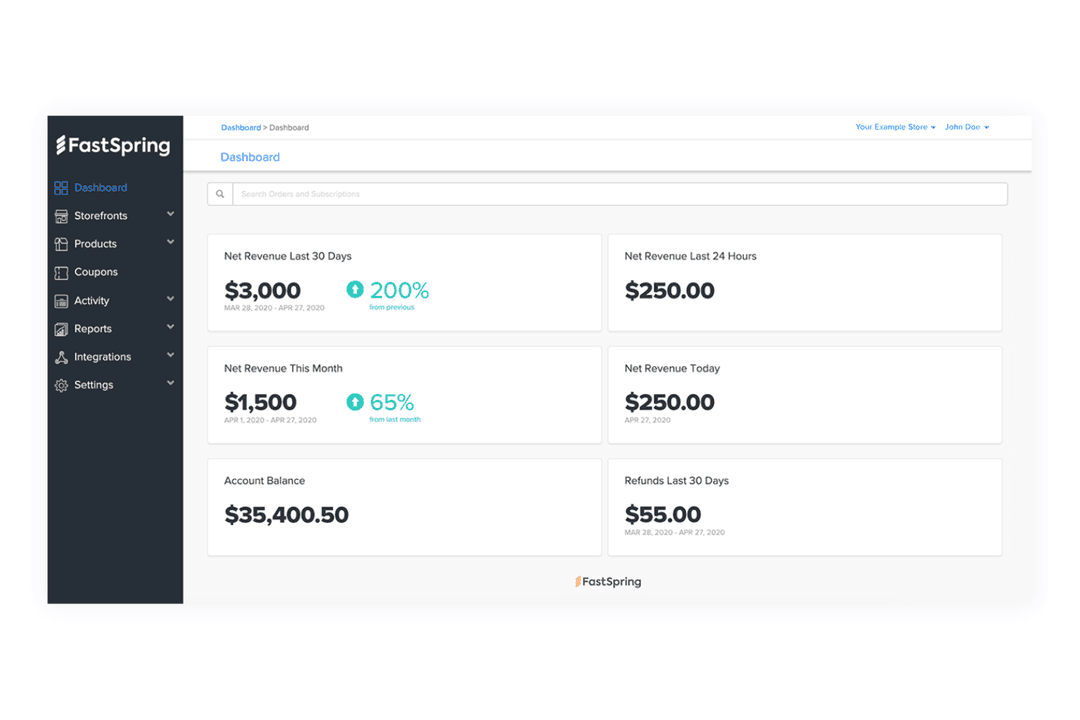
| User Interface | Offers a clean, professional dashboard with detailed reporting and customization. | Features an intuitive, modern interface designed for quick navigation and setup. |
| Onboarding | Guided, implementation-driven onboarding with a Customer Success Manager and post-go-live “hypercare.” | Delivers a fast, self-serve onboarding process with helpful tutorials. |
| Setup Complexity | Requires more initial configuration, especially for advanced workflows. | Simple to set up, especially for digital product sales and subscriptions. |
| Customer Support | Responsive support team with dedicated account managers for enterprise users. | Provides support and documentation resources; specific availability not clearly documented. |
| Workflow Automation | Advanced automation for recurring billing and contract changes. | Streamlined automation for checkout, payments, and tax calculations. |
FastSpring is generally easier to get started with, especially if your priority is quickly launching subscription billing and global payments without managing technical or compliance complexity. It’s designed to streamline monetization workflows and help optimize conversions, making it ideal for selling digital products and subscriptions. Younium, on the other hand, is built for teams managing complex subscription billing and financial operations, so while it requires more setup and structure, it provides greater control over contract management, billing logic, and revenue processes.
Younium
- Strong support for complex B2B subscription models, including usage-based, tiered, and milestone billing.
- Built-in revenue recognition aligned with ASC 606 and IFRS 15, with audit-ready financial workflows.
- End-to-end automation across billing, invoicing, payments, and dunning processes.
- Implementation is structured and guided, which can make onboarding longer than simpler, self-serve tools.
- May feel overly complex for companies with basic or low-volume billing needs.
- Pricing is not publicly available and requires a quote, which hinders upfront evaluation.
FastSpring
- You can easily manage global payments with FastSpring's flexible billing options.
- The platform offers excellent customer support to help your team resolve issues quickly.
- FastSpring's user-friendly interface simplifies daily operations.
- Onboarding can be less intuitive, requiring more time for your team to adapt.
- Some users find feature customization limited compared to other platforms.
- Customer support response times may vary, impacting urgent needs.
Younium
- B2B SaaS CompaniesSupports complex customer subscriptions, including upgrades, downgrades, usage-based pricing, and renewals.
- Finance-Led OrganizationsDesigned for CFOs and finance teams that need accurate reporting, audit trails, and ASC 606/IFRS 15–compliant revenue recognition.
- Companies With Evolving Subscription ContractsHandles contract changes, proration, add-ons, and multi-component pricing within a single subscription structure.
- Mid-Market and Enterprise BusinessesBest suited for organizations with dedicated finance resources and more complex operational requirements.
- Product-Led Growth (PLG) CompaniesSupports self-service signup, checkout (via paywall), and subscription changes without heavy sales involvement.
- Multi-Entity or Multi-Currency OperationsSupports global operations with multiple legal entities, currencies, and localized tax configurations.
FastSpring
- Software CompaniesFastSpring's billing options, APIs, and global payment support make it ideal for software companies with an international customer base.
- Digital Content CreatorsYou can easily manage subscriptions, online payments, and digital sales with FastSpring's optimized checkout and automation tools.
- Subscription ServicesFastSpring simplifies subscription management and billing, helping your team focus on growing your subscriber base.
- E-commerce TeamsIts flexible billing and payment gateway cater well to e-commerce teams handling global sales.
- Finance OperationsFastSpring's capabilities in managing complex billing processes can streamline your finance operations.
- Accounts ReceivablesYour team can benefit from FastSpring's efficient payment processing, reducing collection cycles and handling chargebacks more effectively.
Who Should Use Younium, and Who Should Use FastSpring?
Younium is best suited for B2B SaaS and subscription businesses with complex billing needs and a strong finance function. If you’re managing evolving contracts, usage-based billing, and need accurate revenue recognition (ASC 606/IFRS 15), Younium gives you the control and structure required for audit-ready financial operations. It’s a strong fit for mid-market to enterprise teams that need scalable financial management systems to handle sophisticated workflows and maintain customer retention over time.
FastSpring is an ideal software solution for companies that want to simplify subscription billing, recurring payments, and global tax compliance without building a complex financial stack. If you’re selling digital products or SaaS globally and want to offload payments, VAT/sales tax, and fraud to a single platform, FastSpring’s merchant of record model is a major advantage. It’s especially well-suited for growth-focused teams that want an all-in-one platform with built-in support for multiple payment methods, multi-currency transactions, and simplified payment collection.
| Younium | FastSpring | |
|---|---|---|
| Core Focus | Younium Centralizes subscription management and billing as a system-of-record, with full control over contracts, invoicing, and financial workflows across the quote-to-cash process. | FastSpring Handles subscription billing execution as a merchant of record, managing payments, checkout, and compliance on your behalf. |
| Global Payments | Younium Requires integrations with payment providers; not a payment processor itself. | FastSpring Fully managed global payment processing with localization (currencies, regions, languages). |
| Onboarding Experience | Younium Personalized onboarding and training for complex setups. | FastSpring Fast, self-serve onboarding with easy setup for digital sales. |
| Pricing Model | Younium Custom quotes based on business needs and contract complexity. | FastSpring Transaction-based fees that scale with sales volume. |
| Target Market | Younium Mid-market to enterprise B2B SaaS with complex needs. | FastSpring SaaS, software, and digital product companies selling globally, including startups and small businesses. |
| Automated Billing | Both automate recurring billing and invoicing, reducing manual work and errors for finance teams. |
|---|---|
| Cloud-Based | Both are cloud-based platforms, allowing access from anywhere and easy integration with other SaaS tools. |
| Developer Tools | Both offer developer resources (APIs, docs, webhooks) to extend functionality and integrate with other systems. |
| Reporting & Analytics | Both provide dashboards and financial reporting tools to track revenue, SaaS metrics, and subscription metrics. |
| Subscription Management | Both platforms support subscription-based business models, including recurring plans, upgrades, and downgrades. |