
19 Best Carta Alternatives Reviewed in 2026

Best Carta Alternatives Shortlist
Here’s my shortlist of the best Carta alternatives:


Carta has long been the default for cap table management, but 'default' doesn’t always mean 'optimal.' As your company matures, the friction of rigid pricing tiers or locked-down workflows becomes an operational bottleneck. If your current stack is no longer aligned with your cap table’s complexity—or your budget—it may be time to evaluate Carta's alternative solutions.
In my experience, finding the right software can make a huge difference in efficiency and accuracy. I've independently tested and reviewed various options to help you find the best fit for your team.
In this article, I'll share my top picks for Carta alternatives, focusing on what sets each one apart. You'll get a clear sense of features, benefits, and potential drawbacks, so you can make an informed decision for your business.
What Is Carta?
Carta is a capital structure software that helps businesses manage equity, valuations, and compliance. It's widely used by CFOs, accountants, and legal professionals who need to oversee complex financial operations. Capabilities like equity management, cap table tracking, and compliance tools help maintain accuracy and efficiency in your financial processes. Overall, Carta provides a reliable solution for managing your company's financial structure effectively.
Best Carta Alternatives Summary
This comparison chart summarizes pricing details for my top Carta alternative selections to help you find the best one for your budget and business needs.
| Tool | Best For | Trial Info | Price | ||
|---|---|---|---|---|---|
| 1 | Best for share plan automation | Free plan + free demo available | From €3,000/year | Website | |
| 2 | Best for legal and financial tools | 7-day free trial | From $99/month | Website | |
| 3 | Best for unlimited 409A valuations | Free plan available | From $2/shareholder/month | Website | |
| 4 | Best for late-stage companies | Not available | Pricing upon request | Website | |
| 5 | Best for audit-ready valuations | Free plan + free demo available | From $1,600/year | Website | |
| 6 | Best for automation in equity ops | Free plan available | From $11/stakeholder/year | Website | |
| 7 | Best for startup incorporation efficiency | Not available | From $999/year | Website | |
| 8 | Best for privacy and data security | Free demo available | From £25/month | Website | |
| 9 | Best for ERP integration | Free demo available | Pricing upon request | Website | |
| 10 | Best for startup compliance tools | 30-day free trial + free demo available | From $1,200/year | Website |
Why Trust Our Software Reviews
-

Rippling Spend
Visit WebsiteThis is an aggregated rating for this tool including ratings from Crozdesk users and ratings from other sites.4.8 -
LiveFlow
Visit WebsiteThis is an aggregated rating for this tool including ratings from Crozdesk users and ratings from other sites.4.9 -
Float Financial
Visit WebsiteThis is an aggregated rating for this tool including ratings from Crozdesk users and ratings from other sites.4.1


Best Carta Alternatives Reviews
Below are my detailed summaries of the best Carta alternatives that made it onto my shortlist. My reviews offer a detailed look at the key features, pros and cons, integrations, and ideal use cases of each tool to help you find the best one for you.


Ledgy is an equity management platform that caters to startups and scale-ups, focusing on cap table management, employee participation plans, and investor relations. It's designed to help finance teams and founders manage equity.
Why it's a good Carta alternative: Ledgy offers share plan automation, making it easy for you to manage employee stock options and grants. The platform provides real-time equity updates, so your team always knows the current ownership structure. It’s a great choice for companies looking to automate and optimize their equity processes. Ledgy has teamed up with JP Jenkins to offer private equity management and liquidity, as well.
Standout features and integrations:
Features include scenario modeling, which lets you visualize different financial outcomes. Ledgy provides waterfall analysis to help you understand payout structures in various scenarios. The platform also offers customizable dashboards, giving you a clear view of your equity data.
Integrations include BambooHR, Personio, PayFit, Google Workspace, Microsoft Entra ID, Docusign, and more.
Pros and Cons
Pros:
- Customizable dashboards
- Provides waterfall analysis
- Real-time equity updates
Cons:
- Slow performance with large files
- Higher cost for small teams


SeedLegals is a legal-first platform that automates the documentation and capitalization requirements for funding rounds, share schemes, and ongoing governance. It’s designed to act as a digital alternative to traditional legal counsel for standardized early-stage startup transactions.
Why it's a good Carta alternative: SeedLegals unifies your legal workflows with your cap table management. While Carta primarily functions as a record-keeping and valuation tool for existing data, SeedLegals creates the data by generating the underlying legal contracts, such as term sheets and shareholder agreements, natively on the platform. This reduces the friction between closing a funding round and updating a cap table, as the platform automatically syncs the two in real-time.
Standout features and integrations:
Features include automated document creation, which improves the process of generating legal agreements. SeedLegals provides funding round management tools to help your team navigate investment processes. The platform also offers compliance tracking to ensure your business meets legal requirements.
Integrations include Xero and more.
Pros and Cons
Pros:
- Funding round management
- Automated document creation
- Wide range of legal tools
Cons:
- Template constraints for complex legal structures
- May require legal knowledge


Eqvista is an equity management platform tailored for startups and growing companies. It helps CFOs and founders manage cap tables, valuations, and compliance.
Why it's a good Carta alternative: Eqvista offers unlimited 409A valuations, which is a significant advantage if you're looking to maintain compliance without extra costs. The platform provides detailed cap table management and equity tracking, giving you clear visibility into ownership structures. With its easy-to-use interface, you can manage employee stock options, such as RSUs, and grants. Eqvista's focus on providing detailed valuation services, including ASCs, makes it a strong choice for companies needing frequent assessments.
Standout features and integrations:
Features include automated cap table management, which simplifies the tracking of equity changes and ownership details. Eqvista also offers detailed reporting tools to provide insights into your company's financial health. Additionally, the platform supports employee stock option plans, helping you manage grants and vesting schedules.
Integrations are not publicly listed.
Pros and Cons
Pros:
- Supports stock option plans
- Detailed cap table management
- Unlimited 409A valuations
Cons:
- Not ideal for non-tech industries
- May require onboarding support


Shareworks by Morgan Stanley is an enterprise-grade equity platform that supports companies from early-stage startups through to global public listings. It combines cap table administration and 409A valuations with a "Global Intelligence" database that automates tax and legal compliance in over 170 countries.
Why it's a good Carta alternative: Shareworks is a great Carta alternative if you want to avoid the "switch cost" of outgrowing a smaller provider. It provides the institutional-grade security and global infrastructure required for IPO readiness, while natively managing localized tax and legal requirements. This allows you to manage international subsidiaries on a single, audit-ready source of truth backed by a global financial institution.
Standout features and integrations:
Features include a Private Markets Transaction Desk for executing secondary sales and a dedicated sandbox environment for testing the financial impact of dilution and stock-based compensation. It also generates audit-ready financial statements.
Integrations include Neuron, Workday, Pave, Okta, and more.
Pros and Cons
Pros:
- Regulated institutional security
- Complex secondary liquidity support
- IPO-grade global compliance
Cons:
- Steep administrative learning curve
- Extended implementation timelines


Qapita specializes in equity management and valuations for private companies, with a particular focus on the Southeast Asia market. It unifies cap table administration and fund management into a single platform to scale alongside venture-backed startups.
Why it's a good Carta alternative: Qapita provides audit-ready valuations, which are ideal if you're looking for precision in financial reporting. Its cap table management tools offer real-time insights, helping your team maintain compliance and transparency. With features such as stock plan management and equity compensation advisory, Qapita can tailor equity strategies and workflows to your needs.
Standout features and integrations:
Features include ESOP management to improve employee stock ownership plans. Cap table management can help you oversee share issuance and scenario modeling without spreadsheets. The platform also provides fund administration for efficient capital calls and reporting.
Integrations include Workday, HiBob, Darwinbox, Docusign, and more.
Pros and Cons
Pros:
- Detailed financial reporting
- Tailored equity strategies
- Audit-ready valuations
Cons:
- Heavy focus on India and Southeast Asia
- Limited scenario modeling features

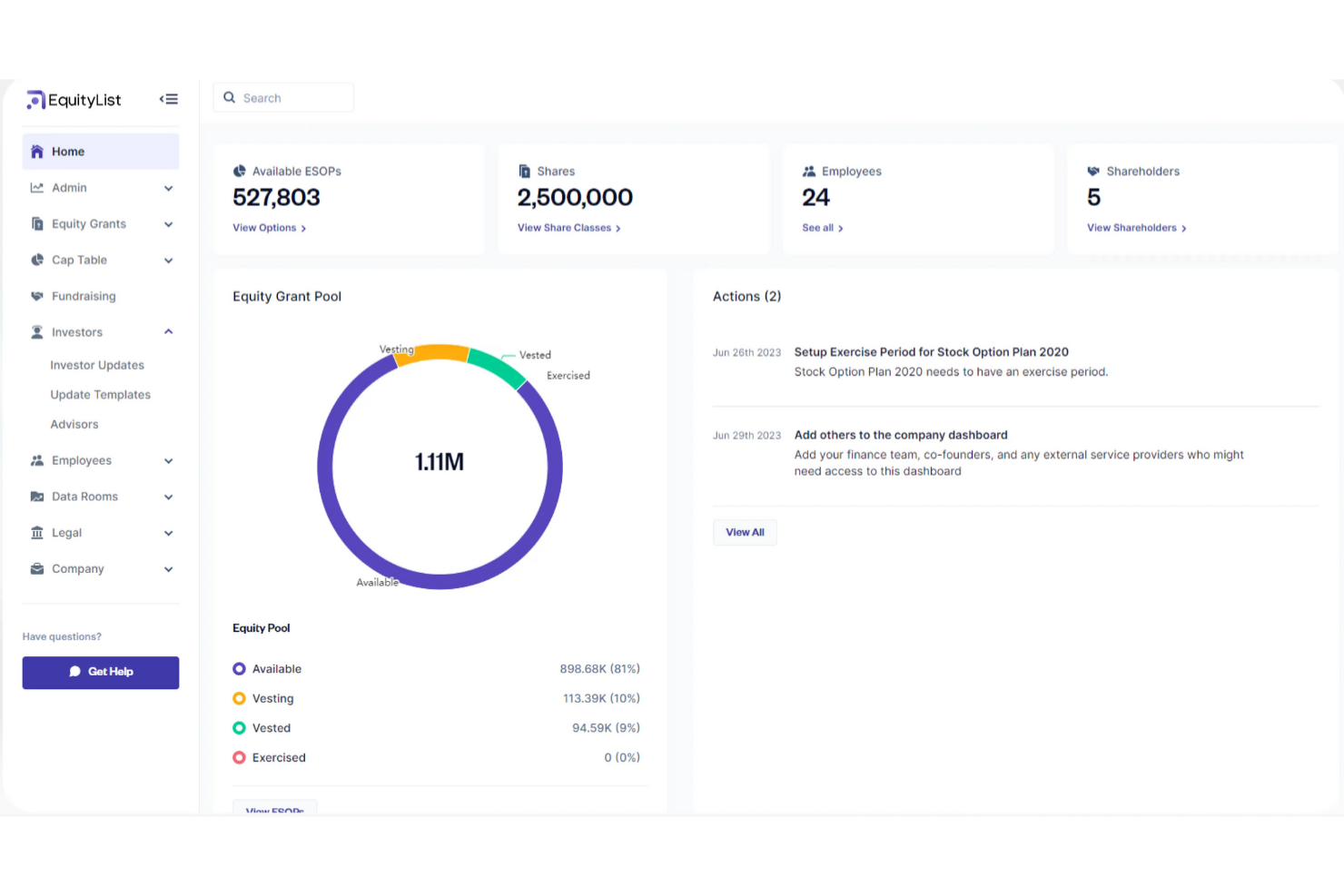
EquityList is an equity management software that offers a cost-effective, "full-stack" solution that combines cap table automation and employee stock option plans (ESOPs) administration with specialized regional compliance and 409A/Indian valuation services.
Why it's a good Carta alternative: EquityList excels at managing cross-border equity for companies operating across the US, India, and Southeast Asia, offering built-in compliance for local tax laws and regional filings. With features such as digital share certificates and compliance services, EquityList ensures you're always audit-ready. It's ideal for businesses looking for a straightforward way to handle equity management.
Standout features and integrations:
Features include cross-border shareholding support, which allows your team to manage international equity. EquityList provides dashboards for improved investor relations, allowing transparency and effective communication. The platform also offers employee equity opportunities.
Integrations include AngelList, Slack, and more.
Pros and Cons
Pros:
- Easy share issuance
- Real-time ownership clarity
- Automates equity operations
Cons:
- Pricing not widely available
- Few integrations available


Capbase is a platform designed to help startups manage incorporation, equity, and compliance. It serves founders and finance teams by providing tools for managing cap tables, legal documents, and compliance tasks.
Why it's a good Carta alternative: Capbase is an excellent choice for first-time founders who want a "company-in-a-box" solution rather than just a cap table. While Carta is the industry standard for established venture-backed startups, Capbase differentiates itself by handling the legal foundation of a company, from incorporation and board setup to initial share issuance, all in one automated workflow.
Standout features and integrations:
Features include automated legal document creation, which simplifies the process of drafting agreements and contracts. Capbase offers compliance tracking to help your team meet regulatory obligations. The platform also provides tools for managing fundraising rounds, making it easier to attract and secure investment.
Integrations include Gusto, Slack, Google Workspace, GitHub, and more.
Pros and Cons
Pros:
- Fundraising management tools
- Compliance tracking features
- Focus on incorporation efficiency
Cons:
- Basic customization options
- Limited advanced analytics


Vestd is an equity management platform designed for startups and small businesses to manage shares and options. It serves founders and finance teams by offering tools for equity distribution and compliance.
Why it's a good Carta alternative: Vestd focuses on privacy and data security, protecting sensitive equity data. The platform provides digital share certificates and secure document storage to improve your data protection measures. With features such as customizable equity plans and automated compliance tracking, Vestd helps your team manage equity securely. These capabilities make it a strong option for companies prioritizing data security in their equity management processes.
Standout features and integrations:
Features include customizable equity plans that allow you to tailor share schemes to your needs. Vestd offers automated compliance tracking to help your team meet regulatory requirements. The platform also provides digital share certificates for a smooth process of issuing and managing shares.
Integrations include Docusign, ADP Workforce Now, Deel, JumpCloud, and more.
Pros and Cons
Pros:
- Secure document storage
- Digital share certificates
- Focus on data security
Cons:
- Workarounds needed for complex events
- May require ongoing support


Certent Equity Management is a platform designed to improve equity compensation and financial reporting for companies. It primarily serves finance and HR teams, providing tools for managing equity plans and compliance.
Why it's a good Carta alternative: Certent Equity Management excels in ERP integration, allowing your team to connect equity data with your existing systems. The platform has many reporting tools that help you improve financial transparency and compliance. You can manage complex equity plans, thanks to features such as automated grant processing and real-time data updates. This makes it a solid choice for businesses looking to integrate equity management with broader financial operations.
Standout features and integrations:
Features include automated grant processing, which simplifies the administration of equity awards. Certent Equity Management offers real-time data updates to ensure your team always has the latest information. The platform also provides detailed reporting tools to improve your financial analysis capabilities.
Integrations include SAP, Oracle, Microsoft Dynamics, and more.
Pros and Cons
Pros:
- Automated grant processing
- Real-time data updates
- Excellent ERP integration
Cons:
- Limited flexibility in making administrative updates
- Steeper learning curve


Astrella is an equity management platform aimed at startups and growing companies, providing tools for cap table management, compliance, and shareholder engagement. It assists finance teams and founders in efficiently managing equity and regulatory compliance.
Why it's a good Carta alternative: Astrella provides a highly secure, blockchain-enabled ledger that guarantees an immutable history of every share transaction, reducing the risk of data discrepancies during an exit or IPO. Unlike Carta's often self-service model, Astrella includes "white-glove" onboarding and unlimited support in its flat-fee pricing. It serves as an ideal bridge for companies planning to go public, as it is owned by Equiniti, a global leader in transfer agent and share registry services.
Standout features and integrations:
Features include automated compliance alerts to keep your team informed about regulatory changes and permissions. Its shareholder communication tools facilitate engagement and transparency.
Integrations are not publicly listed.
Pros and Cons
Pros:
- Automated compliance alerts
- Real-time cap table updates
- Specialized compliance tools
Cons:
- Not suited for large enterprises
- Limited advanced features
Other Carta Alternatives
Here are some additional Carta alternatives that didn’t make it onto my shortlist, but are still worth checking out:
- Pulley
For token and equity cap tables
- Cake Equity
For startup equity management
- Aption
For custom equity solutions
- Linqto
For private market investors
- Orchestra
For startup employee engagement
- Deel Equity
For remote team equity management
- J.P. Morgan Workplace Solutions
For global financial services
- Nasdaq Private Market
For liquidity solutions
- Juniper Square
For real estate investment firms


Carta Alternatives Selection Criteria
When selecting the best Carta alternatives to include in this list, I considered common buyer needs and pain points related to capital structure software products, such as managing complex equity structures and ensuring compliance with regulatory requirements. I also used the following framework to keep my evaluation structured and fair:
Core Functionality (25% of total score)
To be considered for inclusion in this list, each solution had to fulfill these common use cases:
- Manage cap tables
- Track equity grants
- Generate compliance reports
- Facilitate shareholder communication
- Support multiple equity plans
Additional Standout Features (25% of total score)
To help further narrow down the competition, I also looked for unique features, such as:
- Real-time collaboration tools
- Blockchain-based security
- AI-driven analytics
- Customizable dashboards
- Cross-border equity management
Usability (10% of total score)
To get a sense of the usability of each system, I considered the following:
- Intuitive user interface
- Easy navigation
- Clear instructions
- Fast loading times
- Responsive design
Onboarding (10% of total score)
To evaluate the onboarding experience for each platform, I considered the following:
- Availability of training videos
- Interactive product tours
- Access to templates
- Live webinars
- Chatbot assistance
Customer Support (10% of total score)
To assess each software provider's customer support services, I considered the following:
- 24/7 support availability
- Multiple contact channels
- Knowledgeable staff
- Quick response times
- Extensive FAQs
Value For Money (10% of total score)
To evaluate the value for money of each platform, I considered the following:
- Transparent pricing
- Flexible plans
- Feature set relative to cost
- Discounts for startups
- Free trial availability
Customer Reviews (10% of total score)
To get a sense of overall customer satisfaction, I considered the following when reading customer reviews:
- Positive feedback on features
- Consistent performance ratings
- Satisfaction with support
- Value for money perceptions
- Ease of use feedback
Why Look for a Carta Alternative?
While Carta is a good choice of capital structure software, there are a number of reasons why some users seek out alternative solutions. You might be looking for a Carta alternative because…
- You need more advanced customization options
- Your team requires better international support
- You're looking for lower-cost subscription plans
- You want better data security features
- Your business needs faster customer support
- You're dealing with complex equity structures
If any of these sound like you, you've come to the right place. My list contains several capital structure software options that are better suited for teams facing these challenges with Carta and looking for alternative solutions.
Carta Key Features
Here are some of the key features of Carta, to help you contrast and compare what alternative solutions offer:
- Cap table management: Track ownership and equity transactions in real-time to keep your team informed.
- 409A valuations: Get compliance assessments for private company stock valuations.
- Equity plan administration: Manage stock options and vesting schedules.
- Board and stockholder management: Simplify communication and approvals with stakeholders.
- Scenario modeling: Analyze financing and exit scenarios to make informed strategic decisions.
- Liquidity solutions: Facilitate secondary transactions for private shares, offering you flexibility in equity management.
- Ownership tracking: Manage details for investors and employees, including vested and unvested shares.
- Vesting schedule management: Monitor performance of vesting schedules to ensure alignment with company goals.
- Document automation: Automate the distribution of important documents, reducing admin workload.
- Valuation reports: Generate financial analysis reports, including waterfall scenarios, for better insight.
What's Next:
If you're in the process of researching capital structure software, connect with a SoftwareSelect advisor for free recommendations.
You fill out a form and have a quick chat where they get into the specifics of your needs. Then you'll get a shortlist of software to review. They'll even support you through the entire buying process, including price negotiations.