

10 Best Commercial Loan Origination Software in 2026

Best Commercial Loan Origination Software Shortlist


Commercial loan origination software manages business lending from application intake through underwriting, approval, closing, and handoff to servicing. The best software gives lenders structured financial spreading, credit policy controls, document management, approval workflows, collateral tracking, and core system integrations.
This guide compares leading options by features, pricing, implementation needs, and fit, helping your lending team choose software that supports accurate decisions, audit-ready records, and clear pipeline oversight.
Why Trust Our Software Recommendations
Our team has been testing and reviewing software since 2012. As finance leaders ourselves, we know how difficult—and important—it is to choose the right software.
For this guide, we evaluated tools using hands-on testing and independent research, scoring tools using our selection criteria.
Our reviews reflect our human editorial judgment, not a sales pitch.
Comparison Table: Commercial Loan Origination Software
Compare pricing and specs side by side for the best platforms that made it onto my shortlist.
| Tool | Best For | Trial Info | Price | ||
|---|---|---|---|---|---|
| 1 | Best for multi-loan pipelines | Free demo available | Pricing upon request | Website | |
| 2 | Best for SMB credit decisioning | Free demo available | Pricing upon request | Website | |
| 3 | Best for audit-ready credit admin workflows | Free demo available | Pricing upon request | Website | |
| 4 | Best for credit analytics-driven underwriting | Free demo available | Pricing upon request | Website | |
| 5 | Best for large bank portfolio and covenant tracking | Free demo available | Pricing upon request | Website | |
| 6 | Best for full-lifecycle lending | Free demo available | Pricing upon request | Website | |
| 7 | Best for Salesforce-native origination | Free demo available | Pricing upon request | Website | |
| 8 | Best for banks with complex credit analysis needs | Free demo available | Pricing upon request | Website | |
| 9 | Best for enterprise-grade syndicated loan underwriting | Free demo available | Pricing upon request | Website | |
| 10 | Best for community banks on Jack Henry cores | Not available | Pricing upon request | Website |

Commercial Loan Origination Software Reviews
Below are my summaries of the best commercial loan origination platforms that made it onto my shortlist. My reviews examine each platform’s features, best use cases, and capabilities to help you find the right fit.

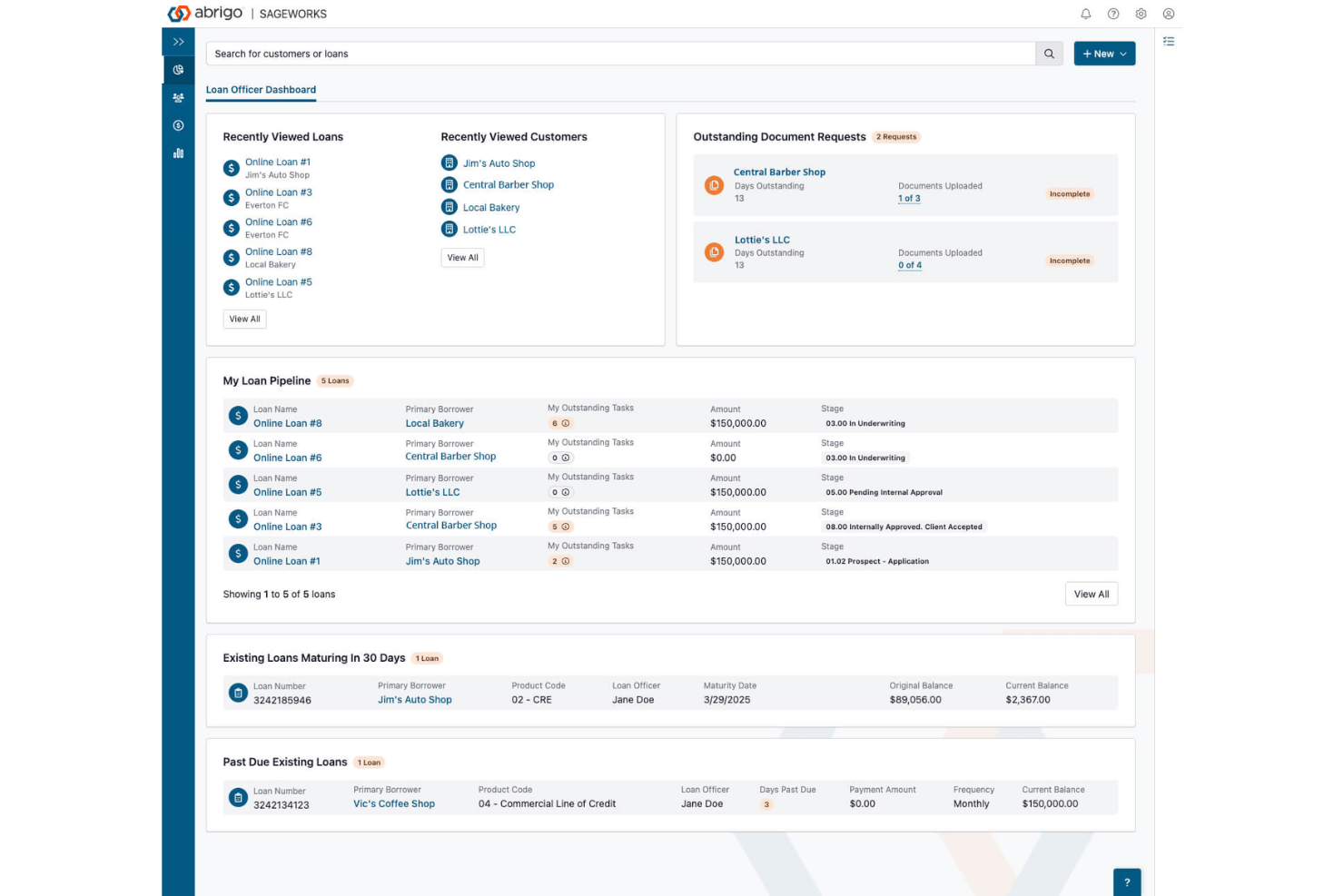
Abrigo is a loan origination platform that handles application intake, credit underwriting, pipeline tracking, and portfolio management.
Who Is Abrigo Best For?
Abrigo is a good fit for community banks and credit unions that originate commercial, small business, construction, and agricultural loans and want them in one system.
Why I Picked Abrigo
Abrigo made my list because it runs all of those loan types on one platform, so your team works in every pipeline in the same place. AI-powered financial spreading and global cash flow analysis carry data from underwriting through closing without re-entry.
Abrigo Key Features
- Covenant and tickler tracking: Flags covenant exceptions and tracks tickler items after closing, so portfolio oversight continues past origination.
- Small business AI loan scoring: Evaluates industry trends, financial statements, and bank transaction data to generate loan decisions with optional lender review.
- CFPB 1071 compliance support: Required small business data fields are built into borrower-facing forms, with report exports and data firewalls that separate protected demographic information.
- Abrigo APX Performance Center: Tracks capacity created, time-to-fund, AI agent activity, and exception findings across the lending pipeline.
Abrigo Integrations
Abrigo integrates with Adobe, DocuSign, Equifax, Persona, Plaid, Route One, and Xactus. It also provides an API for custom integration.
Pros and Cons
Pros:
- Tracks covenants after origination
- No re-keying between underwriting and closing
- Covers agricultural and construction lending
Cons:
- Automated scoring limited to small business loans
- Configuration can make rollout time-consuming

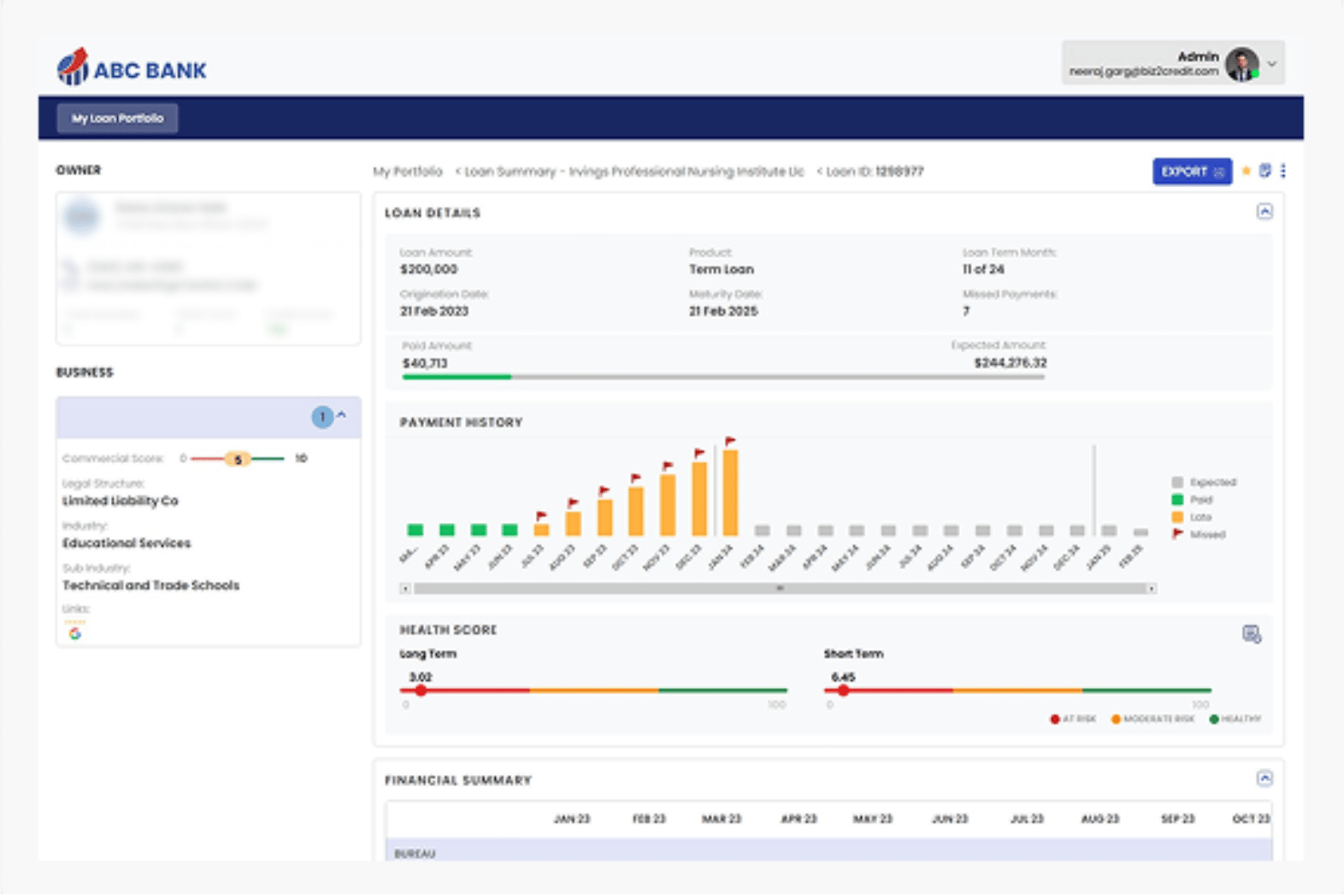
Biz2X is a white-label, cloud-based loan origination platform that combines digital application intake, credit decisioning, financial spreading, and post-close portfolio monitoring.
Who Is Biz2X Best For?
Biz2X is a strong fit for banks, credit unions, and fintechs that originate SMB loans and want decisions grounded in cash-flow data.
Why I Picked Biz2X
I picked Biz2X for the way it builds credit decisions from cash-flow data. The Bank Statement Analyzer parses cash flow at the transaction level, flags risk patterns, and the BA Score builds a borrower-health profile from that behavior alongside bureau data. Together with a no-code Decision Engine that auto-approves or escalates files based on your credit policy, credit analysts can move from application to decision without the usual manual bottlenecks.
Biz2X Key Features
- Borrower self-service portal: Lets applicants submit documents, track application status, and receive offer communications through a branded digital portal.
- Portfolio monitoring dashboard: Segments your loan portfolio into at-risk, moderate, healthy, and renewal buckets with regional heat maps and drill-down views.
- Covenant and compliance monitoring: Tracks loan-level covenants automatically, triggers breach alerts, and generates audit-ready reports.
- SBA loan workflow automation: Supports 7(a), 504, Express, CAPLines, and Microloan programs with automated SBA eligibility checks and direct E-Tran electronic filing.
Biz2X Integrations
Biz2X integrates with AWS, CSC, DocuSign, Equifax, Experian, FICO, Plaid, and Finicity. It also provides REST APIs for custom integrations.
Pros and Cons
Pros:
- Serves banks, credit unions, and fintechs
- White-label branding for borrower-facing screens
- Underwrites on cash flow beyond bureau data
Cons:
- Built around SMB loan sizes
- Limited evidence for complex middle-market structures

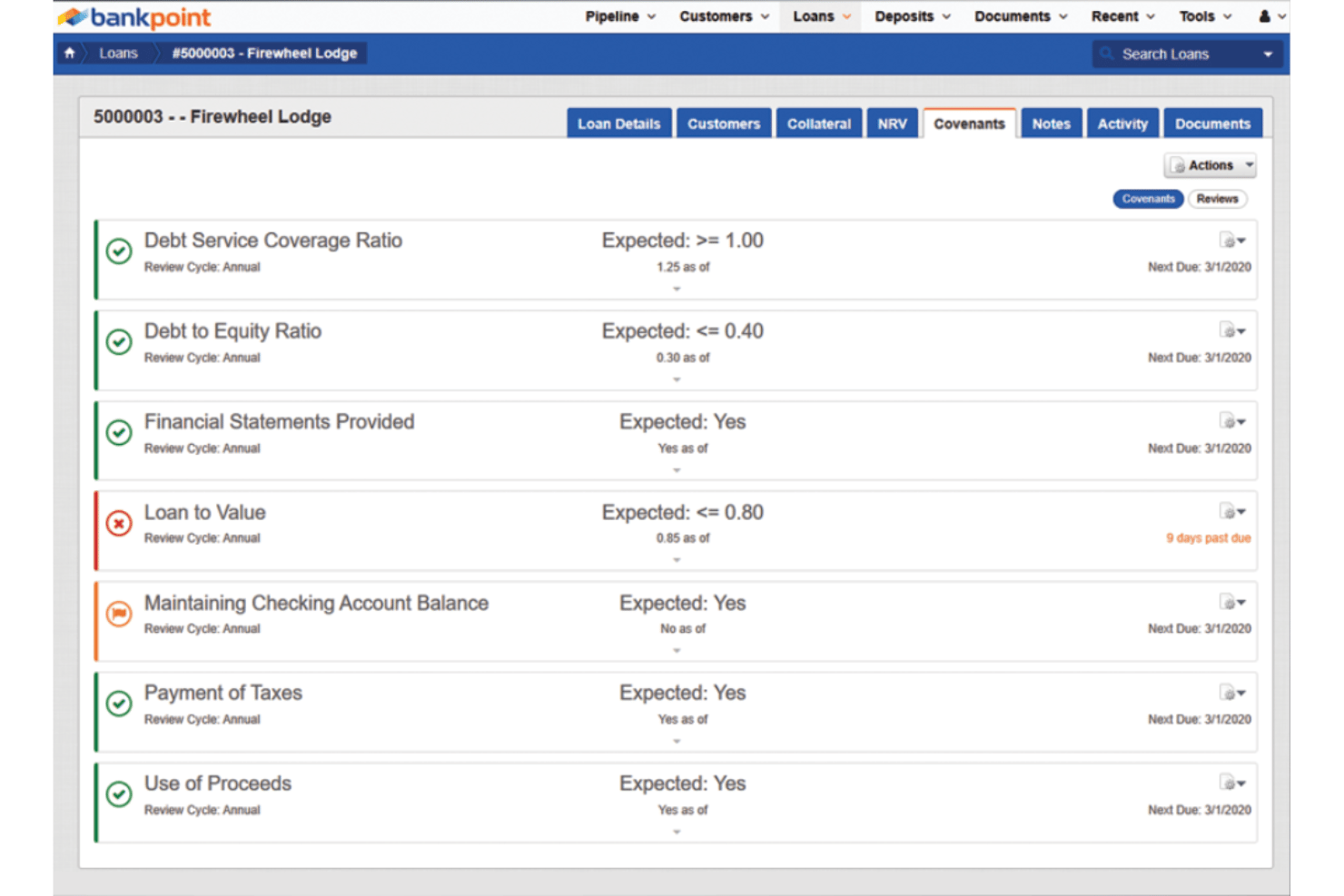
BankPoint is a commercial lending platform that handles deal pipeline tracking, credit administration, covenant and exception monitoring, document management, and portfolio reporting.
Who Is BankPoint Best For?
BankPoint fits community and regional banks where exam readiness and covenant tracking are standing priorities.
Why I Picked BankPoint
I picked BankPoint as one of the best because its credit administration layer is purpose-built for exam readiness in a way most commercial LOS platforms treat as an afterthought. Every risk rating change, charge-off, and non-accrual routes through an automated credit action workflow that produces a full audit trail instantly. I also like the Exception Monitoring module, which auto-escalates overdue covenants, captures actual vs. expected values, and logs every waiver with a structured approval record.
BankPoint Key Features
- DocuPoint borrower portal: A secure portal where borrowers and third parties upload documents, with automatic virus scanning and a review queue for accept or reject decisions.
- Relationship mapping: Maps borrower and guarantor relationships and generates visual diagrams to support legal lending limit analysis.
- Loan pipeline management: A centralized workspace with real-time status updates, customizable dashboards, and drill-down reporting from portfolio to individual loan.
- Boarding worksheet generation: Captures and validates loan data to produce boarding worksheets for core system booking.
BankPoint Integrations
BankPoint offers integrations with Hyland OnBase, Microsoft Office 365, Salesforce, DocuSign, Oracle NetSuite, and Finastra. It also offers an API for custom integrations.
Pros and Cons
Pros:
- Customizable commercial lending workflows
- Detailed covenant and exception tracking
- Audit-ready credit action workflows
Cons:
- Navigation between related records takes time
- No documented financial spreading engine

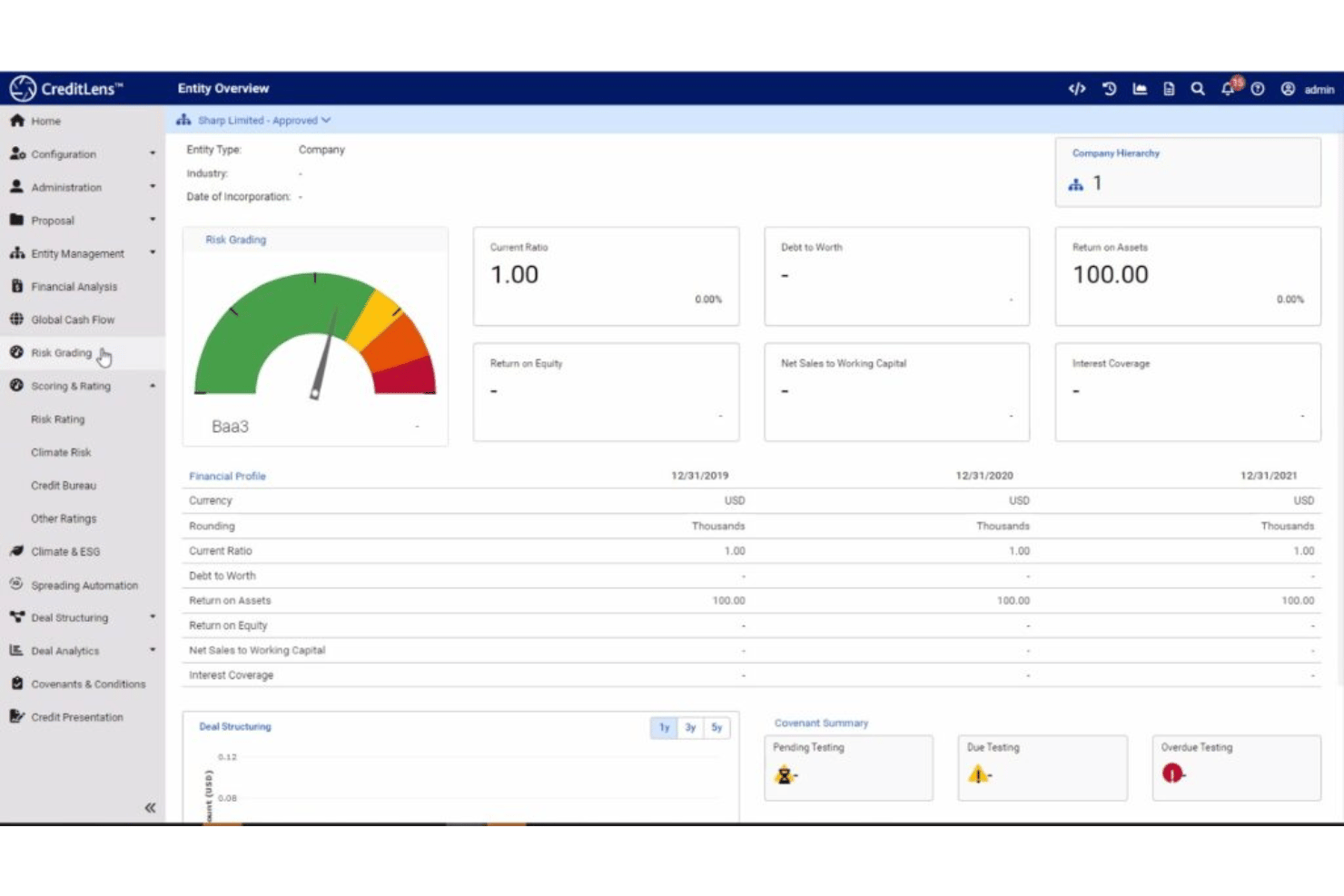
Moody's offers a Lending Suite that covers financial spreading, dual risk rating, scenario and stress testing, configurable underwriting workflows, and a generative AI credit memo tool across CRE, agriculture, and small business lending.
Who Is Moody's Best For?
Moody's is ideal for credit analysts and underwriters at regional and enterprise banks who need proprietary risk models in their underwriting workflow.
Why I Picked Moody's
I chose Moody's because it places Moody's own PD and LGD models, RiskCalc scores, and economic scenarios on the underwriting screen. Analysts get dual risk ratings inside the deal workflow, so risk assessment happens while the credit is being structured.
Moody's Key Features
- Scenario and stress testing: Runs scenario and stress tests on a deal within the underwriting workflow.
- Generative AI credit memos: Drafts structured credit narratives from borrower financials, deal details, and Moody's content.
- Auto-decisioning for small business loans: Loans under $250,000 can be auto-decisioned using configurable credit policies, scoring models, and FICO Small Business Scoring Service integration.
- KYC screening: Screens applicants against Moody's global risk database before credit analysis begins.
Moody's Integrations
Moody's integrates with FICO Small Business Scoring Service but no other integrations have been publicly documented. It offers an API for custom integrations.
Pros and Cons
Pros:
- Audit trails on credit decisions
- AI financial spreading and credit memos
- Supports CRE, agriculture, and small business
Cons:
- Tool administration can consume analyst time
- Enterprise implementation can take months

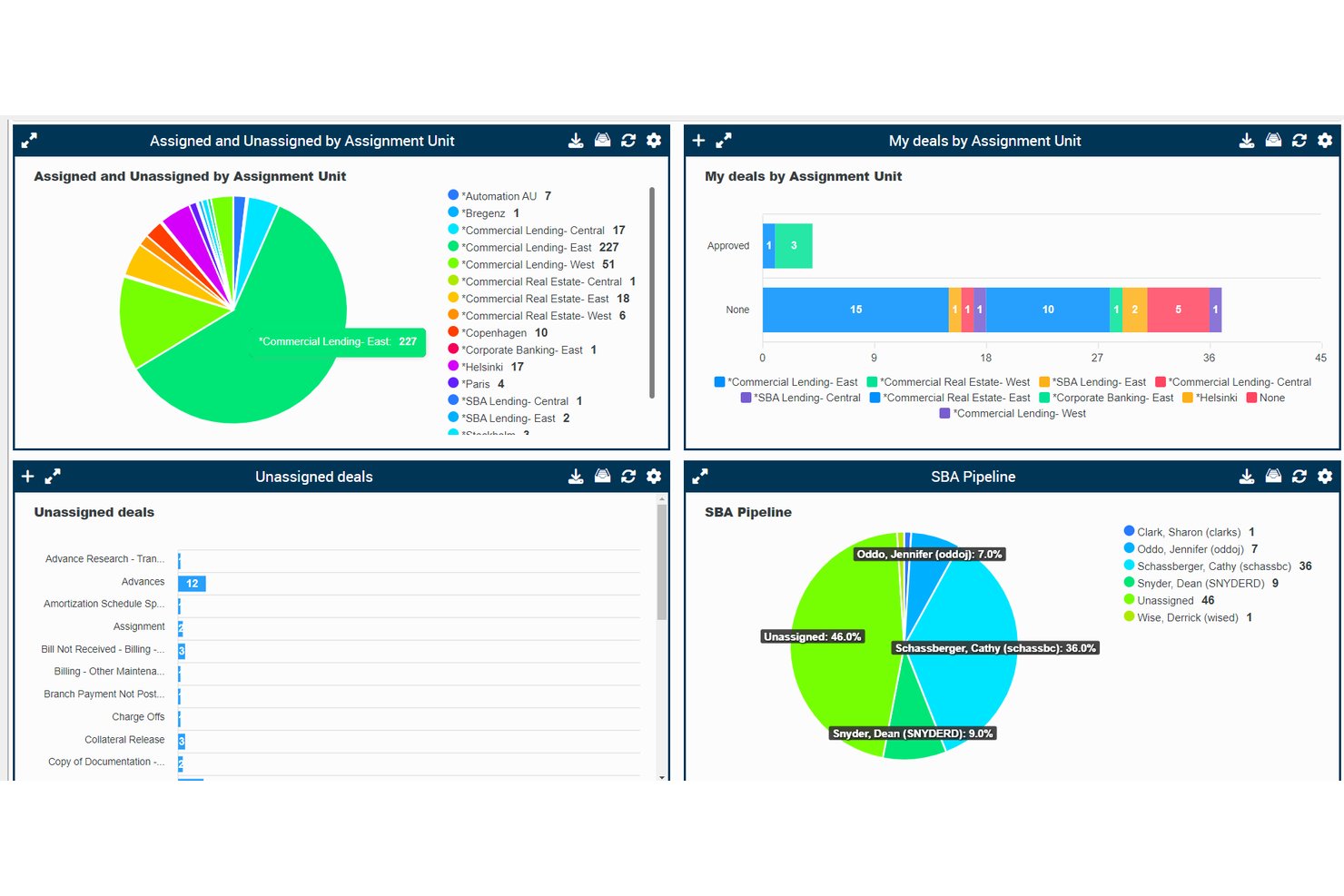
AFSVision is a commercial lending platform that runs origination, underwriting, closing, servicing, and portfolio reporting on a single system.
Who Is AFSVision Best For?
AFSVision works best for large regional and national banks that need covenant and exception oversight across a high loan volume.
Why I Picked AFSVision
I've included AFSVision in my top picks because of the depth of its covenant and exception tracking. The automated exceptions module monitors documents, credit decisions, covenants, and collateral in one place. Pair that with IRIS, which surfaces risk-rating distributions, industry concentrations, and early-warning problem-loan flags in real time, and you've got a capable portfolio oversight setup.
AFSVision Key Features
- Policy-driven workflow engine: Configure credit stages, authority limits, and role-based routing directly into the lending lifecycle.
- Multi-line-of-business support: Manage C&I, CRE, SBA, agriculture, and syndications on one platform without separate systems.
- AI-powered pricing intelligence: Analyzes historical loan data to generate market-informed pricing guidance within lender workflows.
AFSVision Integrations
AFSVision supports integrations via RESTful and DIY APIs, with conversion experience for FIS, Fiserv, Loan IQ, ACBS, McCracken, and Stucky.
Pros and Cons
Pros:
- Supports complex commercial lending lines
- Conversion experience with major core providers
- Native covenant and exception tracking
Cons:
- No applicant-facing intake portal described
- Limited documented spreading and scoring tools

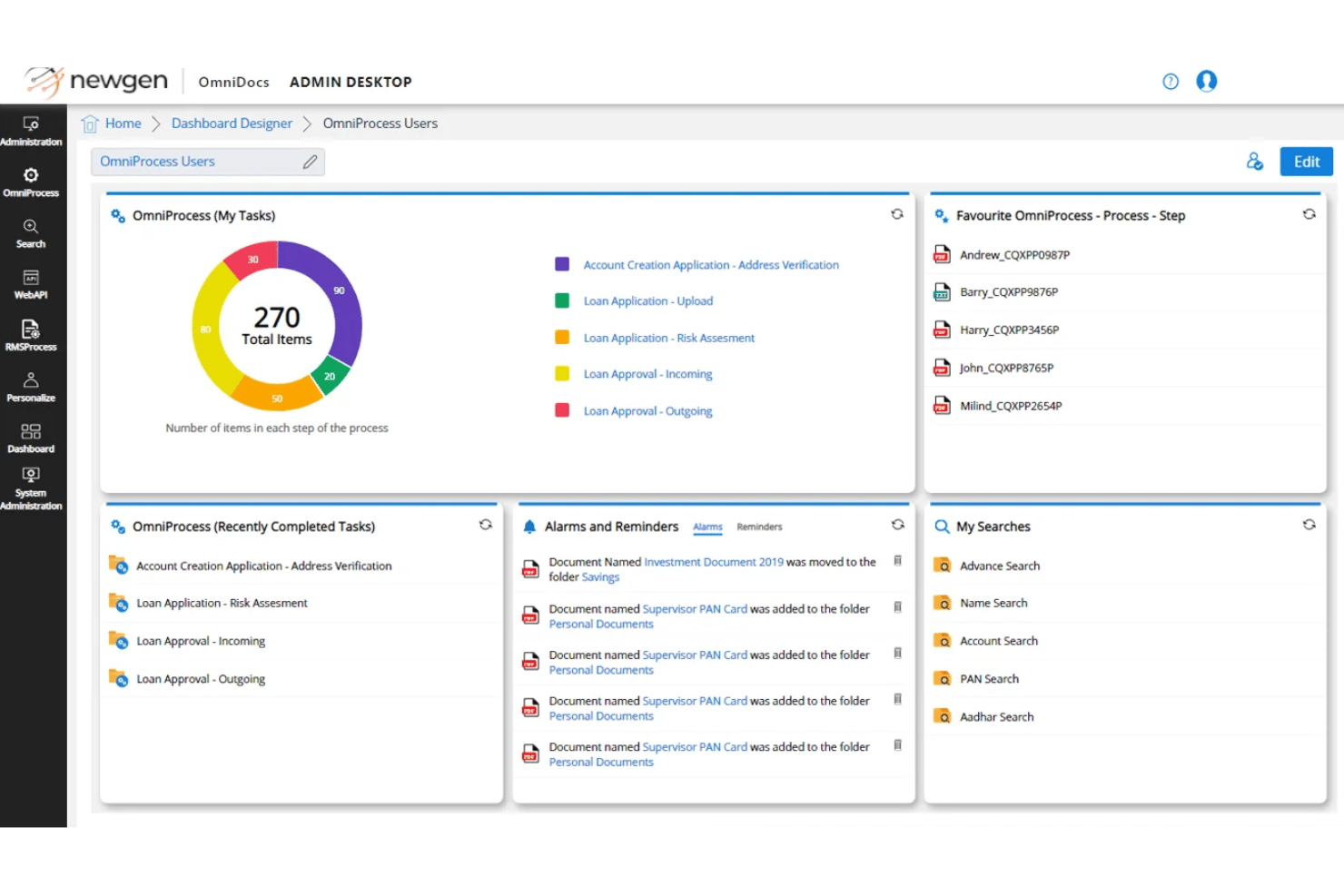
Newgen is a commercial loan origination platform built on the NewgenONE stack, with modules for application intake, financial spreading, underwriting, approval routing, and disbursement.
Who Is Newgen Best For?
Newgen is a strong fit for mid-to-large banks and credit unions that want intake through post-disbursement monitoring on one platform.
Why I Picked Newgen
Newgen made it on my list because it covers every stage of commercial lending without separate tools. Financial spreading, DSCR analysis, and stress testing sit in the same stack as disbursement and post-disbursement monitoring. A credit analyst can take a C&I or CRE deal from underwriting to ongoing monitoring without leaving the platform
Newgen Key Features
- Borrower self-service portal: Lets commercial applicants initiate applications, upload documents, and track status through a branded online portal connected directly to the LOS.
- AI-based document indexing and extraction: Automatically classifies and extracts data from financial statements, tax returns, and collateral documents as they enter the loan file.
- Covenant tracking and maturity monitoring: Tracks covenant compliance ratios, flags breaches, and automates renewal alerts.
- Section 1071 compliance: Collects and manages CFPB small business lending data to support regulatory reporting obligations.
Newgen Integrations
Newgen integrates with Finastra, Plaid, Experian, Deluxe, Glia, and Factual Data. A REST API for custom connections is also available.
Pros and Cons
Pros:
- Routes approvals by amount and risk
- Supports spreading, DSCR, and stress testing
- Low-code platform allows in-house workflow changes
Cons:
- Reviewers report performance and responsiveness issues
- Setup can be complicated

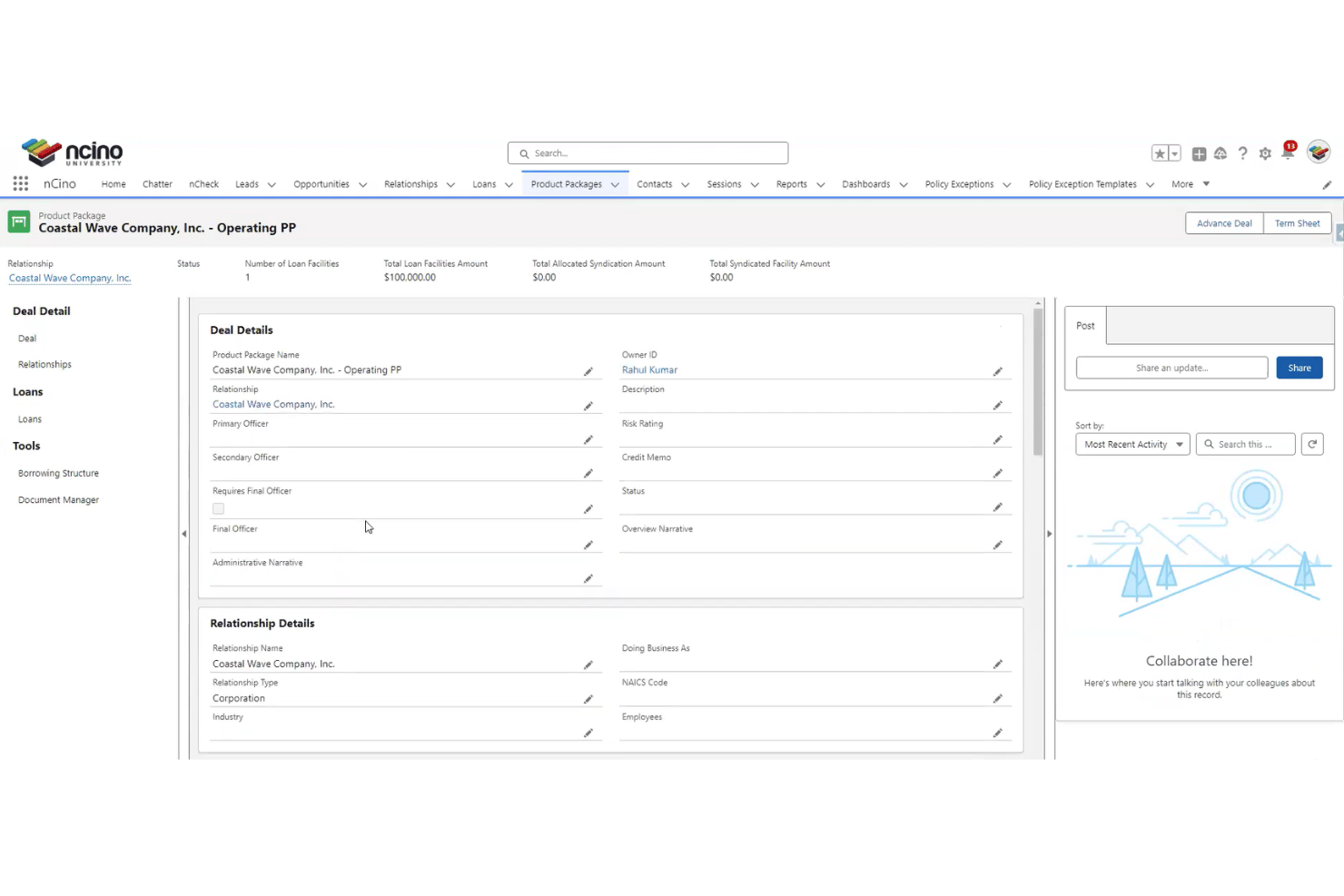
nCino is a commercial loan origination system built on Salesforce that handles underwriting, credit analysis, document management, pricing, and portfolio monitoring.
Who Is nCino Best For?
nCino is ideal for mid-to-large banks and credit unions that already run Salesforce and want lending on the same customer data.
Why I Picked nCino
I included nCino in my top picks because it runs inside Salesforce, so loan data, credit analysis, and relationship history sit in one place without an external sync. Its Automated Spreading tool uses AI to extract and categorize financial statement data, which cuts manual re-keying during underwriting.
nCino Key Features
- Commercial pricing and profitability: Gives bankers real-time loan and relationship profitability data at the deal level, with centrally administered pricing policy built into the origination workflow.
- Portfolio analytics: Covers loan, deposit, application, and customer data, including approval-rate tracking and "what-if" scenario modeling for portfolio forecasting.
- Document Manager: Central repository for all loan-related documents with standardized naming, timestamped activity logs, and borrower self-serve upload with status visibility.
- Continuous credit monitoring: Surfaces early-warning risk indicators and automated credit health insights on an ongoing basis, rather than at scheduled annual review points.
nCino Integrations
nCino integrates with Salesforce, AWS, DocuSign, and Snowflake. Its Integration Gateway connects core banking systems, credit bureaus, fintechs, and third-party applications through real-time or batch synchronization.
Pros and Cons
Pros:
- Large implementation partner network
- Covers SBA alongside commercial loans
- Loan and CRM data share one record
Cons:
- Borrower portal issues frustrate applicants
- Implementation needs specialized Salesforce expertise

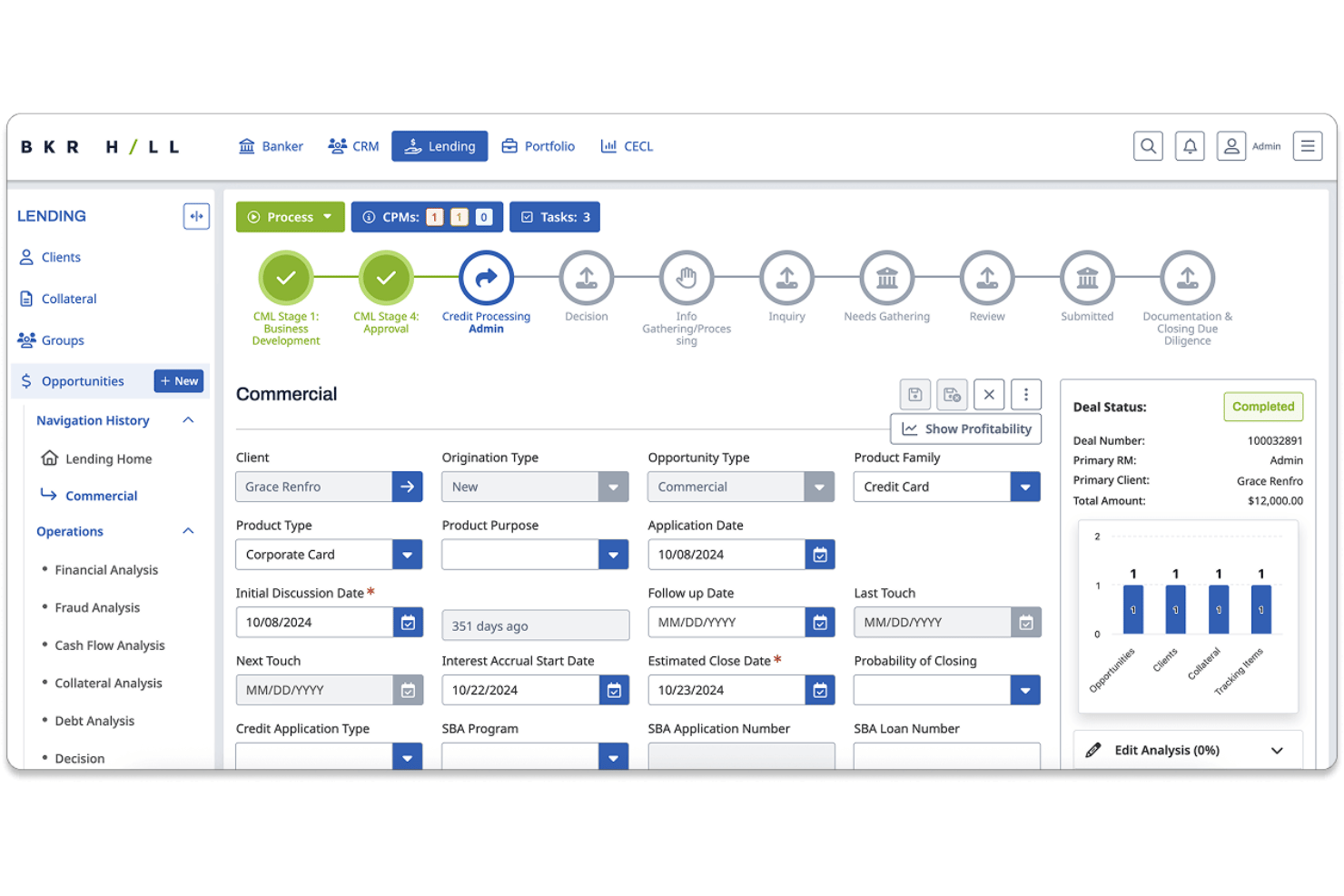
Baker Hill is a commercial loan origination platform that handles statement spreading, document automation, workflow management, and portfolio risk management.
Who Is Baker Hill Best For?
Baker Hill is a strong fit for community banks and credit unions whose commercial deals call for detailed spreading and cash flow analysis.
Why I Picked Baker Hill
Baker Hill earned its spot for its deep credit analysis. The statement spreading module supports global debt service coverage and global cash flow calculations, RMA peer benchmarking, and financial projections that let underwriters test future performance against risk thresholds. Covenants can also be created during spreading, which links credit analysis to portfolio monitoring from the first review.
Baker Hill Key Features
- AI document processing: Extracts financial data from business and personal tax forms, including 1040, 1065, 1120, and 1120S schedules, and populates the LOS.
- Relationship pricing module: Calculates expected return per loan and overall relationship profitability, with what-if modeling across loan structures.
- Smart Workflow Management: Routes tasks automatically, enforces credit policy, and tracks tickler items across the loan lifecycle.
- Ask BKR AI assistant: Searches and analyzes the lending pipeline to surface trends and flag risks.
Baker Hill Integrations
Baker Hill offers integrations with Fiserv, COCC, Corelation, Alloy, DocuSign, Validis, and TruStage. An API for custom connections isn't publicly documented.
Pros and Cons
Pros:
- Combines origination with portfolio risk monitoring
- Pulls data from QuickBooks and tax software
- Long track record with community lenders
Cons:
- NextGen-to-UN/FY transition requires diligence
- Configuration demands substantial implementation effort

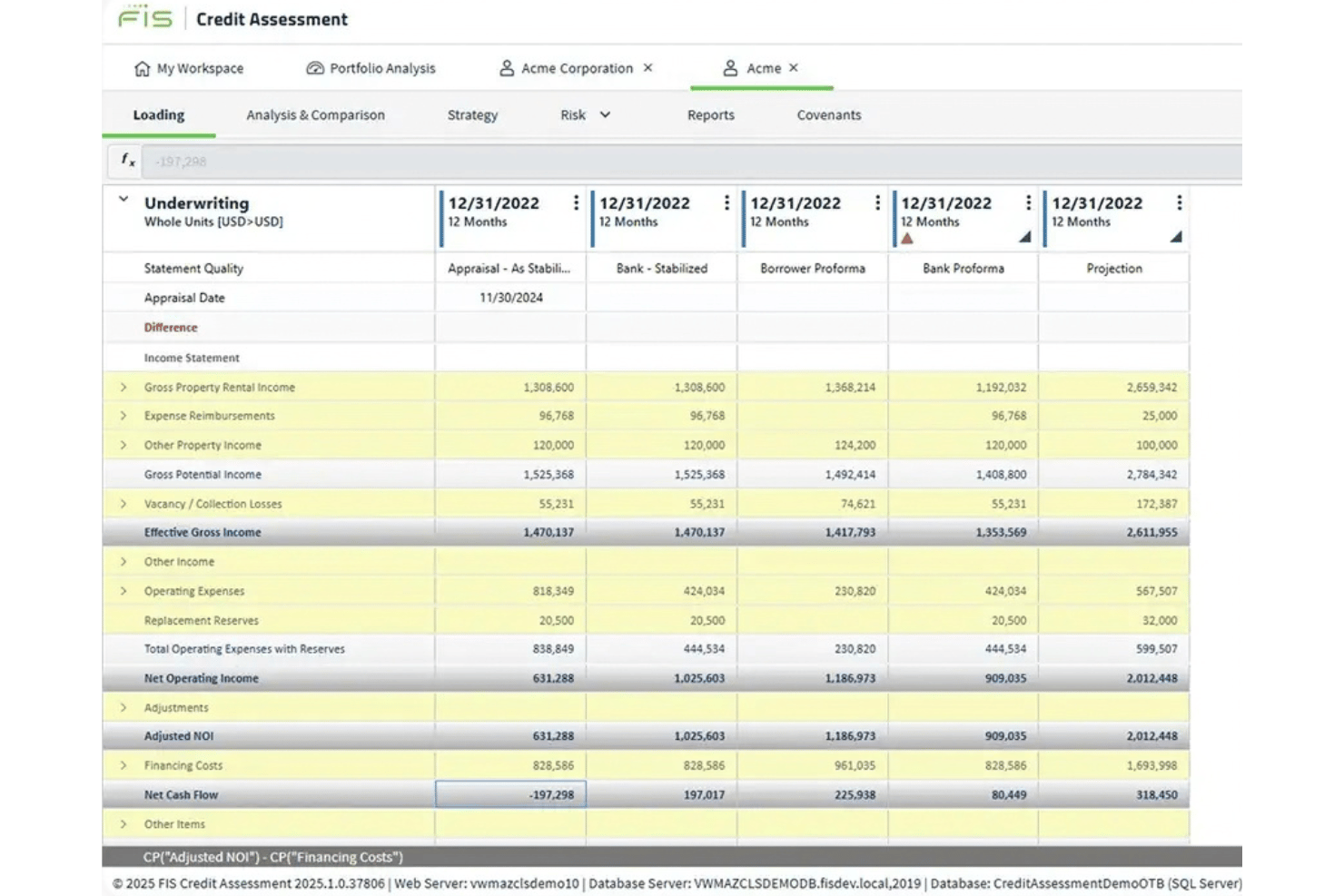
FIS Commercial Lending Suite is a modular commercial loan origination platform that handles credit assessment, financial spreading, underwriting, syndication management, and handoff to loan servicing.
Who Is FIS Commercial Lending Suite Best For?
FIS Commercial Lending Suite is aimed at mid-market and enterprise banks and private credit institutions that manage syndicated, agented, or multi-party loans.
Why I Picked FIS Commercial Lending Suite
I picked FIS Commercial Lending Suite as one of the best because it's built for the complexity of syndicated and agented loans. The Credit Assessment module embeds PD and LGD rating models alongside industry-specific spreading for commercial real estate, agribusiness, and municipalities. SyndTrak adds secure deal rooms for sharing documents with borrowers, agents, and syndicate investors.
FIS Commercial Lending Suite Key Features
- Configurable approval workflow engine: A BPMN/DMN-based low-code engine routes credit decisions through policy-driven, role-based approval rules.
- Document modeling: Auto-generates term sheets, offer letters, and credit memos from deal data.
- 360-degree portfolio dashboard: Consolidates customer and portfolio exposure into multidimensional views.
- SyndTrak digital deal rooms: Provides secure, structured deal sites for sharing documents and coordinating across borrowers, agents, and syndicate investors.
FIS Commercial Lending Suite Integrations
FIS Commercial Lending Suite supports open APIs for CRM, KYC, compliance, spreading, risk rating, bureau, scoring, and core loan platforms.
Pros and Cons
Pros:
- Generates credit memos from deal data
- Embeds PD/LGD models with industry spreading
- Handles syndicated and agented credit structures
Cons:
- Occasional data accuracy issues
- Workflow configuration can require specialist support

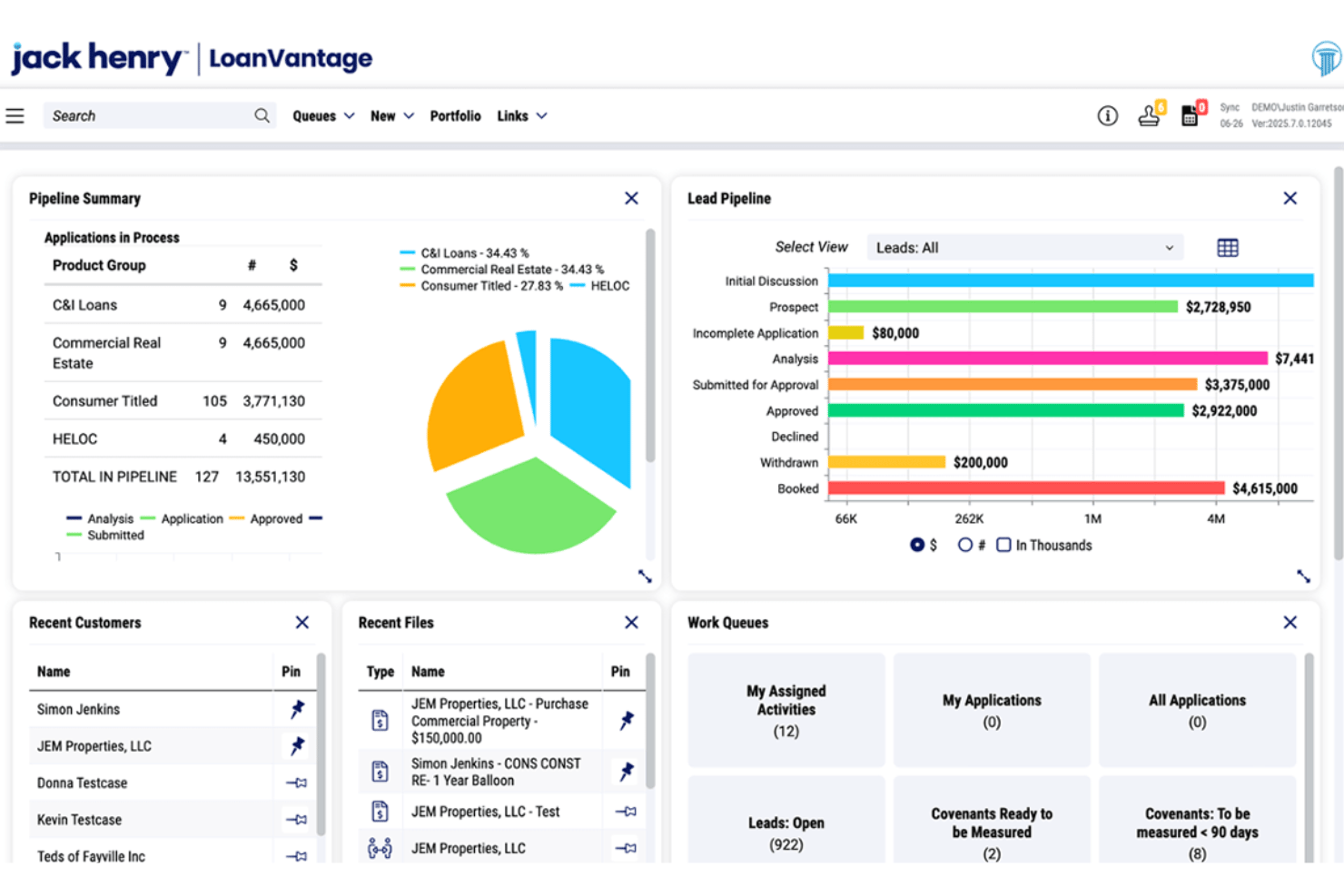
Jack Henry Commercial Lending is a loan origination system with native financial spreading, covenant tracking, collateral management, and compliance tools for commercial, consumer, and agricultural loans.
Who Is Jack Henry Commercial Lending Best For?
Jack Henry Commercial Lending is a good fit for community and regional banks and credit unions already running a Jack Henry core.
Why I Picked Jack Henry Commercial Lending
I've included Jack Henry Commercial Lending in my top picks because Loans Board natively integrates with SilverLake, Symitar, CIF 20/20, and Core Director, which removes the integration work a third-party LOS usually needs. Spreading covers tax returns across 1040, 1120, 1120S, and 1065 forms, UCA and global cash flow, CRE rent rolls, and ABL borrowing base. Covenant tracking pulls measurements from those spreads and generates recurring requirements automatically.
Jack Henry Commercial Lending Key Features
- Presentation report builder: Assembles credit packages using an HTML editor or Microsoft Word add-in, pulling in live financial data, collateral summaries, risk ratings, and policy exceptions into a versioned, printable report.
- Section 1071 compliance module: A standalone data collection tool that emails a secure form to applicants and enforces role-based demographic data segregation.
- Mobile app for lenders: An iOS and Android app lets loan officers manage leads, track sales goals, review approvals, log site visits, and receive alerts from the field.
- Document management: Centralized repository for document collection, automated tracking, e-signatures, and real-time document exception clearing.
Jack Henry Commercial Lending Integrations
Jack Henry Commercial Lending integrates with SilverLake, Symitar, CIF 20/20, and Core Director. It also provides an API for data transfer from third-party CRM systems.
Pros and Cons
Pros:
- CRE and ABL stress testing supports specialized lending
- Supports more than one e-signature provider
- Deep tax-return spreading supports complex underwriting
Cons:
- OCR spreading still requires manual review
- Analysts report inconsistent automation in production
Other Commercial Loan Origination Software
Here are a few additional options that didn’t make my top list but are still worth checking out:
- Temenos Digital
For core-agnostic loan routing
- HES LoanBox
For AI-driven deal origination
- TurnKey Lender
For global loan automation
- Symphonix
For non-bank lenders with credit facilities
- Trade Ledger
For working capital origination at large banks
- Uptiq
For AI agents layered onto an existing LOS
- Linedata Capitalstream
For Section 1071 compliance built-in
- Hawthorn River
For community banks managing post-close exceptions
- CASH Suite
For credit spreading across borrower entities


How I Evaluate Commercial Loan Origination Software
I split my evaluation into three parts. Core functionality carries the most weight: tools must handle structured commercial underwriting and centralized document management. From there, I look at standout features like AI-driven spreading. Finally, I consider implementation support and total cost of ownership.
Core Functionality (Table Stakes for This List)
When I'm selecting tools for my list, I score each one on a scale from 0 (does not offer the functionality) to 5 (excels in this area) for each core functionality listed below. I then convert the total into a percentage to help assess each tool's overall fit, with extra weight on any functionalities I've deemed essential.
- Commercial Underwriting Workflow (Essential): I evaluate whether the platform supports structured financial spreading, credit scoring, and risk-based decisioning for commercial loan types beyond basic consumer or mortgage lending.
- Document & Data Management (Essential): Each tool should centralize borrower financials, tax returns, and collateral records in the loan file with checklist tracking, verification steps, and audit-ready archiving.
- Configurable Approval Workflows: I look for multi-stage, role-based routing that mirrors real credit authority limits, so a deal above a certain threshold automatically escalates to the right approval committee.
- Pipeline & Portfolio Tracking: Dashboards that show pipeline volume by officer, branch, or loan product help me assess whether a platform gives leadership clear visibility into bottlenecks and deal velocity.
- Regulatory Compliance Support: Tools like nCino and Abrigo build fair lending checks and covenant tracking directly into origination workflows, and I check whether compliance reporting is embedded or bolted on.
- Core System & Data Integration: The platform should sync borrower and loan data with core banking, general ledger, and accounting systems so teams aren't rekeying information across platforms.
Once I have a list of tools that meet the criteria, I consider what sets each platform apart.
Differentiating Factors (What Sets Vendors Apart)
Here's how I compare and contrast different vendors:
Standout Features
AI-driven spreading is the first thing I check. Tools like Abrigo and Moody's use OCR to extract and spread tax returns and borrower financials automatically, which cuts hours of analyst time on each deal. I also evaluate covenant and exception tracking—automated alerts for missed covenants or approaching maturities keep portfolio risk visible without relying on spreadsheet reminders. Scenario and stress testing matters too. I look for built-in models that let underwriters shock cash flow or collateral values before approval, not after a borrower misses a payment.
Beyond Features
I evaluate how well a platform fits an institution's actual size and lending complexity. A system built for large multi-entity banks can overwhelm a community lender with unnecessary configuration overhead. Deployment model matters too—SaaS platforms like nCino push updates automatically, while on-premise setups shift that burden to internal IT. I also check vendor ecosystem health, including API openness and partner networks, since a closed platform limits your options when you need to add third-party credit data or connect a new core. Finally, licensing structure deserves close attention; per-loan pricing that looks affordable at current volume can escalate fast as your commercial book grows.
How to Choose Commercial Loan Origination Software
Choose a digital lending platform by testing whether it can represent your credit policy, preserve evidence, and connect with your existing financial institutions and systems.
| If your priority is | Look for |
|---|---|
| Audit-ready credit files | A sample borrower file with source documents, approvals, timestamps, and change history |
| Consistent approval decisions | A configurable authority matrix that routes a sample loan through two approval levels |
| Faster analyst review | A live trial that processes one tax return and produces a reviewable spreading output |
| Portfolio visibility | A pipeline report grouped by officer, stage, maturity, and exception status |
How to Vet Your Shortlist
- Request a documented workflow: Ask each vendor for a five-step diagram covering application intake, underwriting, approval, documentation, and servicing handoff.
- Run a defined trial task: Provide one anonymized borrower package and require the vendor to demonstrate spreading, missing-document checks, and approval routing within 10 business days.
- Test audit evidence: Request an exported credit file containing the decision record, approval timestamps, user changes, and document checklist as a named artifact.
- Validate integration ownership: Ask for a written interface specification naming your core system, data fields, synchronization direction, and error-handling process before signing.
- Choose the operating model: Treat configurable enterprise controls versus faster, simpler deployment as the decision filter, then select the tradeoff your lending policy can support.
What Is Commercial Loan Origination Software?
Commercial loan origination software is a platform that manages business lending from application intake through underwriting, approval, documentation, and handoff to servicing. It centralizes borrower financials, tax returns, collateral records, credit analysis, approval routing, and audit evidence. Banks and lending teams use it to apply credit policies consistently, track pipeline activity, connect with core systems, and monitor exceptions throughout the loan management lifecycle.
Features
Here are the main features I look for in any great commercial loan origination software:
- Commercial underwriting: Structures financial spreading, credit analysis, risk ratings, and repayment assessments for business loans. Underwriters can review borrower performance, debt capacity, collateral, and projected cash flow within one loan file.
- Document management: Stores applications, tax returns, financial statements, appraisals, and legal documents in a central repository. Checklists and document status fields help teams identify missing or outdated materials before approval.
- Approval workflows: Routes applications through predefined review stages based on loan amount, risk level, product type, or approval authority. Role-based permissions help ensure the right reviewers examine and approve each deal.
- Credit policy controls: Applies lending rules to fields such as debt-service coverage, loan-to-value ratios, exposure limits, and policy exceptions. The system can flag applications that require additional review or committee approval.
- Pipeline tracking: Shows each application’s status, assigned loan officer, product, value, and next action. Managers can identify stalled deals, monitor workloads, and review movement from application through closing.
- Collateral management: Records pledged assets, valuations, lien positions, insurance details, and related documents. Teams can connect collateral information to individual facilities and update values during renewals or reviews.
- Compliance monitoring: Captures required disclosures, approval evidence, fair lending checks, and exception records. Time-stamped activity logs support internal reviews, examinations, and audit requests.
- Core system integrations: Transfers borrower, facility, pricing, and servicing data between the origination platform and core banking or accounting systems. Field mapping and error handling reduce duplicate entry and help preserve consistent records.
Benefits
In my experience, commercial loan software offers several benefits, including:
- Faster credit review: Financial spreading, OCR, and centralized borrower records give underwriters structured information for analysis.
- More consistent decisions: Configurable approval workflows apply authority limits, credit policies, and escalation rules across loan applications.
- Audit-ready records: Document checklists, time-stamped activity logs, and archived approvals preserve evidence throughout the loan process.
- Clearer pipeline oversight: Dashboards organize applications by officer, stage, product, value, and next action.
- Earlier risk visibility: Covenant tracking, exception alerts, collateral records, and scenario testing help teams monitor borrower and facility risk.
- Fewer data-entry errors: Core banking and accounting integrations transfer borrower, facility, pricing, and servicing information between systems.
Costs and Pricing
Costs vary based on features, team size, integrations, implementation, and add-ons. Here are the pricing ranges you can typically expect from commercial lending software:
Plan Comparison Table for Commercial Loan Origination Software
| Plan Type | Average Price | Common Features |
|---|---|---|
| Free Plan | $0 | Basic application tracking, limited document storage, and restricted user access. |
| Personal Plan | $50-$150/user/month | Borrower intake, document management, basic pipeline tracking, and email support. |
| Business Plan | $500-$2,000/month | Commercial underwriting, approval workflows, financial spreading, reporting, and core system integrations. |
| Enterprise Plan | $2,000-$10,000+/month | Configurable credit policy controls, advanced portfolio tracking, audit logs, custom integrations, and implementation support. |
FAQs
Some answers to common questions about commercial loan origination platforms:
How long does commercial loan origination software take to implement?
Implementation often takes several weeks to several months, depending on scope. A basic deployment may cover users, workflows, document templates, and permissions. Larger projects may include core integrations, data migration, credit policy rules, and custom reporting. Ask vendors for a phased implementation plan with milestones and assigned responsibilities. Before signing, confirm who owns data mapping, testing, training, and post-launch support. Plan extra time for user acceptance testing with real, anonymized borrower scenarios.
Can commercial loan origination software replace a core banking system?
No, it works alongside a core banking system. The origination platform manages applications, underwriting, approvals, documents, and closing handoffs. The core system typically manages booked facilities, balances, payments, and servicing records. Confirm which system owns each data field before implementation. You should also test how the platforms handle rejected applications, amended facilities, approval changes, and failed data transfers.
How should lenders validate AI-generated financial spreading?
Lenders should require analyst review before accepting any AI-generated spreading output. Test the tool with tax returns and financial statements that contain multiple entities, unusual formats, and handwritten adjustments. Compare extracted values against the source documents. Check whether the system records corrections, preserves the original files, and displays confidence indicators. Your credit policy should define when manual verification is required.
What should a lender ask about data security and access controls?
Ask vendors how they protect borrower data, control user access, and document system activity. Request details about encryption, authentication, role permissions, backups, retention, and incident response. Confirm whether administrators can restrict access by branch, team, loan, or field. Review the audit log during a product demonstration. It should show document changes, approval actions, and permission updates. Also ask how the vendor returns or deletes your data when the contract ends.
Is commercial loan origination software suitable for a small lender?
Yes, smaller lenders can use it when the configuration matches their lending process. Start with the workflows you use most often, such as applications, financial spreading, approvals, and document checklists. Avoid paying for complex modules your team will not maintain. Ask whether pricing depends on users, loans, applications, or integrations. You should also confirm whether the vendor provides implementation help, training, and a support contact after launch.