

Betterment Review: Pros, Cons, Features, and Pricing
Betterment excels with its user-friendly interface and goal-based investing, making it ideal for new investors seeking guidance and ease.

We review tools independently, and commissions help fund our testing. See our transparency policy, our methodology, or suggest a tool.
Betterment is an investment platform and robo-advisor that helps individuals and businesses manage their investment accounts through automated investing and personalized financial planning. It best serves individual investors, beginners, small business owners, and financial advisors looking for a user-friendly way to simplify investment management. Betterment offers intuitive planning tools, diversified investment options, and personalized investment strategies designed to help users achieve long-term financial goals.
Betterment addresses the need for accessible, low-cost, and hands-off investment management for individuals and small teams without advanced financial expertise. In this article, I'll cover Betterment’s price, features, pros and cons, use cases, fee structure, and more, so you can decide if this robo-advisor aligns with your financial goals.
Betterment Evaluation Summary

4.2/5
- From 0.25% for assets up to $1M, annually
- Free demo available
Why Trust Our Software Recommendations
6,700+
Reviews
20
Industry experts
16+
Evaluation factors
14
Years
Our team has been testing and reviewing software since 2012. As finance leaders ourselves, we know how difficult—and important—it is to choose the right software.
For this guide, we evaluated tools using hands-on testing and independent research, scoring tools using our selection criteria.
Our reviews reflect our human editorial judgment, not a sales pitch.
Betterment Overview
In my opinion, Betterment offers a solid investment platform that’s easy to navigate and ideal for beginners. It excels in portfolio management with automated rebalancing, tax-loss harvesting, and a simple interface for retirement accounts like IRAs. The platform combines low fees, a transparent annual fee structure, and diversified ETFs to support a wide range of financial goals. However, it may lack detailed analytics that advanced investors or CFPs might prefer. Betterment’s pricing and expense ratios are competitive, though its customer support could be more responsive. Overall, it’s best for those who want a hands-off, goal-based approach to investment management.
Pros
- It offers a user-friendly interface that's easy for anyone to navigate.
- You get personalized investment strategies tailored to your financial goals.
- Goal-based investing helps you stay focused on your objectives.
Cons
- It may lack advanced features for experienced investors.
- Some users find that customer support could be more responsive.
- Your team might miss the detailed analytics offered by other platforms.
Is Betterment Right For Your Needs?
Who Would be a Good Fit for Betterment?
Betterment is ideal for individual investors and small business owners seeking automated investing and a simple way to achieve financial goals. If your team values ease of use, diversified asset allocation, and clear planning tools, Betterment’s platform helps streamline retirement planning and personal finance. It’s especially useful for beginners, those managing taxable accounts, or users who prefer low fees and automated rebalancing instead of manual trading.
- Individual InvestorsBetterment helps you manage your investment portfolio with automated asset allocation, tax strategies, and recurring deposits to grow wealth steadily.
- Small Business OwnersYour company can benefit from Betterment’s cash management, savings account, and checking account options for employee retirement accounts or business growth.
- Financial AdvisorsCertified financial planners (CFPs) and human advisors can use Betterment’s portfolio options, allocation models, and planning tools to advise clients effectively.
- FreelancersIf you’re self-employed, Betterment simplifies brokerage and cash reserve management with automated investing and retirement account flexibility.
- Young ProfessionalsBetterment’s low-cost ETFs, portfolio management, and mobile app make it easy to start investing early with low fees and no complex setup.
- RetireesRetirees can use Betterment’s tax-advantaged retirement planning tools, rollover options, and automated rebalancing to maintain stable income streams.
Who Would be a Bad Fit for Betterment?
Betterment may not be suitable for large corporations or investors requiring complex investment strategies, smart beta models, or on-premise portfolio management. If you prefer complete trading control, real-time analytics, or crypto diversification, its hands-off approach may not align with your goals.
- Large CorporationsYour corporation might find Betterment's features too simplistic for managing extensive investment portfolios.
- Experienced TradersIf you're an experienced trader, you may miss the advanced tools and analytics found in other platforms.
- Investment BanksInvestment banks require more complex financial instruments and data than Betterment offers.
- Tech-Savvy TeamsTech-savvy teams looking for deep customization will find Betterment's automated approach limiting.
- Hedge FundsHedge funds need sophisticated strategies and tools that Betterment doesn't provide.
- Day TradersDay traders require real-time trading capabilities that Betterment's platform doesn't cater to.
How We Test & Score Tools
We’ve spent years building, refining, and improving our software testing and scoring system. The rubric is designed to capture the nuances of software selection and what makes a tool effective, focusing on critical aspects of the decision-making process.
Below, you can see exactly how our testing and scoring works across seven criteria. It allows us to provide an unbiased evaluation of the software based on core functionality, standout features, ease of use, onboarding, customer support, integrations, customer reviews, and value for money.
Core Functionality (25% of final scoring)
The starting point of our evaluation is always the core functionality of the tool. Does it have the basic features and functions that a user would expect to see? Are any of those core features locked to higher-tiered pricing plans? At its core, we expect a tool to stand up against the baseline capabilities of its competitors.
Standout Features (25% of final scoring)
Next, we evaluate uncommon standout features that go above and beyond the core functionality typically found in tools of its kind. A high score reflects specialized or unique features that make the product faster, more efficient, or offer additional value to the user.
We also evaluate how easy it is to integrate with other tools typically found in the tech stack to expand the functionality and utility of the software. Tools offering plentiful native integrations, 3rd party connections, and API access to build custom integrations score best.
Ease of Use (10% of final scoring)
We consider how quick and easy it is to execute the tasks defined in the core functionality using the tool. High scoring software is well designed, intuitive to use, offers mobile apps, provides templates, and makes relatively complex tasks seem simple.
Onboarding (10% of final scoring)
We know how important rapid team adoption is for a new platform, so we evaluate how easy it is to learn and use a tool with minimal training. We evaluate how quickly a team member can get set up and start using the tool with no experience. High scoring solutions indicate little or no support is required.
Customer Support (10% of final scoring)
We review how quick and easy it is to get unstuck and find help by phone, live chat, or knowledge base. Tools and companies that provide real-time support score best, while chatbots score worst.
Customer Reviews (10% of final scoring)
Beyond our own testing and evaluation, we consider the net promoter score from current and past customers. We review their likelihood, given the option, to choose the tool again for the core functionality. A high scoring software reflects a high net promoter score from current or past customers.
Value for Money (10% of final scoring)
Lastly, in consideration of all the other criteria, we review the average price of entry level plans against the core features and consider the value of the other evaluation criteria. Software that delivers more, for less, will score higher.
Core Features
Automated Portfolio Management: Betterment automatically manages your investment portfolio, performing rebalancing and maintaining proper asset allocation across asset classes.
Tax-Loss Harvesting: A standout feature allowing investors to offset gains and reduce taxable income through tax strategies and automated loss collection in taxable accounts.
Goal-Based Investing: You can set specific financial goals, like buying a home or retirement planning, and Betterment creates a tailored investment portfolio using exchange-traded funds (ETFs).
Diversified Portfolios: Betterment’s core portfolio offers broad diversification through ETFs across global asset classes to balance risk and reward.
Retirement Planning Tools: Its tools project outcomes for IRAs, 401(k) rollovers, and tax-advantaged plans, ensuring alignment with your retirement account objectives.
Cash Reserve Account: Betterment’s cash reserve is a high-yield savings account insured by FDIC insurance and protected under SIPC, giving you a secure place for your account balance.

Ease of Use
Betterment’s user interface is intuitive, guiding users through goal setup, risk tolerance, and asset allocation preferences. Its mobile app simplifies portfolio tracking, rebalancing, and recurring deposits, while customer support resources assist new users efficiently.

Integrations
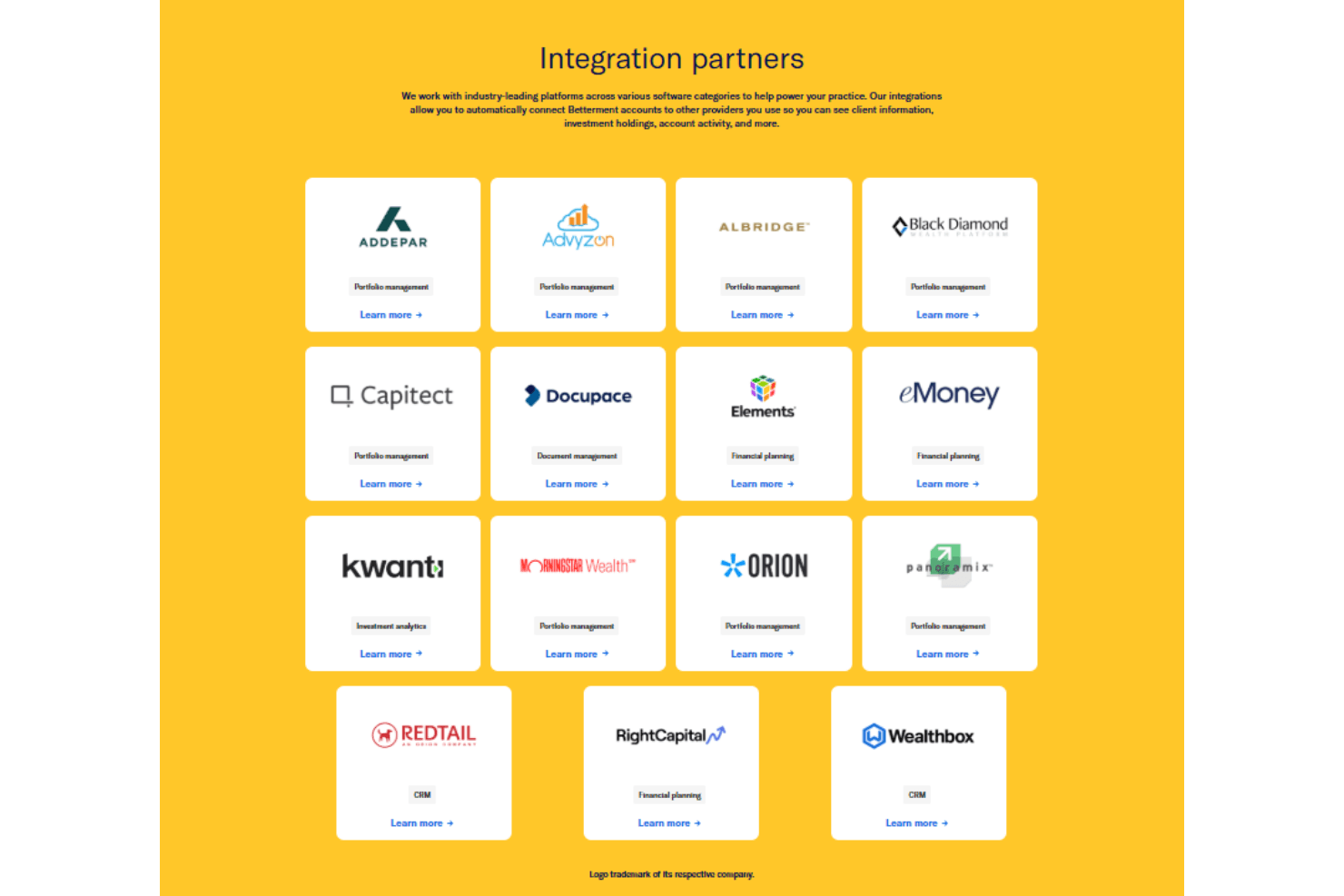
Betterment integrates with RightCapital, Wealthbox, Redtail, Orion, Black Diamond, Advyzon, and Plaid.
Betterment also offers an API for custom integrations and connects with third-party integration tools.
Betterment Specs
- 2-Factor Authentication: Yes
- Accounts Payable: Yes
- Accounts Receivable: Yes
- API: Yes
- Audit Trail: Yes
- Balance Sheet: Yes
- Billing/Invoicing: No
- Budgeting: Yes
- Calendar Management: Yes
- Comparative Reporting: Yes
- Compliance Tracking: Yes
- CRM Integration: Yes
- Custom Reports: Yes
- Dashboard: Yes
- Dashboards: Yes
- Data Export: Yes
- Data Import: Yes
- Data Mining: Yes
- Data Visualization: Yes
- Document Comparison: Yes
- Expense Tracking: Yes
- External Integrations: Yes
- Financial Analysis: Yes
- Forecasting: Yes
- General Account Ledger: Yes
- Multi-Currency: Yes
- Multi-User: Yes
- Notifications: Yes
- P&L: Yes
- Payroll: Yes
- Process Reporting: Yes
- Risk Assessment: Yes
- SAP Integration: Yes
- Scenario Planning: Yes
- Scheduling: Yes
- Tax Management: Yes
- Visualization: Yes
- Workflow Management: Yes


