

Carta Review: Pros, Cons, Features and Pricing
Carta stands out for its intuitive design and comprehensive equity management features, making it a preferred choice for managing cap tables and valuations.

We review tools independently, and commissions help fund our testing. See our transparency policy, our methodology, or suggest a tool.
Carta is a capital planning software built around equity management—cap table tracking, 409A valuations, fund administration, and investor reporting. It's worth a close look if your company is managing equity across multiple stakeholders and needs a single source of truth for ownership data. I'd choose Carta over Pulley if your cap table is growing in complexity; Carta's depth in 409A valuations and fund-level reporting goes further than what Pulley offers at that scale.
Carta Evaluation Summary
4.4/5
- Pricing upon request
- Free demo available
Why Trust Our Software Recommendations
6,700+
Reviews
20
Industry experts
16+
Evaluation factors
14
Years
Our team has been testing and reviewing software since 2012. As finance leaders ourselves, we know how difficult—and important—it is to choose the right software.
For this guide, we evaluated tools using hands-on testing and independent research, scoring tools using our selection criteria.
Our reviews reflect our human editorial judgment, not a sales pitch.
Carta Overview
In my opinion, Carta is a solid choice for capital planning, especially for startups, VC-backed firms, finance teams, and growing companies that prioritize polished cap-table workflows, reliable 409A valuations, and strong scenario modeling. Its standout feature is its user-friendly interface that simplifies equity management.
Compared to other software, it excels in ease of use and onboarding, making it accessible for teams with limited technical expertise. However, its pricing may not offer the best value for small businesses. Carta integrates well with other financial tools, but its customer support could improve. For companies prioritizing intuitive design and equity management, Carta is worth considering, but weigh it against your budget and support needs.
Pros
- According to verified reviews, Carta's interface is intuitive and easy to navigate.
- It provides simplified equity and cap table management
- Integrated 409A valuation services and scenario modeling.
- You get detailed financial reports and insights to support your decisions.
- Native integrations with HR and accounting systems to reduce manual work.
Cons
- Some customers report slower support response times versus expectation on higher tiers.
- Pricing is largely quote-based; costs can scale quickly as the number of security holders increases.
- Some advanced features may not be as comprehensive as you'd like.
- You might find the mobile app lacks some desktop functionality.
Is Carta Right For Your Needs?
Who Would be a Good Fit for Carta?
Carta is ideal for startups and venture-backed companies that need to manage complex cap tables and equity plans. Your team will benefit from its intuitive interface, which simplifies financial reporting and equity management tasks.
If you're in finance or operations, Carta's detailed insights and user-friendly design streamline your work, making it easier to track investments and employee equity. It’s particularly well suited for teams that benefit from integrations with HRIS and accounting systems. Teams with limited technical expertise will appreciate its ease of use and onboarding process, allowing you to focus on strategic growth rather than grappling with complicated software.
- StartupsCarta is perfect for your startup if you need to manage equity and cap tables efficiently.
- Venture Capital FirmsYour firm can track and manage investment portfolios with Carta's detailed financial reporting.
- Finance DepartmentsCarta simplifies your work with its intuitive interface and comprehensive equity management tools.
- Operations TeamsYour team will benefit from Carta's easy-to-use design, making equity tracking straightforward.
- Small to Medium EnterprisesSMEs can leverage Carta for managing employee equity and understanding financial trends.
- Tech CompaniesTech firms can use Carta to handle stock options and equity plans effectively.
- IPO / Private equityThe platform supports companies preparing for an IPO and private equity management, providing robust valuation tracking and compliance features.
Who Would be a Bad Fit for Carta?
Carta might not suit large enterprises with complex, multi-layered financial structures or industries needing specialized accounting features. If your team relies on extensive customer support or requires highly customizable software, Carta's limitations in these areas could hinder your work. Companies that don’t focus on equity management might find Carta’s core features unnecessary for their needs. While Carta offers mobile functionality, some features are limited on Android, which could impact teams needing full mobility.
- Large EnterprisesCarta may struggle with your complex financial structures and specialized accounting needs.
- Manufacturing FirmsYour industry might find Carta lacks specific features tailored to manufacturing operations.
- Retail CompaniesRetail businesses may not benefit from Carta's focus on equity management.
- Customer Support TeamsIf your work relies heavily on support, Carta's response times might disappoint.
- Highly Customizable NeedsCarta might not meet your need for extensive customization in financial software.
- Mobile-Dependent TeamsYour team could find Carta's mobile app lacking in necessary functionality.
How We Test & Score Tools
We’ve spent years building, refining, and improving our software testing and scoring system. The rubric is designed to capture the nuances of software selection and what makes a tool effective, focusing on critical aspects of the decision-making process.
Below, you can see exactly how our testing and scoring works across seven criteria. It allows us to provide an unbiased evaluation of the software based on core functionality, standout features, ease of use, onboarding, customer support, integrations, customer reviews, and value for money.
Core Functionality (25% of final scoring)
The starting point of our evaluation is always the core functionality of the tool. Does it have the basic features and functions that a user would expect to see? Are any of those core features locked to higher-tiered pricing plans? At its core, we expect a tool to stand up against the baseline capabilities of its competitors.
Standout Features (25% of final scoring)
Next, we evaluate uncommon standout features that go above and beyond the core functionality typically found in tools of its kind. A high score reflects specialized or unique features that make the product faster, more efficient, or offer additional value to the user.
We also evaluate how easy it is to integrate with other tools typically found in the tech stack to expand the functionality and utility of the software. Tools offering plentiful native integrations, 3rd party connections, and API access to build custom integrations score best.
Ease of Use (10% of final scoring)
We consider how quick and easy it is to execute the tasks defined in the core functionality using the tool. High scoring software is well designed, intuitive to use, offers mobile apps, provides templates, and makes relatively complex tasks seem simple.
Onboarding (10% of final scoring)
We know how important rapid team adoption is for a new platform, so we evaluate how easy it is to learn and use a tool with minimal training. We evaluate how quickly a team member can get set up and start using the tool with no experience. High scoring solutions indicate little or no support is required.
Customer Support (10% of final scoring)
We review how quick and easy it is to get unstuck and find help by phone, live chat, or knowledge base. Tools and companies that provide real-time support score best, while chatbots score worst.
Customer Reviews (10% of final scoring)
Beyond our own testing and evaluation, we consider the net promoter score from current and past customers. We review their likelihood, given the option, to choose the tool again for the core functionality. A high scoring software reflects a high net promoter score from current or past customers.
Value for Money (10% of final scoring)
Lastly, in consideration of all the other criteria, we review the average price of entry level plans against the core features and consider the value of the other evaluation criteria. Software that delivers more, for less, will score higher.
Core Features
Cap Table Management: Carta lets you manage your cap tables effortlessly, keeping your equity structure clear and organized. You can track changes and share updates with stakeholders easily.
Equity Plan Administration: You can administer employee equity plans smoothly with Carta, ensuring everyone stays informed about their shares and vesting schedules.
Valuation Tracking: Carta helps you track valuations over time, providing insights into your company's financial growth. This feature supports your strategic planning and investor relations.
Financial Reporting: Carta allows you to generate detailed financial reports, thereby giving you a clear view of your company's financial health and assisting in decision-making and compliance.
Document Storage: Store all your important documents securely in one place with Carta. You can access and share files with your team and investors effortlessly.
Scenario Modeling: Carta enables you to create financial scenarios to evaluate potential business outcomes. This helps your team plan effectively for future growth. Its reporting tools also help with benchmarking company equity performance, consequently supporting business development decisions.
Ease of Use
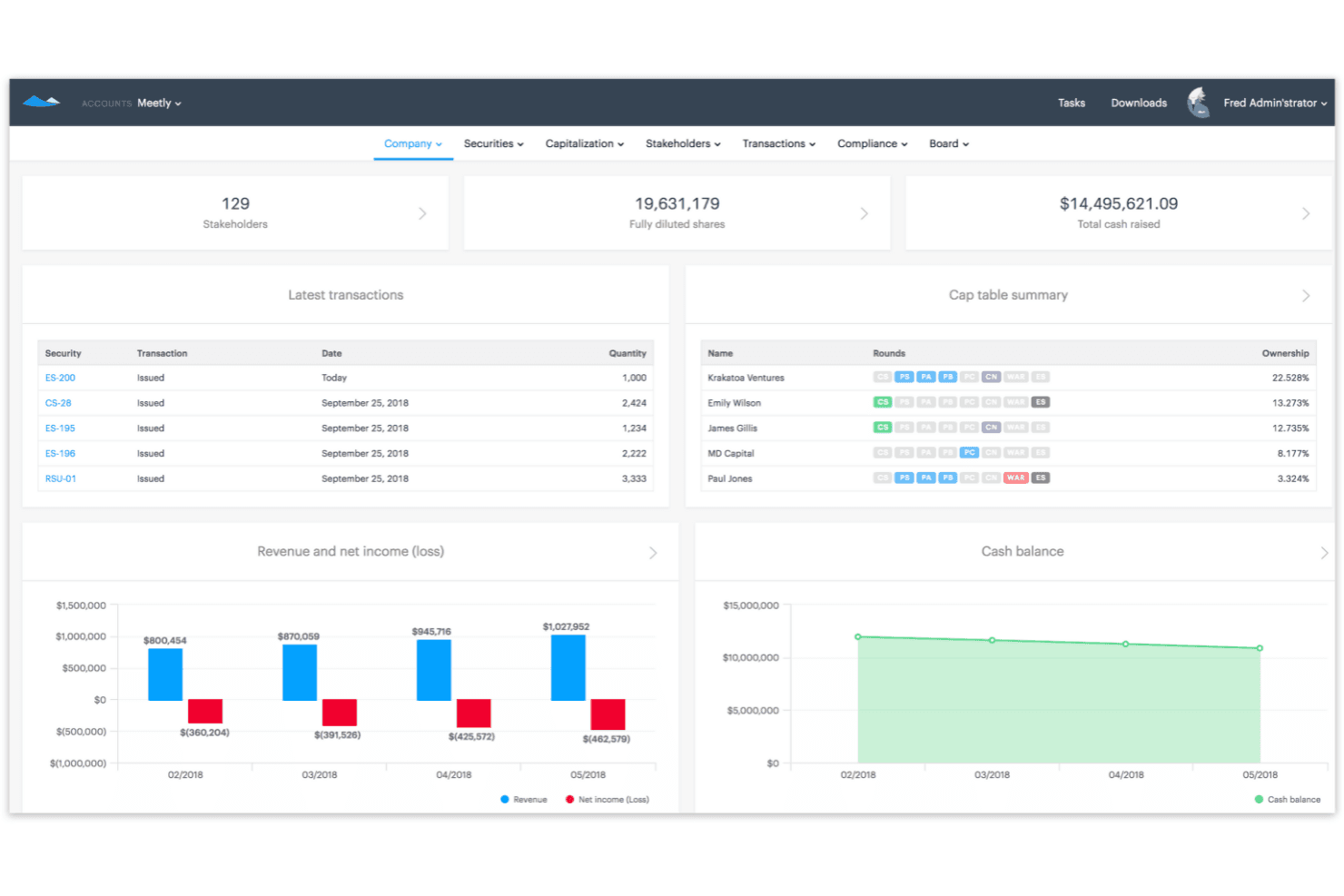
Carta is remarkably user-friendly, making it easy for your team to navigate its features without a steep learning curve. Its intuitive interface simplifies tasks like cap table management and equity plan administration. Users appreciate how quickly they can access financial reports and valuations, enhancing productivity. Carta's clean design and straightforward functionality set it apart, ensuring your team spends more time on strategic planning and less on figuring out the software. Its ease of use makes it a preferred choice for many.
Integrations
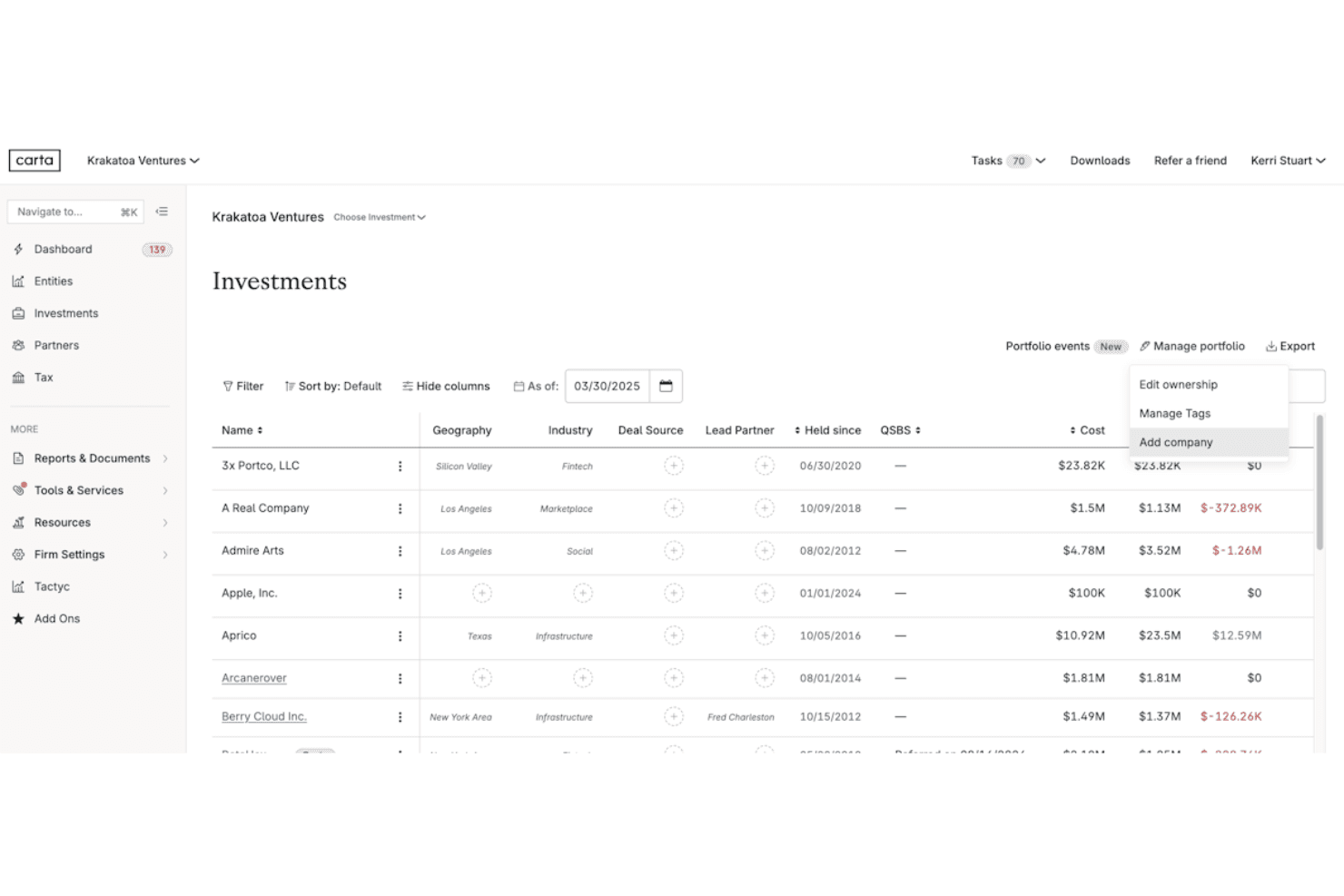
Carta integrates with popular platforms such as QuickBooks, NetSuite, Gusto, Justworks, Rippling, and HRIS systems like BambooHR, Zenefits, and ADP, as well as financial tools like Xero and Quickbooks..
Carta also offers an API for custom integrations and connects with third-party integration tools to extend its functionality further.
Carta Specs
- 2-Factor Authentication: Yes
- API: Yes
- Budgeting: No
- Calendar Management: No
- CRM Integration: No
- Dashboard: Yes
- Data Export: Yes
- Data Import: Yes
- Data Visualization: Yes
- External Integrations: Yes
- Forecasting: No
- Multi-Currency: No
- Multi-User: Yes
- Natural Resources: No
- Notifications: Yes
- Scheduling: Yes
- Trading: No